Beitzah 6a: Talmud study for Daf Yomi
Study the Talmud for Daf Yomi with scanned pages, Hebrew text, English translations from Sefaria and AI-generated French translations.
Passage selection and English or AI-generated French translation are available where the scan has annotations. Daf Study is independent of Torah-Box and Sefaria.
Browse Beitzah · ביצה · All tractatesBeitzah 6a text and translations
This page of Beitzah includes the Aramaic text, an English translation and an AI-generated French translation, alongside the scan above.
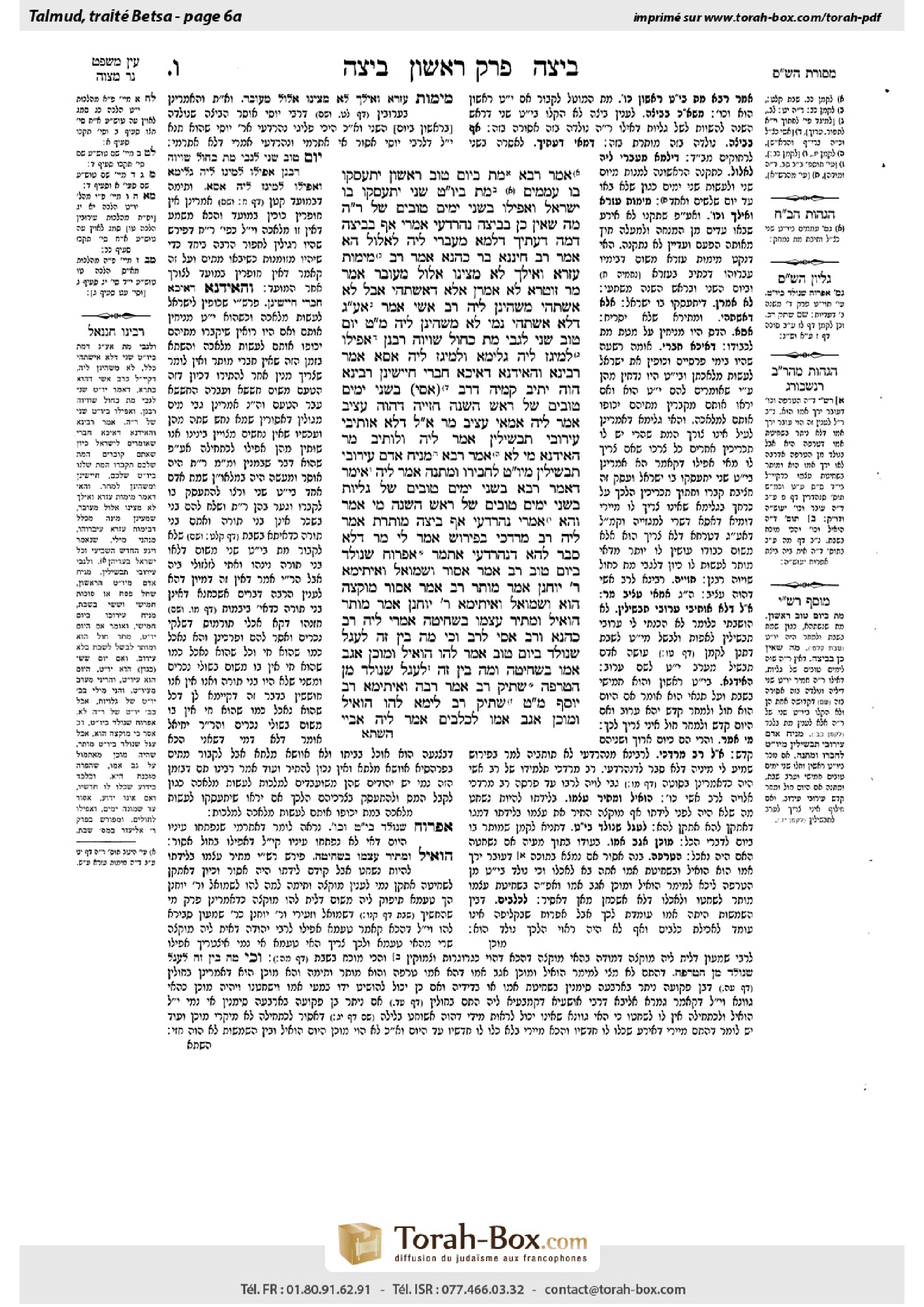
ביצה ו׳ א · Aramaic and Hebrew text
אָמַר רָבָא: מֵת בְּיוֹם טוֹב רִאשׁוֹן — יִתְעַסְּקוּ בּוֹ עֲמָמִים. מֵת בְּיוֹם טוֹב שֵׁנִי — יִתְעַסְּקוּ בּוֹ יִשְׂרָאֵל, וַאֲפִילּוּ בִּשְׁנֵי יָמִים טוֹבִים שֶׁל רֹאשׁ הַשָּׁנָה. מַה שֶּׁאֵין כֵּן בְּבֵיצָה.
נְהַרְדָּעֵי אָמְרִי: אַף בְּבֵיצָה. דְּמָה דַּעְתָּיךְ, דִּלְמָא מְעַבְּרִי לֵיהּ לֶאֱלוּל, הָא אָמַר רַב חִינָּנָא בַּר כָּהֲנָא אָמַר רַב: מִימוֹת עֶזְרָא וְאֵילָךְ לֹא מָצִינוּ אֱלוּל מְעוּבָּר.
אָמַר מָר זוּטְרָא: לָא אֲמַרַן, אֶלָּא דְּאִשְׁתַּהִי. אֲבָל לָא אִשְׁתַּהִי — מַשְׁהִינַן לֵיהּ.
רַב אָשֵׁי אָמַר: אַף עַל גַּב דְּלָא אִשְׁתַּהִי, נָמֵי לָא מַשְׁהִינַן לֵיהּ. מַאי טַעְמָא, יוֹם טוֹב שֵׁנִי לְגַבֵּי מֵת — כְּחוֹל שַׁוְּיוּהּ רַבָּנַן, אֲפִילּוּ לְמֵיגַז לֵיהּ גְּלִימָא, וּלְמֵיגַז לֵיהּ אָסָא.
אָמַר רָבִינָא: וְהָאִידָּנָא דְּאִיכָּא חַבָּרֵי — חָיְישִׁינַן.
רָבִינָא הֲוָה יָתֵיב קַמֵּיהּ דְּרַב (אַסִּי) בִּשְׁנֵי יָמִים טוֹבִים שֶׁל רֹאשׁ הַשָּׁנָה, חַזְיֵיהּ דַּהֲוָה עֲצִיב, אֲמַר לֵיהּ: אַמַּאי עֲצִיב מָר? אֲמַר לֵיהּ: דְּלָא אוֹתִיבִי עֵירוּבֵי תַּבְשִׁילִין.
אֲמַר לֵיהּ: וְלוֹתֵיב מָר הָאִידָּנָא? מִי לָא אָמַר רָבָא: מַנִּיחַ אָדָם עֵירוּבֵי תַבְשִׁילִין מִיּוֹם טוֹב לַחֲבֵירוֹ, וּמַתְנֶה!
אֲמַר לֵיהּ: אֵימַר דְּאָמַר רָבָא בִּשְׁנֵי יָמִים טוֹבִים שֶׁל גָּלִיּוֹת. בִּשְׁנֵי יָמִים טוֹבִים שֶׁל רֹאשׁ הַשָּׁנָה מִי אָמַר?
וְהָא אָמְרִי נְהַרְדָּעֵי: אַף בֵּיצָה מוּתֶּרֶת. אֲמַר לֵיהּ רַב מָרְדֳּכַי: בְּפֵירוּשׁ אֲמַר לִי מָר דְּלָא סָבַר לְהָא דִּנְהַרְדָּעֵי.
אִתְּמַר: אֶפְרוֹחַ שֶׁנּוֹלַד בְּיוֹם טוֹב, רַב אָמַר: אָסוּר. וּשְׁמוּאֵל, וְאִיתֵּימָא רַבִּי יוֹחָנָן אָמַר: מוּתָּר. רַב אָמַר: אָסוּר — מוּקְצֶה הוּא. וּשְׁמוּאֵל, וְאִיתֵּימָא רַבִּי יוֹחָנָן אָמַר: מוּתָּר — הוֹאִיל וּמַתִּיר עַצְמוֹ בִּשְׁחִיטָה.
אָמְרִי לֵיהּ רַב כָּהֲנָא וְרַב אַסִּי לְרַב: וְכִי מָה בֵּין זֶה לְעֵגֶל שֶׁנּוֹלַד בְּיוֹם טוֹב? אֲמַר לְהוּ: הוֹאִיל וּמוּכָן אַגַּב אִמּוֹ בִּשְׁחִיטָה.
וּמָה בֵּין זֶה לְעֵגֶל שֶׁנּוֹלַד מִן הַטְּרֵפָה! שְׁתֵיק רַב.
אֲמַר רַבָּה וְאִיתֵּימָא רַב יוֹסֵף: מַאי טַעְמָא שְׁתֵיק רַב? לֵימָא לְהוּ: הוֹאִיל וּמוּכָן אַגַּב אִמּוֹ לִכְלָבִים!
אֲמַר לֵיהּ אַבָּיֵי:
Beitzah 6a · English translation
§ Rava said: If one died on the first day of a Festival, gentiles should attend to his burial. If he died on the second day of a Festival, Jews should attend to his burial. And even with regard to the two Festival days of Rosh HaShana, the halakha is that the legal status of the two days is like that of the two days of the Festivals; however, that is not so with regard to an egg that was laid on the first day of Rosh HaShana, as it remains prohibited on the second day.
The Sages of Neharde’a say: Even with regard to an egg, Rosh HaShana is no different from other Festivals, as an egg laid on the first day is permitted on the second. As what do you think i.e., what is your concern; perhaps witnesses will fail to arrive, and the court will proclaim the month of Elul full, i.e., thirty days long, and begin counting the year only from the following day? In that case, both days are kept as sacred ab initio. Didn’t Rav Ḥinnana bar Kahana say that Rav already said in this regard: From the days of Ezra and onward we have not found that the month of Elul was full, as the Sages employed various methods to ensure that there would be no need to add a thirtieth day. Consequently, Rosh HaShana would always occur on the thirtieth day after the beginning of Elul.
Mar Zutra said: We said that Jews should attend to the dead on the second day of Rosh HaShana only when the burial of the corpse has already been delayed and for some reason the burial was not on the day that he died. In that case, the body might begin to decay, and the dignity of the dead is at stake. However, if the burial has not been delayed, and there is no concern for the dignity of the corpse, its burial may not be attended to on the Festival; rather, we delay it until the Festival has ended.
Rav Ashi said: Even though the burial was not delayed, but it is the day that he died, we still do not delay the burial. What is the reason for this? With regard to the dead, the Sages equated the legal status of the second Festival day with that of a weekday. This is true to such an extent that on a Festival it is permitted even to cut material to fashion a cloak for the deceased. And similarly, it is permitted to cut myrtles for the deceased, to be placed on the bier in their honor.
Ravina said: And nowadays, when there are ḥabarei, this practice must be adjusted. The ḥabarei were Persian priests who made false accusations against Jews in Babylonia. They cited the fact that Jews were burying their dead on the second Festival day as proof that the day was not holy, and they forced them to work on that day. Since we are concerned about this possibility, we do not bury the dead on the second day.
The Gemara relates: Ravina sat before Rav Ashi on the two Festival days of Rosh HaShana, which occurred that year on Thursday and Friday. Ravina observed that Rav Ashi was sad. He said to him: Why is the Master sad? He said to him: Because I did not prepare a joining of cooked foods, and therefore I cannot prepare food or light a candle on Rosh HaShana for the upcoming Shabbat. When a Festival immediately precedes Shabbat, a joining of cooked foods is prepared before the Festival with ready-to-eat food. It is kept until Shabbat, symbolically indicating that any food prepared on the Festival for Shabbat is merely a continuation of that initial preparation.
Ravina said to him: And let the Master prepare a joining of cooked foods now, on the first day of Rosh HaShana, a Thursday. Didn’t Rava say: A person may prepare a joining of cooked foods from one Festival day of the Diaspora to another, by stipulating the following condition: If today is a weekday and tomorrow is holy, this shall be my joining of cooked foods, by means of which I may prepare food tomorrow for Shabbat; if today is holy and tomorrow a weekday, it is permitted to prepare food tomorrow as it is on any regular weekday, and a joining of cooked foods is not needed.
Rav Ashi said to him: You can say that Rava stated this halakha with regard to the regular two Festival days of the Diaspora; but did he actually say so with regard to the two Festival days of Rosh HaShana? The two days of Rosh HaShana are considered one long day, and they are both equally holy.
Ravina replied: Didn’t the Sages of Neharde’a say that even an egg is permitted on the two days of Rosh HaShana, which are treated exactly the same as other Festival days in the Diaspora? The same ruling should apply to a joining of cooked foods. Rav Mordekhai said to Ravina: This does not resolve Rav Ashi’s difficulty, as the Master, Rav Ashi, explicitly said to me that he does not hold in accordance with this opinion of the Sages of Neharde’a. Rather, he maintains that Rosh HaShana differs from other Festivals, and in this case there is no way to make up for failure to prepare a joining of cooked foods.
§ It was stated that amora’im disputed the following case: With regard to a chick that hatched on a Festival, Rav said: It is prohibited. And Shmuel, and some say Rabbi Yoḥanan, said: It is permitted. The Gemara explains the reasoning for their respective opinions. Rav said: It is prohibited because it is muktze. And Shmuel, and some say Rabbi Yoḥanan said: It is permitted, since it itself is rendered permitted through slaughter. The slaughter of the chicken, which renders it fit to be eaten, is made possible by its hatching. Consequently, hatching likewise removes the prohibition of muktze.
Rav Kahana and Rav Asi said to Rav: And what is the difference between this case and that of a calf born on a Festival, since you agree that a calf may be slaughtered on that day? He said to them: There is a difference. Since a calf inside its mother is considered prepared on account of its mother, by slaughter, the halakha is as follows: If a cow is slaughtered, the calf inside its womb is also permitted. Therefore, that calf never had the status of muktze, whereas the chick was considered muktze before it hatched.
Rav Kahana and Rav Ashi further challenged Rav: And what is the difference between this case and that of a tereifa? If the mother has a condition that will cause it to die within twelve months, neither it nor the calf inside it may be eaten. Nevertheless, after it is born the calf may be slaughtered on a Festival and it is permitted. Rav was silent and did not offer an answer, as though he did not know how to respond to the question.
Rabba said, and some say it was Rav Yosef: What is the reason that Rav was silent? Let him say to them: Even a calf born to a tereifa mother is not considered fully muktze, since it is prepared on account of its mother to be fed to dogs. On a Festival, it is permitted to slaughter a tereifa and give it to dogs as food, and therefore the calf is not fully muktze even before it is born. By contrast, a chick in its shell is not intended as food for dogs, and therefore a chick that hatched on a Festival was unfit for use when the Festival began. Consequently, it was considered muktze and it is now nolad, an object that came into being on Shabbat or a Festival, and it is therefore prohibited.
Abaye said to him:
Beitzah 6a · Traduction française (IA)
§ Rava a dit : Si une personne meurt le premier jour d’un festival, les Gentils doivent s’occuper de son enterrement. Si elle meurt le deuxième jour d’un festival, les Juifs doivent s’occuper de son enterrement. Et même concernant les deux jours de Rosh HaShana, la halakha est que le statut légal des deux jours est comme celui des deux jours des festivals ; cependant, cela n’est pas le cas concernant un œuf pondu le premier jour de Rosh HaShana, car il reste interdit le deuxième jour.
Les Sages de Neharde’a disent : Même concernant un œuf, Rosh HaShana n’est pas différent des autres festivals, car un œuf pondu le premier jour est permis le deuxième. Et que penses-tu, c’est-à-dire quelle est ta préoccupation ; peut-être que les témoins ne viendront pas, et le tribunal déclarera le mois d’Elul complet, c’est-à-dire trente jours, et commencera à compter l’année à partir du lendemain ? Dans ce cas, les deux jours sont considérés comme sacrés dès le début. N’a-t-il pas dit Rav Ḥinnana bar Kahana que Rav avait déjà dit à ce sujet : Depuis les jours d’Ezra et après, nous n’avons pas trouvé que le mois d’Elul était complet, car les Sages utilisaient diverses méthodes pour s’assurer qu’il n’y aurait pas besoin d’ajouter un trentième jour. Ainsi, Rosh HaShana aurait toujours eu lieu le trentième jour après le début d’Elul.
Mar Zutra a dit : Nous avons dit que les Juifs doivent s’occuper du mort le deuxième jour de Rosh HaShana uniquement lorsque l’enterrement du corps a déjà été retardé et pour une raison particulière l’enterrement n’a pas eu lieu le jour où il est mort. Dans ce cas, le corps pourrait commencer à se dégrader, et la dignité du mort est en jeu. Cependant, si l’enterrement n’a pas été retardé et qu’il n’y a pas de préoccupation concernant la dignité du corps, son enterrement ne peut pas être effectué le jour du festival ; nous le reportons jusqu’à la fin du festival.
Rav Ashi a dit : Même si l’enterrement n’a pas été retardé, mais c’est le jour où il est mort, nous ne reportons pas l’enterrement. Quelle est la raison de cela ? Concernant les morts, les Sages ont établi que le statut légal du deuxième jour du festival est équivalent à celui d’un jour ordinaire. Cela est tellement vrai que lors d’un festival, il est permis même de couper des matériaux pour confectionner une couverture pour le défunt. De même, il est permis de couper des myrtes pour le défunt, pour les placer sur la civière en son honneur.
Ravina a dit : Et aujourd’hui, avec les ḥabarei, cette pratique doit être ajustée. Les ḥabarei étaient des prêtres perses qui faisaient des accusations fausses contre les Juifs en Babylonie. Ils citaient le fait que les Juifs enterraient leurs morts le deuxième jour du festival comme preuve que ce jour n’était pas sacré, et ils forçaient ainsi à travailler ce jour-là. Comme nous sommes préoccupés par cette possibilité, nous ne faisons pas enterrer les morts le deuxième jour.
La Guemara rapporte : Ravina était assis devant Rav Ashi sur les deux jours de Rosh HaShana, qui eurent lieu cette année un jeudi et un vendredi. Ravina observa que Rav Ashi était triste. Il lui dit : Pourquoi le Maître est-il triste ? Il lui répondit : Parce que je n’ai pas préparé un mélange de plats, et donc je ne peux pas préparer de nourriture ou allumer une bougie pour le prochain Shabbat. Lorsqu’un festival précède immédiatement le Shabbat, un mélange de plats est préparé avant le festival avec des aliments prêts à l’emploi. Il est conservé jusqu’au Shabbat, symbolisant ainsi que toute nourriture préparée sur le festival pour le Shabbat est simplement une continuation de cette préparation initiale.
Ravina dit à lui : Et que le Maître prépare un mélange de plats maintenant, le premier jour de Rosh HaShana, un jeudi. N’a-t-il pas dit Rava : Une personne peut préparer un mélange de plats d’un jour de fête de la Diaspora à un autre, en stipulant la condition suivante : Si aujourd’hui est un jour ordinaire et demain est sacré, cela sera mon mélange de plats, grâce auquel je pourrai préparer de la nourriture demain pour le Shabbat ; si aujourd’hui est sacré et demain un jour ordinaire, il est permis de préparer de la nourriture demain, car c’est comme un jour ordinaire, et un mélange de plats n’est pas nécessaire.
Rav Ashi dit à lui : Tu peux dire que Rava a énoncé cette halakha concernant les deux jours ordinaires de fête de la Diaspora ; mais a-t-il réellement dit cela concernant les deux jours de Rosh HaShana ? Les deux jours de Rosh HaShana sont considérés comme un seul jour long, et ils sont tous deux également sacrés.
Ravina répondit : N’a-t-il pas dit les Sages de Neharde’a que même un œuf est permis sur les deux jours de Rosh HaShana, qui sont traités exactement comme les autres jours de fête de la Diaspora ? La même décision devrait s’appliquer à un mélange de plats. Rav Mordekhai dit à Ravina : Cela ne résout pas la difficulté de Rav Ashi, car le Maître, Rav Ashi, a explicitement dit à moi qu’il ne suit pas cette opinion des Sages de Neharde’a. Il maintient plutôt que Rosh HaShana diffère des autres festivals, et dans ce cas, il n’y a aucun moyen de compenser l’échec à préparer un mélange de plats.
§ Il a été dit que des amora’im disputaient le cas suivant : Concernant un poussin qui a éclos lors d’un festival, Rav a dit : Il est interdit. Et Shmuel, et certains disent Rabbi Yoḥanan, a dit : Il est permis. La Guemara explique la raison de leurs opinions respectives. Rav a dit : Il est interdit car il est muktze. Et Shmuel, et certains disent Rabbi Yoḥanan, a dit : Il est permis, car il lui-même est rendu permis par la bête. La bête de la poule, qui le rend comestible, est rendue possible par son éclosion. Ainsi, l’éclosion élimine également la prohibition de muktze.
Rav Kahana et Rav Asi dirent à Rav : Et quelle est la différence entre ce cas et celui d’un veau né lors d’un festival, puisque tu acceptes que le veau puisse être sacrifié ce jour-là ? Il leur dit : Il y a une différence. Puisque le veau à l’intérieur de sa mère est considéré comme préparé en raison de sa mère, par la bête, la halakha est la suivante : Si une vache est sacrifiée, le veau à l’intérieur de son ventre est également permis. Ainsi, ce veau n’avait jamais le statut de muktze, tandis que le poussin était considéré comme muktze avant sa naissance.
Rav Kahana et Rav Ashi ont également interrogé Rav en disant : Et quelle est la différence entre ce cas et celui d'une tereifa ? Si la mère souffre d'une maladie qui la fera mourir dans les douze mois, ni elle ni le veau qu'elle porte ne peuvent être mangés. Cependant, après sa naissance, le veau peut être sacrifié pendant un festival et il est permis. Rav a gardé le silence et n'a pas répondu, comme s'il ne savait pas comment répondre à la question.
Rabba a dit, et certains disent que c'était Rav Yosef : Pourquoi Rav a-t-il gardé le silence ? Qu'il dise à ceux-ci : Même un veau né d'une mère tereifa n'est pas considéré comme entièrement muktze, car il est préparé à cause de sa mère pour être donné aux chiens. Pendant un festival, il est permis de sacrifier un tereifa et de le donner aux chiens comme nourriture, et donc le veau n'est pas entièrement muktze même avant sa naissance. En revanche, un poussin dans son coquille n'est pas destiné à être nourriture pour les chiens, et donc un poussin qui est né pendant un festival était inutilisable lors le festival a commencé. Ainsi, il était considéré comme muktze et il est maintenant nolad, un objet qui est entré en existence le sabbat ou un festival, et il est donc interdit.
Abaye a dit à lui :
Traduction française générée par IA à partir de l’édition anglaise de Sefaria. Vérifie toujours un passage avec le texte source.
Text from Sefaria: William Davidson Edition - Vocalized Aramaic (CC BY NC); William Davidson Edition - English (CC BY NC).