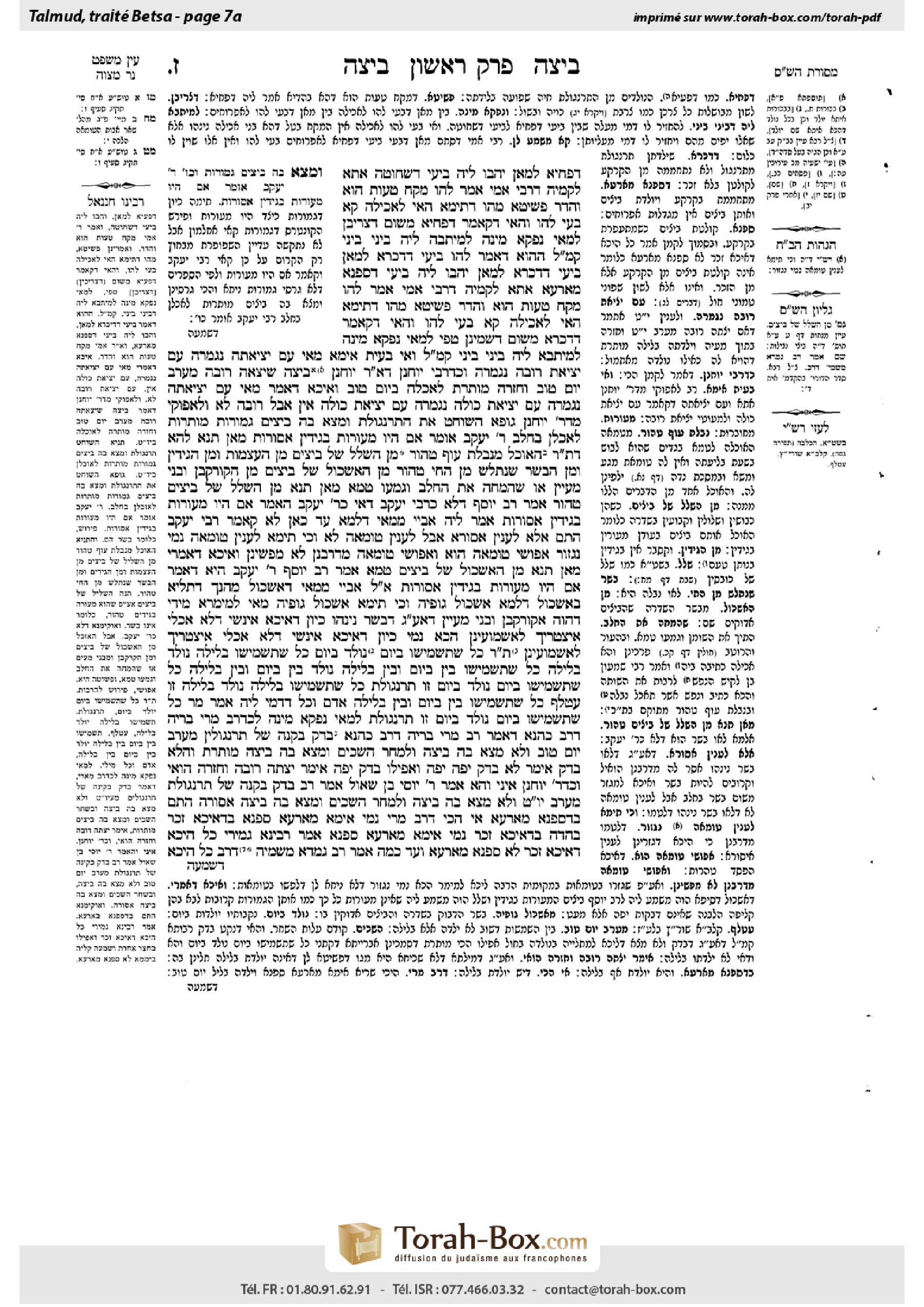
Beitzah 7a: Talmud study for Daf Yomi
Study the Talmud for Daf Yomi with scanned pages, Hebrew text, English translations from Sefaria and AI-generated French translations.
Passage selection and English or AI-generated French translation are available where the scan has annotations. Daf Study is independent of Torah-Box and Sefaria.
Browse Beitzah · ביצה · All tractatesBeitzah 7a text and translations
This page of Beitzah includes the Aramaic text, an English translation and an AI-generated French translation, alongside the scan above.
ביצה ז׳ א · Aramaic and Hebrew text
דְפָחֲיָא לְמַאן? יְהַבוּ לֵיהּ בֵּיעֵי דִשְׁחוּטָה. אֲתָא לְקַמֵּיהּ דְּרַבִּי אַמֵּי, אֲמַר לְהוּ: מִקָּח טָעוּת הוּא, וְהָדַר.
פְּשִׁיטָא! מַהוּ דְּתֵימָא: הַאי לַאֲכִילָה קָא בָּעֵי לְהוּ, וְהַאי דְּקָאָמַר דְּפָחֲיָא — מִשּׁוּם דִּצְרִיבָן, לְמַאי נָפְקָא מִינַּהּ — לְמִיתְּבָא לֵיהּ בֵּינֵי בֵּינֵי, קָא מַשְׁמַע לַן.
הָהוּא דַּאֲמַר לְהוּ: בֵּיעֵי דְּדִכְרָא לְמַאן! בֵּיעֵי דְּדִכְרָא לְמַאן! יְהַבוּ לֵיהּ בֵּיעֵי דְּסָפְנָא מֵאַרְעָא. אֲתָא לְקַמֵּיהּ דְּרַבִּי אַמֵּי, אֲמַר לְהוּ: מִקָּח טָעוּת הוּא, וַהֲדַר.
פְּשִׁיטָא! מַהוּ דְּתֵימָא: הַאי לַאֲכִילָה קָא בָּעֵי לְהוּ, וְהַאי דְּקָאָמַר דְּדִכְרָא — מִשּׁוּם דְּשַׁמִּינָן טְפֵי, לְמַאי נָפְקָא מִינַּהּ — לְמִיתְּבָא לֵיהּ בֵּינֵי בֵּינֵי, קָא מַשְׁמַע לַן.
וְאִי בָּעֵית אֵימָא: מַאי עִם יְצִיאָתָהּ נִגְמְרָה — עִם יְצִיאַת רוּבָּהּ נִגְמְרָה, וְכִדְרַבִּי יוֹחָנָן. דְּאָמַר רַבִּי יוֹחָנָן: בֵּיצָה שֶׁיָּצְאָה רוּבָּהּ מֵעֶרֶב יוֹם טוֹב וְחָזְרָה — מוּתֶּרֶת לְאׇכְלָה בְּיוֹם טוֹב.
וְאִיכָּא דְּאָמַר: מַאי עִם יְצִיאָתָהּ נִגְמְרָה — עִם יְצִיאַת כּוּלָּהּ נִגְמְרָה. עִם יְצִיאַת כּוּלָּהּ — אִין, אֲבָל רוּבָּהּ — לָא. וּלְאַפּוֹקֵי מִדְּרַבִּי יוֹחָנָן.
גּוּפָא: הַשּׁוֹחֵט אֶת הַתַּרְנְגוֹלֶת וּמָצָא בָּהּ בֵּיצִים גְּמוּרוֹת — מוּתָּרוֹת לְאָכְלָן בְּחָלָב. רַבִּי יַעֲקֹב אוֹמֵר: אִם הָיוּ מְעוֹרוֹת בְּגִידִין — אֲסוּרוֹת.
מַאן תְּנָא לְהָא דְּתָנוּ רַבָּנַן: הָאוֹכֵל מִנִּבְלַת עוֹף טָהוֹר, מִן הַשְּׁלָל שֶׁל בֵּיצִים, מִן הָעֲצָמוֹת, וּמִן הַגִּידִין, וּמִן הַבָּשָׂר שֶׁנִּתְלַשׁ מִן הַחַי — טָהוֹר.
מִן הָאֶשְׁכּוֹל שֶׁל בֵּיצִים, מִן הַקּוּרְקְבָן וּבְנֵי מֵעַיִין, אוֹ שֶׁהִמְחָה אֶת הַחֵלֶב וּגְמָעוֹ — טָמֵא.
מַאן תַּנָּא מִן הַשְּׁלָל שֶׁל בֵּיצִים טָהוֹר? אָמַר רַב יוֹסֵף: דְּלָא כְּרַבִּי יַעֲקֹב. דְּאִי כְּרַבִּי יַעֲקֹב, הָאָמַר: אִם הָיוּ מְעוֹרוֹת בְּגִידִין — אֲסוּרוֹת!
אֲמַר לֵיהּ אַבָּיֵי: מִמַּאי? דִּלְמָא עַד כָּאן לָא קָאָמַר רַבִּי יַעֲקֹב הָתָם אֶלָּא לְעִנְיַן אִסּוּרָא, אֲבָל לְעִנְיַן טוּמְאָה — לָא.
וְכִי תֵּימָא לְעִנְיַן טוּמְאָה נָמֵי נִגְזוֹר — אַפּוֹשֵׁי טוּמְאָה הוּא, וְאַפּוֹשֵׁי טוּמְאָה מִדְּרַבָּנַן לָא מַפְּשִׁינַן.
וְאִיכָּא דְּאָמְרִי: מַאן תַּנָּא מִן הָאֶשְׁכּוֹל שֶׁל בֵּיצִים טָמֵא? אָמַר רַב יוֹסֵף: רַבִּי יַעֲקֹב הִיא, דְּאָמַר: אִם הָיוּ מְעוֹרוֹת בְּגִידִין אֲסוּרוֹת. אֲמַר לֵיהּ אַבָּיֵי: מִמַּאי דְּאֶשְׁכּוֹל, מֵהָנָךְ דְּתַלְיָא בְּאֶשְׁכּוֹל? דִּלְמָא אֶשְׁכּוֹל גּוּפֵיהּ.
וְכִי תֵּימָא: אֶשְׁכּוֹל גּוּפֵיהּ מַאי לְמֵימְרָא! מִידֵּי דְּהָוֵה אַקּוּרְקְבָן וּבְנֵי מֵעַיִין, דְּאַף עַל גַּב דְּבָשָׂר נִינְהוּ, כֵּיוָן דְּאִיכָּא אִינָשֵׁי דְּלָא אָכְלִי — אִיצְטְרִיךְ לְאַשְׁמוֹעִינַן, הָכָא נָמֵי: כֵּיוָן דְּאִיכָּא אִינָשֵׁי דְּלָא אָכְלִי — אִיצְטְרִיךְ לְאַשְׁמוֹעִינַן.
תָּנוּ רַבָּנַן: כֹּל שֶׁתַּשְׁמִישׁוֹ בַּיּוֹם — נוֹלָד בַּיּוֹם. כֹּל שֶׁתַּשְׁמִישׁוֹ בַּלַּיְלָה — נוֹלָד בַּלַּיְלָה. כֹּל שֶׁתַּשְׁמִישׁוֹ בֵּין בַּיּוֹם וּבֵין בַּלַּיְלָה — נוֹלָד בֵּין בַּיּוֹם וּבֵין בַּלַּיְלָה. כֹּל שֶׁתַּשְׁמִישׁוֹ בַּיּוֹם נוֹלָד בַּיּוֹם — זוֹ תַּרְנְגוֹלֶת. כֹּל שֶׁתַּשְׁמִישׁוֹ בַּלַּיְלָה נוֹלָד בַּלַּיְלָה — זוֹ עֲטַלֵּף. כֹּל שֶׁתַּשְׁמִישׁוֹ בֵּין בַּיּוֹם וּבֵין בַּלַּיְלָה — אָדָם וְכׇל דְּדָמֵי לֵיהּ.
אָמַר מָר: כֹּל שֶׁתַּשְׁמִישׁוֹ בַּיּוֹם נוֹלָד בַּיּוֹם — זוֹ תַּרְנְגוֹלֶת. לְמַאי נָפְקָא מִינַּהּ? לְכִדְרַב מָרִי בְּרֵיהּ דְּרַב כָּהֲנָא. דְּאָמַר רַב מָרִי בְּרֵיהּ דְּרַב כָּהֲנָא: בָּדַק בְּקִנָּה שֶׁל תַּרְנְגוֹלִין מֵעֶרֶב יוֹם טוֹב וְלֹא מָצָא בָּהּ בֵּיצָה, וּלְמָחָר הִשְׁכִּים וּמָצָא בָהּ בֵּיצָה — מוּתֶּרֶת.
וַהֲלֹא בָּדַק! אֵימַר לֹא בָּדַק יָפֶה יָפֶה. וַאֲפִילּוּ בָּדַק יָפֶה, אֵימַר: יָצְתָה רוּבָּהּ וְחָזְרָה הֲוַאי, וְכִדְרַבִּי יוֹחָנָן.
אִינִי? וְהָא אָמַר רַבִּי יוֹסֵי בֶּן שָׁאוּל אָמַר רַב: בָּדַק בְּקִנָּה שֶׁל תַּרְנְגוֹלֶת מֵעֶרֶב יוֹם טוֹב וְלֹא מָצָא בָּהּ בֵּיצָה, וּלְמָחָר הִשְׁכִּים וּמָצָא בָהּ בֵּיצָה — אֲסוּרָה! הָתָם בִּדְסָפְנָא מֵאַרְעָא.
אִי הָכִי דְּרַב מָרִי נָמֵי אֵימָא מֵאַרְעָא סָפְנָא? בִּדְאִיכָּא זָכָר בַּהֲדַהּ. בִּדְאִיכָּא זָכָר נָמֵי, אֵימָא מֵאַרְעָא סָפְנָא! אָמַר רָבִינָא, גְּמִירִי: כֹּל הֵיכָא דְּאִיכָּא זָכָר — לָא סָפְנָא מֵאַרְעָא.
וְעַד כַּמָּה? אָמַר רַב גַּמָּדָא מִשְּׁמֵיהּ דְּרַב: כֹּל הֵיכָא
Beitzah 7a · English translation
of a live chicken, who has? He sought to purchase eggs of this kind. They gave him eggs of a slaughtered chicken. He came before Rabbi Ami, claiming he had been cheated. Rabbi Ami said to the sellers: This is a mistaken transaction, and it is rescinded; the sale is void.
The Gemara asks: It is obvious that the transaction is void, as he specified exactly what he wanted. The Gemara answers: The ruling is necessary, lest you say that this individual wants them for food rather than for chicks, and that which he said, that he is looking for eggs of a live chicken, he said only because they are hard-shelled, mature eggs. What is the practical difference, i.e., what is this man claiming from the seller according to this rejected interpretation? He is merely demanding to refund him the difference in value between the two types of eggs. Rabbi Ami therefore teaches us that the sale involved a fundamental error, as the eggs of a slaughtered chicken are unfit for incubation. The transaction is therefore void.
The Gemara relates a similar incident: A certain person said to vendors: Does anyone have eggs of a chicken that has had relations with a rooster? Does anyone have eggs of a rooster? They gave him eggs that a hen had absorbed from the ground, i.e., which had not been fertilized by a rooster. He came before Rabbi Ami claiming that he had been cheated. Rabbi Ami said to them: This is a mistaken transaction, and it is rescinded.
The Gemara again asks: It is obvious that this is the case. The Gemara explains: The ruling is necessary, lest you say that this person wants the eggs for food, and that which he said, that he wants eggs of a rooster, he said only because they are fatter. What is the practical difference; i.e., what is this man claiming from the seller according to this rejected interpretation? He is merely demanding that they should refund him the difference in value between the two types. Rav Ami therefore teaches us that this is not the case; rather, the sale is void.
The Gemara suggests another explanation of Rav’s statement. And if you wish, say instead: What is the meaning of the claim: An egg is fully formed upon its emergence? It means that it is fully formed with the emergence of most of it, in accordance with the statement of Rabbi Yoḥanan. As Rabbi Yoḥanan said: It is taught in a baraita that in the case of an egg, most of which emerged from the chicken on a Festival eve, and the egg returned inside the mother and was finally laid on the Festival itself, it is permitted to eat this egg on the Festival. Since most of the egg had emerged before the Festival began, it is considered to have been laid the day before.
And some say the following explanation: What is the meaning of the expression: Fully formed upon its emergence? It means that it is fully formed upon the emergence of all of it. The Gemara infers: Upon the emergence of all of it, yes, it is fully formed at this stage; however, if only most of it came out the day before, no, it is not considered fully formed. And this reading serves to exclude the statement of Rabbi Yoḥanan. In any case, Rav’s statement can correspond to this statement of Rabbi Yoḥanan.
§ Apropos the halakhic status of eggs found inside a slaughtered chicken, the Gemara discusses the matter itself: In the case of one who slaughters a chicken and finds inside it fully formed eggs, it is permitted to eat these eggs with milk. Rabbi Ya’akov says: If the eggs were still attached by sinews, it is prohibited to eat them with milk, as they are considered meat.
The Gemara asks: Who is the tanna who taught this halakha that the Sages taught in a baraita: One who eats one of the following parts of the unslaughtered carcass of a kosher bird: From a cluster of eggs that are still attached to it by sinews, or from its bones, or from the sinews, or from meat that has been detached from a live animal, is ritually pure because none of these are considered part of the meat of the bird, and therefore they do not impart the ritual impurity of an animal carcass.
However, if one ate from the ovary of its eggs, which contains very small eggs that do not possess any of the regular characteristics of eggs, or if he took a piece of the craw or the intestines, or if he melted the fat of a dead bird and swallowed it, he is ritually impure from the impurity imparted by the unslaughtered carcass of a bird.
Who is the tanna who taught that if one ate from a cluster of eggs he is pure, which indicates that eggs still attached by sinews to the chicken are not considered part of the meat of the bird? Rav Yosef said: This ruling is not in accordance with the opinion of Rabbi Ya’akov. For if you say it is in accordance with the opinion of Rabbi Ya’akov, didn’t he say: If the eggs were attached by sinews it is prohibited to eat them with milk, indicating that he considers these eggs meat of the chicken.
Abaye said to Rav Yosef: From where do you draw this conclusion? Perhaps Rabbi Ya’akov stated that these eggs are part of the chicken only there, with regard to the prohibition against eating the eggs with milk; however, perhaps with regard to ritual impurity he did not say that these eggs are considered part of the chicken.
And if you say that with regard to ritual impurity let us also issue a decree and be stringent in a case of uncertainty and therefore rule that these attached eggs should be considered part of the chicken, this would serve to proliferate impurity, and we do not proliferate impurity that is by rabbinic law. One does not declare an item ritually impure by rabbinic law merely because uncertainty has arisen with regard to its status.
And some say a different version of this discussion, according to which the question is: Who is the tanna who taught that if one eats from the ovary of its eggs he is ritually impure? Rav Yosef said: It is Rabbi Ya’akov, who said: If the eggs were attached by sinews, they are prohibited. Abaye said to him: From where do you know that the term ovary means: From these eggs that are hanging from the ovary; perhaps it is referring to the ovary itself, the part of the flesh of the bird where the eggs develop?
And if you say: If it is referring to the ovary itself, what is the purpose of stating this? It is obvious that the ovary itself is meat. One can answer as follows: Just as it is in the case of the craw and the intestines, that even though they are meat according to all opinions, since there are people who do not eat them, it was necessary to teach us that they have the status of meat; here, too, with regard to an ovary, since there are people who do not eat it, it was necessary to teach us that it may not be eaten with milk. Therefore, this argument does not prove that this version of the discussion is incorrect.
§ The Sages taught in a baraita: Any species whose intercourse occurs only in the hours of the day is born only by day; any species whose intercourse occurs only at night is born only by night; any species whose intercourse occurs either by day or by night is born either by day or by night. The Gemara elaborates: Any species whose intercourse occurs by day is born by day, this is referring to a chicken. Any species whose intercourse occurs by night is born by night, this is a bat. Any species whose intercourse occurs either by day or by night, this means a human being and all that are similar to him.
The Master said: Any species whose intercourse occurs by day is born by day, this is a chicken. The Gemara asks: What is the practical halakhic difference of this statement? The Gemara answers: The halakhic difference is with regard to that which Rav Mari, son of Rav Kahana said, as Rav Mari, son of Rav Kahana said: If one examined a chicken’s nest on a Festival eve and did not find an egg in it, and the following day, on the Festival, he rose early and found an egg in it, the egg is permitted, as it can be assumed it was not laid that night.
The Gemara asks: But didn’t he examine the nest before the Festival and fail to find an egg there? If so, the egg must have been laid on the Festival. The Gemara answers: Say that he did not examine very carefully. And even if he did examine carefully, you can say that most of the egg emerged on the eve of the Festival and returned inside its mother, and this ruling is in accordance with the opinion of Rabbi Yoḥanan. This baraita shows that the halakha does not take into account the possibility that a chicken could lay an egg at night.
The Gemara asks: Is that so? But didn’t Rabbi Yosei ben Shaul say that Rav said: If one examined a chicken’s nest on a Festival eve and did not find an egg in it, and the following day he rose early and found an egg in it, it is prohibited? This indicates that a chicken might indeed lay an egg at night. The Gemara answers: There it is referring to an egg that the chicken absorbed from the earth, i.e., one that was not formed by male fertilization. An egg that is not produced by intercourse can be laid at night as well.
The Gemara challenges this: If so, in Rav Mari’s case too, you can say that the chicken absorbed from the earth and laid the egg during the night of the Festival. How, then, could Rav Mari permit the egg? The Gemara answers: There it is referring to a case where there is a male with it. The Gemara asks: Even where there is a male with it, one can also say that it absorbed from the earth rather than from the male. The Gemara answers that Ravina said: It is learned as a tradition that anywhere that a male is present, a chicken does not absorb from the earth.
The Gemara asks: Until where exactly is it considered to have a male with it; How near must a rooster be for this principle to come into effect? Rav Gamda said in the name of Rav: The male must be any place
Beitzah 7a · Traduction française (IA)
d'un poulet vivant, qui a-t-il ? Il voulait acheter des œufs de ce genre. Ils lui ont donné des œufs d'un poulet tué. Il est venu devant Rabbi Ami, affirmant qu'il avait été trompé. Rabbi Ami a dit aux vendeurs : C'est une transaction erronée, et elle est annulée ; la vente est nulle.
La Guemara pose la question : Il est évident que la transaction est nulle, car il a spécifié exactement ce qu'il voulait. La Guemara répond : Cette décision est nécessaire, afin que l'on ne dise pas que cette personne voulait ces œufs pour la nourriture plutôt que pour des poussins, et que ce qu'il a dit, qu'il cherchait des œufs d'un poulet vivant, il l'a dit uniquement parce qu'ils sont des œufs durs, mûrs. Quelle est la différence pratique, c'est-à-dire ce que cet homme réclame aux vendeurs selon cette interprétation rejetée ? Il demande simplement le remboursement de la différence de valeur entre les deux types d'œufs. Rabbi Ami enseigne donc que la vente comportait une erreur fondamentale, car les œufs d'un poulet tué ne sont pas adaptés à l'incubation. La transaction est donc nulle.
La Guemara rapporte un incident similaire : Un certain homme a dit aux vendeurs : Y a-t-il des œufs d'un poulet qui ait eu des relations avec un coq ? Y a-t-il des œufs de coq ? Ils lui ont donné des œufs que la poule avait absorbés du sol, c'est-à-dire qui n'avaient pas été fécondés par un coq. Il est venu devant Rabbi Ami, affirmant qu'il avait été trompé. Rabbi Ami a dit à eux : C'est une transaction erronée, et elle est annulée.
La Guemara pose à nouveau la question : Il est évident que c'est le cas. La Guemara explique : Cette décision est nécessaire, afin que l'on ne dise pas que cette personne voulait les œufs pour la nourriture, et que ce qu'il a dit, qu'il voulait des œufs de coq, il l'a dit uniquement parce qu'ils sont plus gras. Quelle est la différence pratique, c'est-à-dire ce que cet homme réclame aux vendeurs selon cette interprétation rejetée ? Il demande simplement qu'ils lui remboursent la différence de valeur entre les deux types. Rav Ami enseigne donc que cela n'est pas le cas ; plutôt, la vente est nulle.
La Guemara suggère une autre explication de la déclaration de Rav. Et si vous le souhaitez, dites plutôt : Quelle est la signification de l'affirmation : Un œuf est pleinement formé à son émergence ? Cela signifie qu'il est pleinement formé avec l'émergence de la plupart d'entre eux, conformément à la déclaration de Rabbi Yoḥanan. Comme Rabbi Yoḥanan a dit : Il est enseigné dans une baraïta que dans le cas d'un œuf, la plupart duquel est sorti du poulet le soir de la fête, et l'œuf est revenu à l'intérieur de la mère et a été finalement pondu pendant la fête, il est permis de manger cet œuf pendant la fête. Puisque la plupart de l'œuf était sortie avant que la fête ne commence, il est considéré comme étant pondu la veille.
Et certains disent l'explication suivante : Quelle est la signification de l'expression : Pleinement formé à son émergence ? Cela signifie qu'il est pleinement formé à l'émergence de tout. La Guemara déduit : À l'émergence de tout, oui, il est pleinement formé à cette étape ; cependant, si seulement la plupart est sortie la veille, non, il n'est pas considéré comme pleinement formé. Et cette lecture sert à exclure la déclaration de Rabbi Yoḥanan. En tout cas, la déclaration de Rav peut correspondre à cette déclaration de Rabbi Yoḥanan.
§ Concernant le statut halakhique des œufs trouvés à l'intérieur d'un poulet tué, la Guemara discute la question elle-même : Dans le cas d'une personne qui tue un poulet et trouve à l'intérieur des œufs pleinement formés, il est permis de manger ces œufs avec du lait. Rabbi Ya’akov dit : Si les œufs étaient encore attachés par des nerfs, il est interdit de les manger avec du lait, car ils sont considérés comme de la viande.
La Guemara pose la question : Qui est le tanna qui a enseigné cette halakha que les Sages ont enseignée dans une baraïta : Celui qui mange l'une des parties suivantes du cadavre non sacrifié d'un oiseau kasher : d'un groupe d'œufs encore attachés par des nerfs à l'oiseau, ou de ses os, ou des nerfs, ou de la viande détachée d'un animal vivant, est considéré comme purement rituellement, car aucune de ces parties n'est considérée comme faisant partie de la viande de l'oiseau, et par conséquent elles ne transmettent pas l'impureté rituelle d'un cadavre d'animal.
Cependant, si l'on a mangé de l'ovaire de ses œufs, qui contient des œufs très petits qui n'ont aucun des caractéristiques régulières des œufs, ou si l'on a pris une partie du bec ou des intestins, ou si l'on a fondu le gras d'un oiseau mort et l'a avalé, il est impur à cause de l'impureté transmise par le cadavre non sacrifié d'un oiseau.
Qui est le tanna qui a enseigné que si l'on a mangé d'un groupe d'œufs, il est pur, ce qui indique que les œufs encore attachés par des nerfs à l'oiseau ne sont pas considérés comme faisant partie de la viande de l'oiseau ? Rav Yosef a dit : Cette décision ne correspond pas à l'opinion de Rabbi Ya’akov. Car si vous dites qu'elle correspond à l'opinion de Rabbi Ya’akov, n'a-t-il pas dit : Si les œufs étaient attachés par des nerfs, il est interdit de les manger avec du lait, indiquant qu'il considère ces œufs comme faisant partie de la viande de l'oiseau ?
Abaye a dit à Rav Yosef : D'où tirez-vous cette conclusion ? Peut-être que Rabbi Ya’akov a dit que ces œufs font partie de l'oiseau uniquement en ce qui concerne l'interdiction de manger les œufs avec du lait ; cependant, peut-être en ce qui concerne l'impureté rituelle, il n'a pas dit qu'ils font partie de l'oiseau.
Et si vous dites que concernant l'impureté rituelle, nous devons également émettre une déclaration et être stricts dans un cas d'incertitude, et donc décider que ces œufs attachés sont considérés comme faisant partie de l'oiseau, cela servirait à multiplier l'impureté, et nous ne multiplions pas l'impureté qui est d'origine rabbinique. On ne déclare pas un objet impur par la loi rabbinique simplement parce qu'une incertitude existe concernant son statut.
Et certains disent une autre version de cette discussion, selon laquelle la question est : Qui est le tanna qui a enseigné que si l'on mange de l'ovaire des œufs, on est impur rituellement ? Rav Yosef dit : C'est Rabbi Ya'akov, qui a dit : Si les œufs étaient attachés par des nerfs, ils sont interdits. Abaye lui répondit : D'où sais-tu que le terme d'ovaire signifie : ces œufs qui pendent de l'ovaire ; peut-être désigne-t-il l'ovaire lui-même, la partie de la chair du oiseau où les œufs se développent ?
Et si tu dis : Si c'est l'ovaire lui-même, à quoi sert de le préciser ? C'est évident que l'ovaire lui-même est de la viande. On peut répondre comme suit : Tout comme dans le cas des pattes et des intestins, qui sont de la viande selon toutes les opinions, puisque certains ne les mangent pas, il a fallu nous apprendre qu'ils ont le statut de viande ; ici aussi, concernant l'ovaire, puisque certains ne le mangent pas, il a fallu nous apprendre qu'il ne doit pas être mangé avec du lait. Ainsi, cet argument ne prouve pas que cette version de la discussion est incorrecte.
§ Les Sages ont enseigné dans une baraïta : Tout espèce dont l'acte sexuel a lieu uniquement pendant la journée est conçu uniquement pendant la journée ; tout espèce dont l'acte sexuel a lieu uniquement pendant la nuit est conçu uniquement pendant la nuit ; tout espèce dont l'acte sexuel a lieu soit pendant la journée soit pendant la nuit est conçu soit pendant la journée soit pendant la nuit. La Guemara développe : Tout espèce dont l'acte sexuel a lieu pendant la journée est conçu pendant la journée, cela concerne un poulet. Tout espèce dont l'acte sexuel a lieu pendant la nuit est conçu pendant la nuit, cela concerne une chauve-souris. Tout espèce dont l'acte sexuel a lieu soit pendant la journée soit pendant la nuit, cela signifie un être humain et tout ce qui lui ressemble.
Le Maître dit : Tout espèce dont l'acte sexuel a lieu pendant la journée est conçu pendant la journée, cela concerne un poulet. La Guemara pose la question : Quelle est la différence halakhique pratique de cette déclaration ? La Guemara répond : La différence halakhique concerne ce que Rav Mari, fils de Rav Kahana, a dit, comme Rav Mari, fils de Rav Kahana a dit : Si l'on a examiné le nid d'un poulet le soir de la fête et n'a pas trouvé d'œuf dedans, et le lendemain, pendant la fête, il s'est levé tôt et a trouvé un œuf dedans, l'œuf est permis, car on peut supposer qu'il n'a pas été pondu cette nuit-là.
La Guemara pose la question : Mais n'a-t-il pas examiné le nid avant la fête et n'a pas trouvé d'œuf dedans ? Si c'est le cas, l'œuf a dû être pondu pendant la fête. La Guemara répond : Dis qu'il n'a pas examiné très soigneusement. Et même s'il a examiné soigneusement, on peut dire que la plupart de l'œuf est sorti la veille de la fête et est rentré dans sa mère, et cette décision est selon l'opinion de Rabbi Yoḥanan. Cette baraïta montre que la halakha ne tient pas compte de la possibilité qu'un poulet puisse pondre un œuf pendant la nuit.
La Guemara pose la question : Est-ce ainsi ? Mais n'a-t-il pas dit Rabbi Yosei ben Shaul que Rav a dit : Si l'on a examiné le nid d'un poulet le soir de la fête et n'a pas trouvé d'œuf dedans, et le lendemain il s'est levé tôt et a trouvé un œuf dedans, il est interdit ? Cela indique que le poulet peut effectivement pondre un œuf pendant la nuit. La Guemara répond : Il s'agit là d'un œuf que le poulet a absorbé du sol, c'est-à-dire un œuf qui n'a pas été formé par la fécondation masculine. Un œuf qui n'est pas produit par l'acte sexuel peut être pondu pendant la nuit aussi.
La Guemara conteste cela : Si c'est ainsi, dans le cas de Rav Mari aussi, on peut dire que le poulet a absorbé du sol et a pondu l'œuf pendant la nuit de la fête. Comment alors Rav Mari a-t-il permis l'œuf ? La Guemara répond : Il s'agit là d'un cas où il y a un mâle présent. La Guemara pose la question : Même là où il y a un mâle présent, on peut aussi dire qu'il a absorbé du sol plutôt que du mâle. La Guemara répond que Ravina a dit : On l'apprend comme une tradition que partout où il y a un mâle, un poulet ne s'absorbe pas du sol.
La Guemara pose la question : Jusqu'où exactement est-il considéré comme ayant un mâle présent ; à quelle distance doit être le coq pour que ce principe entre en jeu ? Rav Gamda a dit en nom de Rav : Le mâle doit être n'importe où
Traduction française générée par IA à partir de l’édition anglaise de Sefaria. Vérifie toujours un passage avec le texte source.
Text from Sefaria: William Davidson Edition - Vocalized Aramaic (CC BY NC); William Davidson Edition - English (CC BY NC).