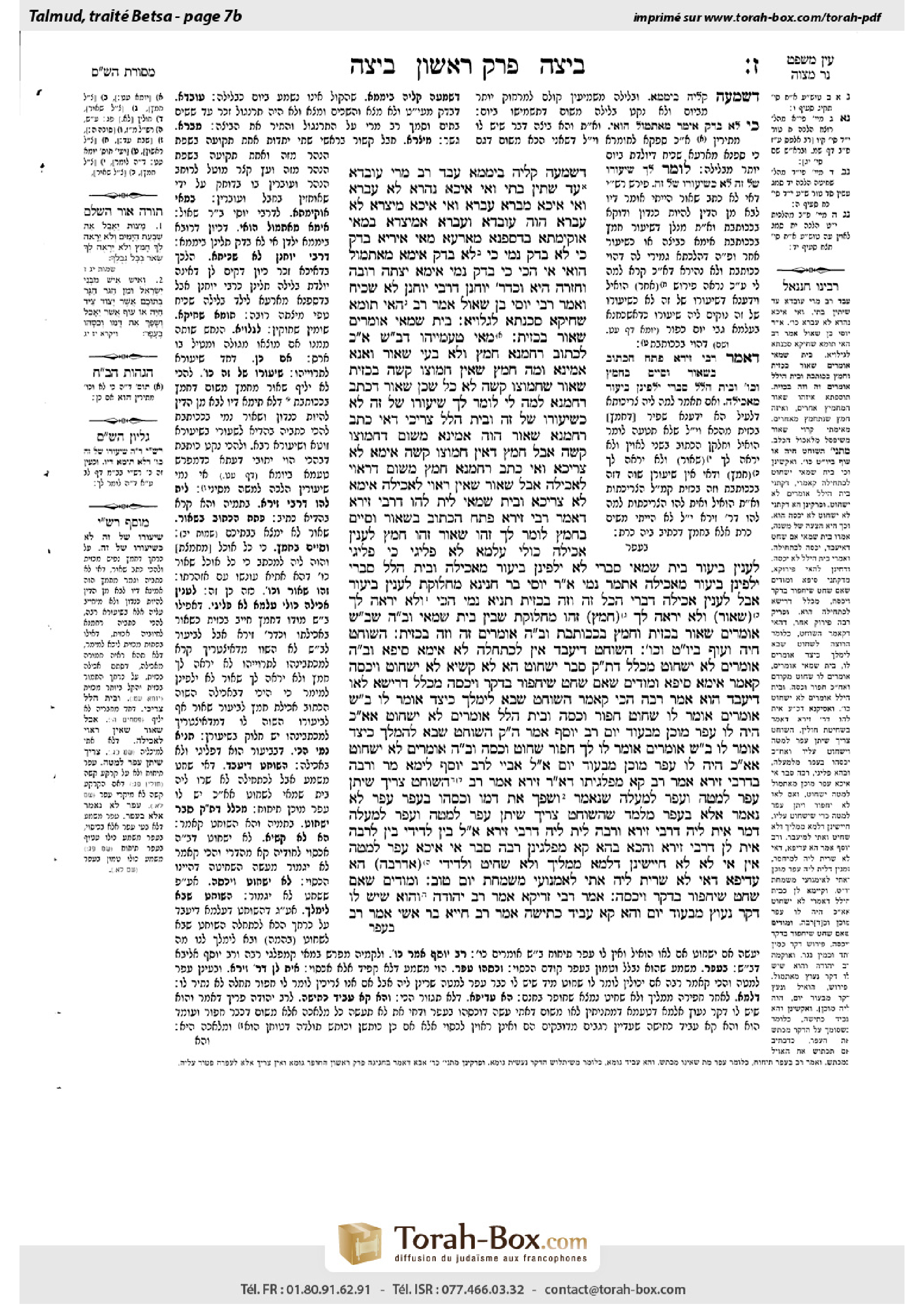
Beitzah 7b: Talmud study for Daf Yomi
Study the Talmud for Daf Yomi with scanned pages, Hebrew text, English translations from Sefaria and AI-generated French translations.
Passage selection and English or AI-generated French translation are available where the scan has annotations. Daf Study is independent of Torah-Box and Sefaria.
Browse Beitzah · ביצה · All tractatesBeitzah 7b text and translations
This page of Beitzah includes the Aramaic text, an English translation and an AI-generated French translation, alongside the scan above.
ביצה ז׳ ב · Aramaic and Hebrew text
דְּשָׁמְעָה קָלֵיהּ בִּימָמָא.
עֲבַד רַב מָרִי עוֹבָדָא עַד שִׁתִּין בָּתֵּי.
וְאִי אִיכָּא נַהֲרָא — לָא עָבְרָא. וְאִי אִיכָּא מַבָּרָא — עָבְרָא. וְאִי אִיכָּא מִיצְרָא — לָא עָבְרָא. הֲוָה עוֹבָדָא, וְעָבְרָא אַמִּיצְרָא.
בְּמַאי אוֹקֵימְתָּא — בִּדְסָפְנָא מֵאַרְעָא, מַאי אִירְיָא בָּדַק? כִּי לָא בָּדַק נָמֵי!
כִּי לָא בָּדַק, אֵימָא מֵאֶתְמוֹל הֲוַאי. אִי הָכִי כִּי בָּדַק נָמֵי, אֵימָא: יָצְתָה רוּבָּהּ וְחָזְרָה הִיא, וְכִדְרַבִּי יוֹחָנָן! דְּרַבִּי יוֹחָנָן לָא שְׁכִיחַ.
וְאָמַר רַבִּי יוֹסֵי בֶּן שָׁאוּל אָמַר רַב: הַאי תּוּמָא שְׁחִיקָא, סַכַּנְתָּא לְגִלּוּיָא.
בֵּית שַׁמַּאי אוֹמְרִים: שְׂאוֹר בְּכַזַּיִת.
מַאי טַעְמַיְיהוּ דְּבֵית שַׁמַּאי? אִם כֵּן, לִכְתּוֹב רַחֲמָנָא חָמֵץ, וְלָא בָּעֵי שְׂאוֹר, וַאֲנָא אָמֵינָא: וּמָה חָמֵץ שֶׁאֵין חִמּוּצוֹ קָשֶׁה — בִּכְזַיִת, שְׂאוֹר שֶׁחִמּוּצוֹ קָשֶׁה — לֹא כׇּל שֶׁכֵּן. שְׂאוֹר דִּכְתַב רַחֲמָנָא לְמָה לִי? לוֹמַר לְךָ: שִׁיעוּרוֹ שֶׁל זֶה לֹא כְּשִׁיעוּרוֹ שֶׁל זֶה.
וּבֵית הִלֵּל: צְרִיכִי, דְּאִי כְּתַב רַחֲמָנָא שְׂאוֹר, הֲוָה אָמֵינָא: מִשּׁוּם דְּחִמּוּצוֹ קָשֶׁה, אֲבָל חָמֵץ, דְּאֵין חִמּוּצוֹ קָשֶׁה — אֵימָא לָא, צְרִיכָא.
וְאִי כְּתַב רַחֲמָנָא חָמֵץ, מִשּׁוּם דְּרָאוּי לַאֲכִילָה. אֲבָל שְׂאוֹר, שֶׁאֵין רָאוּי לַאֲכִילָה — אֵימָא לָא, צְרִיכָא.
וּבֵית שַׁמַּאי לֵית לְהוּ דְּרַבִּי זֵירָא, דְּאָמַר רַבִּי זֵירָא: פְּתַח הַכָּתוּב בִּשְׂאוֹר וְסִיֵּים בְּחָמֵץ, לוֹמַר לְךָ: זֶהוּ שְׂאוֹר זֶהוּ חָמֵץ!
לְעִנְיַן אֲכִילָה כּוּלֵּי עָלְמָא לָא פְלִיגִי. כִּי פְּלִיגִי לְעִנְיַן בִּיעוּר. בֵּית שַׁמַּאי סָבְרִי: לָא יָלְפִינַן בִּיעוּר מֵאֲכִילָה, וּבֵית הִלֵּל סָבְרִי: יָלְפִינַן בִּיעוּר מֵאֲכִילָה.
אִתְּמַר נָמֵי, אָמַר רַבִּי יוֹסֵי בַּר חֲנִינָא: מַחְלוֹקֶת לְעִנְיַן בִּיעוּר, אֲבָל לְעִנְיַן אֲכִילָה — דִּבְרֵי הַכֹּל זֶה וְזֶה בִּכְזַיִת.
תַּנְיָא נָמֵי הָכִי: ״וְלֹא יֵרָאֶה לְךָ (שְׂאוֹר) וְלֹא יֵרָאֶה לְךָ (חָמֵץ)״. זֶהוּ מַחְלוֹקֶת שֶׁבֵּין בֵּית שַׁמַּאי וּבֵית הִלֵּל. שֶׁבֵּית שַׁמַּאי אוֹמְרִים: שְׂאוֹר בִּכְזַיִת וְחָמֵץ בִּכְכוֹתֶבֶת, וּבֵית הִלֵּל אוֹמְרִים: זֶה וְזֶה בִּכְזַיִת.
הַשּׁוֹחֵט חַיָּה וָעוֹף בְּיוֹם טוֹב וְכוּ׳.
הַשּׁוֹחֵט, דִּיעֲבַד אִין, לְכַתְּחִלָּה לָא? אֵימָא סֵיפָא: וּבֵית הִלֵּל אוֹמְרִים: לֹא יִשְׁחוֹט. מִכְּלָל דְּתַנָּא קַמָּא סָבַר יִשְׁחוֹט!
הָא לָא קַשְׁיָא: לֹא יִשְׁחוֹט וִיכַסֶּה קָאָמַר.
אֵימָא סֵיפָא: וּמוֹדִים שֶׁאִם שָׁחַט, שֶׁיַּחְפּוֹר בַּדֶּקֶר וִיכַסֶּה. מִכְּלָל דְּרֵישָׁא לָאו דִּיעֲבַד הוּא!
אָמַר רַבָּה, הָכִי קָאָמַר: הַשּׁוֹחֵט שֶׁבָּא לִימָּלֵךְ — כֵּיצַד אוֹמֵר לוֹ? בֵּית שַׁמַּאי אוֹמְרִים, אוֹמֵר לוֹ: שְׁחוֹט, חֲפוֹר וְכַסֵּה. וּבֵית הִלֵּל אוֹמְרִים: לֹא יִשְׁחוֹט אֶלָּא אִם כֵּן הָיָה לוֹ עָפָר מוּכָן מִבְּעוֹד יוֹם.
רַב יוֹסֵף אָמַר, הָכִי קָאָמַר: הַשּׁוֹחֵט שֶׁבָּא לְהִמָּלֵךְ, כֵּיצַד אוֹמֵר לוֹ? בֵּית שַׁמַּאי אוֹמְרִים, אוֹמֵר לוֹ: לֵךְ חֲפוֹר, שְׁחוֹט וְכַסֵּה, וּבֵית הִלֵּל אוֹמְרִים: לֹא יִשְׁחוֹט אֶלָּא אִם כֵּן הָיָה לוֹ עָפָר מוּכָן מִבְּעוֹד יוֹם.
אֲמַר לֵיהּ אַבָּיֵי לְרַב יוֹסֵף: לֵימָא מָר וְרַבָּה בִּדְרַבִּי זֵירָא אָמַר רַב קָא מִפַּלְגִיתוּ, דְּאָמַר רַבִּי זֵירָא אָמַר רַב: הַשּׁוֹחֵט, צָרִיךְ שֶׁיִּתֵּן עָפָר לְמַטָּה וְעָפָר לְמַעְלָה, שֶׁנֶּאֱמַר: ״וְשָׁפַךְ אֶת דָּמוֹ וְכִסָּהוּ בֶּעָפָר״. ״עָפָר״ לֹא נֶאֱמַר, אֶלָּא ״בֶּעָפָר״ — מְלַמֵּד שֶׁהַשּׁוֹחֵט צָרִיךְ שֶׁיִּתֵּן עָפָר לְמַטָּה וְעָפָר לְמַעְלָה.
דְּמָר אִית לֵיהּ דְּרַבִּי זֵירָא, וְרַבָּה לֵית לֵיהּ דְּרַבִּי זֵירָא?
אֲמַר לֵיהּ: בֵּין לְדִידִי בֵּין לְרַבָּה אִית לַן דְּרַבִּי זֵירָא. וְהָכָא בְּהָא קָא מִפַּלְגִינַן, רַבָּה סָבַר: אִי אִיכָּא עָפָר לְמַטָּה — אִין, אִי לָא — לָא. חָיְישִׁינַן דִּלְמָא מִמְּלִיךְ וְלָא שָׁחֵיט. וּלְדִידִי (אַדְּרַבָּה) הָא עֲדִיפָא, דְּאִי לָא שָׁרֵית לֵיהּ — אָתֵי לְאִמְּנוֹעֵי מִשִּׂמְחַת יוֹם טוֹב.
וּמוֹדִים שֶׁאִם שָׁחַט — שֶׁיַּחְפּוֹר בַּדָּקָר וִיכַסֶּה. אָמַר רַבִּי זְרִיקָא אָמַר רַב יְהוּדָה: וְהוּא שֶׁיֵּשׁ לוֹ דָּקָר נָעוּץ מִבְּעוֹד יוֹם. וְהָא קָא עָבֵיד כְּתִישָׁה! אָמַר רַב חִיָּיא בַּר אָשֵׁי אָמַר רַב:
Beitzah 7b · English translation
where the hen can hear its voice by day, when sounds cannot be heard as easily as at night. If the chicken is close enough to hear the rooster’s call by day, the rooster is considered close enough to the chicken that the latter will produce eggs only through fertilization by the male.
The Gemara relates: Rav Mari took action in accordance with this opinion, when he found an egg on a Festival morning after he had looked in the nest the day before and failed to find an egg there. He examined up to a distance of sixty houses from the chicken, and although he did not find a rooster within this area, he assumed there was one further away and permitted the egg.
The Gemara comments: And if there is a river between the rooster and the chicken, the chicken does not cross the river; but if there is a bridge, it crosses the river. And if there is only a rope bridge suspended across the river, the chicken will not cross on the rope. The Gemara comments: Nevertheless, an incident occurred in which a chicken crossed over on a rope bridge. However, one may not rely on this possibility.
The Gemara further asks: In what manner did you establish this halakha of Rabbi Yosei ben Shaul, who prohibits eating an egg discovered in a nest on a Festival morning after the previous day’s examination revealed nothing? You said that it is referring to a case in which the chicken absorbed from the earth. If so, why discuss specifically a situation in which one examined the nest the evening before? The same halakha should apply even when one did not examine the nest beforehand.
The Gemara answers: In a case where he did not examine the nest, one could say that the egg was laid yesterday, and there is no reason to prohibit its use. Rabbi Yosei ben Shaul therefore specified that he checked the day before and is certain that the egg was not laid prior to the Festival. The Gemara challenges this: If so, when he examined the nest as well, say: Perhaps this is a case in which most of the egg emerged and returned, and the halakha is in accordance with the opinion of Rabbi Yoḥanan? The Gemara answers: The case discussed by Rabbi Yoḥanan, where most of the egg emerged from the chicken and returned, is uncommon, and therefore it is assumed not to have occurred.
Apropos one statement of Rabbi Yosei ben Shaul in the name of Rav, the Gemara cites another ruling that Rabbi Yosei ben Shaul said that Rav said: This crushed garlic poses the danger of exposure. If mashed garlic is not properly covered, there is concern that a snake might have tasted from it and thereby injected its venom into the food. This garlic is consequently prohibited as a health risk.
§ The mishna states that Beit Shammai say: The measure that determines liability for leaven is an olive-bulk. However, the measure for leavened bread is greater, a large date-bulk. According to Beit Hillel, the measure in both cases is an olive-bulk.
The Gemara asks: What is the reason for the opinion of Beit Shammai? The Gemara explains: If it is so that the measures are equal, let the Merciful One write only the prohibition of leavened bread, and it would not be necessary to write leaven, and I would say an a fortiori inference: If the measure that determines liability for leavened bread, whose leavening is not as extensive, is an olive-bulk, then leaven, whose leavening is extensive, all the more so should the measure that determines liability be an olive-bulk. If so, why do I need the explicit reference to leaven that the Merciful One wrote in the verse: “Seven days there shall be no leaven found in your houses” (Exodus 12:19)? It must be to tell you that the measure of this, leavened bread, is not equal to the measure of that, leaven. Rather, the measure that determines liability for leaven is smaller.
The Gemara asks: And Beit Hillel maintain that both the mention of both leaven and leavened bread are necessary. As if the Merciful One had written only leaven, I would have said its measure that determines liability is an olive-bulk because its leavening is extensive. However, with regard to leavened bread, whose leavening is not extensive, say no, that is not the measure. Therefore, it is necessary to mention leavened bread as well.
And conversely, if the Merciful One had written only leavened bread, I would have said that the measure that determines liability for leavened bread is an olive-bulk, because it is fit for consumption on its own; however, leaven, which is not fit for consumption on its own but only when used as a leavening agent for dough, say no, its measure is not like that of leavened bread. Therefore, it is necessary to mention both cases.
The Gemara asks: And Beit Shammai, don’t they hold in accordance with Rabbi Zeira’s opinion? As Rabbi Zeira said, the verse states: “Seven days there shall be no leaven found in your houses, for whoever eats that which is leavened, that soul shall be cut off from the assembly of Israel” (Exodus 12:19). The verse begins with leaven and ends with leavened bread to say to you that leaven is equivalent to leavened bread. How, then, can Beit Shammai maintain that the two are prohibited by different measures?
The Gemara answers: Indeed, with regard to the measure that determines liability for eating, everyone agrees that the same measure applies to leavened bread and leaven. When they disagree it is with regard to the removal of leavened bread from one’s house. Beit Shammai hold that we do not derive the halakha of removal from that of eating. Rather, with regard to the obligation of removal, different measures apply to leavened bread and leaven. And Beit Hillel hold that we derive the halakha of removal from the measure that determines liability for eating.
The Gemara comments: This idea was also stated explicitly by amora’im. Rabbi Yosei bar Ḥanina said: The dispute between Beit Shammai and Beit Hillel was stated with regard to the removal of leavened bread; however, with regard to the measure that determines liability for eating, everyone agrees that the measure for both this and that is an olive-bulk.
That opinion is also taught in a baraita. The verse states: “And no leavened bread shall be seen with you, and no leaven shall be found in all your borders” (Exodus 13:7). This obligation to remove leavened bread is subject to a dispute between Beit Shammai and Beit Hillel, as Beit Shammai say: The measure that determines liability for removal of leaven is an olive-bulk, and the measure for leavened bread is a large date-bulk, and Beit Hillel say: The measure for both this and that is an olive-bulk. This baraita indicates that the dispute between Beit Shammai and Beit Hillel is with regard to the obligation to remove leavened bread, not liability for eating it.
§ The mishna states that Beit Shammai and Beit Hillel also dispute whether or not one who slaughters an undomesticated animal or a bird on a Festival, without having prepared earth the day before with which to cover the blood after the slaughter, may dig out earth on the Festival itself to cover the blood.
The Gemara analyzes the wording of the mishna: One who slaughters an animal; this indicates that after the fact, yes, one may dig out dirt, but ab initio, no, even Beit Shammai agree that one may not slaughter an undomesticated animal or a bird if there is no prepared dirt. Otherwise, the mishna would have said: One may slaughter an undomesticated animal or a bird on a Festival. Say the latter clause of the mishna: And Beit Hillel say that one may not slaughter it. This proves by inference that the first tanna, Beit Shammai, holds that one may slaughter it even ab initio.
The Gemara answers: This is not difficult, as Beit Hillel said and meant the following: One may not slaughter an animal and cover the blood. They are emphasizing that one may not cover the blood even if he slaughtered an animal, whereas Beit Shammai maintain that if one slaughtered he may cover the blood ab initio.
The Gemara challenges this explanation: Say the latter clause of the mishna: And Beit Hillel concede that if he already slaughtered, then he may dig with a shovel and cover the blood, which indicates that Beit Hillel were not emphasizing the covering of the blood. This proves by inference that the first clause of the mishna is not referring to one’s action after the fact, but to the halakha ab initio.
Rabba said that this is what the mishna is saying. The phrase: One who slaughters an animal, is not a broad directive on how to act, but rather it means: If there is one who slaughters animals who comes to consult a Sage on how to proceed, what should the Sage say to him? Beit Shammai say that the Sage says to him: Slaughter it ab initio, dig, and cover the blood. And Beit Hillel say: He may slaughter the animal only if he had earth that was prepared while it was still day.
Rav Yosef provided a slightly different explanation of the mishna and said that this is what the mishna is saying: With regard to one who slaughters animals who comes to consult, what does the Sage say to him? Beit Shammai say that he says to him: Go dig, slaughter the animal, and cover the blood. And Beit Hillel say: He may slaughter the animal, only if he had earth that was prepared while it was still day.
Abaye said to Rav Yosef: Let us say that the Master, i.e., Rav Yosef, and Rabba dispute the following statement that Rabbi Zeira said that Rav said, as Rabbi Zeira said that Rav said: One who slaughters an undomesticated animal or bird is obligated to perform the mitzva of covering the blood, and therefore he must place earth beneath the blood and earth above it, as it is stated: “And he shall pour out its blood and cover it in earth” (Leviticus 17:13). It is not stated: Cover it with earth, but “in earth,” indicating that the blood must be concealed inside the earth. The verse thereby teaches that one who slaughters an animal must place earth beneath and earth above the blood.
Abaye is suggesting that the Master is of the opinion that the ruling is in accordance with the opinion of Rabbi Zeira, and therefore he requires one to dig first and only afterward slaughter the animal and have the blood flow onto that earth and then cover it with additional earth, and that Rabba is of the opinion that the ruling is not in accordance with the opinion of Rabbi Zeira.
Rav Yosef said to Abaye: This is not so; rather, both according to me and according to Rabba we are of the opinion that the ruling is in accordance with the opinion of Rabbi Zeira, and here we disagree with regard to this matter: Rabba holds that if there is prepared earth beneath, yes, in that case one may slaughter an animal, but if there is no earth prepared beneath, no, he may not slaughter it at all. Why not? Rabba says: We are concerned that perhaps one will reconsider and not slaughter it at all, and he will have dug a hole on a Festival unnecessarily. And according to my opinion, on the contrary: This situation, in which he is permitted to dig first, is preferable, since if you do not permit him to dig in all cases for the purpose of slaughter, he will be unable to eat meat and will refrain from rejoicing on the Festival.
§ That mishna states: And Beit Hillel concede that if one transgressed and slaughtered an animal, then he digs with a shovel and covers the blood. Rabbi Zerika said that Rav Yehuda said: And that is the halakha specifically when one has a shovel already embedded in the ground while it was still day, before the onset of the Festival. The Gemara asks: But what purpose does an embedded shovel serve; doesn’t he still perform the act of crushing, as one must crush the lumps of earth to make the soil fit for covering? Rav Ḥiyya bar Ashi said that Rav said:
Beitzah 7b · Traduction française (IA)
où la poule peut entendre sa voix de jour, lorsque les sons ne sont pas aussi facilement entendus que la nuit. Si la poule est suffisamment proche pour entendre l'appel du coq de jour, le coq est considéré comme suffisamment proche de la poule pour que celle-ci produise des œufs uniquement par fécondation par le mâle.
La Guemara rapporte : Rav Mari a pris une décision en conformité avec cet avis, lorsqu'il a trouvé un œuf le matin de la fête après avoir examiné le nid la veille et n'avoir pas trouvé d'œuf là. Il a examiné jusqu'à une distance de soixante maisons du poulet, et bien qu'il n'ait pas trouvé de coq dans cette zone, il a supposé qu'il en existait un plus loin et a permis l'œuf.
La Guemara commente : Et si un fleuve sépare le coq de la poule, la poule ne traverse pas le fleuve ; mais si un pont existe, elle traverse le fleuve. Et si il n'y a qu'un pont de corde suspendu sur le fleuve, la poule ne traversera pas sur la corde. La Guemara commente : Cependant, un incident s'est produit où une poule a traversé sur un pont de corde. Cependant, on ne peut pas compter sur cette possibilité.
La Guemara pose une question supplémentaire : De quelle manière avez-vous établi cette halakha de Rabbi Yosei ben Shaul, qui interdit de manger un œuf découvert dans un nid le matin de la fête après que l'examen de la veille n'ait révélé aucun œuf ? Vous avez dit que cela se réfère à un cas où la poule a absorbé de la terre. Si c'est ainsi, pourquoi discuter spécifiquement d'un cas où l'on a examiné le nid la veille ? La même halakha devrait s'appliquer même si l'on n'avait pas examiné le nid auparavant.
La Guemara répond : Dans un cas où l'on n'a pas examiné le nid, on pourrait dire que l'œuf a été pondu la veille, et il n'y a pas de raison d'interdire son utilisation. Rabbi Yosei ben Shaul a donc spécifié qu'il avait examiné la veille et est certain que l'œuf n'avait pas été pondu avant la fête. La Guemara conteste cela : Si c'est ainsi, lorsqu'il a examiné le nid également, dites : Peut-être s'agit-il d'un cas où la plupart de l'œuf est sorti et est revenu, et la halakha est selon l'opinion de Rabbi Yoḥanan ? La Guemara répond : Le cas discuté par Rabbi Yoḥanan, où la plupart de l'œuf est sorti de la poule et est revenu, est rare, et donc on suppose qu'il n'a pas eu lieu.
En ce qui concerne l'une des déclarations de Rabbi Yosei ben Shaul en nom de Rav, la Guemara cite une autre décision que Rabbi Yosei ben Shaul a rapportée que Rav a dit : Ce garlic écrasé présente le danger d'exposition. Si le garlic écrasé n'est pas correctement couvert, on craint que le serpent n'ait goûté à cela et n'ait ainsi injecté son venin dans les aliments. Ce garlic est donc interdit en raison du danger pour la santé.
§ La Michna stipule que Beit Shammai disent : La mesure qui détermine la responsabilité pour la levain est une quantité d'olive. Cependant, la mesure pour le pain levé est plus grande, une quantité de date. Selon Beit Hillel, la mesure est la même dans les deux cas.
La Guemara pose une question : Quel est le raisonnement de l'opinion de Beit Shammai ? La Guemara explique : Si c'est ainsi que les mesures sont égales, que le Miséricordieux ait écrit seulement la prohibition du pain levé, et il n'aurait pas été nécessaire d'écrire le levain, et je dirais une inférence a fortiori : Si la mesure qui détermine la responsabilité pour le pain levé, dont la levain est moins étendue, est une quantité d'olive, alors le levain, dont la levain est étendue, encore plus, la mesure qui détermine la responsabilité devrait être une quantité d'olive. Si c'est ainsi, pourquoi ai-je besoin de la référence explicite au levain que le Miséricordieux a écrit dans la paracha : « Sept jours il ne doit pas y avoir de levain trouvé dans vos maisons » (Exode 12:19) ? Il doit être pour vous dire que la mesure de celui-ci, le levain, n'est pas égale à la mesure de celui-là, le pain levé. Plutôt, la mesure qui détermine la responsabilité pour le levain est plus petite.
La Guemara pose une question : Et Beit Hillel maintiennent que la mention des deux levain et du pain levé sont nécessaires. Comme si le Miséricordieux avait écrit seulement le levain, je dirais que la mesure qui détermine la responsabilité pour le levain est une quantité d'olive, car sa levain est étendue. Cependant, concernant le pain levé, dont la levain n'est pas étendue, disons non, ce n'est pas la mesure. Par conséquent, il est nécessaire de mentionner le pain levé également.
Et inversement, si le Miséricordieux avait écrit seulement le pain levé, je dirais que la mesure qui détermine la responsabilité pour le pain levé est une quantité d'olive, car il est adapté à la consommation seul. Cependant, le levain, qui n'est pas adapté à la consommation seul mais seulement en tant qu'agent de levain pour la pâte, disons non, sa mesure n'est pas comme celle du pain levé. Par conséquent, il est nécessaire de mentionner les deux cas.
La Guemara pose une question : Et Beit Shammai, ne tiennent-ils pas selon l'opinion de Rabbi Zeira ? Comme Rabbi Zeira a dit, la paracha stipule : « Sept jours il ne doit pas y avoir de levain trouvé dans vos maisons, celui qui mange ce qui est levain, cette âme sera coupée de l'assemblée d'Israël » (Exode 12:19). La paracha commence par le levain et finit par le pain levé pour vous dire que le levain est équivalent au pain levé. Comment alors Beit Shammai peut-il maintenir que les deux sont interdits selon des mesures différentes ?
La Guemara répond : En effet, concernant la mesure qui détermine la responsabilité pour la consommation, tout le monde convient que la même mesure s'applique au levain et au pain levé. Lorsqu'ils divergent, c'est concernant la suppression du pain levé de sa maison. Beit Shammai tiennent que nous ne dérivons pas la halakha de la suppression de celle de la consommation. Plutôt, concernant l'obligation de suppression, des mesures différentes s'appliquent au pain levé et au levain. Et Beit Hillel tiennent que nous dérivons la halakha de la suppression de la mesure qui détermine la responsabilité pour la consommation.
La Guemara commente : Cette idée a également été explicitement émise par des amoraïm. Rabbi Yosei bar Ḥanina dit : Le débat entre Beit Shammai et Beit Hillel a eu lieu concernant la suppression du pain aisé ; cependant, concernant la mesure qui détermine la responsabilité pour l'ingestion, tout le monde s'accorde sur le fait que la mesure pour ce qui est de ce pain et de celui-ci est celle d'une olive.
Cette opinion est également enseignée dans une baraïta. La parole dit : « Et aucun pain aisé ne sera vu avec toi, et aucune levain ne sera trouvée dans tous tes confins » (Exode 13:7). Cette obligation de supprimer le pain aisé est soumise à un débat entre Beit Shammai et Beit Hillel, car Beit Shammai disent : La mesure qui détermine la responsabilité pour la suppression du pain aisé est celle d'une olive, et la mesure pour le pain aisé est celle d'une date grande, et Beit Hillel disent : La mesure pour ce qui est de ce pain et de celui-ci est celle d'une olive. Cette baraïta indique que le débat entre Beit Shammai et Beit Hillel concerne l'obligation de supprimer le pain aisé, et non la responsabilité pour l'ingestion.
§ La mitsva dit que Beit Shammai et Beit Hillel disputent également si l'on peut ou non sacrifier un animal non domestiqué ou un oiseau pendant un festival, sans avoir préparé la terre la veille pour couvrir le sang après la sacrifice.
La Guemara analyse la formulation de la Michna : Celui qui sacrifie un animal ; cela indique que, après l'événement, oui, on peut creuser de la terre, mais ab initio, non, même Beit Shammai s'accordent sur le fait qu'on ne peut pas sacrifier un animal non domestiqué ou un oiseau si l'on n'a pas préparé la terre. Sinon, la Michna aurait dit : On peut sacrifier un animal non domestiqué ou un oiseau pendant un festival. Disent la dernière partie de la Michna : Et Beit Hillel disent qu'on ne peut pas sacrifier. Cela prouve par déduction que le premier tanna, Beit Shammai, considère qu'on peut sacrifier ab initio.
La Guemara répond : Ce n'est pas difficile, car Beit Hillel a dit et entendu cela : On ne peut pas sacrifier un animal et couvrir le sang. Ils insistent sur le fait qu'on ne peut pas couvrir le sang même si l'on a sacrifié un animal, tandis que Beit Shammai maintiennent que si l'on a sacrifié, on peut couvrir le sang ab initio.
La Guemara conteste cette explication : Disent la dernière partie de la Michna : Et Beit Hillel reconnaissent qu'une fois qu'il a sacrifié, il peut creuser avec une pelle et couvrir le sang, ce qui indique que Beit Hillel ne mettaient pas l'accent sur la couverture du sang. Cela prouve par déduction que la première partie de la Michna ne fait pas référence à l'action après l'événement, mais à la halakha ab initio.
Rabba dit que c'est ce que la mitsna dit. La phrase : Celui qui sacrifie un animal, n'est pas une directive générale sur la manière d'agir, mais plutôt cela signifie : Si quelqu'un sacrifie un animal et vient consulter un Sage sur la manière de procéder, que devrait le Sage lui dire ? Beit Shammai disent que le Sage dit à lui : Sacrifie ab initio, creuse et couvre le sang. Et Beit Hillel disent : On peut sacrifier l'animal uniquement si l'on a préparé la terre pendant la journée.
Rav Yosef a donné une explication légèrement différente de la mitsna et a dit que c'est ce que la mitsna dit : Concernant celui qui sacrifie des animaux et vient consulter, que dit le Sage à lui ? Beit Shammai disent que le Sage dit à lui : Va creuser, sacrifie l'animal et couvre le sang. Et Beit Hillel disent : On peut sacrifier l'animal uniquement si l'on a préparé la terre pendant la journée.
Abaye a dit à Rav Yosef : Disons que le Maître, c'est-à-dire Rav Yosef, et Rabba disputent la suivante déclaration que Rabbi Zeira a dit que Rav a dit, comme Rabbi Zeira a dit que Rav a dit : Celui qui sacrifie un animal non domestiqué ou un oiseau est tenu de faire la mitsva de couvrir le sang, et donc il doit placer de la terre sous le sang et de la terre au-dessus, comme il est dit : « Et il versera son sang et le couvrira de terre » (Lévitique 17:13). Il n'est pas dit : Couvre-le avec de la terre, mais « dans la terre », indiquant que le sang doit être caché à l'intérieur de la terre. La parole enseigne ainsi que celui qui sacrifie un animal doit placer de la terre sous et au-dessus du sang.
Abaye suggère que le Maître est d'avis que la décision est conforme à l'opinion de Rabbi Zeira, et donc il exige de creuser d'abord et seulement ensuite de sacrifier l'animal et de faire couler le sang sur cette terre et de le recouvrir avec de la terre supplémentaire, et que Rabba est d'avis que la décision n'est pas conforme à l'opinion de Rabbi Zeira.
Rav Yosef a dit à Abaye : Ce n'est pas ainsi ; plutôt, selon moi et selon Rabba, nous sommes d'avis que la décision est conforme à l'opinion de Rabbi Zeira, et ici nous disputons sur ce point : Rabba considère que si la terre est préparée sous, oui, dans ce cas on peut sacrifier un animal, mais si la terre n'est pas préparée sous, non, on ne peut pas sacrifier du tout. Pourquoi pas ? Rabba dit : Nous craignons que l'on puisse réfléchir et ne pas sacrifier du tout, et il creusera inutilement un trou pendant le festival. Et selon mon avis, au contraire : Cette situation, où il est permis de creuser d'abord, est préférable, car si on ne permet pas de creuser dans tous les cas pour le sacrifice, il ne pourra pas manger de viande et se refusera à se réjouir pendant le festival.
§ Cette mitsva dit : Et Beit Hillel reconnaissent qu'une fois qu'on a transgressé et sacrifié un animal, alors on creuse avec une pelle et couvre le sang. Rabbi Zerika a dit que Rav Yehuda a dit : Et c'est la halakha spécifiquement quand on a une pelle déjà enfoncée dans le sol pendant la journée, avant le début du festival. La Guemara pose la question : Mais à quel usage sert une pelle enfoncée dans le sol ; ne doit-il pas encore écraser, comme on doit écraser les boulettes de terre pour que le sol soit adapté à la couverture ? Rav Ḥiyya bar Ashi a dit que Rav a dit :
Traduction française générée par IA à partir de l’édition anglaise de Sefaria. Vérifie toujours un passage avec le texte source.
Text from Sefaria: William Davidson Edition - Vocalized Aramaic (CC BY NC); William Davidson Edition - English (CC BY NC).