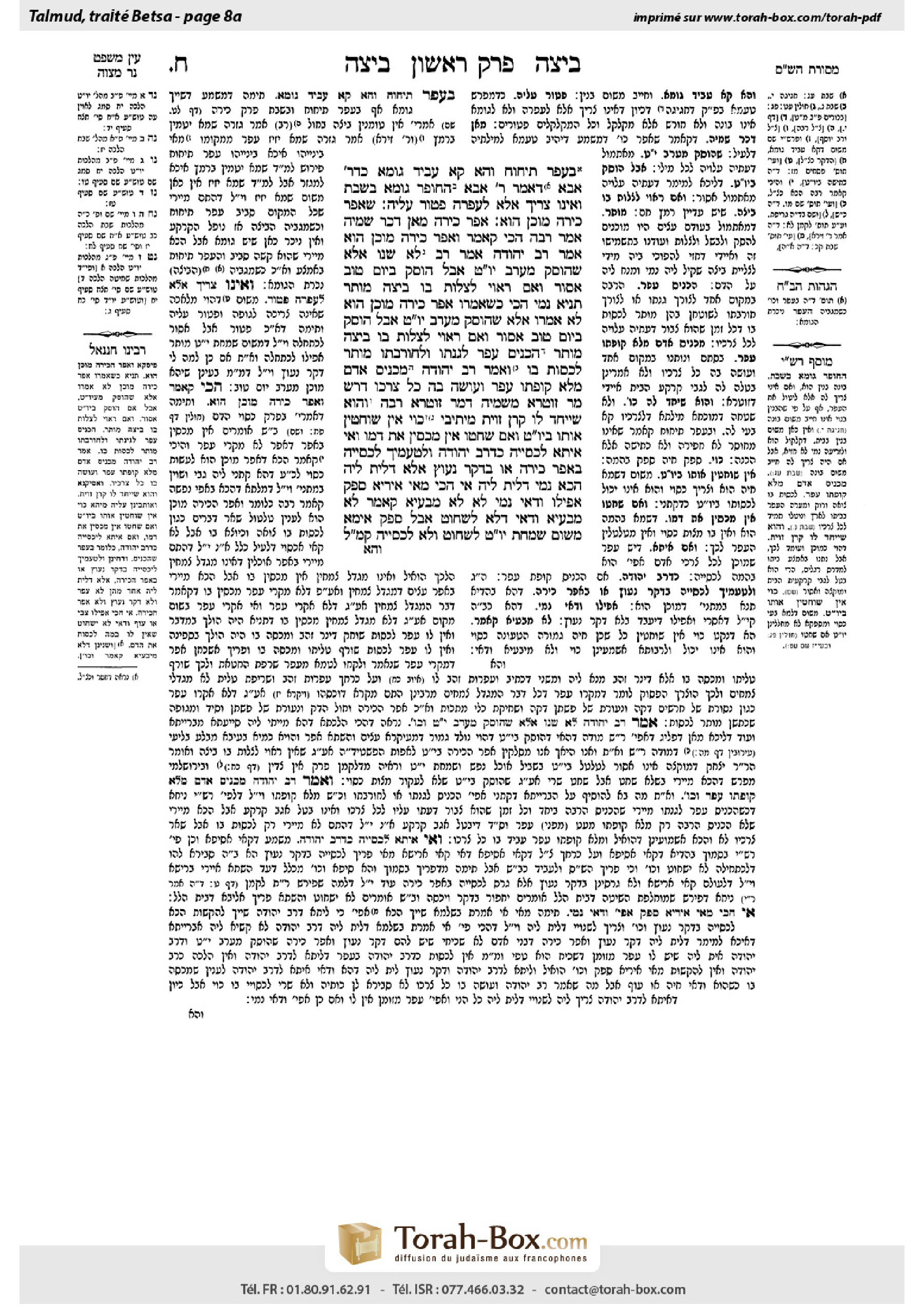
Beitzah 8a: Talmud study for Daf Yomi
Study the Talmud for Daf Yomi with scanned pages, Hebrew text, English translations from Sefaria and AI-generated French translations.
Passage selection and English or AI-generated French translation are available where the scan has annotations. Daf Study is independent of Torah-Box and Sefaria.
Browse Beitzah · ביצה · All tractatesBeitzah 8a text and translations
This page of Beitzah includes the Aramaic text, an English translation and an AI-generated French translation, alongside the scan above.
ביצה ח׳ א · Aramaic and Hebrew text
בְּעָפָר תִּיחוּחַ.
וְהָא קָא עָבֵיד גּוּמָּא! כִּדְרַבִּי אַבָּא. דְּאָמַר רַבִּי אַבָּא: הַחוֹפֵר גּוּמָּא בְּשַׁבָּת, וְאֵינוֹ צָרִיךְ אֶלָּא לַעֲפָרָהּ — פָּטוּר עָלֶיהָ.
שֶׁאֵפֶר כִּירָה מוּכָן הוּא. אֵפֶר כִּירָה מַאן דְּכַר שְׁמֵיהּ? אָמַר רַבָּה, הָכִי קָאָמַר: וְאֵפֶר כִּירָה מוּכָן הוּא.
אָמַר רַב יְהוּדָה אָמַר רַב: לֹא שָׁנוּ אֶלָּא שֶׁהוּסַּק מֵעֶרֶב יוֹם טוֹב, אֲבָל הוּסַּק בְּיוֹם טוֹב — אָסוּר. וְאִם רָאוּי לִצְלוֹת בּוֹ בֵּיצָה — מוּתָּר.
תַּנְיָא נָמֵי הָכִי: כְּשֶׁאָמְרוּ אֵפֶר כִּירָה מוּכָן הוּא — לֹא אָמְרוּ אֶלָּא שֶׁהוּסַּק מֵעֶרֶב יוֹם טוֹב, אֲבָל הוּסַּק בְּיוֹם טוֹב — אָסוּר. וְאִם רָאוּי לִצְלוֹת בּוֹ בֵּיצָה — מוּתָּר.
הִכְנִיס עָפָר לְגִנָּתוֹ וּלְחוּרְבָּתוֹ — מוּתָּר לְכַסּוֹת בּוֹ. וְאָמַר רַב יְהוּדָה: מַכְנִיס אָדָם מְלֹא קוּפָּתוֹ עָפָר וְעוֹשֶׂה בָּהּ כׇּל צָרְכּוֹ.
דָּרֵשׁ מָר זוּטְרָא מִשְּׁמֵיהּ דְּמָר זוּטְרָא רַבָּה: וְהוּא שֶׁיִּיחֵד לוֹ קֶרֶן זָוִית.
מֵיתִיבִי: כּוֹי, אֵין שׁוֹחֲטִין אוֹתוֹ בְּיוֹם טוֹב, וְאִם שְׁחָטוֹ — אֵין מְכַסִּין אֶת דָּמוֹ. וְאִי אִיתָא, לְכַסְּיֵיהּ כִּדְרַב יְהוּדָה!
וּלְטַעְמָיךְ: לְכַסְּיֵיהּ בָּאֵפֶר כִּירָה, אוֹ בְּדָקָר נָעוּץ! אֶלָּא — דְּלֵית לֵיהּ, הָכָא נָמֵי — דְּלֵית לֵיהּ.
אִי הָכִי מַאי אִירְיָא סָפֵק, אֲפִילּוּ וַדַּאי נָמֵי לָא!
לָא מִבַּעְיָא קָאָמַר: לָא מִבַּעְיָא וַדַּאי דְּלָא לִשְׁחוֹט, אֲבָל סָפֵק — אֵימָא מִשּׁוּם שִׂמְחַת יוֹם טוֹב לִשְׁחוֹט וְלָא לְכַסְּיֵיהּ, קָא מַשְׁמַע לַן.
Beitzah 8a · English translation
Here it is referring to loose earth that does not require further crushing.
The Gemara challenges this: But even in the case of loose earth, one makes a hole by the very act of removing the earth or the shovel from that place. The Gemara answers: This ruling is in accordance with the opinion of Rabbi Abba, as Rabbi Abba said: One who digs a hole on Shabbat, but he needs only its earth and has no interest in forming a pit, is exempt for that act. Since he has no interest in the hole, he is considered to have performed a destructive act, and the halakha is that one who commits a destructive act is not liable for the performance of prohibited labor on Shabbat and Festivals.
§ The mishna states: That the ashes of a stove are prepared. The Gemara express puzzlement at this statement: The ashes of a stove, who mentioned anything about it? Why does the mishna suddenly speak about the ashes of a stove when it had not previously discussed or even mentioned them? Rabba said: This is what the tanna said: And the ashes of a stove are prepared. In other words, everyone agrees that in addition to prepared earth, the ashes of a stove are also considered prepared, and one may cover the blood with them. It is not necessary to prepare these ashes especially for this purpose the day before.
Rav Yehuda said that Rav said: They only taught that the ashes of a stove are considered prepared if the stove was ignited on the Festival eve, so that the ashes had already formed at the start of the Festival. However, if it was ignited on the Festival itself, the ashes are prohibited. And if the ashes are still hot and fit to roast an egg in them, they are not considered muktze, and therefore it is permitted to use them for covering as well.
The Gemara comments: That opinion is also taught in a baraita: When they said that the ashes of a stove are prepared, they said so only when it was ignited on the Festival eve; however, if it was ignited on the Festival, they are prohibited. And if the ashes are still hot and fit to roast an egg in them, they are permitted.
The Gemara further states: If before the Festival one brought earth into his garden or his ruin to use for various needs, it is permitted to cover blood with it. And Rav Yehuda likewise said: A person may bring in a basketful of earth the day before the Festival and use both the basket and the earth it contains for all his needs on the Festival.
With regard to this case, Mar Zutra added and taught in public in the name of Mar Zutra the Great that the application of this halakha is limited: And that is the case only if one designated a corner for this earth, thereby demonstrating that he intends to use it for all his requirements, rather than merely bringing earth in to scatter over the floor of the house. In that case, the dirt is nullified. It is considered part of the floor, which means that it is once again classified as muktze.
The Gemara raises an objection against this from a mishna (Bikkurim 4:9): In the case of a koy, a kosher animal with characteristics of both domesticated and non-domesticated animals, one may not slaughter it on a Festival, as it is uncertain whether or not its blood requires covering. And if one did slaughter it, he may not cover its blood. And if it is so, that one may use his basket of earth as he wishes, as claimed by Rav Yehuda, even if a koy is definitely a domesticated animal, let him cover it, in accordance with the opinion of Rav Yehuda.
The Gemara expresses surprise at this objection: And according to your reasoning, one could equally suggest: Let him cover the blood of the koy with ashes of a stove or with earth dug up with an embedded shovel. Rather, this mishna must be referring to a situation where one does not have prepared earth to use for covering the blood; here too, one can say that he does not have a basket of earth ready for all his needs.
The Gemara asks: If so, if the mishna is referring to a situation where one does not have prepared earth, why discuss specifically the case of a koy, where there is uncertainty whether there is a mitzva to cover its blood? Even in the case of an undomesticated animal, whose blood must certainly be covered, slaughter should also not be permitted, as the halakha is in accordance with the opinion of Beit Hillel that one may not slaughter if he does not have prepared earth.
The Gemara explains that this baraita is speaking utilizing the style of: It is not necessary, as follows: It is not necessary to state the halakha with regard to definite undomesticated animals and birds, that it is not permitted to slaughter them; however, with regard to an uncertainty, one might say: Due to the joy of the Festival let one slaughter it and not cover its blood, as there is uncertainty whether there is a mitzva to cover its blood, and therefore it is overridden by the mitzva to rejoice on a Festival. The baraita therefore teaches us that one should not slaughter it ab initio if he does not have something prepared with which to cover the blood.
Beitzah 8a · Traduction française (IA)
Il s'agit d'un sol meuble qui ne nécessite pas de broyage supplémentaire.
La Guemara soulève un défi à cela : Mais même dans le cas d'un sol meuble, on creuse un trou en retirant le sol ou la pelle de ce lieu. La Guemara répond : Cette décision s'inspire de l'opinion du Rabbi Abba, car Rabbi Abba a dit : Celui qui creuse un trou le sabbat, mais dont il n'a besoin que du sol et n'a pas l'intention de former un trou, est exempt de cette action. Puisqu'il n'a pas l'intention du trou, il est considéré comme ayant commis une action destructive, et la halakha est que celui qui commet une action destructive n'est pas tenu responsable de l'accomplissement d'un travail interdit le sabbat et les fêtes.
§ La mitsna dit : Que les cendres d'une cheminée sont préparées. La Guemara exprime une perplexité à cet égard : Les cendres d'une cheminée, qui a mentionné cela ? Pourquoi la mitsna parle soudain des cendres d'une cheminée alors qu'elle n'avait pas auparavant discuté ou même mentionné cela ? Rabba a dit : C'est ce que le tanna a dit : Et les cendres d'une cheminée sont préparées. Autrement dit, tout le monde convient que, en plus du sol préparé, les cendres d'une cheminée sont également considérées comme préparées, et l'on peut recouvrir le sang avec elles. Il n'est pas nécessaire de préparer ces cendres spécialement à cette fin la veille.
Rav Yehuda a dit que Rav a dit : Ils n'ont enseigné que les cendres d'une cheminée sont considérées comme préparées si la cheminée avait été allumée la veille du festival, de sorte que les cendres avaient déjà pris forme au début du festival. Cependant, si elle avait été allumée durant le festival, les cendres sont interdites. Et si les cendres sont encore chaudes et peuvent cuire un œuf dedans, elles ne sont pas considérées comme muktze, et par conséquent il est permis d'utiliser ces cendres pour recouvrir le sang également.
La Guemara commente : Cette opinion est également enseignée dans une baraïta : Lorsqu'ils ont dit que les cendres d'une cheminée sont préparées, ils l'ont dit uniquement si la cheminée avait été allumée la veille du festival ; cependant, si elle avait été allumée durant le festival, elles sont interdites. Et si les cendres sont encore chaudes et peuvent cuire un œuf dedans, elles sont permises.
La Guemara ajoute encore : Si avant le festival on avait apporté du sol dans son jardin ou son ruine à utiliser pour divers besoins, il est permis de recouvrir le sang avec ce sol. Et Rav Yehuda a dit également : Une personne peut apporter un panier de sol la veille du festival et utiliser à la fois le panier et le sol qu'il contient pour tous ses besoins durant le festival.
Concernant ce cas, Mar Zutra a ajouté et enseigné en public au nom de Mar Zutra le Grand que l'application de cette halakha est limitée : c'est le cas uniquement si l'on a désigné un coin pour ce sol, démontrant ainsi qu'on l'utilise pour tous ses besoins, plutôt que simplement apporter du sol pour le répandre sur le plancher de la maison. Dans ce cas, le sol est annulé. Il est considéré comme faisant partie du plancher, ce qui signifie qu'il est à nouveau classé comme muktze.
La Guemara soulève une objection contre cela à partir d'une mitsva (Bikkurim 4:9) : dans le cas d'un koy, un animal kasher ayant des caractéristiques de tantôt animal domestique que non domestique, on ne peut pas le sacrifier durant un festival, car il est incertain si son sang nécessite d'être recouvert. Et si l'on a sacrifié ce koy, on ne peut pas recouvrir son sang. Et si c'est ainsi, que l'on puisse utiliser son panier de sol comme il l'entend, selon l'opinion de Rav Yehuda, même si un koy est certainement un animal domestique, qu'on recouvre son sang, conformément à l'opinion de Rav Yehuda.
La Guemara exprime une surprise à l'égard de cette objection : et selon votre raisonnement, on pourrait aussi suggérer : qu'on recouvre le sang du koy avec les cendres d'une cheminée ou avec du sol creusé avec une pelle intégrée. Plutôt, cette mitsva doit se référer à un cas où l'on n'a pas de sol préparé à utiliser pour recouvrir le sang ; ici aussi, on peut dire qu'il n'a pas de panier de sol prêt pour tous ses besoins.
La Guemara pose une question : Si c'est ainsi, si la Michna se réfère à un cas où l'on n'a pas de sol préparé, pourquoi discuter spécifiquement du cas d'un koy, où il y a incertitude sur le fait que son sang nécessite d'être recouvert ? Même dans le cas d'un animal non domestique, dont le sang doit certainement être recouvert, le sacrifice ne devrait pas être permis, car la halakha suit l'opinion de Beit Hillel qui dit qu'on ne peut pas sacrifier si l'on n'a pas de sol préparé à utiliser pour recouvrir le sang.
La Guemara explique que cette baraïta parle en utilisant le style suivant : Il n'est pas nécessaire, comme suit : Il n'est pas nécessaire d'énoncer la halakha concernant les animaux non domestiques et les oiseaux certains, que leur sacrifice n'est pas permis ; cependant, concernant une incertitude, on pourrait dire : En raison de la joie du festival, on peut sacrifier et ne pas recouvrir leur sang, car il y a incertitude sur le fait qu'il y a une mitsva de recouvrir leur sang, et par conséquent cela est surpasse par la mitsva de se réjouir durant un festival. La baraïta enseigne donc que l'on ne devrait pas sacrifier d'abord si l'on n'a pas quelque chose préparé avec lequel recouvrir le sang.
Traduction française générée par IA à partir de l’édition anglaise de Sefaria. Vérifie toujours un passage avec le texte source.
Text from Sefaria: William Davidson Edition - Vocalized Aramaic (CC BY NC); William Davidson Edition - English (CC BY NC).