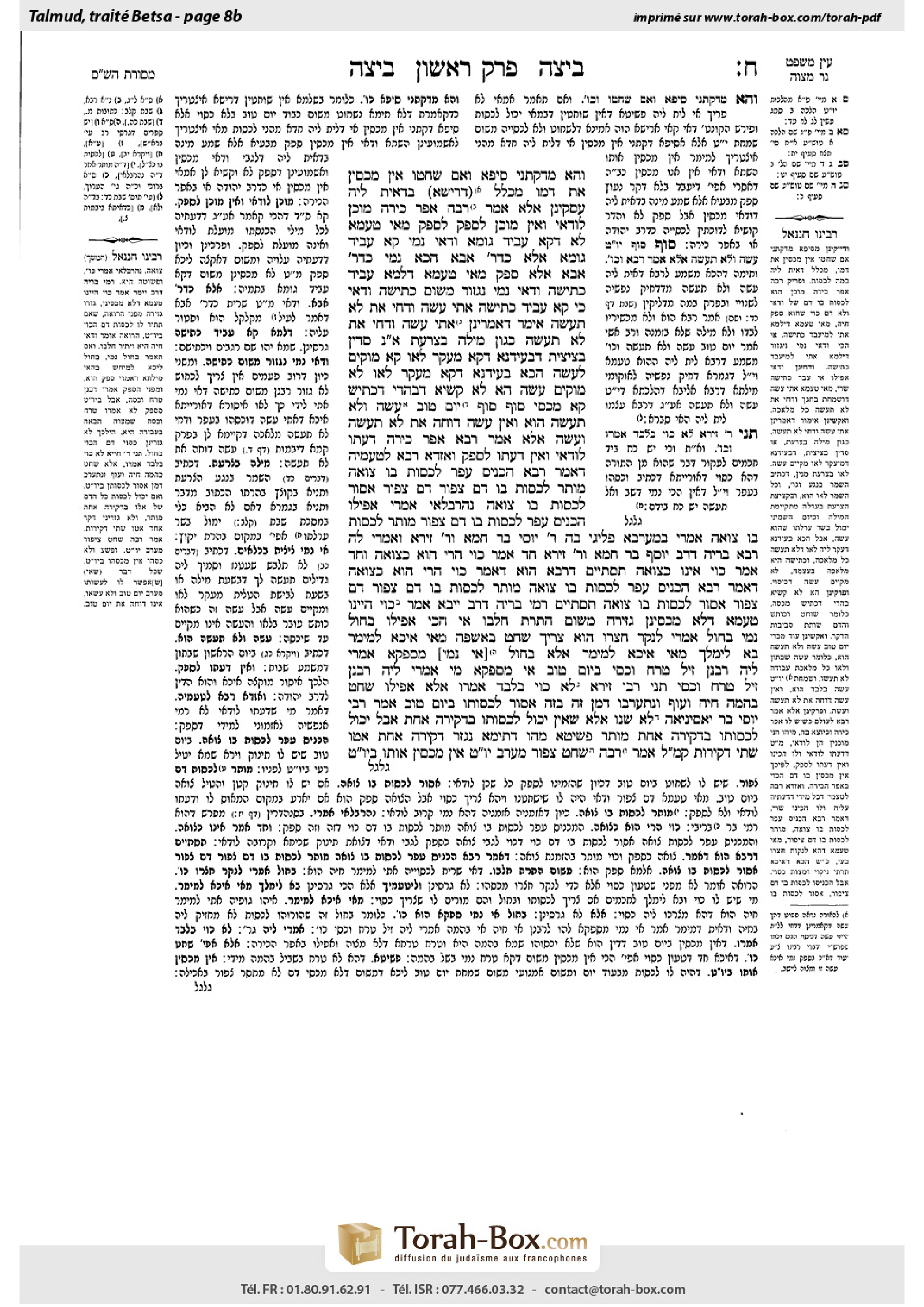
Beitzah 8b: Talmud study for Daf Yomi
Study the Talmud for Daf Yomi with scanned pages, Hebrew text, English translations from Sefaria and AI-generated French translations.
Passage selection and English or AI-generated French translation are available where the scan has annotations. Daf Study is independent of Torah-Box and Sefaria.
Browse Beitzah · ביצה · All tractatesBeitzah 8b text and translations
This page of Beitzah includes the Aramaic text, an English translation and an AI-generated French translation, alongside the scan above.
ביצה ח׳ ב · Aramaic and Hebrew text
וְהָא מִדְּקָתָנֵי סֵיפָא: וְאִם שְׁחָטוֹ — אֵין מְכַסִּין אֶת דָּמוֹ, מִכְּלָל (דְּרֵישָׁא) בִּדְאִית לֵיהּ עָסְקִינַן!
אֶלָּא אָמַר רַבָּה: אֵפֶר כִּירָה — מוּכָן לְוַדַּאי וְאֵין מוּכָן לְסָפֵק.
לְסָפֵק מַאי טַעְמָא לָא — דְּקָא עָבֵיד גּוּמָּא, וַדַּאי נָמֵי קָא עָבֵיד גּוּמָּא! אֶלָּא כִּדְרַבִּי אַבָּא, הָכָא נָמֵי כִּדְרַבִּי אַבָּא!
אֶלָּא: סָפֵק מַאי טַעְמָא — דִּלְמָא עָבֵיד כְּתִישָׁה. וַדַּאי נָמֵי נִגְזוֹר מִשּׁוּם כְּתִישָׁה! וַדַּאי, כִּי קָא עָבֵיד כְּתִישָׁה — אָתֵי עֲשֵׂה וְדָחֵי אֶת לֹא תַעֲשֶׂה.
אֵימַר דְּאָמְרִינַן אָתֵי עֲשֵׂה וְדָחֵי אֶת לֹא תַעֲשֶׂה כְּגוֹן מִילָה בְּצָרַעַת, אִי נָמֵי סָדִין בְּצִיצִית.
דִּבְעִידָּנָא דְּקָא מִעֲקַר לָאו — קָא מוֹקֵים לַעֲשֵׂה. הָכָא, בְּעִידָּנָא דְּקָא מִעֲקַר לָאו — לָא מוֹקֵים עֲשֵׂה! הָא לָא קַשְׁיָא, דְּבַהֲדֵי דְּכָתֵישׁ קָא מִכַּסֵּי.
סוֹף סוֹף, יוֹם טוֹב עֲשֵׂה וְלֹא תַעֲשֶׂה הוּא — וְאֵין עֲשֵׂה דּוֹחֶה אֶת לֹא תַעֲשֶׂה וַעֲשֵׂה!
אֶלָּא אָמַר רָבָא: אֵפֶר כִּירָה דַּעְתּוֹ לְוַדַּאי, וְאֵין דַּעְתּוֹ לְסָפֵק.
וְאַזְדָּא רָבָא לְטַעְמֵיהּ, דְּאָמַר רָבָא: הִכְנִיס עָפָר לְכַסּוֹת בּוֹ צוֹאָה — מוּתָּר לְכַסּוֹת בּוֹ דַּם צִפּוֹר. דַּם צִפּוֹר — אָסוּר לְכַסּוֹת בּוֹ צוֹאָה.
נְהַרְבְּלָאֵי אָמְרִי: אֲפִילּוּ הִכְנִיס עָפָר לְכַסּוֹת בּוֹ דַּם צִפּוֹר — מוּתָּר לְכַסּוֹת בּוֹ צוֹאָה.
אָמְרִי בְּמַעְרְבָא: פְּלִיגִי בַּהּ רַבִּי יוֹסֵי בַּר חָמָא וְרַבִּי זֵירָא, וְאָמְרִי לַהּ רָבָא בְּרֵיהּ דְּרַב יוֹסֵף בַּר חָמָא וְרַבִּי זֵירָא. חַד אָמַר: כּוֹי, הֲרֵי הוּא כְּצוֹאָה. וְחַד אָמַר: כּוֹי אֵינוֹ כְּצוֹאָה.
תִּסְתַּיַּים דְּרָבָא הוּא דְּאָמַר כּוֹי הֲרֵי הוּא כְּצוֹאָה, דְּאָמַר רָבָא: הִכְנִיס עָפָר לְכַסּוֹת בּוֹ צוֹאָה — מוּתָּר לְכַסּוֹת בּוֹ דַּם צִפּוֹר, דַּם צִפּוֹר — אָסוּר לְכַסּוֹת בּוֹ צוֹאָה. תִּסְתַּיַּים.
רָמֵי בְּרֵיהּ דְּרַב יֵיבָא אָמַר: כּוֹי הַיְינוּ טַעְמָא דְּלָא מְכַסֵּינַן, גְּזֵירָה מִשּׁוּם הַתָּרַת חֶלְבּוֹ.
אִי הָכִי, אֲפִילּוּ בְּחוֹל נָמֵי! בַּחוֹל אָמְרִי לְנַקֵּר חֲצֵרוֹ הוּא צָרִיךְ.
שָׁחַט בְּאַשְׁפָּה, מַאי אִיכָּא לְמֵימַר? בָּא לִימָּלֵךְ, מַאי אִיכָּא לְמֵימַר?
אֶלָּא: בְּחוֹל [אִי נָמֵי] מִסְּפֵקָא, אָמְרִי לֵיהּ רַבָּנַן: זִיל טְרַח וְכַסִּי. בְּיוֹם טוֹב אִי מִסְּפֵקָא — מִי אָמְרִי לֵיהּ רַבָּנַן זִיל טְרַח וְכַסִּי?
תָּנֵי רַבִּי זֵירָא: לֹא כּוֹי בִּלְבַד אָמְרוּ, אֶלָּא אֲפִילּוּ שָׁחַט בְּהֵמָה, חַיָּה וָעוֹף וְנִתְעָרְבוּ דָּמָן זֶה בָּזֶה — אָסוּר לְכַסּוֹתוֹ בְּיוֹם טוֹב.
אָמַר רַבִּי יוֹסֵי בַּר יָאסִינִיאָה: לֹא שָׁנוּ אֶלָּא שֶׁאֵין יָכוֹל לְכַסּוֹתוֹ בִּדְקִירָה אַחַת, אֲבָל יָכוֹל לְכַסּוֹתוֹ בִּדְקִירָה אַחַת — מוּתָּר.
פְּשִׁיטָא! מַהוּ דְּתֵימָא: נִגְזַר דְּקִירָה אַחַת אַטּוּ שְׁתֵּי דְקִירוֹת, קָא מַשְׁמַע לַן.
אָמַר רַבָּה: שָׁחַט צִפּוֹר מֵעֶרֶב יוֹם טוֹב, אֵין מְכַסִּין אוֹתוֹ בְּיוֹם טוֹב.
Beitzah 8b · English translation
The Gemara challenges this: From the fact that the latter clause teaches: And if he slaughtered it one may not cover its blood, it may be inferred that in the first clause we are dealing with a situation where he does have something with which to cover the blood. If he does not have anything he can use, why is it necessary to state that one may not cover it? And consequently, if he does in fact have material with which to cover the blood, why may he not do so, either with his basket of earth, in accordance with the opinion of Rabbi Yehuda, or with the ashes of a stove?
Rather, Rabba said that the ashes of a stove, which the mishna stated are prepared, are prepared only for covering the blood in a case of a definite obligation, but they are not considered prepared for a case of uncertainty. Although his intention was to use these ashes to cover the blood of any animal he slaughters, whether in a definite or an uncertain case, they are nevertheless not considered prepared for an uncertain case.
The Gemara inquires: In a case of uncertainty, what is the reason that the ashes are not considered prepared? If the reason is that one makes a hole in the mound of ashes when he removes part of it for covering, in a definite case he also makes a hole. If it is prohibited to make a hole, that prohibition applies in all cases. Rather, one must say, in accordance with the opinion of Rabbi Abba, that the making of this hole is not considered prohibited labor, as he is merely performing a destructive act. If so, here too, in a case of uncertainty, there should be no cause for concern, in accordance with the opinion of Rabbi Abba.
Rather, the Gemara retracts from the previous suggestion and offers an alternative: With regard to a case of uncertainty, what is the reason that it is prohibited? The reason is that perhaps one will forget and perform crushing with this earth, to ready it for covering. However, the same problem arises as before: If so, we should also decree against covering the blood in a definite case, because he might crush the earth. The Gemara answers: This presents no difficulty, as when one fulfills the mitzva of covering the blood in a definite case, even if he performs crushing, the positive mitzva of covering the blood comes and overrides the prohibition concerning the desecration of a Festival.
The Gemara challenges this: Say that we said the following principle: A positive mitzva comes and overrides a prohibition in a case such as the circumcision of a child who has leprosy. Cutting off a leprous blemish is a violation of a prohibition. However, if a baby’s foreskin is leprous, it is permitted to cut it off by circumcision. Alternatively, the principle applies to a case of a linen cloak on which woolen ritual fringes are placed, despite the prohibition against wearing diverse kinds, i.e., a mixture of wool and linen.
The Gemara explains the difference between those halakhot and the issue at hand. In those cases, at the time that one uproots the prohibition, he fulfills the positive mitzva with the same act. However, here, in the case of covering blood, two separate actions are involved, as at the time that one uproots the prohibition, when he crushes the earth, he does not fulfill the positive mitzva of covering the blood. The Gemara answers: This is not difficult, as it is possible to say that when one crushes the earth, he covers the blood with it; he fulfills the positive mitzva by means of the same action through which he uproots the prohibition.
The Gemara challenges this explanation from a different perspective: Ultimately, a Festival is a mitzva that includes both the positive mitzva of rest and also the prohibition against performing prohibited labor, and there is a principle that a positive mitzva by itself does not override a prohibition and a positive mitzva together.
Rather, the Gemara rejects the previous explanation, in favor of the following. Rava said: One’s initial intention is to use the ashes of a stove for a mitzva that is definite, and he does not have this intention for cases of uncertainty. One may not use an article on a Festival for a purpose which he did not have in mind beforehand.
The Gemara comments: And Rava follows his regular line of reasoning in this regard, as Rava said: If one brought in earth in order to cover a baby’s excrement with it on a Festival, it is likewise permitted to cover with it the blood of a slaughtered bird. Since he prepared this earth for a case of uncertainty, as it is possible that the baby will not soil the house, he certainly intended to use it for covering the blood of a bird prepared before the Festival for slaughter. If, however, one prepared the earth at the outset to cover the blood of a bird, it is prohibited to cover excrement with it, as he did not know in advance that he would require the earth for this purpose. He had only definite uses in mind, not possible ones such as covering excrement.
The Sages of Neharbela said: Even if one brought in earth to cover the blood of a bird with it, it is permitted to cover excrement with it, as it cannot be said that he did not intend this usage.
They say in the West, Eretz Yisrael, that Rabbi Yosei bar Ḥama and Rabbi Zeira disagree with regard to this issue, and some say it was disputed by Rava, son of Rav Yosef bar Ḥama, commonly mentioned in the Babylonian Talmud as Rava, without the patronymic, and Rabbi Zeira. The Gemara elaborates: One of them said that a koy is similar to excrement in this regard. Just as one may cover the blood of a bird with earth brought in for the purpose of covering excrement, he may likewise use it for covering the blood of a koy, as both the case of excrement and the case of the koy are cases of uncertainty. And the other one said: A koy is not similar to excrement. Since the covering of excrement is common, it is regarded as a definite purpose in comparison to a koy, which is by definition an uncertain case. It is therefore prohibited to cover the blood of a koy with earth prepared for the sake of covering excrement.
The Gemara comments: Conclude that Rava is the one who said that a koy is similar to excrement, as Rava said: If one brought in earth to cover excrement with it, it is permitted to cover the blood of a bird with it; if he did bring in earth to cover the blood of a bird, it is prohibited to cover excrement with it. One intends to use the earth for the definite rather than the uncertain purpose, and likewise in the case of a koy. The Gemara summarizes: Indeed, conclude that this is the correct version of the opinions in the dispute.
§ Rami, son of Rav Yeiva, said a different reason: In the case of a koy, this is the reasoning for the halakha that one may not cover its blood: It is not because this action would constitute prohibited labor; rather, it is a rabbinic decree due to the permission of its prohibited fat. If one were to cover its blood, people might think that a koy is definitely an undomesticated animal, and it is well known that the fats of an undomesticated animal may be eaten, whereas those of a domesticated animal are prohibited.
The Gemara challenges this: If so, even on a weekday as well, the blood of a koy should not be covered, due to this concern. The Gemara answers: On a weekday, people will say that he needs to clean his courtyard, and that he is covering the blood merely to keep his courtyard presentable, rather than to fulfill the mitzva of covering blood.
The Gemara asks: And if he slaughtered a koy in a dunghill, a place used for the disposal of refuse, what is there to say? It will be evident that he is not concerned about its cleanliness, and that he is attempting to perform the mitzva of covering blood. Alternatively, if he comes to consult a Sage concerning whether or not he should cover the blood of a koy on a weekday, what is there to say? If the owner of the koy is instructed to cover the blood, would he not come to the erroneous conclusion that its fats are permitted?
Rather, the Gemara answers: On a weekday, even if the matter is uncertain, the Sages nevertheless say to him: Go and take the trouble and cover it, as it involves the possible fulfillment of a mitzva. On a Festival, however, if there is uncertainty, would the Sages say to him: Go and take the trouble and cover it? If one was told to cover the blood on a Festival, this would indicate that a koy is definitely an undomesticated animal.
Rabbi Zeira teaches the following baraita: Not only did the Sages say that the blood of a koy should not be covered on a Festival, but even if one slaughtered a domesticated animal, whose blood need not be covered, and also slaughtered an undomesticated animal or a fowl, whose blood must be covered, and their bloods became mingled together, it is prohibited to cover the mixture of blood on a Festival.
Rabbi Yosei bar Yasinia said: They taught this halakha only in a case where one cannot cover the entire mixture by one thrust of a shovel. However, if he can cover it with one thrust, it is permitted. Since the entire amount of blood can be covered with a single action, it does not matter if one unnecessarily covers the blood of a domesticated animal while performing the mitzva of covering the blood of a fowl or an undomesticated animal.
The Gemara comments: It is obvious that this is the case; since he covers all the blood in a single action, clearly he performs a mitzva. The Gemara answers: This ruling is nevertheless necessary, lest you say that we should decree and prohibit even one thrust, due to the possibility that he might perform two thrusts. Therefore, Rabbi Yosei bar Yasinia teaches us that this concern is not taken into account.
§ Rabba said: If one slaughtered a bird on the eve of a Festival, one may not cover its blood on the Festival itself.
Beitzah 8b · Traduction française (IA)
Le Guemara soulève un défi : D'après le fait que la clause ultérieure enseigne : Et s'il l'a sacrifié, on ne peut pas recouvrir son sang, on peut en déduire que dans la clause première, nous sommes en présence d'une situation où il possède quelque chose avec lequel recouvrir le sang. S'il n'a pas de matériel à utiliser, pourquoi est-il nécessaire de préciser qu'on ne peut pas recouvrir le sang ? Et par conséquent, si en effet il possède un matériel avec lequel recouvrir le sang, pourquoi ne peut-il pas le faire, soit avec son panier de terre, selon l'opinion de Rabbi Yéhuda, soit avec les cendres d'une cheminée ?
Plutôt, Rabba a dit que les cendres d'une cheminée, qui sont préparées selon la Michna, sont préparées uniquement pour recouvrir le sang dans un cas d'obligation définie, mais elles ne sont pas considérées comme préparées pour un cas d'incertitude. Bien que son intention fût d'utiliser ces cendres pour recouvrir le sang de tout animal qu'il sacrifie, qu'il s'agisse d'un cas défini ou d'un cas incertain, elles ne sont toutefois pas considérées comme préparées pour un cas d'incertitude.
Le Guemara interroge : Dans un cas d'incertitude, quelle est la raison pour laquelle les cendres ne sont pas considérées comme préparées ? Si la raison est que l'on fait un trou dans la pile de cendres lorsqu'on en retire une partie pour recouvrir le sang, dans un cas défini, on fait également un trou. Si l'interdiction de faire un trou s'applique à tous les cas, alors il faut dire, selon l'opinion de Rabbi Abba, que la réalisation de ce trou n'est pas considérée comme un travail interdit, car il s'agit simplement d'une action destructive. Si tel est le cas, ici aussi, dans un cas d'incertitude, il ne devrait pas y avoir de cause d'inquiétude, selon l'opinion de Rabbi Abba.
Plutôt, le Guemara retire la suggestion précédente et propose une alternative : Concernant un cas d'incertitude, quelle est la raison pour laquelle il est interdit ? La raison est que peut-être l'on oubliera et l'on effectuera un écrasement avec cette terre, afin de la préparer pour le recouvrement. Cependant, le même problème se répète que précédemment : Si tel est le cas, nous devrions également interdire le recouvrement du sang dans un cas défini, car l'on pourrait écraser la terre. Le Guemara répond : Cela ne présente pas de difficulté, car lorsque l'on accomplit la mitsva de recouvrir le sang dans un cas défini, même s'il effectue un écrasement, la mitsva positive de recouvrir le sang l'emporte sur l'interdiction concernant la violation du Festival.
Le Guemara soulève un défi : Disons que nous avons dit le principe suivant : Une mitsva positive l'emporte sur une interdiction dans un cas tel que la circoncision d'un enfant souffrant de lepra. Couper un blemish leprouse est une violation d'une interdiction. Cependant, si le prépuce d'un bébé est leprouse, il est permis de le couper par la circoncision. Alternativement, ce principe s'applique à un cas d'un manteau de lin sur lequel des franges rituelles de laine sont placées, malgré l'interdiction d'habiller avec des tissus mixtes, c'est-à-dire un mélange de laine et de lin.
Le Guemara explique la différence entre ces halakhot et le problème en question. Dans ces cas, au moment où l'on annule l'interdiction, on accomplit la mitsva positive avec la même action. Cependant, ici, dans le cas du recouvrement du sang, deux actions distinctes sont impliquées, car au moment où l'on annule l'interdiction, lorsqu'on écrase la terre, on ne accomplit pas la mitsva positive de recouvrir le sang. Le Guemara répond : Cela n'est pas difficile, car on peut dire que lorsqu'on écrase la terre, on recouvre le sang avec elle ; on accomplit la mitsva positive par la même action grâce à laquelle on annule l'interdiction.
Le Guemara soulève un défi à cette explication sous un autre angle : En fin de compte, un festival est une mitsva qui inclut à la fois la mitsva positive de repos et l'interdiction de faire un travail interdit, et il y a un principe selon lequel une mitsva positive seule ne l'emporte pas sur une interdiction et une mitsva positive ensemble.
Plutôt, le Guemara rejette l'explication précédente en faveur de la suivante. Rava a dit : Son intention initiale est d'utiliser les cendres d'une cheminée pour une mitsva définie, et il n'a pas cette intention pour les cas d'incertitude. On ne peut pas utiliser un objet lors d'un festival pour un usage qui n'était pas prévu à l'avance.
Le Guemara commente : Et Rava suit sa ligne de raisonnement habituelle à cet égard, car Rava a dit : Si l'on a apporté de la terre afin de recouvrir les excréments d'un bébé avec elle lors d'un festival, il est également permis de la utiliser pour recouvrir le sang d'un oiseau sacrifié. Puisque l'on a préparé cette terre pour un cas d'incertitude, car il est possible que le bébé ne salisse pas la maison, il a certainement l'intention d'utiliser cette terre pour recouvrir le sang d'un oiseau préparé avant le festival pour la sacrifice. Cependant, si l'on a préparé la terre dès le début pour recouvrir le sang d'un oiseau, il est interdit de l'utiliser pour recouvrir les excréments, car l'on ne savait pas à l'avance qu'on en aurait besoin pour cette utilisation. Il avait uniquement en tête des usages définis, pas des usages possibles tels que le recouvrement des excréments.
Les Sages de Neharbela ont dit : Même si l'on apporte de la terre pour recouvrir le sang d'un oiseau avec elle, il est permis de l'utiliser pour recouvrir les excréments, car on ne peut pas dire qu'il n'avait pas l'intention d'utiliser cette utilisation.
Ils disent en Occident, en Eretz Yisrael, que Rabbi Yosei bar Ḥama et Rabbi Zeira sont en désaccord sur ce point, et certains disent que cela a été discuté par Rava, fils de Rav Yosef bar Ḥama, souvent mentionné dans le Talmud babylonien comme Rava sans patronyme, et Rabbi Zeira. Le Guemara développe : L'un d'eux a dit qu'un koy est semblable aux excréments à cet égard. Aussi bien que l'on peut recouvrir le sang d'un oiseau avec de la terre apportée pour recouvrir les excréments, on peut également l'utiliser pour recouvrir le sang d'un koy, car les cas d'excréments et celui du koy sont des cas d'incertitude. Et l'autre a dit : Un koy n'est pas semblable aux excréments. Puisque le recouvrement des excréments est courant, il est considéré comme un usage défini par rapport à un koy, qui est par définition un cas d'incertitude. Il est donc interdit de recouvrir le sang d'un koy avec de la terre préparée à cet effet.
Le Guemara commente : Conclure que Rava est celui qui a dit qu'un koy est semblable aux déjections, comme Rava a dit : Si l'on apporte de la terre pour couvrir les déjections avec elle, il est permis de couvrir le sang d'un oiseau avec elle ; si l'on apporte de la terre pour couvrir le sang d'un oiseau, il est interdit de couvrir les déjections avec elle. On veut utiliser la terre à un but certain plutôt qu'à un but incertain, et de même dans le cas d'un koy. Le Guemara conclut : En effet, conclure que c'est la version correcte des opinions dans le débat.
§ Rami, fils de Rav Yeiva, a donné une autre raison : Dans le cas d'un koy, c'est la raison de la halakha qui interdit de couvrir son sang : Ce n'est pas parce que cette action constituerait un travail interdit ; plutôt, c'est une déclaration rabbinique en raison de la permission de sa graisse interdite. Si l'on couvrait son sang, les gens pourraient penser qu'un koy est un animal sauvage, et il est bien connu que les graisses d'un animal sauvage peuvent être mangées, tandis que celles d'un animal domestique sont interdites.
Le Guemara conteste cela : Si c'est ainsi, même le sang d'un koy ne devrait pas être couvert même un jour de semaine, en raison de cette préoccupation. Le Guemara répond : Le jour de semaine, les gens diront qu'il a besoin de nettoyer son jardin, et qu'il couvre le sang uniquement pour le rendre présentable, et non pas pour accomplir la mitsva de couvrir le sang.
Le Guemara pose la question : Et s'il a sacrifié un koy dans un tas d'ordures, un lieu utilisé pour l'élimination des déchets, qu'est-ce que cela signifie ? Il sera évident qu'il n'est pas préoccupé par sa propreté, et qu'il tente d'accomplir la mitsva de couvrir le sang. Alternativement, s'il vient consulter un Sage concernant savoir s'il doit couvrir le sang d'un koy un jour de semaine, qu'est-ce que cela signifie ? Si l'propriétaire du koy est instruit de couvrir le sang, ne conclurait-il pas à tort que ses graisses sont permises ?
Plutôt, le Guemara répond : Le jour de semaine, même si la question est incertaine, les Sages disent tout de même : Va et prends la peine de le couvrir, car cela implique la possible accomplissement d'une mitsva. Cependant, le jour de fête, si la question est incertaine, les Sages diraient-ils : Va et prends la peine de le couvrir ? Si l'on est informé de couvrir le sang le jour de fête, cela indiquerait qu'un koy est un animal sauvage.
Rabbi Zeira enseigne la suivante baraïta : Non seulement les Sages ont dit que le sang d'un koy ne doit pas être couvert le jour de fête, mais même si l'on a sacrifié un animal domestique, dont le sang n'a pas besoin d'être couvert, et aussi un animal sauvage ou un oiseau, dont le sang doit être couvert, et leurs sangs sont devenus mélangés, il est interdit de couvrir le mélange de sang le jour de fête.
Rabbi Yosei bar Yasinia a dit : Ils ont enseigné cette halakha uniquement dans le cas où l'on ne peut pas couvrir l'ensemble du mélange avec une seule pichenotte. Cependant, si l'on peut le couvrir avec une seule pichenotte, cela est permis. Puisque la quantité totale de sang peut être couverte avec une seule action, cela n'a pas d'importance si l'on couvre inutilement le sang d'un animal domestique en accomplissant la mitsva de couvrir le sang d'un oiseau ou d'un animal sauvage.
Le Guemara commente : Cela est évident ; puisque l'on couvre tout le sang en une seule action, clairement l'on accomplit une mitsva. Le Guemara répond : Ce jugement est toutefois nécessaire, afin que vous ne disiez pas que nous devons décréter et interdire même une seule pichenotte, en raison de la possibilité qu'il accomplisse deux pichenottes. Ainsi, Rabbi Yosei bar Yasinia nous enseigne que cette préoccupation n'est pas prise en compte.
§ Rabba a dit : Si l'on a sacrifié un oiseau la veille d'un jour de fête, on ne peut pas couvrir son sang le jour de fête lui-même.
Traduction française générée par IA à partir de l’édition anglaise de Sefaria. Vérifie toujours un passage avec le texte source.
Text from Sefaria: William Davidson Edition - Vocalized Aramaic (CC BY NC); William Davidson Edition - English (CC BY NC).