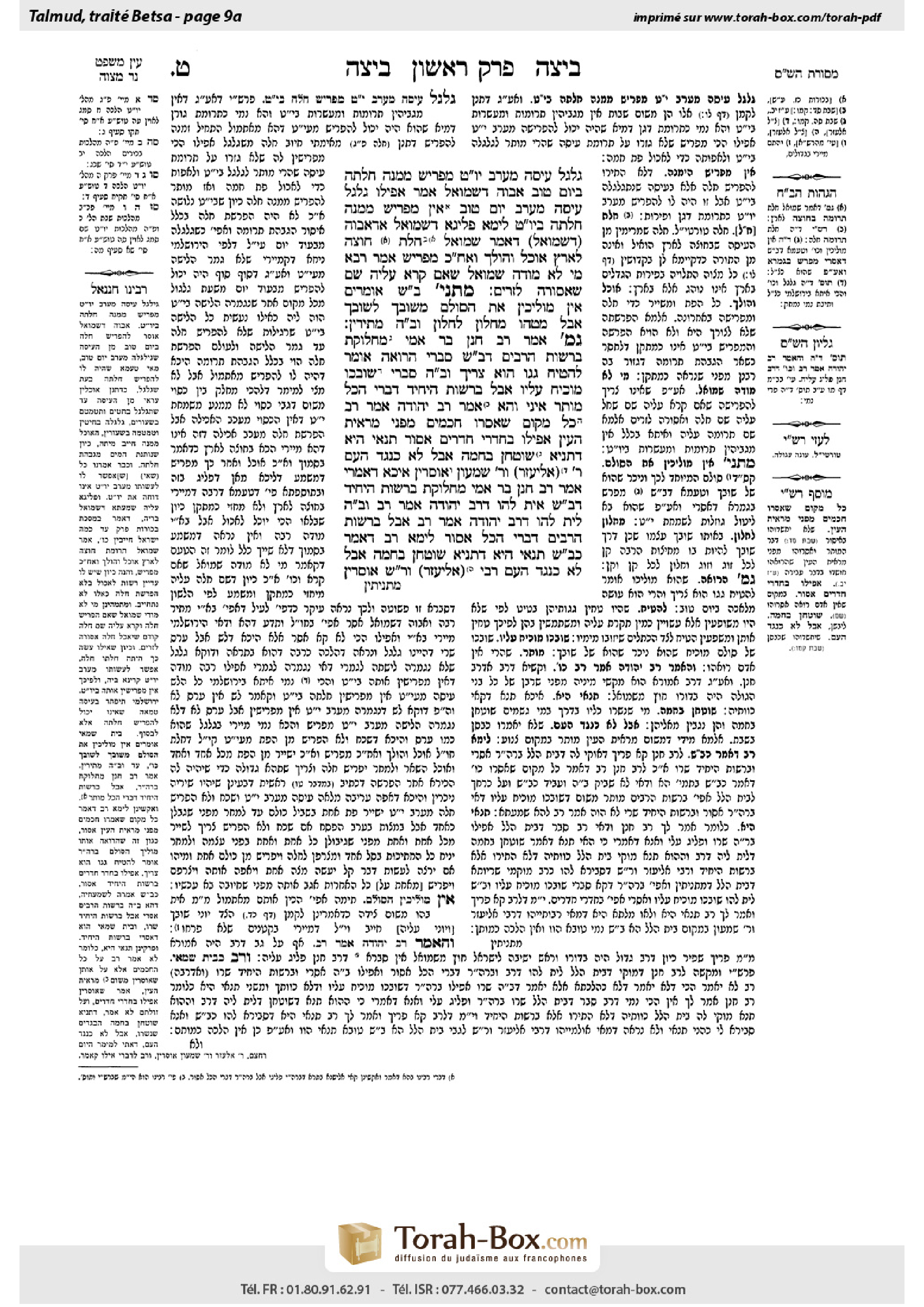
Beitzah 9a: Talmud study for Daf Yomi
Study the Talmud for Daf Yomi with scanned pages, Hebrew text, English translations from Sefaria and AI-generated French translations.
Passage selection and English or AI-generated French translation are available where the scan has annotations. Daf Study is independent of Torah-Box and Sefaria.
Browse Beitzah · ביצה · All tractatesBeitzah 9a text and translations
This page of Beitzah includes the Aramaic text, an English translation and an AI-generated French translation, alongside the scan above.
ביצה ט׳ א · Aramaic and Hebrew text
גִּלְגֵּל עִיסָּה מֵעֶרֶב יוֹם טוֹב — מַפְרִישׁ מִמֶּנָּה חַלָּתָהּ בְּיוֹם טוֹב. אֲבוּהּ דִּשְׁמוּאֵל אָמַר: אֲפִילּוּ גִּלְגֵּל עִיסָּה מֵעֶרֶב יוֹם טוֹב — אֵין מַפְרִישׁ מִמֶּנָּה חַלָּתָהּ בְּיוֹם טוֹב.
לֵימָא פְּלִיגָא דִּשְׁמוּאֵל אַדַּאֲבוּהּ (דִּשְׁמוּאֵל). דְּאָמַר שְׁמוּאֵל: חַלַּת חוּצָה לָאָרֶץ, אוֹכֵל וְהוֹלֵךְ וְאַחַר כָּךְ מַפְרִישׁ!
אָמַר רָבָא: מִי לֹא מוֹדֶה שְׁמוּאֵל שֶׁאִם קָרָא עָלֶיהָ שֵׁם שֶׁאֲסוּרָה לְזָרִים?
מַתְנִי׳ בֵּית שַׁמַּאי אוֹמְרִים: אֵין מוֹלִיכִין אֶת הַסּוּלָּם מִשּׁוֹבָךְ לְשׁוֹבָךְ, אֲבָל מַטֵּהוּ מֵחַלּוֹן לְחַלּוֹן. וּבֵית הִלֵּל מַתִּירִין.
גְּמָ׳ אָמַר רַב חָנָן בַּר אַמֵּי: מַחְלוֹקֶת בִּרְשׁוּת הָרַבִּים, דְּבֵית שַׁמַּאי סָבְרִי: הָרוֹאֶה אוֹמֵר לְהָטִיחַ גַּגּוֹ הוּא צָרִיךְ, וּבֵית הִלֵּל סָבְרִי: שׁוֹבָכוֹ מוֹכִיחַ עָלָיו. אֲבָל בִּרְשׁוּת הַיָּחִיד — דִּבְרֵי הַכֹּל מוּתָּר.
אִינִי? וְהָא אָמַר רַב יְהוּדָה אָמַר רַב: כׇּל מָקוֹם שֶׁאָסְרוּ חֲכָמִים מִפְּנֵי מַרְאִית הָעַיִן, אֲפִילּוּ בְּחַדְרֵי חֲדָרִים אָסוּר! תַּנָּאֵי הִיא. דְּתַנְיָא: שׁוֹטְחָן בַּחַמָּה, אֲבָל לֹא כְּנֶגֶד הָעָם. רַבִּי (אֱלִיעֶזֶר) וְרַבִּי שִׁמְעוֹן אוֹסְרִין.
אִיכָּא דְּאָמְרִי, אָמַר רַב חָנָן בַּר אַמֵּי: מַחְלוֹקֶת בִּרְשׁוּת הַיָּחִיד, דְּבֵית שַׁמַּאי אִית לְהוּ דְּרַב יְהוּדָה אָמַר רַב, וּבֵית הִלֵּל לֵית לְהוּ דְּרַב יְהוּדָה אָמַר רַב, אֲבָל בִּרְשׁוּת הָרַבִּים — דִּבְרֵי הַכֹּל אָסוּר.
לֵימָא רַב דְּאָמַר כְּבֵית שַׁמַּאי?
תַּנָּאֵי הִיא, דְּתַנְיָא: שׁוֹטְחָן בַּחַמָּה, אֲבָל לֹא כְּנֶגֶד הָעָם. רַבִּי (אֱלִיעֶזֶר) וְרַבִּי שִׁמְעוֹן אוֹסְרִין.
Beitzah 9a · English translation
If one kneaded dough on a Festival eve, i.e., the day before the Festival, he may separate its ḥalla on the Festival. In general, one may not separate teruma and tithes on a Festival. However, since it is permitted to bake bread on the Festival for the requirements of the day, and because bread may not be eaten unless ḥalla has first been separated from it, separating ḥalla is considered a necessary stage in the preparation of bread, and the Sages permitted it. Shmuel’s father said: Even if one kneaded dough on a Festival eve, he may not separate its ḥalla on the Festival, as he should have separated ḥalla then. The mitzva of separating ḥalla goes into effect at the time of the kneading of the dough.
The Gemara comments: Let us say that Shmuel disagrees with his father, as Shmuel said: With regard to ḥalla from outside of Eretz Yisrael, where the separation of ḥalla is a rabbinic obligation, one may proceed to eat the bread and afterward separate the ḥalla from the remainder of the dough. This statement indicates that the separation of ḥalla outside of Eretz Yisrael is not required to render the bread permitted, in contrast to the separation of teruma and tithes from produce. Consequently, separating ḥalla is permitted on a Festival, as it does not involve a significant change. This contradicts the opinion of Shmuel’s father, who prohibited separating ḥalla that could have been separated before the Festival.
Rava said: This is not necessarily the case. Doesn’t Shmuel concede that if one designated a piece of dough as ḥalla outside of Eretz Yisrael, it is prohibited to non-priests? This proves that even Shmuel admits that a certain measure of sanctity applies to the ḥalla. Therefore, he might also agree with his father that it is prohibited to separate ḥalla on a Festival even outside of Eretz Yisrael.
MISHNA: Beit Shammai say: One may not carry a ladder, which was used for reaching doves, from one dovecote to another. However, one may move it slightly so that he tilts it from one window to another in the same dovecote. And Beit Hillel permit even carrying a ladder from one dovecote to another.
GEMARA: Rav Ḥanan bar Ami said: This dispute applies only in a case where one moves the ladder in the public domain, as Beit Shammai hold that one who sees someone carrying his ladder will say to himself: He must need the ladder to plaster his roof, to prevent rainwater from dripping into his house. In other words, an onlooker will suspect him of performing prohibited labor on the Festival. And Beit Hillel hold that his dovecote proves about him that he is not moving the ladder for the purpose of a transgression, as it is evident that he is placing the ladder alongside the second dovecote, and everyone will understand his intention. However, in the private domain, where one will not be observed by strangers, everyone agrees that it is permitted.
The Gemara asks: Is that so? But didn’t Rav Yehuda say that Rav said: Wherever the Sages prohibited an action due to the appearance of prohibition, even if one performs the act in his innermost chamber, where no one will see it, it is prohibited. The Gemara answers: This is a dispute between tanna’im, as it is taught in a baraita: One whose clothes fell into water on Shabbat or a Festival may spread them out to dry in the sun, but he may not do so opposite the masses, i.e., in a place where people can see him, lest they suspect him of laundering on Shabbat. However, Rabbi Eliezer and Rabbi Shimon prohibit doing so even in private.
Some say a different version of this discussion. Rav Ḥanan bar Ami said: The dispute applies to the private domain, as Beit Shammai are of the opinion that the halakha is in accordance with that which Rav Yehuda said that Rav said, and therefore Beit Shammai apply the decree to the private domain. And Beit Hillel, by contrast, are of the opinion that the halakha is not in accordance with that which Rav Yehuda said that Rav said. However, in the public domain, everyone agrees that it is prohibited to move the ladder.
The Gemara challenges this interpretation: Should we say that Rav stated his opinion in accordance with that of Beit Shammai? According to Rav Ḥanan bar Ami, only Beit Shammai maintains that anything prohibited by the Sages due to appearances may not be performed even in private.
The Gemara rejects this suggestion: No, it is a dispute between tanna’im, as it is taught in a baraita: If clothes fell into water on Shabbat or a Festival, one may spread them out in the sun but not opposite the masses. Rabbi Eliezer and Rabbi Shimon prohibit doing so. Rav Ḥanan bar Ami accepts the opinion of the first tanna in the baraita, who rejects Rav’s principle. According to the opinion of that tanna, it can be claimed that Beit Hillel also rejected Rav’s principle, and they permitted moving the ladder in private but not in public. Rav, on the other hand, follows the opinion of Rabbi Eliezer and Rabbi Shimon in interpreting the opinion of Beit Hillel.
Beitzah 9a · Traduction française (IA)
Si quelqu'un a pétri de la pâte le soir de la fête, c'est-à-dire la veille de la fête, il peut séparer la challa de cette pâte lors de la fête. En général, on ne peut pas séparer la terouma et les dîmes lors d'une fête. Cependant, puisque l'on peut cuire du pain lors de la fête pour les besoins du jour, et que le pain ne peut être mangé qu'après que la challa ait été séparée, séparer la challa est considéré comme une étape nécessaire de la préparation du pain, et les Sages ont permis cela. Le père de Shmuel a dit : Même si quelqu'un a pétri de la pâte le soir de la fête, il ne peut pas séparer la challa de cette pâte lors de la fête, car il aurait dû le faire alors. La mitsva de séparer la challa prend effet au moment de pétrissage de la pâte.
Le Guemara commente : Disons que Shmuel est en désaccord avec son père, car Shmuel a dit : En ce qui concerne la challa en dehors de la Terre d'Israël, où la séparation de la challa est une obligation rabbinique, on peut manger le pain et ensuite séparer la challa du reste de la pâte. Cette déclaration indique que la séparation de la challa en dehors de la Terre d'Israël n'est pas nécessaire pour rendre le pain permis, contrairement à la séparation de la terouma et des dîmes des produits. Par conséquent, la séparation de la challa est permise lors d'une fête, car elle ne constitue pas un changement significatif. Cela contredit l'opinion du père de Shmuel, qui interdisait de séparer la challa qui aurait pu être séparée avant la fête.
Rava a dit : Ce n'est pas nécessairement le cas. Ne reconnaît pas Shmuel que si on a désigné une portion de pâte comme challa en dehors de la Terre d'Israël, il est interdit de la donner aux non-prêtres ? Cela prouve que même Shmuel admet que la challa possède une certaine sanctité. Par conséquent, il pourrait aussi accepter l'opinion de son père selon laquelle il est interdit de séparer la challa lors d'une fête même en dehors de la Terre d'Israël.
MICHNA : Beit Shammai disent : On ne peut pas transporter une échelle, utilisée pour atteindre des moineaux, d'un colombier à un autre. Cependant, on peut la déplacer légèrement afin de la pencher d'une fenêtre à l'autre dans le même colombier. Et Beit Hillel autorisent même le transport d'une échelle d'un colombier à un autre.
GUEMARA : Rav Ḥanan bar Ami a dit : Ce débat s'applique uniquement dans un cas où l'on déplace l'échelle dans le domaine public, car Beit Shammai pensent que celui qui voit quelqu'un transporter son échelle se dira : Il doit avoir besoin de l'échelle pour plâtrer son toit, afin d'empêcher l'eau de pluie de tomber dans sa maison. En d'autres termes, un observateur soupçonnera qu'il commet un travail interdit lors de la fête. Et Beit Hillel pensent que son colombier prouve qu'il ne déplace l'échelle pas pour commettre une transgression, car il est évident qu'il place l'échelle à côté du deuxième colombier, et tout le monde comprendra son intention. Cependant, dans le domaine privé, où l'on ne sera pas observé par des étrangers, tout le monde convient qu'il est permis.
Le Guemara pose la question : Est-ce ainsi ? Mais n'a-t-il pas dit Rav Yehuda que Rav a dit : Partout où les Sages ont interdit une action en raison de l'apparence d'une interdiction, même si l'on effectue l'acte dans sa chambre la plus intime, où personne ne le voit, il est interdit. Le Guemara répond : C'est un débat entre les tannaïm, car il est enseigné dans une baraïta : Celui dont les vêtements sont tombés dans l'eau le sabbat ou une fête peut étendre ses vêtements pour les sécher au soleil, mais il ne peut pas le faire face à la foule, c'est-à-dire dans un lieu où les gens peuvent le voir, de peur qu'ils soupçonnent qu'il lave ses vêtements le sabbat. Cependant, Rabbi Eliezer et Rabbi Shimon interdisent de le faire même en privé.
Certains donnent une version différente de ce débat. Rav Ḥanan bar Ami a dit : Ce débat s'applique au domaine privé, car Beit Shammai sont d'avis que la halakha suit ce que Rav Yehuda a rapporté que Rav avait dit, et donc Beit Shammai appliquent le décret au domaine privé. Et Beit Hillel, au contraire, sont d'avis que la halakha ne suit pas ce que Rav Yehuda a rapporté que Rav avait dit. Cependant, dans le domaine public, tout le monde convient qu'il est interdit de déplacer l'échelle.
Le Guemara remet en question cette interprétation : Doit-on dire que Rav a exprimé son opinion conformément à celle de Beit Shammai ? Selon Rav Ḥanan bar Ami, seulement Beit Shammai maintiennent que tout ce qui est interdit par les Sages en raison de l'apparence d'une interdiction ne peut pas être effectué même en privé.
Le Guemara rejette cette suggestion : Non, c'est un débat entre les tannaïm, car il est enseigné dans une baraïta : Si des vêtements sont tombés dans l'eau le sabbat ou une fête, on peut les étendre au soleil mais pas face à la foule, c'est-à-dire dans un lieu où les gens peuvent le voir, de peur qu'ils soupçonnent qu'il lave ses vêtements le sabbat. Rabbi Eliezer et Rabbi Shimon interdisent de le faire. Rav Ḥanan bar Ami accepte l'opinion du premier tanna de la baraïta, qui rejette le principe de Rav. Selon l'opinion de ce tanna, on peut affirmer que Beit Hillel ont également rejeté le principe de Rav, et ils ont permis de déplacer l'échelle en privé mais pas en public. Rav, en revanche, suit l'opinion de Rabbi Eliezer et Rabbi Shimon lors de l'interprétation de l'opinion de Beit Hillel.
Traduction française générée par IA à partir de l’édition anglaise de Sefaria. Vérifie toujours un passage avec le texte source.
Text from Sefaria: William Davidson Edition - Vocalized Aramaic (CC BY NC); William Davidson Edition - English (CC BY NC).