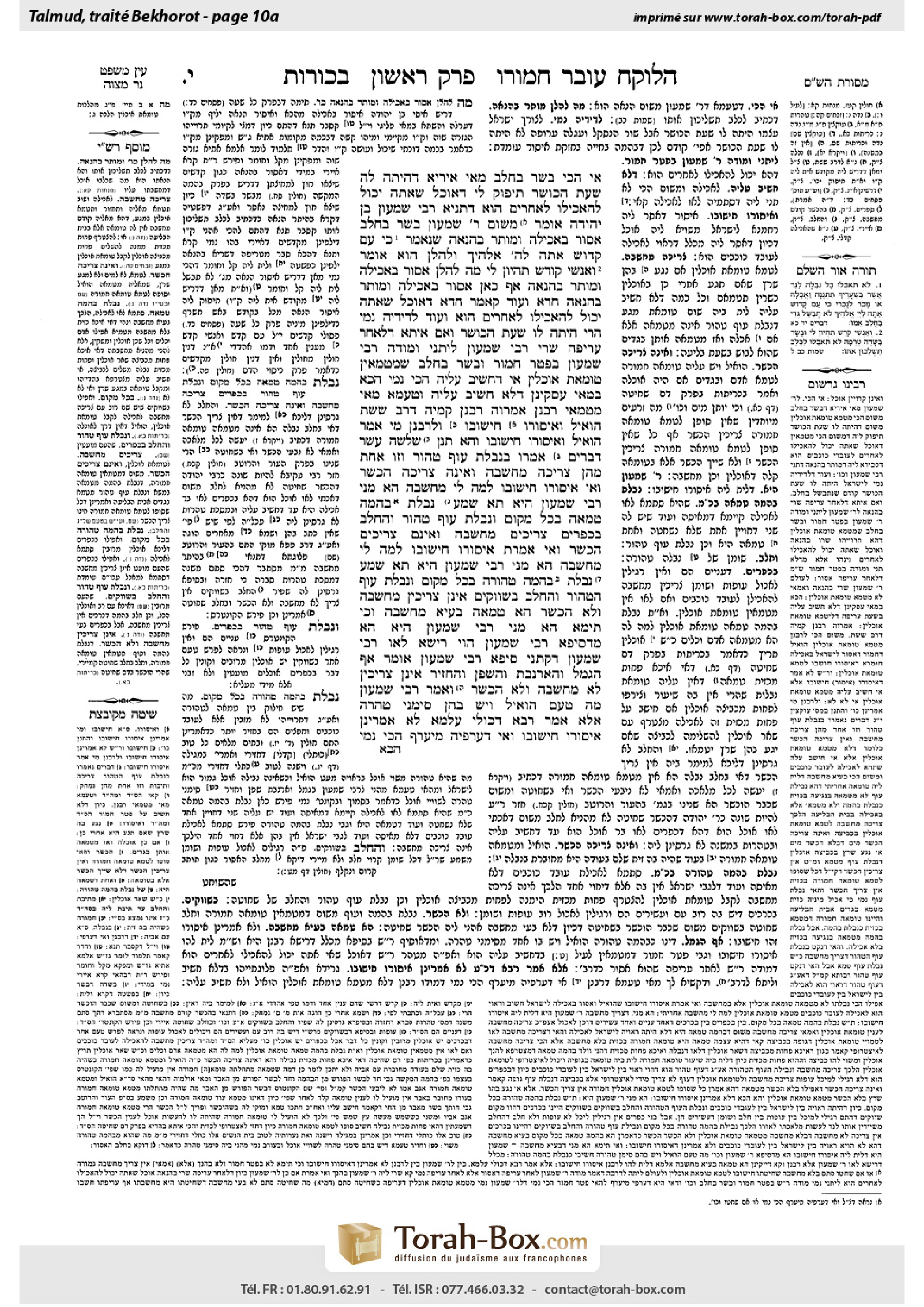
Bekhorot 10a: Talmud study for Daf Yomi
Study the Talmud for Daf Yomi with scanned pages, Hebrew text, English translations from Sefaria and AI-generated French translations.
Passage selection and English or AI-generated French translation are available where the scan has annotations. Daf Study is independent of Torah-Box and Sefaria.
Browse Bekhorot · בכורות · All tractatesBekhorot 10a text and translations
This page of Bekhorot includes the Aramaic text, an English translation and an AI-generated French translation, alongside the scan above.
בכורות י׳ א · Aramaic and Hebrew text
אִי הָכִי, בָּשָׂר בְּחָלָב מַאי אִירְיָא דְּהָיְתָה לָהּ שְׁעַת הַכּוֹשֶׁר? תִּיפּוֹק לִי דְּאוֹכֶל שֶׁאַתָּה יָכוֹל לְהַאֲכִילוֹ לַאֲחֵרִים הוּא!
דְּתַנְיָא, רַבִּי שִׁמְעוֹן בֶּן יְהוּדָה אוֹמֵר מִשּׁוּם רַבִּי שִׁמְעוֹן: בָּשָׂר בְּחָלָב אָסוּר בַּאֲכִילָה וּמוּתָּר בַּהֲנָאָה, שֶׁנֶּאֱמַר: ״כִּי עַם קָדוֹשׁ אַתָּה לַה׳ אֱלֹהֶיךָ״, וּלְהַלָּן הוּא אוֹמֵר: ״וְאַנְשֵׁי קֹדֶשׁ תִּהְיוּן לִי״, מָה לְהַלָּן אָסוּר בַּאֲכִילָה וּמוּתָּר בַּהֲנָאָה, אַף כָּאן אָסוּר בַּאֲכִילָה וּמוּתָּר בַּהֲנָאָה!
חֲדָא וְעוֹד קָאָמַר: חֲדָא — דְּאוֹכֶל שֶׁאַתָּה יָכוֹל לְהַאֲכִילוֹ לַאֲחֵרִים הוּא, וְעוֹד — לְדִידֵיהּ נָמֵי הֲרֵי הָיְתָה לוֹ שְׁעַת הַכּוֹשֶׁר.
וְאִם אִיתָא דִּלְאַחַר עֲרִיפָה שָׁרֵי רַבִּי שִׁמְעוֹן, לִיתְנֵי: וּמוֹדֶה רַבִּי שִׁמְעוֹן בְּפֶטֶר חֲמוֹר וּבָשָׂר בְּחָלָב שֶׁמִּטַּמְּאִין טוּמְאַת אֳוכָלִין!
אִי דְּחַשֵּׁיב עֲלֵיהּ — הָכִי נָמֵי; הָכָא בְּמַאי עָסְקִינַן — דְּלָא חַשֵּׁיב עֲלֵיהּ.
וְטַעְמָא מַאי מְטַמְּאִי רַבָּנַן? אַמְרוּהָ רַבָּנַן קַמֵּיהּ דְּרַב שֵׁשֶׁת: הוֹאִיל וְאִיסּוּרוֹ חִישּׁוּבוֹ.
וּלְרַבָּנַן מִי אָמַר הוֹאִיל וְאִיסּוּרוֹ חִישּׁוּבוֹ? וְהָא תְּנַן: שְׁלֹשָׁה עָשָׂר דְּבָרִים אָמְרוּ בְּנִבְלַת עוֹף טָהוֹר, וְזוֹ אַחַת מֵהֶן — צְרִיכָה מַחְשָׁבָה, וְאֵינָהּ צְרִיכָה הֶכְשֵׁר.
וְאִי אִיסּוּרוֹ חִישּׁוּבוֹ, לְמָה לִּי מַחְשָׁבָה? הָא מַנִּי? רַבִּי שִׁמְעוֹן הִיא.
תָּא שְׁמַע: נִבְלַת בְּהֵמָה טְמֵאָה בְּכׇל מָקוֹם, וְנִבְלַת עוֹף טָהוֹר וְהַחֵלֶב בַּכְּפָרִים — צְרִיכִים מַחְשָׁבָה, וְאֵינָם צְרִיכִים הֶכְשֵׁר. וְאִי אָמְרַתְּ אִיסּוּרוֹ חִישּׁוּבוֹ, לְמָה לִּי מַחְשָׁבָה? הָא מַנִּי? רַבִּי שִׁמְעוֹן הִיא.
תָּא שְׁמַע: נִבְלַת בְּהֵמָה טְהוֹרָה בְּכׇל מָקוֹם, וְנִבְלַת עוֹף הַטָּהוֹר וְהַחֵלֶב בַּשְּׁוָוקִים — אֵינָן צְרִיכִין מַחְשָׁבָה וְלֹא הֶכְשֵׁר. הָא טְמֵאָה בָּעֲיָא מַחְשָׁבָה.
וְכִי תֵּימָא: הָא מַנִּי רַבִּי שִׁמְעוֹן הִיא — הָא מִדְּסֵיפָא רַבִּי שִׁמְעוֹן הָוֵי, רֵישָׁא לָאו רַבִּי שִׁמְעוֹן. דְּקָתָנֵי סֵיפָא: רַבִּי שִׁמְעוֹן אוֹמֵר: אַף הַגָּמָל וְהָאַרְנֶבֶת וְהַשָּׁפָן וְהַחֲזִיר אֵינָן צְרִיכִין לֹא מַחְשָׁבָה וְלֹא הֶכְשֵׁר. וְאָמַר רַבִּי שִׁמְעוֹן: מָה טַעַם? הוֹאִיל וְיֵשׁ בָּהֶן סִימָנֵי טׇהֳרָה.
אֶלָּא אָמַר רָבָא: דְּכוּלֵּי עָלְמָא לָא אָמְרִינַן אִיסּוּרוֹ חִישּׁוּבוֹ, וְאִי דְּעַרְפֵיהּ מִיעְרָף — הָכִי נָמֵי,
Bekhorot 10a · English translation
The Gemara asks: If so, if this is indeed Rabbi Shimon’s opinion, why, then, does he specifically state that meat cooked in milk is susceptible to impurity because it had a period of susceptibility to contracting impurity before they were cooked together? Derive this halakha from the fact that it is food that you can feed to others, as Rabbi Shimon maintains that deriving benefit from meat and milk cooked together is not prohibited.
As it is taught in a baraita: Rabbi Shimon ben Yehuda says in the name of Rabbi Shimon: With regard to meat cooked in milk, eating it is forbidden and deriving benefit from it is permitted, as it is stated: “For you are a holy people to the Lord your God; you shall not cook a kid in its mother’s milk” (Deuteronomy 14:21). And elsewhere the verse states: “And you shall be holy men to Me; therefore you shall not eat any flesh that is torn by animals in the field” (Exodus 22:30). Just as there, with regard to an animal torn by animals, which is forbidden as a tereifa, i.e., an animal possessing a wound that will cause it to die within twelve months, eating it is forbidden but deriving benefit from it is permitted, so too here, with regard to meat cooked in milk, where the verse mentions being holy just as the other verse did, eating it is forbidden but deriving benefit from it is permitted.
The Gemara answers: The baraita that cites Rabbi Shimon’s opinion states one reason why meat cooked in milk is susceptible to impurity and adds another. One reason is because it is food that you can feed to others. Therefore, it is called food for the purpose of being susceptible to impurity. And another reason is because even for him, i.e., a Jew, although eating the milk and meat is currently prohibited, it had a time when it was fit for consumption, i.e., before they were cooked together, and therefore they remain susceptible to impurity.
The opinion of Rabbi Shimon that all items from which deriving benefit is prohibited are not susceptible to the impurity of food except for meat cooked in milk has been elucidated. Rava now proceeds to explain his proof that even according to Rabbi Shimon, deriving benefit from a firstborn donkey after the breaking of its neck is forbidden: And if it is so, that after breaking the neck of the firstborn donkey Rabbi Shimon deems it permitted for one to derive benefit from it, let the tanna teach: And Rabbi Shimon concedes with regard to a firstborn donkey and meat cooked in milk, that they are susceptible to the impurity of food. Since a firstborn donkey is not listed as an exception, Rabbi Shimon must hold that it is prohibited to derive benefit from it after its neck is broken, and it is therefore not susceptible to impurity.
The Gemara responds: If it is a case where the one who broke the neck of the donkey intended at the time that people would eat from it, so too it would be susceptible to the impurity of food according to Rabbi Shimon, as it is permitted to derive benefit from it. Here we are dealing with a case where he did not intend for it to be eaten, as even gentiles do not usually consume the meat of a donkey, and it therefore is not considered food.
The Gemara asks: But if he did not intend for anyone to eat it, what is the reason the Rabbis deem the flesh susceptible to the impurity of food? The Sages said before Rav Sheshet: It is susceptible to the impurity of food because the prohibition to eat it serves as intent to treat it as food, i.e., the very fact that it is forbidden renders it significant enough to be deemed a food.
The Gemara asks: But according to the Rabbis, did they actually say that an item is susceptible to the impurity of food since its prohibition serves as its intent? But didn’t we learn in a mishna (Teharot 1:1) that the Sages stated thirteen matters concerning the unslaughtered carcass of a kosher bird, and this is one of them: It requires explicit intent that it will be eaten in order to become susceptible to the impurity of food, as most gentiles are unaccustomed to eating it, but it does not require contact with liquid to be rendered susceptible to ritual impurity.
And if the logic of: Its prohibition serves as its intent, is accepted, why do I need the intent here, as an unslaughtered carcass is forbidden to be eaten? The Gemara answers: In accordance with whose opinion is this? It is in accordance with the opinion of Rabbi Shimon, who does not hold that its prohibition serves as its intent.
The Gemara suggests: Come and hear a proof from another mishna (Okatzin 3:3): A carcass of a non-kosher animal, such as a horse or donkey, found in any location; or an unslaughtered carcass of a kosher bird or the fat of a kosher animal found in the villages, where the local gentiles are unaccustomed to eating it, all require intent to consume it in order to become susceptible to the impurity of food, but they do not require being rendered susceptible to impurity by coming in contact with liquid. And if you say its prohibition serves as its intent, why do I need intent? All these foods are forbidden for consumption by a Jew. The Gemara responds: In accordance with whose opinion is this? It is in accordance with the opinion of Rabbi Shimon.
The Gemara suggests: Come and hear a proof from the continuation of the same mishna: An unslaughtered carcass of a kosher animal found in any location, or the unslaughtered carcass of a kosher bird found in any location, or the fat of a kosher animal found in the marketplaces, i.e., in a large city that has marketplaces, where some people do eat it, do not require intent for consumption in order to be regarded as subject to impurity, as they are presumed to be food for gentiles; nor do they require contact with liquid in order for them to be rendered susceptible to impurity. The Gemara infers that only the carcass of a kosher animal does not require intent, but the carcass of a non-kosher animal requires intent. If its prohibition serves as its intent, why does it require intent for consumption?
And if you would say: In accordance with whose opinion is this, it is also in accordance with the opinion of Rabbi Shimon; one could respond that since the latter clause is the opinion of Rabbi Shimon it follows that the former clause, which is written without attribution, is not in accordance with the opinion of Rabbi Shimon. As the latter clause teaches: Rabbi Shimon says even the meat of the camel, and the hare, and the rock badger, and the pig do not require intent or contact with liquid to be rendered susceptible to impurity. And Rabbi Shimon said: What is the reason? The reason is that they have some characteristics of kosher animals (see Leviticus 11:4–7). If so, the dispute between Rabbi Shimon and the Rabbis cannot be based on whether the prohibition of the animal serves as its intent.
Rather, Rava says: Everyone, including the Rabbis, agrees that we do not say its prohibition serves as its intent. And with regard to a firstborn donkey, if one broke its neck, so too, the Rabbis hold that it is not susceptible to the impurity of food, since the one who broke its neck did not intend for it to be eaten.
Bekhorot 10a · Traduction française (IA)
La Guemara pose la question : Si c’est ainsi, c’est-à-dire si c’est effectivement l’opinion de Rabbi Shimon, pourquoi alors précise-t-il spécifiquement que la viande cuite avec du lait est sujette à la souillure, car elle a eu une période de souillure avant d’être cuite ensemble ? Cela découle du fait qu’il s’agit d’un aliment que l’on peut servir aux autres, comme Rabbi Shimon affirme que tirer un bénéfice de la viande et du lait cuits ensemble n’est pas interdit.
Comme il est enseigné dans une baraïta : Rabbi Shimon ben Yehuda cite Rabbi Shimon : En ce qui concerne la viande cuite avec du lait, manger est interdit, mais tirer un bénéfice est permis, car il est dit : « Vous êtes un peuple saint au Seigneur votre Dieu ; vous ne cuirez pas un petit veau dans le lait de sa mère » (Deutéronome 14:21). Et ailleurs, la Parole dit : « Et vous serez saints pour Moi ; donc vous ne mangerez pas de chair qui a été déchirée par des animaux dans le champ » (Exode 22:30). Aussi bien là, concernant un animal déchiré par des animaux, qui est interdit comme un tereifa, c’est-à-dire un animal ayant une plaie qui le fera mourir en douze mois, manger est interdit mais tirer un bénéfice est permis, ainsi que dans ce cas-ci, concernant la viande cuite avec du lait, où la Parole mentionne la sainteté de la même manière que dans l’autre, manger est interdit mais tirer un bénéfice est permis.
La Guemara répond : La baraïta qui cite l’opinion de Rabbi Shimon indique une raison pour laquelle la viande cuite avec du lait est sujette à la souillure et ajoute une autre. Une raison est qu’il s’agit d’un aliment que l’on peut servir aux autres. C’est pourquoi on l’appelle aliment à l’effet de la souillure. Une autre raison est que même pour lui, c’est-à-dire un Juif, bien que manger la viande et le lait soit interdit, il y avait un moment où ils étaient comestibles, c’est-à-dire avant qu’ils ne soient cuits ensemble, et c’est pourquoi ils restent sujets à la souillure.
L’opinion de Rabbi Shimon selon laquelle tous les objets dont l’usage est interdit ne sont pas sujets à la souillure alimentaire, sauf la viande cuite avec du lait, a été clarifiée. Rav continue alors à expliquer sa preuve selon laquelle même selon l’opinion de Rabbi Shimon, tirer un bénéfice d’un âne premier après avoir cassé son cou est interdit : Et si c’est ainsi, c’est-à-dire si après avoir cassé le cou de l’âne premier Rabbi Shimon considère qu’il est permis de tirer un bénéfice d’avec, que le tanna enseigne : Et Rabbi Shimon reconnaît concernant l’âne premier et la viande cuite avec du lait qu’ils sont sujets à la souillure alimentaire. Puisque l’âne premier n’est pas mentionné comme une exception, Rabbi Shimon doit considérer qu’il est interdit de tirer un bénéfice d’avec après que son cou ait été cassé, et il n’est donc pas sujet à la souillure.
La Guemara répond : Si c’est un cas où celui qui a cassé le cou de l’âne avait l’intention que les gens mangent de lui, alors aussi il serait sujet à la souillure alimentaire selon Rabbi Shimon, car il est permis de tirer un bénéfice d’avec. Ici, nous sommes en présence d’un cas où il n’avait pas l’intention qu’on le mange, car même les non-Juifs ne mangent généralement pas la viande d’un âne, et il n’est donc pas considéré comme un aliment.
La Guemara pose la question : Mais si l’intention n’était pas que quelqu’un le mange, quelle est la raison pour laquelle les Sages considèrent la chair comme sujette à la souillure alimentaire ? Les Sages dirent devant Rav Sheshet : Elle est sujette à la souillure alimentaire car l’interdiction de la manger sert d’intention, c’est-à-dire que le fait qu’elle soit interdite la rend suffisamment importante pour être considérée comme un aliment.
La Guemara pose la question : Mais selon les Sages, n’ont-ils pas dit que l’objet est sujet à la souillure alimentaire parce que son interdiction sert d’intention ? Mais n’avons-nous pas appris dans une mitsva (Téharot 1:1) que les Sages ont dit treize choses concernant la carcasse non sacrifiée d’un oiseau kasher, et celle-ci est l’une d’entre elles : Elle exige une intention explicite qu’elle sera mangée pour devenir sujette à la souillure alimentaire, car la plupart des non-Juifs ne mangent pas cela, mais elle ne nécessite pas le contact avec un liquide pour devenir sujette à la souillure rituelle.
Et si la logique de : Son interdiction sert d’intention, est acceptée, pourquoi ai-je besoin de l’intention ici, car la carcasse non sacrifiée est interdite à manger ? La Guemara répond : Selon l’opinion de qui est-ce ? C’est selon l’opinion de Rabbi Shimon, qui ne considère pas que son interdiction sert d’intention.
La Guemara suggère : Viens entendre une preuve d’une autre mitsva (Okatzin 3:3) : Une carcasse d’un animal non-kasher, comme un cheval ou un âne, trouvée n’importe où ; ou une carcasse non sacrifiée d’un oiseau kasher ou la graisse d’un animal kasher trouvée dans les villages, où les non-Juifs ne sont pas habitués à manger cela, toutes nécessitent une intention de consommation pour devenir sujette à la souillure alimentaire, mais ne nécessitent pas d’être rendue sujette à la souillure par le contact avec un liquide. Et si tu dis que son interdiction sert d’intention, pourquoi ai-je besoin d’intention ? Tous ces aliments sont interdits à la consommation par un Juif. La Guemara répond : Selon l’opinion de qui est-ce ? C’est selon l’opinion de Rabbi Shimon.
La Guemara suggère : Viens entendre une preuve tirée de la continuation de la même mitsna : Une carcasse non sacrifiée d’un animal kasher trouvée n’importe où, ou la carcasse non sacrifiée d’un oiseau kasher trouvée n’importe où, ou la graisse d’un animal kasher trouvée dans les marchés, c’est-à-dire dans une grande ville qui possède des marchés, où certaines personnes y mangent, ne nécessite pas d’intention pour la consommation afin d’être considérée comme sujette à la souillure, car elle est supposée être de la nourriture pour les non-Juifs ; ni ne nécessite le contact avec un liquide pour être rendue sujette à la souillure. La Guemara infère que seule la carcasse d’un animal kasher ne nécessite pas d’intention, mais la carcasse d’un animal non-kasher nécessite une intention. Si l’interdiction sert d’intention, pourquoi a-t-elle besoin d’intention pour la consommation ?
Et si l'on disait : Selon quel avis est-ce ? C'est aussi selon l'avis de Rabbi Shimon ; on pourrait répondre que puisque la clause ultérieure est l'avis de Rabbi Shimon, cela implique que la clause antérieure, qui est écrite sans attribution, n'est pas selon l'avis de Rabbi Shimon. Comme la clause ultérieure enseigne : Rabbi Shimon dit même que la viande du chameau, du lapin, du lièvre et du porc ne nécessite pas l'intention ou le contact avec un liquide pour être rendue susceptible d'impureté. Et Rabbi Shimon dit : Quelle est la raison ? La raison est qu'ils possèdent certains caractères d'animaux kasher (voir Lévitique 11:4–7). Si tel est le cas, le débat entre Rabbi Shimon et les Rabbins ne peut pas être fondé sur le fait que l'interdiction de l'animal serve d'intention.
Plutôt, Rava dit : Tout le monde, y compris les Rabbins, est d'accord sur le fait que nous ne disons pas que l'interdiction de l'animal sert d'intention. Et concernant un âne premier-né, si l'on brise son cou, de même les Rabbins considèrent qu'il n'est pas susceptible d'impureté alimentaire, car celui qui a brisé son cou n'avait pas l'intention de le manger.
Traduction française générée par IA à partir de l’édition anglaise de Sefaria. Vérifie toujours un passage avec le texte source.
Text from Sefaria: William Davidson Edition - Vocalized Aramaic (CC BY NC); William Davidson Edition - English (CC BY NC).