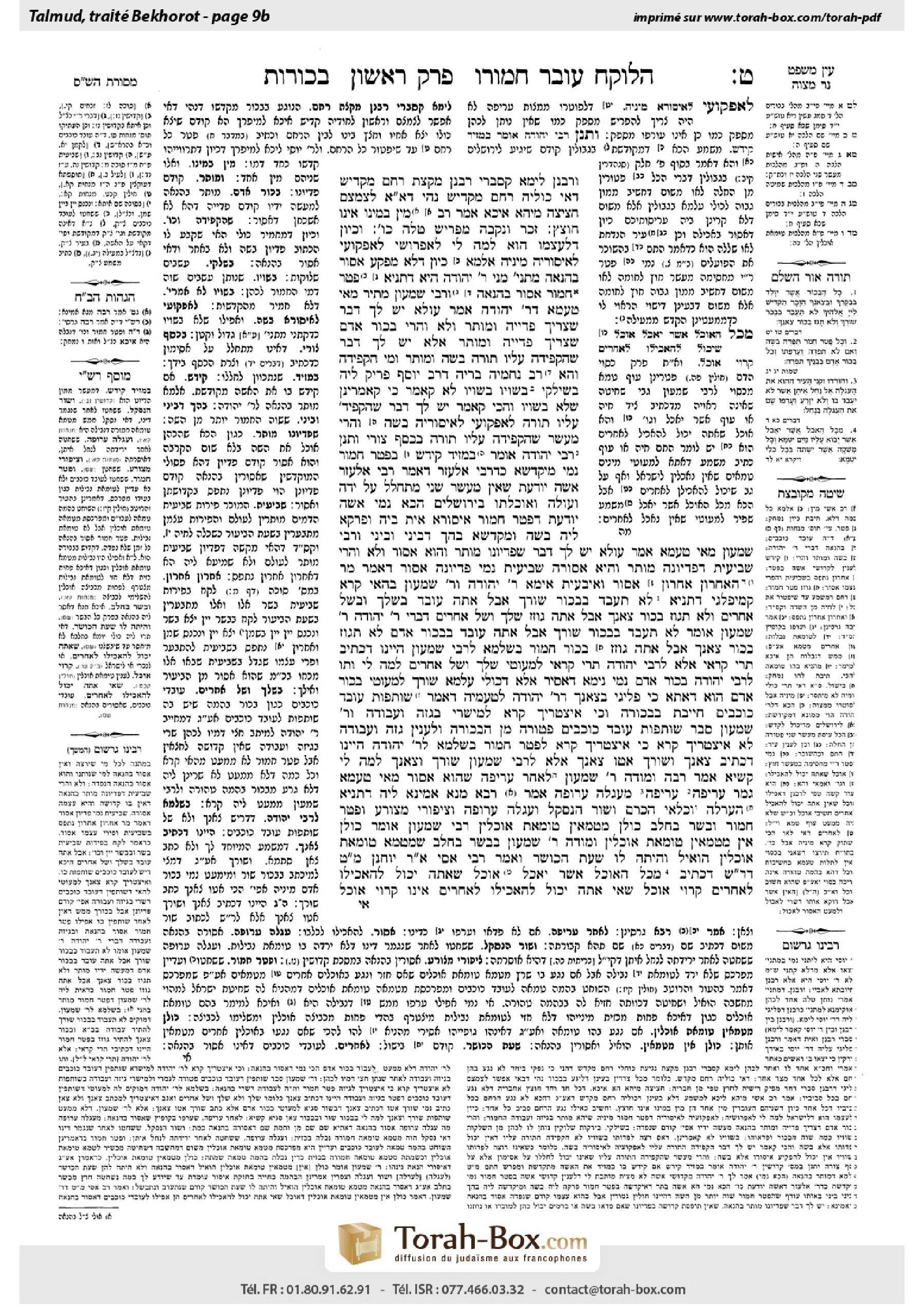
Bekhorot 9b: Talmud study for Daf Yomi
Study the Talmud for Daf Yomi with scanned pages, Hebrew text, English translations from Sefaria and AI-generated French translations.
Passage selection and English or AI-generated French translation are available where the scan has annotations. Daf Study is independent of Torah-Box and Sefaria.
Browse Bekhorot · בכורות · All tractatesBekhorot 9b text and translations
This page of Bekhorot includes the Aramaic text, an English translation and an AI-generated French translation, alongside the scan above.
בכורות ט׳ ב · Aramaic and Hebrew text
וְרַבָּנַן, לֵימָא קָסָבְרִי רַבָּנַן מִקְצָת רֶחֶם מַקְדֵּישׁ? דְּאִי כּוּלֵּיהּ רֶחֶם מַקְדֵּישׁ — נְהִי דְּאִי אֶפְשָׁר לְצַמְצֵם, חֲצִיצָה מִיהָא אִיכָּא!
אָמַר רַב: מִין בְּמִינוֹ אֵינוֹ חוֹצֵץ.
זָכָר וּנְקֵבָה — מַפְרִישׁ טָלֶה כּוּ׳. וְכֵיוָן דִּלְעַצְמוֹ הוּא, לְמָה לִי לְאַפְרוֹשֵׁי? לְאַפְקוֹעֵי לְאִיסּוּרֵיהּ מִינֵּיהּ.
אַלְמָא, כֵּיוָן דְּלָא מַפְקַע לְאִיסּוּרֵיהּ, אָסוּר בַּהֲנָאָה. מַתְנִיתִין מַנִּי? רַבִּי יְהוּדָה הִיא, דְּתַנְיָא: פֶּטֶר חֲמוֹר אָסוּר בַּהֲנָאָה, וְרַבִּי שִׁמְעוֹן מַתִּיר.
מַאי טַעְמָא דְּרַבִּי יְהוּדָה? אָמַר עוּלָּא: יֵשׁ לְךָ דָּבָר שֶׁצָּרִיךְ פְּדִיָּיה וּמוּתָּר? וְלָא?! וַהֲרֵי בְּכוֹר אָדָם שֶׁצָּרִיךְ פְּדִיָּיה וּמוּתָּר! אֶלָּא, יֵשׁ לְךָ דָּבָר שֶׁהִקְפִּידָה עָלָיו תּוֹרָה בְּשֶׂה וּמוּתָּר?
וּמִי הִקְפִּידָה?! וְהָא רַב נְחֶמְיָה בְּרֵיהּ דְּרַב יוֹסֵף פָּרֵיק לֵיהּ בְּשִׁילְקֵי בְּשׇׁוְיוֹ! בְּשׇׁוְיוֹ לָא קָאָמְרִינַן, כִּי קָאָמְרִינַן שֶׁלֹּא בְּשׇׁוְיוֹ, וְהָכִי קָאָמַר: יֵשׁ לְךָ דָּבָר שֶׁהִקְפִּידָה עָלָיו תּוֹרָה לְאַפְקוֹעֵי לְאִיסּוּרֵיהּ בְּשֶׂה?
וַהֲרֵי מַעֲשֵׂר, שֶׁהִקְפִּידָה עָלָיו תּוֹרָה בְּכֶסֶף צוֹרִי, וּתְנַן: רַבִּי יְהוּדָה אוֹמֵר: בְּמֵזִיד — קִידֵּשׁ!
בְּפֶטֶר חֲמוֹר נָמֵי מִיקַּדְּשָׁא, כִּדְרַבִּי אֶלְעָזָר, דְּאָמַר רַבִּי אֶלְעָזָר: אִשָּׁה יוֹדַעַת שֶׁאֵין מַעֲשֵׂר שֵׁנִי מִתְחַלֵּל עַל יָדָהּ, וְעוֹלָה וְאוֹכַלְתּוֹ בִּירוּשָׁלַיִם.
הָכָא נָמֵי, אִשָּׁה יוֹדַעַת דְּפֶטֶר חֲמוֹר אִיסּוּרָא אִית בֵּיהּ, וּפָרְקָא לֵיהּ בְּשֶׂה, וּמַקְדְּשָׁא בְּהָךְ דְּבֵינֵי וּבֵינֵי.
וְרַבִּי שִׁמְעוֹן מַאי טַעְמֵאּ? אָמַר עוּלָּא: יֵשׁ לְךָ דָּבָר שֶׁפִּדְיוֹנוֹ מוּתָּר וְהוּא אָסוּר?
וְלָא? וַהֲרֵי שְׁבִיעִית, דְּפִדְיוֹנָהּ מוּתָּר, וְהִיא אֲסוּרָה!
שְׁבִיעִית נָמֵי פִּדְיוֹנָהּ אָסוּר, דְּאָמַר מָר: הָאַחֲרוֹן אַחֲרוֹן אָסוּר.
וְאִיבָּעֵית אֵימָא: רַבִּי יְהוּדָה וְרַבִּי שִׁמְעוֹן בְּהַאי קְרָא קָמִיפַּלְגִי, דְּתַנְיָא: ״לֹא תַעֲבֹד בִּבְכוֹר שׁוֹרֶךָ״ — אֲבָל אַתָּה עוֹבֵד בְּשֶׁלְּךָ וּבְשֶׁל אֲחֵרִים, ״וְלֹא תָגֹז בְּכוֹר צֹאנֶךָ״ — אֲבָל אַתָּה גּוֹזֵז שֶׁלְּךָ וְשֶׁל אֲחֵרִים, דִּבְרֵי רַבִּי יְהוּדָה.
רַבִּי שִׁמְעוֹן אוֹמֵר: ״לֹא תַעֲבֹד בִּבְכוֹר שׁוֹרֶךָ״ — אֲבָל אַתָּה עוֹבֵד בִּבְכוֹר אָדָם, ״לֹא תָגֹז בְּכוֹר צֹאנֶךָ״ — אֲבָל אַתָּה גּוֹזֵז בְּכוֹר חֲמוֹר.
בִּשְׁלָמָא לְרַבִּי שִׁמְעוֹן, הַיְינוּ דִּכְתִיב תְּרֵי קְרָאֵי, אֶלָּא לְרַבִּי יְהוּדָה, תְּרֵי קְרָאֵי לְמַעוֹטֵי שֶׁלְּךָ וְשֶׁל אֲחֵרִים לְמָה לִי? וְתוּ לְרַבִּי יְהוּדָה, בְּכוֹר אָדָם נָמֵי נֵימָא דַּאֲסִיר!
אֶלָּא דְּכוּלֵּי עָלְמָא ״שׁוֹרֶךָ״ לְמַעוֹטֵי בְּכוֹר אָדָם הוּא דַּאֲתָא, כִּי פְּלִיגִי בְּ״צֹאנֶךָ״. דְּרַבִּי יְהוּדָה לְטַעְמֵיהּ, דְּאָמַר: שׁוּתָּפוּת גּוֹי חַיֶּיבֶת בִּבְכוֹרָה, וְכִי אִיצְטְרִיךְ קְרָא לְמִישְׁרֵי בְּגִזָּה וַעֲבוֹדָה.
וְרַבִּי שִׁמְעוֹן סָבַר: שׁוּתָּפוּת גּוֹי פְּטוּרָה מִן הַבְּכוֹרָה, וּלְעִנְיַן גִּזָּה וַעֲבוֹדָה לָא אִיצְטְרִיךְ קְרָא, כִּי אִיצְטְרִיךְ קְרָא לְפֶטֶר חֲמוֹר.
בִּשְׁלָמָא לְרַבִּי יְהוּדָה, הַיְינוּ דִּכְתִיב ״צֹאנֶךָ״ וְ״שׁוֹרֶךָ״, אַטּוּ ״צֹאנֶךָ״. אֶלָּא לְרַבִּי שִׁמְעוֹן, ״שׁוֹרֶךָ״ וְ״צֹאנֶךָ״ לְמָה לִי? קַשְׁיָא.
אָמַר רַבָּה: וּמוֹדֶה רַבִּי שִׁמְעוֹן לְאַחַר עֲרִיפָה, שֶׁהוּא אָסוּר.
מַאי טַעְמָא? גָּמַר ״עֲרִיפָה״ ״עֲרִיפָה״ מֵעֶגְלָה עֲרוּפָה.
אָמַר רָבָא: מְנָא אָמֵינָא לֵיהּ דְּתַנְיָא: הָעׇרְלָה וְכִלְאֵי הַכֶּרֶם, וְשׁוֹר הַנִּסְקָל, וְעֶגְלָה עֲרוּפָה, וְצִיפּוֹרֵי מְצוֹרָע, וּפֶטֶר חֲמוֹר, וּבָשָׂר בְּחָלָב — כּוּלָּן מִטַּמְּאִין טוּמְאַת אֳוכָלִין.
רַבִּי שִׁמְעוֹן אוֹמֵר: כּוּלָּן אֵין מִטַּמְּאִין טוּמְאַת אֳוכָלִין, וּמוֹדֶה רַבִּי שִׁמְעוֹן בְּבָשָׂר בְּחָלָב שֶׁמְּטַמֵּא טוּמְאַת אֳוכָלִין, הוֹאִיל וְהָיְתָה לוֹ שְׁעַת הַכּוֹשֶׁר.
וְאָמַר רַבִּי אַסִּי אָמַר רַבִּי יוֹחָנָן: מַאי טַעְמָא דְּרַבִּי שִׁמְעוֹן? דִּכְתִיב: ״מִכׇּל הָאֹכֶל אֲשֶׁר יֵאָכֵל״, אוֹכֶל שֶׁאַתָּה יָכוֹל לְהַאֲכִילוֹ לַאֲחֵרִים — קָרוּי אוֹכֶל, שֶׁאִי אַתָּה יָכוֹל לְהַאֲכִילוֹ לַאֲחֵרִים — אֵינוֹ קָרוּי אוֹכֶל.
Bekhorot 9b · English translation
The Gemara asks: And with regard to the opinion of the Rabbis, let us say the Rabbis hold that even a portion of the mouth of the womb sanctifies a firstborn despite the offspring never having touched the entire area. As, if only the entire mouth of the womb sanctifies the firstborn, then in a case where the heads emerged as one, granted that it is impossible for both births to coincide precisely and one certainly emerged first, but in any event there is an interposition, i.e., the head of the other fetus, between each fetus and the mouth of the womb.
The Gemara answers that Rav says: No proof may be drawn from here that a portion of the womb sanctifies a firstborn, as a substance that is in contact with the same type of substance does not interpose. Therefore, each fetus is still considered to be touching the entire womb.
§ The mishna teaches that if a female donkey that had not yet given birth gives birth to a male and a female, and there is uncertainty with regard to which was born first, the owner designates a lamb in case the male was born first, which he keeps for himself. The Gemara asks: But since he keeps it for himself, why do I need him to designate it? The Gemara answers: It is necessary in order to abrogate its forbidden status.
The Gemara comments: Apparently, since prior to the designation the sanctity is not yet abrogated, it is prohibited to derive benefit from the donkey at that stage. If so, whose opinion is expressed in the mishna? It is the opinion of Rabbi Yehuda, as it is taught in a baraita: It is prohibited to derive benefit from a firstborn donkey, in accordance with the opinion of Rabbi Yehuda; and Rabbi Shimon deems it permitted.
The Gemara asks: What is the reason for the opinion of Rabbi Yehuda? Ulla says: Do you have an item that requires redemption and it is nevertheless permitted to derive benefit from it? The Gemara challenges: And is there no such item? But doesn’t a woman’s firstborn son require redemption with five shekels, and it is nevertheless permitted to derive benefit from him? Rather, this is what Ulla means: Do you have an item about which the Torah was particular and requires that it be redeemed specifically with a lamb, and yet it is still permitted prior to redemption?
The Gemara challenges: And is the Torah particular about redeeming a firstborn donkey specifically with a lamb? But didn’t Rav Neḥemya, son of Rav Yosef, redeem a firstborn donkey with boiled vegetables that were worth its full value? The Gemara answers: Ulla is not saying, i.e., referring to, a case where the donkey is redeemed at its full value. Rather, when we say the Torah is particular that the donkey be redeemed with a lamb, the reference is to redeeming it not at its full value, and this is what Ulla is saying: Do you have an item about which the Torah was particular so as to require abrogating its forbidden status specifically with a lamb, if the lamb is worth less than the donkey? Therefore, Rabbi Yehuda holds that deriving benefit from a firstborn donkey is forbidden.
The Gemara challenges: But this contradicts Rabbi Yehuda’s ruling with regard to second-tithe produce, concerning which the Torah was particular about its being redeemed only with a minted coin, and we learned in a mishna that Rabbi Yehuda says: If one betrothed a woman with second-tithe produce, if he did so intentionally, he has betrothed her. Apparently, he maintains that deriving benefit from second-tithe produce is not prohibited prior to redemption.
The Gemara answers: That is not proof, as according to Rabbi Yehuda, if a man betrothed a woman with a firstborn donkey, she is also betrothed. This applies even if deriving benefit from the animal is prohibited, in accordance with the opinion of Rabbi Elazar. As Rabbi Elazar says: The reason a woman is betrothed with second-tithe produce is that she knows that second-tithe produce is not desacralized by her betrothal. Rather, it remains prohibited, and she will subsequently ascend and consume it in Jerusalem, where consumption of second-tithe produce is permitted. She is therefore betrothed with the benefit of that future consumption.
Here too, where one betroths a woman with a firstborn donkey, the betrothal is effective despite the fact that it is prohibited to derive benefit from the animal. This is because a woman knows that a firstborn donkey has a forbidden status and she will therefore redeem it with a lamb. And she is betrothed with that amount, i.e., of the difference between the value of the donkey and the value of the lamb, as the value of the lamb is lower.
The Gemara asks: And as for Rabbi Shimon, what is the reason he holds it is permitted to derive benefit from a firstborn donkey prior to its redemption? The Gemara answers that Ulla says: Do you have an item whereby its redemption, i.e., the item with which it is redeemed, is permitted, but the item itself is forbidden? Here too, since the lamb that is given to the priest is permitted, the donkey that it redeems should have been permitted as well prior to the redemption.
The Gemara asks: And is there not such a case? But isn’t there the case of selling produce from the Sabbatical Year? As its redemption, i.e., the money received in exchange for the produce, is permitted. But deriving benefit from the produce itself is prohibited after that type of produce is unavailable in the fields, as at that time it must be removed from the house as well.
The Gemara answers: With regard to the produce of the Sabbatical Year as well, its redemption is forbidden, as the Master says: If one purchased meat with produce of the Sabbatical Year, both the produce and the meat must be removed during the Sabbatical Year after the point when produce of that kind no longer remains in the field. If one purchased wine in exchange for the meat, the meat’s consecrated status is negated and the wine assumes consecrated status. This process continues until the very last item purchased assumes the consecrated status of the produce of the Sabbatical Year, and the actual produce itself remains consecrated and forbidden following the time of removal.
The Gemara offers an additional basis for the dispute between Rabbi Yehuda and Rabbi Shimon: And if you wish, say that Rabbi Yehuda and Rabbi Shimon disagree with regard to the following verse, as it is taught in a baraita with regard to the prohibition against shearing and working a firstborn kosher animal that the Torah states: “You shall do no work with the firstborn of your ox” (Deuteronomy 15:19), but you may perform labor with a firstborn animal that is both your own and also that of others, i.e., an animal owned in partnership with a gentile. Although firstborn status applies to the Jew’s share in the animal and he must give the value of his share to a priest, nevertheless, it has no sanctity and deriving benefit from it is permitted. The verse continues: “Nor shear the firstborn of your flock,” but you may shear a firstborn animal that is yours and that is also that of others. This is the statement of Rabbi Yehuda.
Rabbi Shimon says the verse should be interpreted as follows: “You shall do no work with the firstborn of your ox,” but you may do work with a woman’s firstborn son, as no prohibition exists with regard to deriving benefit from the labor of a firstborn boy even before he is redeemed. “Nor shear the firstborn of your flock,” but you may shear a firstborn donkey, as deriving benefit from it is permitted. Rabbi Yehuda, who does not interpret the verse in this manner, holds that it is prohibited to shear and derive benefit from a firstborn donkey as well.
The Gemara asks: Granted, according to the opinion of Rabbi Shimon, that is the reason that two verses, i.e., phrases, are written, one that excludes a woman’s firstborn son from the prohibition against deriving benefit and another that excludes a firstborn donkey. But according to Rabbi Yehuda, why do I need two verses to exclude a firstborn animal that is yours and that is also that of others, i.e., owned jointly by a Jew and a gentile, from the prohibition against deriving benefit from the firstborn? And furthermore, according to Rabbi Yehuda, shall we say that deriving benefit from a woman’s firstborn son should also be forbidden, since it was not excluded by any verse?
Rather, everyone agrees that the term “your ox” comes to exclude a woman’s firstborn son, from whom it is permitted to derive benefit. When they disagree, it is with regard to the term “your flock.” As Rabbi Yehuda conforms to his line of reasoning, as he says that an animal that is owned in partnership with a gentile is obligated in a firstborn, i.e., subject to the requirement that its owner count its offspring as a firstborn, and therefore the verse was necessary to permit shearing and using the animal for labor.
And Rabbi Shimon holds that an animal owned in partnership with a gentile is exempt from its offspring being counted a firstborn, and therefore with regard to shearing and labor, no verse was necessary. Rather, the verse was necessary to exclude the case of a firstborn donkey from the prohibition against shearing and working the firstborn animal.
The Gemara asks: Granted, according to the opinion of Rabbi Yehuda, this is the reason that the term “your flock” is written, and not simply the word flock. It excludes sheep that are owned in partnership with a gentile. And with regard to the term “your ox,” the word ox alone is sufficient to exclude a woman’s firstborn son from the prohibition; and the verse employed the term “your ox” because of the term “your flock,” so that the two would be stylistically similar. But according to the opinion of Rabbi Shimon, who derives from the term “your flock” that a firstborn donkey is not included, writing the terms flock and donkey alone would suffice. Why do I need the terms “your ox” and “your flock”? The Gemara concludes: This is difficult.
§ Rabba says: And Rabbi Shimon concedes that even if it is permitted to derive benefit from a firstborn donkey that was not redeemed, following the breaking of its neck in fulfillment of the verse: “And you shall redeem every firstborn donkey with a lamb, and if you do not redeem it, then you shall break its neck” (Exodus 13:13), it is forbidden to derive benefit from its carcass.
What is the reason for this ruling? He derives this halakha by a verbal analogy between the expression: “Breaking the neck,” stated here, and the expression: “Breaking the neck,” stated in the case of the heifer whose neck is broken by the Elders of the city due to a unresolved murder (see Deuteronomy 21:1–9). Just as it is forbidden to derive benefit from the heifer after its neck is broken, so too is it prohibited to derive benefit from a firstborn donkey that was not redeemed following the breaking of its neck.
Rava said: From where do I say that this is the opinion of Rabbi Shimon? As it is taught in a baraita (Tosefta, Okatzin 3:12): The fruit of a tree during the first three years after its planting [orla], and diverse kinds in a vineyard, and the flesh of an ox that was to be stoned for killing or copulating with a person but was slaughtered instead, and that of a heifer whose neck was to be broken but was slaughtered instead, and of the birds offered by a leper (see Leviticus 14:4–7), and of a firstborn donkey whose neck was broken, and meat cooked together with milk, are all susceptible to the ritual impurity of food, despite the fact that their consumption is forbidden.
Rabbi Shimon says: All of them are not susceptible to the ritual impurity of food, since they are all items from which deriving benefit is prohibited and are therefore not considered food. And Rabbi Shimon concedes with regard to meat cooked together with milk that it is susceptible to the impurity of food, since both the meat and the milk had a period of susceptibility to contracting impurity before they were cooked together.
And Rabbi Asi says that Rabbi Yoḥanan says: What is the reason for the opinion of Rabbi Shimon that an item from which deriving benefit is prohibited is not susceptible to the impurity of food? It is as it is written: “All food therein that may be eaten [ha’okhel asher ye’akhel], that on which water comes, shall be impure” (Leviticus 11:34). The use of the Hebrew root alef, khaf, lamed twice in this phrase indicates that specifically food that you are able to feed to others, i.e., gentiles, is called food with regard to susceptibility to the impurity of food. But food that you are not able to feed to others is not called food. Therefore, an item from which deriving benefit is prohibited and which one is consequently forbidden to feed to gentiles is not considered food in this context.
Bekhorot 9b · Traduction française (IA)
La Guemara pose la question : Et concernant l'opinion des Rabbins, disons que les Rabbins pensent que même une partie de la bouche du ventre sanctifie un premier-né, même si l'animal n'a jamais touché l'ensemble de la zone. En effet, si seulement la bouche entière du ventre sanctifie le premier-né, alors dans un cas où les têtes sont sorties ensemble, il est impossible que les deux naissances coïncident exactement et qu'une soit certainement sortie en premier, mais en tout cas, il y a une interposition, c'est-à-dire la tête de l'autre fœtus, entre chaque fœtus et la bouche du ventre.
La Guemara répond que Rav dit : On ne peut pas tirer de preuve ici que même une partie du ventre sanctifie un premier-né, car une substance en contact avec une substance du même type ne s'interpose pas. Ainsi, chaque fœtus est encore considéré comme touchant l'ensemble du ventre.
§ La mitsna enseigne que si une jument femelle qui n'avait pas encore donné naissance donne naissance à un mâle et à une femelle, et qu'il y a incertitude sur celui qui est né en premier, l'propriétaire désigne un agneau dans le cas où le mâle est né en premier, qu'il garde pour lui. La Guemara pose la question : Mais puisqu'il le garde pour lui, pourquoi a-t-il besoin de le désigner ? La Guemara répond : C'est nécessaire afin d'abroger son statut interdit.
La Guemara commente : Apparemment, puisque avant la désignation la sanctité n'est pas encore abrogée, il est interdit de tirer un bénéfice du chamar à cette étape. Si c'est ainsi, quel est l'opinion exprimée dans la mitsva ? C'est l'opinion de Rabbi Yéhuda, comme il est enseigné dans une baraïta : Il est interdit de tirer un bénéfice d'un chamar premier-né, selon l'opinion de Rabbi Yéhuda ; et Rabbi Shimon considère qu'il est permis.
La Guemara pose la question : Quel est le motif de l'opinion de Rabbi Yéhuda ? Ulla dit : Avez-vous un objet qui nécessite une délivrance et pourtant il est permis de tirer un bénéfice d'avec lui ? La Guemara conteste : Et n'y a-t-il pas un tel objet ? Mais n'est-ce pas le cas d'un premier-né fils de femme qui nécessite une délivrance avec cinq sicles, et pourtant il est permis de tirer un bénéfice d'avec lui ? Plutôt, c'est ce que Ulla veut dire : Avez-vous un objet dont la Torah a été particulière et qui nécessite qu'il soit délivré spécifiquement avec un agneau, et pourtant il est encore permis avant la délivrance ?
La Guemara conteste : Et la Torah est-elle particulière à délivrer un chamar premier-né spécifiquement avec un agneau ? Mais n'a-t-il pas été délivré par Rav Néchemyah, fils de Rav Yosef, un chamar premier-né avec des légumes bouillis qui valaient sa valeur totale ? La Guemara répond : Ulla ne parle pas, c'est-à-dire ne fait référence à, un cas où le chamar est délivré à sa valeur totale. Plutôt, quand nous disons que la Torah est particulière à délivrer le chamar avec un agneau, la référence est à délivrer le chamar sans sa valeur totale, et c'est ce que Ulla dit : Avez-vous un objet dont la Torah a été particulière afin de nécessiter l'abrogation de son statut interdit spécifiquement avec un agneau, si l'agneau vaut moins que le chamar ? Ainsi, Rabbi Yéhuda considère que tirer un bénéfice d'un chamar premier-né est interdit.
La Guemara conteste : Mais cela contredit la décision de Rabbi Yéhuda concernant les dixièmes de seconde année, concernant lesquels la Torah a été particulière à ce qu'ils soient rachetés seulement avec une monnaie, et nous avons appris dans une mitsva que Rabbi Yéhuda dit : Si l'on a betroché une femme avec des dixièmes de seconde année, si l'on l'a fait intentionnellement, on a betroché elle. Apparemment, il maintient que tirer un bénéfice des dixièmes de seconde année est autorisé avant la rachat.
La Guemara répond : Ce n'est pas une preuve, car selon Rabbi Yéhuda, si un homme betroche une femme avec une jument première-née, elle est également betrochée. Cela s'applique même si tirer un bénéfice de l'animal est interdit, selon l'opinion de Rabbi Eléazar. Car Rabbi Eléazar dit : La raison pour laquelle une femme est betrochée avec des dixièmes de seconde année est qu'elle sait que les dixièmes de seconde année ne sont pas désacrals par son betrothal. Ils restent interdits, et elle montera ensuite et les consommera à Jérusalem, où la consommation des dixièmes de seconde année est autorisée. Elle est donc betrochée avec le bénéfice de cette consommation future.
Ici aussi, où l'on betroche une femme avec une jument première-née, le betrothal est efficace malgré le fait que tirer un bénéfice de l'animal est interdit. C'est parce qu'une femme sait qu'une jument première-née a un statut interdit et elle redémera donc l'animal avec un agneau. Et elle est betrochée avec cette somme, c'est-à-dire la différence entre la valeur de la jument et la valeur de l'agneau, car la valeur de l'agneau est inférieure.
La Guemara pose la question : Et concernant Rabbi Shimon, quelle est la raison pour laquelle il considère qu'il est permis de tirer un bénéfice d'une jument première-née avant sa délivrance ? La Guemara répond que Ulla dit : Avez-vous un objet dont la délivrance, c'est-à-dire l'objet avec lequel elle est délivrée, est permise, mais l'objet lui-même est interdit ? Ici aussi, puisque l'agneau donné au prêtre est permis, la jument qu'il délivre devrait avoir été permise avant la délivrance.
La Guemara pose la question : Et n'y a-t-il pas un tel cas ? Mais n'y a-t-il pas le cas de la vente des produits de l'année sabbatique ? Car sa délivrance, c'est-à-dire l'argent reçu en échange des produits, est permise. Mais tirer un bénéfice des produits eux-mêmes est interdit après que ce type de produit n'ait plus été disponible dans les champs, car à cette époque il doit être retiré de la maison également.
La Guemara répond : En ce qui concerne les produits de l'année sabbatique également, leur rachat est interdit, comme le Maître dit : Si l'on achète de la viande avec des produits de l'année sabbatique, à la fois les produits et la viande doivent être retirés pendant l'année sabbatique après le moment où les produits de ce genre n'ont plus de place dans le champ. Si l'on achète du vin en échange de la viande, le statut sacré de la viande est annulé et le vin assume le statut sacré. Ce processus continue jusqu'au dernier objet acheté, qui assume le statut sacré des produits de l'année sabbatique, et les produits eux-mêmes restent sacrés et interdits après le moment du retrait.
La Guemara propose une autre base pour le débat entre Rabbi Yehuda et Rabbi Shimon : Et si l'on veut, disons que Rabbi Yehuda et Rabbi Shimon divergent concernant la suivante verset, comme il est enseigné dans une baraïta concernant l'interdiction de tailler et de travailler un animal premier de la catégorie kasher, que la Torah dit : « Tu ne feras aucun travail avec le premier de ton bœuf » (Lévitique 15:19), mais tu peux effectuer un travail avec un animal premier qui est à toi et qui est aussi celui des autres, c'est-à-dire un animal possédé en partage avec un non-Juif. Bien que le statut de premier s'applique à la part du Juif dans l'animal et qu'il doive donner la valeur de sa part à un prêtre, néanmoins, il n'a pas de sanctité et il est permis d'en tirer un bénéfice. Le verset continue : « Ni tailler le premier de ton troupeau », mais tu peux tailler un animal premier qui est à toi et qui est aussi celui des autres. C'est la déclaration de Rabbi Yehuda.
Rabbi Shimon dit que le verset doit être interprété ainsi : « Tu ne feras aucun travail avec le premier de ton bœuf », mais tu peux faire un travail avec le premier fils de femme, car il n'y a pas d'interdiction concernant le bénéfice tiré du travail d'un premier fils même avant son rachat. « Ni tailler le premier de ton troupeau », mais tu peux tailler un premier âne, car il est permis d'en tirer un bénéfice. Rabbi Yehuda, qui ne n'interprète pas le verset ainsi, considère que tailler et tirer un bénéfice d'un premier âne est également interdit.
La Guemara demande : D'accord, selon l'opinion de Rabbi Shimon, c'est la raison pour laquelle deux versets, c'est-à-dire des phrases, sont écrits, l'un qui exclut le premier fils de femme de l'interdiction de tirer un bénéfice et l'autre qui exclut un premier âne. Mais selon Rabbi Yehuda, pourquoi ai-je besoin de deux versets pour exclure un animal premier qui est à toi et qui est aussi celui des autres, c'est-à-dire possédé en partage avec un non-Juif, de l'interdiction de tirer un bénéfice du premier ? Et de plus, selon Rabbi Yehuda, devons-nous dire que tirer un bénéfice du premier fils de femme est également interdit, puisqu'il n'a pas été exclu par aucun verset ?
Plutôt, tout le monde convient que le terme « ton bœuf » sert à exclure le premier fils de femme, duquel il est permis de tirer un bénéfice. Lorsqu'ils divergent, c'est concernant le terme « ton troupeau ». Comme Rabbi Yehuda suit sa ligne de raisonnement, il dit qu'un animal possédé en partage avec un non-Juif est tenu de premier, c'est-à-dire soumis à la condition que son propriétaire compte ses descendants comme des premiers, et donc le verset était nécessaire pour permettre la taille et l'utilisation de l'animal.
Et Rabbi Shimon affirme qu'un animal possédé en partage avec un non-Juif est exempt de la condition que ses descendants soient comptés comme premiers, et donc concernant la taille et le travail, aucun verset n'était nécessaire. Plutôt, le verset était nécessaire pour exclure le cas d'un premier âne de l'interdiction de tailler et de travailler un animal premier.
La Guemara demande : D'accord, selon l'opinion de Rabbi Yehuda, c'est la raison pour laquelle le terme « ton troupeau » est écrit, et non simplement le mot troupeau. Il exclut les brebis possédées en partage avec un non-Juif. Et concernant le terme « ton bœuf », le mot bœuf seul suffit pour exclure le premier fils de femme de l'interdiction de tirer un bénéfice ; et le verset a utilisé le terme « ton bœuf » à cause du terme « ton troupeau », afin que les deux soient stylistiquement semblables. Mais selon l'opinion de Rabbi Shimon, qui dérive du terme « ton troupeau » que le premier âne n'est pas inclus, écrire les termes « troupeau » et « âne » seul suffirait. Pourquoi ai-je besoin des termes « ton bœuf » et « ton troupeau » ? La Guemara conclut : Cela est difficile.
§ Rabba dit : Et Rabbi Shimon reconnaît que même si il est permis de tirer un bénéfice d'un premier âne non racheté, après la cassure de son cou en accomplissement du verset : « Et tu rachèteras chaque premier âne avec un agneau, et si tu ne le rachètes pas, alors tu casseras son cou » (Exode 13:13), il est interdit de tirer un bénéfice de son cadavre.
Quelle est la raison de cette halakha ? Il dérive cette halakha par une analogie verbale entre l'expression : « Casser le cou », mentionnée ici, et l'expression : « Casser le cou », mentionnée dans le cas de la bête dont le cou est cassé par les Anciens de la ville en raison d'un meurtre non résolu (voir Deutéronome 21:1–9). Comme il est interdit de tirer un bénéfice de la bête après que son cou ait été cassé, de même il est interdit de tirer un bénéfice d'un premier âne non racheté après la cassure de son cou.
Rava dit : D'où puis-je dire que c'est l'opinion de Rabbi Shimon ? Comme il est enseigné dans une baraïta (Tosefta, Okatzin 3:12) : Les fruits d'un arbre pendant les trois premières années après sa plantation [orla], et les diverses sortes dans un vignoble, et la viande d'un bœuf qui devait être lapidé pour avoir tué ou copulé avec une personne mais a été tué à la place, et celle d'une bête dont le cou devait être cassé mais a été tué à la place, et les oiseaux offerts par un lépreux (voir Lévitique 14:4–7), et le premier âne dont le cou a été cassé, et la viande cuite avec du lait, sont tous sujets à la souillure rituelle des aliments, malgré le fait que leur consommation est interdite.
Rabbi Shimon dit : Tous ces objets ne sont pas sujets à la souillure alimentaire, car ils sont tous des objets dont l'usage est interdit et sont donc considérés comme non alimentaires. Et Rabbi Shimon reconnaît cependant que la viande cuite avec du lait est sujette à la souillure alimentaire, car à l'origine, à la fois la viande et le lait étaient sujets à la souillure avant d'être cuits ensemble.
Et Rabbi Asi dit que Rabbi Yoḥanan dit : Quelle est la raison de l'opinion de Rabbi Shimon selon laquelle un objet dont l'usage est interdit n'est pas sujet à la souillure alimentaire ? C'est ce qui est écrit : « Toute nourriture qui peut être mangée [ha’okhel asher ye’akhel], sur laquelle de l'eau vient, devient souillée » (Lévitique 11:34). L'emploi du racine hébraïque alef, khaf, lamed deux fois dans cette phrase indique que spécifiquement la nourriture que l'on peut donner à autrui, c'est-à-dire aux non-juifs, est appelée nourriture en ce qui concerne la souillure alimentaire. Mais la nourriture que l'on ne peut pas donner à autrui n'est pas appelée nourriture. Ainsi, un objet dont l'usage est interdit et que l'on ne peut donc pas donner aux non-juifs n'est pas considéré comme nourriture dans ce contexte.
Traduction française générée par IA à partir de l’édition anglaise de Sefaria. Vérifie toujours un passage avec le texte source.
Text from Sefaria: William Davidson Edition - Vocalized Aramaic (CC BY NC); William Davidson Edition - English (CC BY NC).