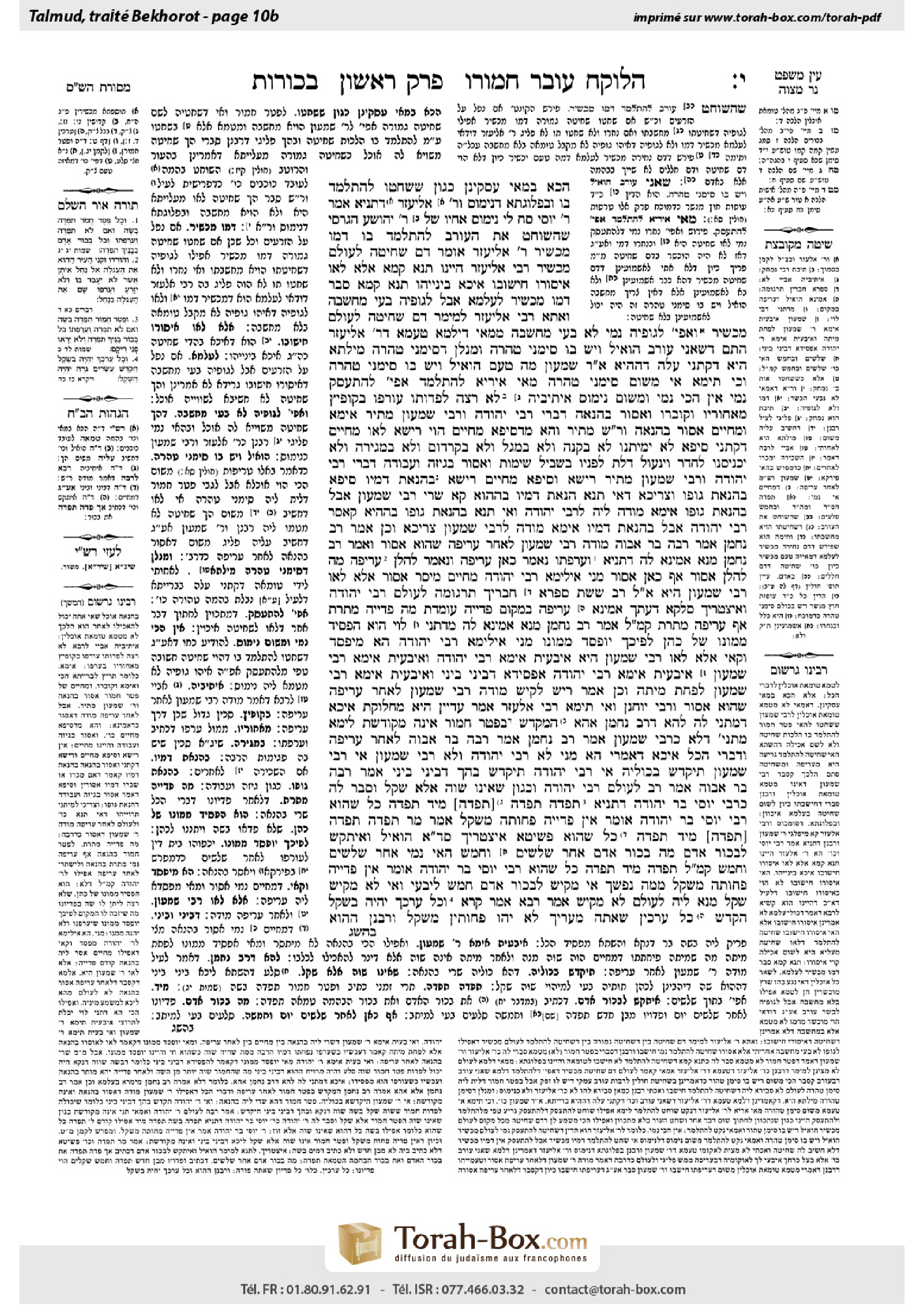
Bekhorot 10b: Talmud study for Daf Yomi
Study the Talmud for Daf Yomi with scanned pages, Hebrew text, English translations from Sefaria and AI-generated French translations.
Passage selection and English or AI-generated French translation are available where the scan has annotations. Daf Study is independent of Torah-Box and Sefaria.
Browse Bekhorot · בכורות · All tractatesBekhorot 10b text and translations
This page of Bekhorot includes the Aramaic text, an English translation and an AI-generated French translation, alongside the scan above.
בכורות י׳ ב · Aramaic and Hebrew text
הָכָא בְּמַאי עָסְקִינַן? כְּגוֹן שֶׁשְּׁחָטוֹ לְהִתְלַמֵּד בּוֹ, וּבִפְלוּגְתָּא דְּנִימוֹס וְרַבִּי אֱלִיעֶזֶר.
דְּתַנְיָא, אָמַר רַבִּי יוֹסֵי: סָח לִי נִימוֹס, אָחִיו שֶׁל רַבִּי יְהוֹשֻׁעַ הַגַּרְסִי, שֶׁהַשּׁוֹחֵט אֶת הָעוֹרֵב לְהִתְלַמֵּד בּוֹ — דָּמוֹ מַכְשִׁיר. רַבִּי אֱלִיעֶזֶר אוֹמֵר: דַּם שְׁחִיטָה לְעוֹלָם מַכְשִׁיר.
רַבִּי אֱלִיעֶזֶר הַיְינוּ תַּנָּא קַמָּא! אֶלָּא לָאו אִיסּוּרוֹ חִישּׁוּבוֹ אִיכָּא בֵּינַיְיהוּ.
תַּנָּא קַמָּא סָבַר: דָּמוֹ מַכְשִׁיר לְעָלְמָא, אֲבָל לְגוּפֵיהּ בָּעֵי מַחְשָׁבָה.
וַאֲתָא רַבִּי אֱלִיעֶזֶר לְמֵימַר: דַּם שְׁחִיטָה לְעוֹלָם מַכְשִׁיר, וַאֲפִילּוּ לְגוּפֵיהּ נָמֵי לָא בָּעֵי מַחְשָׁבָה.
מִמַּאי? דִּילְמָא טַעְמָא דְּרַבִּי אֱלִיעֶזֶר הָתָם — דְּשָׁאנֵי עוֹרֵב, הוֹאִיל וְיֵשׁ בּוֹ סִימָנֵי טׇהֳרָה.
וּמְנָלַן דְּסִימָנֵי טׇהֳרָה מִילְּתָא הִיא? דְּקָתָנֵי עֲלַהּ דְּהַהִיא, אָמַר רַבִּי שִׁמְעוֹן: מָה טַעַם? הוֹאִיל וְיֵשׁ בּוֹ סִימָנֵי טׇהֳרָה.
וְכִי תֵּימָא: אִי מִשּׁוּם סִימָנֵי טׇהֳרָה, מַאי אִירְיָא לְהִתְלַמֵּד? אֲפִילּוּ לְהִתְעַסֵּק נָמֵי! אִין הָכִי נָמֵי, וּמִשּׁוּם נִימוֹס.
אֵיתִיבֵיהּ: לֹא רָצָה לִפְדּוֹתוֹ — עוֹרְפוֹ בְּקוֹפִיץ מֵאֲחוֹרָיו וְקוֹבְרוֹ, וְאָסוּר בַּהֲנָאָה, דִּבְרֵי רַבִּי יְהוּדָה, וְרַבִּי שִׁמְעוֹן מַתִּיר!
אֵימָא: וּמֵחַיִּים אָסוּר בַּהֲנָאָה, וְרַבִּי שִׁמְעוֹן מַתִּיר.
וְהָא מִדְּסֵיפָא מֵחַיִּים הָוֵי, רֵישָׁא לָאו מֵחַיִּים.
דְּקָתָנֵי סֵיפָא: לֹא יְמִיתֶנּוּ, לֹא בְּקָנֶה וְלֹא בְּמַגָּל וְלֹא בְּקַרְדּוֹם וְלֹא בִּמְגֵירָה, וְלֹא יַכְנִיסֶנּוּ לַחֶדֶר וְיִנְעוֹל דֶּלֶת לְפָנָיו בִּשְׁבִיל שֶׁיָּמוּת, וְאָסוּר בְּגִיזָּה וַעֲבוֹדָה, דִּבְרֵי רַבִּי יְהוּדָה, וְרַבִּי שִׁמְעוֹן מַתִּיר!
רֵישָׁא וְסֵיפָא מֵחַיִּים, רֵישָׁא — בַּהֲנָאַת דָּמָיו, סֵיפָא — בַּהֲנָאַת גּוּפוֹ.
וּצְרִיכָא, דְּאִי תְּנָא הֲנָאַת דָּמָיו — בְּהָהוּא קָא שָׁרֵי רַבִּי שִׁמְעוֹן, אֲבָל בַּהֲנָאַת גּוּפוֹ אֵימָא מוֹדֶה לֵיהּ לְרַבִּי יְהוּדָה. וְאִי תְּנָא בַּהֲנָאַת גּוּפוֹ — בְּהָהִיא קָאָסַר רַבִּי יְהוּדָה, אֲבָל בַּהֲנָאַת דָּמָיו אֵימָא מוֹדֶה לְרַבִּי שִׁמְעוֹן. צְרִיכָא.
וְכֵן אָמַר רַב נַחְמָן אָמַר רַבָּה בַּר אֲבוּהּ: מוֹדֶה רַבִּי שִׁמְעוֹן לְאַחַר עֲרִיפָה שֶׁהוּא אָסוּר.
וְאָמַר רַב נַחְמָן: מְנָא אָמֵינָא לַהּ? דְּתַנְיָא: ״וַעֲרַפְתּוֹ״, נֶאֱמַר כָּאן עֲרִיפָה, וְנֶאֱמַר לְהַלָּן עֲרִיפָה, מָה לְהַלָּן אָסוּר — אַף כָּאן אָסוּר.
מַנִּי? אִילֵימָא רַבִּי יְהוּדָה — מֵחַיִּים מֵיסָר אָסַר! אֶלָּא לָאו רַבִּי שִׁמְעוֹן הִיא?
אֲמַר לֵיהּ רַב שֵׁשֶׁת: סָפְרָא חַבְרָיךְ תַּרְגּוּמַהּ: לְעוֹלָם רַבִּי יְהוּדָה, וְאִיצְטְרִיךְ, סָלְקָא דַּעְתָּךְ אָמֵינָא: עֲרִיפָה בִּמְקוֹם פְּדִיָּיה עוֹמֶדֶת, מָה פְּדִיָּיה מַתֶּרֶת — אַף עֲרִיפָה מַתֶּרֶת, קָא מַשְׁמַע לַן.
אָמַר רַב נַחְמָן: מְנָא אָמֵינָא לַהּ? מִדְּתָנֵי לֵוִי: הוּא הִפְסִיד מָמוֹנוֹ שֶׁל כֹּהֵן, לְפִיכָךְ יוּפְסַד מָמוֹנוֹ.
מַנִּי? אִילֵימָא רַבִּי יְהוּדָה — הָא מַיפְסַד וְקָאֵי! אֶלָּא לָאו רַבִּי שִׁמְעוֹן הִיא?
אִיבָּעֵית אֵימָא: רַבִּי יְהוּדָה, וְאִיבָּעֵית אֵימָא רַבִּי שִׁמְעוֹן.
אִיבָּעֵית אֵימָא: רַבִּי יְהוּדָה, אַפְּסֵידָא דְּבֵינֵי בֵּינֵי.
וְאִיבָּעֵית אֵימָא: רַבִּי שִׁמְעוֹן, לִפְחַת מִיתָה.
וְכֵן אָמַר רֵישׁ לָקִישׁ: מוֹדֶה רַבִּי שִׁמְעוֹן לְאַחַר עֲרִיפָה שֶׁהוּא אָסוּר, וְרַבִּי יוֹחָנָן, וְאִי תֵּימָא רַבִּי אֶלְעָזָר אֲמַר: עֲדַיִין הִיא מַחְלוֹקֶת.
אִיכָּא דְּמַתְנֵי לַהּ לְהָא דְּרַב נַחְמָן, אַהָא: ״הַמְקַדֵּשׁ בְּפֶטֶר חֲמוֹר אֵינָהּ מְקוּדֶּשֶׁת״. לֵימָא מַתְנִיתִין דְּלָא כְּרַבִּי שִׁמְעוֹן? אָמַר רַב נַחְמָן אָמַר רַבָּה בַּר אֲבוּהּ: לְאַחַר עֲרִיפָה, וְדִבְרֵי הַכֹּל.
אִיכָּא דְאָמְרִי: הָא מַנִּי? לָא רַבִּי יְהוּדָה וְלָא רַבִּי שִׁמְעוֹן. אִי רַבִּי שִׁמְעוֹן — תִּיקְדַּשׁ בְּכוּלֵּיהּ, אִי רַבִּי יְהוּדָה — תִּיקְדַּשׁ בְּהָךְ דְּבֵינֵי בֵּינֵי!
אָמַר רַבָּה בַּר אֲבוּהּ אָמַר רַב: לְעוֹלָם רַבִּי יְהוּדָה, וּכְגוֹן שֶׁאֵינוֹ שָׁוֶה אֶלָּא שֶׁקֶל, וְסָבַר לַהּ כְּרַבִּי יוֹסֵי בַּר יְהוּדָה. דְּתַנְיָא: ״תִּפְדֶּה״ ״תִּפְדֶּה״ — תִּפְדֶּה מִיָּד, תִּפְדֶּה כׇּל שֶׁהוּא. רַבִּי יוֹסֵי בַּר יְהוּדָה אוֹמֵר: אֵין פְּדִיָּיה פְּחוּתָה מִשֶּׁקֶל.
אָמַר מָר: ״תִּפְדֶּה״ ״תִּפְדֶּה״ — תִּפְדֶּה מִיָּד, תִּפְדֶּה כׇּל שֶׁהוּא. פְּשִׁיטָא!
אִיצְטְרִיךְ, סָלְקָא דַּעְתָּךְ אָמֵינָא: הוֹאִיל וְאִיתַּקַּשׁ לִבְכוֹר אָדָם, מָה בְּכוֹר אָדָם אַחַר שְׁלֹשִׁים וְחָמֵשׁ, הַאי נָמֵי אַחַר שְׁלֹשִׁים וְחָמֵשׁ.
קָא מַשְׁמַע לַן: ״תִּפְדֶּה״ — מִיָּד, ״תִּפְדֶּה״ — כׇּל שֶׁהוּא.
רַבִּי יוֹסֵי בַּר יְהוּדָה אוֹמֵר: אֵין פְּדִיָּיה פְּחוּתָה מִשֶּׁקֶל. מִמָּה נַפְשָׁךְ: אִי מַקֵּישׁ לִבְכוֹר אָדָם — חָמֵשׁ לִיבְעֵי, וְאִי לָא מַקֵּישׁ — שֶׁקֶל מְנָא לֵיהּ?
לְעוֹלָם לָא מַקֵּישׁ, אָמַר רָבָא: אָמַר קְרָא ״וְכׇל עֶרְכְּךָ יִהְיֶה בְּשֶׁקֶל הַקֹּדֶשׁ״, כׇּל עֲרָכִין שֶׁאַתָּה מַעֲרִיךְ לֹא יְהוּ פְּחוּתִין מִשֶּׁקֶל.
וְרַבָּנַן: הַהוּא
Bekhorot 10b · English translation
The Gemara answers: Here, we are dealing with a case where he slaughtered the firstborn donkey in order to teach himself how to properly slaughter an animal, and not in order to eat it. In this case, Rabbi Shimon and the Rabbis disagree whether the prohibition against a Jew’s consuming it serves as intent that it be treated as food. And they disagree with regard to the issue that is the subject of the dispute between Nimos and Rabbi Eliezer.
As it is taught in a baraita that Rabbi Yosei says: Nimos, the brother of Rabbi Yehoshua HaGarsi, once related to me that in the case of one who slaughters a crow in order to teach himself how to slaughter a bird properly, its blood renders other foods susceptible to impurity, as blood is one of the seven liquids that is capable of rendering foods susceptible to impurity. Rabbi Eliezer says: The blood that comes from the slaughter of an animal always renders food susceptible to impurity.
The Gemara asks: Isn’t this statement of Rabbi Eliezer identical to the statement of the first tanna, i.e., Nimos? Both hold that the blood of slaughter renders food susceptible to impurity. Rather, isn’t the difference between them with regard to whether concerning the crow its prohibition serves as its intent that it should be used as food?
Accordingly, the first tanna holds that the prohibition against consuming a crow does not render it a food. Therefore, its blood renders foods in general susceptible to impurity, but to render the crow itself a food, intent to eat it is also required, as people do not generally consume the meat of crows.
And Rabbi Eliezer comes to say that the blood of slaughter always renders other foods susceptible to impurity, and even with regard to the crow itself, intent to consume it is not required, as he holds that its prohibition serves as intent to consume it. Likewise, Rabbi Shimon and the Rabbis disagree with regard to a firstborn donkey in a case where it is slaughtered only in order to teach oneself how to slaughter properly. According to Rabbi Shimon, intent to eat it is required in order to render it susceptible to the impurity of food, while according to the Rabbis the prohibition to eat it in this case serves as intent for it to be used as food.
The Gemara responds: From where is it inferred that the dispute between Nimos and Rabbi Eliezer is with regard to this issue? Perhaps the reason for the opinion of Rabbi Eliezer there is that a crow is different, since it has some indicators of a kosher bird, and is therefore considered food. By contrast, with regard to a donkey, which has no indicators of a kosher animal, slaughtering it in order to learn how to slaughter properly does not render it food.
The Gemara presents support for this explanation: And from where do we derive that indicators of a kosher animal are considered a significant matter concerning the impurity of food? As a baraita teaches with regard to the mishna cited on 10a that Rabbi Shimon says: What is the reason that the meat of the camel, hare, rock-badger, and pig are automatically susceptible to impurity of food without any other conditions? It is because they have some indicators of kosher animals.
And if you would say that if the meat of the crow is susceptible to the impurity of food because of its kosher indicators, why do Rabbi Eliezer and Nimos specifically disagree in the case where it was slaughtered in order to teach oneself how to slaughter properly? Even if the one who slaughtered it acted unawares, Rabbi Eliezer should hold that its flesh should be suceptible to impurity. The response would be that yes, this is indeed so according to Rabbi Eliezer, and they disagreed in this case only because of the opinion of Nimos, who holds that even where one slaughtered the crow intentionally, if he slaughtered it in order to teach himself how to slaughter properly the crow is not susceptible to impurity.
§ The Gemara raises an objection from a baraita to the opinion of Rabba, who holds that even according to the opinion of Rabbi Shimon it is prohibited to derive benefit from a firstborn donkey following the breaking of its neck: If one does not want to redeem his firstborn donkey with a lamb, he breaks the donkey’s neck from behind with a cleaver and buries the donkey, and it is prohibited to derive benefit from the donkey; this is the statement of Rabbi Yehuda. And Rabbi Shimon deems it permitted for one to derive benefit from the donkey.
The Gemara responds: Say the baraita means: And while the donkey is still alive it is prohibited to derive benefit from it; this is the statement of Rabbi Yehuda. And Rabbi Shimon deems it permitted. Perhaps Rabbi Shimon agrees that following the breaking of its neck, it is prohibited to derive benefit from it.
The Gemara challenges: But from the fact that the latter clause of the baraita is referring to the prohibition to derive benefit while the donkey is alive it is apparent that the first clause, due to which this objection was raised, is not referring to deriving benefit while it is still alive.
As the latter clause teaches: One may not kill the firstborn donkey with a reed, nor with a sickle, nor with an ax, nor with a saw; nor may one put it in a room and close the door so that it will die from starvation. These are not the manners of killing the animal mandated by the Torah, which requires one to break its neck. And shearing the donkey or using it for labor is prohibited; this is the statement of Rabbi Yehuda. And Rabbi Shimon deems it permitted to shear it and to perform labor with it. Since the latter clause mentions the prohibition against shearing and working the animal, which applies only when the animal is still alive, the first clause must be referring to a case where the animal was already dead.
The Gemara responds: The first clause and the latter clause are both referring to a case where the animal is alive, but the first clause is referring to the prohibition against deriving benefit from its value by renting or selling it, while the latter clause is referring to deriving benefit from the animal itself by shearing it or performing labor with it.
And it is necessary to state the dispute between Rabbi Yehuda and Rabbi Shimon in both cases, as had the tanna taught only the case of deriving benefit from its value one would think that in that case Rabbi Shimon deems deriving benefit permitted; but in the case of deriving benefit from the donkey itself, say that Rabbi Shimon concedes to Rabbi Yehuda that it is forbidden. And had the tanna taught only the case of deriving benefit from the animal itself one would think that in that case Rabbi Yehuda deems deriving benefit forbidden; but in the case of deriving benefit from its value, say that he concedes to Rabbi Shimon. Therefore, it is necessary to teach the dispute in both instances.
The Gemara cites an additional amora who agrees with Rabba: And similarly, Rav Naḥman says that Rabba bar Avuh says: Rabbi Shimon concedes that after breaking the donkey’s neck it is prohibited to derive benefit from it.
And Rav Naḥman said: From where do I say it? As it is taught in a baraita that the Torah states: “And if you do not redeem it, then you shall break its neck” (Exodus 13:13). The expression of breaking the neck is stated here, and the expression of breaking the neck is stated there with regard to the heifer whose neck is broken (see Deuteronomy 21:4). Just as there, in the case of the heifer whose neck is broken, it is prohibited to derive benefit from it following the ceremony, so too here, it is prohibited to derive benefit from a firstborn donkey following the breaking of its neck.
The Gemara clarifies: Who is the tanna cited in this baraita? If we say that it is Rabbi Yehuda, that is difficult, as he holds that it is already prohibited to derive benefit from a firstborn donkey while it is still alive. Why, then, would the verse need to forbid it again following the breaking of its neck? Rather, is it not the opinion of Rabbi Shimon, indicating that he concedes that deriving benefit from the donkey is prohibited following the breaking of its neck?
Rav Sheshet said to Rav Naḥman: Safra, your colleague, interpreted it as follows: Actually, Rabbi Yehuda is the tanna cited, and it was necessary for the verse to prohibit deriving benefit after the donkey’s death as well, as it might enter your mind to say that breaking the neck stands in place of redeeming the donkey, as it is stated: “And if you do not redeem it, then you shall break its neck” (Exodus 13:13). Therefore, it could be claimed that just as redemption permits one to derive benefit from the firstborn donkey, so too, breaking the neck permits one to derive benefit from it. Therefore, the verse teaches us that breaking the neck does not permit one to derive benefit from it.
Rav Naḥman said: From where do I say that Rabbi Shimon holds it is prohibited to derive benefit from a firstborn donkey following the breaking of its neck? I say it from that which Levi teaches in a baraita with regard to the reason the Torah commands that the donkey’s neck be broken: He, the owner, caused a loss of the money of a priest by not giving him a lamb in exchange for the donkey. Therefore, his money shall also be lost.
The Gemara clarifies: Whose opinion is followed in this baraita? If we say it is the opinion of Rabbi Yehuda, the donkey’s monetary value is already lost, as it was already prohibited to derive benefit from it while it was alive. Rather, is it not the opinion of Rabbi Shimon? This indicates that breaking the neck of the donkey renders deriving benefit from it prohibited.
The Gemara responds: If you wish, say the baraita follows the opinion of Rabbi Yehuda, and if you wish, say instead that it follows the opinion of Rabbi Shimon, even if he holds that it is permitted to derive benefit from a firstborn donkey after its neck is broken.
The Gemara explains: If you wish, say the baraita follows the opinion of Rabbi Yehuda, and it is referring to the loss of the difference between the value of the donkey while it is alive and the value of the lamb given as redemption to the priest, which is less than that of the donkey. This value, which the owner would have gained had he redeemed the donkey, is lost once the donkey is not redeemed.
And if you wish, say instead that it is the opinion of Rabbi Shimon, and although he permits deriving benefit from the donkey after the breaking of its neck, there is nevertheless a depreciation of value caused by the death of the animal, as a dead donkey is worth less than a live one.
The Gemara comments: And Reish Lakish similarly says that Rabbi Shimon concedes that deriving benefit from a firstborn donkey after the breaking of its neck is prohibited, in accordance with the statements of Rabba and Rav Naḥman. But Rabbi Yoḥanan, and some say Rabbi Elazar, says: The matter is still subject to dispute, i.e., Rabbi Shimon disagrees with Rabbi Yehuda even after the death of the firstborn donkey, and permits deriving benefit from it even then.
There are those who teach that which Rav Naḥman said concerning the opinion of Rabbi Shimon with regard to this, i.e., the mishna in Kiddushin (56b): In the case of one who betroths a woman with a firstborn donkey, the woman is not betrothed, as it is prohibited to derive benefit from the donkey. Let us say that the mishna is not in accordance with the opinion of Rabbi Shimon, as he holds that one is permitted to derive benefit from a firstborn donkey. Rav Naḥman says that Rabba bar Avuh says: It is referring to a case of betrothal after the breaking of the donkey’s neck, and all agree, even Rabbi Shimon, that it is prohibited to derive benefit from it at that stage.
There are those who say that the discussion with regard to the mishna proceeded as follows: In accordance with whose opinion is this? Ostensibly, it is neither the opinion of Rabbi Yehuda nor that of Rabbi Shimon. If it is in accordance with the opinion of Rabbi Shimon, who permits deriving benefit from a firstborn donkey, the woman should be betrothed with the entire value. If it follows the opinion of Rabbi Yehuda, she should be betrothed with that difference between the value of the donkey after being redeemed, which remains hers, and the value of the lamb that must be given to the priest in exchange for the donkey.
Rabba bar Avuh says that Rav says: Actually, it follows the opinion of Rabbi Yehuda, and is referring to a case where the firstborn donkey is worth only a shekel, the same value as a lamb suitable for redemption, in which case there is no difference between the value of the donkey and that of the lamb. And Rabbi Yehuda holds in accordance with the opinion of Rabbi Yosei bar Yehuda that one may not redeem a firstborn donkey with a lamb that is less than the value of a shekel, as it is taught in a baraita: When the Torah states: “You shall redeem,” with regard to a firstborn donkey, it teaches that you shall redeem it immediately, and you shall redeem it for any amount. Rabbi Yosei bar Yehuda says: There is no redemption for less than a shekel.
The Gemara analyzes the baraita: The Master said that the verse: “You shall redeem,” teaches that you shall redeem it immediately, and you shall redeem it for any amount. The Gemara asks: Isn’t it obvious? Why is it necessary to derive these halakhot from the verse?
The Gemara answers: It was necessary, as it might enter your mind to say that since the mitzva of redeeming a firstborn donkey is juxtaposed with that of redeeming a woman’s firstborn son in the verse: “Yet you shall redeem the firstborn of man, and the firstborn of non-kosher animals you shall redeem” (Numbers 18:15), it should be inferred that just as a woman’s firstborn son is redeemed after the baby is thirty days old and involves giving the monetary value of five sela to a priest, as stated in the next verse: “And their redemption-money, from a month old you shall redeem them, it shall be, according to your valuation, five shekels of silver” (Numbers 18:16), this firstborn donkey too should be redeemed after it is thirty days old, and a lamb whose value is at least five sela should be given to the priest.
Therefore, the baraita teaches us: “You shall redeem,” indicating that the redemption of the donkey must be done immediately after its birth, and that you shall redeem it for any amount.
The baraita also states that Rabbi Yosei bar Yehuda says: There is no redemption for less than a shekel. The Gemara asks: Whichever way you look at it, this statement is difficult: If Rabbi Yosei bar Yehuda holds that the verse compares a firstborn donkey to a woman’s firstborn son, he should require a lamb worth five sela, and if the verse does not compare them, from where does Rabbi Yosei bar Yehuda derive that a lamb worth a shekel is necessary?
The Gemara answers: Actually, the verse does not compare them, and the reason a lamb worth a shekel is required is due to that which Rava says: The verse states with regard to redemption of consecrated property: “And all your valuations shall be with the shekel of the Sanctuary” (Leviticus 27:25), which indicates that all valuations that you assess should not be less than the value of a shekel.
And the Rabbis who disagree with him hold that that verse
Bekhorot 10b · Traduction française (IA)
La Guemara répond : Ici, nous sommes en présence d’un cas où l’on a sacrifié un âne premier-né afin d’apprendre à bien sacrifier un animal, et non pour le manger. Dans ce cas, Rabbi Shimon et les Rabbins s’opposent sur le fait que la prohibition de consommer un animal par un Juif serve-t-elle d’intention pour le traiter comme de la nourriture. Et ils s’opposent sur la question qui est au centre du débat entre Nimos et Rabbi Eliezer.
Comme il est enseigné dans une baraïta que Rabbi Yosei dit : Nimos, le frère de Rabbi Yéhoshua HaGarsi, m’a rapporté un jour que dans le cas d’un homme qui sacrifie un corbeau afin d’apprendre à bien sacrifier un oiseau, son sang rend d’autres aliments sujets à la souillure, car le sang est l’un des sept liquides capables de rendre les aliments sujets à la souillure. Rabbi Eliezer dit : Le sang qui provient de la sacrifice d’un animal rend toujours les aliments sujets à la souillure.
La Guemara demande : Ce n’est pas cette déclaration de Rabbi Eliezer qui est identique à celle du premier tanna, c’est-à-dire Nimos ? Les deux tiennent que le sang de la sacrifice rend les aliments sujets à la souillure. Plutôt, n’est-ce pas la différence entre eux concernant le fait que, concernant le corbeau, sa prohibition serve-t-elle d’intention pour qu’il soit utilisé comme nourriture ?
Ainsi, le premier tanna considère que la prohibition de consommer un corbeau ne le rend pas une nourriture. Par conséquent, son sang rend les aliments généralement sujets à la souillure, mais pour rendre le corbeau lui-même une nourriture, il faut aussi l’intention de le manger, car les gens ne mangent généralement pas la viande de corbeaux.
Et Rabbi Eliezer vient dire que le sang de la bête sacrifiée rend toujours d’autres aliments sujets à la souillure, et même concernant le corbeau lui-même, l’intention de le manger n’est pas requise, car il considère que sa prohibition sert d’intention pour le manger. De même, Rabbi Shimon et les Rabbins s’opposent concernant un âne premier-né dans le cas où il est sacrifié uniquement pour apprendre à sacrifier correctement. Selon Rabbi Shimon, l’intention de le manger est requise pour le rendre sujet à la souillure alimentaire, tandis que selon les Rabbins, la prohibition de le manger dans ce cas sert d’intention pour le traiter comme nourriture.
La Guemara répond : D’où infère-t-on que le débat entre Nimos et Rabbi Eliezer est concernant cette question ? Peut-être que la raison de l’opinion de Rabbi Eliezer est que le corbeau est différent, car il a certains signes d’un oiseau kasher, et est donc considéré comme nourriture. À l’inverse, concernant un âne, qui n’a aucun signe d’un animal kasher, sacrifier un âne pour apprendre à sacrifier correctement ne le rend pas une nourriture.
La Guemara présente un soutien à cette explication : Et d’où déduit-on que les signes d’un animal kasher sont considérés comme une question importante concernant la souillure alimentaire ? Comme une baraïta enseigne concernant la mishna citée sur 10a que Rabbi Shimon dit : Quelle est la raison pour laquelle la viande du chameau, du lièvre, du chien des rochers et du porc est automatiquement sujette à la souillure alimentaire sans aucune autre condition ? C’est parce qu’ils ont certains signes d’animaux kasher.
Et si l’on disait que la viande du corbeau est sujette à la souillure alimentaire en raison de ses signes d’animaux kasher, pourquoi Rabbi Eliezer et Némos s’opposent-ils spécifiquement dans le cas où il a été sacrifié pour apprendre à sacrifier correctement ? Même si celui qui a sacrifié l’a fait sans savoir, Rabbi Eliezer devrait considérer que sa chair est sujette à la souillure. La réponse serait que oui, c’est effectivement ainsi selon Rabbi Eliezer, et ils s’opposent dans ce cas uniquement en raison de l’opinion de Némos, qui considère que même si l’on sacrifie le corbeau intentionnellement, s’il le sacrifie pour apprendre à sacrifier correctement, la chair du corbeau n’est pas sujette à la souillure.
§ La Guemara soulève une objection contre l’opinion de Rabba, qui considère que même selon l’opinion de Rabbi Shimon, il est interdit de tirer un bénéfice d’un âne premier-né après la cassure de son cou : Si l’on ne veut pas racheter son âne premier-né avec un agneau, il casse le cou de l’âne du dos avec un marteau et l’enterré, et il est interdit de tirer un bénéfice de l’âne ; c’est la déclaration de Rabbi Yéhuda. Et Rabbi Shimon considère qu’il est permis de tirer un bénéfice de l’âne.
La Guemara répond : La baraïta signifie : Et pendant que l’âne est encore vivant, il est interdit de tirer un bénéfice de lui ; c’est la déclaration de Rabbi Yéhuda. Rabbi Shimon considère qu’il est permis. Peut-être que Rabbi Shimon accepte que, après la cassure de son cou, il est interdit de tirer un bénéfice de lui.
La Guemara conteste : Mais du fait que la clause ultérieure de la baraïta fait référence à l’interdiction de tirer un bénéfice pendant que l’âne est vivant, il est évident que la première clause, à cause de laquelle cette objection a été soulevée, ne fait pas référence à tirer un bénéfice pendant qu’il est encore vivant.
Comme la clause ultérieure enseigne : On ne peut pas tuer l’âne premier-né avec une canne, ni avec une faucille, ni avec un marteau, ni avec une scie ; on ne peut pas le mettre dans une pièce et fermer la porte pour qu’il meure de faim. Ces sont des manières de tuer l’animal non prescrites par la Torah, qui exige de briser son cou. Et la toileter l’âne ou l’utiliser pour le travail est interdit ; c’est la déclaration de Rabbi Yéhuda. Rabbi Shimon considère qu’il est permis de toileter l’âne et de le travailler. Puisque la clause ultérieure mentionne l’interdiction de toileter et de travailler l’animal, qui s’applique uniquement lorsque l’animal est encore vivant, la première clause doit faire référence à un cas où l’animal était déjà mort.
La Guemara répond : Les deux clauses mentionnées sont relatives à un cas où l'animal est vivant, mais la première clause fait référence à l'interdiction de tirer un bénéfice de sa valeur en le louant ou en le vendant, tandis que la seconde clause fait référence à tirer un bénéfice de l'animal lui-même, par exemple en le toilettant ou en le faisant travailler.
Il est nécessaire d'évoquer le débat entre Rabbi Yéhuda et Rabbi Shimon dans les deux cas, car si le tanna avait enseigné uniquement le cas de tirer un bénéfice de sa valeur, on pourrait penser que Rabbi Shimon considère que tirer un bénéfice est permis ; mais dans le cas de tirer un bénéfice de l'âne lui-même, on dit que Rabbi Shimon reconnaît la position de Rabbi Yéhuda selon laquelle c'est interdit. Et si le tanna avait enseigné uniquement le cas de tirer un bénéfice de l'animal lui-même, on pourrait penser que Rabbi Yéhuda considère que tirer un bénéfice est interdit ; mais dans le cas de tirer un bénéfice de sa valeur, on dit qu'il reconnaît la position de Rabbi Shimon. Ainsi, il est nécessaire d'enseigner le débat dans les deux cas.
La Guemara cite un autre amora qui s'accorde avec Rabba : De même, Rav Naḥman dit que Rabba bar Avouh dit : Rabbi Shimon reconnaît que, après avoir brisé le cou de l'âne, il est interdit de tirer un bénéfice de lui.
Et Rav Naḥman dit : D'où dis-je cela ? Comme il est enseigné dans une baraïta que la Torah dit : « Et si tu n'achètes pas, alors tu briseras son cou » (Exode 13:13). L'expression de briser le cou est mentionnée ici, et l'expression de briser le cou est mentionnée là concernant la bête dont le cou est brisé (voir Deutéronome 21:4). Aussi bien là, dans le cas de la bête dont le cou est brisé, il est interdit de tirer un bénéfice d'elle après la cérémonie, ainsi que ici, il est interdit de tirer un bénéfice d'un âne premier après avoir brisé son cou.
La Guemara clarifie : De quel tanna s'agit-il dans cette baraïta ? Si l'on dit que c'est l'opinion de Rabbi Yéhuda, cela pose un problème, car il considère déjà interdit de tirer un bénéfice d'un âne premier alors qu'il est encore vivant. Pourquoi, alors, la Torah aurait-elle besoin d'interdire cela à nouveau après avoir brisé son cou ? Plutôt, n'est-ce pas l'opinion de Rabbi Shimon, indiquant qu'il reconnaît que tirer un bénéfice de l'âne est interdit après avoir brisé son cou ?
Rav Sheshet dit à Rav Naḥman : Safra, ton collègue, l'interprète ainsi : En réalité, c'est l'opinion de Rabbi Yéhuda qui est citée, et il était nécessaire que la Torah interdise de tirer un bénéfice après la mort de l'âne, car on pourrait penser que briser le cou remplace l'achèvement de l'âne, comme il est dit : « Et si tu n'achètes pas, alors tu briseras son cou » (Exode 13:13). Ainsi, on pourrait affirmer que tout comme l'achèvement permet de tirer un bénéfice de l'âne premier, ainsi briser le cou permettrait de tirer un bénéfice de lui. La Torah nous enseigne donc que briser le cou ne permet pas de tirer un bénéfice de lui.
Rav Naḥman dit : D'où dis-je que Rabbi Shimon considère que tirer un bénéfice d'un âne premier après avoir brisé son cou est interdit ? Je le dis à partir de ce que Levi enseigne dans une baraïta concernant la raison pour laquelle la Torah ordonne de briser le cou de l'âne : L'homme, propriétaire, a causé une perte à un prêtre en ne lui donnant pas un agneau en échange de l'âne. Ainsi, sa propre richesse sera également perdue.
La Guemara clarifie : De quel opinion s'agit-il dans cette baraïta ? Si l'on dit que c'est l'opinion de Rabbi Yéhuda, la valeur monétaire de l'âne est déjà perdue, car elle était déjà interdite de tirer un bénéfice d'elle alors qu'elle était vivante. Plutôt, n'est-ce pas l'opinion de Rabbi Shimon ? Cela indique que briser le cou de l'âne rend interdit de tirer un bénéfice de lui.
La Guemara répond : Si tu le souhaites, dis que la baraïta suit l'opinion de Rabbi Yéhuda, et si tu le souhaites, dis plutôt qu'elle suit l'opinion de Rabbi Shimon, même s'il considère que tirer un bénéfice d'un âne premier après avoir brisé son cou est permis.
La Guemara explique : Si tu le souhaites, dis que la baraïta suit l'opinion de Rabbi Yéhuda, et elle fait référence à la perte de la différence entre la valeur de l'âne vivant et la valeur de l'agneau donné en échange pour l'achèvement du prêtre, qui est inférieure à celle de l'âne. Cette valeur, que l'owner aurait pu gagner s'il avait racheté l'âne, est perdue une fois que l'âne n'est pas racheté.
Et si tu le souhaites, dis plutôt que c'est l'opinon de Rabbi Shimon, et bien qu'il permette de tirer un bénéfice de l'âne après avoir brisé son cou, il y a toutefois une dépréciation de valeur causée par la mort de l'animal, car un âne mort vaut moins qu'un âne vivant.
La Guemara commente : Et Reish Lakish dit également que Rabbi Shimon reconnaît que tirer un bénéfice d'un âne premier après avoir brisé son cou est interdit, conformément aux déclarations de Rabba et de Rav Naḥman. Mais Rabbi Yoḥanan, et certains disent Rabbi Eléazar, dit : La question est encore en débat, c'est-à-dire que Rabbi Shimon est en désaccord avec Rabbi Yéhuda même après la mort de l'âne premier, et permet de tirer un bénéfice de lui même alors.
Certains enseignent ce que Rav Naḥman a dit concernant l'opinion de Rabbi Shimon à ce sujet, c'est-à-dire la mitsna dans Kiddushin (56b) : Dans le cas d'un homme qui fiance une femme avec un âne premier, la femme n'est pas fiancée, car il est interdit de tirer un bénéfice de l'âne. Disons que la mitsna n'est pas en accord avec l'opinion de Rabbi Shimon, car il considère que tirer un bénéfice d'un âne premier est permis. Rav Naḥman dit que Rabba bar Avuh dit : Il s'agit d'un cas de fiancement après avoir brisé le cou de l'âne, et tous s'accordent, même Rabbi Shimon, à ce que tirer un bénéfice de lui à cette étape est interdit.
Il y a ceux qui disent que la discussion concernant la mitsna s'est déroulée ainsi : Selon quel avis est-ce ? Apparemment, ce n'est ni l'avis de Rabbi Yéhuda ni celui de Rabbi Shimon. Si c'est selon l'avis de Rabbi Shimon, qui permet d'exploiter un âne premier, la femme devrait être fiancée avec la valeur totale. Si c'est selon l'avis de Rabbi Yéhuda, elle devrait être fiancée avec la différence entre la valeur de l'âne après sa libération, qui lui appartient, et la valeur de l'agneau que l'on doit donner au prêtre en échange de l'âne.
Rabba bar Avoua dit que Rav dit : En réalité, c'est selon l'avis de Rabbi Yéhuda, et il s'agit d'un cas où l'âne premier vaut seulement un sela, la même valeur qu'un agneau adapté à la libération, dans ce cas, il n'y a pas de différence entre la valeur de l'âne et celle de l'agneau. Et Rabbi Yéhuda tient compte de l'avis de Rabbi Yosei bar Yéhuda qui dit qu'on ne peut pas libérer un âne premier avec un agneau valant moins qu'un sela, comme il est enseigné dans une baraïta : Lorsque la Torah dit : « Vous redonnerez », concernant un âne premier, elle enseigne que vous devez le libérer immédiatement et que vous pouvez le libérer pour toute somme. Rabbi Yosei bar Yéhuda dit : Il n'y a pas de libération pour moins d'un sela.
La Guemara analyse la baraïta : Le Maître dit que la parole : « Vous redonnerez » enseigne que vous devez le libérer immédiatement et que vous pouvez le libérer pour toute somme. La Guemara demande : N'est-ce pas évident ? Pourquoi est-il nécessaire d'extraire ces halakhot de la parole ?
La Guemara répond : Il était nécessaire, car il pourrait entrer en vous l'idée de dire que puisque la mitsva de la libération d'un âne premier est juxtaposée à celle de la libération du premier-né d'une femme dans la parole : « Vous redonneriez le premier-né de l'homme, et le premier-né des animaux non-kosher vous redonneriez » (Nombres 18 : 15), il devrait être inféré que tout comme le premier-né d'une femme est libéré après qu'il ait atteint l'âge de trente jours et implique de donner la valeur de cinq sela à un prêtre, comme il est dit dans la parole suivante : « Et leur prix de libération, à partir d'un mois vous redonneriez, il sera selon votre estimation, cinq sela d'argent » (Nombres 18 : 16), l'âne premier devrait aussi être libéré après qu'il ait atteint l'âge de trente jours, et un agneau dont la valeur est au moins de cinq sela devrait être donné au prêtre.
Par conséquent, la baraïta nous enseigne : « Vous redonneriez », indiquant que la libération de l'âne doit être faite immédiatement après sa naissance, et que vous pouvez le libérer pour toute somme.
La baraïta mentionne aussi que Rabbi Yosei bar Yéhuda dit : Il n'y a pas de libération pour moins d'un sela. La Guemara demande : Quel que soit le point de vue, cette déclaration est difficile : Si Rabbi Yosei bar Yéhuda tient que la parole compare un âne premier à un premier-né d'une femme, il devrait exiger un agneau valant cinq sela, et si la parole ne les compare pas, d'où Rabbi Yosei bar Yéhuda dérive-t-il que l'agneau valant un sela est nécessaire ?
La Guemara répond : En réalité, la parole ne les compare pas, et la raison pour laquelle un agneau valant un sela est nécessaire est due à ce que Rava dit : La parole dit concernant la libération des biens consacrés : « Et toutes vos estimations seront avec le sela du Sanctuaire » (Lévitique 27 : 25), ce qui indique que toutes les estimations que vous évaluez ne devraient pas être inférieures à la valeur d'un sela.
Et les Rabbins qui s'y opposent pensent que cette parole
Traduction française générée par IA à partir de l’édition anglaise de Sefaria. Vérifie toujours un passage avec le texte source.
Text from Sefaria: William Davidson Edition - Vocalized Aramaic (CC BY NC); William Davidson Edition - English (CC BY NC).