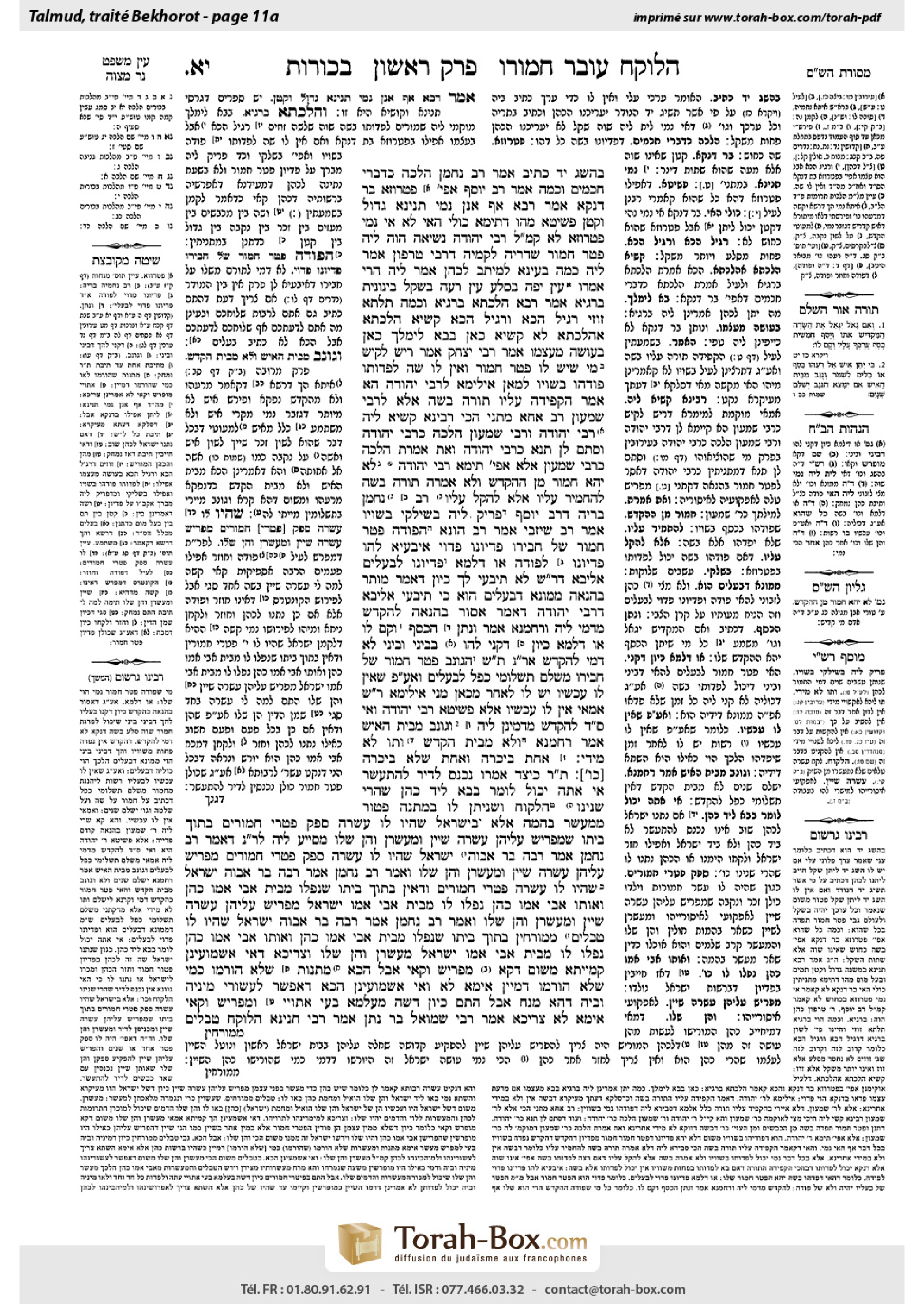
Bekhorot 11a: Talmud study for Daf Yomi
Study the Talmud for Daf Yomi with scanned pages, Hebrew text, English translations from Sefaria and AI-generated French translations.
Passage selection and English or AI-generated French translation are available where the scan has annotations. Daf Study is independent of Torah-Box and Sefaria.
Browse Bekhorot · בכורות · All tractatesBekhorot 11a text and translations
This page of Bekhorot includes the Aramaic text, an English translation and an AI-generated French translation, alongside the scan above.
בכורות י״א א · Aramaic and Hebrew text
בְּהֶשֵּׂג יָד כְּתִיב.
אָמַר רַב נַחְמָן: הֲלָכָה כְּדִבְרֵי חֲכָמִים, וְכַמָּה? אָמַר רַב יוֹסֵף: אֲפִילּוּ פַּטְרוֹזָא בַּר דַּנְקָא, אָמַר רָבָא: אַף אֲנַן נָמֵי תְּנֵינָא גָּדוֹל וְקָטָן.
פְּשִׁיטָא! מַהוּ דְּתֵימָא כּוּלֵּי הַאי לָא? אִי נָמֵי, פַּטְרוֹזָא לָא? קָא מַשְׁמַע לַן.
רַבִּי יְהוּדָה נְשִׂיאָה הֲוָה לֵיהּ פֶּטֶר חֲמוֹר, שַׁדְּרֵיהּ לְקַמֵּיהּ דְּרַבִּי טַרְפוֹן, אֲמַר לֵיהּ: כַּמָּה בָּעֵינָא לְמִיתַּב לְכֹהֵן? אֲמַר לֵיהּ: הֲרֵי אָמְרוּ: עַיִן יָפָה בְּסֶלַע, עַיִן רָעָה בְּשֶׁקֶל, בֵּינוֹנִית בְּרִגְיָא.
אָמַר רָבָא: הִלְכְתָא בְּרִגְיָא. וְכַמָּה? תְּלָתָא זוּזֵי. רְגִיל הָכָא וְרָגִיל הָכָא.
קַשְׁיָא הִלְכְתָא אַהִלְכְתָא! לָא קַשְׁיָא, כָּאן — בְּבָא לִימָּלֵךְ, כָּאן — בְּעוֹשֶׂה מֵעַצְמוֹ.
אָמַר רַבִּי יִצְחָק אָמַר רֵישׁ לָקִישׁ: מִי שֶׁיֵּשׁ לוֹ פֶּטֶר חֲמוֹר וְאֵין לוֹ שֶׂה לִפְדּוֹתוֹ — פּוֹדֵהוּ בְּשׇׁוְיוֹ. לְמַאן? אִילֵימָא לְרַבִּי יְהוּדָה — הָא אָמַר: הִקְפִּידָה עָלָיו תּוֹרָה בְּשֶׂה! אֶלָּא לְרַבִּי שִׁמְעוֹן.
רַב אַחָא מַתְנִי הָכִי, רָבִינָא קַשְׁיָא לֵיהּ: רַבִּי יְהוּדָה וְרַבִּי שִׁמְעוֹן — הֲלָכָה כְּרַבִּי יְהוּדָה!
וּסְתַם לַן תַּנָּא כְּרַבִּי יְהוּדָה, וְאַתְּ אָמְרַתְּ הֲלָכָה כְּרַבִּי שִׁמְעוֹן?!
אֶלָּא, אֲפִילּוּ תֵּימָא רַבִּי יְהוּדָה, לֹא יְהֵא חָמוּר מִן הַהֶקְדֵּשׁ, וְלֹא אָמְרָה תּוֹרָה ״בְּשֶׂה״ לְהַחְמִיר עָלָיו אֶלָּא לְהָקֵל עָלָיו. רַב נַחְמָן בְּרֵיהּ דְּרַב יוֹסֵף פָּרֵיק לֵיהּ בְּשִׁילְקֵי בְּשׇׁוְיוֹ.
אָמַר רַב שֵׁיזְבִי אָמַר רַב הוּנָא: הַפּוֹדֶה פֶּטֶר חֲמוֹר שֶׁל חֲבֵירוֹ, פִּדְיוֹנוֹ פָּדוּי. אִיבַּעְיָא לְהוּ: פִּדְיוֹנוֹ לַפּוֹדֶה, אוֹ דִלְמָא פִּדְיוֹנוֹ לַבְּעָלִים?
אַלִּיבָּא דְּרַבִּי שִׁמְעוֹן לָא תִּיבְּעֵי לָךְ, כֵּיוָן דְּאָמַר מוּתָּר בַּהֲנָאָה — מָמוֹנָא דִבְעָלִים הוּא, כִּי תִּיבְּעֵי אַלִּיבָּא דְּרַבִּי יְהוּדָה, דְּאָמַר אָסוּר בַּהֲנָאָה.
לְהֶקְדֵּשׁ מְדַמֵּי לֵיהּ, וְרַחֲמָנָא אָמַר: ״וְנָתַן הַכֶּסֶף וְקָם לוֹ״, אוֹ דִלְמָא, כֵּיוָן דְּקָנֵי לְהוּ בְּבֵינֵי וּבֵינֵי, לָא דָּמֵי לְהֶקְדֵּשׁ?
אָמַר רַב נַחְמָן, תָּא שְׁמַע: הַגּוֹנֵב פֶּטֶר חֲמוֹר שֶׁל חֲבֵירוֹ — מְשַׁלֵּם תַּשְׁלוּמֵי כֶפֶל לַבְּעָלִים, וְאַף עַל פִּי שֶׁאֵין לוֹ עַכְשָׁיו — יֵשׁ לוֹ לְאַחַר מִכָּאן.
מַנִּי? אִילֵימָא רַבִּי שִׁמְעוֹן, אַמַּאי אֵין לוֹ עַכְשָׁיו? אֶלָּא פְּשִׁיטָא רַבִּי יְהוּדָה.
וְאִי סָלְקָא דַעְתָּךְ לְהֶקְדֵּשׁ מְדַמֵּינַן לֵיהּ, ״וְגֻנַּב מִבֵּית הָאִישׁ״ אָמַר רַחֲמָנָא, וְלֹא מִבֵּית הֶקְדֵּשׁ! וְתוּ לָא מִידֵּי.
אַחַת בִּיכְּרָה וְאַחַת שֶׁלֹּא בִּיכְּרָה [כּוּ׳]. תָּנוּ רַבָּנַן: כֵּיצַד אָמְרוּ נִכְנַס לְדִיר לְהִתְעַשֵּׂר?
אִי אַתָּה יָכוֹל לוֹמַר בְּבָא לְיַד כֹּהֵן, שֶׁהֲרֵי שָׁנִינוּ: הַלָּקוּחַ וְשֶׁנִּיתַּן לוֹ בְּמַתָּנָה פָּטוּר מִמַּעְשַׂר בְּהֵמָה, אֶלָּא בְּיִשְׂרָאֵל שֶׁהָיוּ לוֹ עֲשָׂרָה סְפֵק פִּטְרֵי חֲמוֹרִים בְּתוֹךְ בֵּיתוֹ, שֶׁמַּפְרִישׁ עֲלֵיהֶן עֲשָׂרָה שֵׂיִין, וּמְעַשְּׂרָן, וְהֵן שֶׁלּוֹ.
מְסַיַּיע לֵיהּ לְרַב נַחְמָן, דְּאָמַר רַב נַחְמָן אָמַר רַבָּה בַּר אֲבוּהּ: יִשְׂרָאֵל שֶׁהָיוּ לוֹ עֲשָׂרָה סְפֵק פִּטְרֵי חֲמוֹרִים — מַפְרִישׁ עֲלֵיהֶן עֲשָׂרָה שֵׂיִין, וּמְעַשְּׂרָן, וְהֵן שֶׁלּוֹ.
וְאָמַר רַב נַחְמָן אָמַר רַבָּה בַּר אֲבוּהּ: יִשְׂרָאֵל שֶׁהָיוּ לוֹ עֲשָׂרָה פִּטְרֵי חֲמוֹרִים וַדָּאִין בְּתוֹךְ בֵּיתוֹ, שֶׁנָּפְלוּ מִבֵּית אֲבִי אִמּוֹ כֹּהֵן, וְאוֹתוֹ אֲבִי אִמּוֹ כֹּהֵן נָפְלוּ לוֹ מִבֵּית אֲבִי אִמּוֹ יִשְׂרָאֵל.
מַפְרִישׁ עֲלֵיהֶן עֲשָׂרָה שֵׂיִין, וּמְעַשְּׂרָן, וְהֵן שֶׁלּוֹ.
וְאָמַר רַב נַחְמָן אָמַר רַבָּה בַּר אֲבוּהּ: יִשְׂרָאֵל שֶׁהָיוּ לוֹ טְבָלִים מְמוֹרָחִין בְּתוֹךְ בֵּיתוֹ, שֶׁנָּפְלוּ מִבֵּית אֲבִי אִמּוֹ כֹּהֵן, וְאוֹתוֹ אֲבִי אִמּוֹ כֹּהֵן נָפְלוּ לוֹ מִבֵּית אֲבִי אִמּוֹ יִשְׂרָאֵל — מְעַשְּׂרָן וְהֵן שֶׁלּוֹ.
וּצְרִיכָא, דְּאִי אַשְׁמְעִינַן קַמַּיְיתָא — מִשּׁוּם דְּקָא מַפְרַישׁ וְקָאֵי.
אֲבָל הָכָא — מַתָּנוֹת שֶׁלֹּא הוּרְמוּ כְּמִי שֶׁלֹּא הוּרְמוּ דָּמְיָין, אֵימָא לָא.
וְאִי אַשְׁמְועִינַן הָכָא — דְּאֶפְשָׁר לְעַשּׂוֹרֵי מִינֵּיהּ וּבֵיהּ, דְּהָא מַנַּח, אֲבָל הָתָם — כֵּיוָן דְּשֶׂה מֵעָלְמָא בָּעֵי אֵתוֹיֵי, וּמַפְרַישׁ וְקָאֵי, אֵימָא לָא, צְרִיכָא.
אָמַר רַבִּי שְׁמוּאֵל בַּר נָתָן אָמַר רַבִּי חֲנִינָא: הַלּוֹקֵחַ טְבָלִים
Bekhorot 11a · English translation
is written with regard to affordability, i.e., a case where one vows to give the valuation of an individual to the Temple but does not have sufficient funds to fulfill his vow. In such a case, he must pay at least a shekel. It does not apply to other matters.
Rav Naḥman says: The halakha is in accordance with the statement of the Rabbis that one may redeem a firstborn donkey with a lamb that is worth even less than a shekel. And how much must the lamb be worth? Rav Yosef says: Even a lean lamb [patruza] that is worth only a ma’a [danka] may be used. Rava says: We learn in the mishna (9a) as well that the owner may give either a big or a small lamb, which supports Rav Yosef’s ruling.
The Gemara asks: Isn’t it obvious that even a lean lamb worth one ma’a may be used? The baraita states that the lamb may be worth any amount. The Gemara answers: Lest you say that if the lamb is of such little value one may not redeem with it, Rav Yosef states that one may redeem with it. Alternatively, it could be claimed that a lean lamb may not be used for redemption due to its physical state. Therefore, Rav Yosef teaches us that one may redeem a firstborn donkey even with such a lamb.
Rabbi Yehuda Nesia had a firstborn donkey. He sent it before Rabbi Tarfon, and said to him: How much do I need to give a priest for its redemption, i.e., how much must the lamb used for its redemption be worth? Rabbi Tarfon said to him: Didn’t the Sages say: One who has a generous disposition redeems his firstborn donkey with a lamb worth a sela, one who has a miserly disposition redeems his donkey with a lamb worth a shekel, and one who has an intermediate disposition redeems his donkey with a lamb worth a ragya?
Rava said: The halakha is that one must redeem the firstborn donkey with a lamb that is worth at least a ragya. The Gemara asks: And how much is the value of a ragya? The Gemara answers: A ragya is worth three dinars, and is called a ragya because it is close to [ragil] here and close to there, i.e., its value is between that of a sela, which is worth fours dinars, and a shekel, which is worth two dinars.
The Gemara comments: The contradiction between this halakha, that one must give a lamb worth three dinars, and the halakha stated by Rav Naḥman, that one may give a lamb of any monetary value, poses a difficulty. The Gemara responds: That is not difficult, as here the reference is to one who comes to consult; he is told to give a lamb worth three dinars. There, the reference is to one who acts on his own, i.e., one who redeems his donkey without consultation, in which case he has fulfilled his obligation even if the lamb is worth only a ma’a.
§ Rabbi Yitzḥak says that Reish Lakish says: One who has a firstborn donkey but does not have a lamb with which to redeem it may redeem the donkey with a sum of money equal to the donkey’s value and give it to a priest. The Gemara asks: In accordance with whose opinion is this statement? If we say that it is in accordance with the opinion of Rabbi Yehuda, doesn’t he say that the Torah is particular that the donkey be redeemed with a lamb (see 9a)? Rather, clearly it is in accordance with the opinion of Rabbi Shimon.
The Gemara comments: Rav Aḥa teaches it in this way, that the statement of Reish Lakish was made in accordance with the opinion of Rabbi Shimon. Ravina found this difficult, as wherever there is a dispute between Rabbi Yehuda and Rabbi Shimon, the halakha is in accordance with the opinion of Rabbi Yehuda.
And furthermore, the tanna taught us an unattributed mishna in accordance with the opinion of Rabbi Yehuda. The mishna on 9a states that in a case where the firstborn status of a donkey is uncertain, the owner must redeem it with a lamb to abrogate its forbidden status, and he may then keep the lamb. The Gemara on 9b explains that this is in accordance with the opinion of Rabbi Yehuda that a firstborn donkey is forbidden before its redemption. And you say that Reish Lakish rules that the halakha is in accordance with the opinion of Rabbi Shimon?
Ravina concludes: Rather, the statement of Reish Lakish is correct even if you say that the halakha is in accordance with the opinion of Rabbi Yehuda, as the halakha of a firstborn donkey should not be more stringent than that of consecrated items. One who redeems a consecrated animal from its consecrated status redeems it with any movable property that is worth its value. And the Torah did not state that one must redeem a firstborn donkey with a lamb in order to be stringent with the owner, but in order to be lenient with the owner such that he is not obligated to redeem it at its value, as a lamb is worth less than a donkey. The Gemara relates that Rav Naḥman, son of Rav Yosef, redeemed a firstborn donkey with boiled vegetables that were worth its value.
§ Rav Sheizevi says that Rav Huna says: In the case of one who redeems the firstborn donkey of another, his object of redemption, i.e., the firstborn donkey, is redeemed, despite the fact that the owner did not redeem it. A dilemma was raised before the Sages: Does his object of redemption belong to the one who redeems it, or perhaps his object of redemption belongs to the owner?
The Gemara clarifies: According to the opinion of Rabbi Shimon you should not raise the dilemma, since he says that prior to the redemption it is permitted for the owner to derive benefit from the firstborn donkey by using it for labor or renting it out. Therefore, it is the property of the owner, and giving a lamb to the priest does not change this status. When you raise the dilemma, it should be according to the opinion of Rabbi Yehuda, who says that it is prohibited to derive benefit from the firstborn donkey prior to its redemption. If so, it does not belong to the owner initially, and only redeeming the donkey with the lamb allows him to take possession of it.
Consequently, one can ask whether the firstborn donkey is compared to consecrated property; and the Merciful One says with regard to redeeming consecrated property: “And he will give the money and it will be assured to him” (see Leviticus 27:19), which indicates that the one who gives the redemption money acquires the item even if he did not consecrate it initially. Or perhaps since the owner may redeem the firstborn donkey with a lamb that is worth less than the donkey, he owns the difference between the price of the donkey and the price of the lamb, and therefore it is not similar to consecrated property, where the one who consecrated it does not retain any ownership of the item.
Rav Naḥman said: Come and hear a resolution from a baraita: In the case of one who steals the firstborn donkey of another before it is redeemed and he is then caught, he pays the payment of double the principal to the owner (see Exodus 22:3). And even though the owner does not have rights to the donkey now, he does have rights to it afterward, i.e., after the redemption.
The Gemara analyzes the baraita: Whose opinion does this follow? If we say that it is in accordance with the opinion of Rabbi Shimon, why does the owner not have rights to it now? Rabbi Shimon holds that it is permitted to derive benefit from a firstborn donkey even before its redemption. Rather, it is obvious that it is in accordance with the opinion of Rabbi Yehuda, who deems it prohibited to derive benefit from a firstborn donkey prior to its redemption.
And if it enters your mind that we compare it to consecrated property, then why must the thief pay double the principal? Doesn’t the Merciful One state with regard to the double payment of a thief: “And it be stolen from the man’s house” (Exodus 22:6), indicating: But not when it is stolen from the Temple treasury? In such a case the thief does not pay double. Evidently, a firstborn donkey does not have the status of consecrated property, and if another person redeemed it, it still belongs to the owner. The Gemara concludes: And nothing more remains to be said about this issue, as this is a clear proof.
§ The mishna states that if a person owned two donkeys, and one had previously given birth and one had not previously given birth, and they gave birth to a male and a female, and it is not clear which donkey gave birth to the male and which to the female, he designates one lamb as redemption due to the uncertainty, as perhaps the one that had not previously given birth was the one that gave birth to the male. The mishna also states that this lamb is tithed with the other non-sacred animals. With regard to this point, the Gemara states that the Sages taught in a baraita: In what case did the Sages say that this lamb enters the pen in order to be tithed?
You cannot say that this is referring to a case where the lamb had already entered the possession of a priest, as we learned in a mishna (55b): An animal that was purchased by a person or that was given to him as a present is exempt from animal tithe, and this lamb was given as a present to the priest. Rather, it is referring to an Israelite who has ten donkeys in his house whose firstborn status is uncertain, who designates ten lambs for them in order to redeem them due to the uncertainty, and he tithes those lambs as well, and they are his.
The Gemara comments that this baraita supports the statement of Rav Naḥman, as Rav Naḥman says that Rabba bar Avuh says: An Israelite who has in his house ten donkeys whose firstborn status is uncertain designates ten lambs to redeem them, and tithes the lambs, separating one as a tithe, and they all belong to him, as a priest cannot prove that he is entitled to any of the ten.
And in addition, Rav Naḥman says that Rabba bar Avuh says: In the case of an Israelite who has ten certain firstborn donkeys in his house that were bequeathed to him from the household of his mother’s father, who was a priest and was therefore exempt from the redemption of firstborn donkeys, but that mother’s father who was a priest had the donkeys bequeathed to him from the household of his mother’s father, who was an Israelite, the donkeys initially required redemption, and the priest should have redeemed them with lambs, though it was permitted for him to keep the lambs for himself.
Therefore, his grandson, who inherits these donkeys and is an Israelite, designates ten lambs for them and tithes them and they are his, as if his grandfather had designated the lambs himself and bequeathed them to him.
And likewise, Rav Naḥman says that Rabba bar Avuh says: In the case of an Israelite who has smoothed piles of untithed produce in his house, from which one is obligated to separate teruma for the priests and tithes for the Levites, and it is produce that was bequeathed to him from the household of his mother’s father, who was a priest, and that mother’s father who was a priest previously had it bequeathed to him from the household of his mother’s father, who was an Israelite, he separates teruma and tithes from the produce and it is his, just as if his grandfather who was a priest had tithed the produce, acquired the tithe, and bequeathed it to him as an inheritance.
The Gemara comments that both rulings of Rav Naḥman, i.e., the one concerning firstborn donkeys and the one concerning untithed produce, are necessary. Because had he taught us only the first case, i.e., that of the firstborn donkeys, one could claim that perhaps only in that case the Israelite grandson may keep the lambs; it is considered as if his grandfather who was a priest designated the lambs and acquired them because they stand separated. An act of separation would have been unnecessary, as the priest could have simply declared that his own lambs were serving to redeem the donkeys.
But here, with regard to the untithed produce, one must separate the teruma and declare it as such in order for the priest to acquire it. Therefore, perhaps gifts to which members of the priesthood are entitled that were not separated are treated as if they were not separated, even if they were already in the possession of a priest. If so, say that it is not considered as if his grandfather who was a priest acquired the teruma.
And had Rav Naḥman taught us only here, with regard to untithed produce, that it is treated as if his grandfather who was a priest separated the teruma and acquired it, one might claim that this is only because it is possible to tithe the produce from itself, as both the untithed produce and the teruma that will be separated from it lie together. But there, with regard to a firstborn donkey, since one needs to bring a lamb from elsewhere to redeem it, say that the principle that the lamb stands separated and does not require additional separation is not applied. Therefore, it is necessary for both cases to be stated.
§ The Gemara discusses a variation of the previous case. Rabbi Shmuel bar Natan says that Rabbi Ḥanina says: With regard to one who purchases untithed produce
Bekhorot 11a · Traduction française (IA)
Il est écrit en ce qui concerne l'accessibilité, c'est-à-dire un cas où l'on fait un vœu de donner la valeur d'un individu au Temple, mais l'on n'a pas suffisamment d'argent pour remplir son vœu. Dans ce cas, il doit payer au moins un sela. Cela ne s'applique pas aux autres affaires.
Rav Naḥman dit : La halakha suit l'opinion des Sages qui disent qu'on peut racheter un âne premier-né avec un agneau qui vaut même moins qu'un sela. Et combien doit valoir l'agneau ? Rav Yosef dit : Même un agneau maigre [patruza] qui vaut seulement un ma'a [danka] peut être utilisé. Rava dit : Nous apprenons également dans la mishna (9a) que l'propriétaire peut donner soit un grand agneau, soit un petit agneau, ce qui soutient l'opinion de Rav Yosef.
Le Guemara pose la question : N'est-ce pas évident que même un agneau maigre valant un ma'a puisse être utilisé ? La baraïta dit que l'agneau peut avoir toute valeur. Le Guemara répond : Pour éviter que l'on dise qu'on ne peut pas racheter avec un agneau de si faible valeur, Rav Yosef dit qu'on peut le faire. Alternativement, on pourrait affirmer qu'un agneau maigre ne peut pas être utilisé pour le rachat en raison de son état physique. Ainsi, Rav Yosef nous apprend que l'on peut racheter un âne premier-né même avec un tel agneau.
Rabbi Yehuda Nesia avait un âne premier-né. Il l'envoya devant Rabbi Tarfon et lui dit : Combien dois-je donner à un prêtre pour son rachat, c'est-à-dire combien doit valoir l'agneau utilisé pour son rachat ? Rabbi Tarfon lui dit : N'avez-vous pas entendu les Sages dire : Celui qui a un tempérament généreux rachète son âne premier-né avec un agneau valant un sela, celui qui a un tempérament miséreux rachète son âne avec un agneau valant un shekel, et celui qui a un tempérament intermédiaire rachète son âne avec un agneau valant un ragya ?
Rava dit : La halakha est que l'on doit racheter l'âne premier-né avec un agneau valant au moins un ragya. Le Guemara pose la question : Et combien vaut un ragya ? Le Guemara répond : Un ragya vaut trois dinars, et s'appelle ragya parce qu'il est proche [ragil] ici et proche là, c'est-à-dire que sa valeur est entre celle d'un sela, qui vaut quatre dinars, et celle d'un shekel, qui vaut deux dinars.
Le Guemara commente : La contradiction entre cette halakha, qui exige un agneau valant trois dinars, et la halakha énoncée par Rav Naḥman, qui permet d'utiliser un agneau de toute valeur, pose un problème. Le Guemara répond : Ce n'est pas difficile, car ici la référence est à celui qui vient consulter ; il est informé de donner un agneau valant trois dinars. Là, la référence est à celui qui agit seul, c'est-à-dire celui qui rachète son âne sans consulter, dans ce cas il a accompli son obligation même si l'agneau vaut seulement un ma'a.
§ Rabbi Yitzḥak dit que Reish Lakish dit : Celui qui a un âne premier-né mais n'a pas d'agneau pour le racheter peut racheter l'âne avec une somme d'argent égale à la valeur de l'âne et la donner à un prêtre. Le Guemara pose la question : Selon l'opinion de qui est cette déclaration ? Si nous disons qu'elle suit l'opinion de Rabbi Yehuda, n'a-t-il pas dit que la Torah exige spécifiquement que l'âne soit racheté avec un agneau (voir 9a) ? Plutôt, clairement, elle suit l'opinion de Rabbi Shimon.
Le Guemara commente : Rav Aḥa l'enseigne ainsi, que la déclaration de Reish Lakish a été faite selon l'opinion de Rabbi Shimon. Ravina a trouvé cela difficile, car partout où il y a un désaccord entre Rabbi Yehuda et Rabbi Shimon, la halakha suit l'opinion de Rabbi Yehuda.
Et de plus, le tanna nous a appris une mishna non attribuée selon l'opinion de Rabbi Yehuda. La mishna sur 9a dit que dans un cas où le statut de premier-né d'un âne est incertain, l'propriétaire doit le racheter avec un agneau pour annuler son statut interdit, et il peut alors garder l'agneau. Le Guemara sur 9b explique que cela suit l'opinion de Rabbi Yehuda qui dit qu'un âne premier-né est interdit avant son rachat. Et vous dites que Reish Lakish décide que la halakha suit l'opinion de Rabbi Shimon ?
Ravina conclut : Plutôt, la déclaration de Reish Lakish est correcte même si vous dites que la halakha suit l'opinion de Rabbi Yehuda, car la halakha concernant un âne premier-né ne devrait pas être plus stricte que celle concernant les objets consacrés. Celui qui rachète un animal consacré de son statut consacré le rachète avec toute propriété mobile ayant sa valeur. Et la Torah n'a pas dit qu'on doive racheter un âne premier-né avec un agneau, mais afin d'être indulgent avec l'owner de sorte qu'il ne soit pas tenu de le racheter à sa valeur, car un agneau vaut moins qu'un âne. Le Guemara rapporte que Rav Naḥman, fils de Rav Yosef, a racheté un âne premier-né avec des légumes bouillis ayant la valeur de l'âne.
§ Rav Sheizevi dit que Rav Huna dit : Dans le cas où l'on rachète l'âne premier-né d'un autre, son objet de rachat, c'est-à-dire l'âne premier-né, est racheté, malgré le fait que l'owner n'ait pas racheté. Un dilemme a été soulevé devant les Sages : Son objet de rachat appartient-il à celui qui le rachète, ou peut-être son objet de rachat appartient-il à l'owner ?
Le Guemara clarifie : Selon l'opinion de Rabbi Shimon, vous ne devriez pas soulever ce dilemme, car il dit que, avant le rachat, l'owner peut tirer un bénéfice de l'âne premier-né en le faisant travailler ou en le louant. Ainsi, c'est la propriété de l'owner, et donner un agneau au prêtre ne change pas ce statut. Lorsque vous soulevez ce dilemme, il doit être selon l'opinion de Rabbi Yehuda, qui dit qu'il est interdit de tirer un bénéfice de l'âne premier-né avant son rachat. Si c'est ainsi, il n'appartient pas à l'owner initialement, et seul le rachat de l'âne avec l'agneau permet à l'owner de prendre possession de lui.
Par conséquent, on peut se demander si l'âne premier-né est comparable à une propriété consacrée ; et le Tout-Puissant dit concernant le rachat d'une propriété consacrée : « Et il donnera l'argent et cela sera assuré à lui » (cf. Lévitique 27:19), ce qui indique que celui qui paie l'argent de rachat acquiert l'objet même s'il ne l'avait pas consacré initialement. Ou peut-être, puisque l'owner peut racheter l'âne premier-né avec un agneau dont la valeur est inférieure à celle du âne, il possède la différence entre le prix du âne et celui de l'agneau, et par conséquent, il n'est pas comparable à une propriété consacrée, où celui qui a consacré l'objet ne conserve aucun droit sur l'objet.
Rav Naḥman a dit : Viens écouter une décision tirée d'une baraïta : Dans le cas d'une personne qui vole l'âne premier-né d'un autre avant qu'il ne soit racheté et qu'il est ensuite pris, il paie le double du principal à l'owner (cf. Exode 22:3). Et même si l'owner n'a pas de droits sur l'âne maintenant, il en a sur celui-ci après, c'est-à-dire après le rachat.
L'Guemara analyse la baraïta : De quel opinion suit-ce ? Si nous disons qu'il s'agit de l'opinion de Rabbi Shimon, pourquoi l'owner n'a-t-il pas de droits sur l'objet maintenant ? Rabbi Shimon considère que l'on peut tirer un bénéfice d'un âne premier-né même avant son rachat. Par contre, il est évident qu'il s'agit de l'opinion de Rabbi Yehuda, qui considère que tirer un bénéfice d'un âne premier-né avant son rachat est interdit.
Et si cela t'entre en tête que nous comparons cela à une propriété consacrée, alors pourquoi le voleur paie-t-il le double du principal ? N'est-ce pas que le Tout-Puissant dit concernant le paiement double du voleur : « Et il est volé de la maison de l'homme » (Exode 22:6), ce qui indique : Mais pas lorsqu'il est volé du trésor du Temple ? Dans ce cas, le voleur ne paie pas le double. Il est évident qu'un âne premier-né n'a pas le statut d'une propriété consacrée, et même si une autre personne le rachète, il appartient toujours à l'original. La Guemara conclut : Et plus rien ne reste à dire à ce sujet, car c'est une preuve claire.
§ La Mitsna stipule que si une personne possédait deux ânes, l'un ayant déjà donné naissance et l'autre non, et qu'ils donnèrent naissance à un mâle et à une femelle, sans qu'il ne soit clair quel âne avait donné naissance au mâle et à la femelle, il désigne un agneau comme rachat en raison de l'incertitude, car peut-être l'âne qui n'avait pas encore donné naissance était celui qui avait donné naissance au mâle. La Mitsna stipule également que cet agneau est tithé avec les autres animaux non sacrés. Concernant ce point, la Guemara dit que les Sages ont enseigné dans une baraïta : Dans quel cas les Sages ont-ils dit que cet agneau entre dans la cour afin d'être tithé ?
On ne peut pas dire que cela fait référence à un cas où l'agneau avait déjà été mis en possession d'un prêtre, car nous avons appris dans une Mitsna (55b) : Un animal acheté par une personne ou donné en cadeau est exempt de la tithe animale, et cet agneau avait été donné en cadeau au prêtre. Par contre, il s'agit d'un Israélite qui possède dix ânes dans sa maison dont le statut de premier-né est incertain, qui désigne dix agneaux pour les racheter en raison de l'incertitude, et il tithé ces agneaux également, et ils lui appartiennent.
La Guemara commente que cette baraïta soutient la déclaration de Rav Naḥman, car Rav Naḥman dit que Rabba bar Avuh dit : Un Israélite qui possède dans sa maison dix ânes dont le statut de premier-né est incertain désigne dix agneaux pour les racheter, et tithé ces agneaux, séparant un comme tithe, et ils appartiennent tous à lui, car un prêtre ne peut prouver qu'il est dû à l'un des dix.
Et en outre, Rav Naḥman dit que Rabba bar Avuh dit : Dans le cas d'un Israélite qui possède dans sa maison dix premier-nés certains qui lui ont été légués par la maison de son grand-père paternel, qui était un prêtre et donc exempt du rachat des premier-nés, mais ce grand-père patural qui était un prêtre avait reçu les ânes de la maison de son grand-mère paternelle, qui était un Israélite, les ânes devaient initialement être rachetés, et le prêtre aurait dû les racheter avec des agneaux, bien qu'il fût permis à lui-même de garder les agneaux pour lui.
Par conséquent, son petit-fils, qui hérite de ces ânes et est un Israélite, désigne dix agneaux pour eux et tithé ces agneaux, et ils lui appartiennent, comme si son grand-père avait désigné les agneaux lui-même et les avait légués à lui.
Et de même, Rav Naḥman dit que Rabba bar Avuh dit : Dans le cas d'un Israélite qui a nivelé des tas de produits non tithés dans sa maison, dont on est tenu de séparer la terouma pour les prêtres et la tithe pour les Lévites, et ce sont des produits légués à lui par la maison de son grand-père paternel, qui était un prêtre, et ce grand-père paternel, qui était un prêtre, avait reçu ces produits de la maison de son grand-mère paternelle, qui était un Israélite, il sépare la terouma et la tithe à partir des produits et ils lui appartiennent, comme s'il avait été le prêtre qui avait tithé les produits, avait acquis la tithe et les avait légués à lui en héritage.
L'Guemara commente que les deux décisions de Rav Naḥman, c'est-à-dire celle concernant les ânes premier-nés et celle concernant les produits non tithés, sont nécessaires. Car s'il nous avait enseigné seulement le premier cas, c'est-à-dire celui des ânes premier-nés, on pourrait affirmer que peut-être seulement dans ce cas l'Israélite petit-fils peut garder les agneaux ; on considère qu'il est comme si son grand-père, qui était un prêtre, avait désigné les agneaux et les avait acquis, car ils sont séparés. Un acte de séparation n'aurait pas été nécessaire, car le prêtre aurait pu simplement déclarer que ses propres agneaux servaient à racheter les ânes.
Mais ici, concernant les produits non bénis, il faut séparer la terouma et déclarer qu'il s'agit de terouma afin que le prêtre puisse l'acquérir. Ainsi, peut-être les dons auxquels les membres du clergé ont droit, qui n'ont pas été séparés, sont traités comme s'ils n'avaient pas été séparés, même s'ils étaient déjà en possession d'un prêtre. Si c'est le cas, disons que cela ne s'applique pas à son grand-père qui était prêtre ayant acquis la terouma.
Et si Rava Naḥman nous avait enseigné uniquement ici, concernant les produits non bénis, que cela est traité comme si son grand-père qui était prêtre avait séparé la terouma et l'avait acquis, on pourrait affirmer que c'est uniquement parce que l'on peut bénir les produits par eux-mêmes, car à la fois les produits non bénis et la terouma qui sera séparée d'eux sont ensemble. Mais là, concernant un âne premier-né, puisqu'il faut apporter un agneau d'ailleurs pour le racheter, disons que le principe selon lequel l'agneau est déjà séparé et n'a pas besoin d'une séparation supplémentaire ne s'applique pas. Ainsi, il est nécessaire d'énoncer les deux cas.
§ La Guemara discute d'une variation du cas précédent. Rabbi Šmuel bar Natan dit que Rabbi Ḥanina dit : Concernant celui qui achète des produits non bénis
Traduction française générée par IA à partir de l’édition anglaise de Sefaria. Vérifie toujours un passage avec le texte source.
Text from Sefaria: William Davidson Edition - Vocalized Aramaic (CC BY NC); William Davidson Edition - English (CC BY NC).