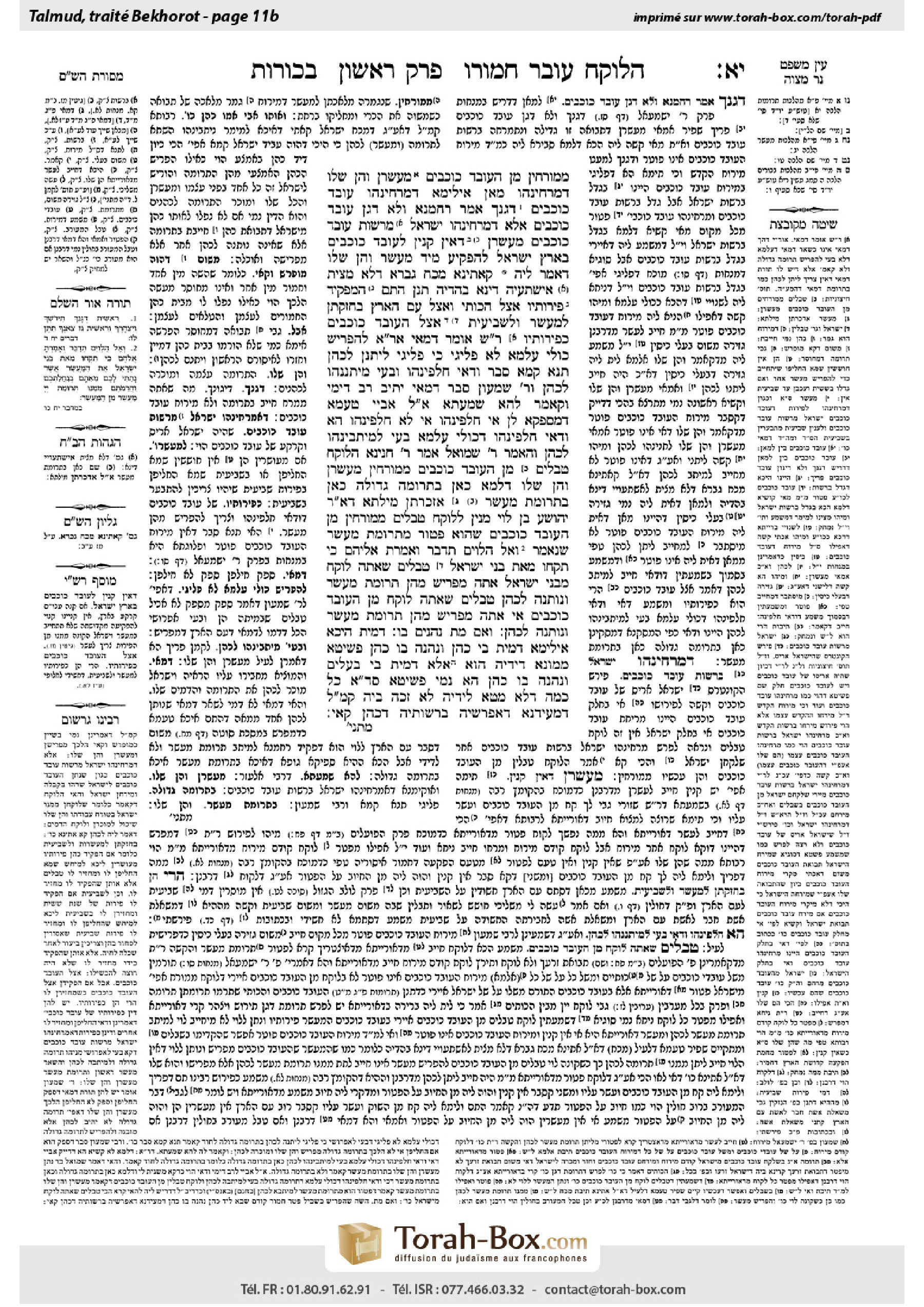
Bekhorot 11b: Talmud study for Daf Yomi
Study the Talmud for Daf Yomi with scanned pages, Hebrew text, English translations from Sefaria and AI-generated French translations.
Passage selection and English or AI-generated French translation are available where the scan has annotations. Daf Study is independent of Torah-Box and Sefaria.
Browse Bekhorot · בכורות · All tractatesBekhorot 11b text and translations
This page of Bekhorot includes the Aramaic text, an English translation and an AI-generated French translation, alongside the scan above.
בכורות י״א ב · Aramaic and Hebrew text
מְמוֹרָחִין מִן הַגּוֹי, מְעַשְּׂרָן וְהֵן שֶׁלּוֹ.
דְּמָרְחִינְהוּ מַאן? אִילֵימָא דְּמָרְחִינְהוּ גּוֹי — ״דְּגָנְךָ״ אָמַר רַחֲמָנָא, וְלֹא דְּגַן גּוֹי!
אֶלָּא דְּמָרְחִינְהוּ יִשְׂרָאֵל מֵרְשׁוּת גּוֹי. מְעַשְּׂרָן, דְּאֵין קִנְיָן לְגוֹי בְּאֶרֶץ יִשְׂרָאֵל לְהַפְקִיעַ מִיַּד מַעֲשֵׂר, וְהֵן שֶׁלּוֹ — דְּאָמַר לֵיהּ: קָאָתֵינָא מִכֹּחַ גַּבְרָא דְּלָא מָצֵית (אִישְׁתַּעֵית) [אִישְׁתַּעוֹיֵי] דִּינָא בַּהֲדֵיהּ.
תְּנַן הָתָם: הַמַּפְקִיד פֵּירוֹתָיו אֵצֶל הַכּוּתִי וְאֵצֶל עַם הָאָרֶץ, בְּחֶזְקָתָן לַמַּעֲשֵׂר וְלַשְּׁבִיעִית.
אֵצֶל הַגּוֹי — כְּפֵירוֹתָיו, רַבִּי שִׁמְעוֹן אוֹמֵר: דְּמַאי.
אָמַר רַבִּי אֶלְעָזָר: לְהַפְרִישׁ — כּוּלֵּי עָלְמָא לָא פְּלִיגִי, כִּי פְּלִיגִי — לִיתְּנָן לְכֹהֵן. תַּנָּא קַמָּא סָבַר: וַדַּאי חַלְּפִינְהוּ, וּבָעֵי מִיתְּנַנְהוּ לְכֹהֵן, וְרַבִּי שִׁמְעוֹן סָבַר: דְּמַאי.
יָתֵיב רַב דִּימִי וְקָאָמַר לְהָא שְׁמַעְתָּא, אֲמַר לֵיהּ אַבָּיֵי: טַעְמָא דִּמְסַפְּקָא לַן אִי חַלְּפִינְהוּ אִי לָא חַלְּפִינְהוּ, הָא וַדַּאי חַלְּפִינְהוּ — דְּכוּלֵּי עָלְמָא בָּעֵי לְמִיתְּבִינְהוּ לְכֹהֵן, וְהָאָמַר רַבִּי שְׁמוּאֵל אָמַר רַבִּי חֲנִינָא: הַלּוֹקֵחַ טְבָלִים מִן הַגּוֹי מְמוֹרָחִין — מְעַשְּׂרָן וְהֵן שֶׁלּוֹ!
דִּלְמָא כָּאן בִּתְרוּמָה גְּדוֹלָה, כָּאן בִּתְרוּמַת מַעֲשֵׂר!
אַזְכַּרְתַּן מִילְּתָא דְּאָמַר רַבִּי יְהוֹשֻׁעַ בֶּן לֵוִי: מִנַּיִן לַלּוֹקֵחַ טְבָלִים מְמוֹרָחִין מִן הַגּוֹי שֶׁהוּא פָּטוּר מִתְּרוּמַת מַעֲשֵׂר? שֶׁנֶּאֱמַר: ״וְאֶל הַלְוִיִּם תְּדַבֵּר וְאָמַרְתָּ אֲלֵיהֶם כִּי תִקְחוּ מֵאֵת בְּנֵי יִשְׂרָאֵל״, טְבָלִים שֶׁאַתָּה לוֹקֵחַ מִבְּנֵי יִשְׂרָאֵל — אַתָּה מַפְרִישׁ מֵהֶן תְּרוּמַת מַעֲשֵׂר וְנוֹתְנָהּ לַכֹּהֵן, טְבָלִים שֶׁאַתָּה לוֹקֵחַ מִן הַגּוֹי — אִי אַתָּה מַפְרִישׁ מֵהֶן תְּרוּמַת מַעֲשֵׂר וְנוֹתְנָהּ לַכֹּהֵן.
וְאִם מֵת נֶהֱנִים בּוֹ. דְּמִית הֵיכָא? אִילֵּימָא דְּמִית בֵּי כֹהֵן, וְנֶהֱנֶה בּוֹ כֹּהֵן — פְּשִׁיטָא, מָמוֹנָא דִּידֵיהּ הוּא! אֶלָּא, דְּמִית בֵּי בְעָלִים וְנֶהֱנֶה בּוֹ כֹּהֵן — הָא נָמֵי פְּשִׁיטָא!
סָלְקָא דַעְתָּךְ אָמֵינָא, כֹּל כַּמָּה דְּלָא מְטָא לִידֵיהּ לָא זְכָה בֵּיהּ, קָא מַשְׁמַע לַן דְּמֵעִידָּנָא דְּאַפְרְשֵׁיהּ, בִּרְשׁוּתֵיהּ דְּכֹהֵן קָאֵי.
Bekhorot 11b · English translation
that is gathered in smoothed piles, from a gentile, he tithes the piles but they are his, as he is not required to give the teruma to a priest or the tithes to a Levite.
The Gemara asks: Who smoothed the piles? If we say that a gentile smoothed them, doesn’t the Merciful One state: “Your grain” (Deuteronomy 12:17, 18:4), with regard to teruma and tithes, indicating that only grain whose processing is completed by a Jew is subject to the rules of teruma and tithes, but not the grain of a gentile?
Rather, clearly a Jew smoothed them while they were in the possession of the gentile before purchasing them. Therefore, he tithes them, as a gentile has no capability of acquisition of land in Eretz Yisrael that would cause the abrogation of the sanctity of the land, thereby removing it from the obligation to tithe its produce. But the tithes are still the Jew’s, as he says to the priest: I have come to own this produce on the basis of the rights of a man with whom you cannot engage in litigation, i.e., a gentile, from whom I bought the produce. Since he is not obligated to give teruma or tithes to the priest, I am not required to give them either.
§ The Gemara cites an additional discussion involving this issue: We learned in a mishna elsewhere (Demai 3:4) that with regard to one who deposits his produce with a Samaritan or with one who is unreliable with regard to tithes [am ha’aretz], when they return it to him, the produce retains its presumptive status with regard to the halakhot of tithe and produce of the Sabbatical Year, both of which must be removed from one’s property. The Samaritan or am ha’aretz is not suspected of having exchanged the deposited produce with untithed produce or produce of the Sabbatical Year.
But in the case of one who deposits his produce with a gentile, the produce returned to him is treated as the produce of the gentile, as he presumably exchanged it with his own. Rabbi Shimon says: It is treated as doubtfully tithed produce [demai], as it is uncertain whether the gentile exchanged the produce or not.
The mishna continues: Rabbi Elazar says: Everyone agrees that one is obligated to separate teruma and tithes from the produce that the gentile returned to him. When they disagree it is with regard to giving it to the priest following the separation. The first tanna holds that the gentile certainly exchanged the produce, and therefore the owner needs to give the teruma to the priest. And Rabbi Shimon holds that the produce is treated as demai, so in order to receive teruma, the priest must bring proof that the produce requires tithing.
Rav Dimi sat and stated this halakha of Rabbi Elazar. Abaye said to him: The reason that Rabbi Shimon disagrees is that we are uncertain whether the gentile exchanged it or whether he did not exchange it. But if he definitely exchanged it, everyone agrees that he is required to give the teruma and tithes to a priest. Why? But doesn’t Rabbi Shmuel say that Rabbi Ḥanina says: In the case of one who purchases untithed produce from a gentile that is gathered in smoothed piles, i.e., it was completely processed, he tithes and separates teruma from the piles of produce but they are his, and he is not required to give the teruma to a priest?
Rav Dimi said to him: Perhaps here, in the mishna that indicates that he must give the teruma to a priest, it is referring to teruma gedola, i.e., the teruma that is separated from the produce before tithes, whereas there, Rabbi Ḥanina’s statement that he separates tithes from them but they are his is referring to the teruma that is separated from the tithe.
Abaye said to him: You reminded me of a statement that Rabbi Yehoshua ben Levi said: From where is it derived that one who purchases from a gentile untithed produce that is gathered in smoothed piles is exempt from separating the teruma of the tithe? It is derived from a verse, as it is stated: “And you shall speak to the Levites, and say to them: When you take the tithe from the children of Israel…then you shall set apart of it a gift for the Lord, even a tithe of the tithe” (Numbers 18:26). It can be inferred from here that concerning untithed produce that you purchase from the children of Israel, you separate teruma of the tithe from it and give the teruma of the tithe to a priest, but concerning untithed produce that you purchase from a gentile, you do not separate teruma of the tithe from it and give it to a priest.
§ The mishna teaches with regard to the lamb that is used to redeem the firstborn donkey: And if it dies, one may derive benefit from it. The Gemara asks: Where did it die? If we say that it died in the house of the priest, and the mishna means that the priest may derive benefit from it, isn’t it obvious? The lamb is his property. Rather, perhaps the mishna means that it died in the house of the owner before it was given to the priest, and teaches that the priest may derive benefit from it. Isn’t this also obvious?
The Gemara responds: It might enter your mind to say that as long as the lamb has not reached the possession of the priest, the priest has not acquired it. Therefore, the mishna teaches us that from the time that the Israelite separated it, it stands in the possession of the priest.
Bekhorot 11b · Traduction française (IA)
celui qui est rassemblé en tas lisses, d'un non-Juif, il tithise les tas mais ils lui appartiennent, car il n'est pas tenu de donner la terouma à un prêtre ou les dîmes à un Lévi.
La Guemara pose la question : Qui a lissé les tas ? Si nous disons qu'un non-Juif les a lissés, ne dit pas le Très Miséricordieux : « Votre blé » (Deutéronome 12:17, 18:4), concernant la terouma et les dîmes, indiquant que seul le blé dont le traitement est achevé par un Juif est soumis aux règles de la terouma et des dîmes, mais pas le blé d'un non-Juif ?
Au contraire, clairement un Juif les a lissés alors qu'ils étaient encore en possession du non-Juif avant qu'il ne les achète. Ainsi, il tithise ces tas, car un non-Juif n'a pas la capacité d'acquisition de terres en Eretz Yisrael qui pourrait annuler la sanctité de la terre, éliminant ainsi l'obligation de tithiser ses produits. Cependant, les dîmes restent la propriété du Juif, car il dit au prêtre : Je suis venu posséder ces produits sur la base des droits d'un homme avec lequel vous ne pouvez pas engager un litige, c'est-à-dire un non-Juif, d'où j'ai acheté les produits. Puisque celui-ci n'est pas tenu de donner la terouma ou les dîmes au prêtre, je ne suis pas non plus tenu de le faire.
§ La Guemara cite une discussion supplémentaire concernant ce sujet : Nous avons appris dans une mitsva ailleurs (Demai 3:4) que concernant celui qui dépose ses produits chez un Samaritain ou chez un homme peu fiable concernant les dîmes [am ha'aretz], lorsqu'ils les lui rendent, les produits conservent leur statut présomptif concernant les halakhot des dîmes et des produits de l'année sabbatique, qui doivent être retirés de sa propriété. Le Samaritain ou l'am ha'aretz n'est pas soupçonné d'avoir échangé les produits déposés avec des produits non tithés ou des produits de l'année sabbatique.
Mais dans le cas d'une personne qui dépose ses produits chez un non-Juif, les produits rendus à lui sont traités comme les produits du non-Juif, car il a probablement échangé ses produits avec les siens. Rabbi Shimon dit : Ils sont traités comme des produits douteusement tithés [demai], car il est incertain que le non-Juif ait échangé les produits ou non.
La mitsva continue : Rabbi Eléazar dit : Tout le monde convient qu'on est tenu de séparer la terouma et les dîmes des produits que le non-Juif lui a rendus. Lorsqu'ils divergent, c'est concernant la remise à un prêtre après la séparation. Le premier tanna affirme que le non-Juif a certainement échangé les produits, et donc l'propriétaire doit donner la terouma au prêtre. Et Rabbi Shimon affirme que les produits sont traités comme des demai, donc pour recevoir la terouma, le prêtre doit apporter la preuve que les produits nécessitent d'être tithés.
Rav Dimi s'est assis et a déclaré cette halakha de Rabbi Elazar. Abaye lui a dit : La raison pour laquelle Rabbi Shimon diverge est que nous sommes incertains si le gentil a échangé les produits ou non. Mais si le gentil a certainement échangé les produits, tout le monde convient qu'il est tenu de donner la terouma et les dîmes à un prêtre. Pourquoi ? Mais ne dit pas Rabbi Shmuel que Rabbi Ḥanina dit : Dans le cas d'une personne qui achète des produits non tithés d'un gentil qui sont rassemblés en tas lisses, c'est-à-dire qu'ils ont été entièrement traités, il tithise et sépare la terouma des tas de produits mais ils lui appartiennent, et il n'est pas tenu de donner la terouma au prêtre ?
Rav Dimi a dit à lui : Peut-être ici, dans la mitsva qui indique qu'il doit donner la terouma au prêtre, il s'agit de la terouma gedola, c'est-à-dire la terouma séparée des produits avant les dîmes, tandis que là, la déclaration de Rabbi Ḥanina que l'on sépare les dîmes d'entre eux mais qu'ils lui appartiennent fait référence à la terouma séparée des dîmes.
Abaye a dit à lui : Vous m'avez rappelé une déclaration que Rabbi Yéhoshua ben Levi a faite : D'où est tiré le fait qu'une personne qui achète des produits non tithés d'un gentil qui sont rassemblés en tas lisses est exempté de séparer la terouma des dîmes ? C'est tiré d'un verset, car il est dit : « Et tu parleras aux Lévites, et tu diras à eux : Lorsque tu prendras la dîme des enfants d'Israël... alors tu sépareras de celle-ci un don pour l'Éternel, c'est-à-dire une dîme de la dîme » (Nombres 18:26). On peut en déduire ici que concernant les produits non tithés que vous achetez des enfants d'Israël, vous séparez la terouma des dîmes de ceux-ci et vous donnez la terouma des dîmes à un prêtre, mais concernant les produits non tithés que vous achetez d'un gentil, vous ne séparez pas la terouma des dîmes de ceux-ci et vous ne les donnez pas au prêtre.
§ La mitsva enseigne concernant l'agneau utilisé pour racheter le premier âne : Et s'il meurt, on peut en tirer un bénéfice. La Guemara pose la question : Où est-il mort ? Si nous disons qu'il est mort chez le prêtre, et que la mitsva signifie que le prêtre peut en tirer un bénéfice, n'est-ce pas évident ? L'agneau est sa propriété. Au contraire, peut-être la mitsva signifie qu'il est mort chez l'owner avant qu'il ne soit donné au prêtre, et enseigne que le prêtre peut en tirer un bénéfice. N'est-ce pas aussi évident ?
La Guemara répond : Il pourrait entrer en votre esprit de dire que tant que l'agneau n'a pas atteint la possession du prêtre, le prêtre n'a pas acquis l'agneau. Ainsi, la mitsva nous enseigne que dès que l'Israelite a séparé l'agneau, il est en possession du prêtre.
Traduction française générée par IA à partir de l’édition anglaise de Sefaria. Vérifie toujours un passage avec le texte source.
Text from Sefaria: William Davidson Edition - Vocalized Aramaic (CC BY NC); William Davidson Edition - English (CC BY NC).