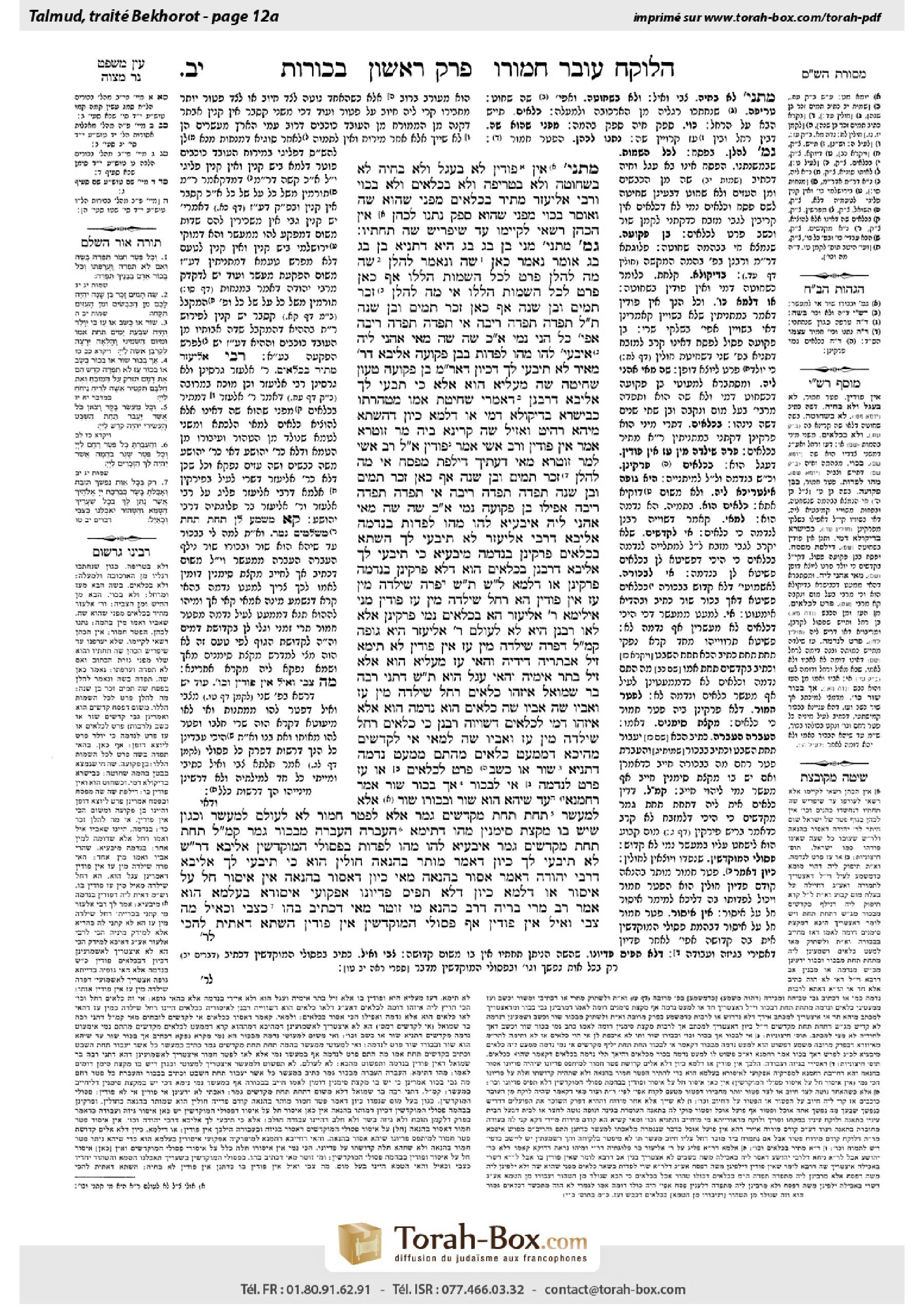
Bekhorot 12a: Talmud study for Daf Yomi
Study the Talmud for Daf Yomi with scanned pages, Hebrew text, English translations from Sefaria and AI-generated French translations.
Passage selection and English or AI-generated French translation are available where the scan has annotations. Daf Study is independent of Torah-Box and Sefaria.
Browse Bekhorot · בכורות · All tractatesBekhorot 12a text and translations
This page of Bekhorot includes the Aramaic text, an English translation and an AI-generated French translation, alongside the scan above.
בכורות י״ב א · Aramaic and Hebrew text
מַתְנִי׳ אֵין פּוֹדִין לֹא בְּעֵגֶל וְלֹא בְּחַיָּה, לֹא בִּשְׁחוּטָה וְלֹא בִּטְרֵיפָה, וְלֹא בְּכִלְאַיִם וְלֹא בְּכוֹי. וְרַבִּי אֱלִיעֶזֶר מַתִּיר בַּכִּלְאַיִם מִפְּנֵי שֶׁהוּא שֶׂה, וְאוֹסֵר בַּכּוֹי מִפְּנֵי שֶׁהוּא סָפֵק. נְתָנוֹ לְכֹהֵן — אֵין הַכֹּהֵן רַשַּׁאי לְקַיְּימוֹ עַד שֶׁיַּפְרִישׁ שֶׂה תַּחְתָּיו.
גְּמָ׳ מַתְנִיתִין מַנִּי? בֶּן בַּג בַּג הִיא, דְּתַנְיָא: בֶּן בַּג בַּג אוֹמֵר: נֶאֱמַר כָּאן ״שֶׂה״, וְנֶאֱמַר לְהַלָּן ״שֶׂה״, מָה לְּהַלָּן פְּרָט לְכׇל הַשֵּׁמוֹת הַלָּלוּ, אַף כָּאן פְּרָט לְכׇל הַשֵּׁמוֹת הַלָּלוּ.
אִי מָה לְהַלָּן זָכָר תָּמִים וּבֶן שָׁנָה, אַף כָּאן זָכָר תָּמִים וּבֶן שָׁנָה? תַּלְמוּד לוֹמַר: ״תִּפְדֶּה״ ״תִּפְדֶּה״ — רִיבָּה.
אִי ״תִּפְדֶּה״ ״תִּפְדֶּה״ רִיבָּה, אֲפִילּוּ כֹּל הָנֵי נָמֵי? אִם כֵּן, ״שֶׂה״ ״שֶׂה״ מַאי אַהֲנִי לֵיהּ?
אִיבַּעְיָא לְהוּ: מַהוּ לִפְדּוֹת בְּבֶן פְּקוּעָה? אַלִּיבָּא דְּרַבִּי מֵאִיר לָא תִּיבְּעֵי לָךְ, דְּכֵיוָן דְּאָמַר רַבִּי מֵאִיר: בֶּן פְּקוּעָה טָעוּן שְׁחִיטָה, שֶׂה מְעַלְּיָא הוּא. אֶלָּא כִּי תִּבְּעֵי לָךְ אַלִּיבָּא דְּרַבָּנַן, דְּאָמְרִי: שְׁחִיטַת אִמּוֹ מְטַהַרְתּוֹ.
כְּבִישְׂרָא בְּדִיקּוּלָא דָּמֵי, אוֹ דִלְמָא: כֵּיוָן דְּהַשְׁתָּא מִיהָא רָהֵיט וְאָזֵיל, ״שֶׂה״ קָרֵינָא בֵּיהּ?
מָר זוּטְרָא אָמַר: אֵין פּוֹדִין, וְרַב אָשֵׁי אָמַר: פּוֹדִין.
אֲמַר לֵיהּ רַב אָשֵׁי לְמָר זוּטְרָא: מַאי דַּעְתָּיךְ? דְּיָלְפַתְּ מִפֶּסַח. אִי מָה לְהַלָּן זָכָר תָּמִים וּבֶן שָׁנָה, אַף כָּאן זָכָר תָּמִים וּבֶן שָׁנָה! ״תִּפְדֶּה״ ״תִּפְדֶּה״ — רִיבָּה.
אִי ״תִּפְדֶּה״ ״תִּפְדֶּה״ רִיבָּה, אֲפִילּוּ בֶּן פְּקוּעָה נָמֵי! אִם כֵּן, ״שֶׂה״ ״שֶׂה״ מַאי אַהֲנִי לֵיהּ?
אִיבַּעְיָא לְהוּ: מַהוּ לִפְדּוֹת בְּנִדְמָה? אַלִּיבָּא דְּרַבִּי אֱלִיעֶזֶר לָא תִּיבְּעֵי לָךְ, הַשְׁתָּא בְּכִלְאַיִם פָּרְקִינַן, בְּנִדְמָה מִיבַּעְיָא?
כִּי תִּיבְּעֵי לָךְ אַלִּיבָּא דְּרַבָּנַן, בְּכִלְאַיִם הוּא דְּלָא פָּרְקִינַן, בְּנִדְמָה פָּרְקִינַן, אוֹ דִלְמָא לָא שְׁנָא?
תָּא שְׁמַע: פָּרָה שֶׁיָּלְדָה מִין עֵז — אֵין פּוֹדִין, הָא רָחֵל שֶׁיָּלְדָה מִין עֵז — פּוֹדִין. מַנִּי? אִילֵימָא רַבִּי אֱלִיעֶזֶר — הָא בְּכִלְאַיִם נָמֵי פָּרְקִינַן! אֶלָּא לָאו רַבָּנַן הִיא?
לָא, לְעוֹלָם רַבִּי אֱלִיעֶזֶר הִיא, גּוּפַהּ קָא מַשְׁמַע לַן דְּפָרָה שֶׁיָּלְדָה מִין עֵז — אֵין פּוֹדִין. לָא תֵּימָא: זִיל אַבָּתְרֵיהּ דִּידֵיהּ, וְהַאי עֵז מְעַלְּיָא הוּא, אֶלָּא זִיל בָּתַר אִימֵּיהּ — וְהַאי עֵגֶל הוּא.
תָּא שְׁמַע, דְּתָנֵי רַבָּה בַּר שְׁמוּאֵל: אֵיזֶהוּ כִּלְאַיִם? רָחֵל שֶׁיָּלְדָה מִין עֵז, וְאָבִיו שֶׂה. אָבִיו שֶׂה, כִּלְאַיִם הוּא? נִדְמֶה הוּא! אֶלָּא, אֵיזֶהוּ דָּמֵי לְכִלְאַיִם, דְּשַׁוְּיוּהּ רַבָּנַן כִּי כִלְאַיִם? רָחֵל שֶׁיָּלְדָה מִין עֵז, וְאָבִיו שֶׂה.
לְמַאי? אִי לְקָדָשִׁים — מֵהֵיכָא דִּמְמַעֵט כִּלְאַיִם, מֵהָתָם מְמַעֵט נִדְמֶה, דְּתַנְיָא: ״שׁוֹר אוֹ כֶשֶׂב״ — פְּרָט לְכִלְאַיִם, ״אוֹ עֵז״ — פְּרָט לְנִדְמֶה!
אִי לִבְכוֹר, ״אַךְ בְּכוֹר שׁוֹר״ אָמַר רַחֲמָנָא, עַד שֶׁיְּהֵא הוּא שׁוֹר וּבְכוֹרוֹ שׁוֹר!
אֶלָּא לְמַעֲשֵׂר, ״תַּחַת״ ״תַּחַת״ מִקֳּדָשִׁים גָּמַר! אֶלָּא לְפֶטֶר חֲמוֹר.
לָא, לְעוֹלָם לְמַעֲשֵׂר, וּכְגוֹן שֶׁיֵּשׁ בּוֹ מִקְצָת סִימָנִין, מַהוּ דְּתֵימָא ״הַעֲבָרָה״ ״הַעֲבָרָה״ מִבְּכוֹר גָּמַר,
קָא מַשְׁמַע לַן, ״תַּחַת״ ״תַּחַת״ מִקֳּדָשִׁים גָּמַר.
אִיבַּעְיָא לְהוּ: מַהוּ לִפְדּוֹת בִּפְסוּלֵי הַמּוּקְדָּשִׁין?
אַלִּיבָּא דְּרַבִּי שִׁמְעוֹן לָא תִּיבְּעֵי לָךְ, כֵּיוָן דְּאָמַר מוּתָּר בַּהֲנָאָה — חוּלִּין הוּא, כִּי תִּיבְּעֵי לָךְ אַלִּיבָּא דְּרַבִּי יְהוּדָה דְּאָמַר אָסוּר בַּהֲנָאָה.
מַאי? כֵּיוָן דְּאָסוּר בַּהֲנָאָה, אֵין אִיסּוּר חָל עַל אִיסּוּר?
אוֹ דִלְמָא, כֵּיוָן דְּלָא תָּפֵיס פִּדְיוֹנוֹ, אַפְקוֹעֵי אִיסּוּרָא בְּעָלְמָא הוּא?
אָמַר רַב מָרִי בְּרֵיהּ דְּרַב כָּהֲנָא: מִי זוּטַר מַאי דִּכְתִיב בְּהוּ, ״כַּצְּבִי וְכָאַיָּל״? מָה צְבִי וְאַיָּל אֵין פּוֹדִין, אַף פְּסוּלֵי הַמּוּקְדָּשִׁין אֵין פּוֹדִין!
הַשְׁתָּא דְּאָתֵית לְהָכִי,
Bekhorot 12a · English translation
MISHNA: One may not redeem a firstborn donkey, neither with a calf, nor with an undomesticated animal, nor with a slaughtered animal, nor with a tereifa, nor with a hybrid of a sheep and a goat, nor with a koy, which is an animal with regard to which it is uncertain whether it is domesticated or undomesticated. And Rabbi Eliezer deems it permitted to redeem a firstborn donkey with a hybrid of a sheep and a goat, because it is a lamb, i.e., that hybrid has the status of a lamb, but prohibits redeeming it with a koy, because its status is uncertain. If one gave the firstborn donkey to a priest, the priest may not keep it unless he first designates a lamb in its stead for redemption.
GEMARA: Whose opinion is expressed in the first clause of the mishna? It is the opinion of ben Bag Bag, as it is taught in a baraita that ben Bag Bag says: It is stated here, with regard to the redemption of a firstborn donkey: “And you shall redeem a firstborn donkey with a lamb” (Exodus 13:13), and it is stated there, with regard to the Paschal offering: “In the tenth day of this month they shall take to them every man a lamb” (Exodus 12:3). By inference, just as there, with regard to the Paschal offering, the Torah excludes all of these names, i.e., all of these types of animals listed in the mishna, from being fit for sacrifice as a Paschal offering, so too here, with regard to the redemption of a firstborn donkey, the Torah excludes all of these names.
The Gemara challenges: If this halakha is derived from the Paschal offering, then perhaps just as there, the Paschal offering must be a lamb that is male, unblemished, and in its first year (Exodus 12:5), so too here, the lamb must be male, unblemished, and in its first year. The Gemara explains that the verse states: “You shall redeem” (Exodus 13:13), and: “You shall redeem” (Exodus 34:20). This repetition serves to include female lambs, blemished lambs, and lambs that are beyond their first year.
The Gemara asks: If the repetition of the terms “you shall redeem,” “you shall redeem,” serves to include, then even all of these types of animals that are listed in the mishna should be included. The Gemara answers: If so, what purpose does the verbal analogy of “lamb,” “lamb,” between the firstborn donkey and the Paschal offering serve?
§ A dilemma was raised before the Sages: What is the halakha with regard to redeeming a firstborn donkey with a lamb that was removed alive from its mother’s womb after the mother was ritually slaughtered [ben pekua]? The Gemara explains the question: According to the opinion of Rabbi Meir you should not raise the dilemma, as since Rabbi Meir says that a ben pekua requires ritual slaughter, it is considered a full-fledged lamb. Rather, you should raise the dilemma according to the opinion of the Rabbis, who say that the slaughter of its mother renders the fetus permitted for consumption, as it is considered part of the mother, which was already slaughtered.
Is it considered like meat that is placed in a pot, i.e., as if it had been slaughtered, in which case it is included in the prohibition against redeeming a firstborn donkey with a slaughtered animal? Or perhaps since now, in any event, it runs along, we call it a lamb.
The Gemara cites a dispute with regard to this issue: Mar Zutra said that one may not redeem a firstborn donkey with a ben pekua, and Rav Ashi said that one may redeem with it.
Rav Ashi said to Mar Zutra: What is the reason for your opinion? Is it because you derive the halakhot of redeeming a firstborn donkey from the Paschal offering, and a ben pekua is unfit for sacrifice as a Paschal offering? If so, just as there, with regard to the Paschal offering, it must be male, unblemished, and in its first year, so too here, the lamb must be male, unblemished, and in its first year. Mar Zutra responded: The repetition of the terms “you shall redeem,” “you shall redeem,” included a lamb that is not male, unblemished, or in its first year.
Rav Ashi said to him: If the repetition of the terms “you shall redeem,” “you shall redeem,” included additional types of lambs, even a ben pekua is included. Mar Zutra responded: If so, what purpose does the verbal analogy of “lamb,” “lamb,” between the firstborn donkey and the Paschal offering serve? It must be that the term “you shall redeem” does not serve to include those animals.
§ A dilemma was raised before the Sages: What is the halakha with regard to redeeming a firstborn donkey with a lamb whose parents are both sheep but it resembles another animal such as a goat? The Gemara clarifies: According to the opinion of Rabbi Eliezer, do not raise the dilemma, as now that it is established that he holds that one may redeem with a hybrid of a goat and a sheep, with regard to a lamb that resembles a goat but is not from a hybrid, is it necessary to state that one may redeem with it?
Rather, when should you raise the dilemma? Raise it according to the opinion of the Rabbis, who hold that one may not redeem a firstborn donkey with a hybrid of a sheep and a goat. Do they hold that one does not redeem with a hybrid of a goat and a sheep, but one does redeem with a lamb that resembles another animal? Or perhaps there is no difference between them?
The Gemara suggests: Come and hear a resolution from a baraita: With regard to a cow that gave birth to a goat of sorts, one may not redeem a firstborn donkey with the goat of sorts. The Gemara infers: But it can be inferred that with regard to a ewe that gave birth to a goat of sorts, one may redeem with it. Whose opinion is expressed in the baraita? If we say that it is the opinion of Rabbi Eliezer, he holds that one may redeem even with a hybrid of a sheep and goat, and this ruling would be unnecessary. Rather, is it not the opinion of the Rabbis, indicating that they hold that one may redeem a firstborn donkey with a lamb that resembles another animal?
The Gemara responds: No, actually the baraita is in accordance with the opinion of Rabbi Eliezer, and it teaches us the halakha itself that one may not redeem using the offspring in a case where a cow gave birth to a goat of sorts, i.e., where the offspring has the appearance of a goat. This is necessary so that you do not say that the halakha should follow the appearance of the offspring itself, and therefore this offspring is a full-fledged goat and should be suitable for redeeming a firstborn donkey. Rather, follow its mother, and this offspring is treated as a calf, which is not suitable for redeeming a firstborn donkey.
The Gemara suggests: Come and hear a resolution from a baraita that Rabba bar Shmuel teaches: What is considered an animal that is a hybrid? It is a ewe that gave birth to a goat of sorts and the father of the offspring is a lamb. The Gemara analyzes the baraita: If its father is a lamb, is the offspring a hybrid? It is an animal that resembles an animal of another type. Rather, the baraita means: What animal is similar to a hybrid, and the Rabbis rendered it tantamount to a hybrid, which is unsuitable for redeeming? It is a ewe that gave birth to a goat of sorts and its father is a lamb.
Now, to what halakha is this baraita referring? If it is referring to sacrificial animals, i.e., to the fact that such an animal is unfit for sacrifice as an offering, why does the baraita derive its status from that of a hybrid? From the same verse where one derives that the Torah excludes a hybrid as an offering, one can derive that it also excludes an animal that resembles an animal of another type. As it is taught in a baraita that in the verse: “When a bull, or a lamb, or a goat, is brought forth…it may be accepted as an offering…to the Lord” (Leviticus 22:27), the words “a bull, or a lamb” are interpreted as excluding a hybrid, and the words “or a goat” are interpreted as excluding an animal that resembles an animal of another type.
If the baraita is referring to the halakha of a firstborn and teaches that an animal that resembles an animal of another type does not have firstborn status, this is derived from another verse, as the Merciful One states: “But the firstborn of an ox” (Numbers 18:17), which indicates that there is firstborn status only if it is an ox and its firstborn is an ox, but not when the offspring resembles an animal of another type.
Rather, perhaps it is referring to the mitzva of the animal tithe and teaches that an animal that resembles an animal of another type is not tithed with the other animals. This ruling is also unnecessary, as it is derived via a verbal analogy from the word: “Under” (Leviticus 22:27), which is stated with regard to sacrificial animals, and the word: “Under” (Leviticus 27:32), which is stated in the context of animal tithe. Rather, the baraita must be referring to the lamb that is used to redeem a firstborn donkey, and it teaches that a lamb that resembles an animal of another type is unfit for use as redemption.
The Gemara responds: No, actually the baraita is referring to the halakha of animal tithe in a case where the animal that resembles an animal of another type has some characteristics of the mother. It was necessary for the baraita to teach that such an animal is not included in the animal tithe, lest you say that it is derived via a verbal analogy from the term: Passing, stated with regard to the animal tithe (see Leviticus 27:32), and the term: Passing, stated with regard to a firstborn animal (see Exodus 13:12), that just as an animal with some characteristics of the mother does have firstborn status (see 16b), so too, such an animal should be included in the obligation of animal tithe.
Therefore, the tanna teaches us that it is derived via a verbal analogy from the word “under” that is stated with regard to sacrificial animals and the word “under” that is stated in the context of animal tithe, that an animal with some characteristics of the mother is unfit for animal tithe. The status of such a lamb with regard to redeeming a firstborn donkey may not be proven from the baraita.
§ A dilemma was raised before the Sages: What is the halakha with regard to redeeming a firstborn donkey with disqualified consecrated animals that were redeemed? It is forbidden to shear or work such animals. Does the principle of: A prohibition does not take effect where another prohibition already exists, apply here?
The Gemara clarifies: According to the opinion of Rabbi Shimon, you should not raise the dilemma. Since he says that it is permitted to derive benefit from a firstborn donkey, its status is non-sacred, and no forbidden status is transferred to the redemption lamb. When should you raise the dilemma? Raise it according to the opinion of Rabbi Yehuda, who says that it is prohibited to derive benefit from a firstborn donkey.
What is the halakha? It could be reasoned that since it is prohibited to derive benefit from the firstborn donkey, when he redeems it with a lamb, the forbidden status of the donkey must be able to be transferred to the lamb, which cannot occur in the case of a disqualified consecrated lamb, as a prohibition does not take effect where another prohibition already exists.
Or perhaps it could be reasoned that since the actual prohibition against deriving benefit from the donkey is not transferred to its object of redemption, i.e., the lamb, as deriving benefit from the lamb is permitted, the act of redemption should be seen as merely an abrogation of the donkey’s forbidden status. The forbidden status is not transferred to the lamb, and consequently the principle that a prohibition does not take effect where another prohibition already exists does not apply.
Rav Mari, son of Rav Kahana, says: Is that which is written with regard to disqualified consecrated animals insignificant? The Torah states that their status is: “Like the gazelle and like the hart” (Deuteronomy 12:15), indicating that just as one may not redeem a firstborn donkey with a gazelle or a hart, so too, one may not redeem a firstborn donkey with disqualified consecrated animals.
The Gemara comments: Now that you have arrived at this explanation,
Bekhorot 12a · Traduction française (IA)
MICHNA: On ne peut pas racheter un âne premier-né avec un veau, ni avec un animal sauvage, ni avec un animal tué, ni avec un tereifa, ni avec un hybride de mouton et de chèvre, ni avec un koy, qui est un animal dont on ne sait pas s'il est domestiqué ou sauvage. Rabbi Eliezer considère que l'on peut racheter un âne premier-né avec un hybride de mouton et de chèvre, car il a le statut d'un agneau, mais il interdit de le racheter avec un koy, car son statut est incertain. Si l'on donne l'âne premier-né à un prêtre, le prêtre ne peut pas le garder à moins qu'il ne désigne d'abord un agneau à la place pour le rachat.
GUEMARA: Quel est l'opinion exprimée dans la première partie de la mishna ? C'est l'opinion de ben Bag Bag, comme il est enseigné dans une baraïta que ben Bag Bag dit : Il est dit ici, concernant le rachat d'un âne premier-né : « Et tu rachèteras un âne premier-né avec un agneau » (Exode 13:13), et il est dit là, concernant l'offrande pascal : « Le dixième jour de ce mois, ils prendront chacun un agneau » (Exode 12:3). Par déduction, tout comme là, concernant l'offrande pascal, la Torah exclut tous ces noms, c'est-à-dire tous ces types d'animaux mentionnés dans la mishna, de l'être adapté comme offrande pascal, ainsi ici, concernant le rachat d'un âne premier-né, la Torah exclut tous ces noms.
La Guemara soulève un défi : Si cette halakha est dérivée de l'offrande pascal, alors peut-être tout comme là, l'offrande pascal doit être un agneau mâle, sans tache et de première année (Exode 12:5), ainsi ici, l'agneau doit être mâle, sans tache et de première année. La Guemara explique que le verset dit : « Tu rachèteras » (Exode 13:13), et : « Tu rachèteras » (Exode 34:20). Cette répétition sert à inclure les agneaux femelles, les agneaux tachés et les agneaux au-delà de leur première année.
La Guemara pose une question : Si la répétition des termes « tu rachèteras », « tu rachèteras », sert à inclure, alors même tous ces types d'animaux mentionnés dans la mishna devraient être inclus. La Guemara répond : Si c'est ainsi, à quoi sert l'analogie verbale de « agneau », « agneau », entre l'âne premier-né et l'offrande pascal ?
§ Un dilemme a été soulevé devant les Sages : Quelle est la halakha concernant le rachat d'un âne premier-né avec un agneau qui a été retiré vivant du ventre de sa mère après que la mère ait été tuée rituellement [ben pekua] ? La Guemara explique la question : Selon l'opinion de Rabbi Meir, on ne devrait pas soulever ce dilemme, car puisque Rabbi Meir dit qu'un ben pekua nécessite une immolation rituelle, il est considéré comme un agneau complet. Au contraire, on devrait soulever ce dilemme selon l'opinion des Rabbins, qui disent que la mort de sa mère rend le fœtus permis à la consommation, car il est considéré comme faisant partie de la mère, qui a déjà été tuée.
La Guemara pose la question : Est-ce considéré comme de la viande placée dans une marmite, c'est-à-dire comme si elle avait été tuée, dans ce cas, elle serait incluse dans l'interdiction de racheter un âne premier-né avec un animal tué ? Ou peut-être, puisque maintenant, en tout cas, il court, on l'appelle un agneau.
La Guemara cite un débat concernant cette question : Mar Zutra dit qu'on ne peut pas racheter un âne premier-né avec un ben pekua, et Rav Ashi dit qu'on peut le racheter.
Rav Ashi dit à Mar Zutra : Quelle est la raison de ton opinion ? Est-ce parce que tu dérives les halakhot du rachat d'un âne premier-né de l'offrande pascal, et un ben pekua n'est pas adapté comme offrande pascal ? Si c'est ainsi, tout comme là, concernant l'offrande pascal, il doit être mâle, sans tache et de première année, ainsi ici, l'agneau doit être mâle, sans tache et de première année. Mar Zutra répondit : La répétition des termes « tu rachèteras », « tu rachèteras », inclut un agneau qui n'est pas mâle, sans tache ou de première année.
Rav Ashi dit à lui : Si la répétition des termes « tu rachèteras », « tu rachèteras », inclut des types supplémentaires d'agneaux, même un ben pekua est inclus. Mar Zutra répondit : Si c'est ainsi, à quoi sert l'analogie verbale de « agneau », « agneau », entre l'âne premier-né et l'offrande pascal ? Il doit être que le terme « tu rachèteras » ne sert pas à inclure ces animaux.
§ Un dilemme a été soulevé devant les Sages : Quelle est la halakha concernant le rachat d'un âne premier-né avec un agneau dont les parents sont tous deux des moutons mais qui ressemble à un autre animal tel qu'un chèvre ? La Guemara clarifie : Selon l'opinion de Rabbi Eliezer, ne pas soulever ce dilemme, car maintenant qu'il est établi qu'il considère que l'on peut racheter avec un hybride de chèvre et de mouton, concernant un agneau qui ressemble à un chèvre mais n'est pas un hybride, est-il nécessaire de dire qu'on peut le racheter ?
Au contraire, quand devrait-on soulever ce dilemme ? Soulevez-le selon l'opinion des Rabbins, qui considèrent que l'on ne peut pas racheter un âne premier-né avec un hybride de mouton et de chèvre. Ils considèrent-ils qu'on ne rachète pas avec un hybride de chèvre et de mouton, mais qu'on rachète avec un agneau qui ressemble à un autre animal ? Ou peut-être qu'il n'y a pas de différence entre eux ?
La Guemara suggère : Viens écouter une résolution d'une baraïta : Concernant une vache qui a donné naissance à un chèvre, on ne peut pas racheter un âne premier-né avec ce chèvre. La Guemara déduit : Mais on peut déduire que concernant une brebis qui a donné naissance à un chèvre, on peut racheter avec lui. Quelle est l'opinion exprimée dans la baraïta ? Si on dit qu'il s'agit de l'opinion de Rabbi Eliezer, il considère que l'on peut racheter même avec un hybride de mouton et de chèvre, et cette décision serait inutile. Au contraire, n'est-ce pas l'opinion des Rabbins, indiquant qu'ils considèrent que l'on peut racheter un âne premier-né avec un agneau qui ressemble à un autre animal ?
La Guemara répond : Non, en réalité la baraïta suit l'opinion de Rabbi Eliezer, et elle nous enseigne la halakha elle-même, à savoir qu'on ne peut pas racheter un premier-né avec l'offspring dans le cas où une vache a donné naissance à un bouc, c'est-à-dire dans le cas où l'offspring a l'apparence d'un bouc. Cela est nécessaire afin que vous ne disiez pas que la halakha suit l'apparence de l'offspring lui-même, et donc cet offspring est un bouc complet et devrait être adapté pour racheter un âne premier-né. Plutôt, suivez sa mère, et cet offspring est traité comme un veau, qui n'est pas adapté pour racheter un âne premier-né.
La Guemara suggère : Venez écouter une résolution d'une baraïta que Rabba bar Shmuel enseigne : Quel animal est considéré comme un hybride ? C'est une brebis qui a donné naissance à un bouc et dont le père de l'offspring est un agneau. La Guemara analyse la baraïta : Si son père est un agneau, l'offspring est-il un hybride ? C'est un animal qui ressemble à un autre type d'animal. Plutôt, la baraïta signifie : Quel animal est semblable à un hybride, et les Rabbins l'ont rendu équivalent à un hybride, qui n'est pas adapté pour le rachat ? C'est une brebis qui a donné naissance à un bouc et dont le père est un agneau.
Maintenant, à quelle halakha cette baraïta fait-elle référence ? Si elle fait référence aux animaux sacrés, c'est-à-dire au fait que cet animal n'est pas adapté pour l'offrande, pourquoi la baraïta dérive-t-elle son statut de celui d'un hybride ? D'après le même verset où l'on dérive que la Torah exclut un hybride comme offrande, l'on peut dériver que l'animal qui ressemble à un autre type d'animal est également exclu. Comme il est enseigné dans une baraïta que dans le verset : « Quand un taureau, ou un agneau, ou un bouc est né… il peut être accepté comme offrande… à l'Éternel » (Lévitique 22:27), les mots « un taureau, ou un agneau » sont interprétés comme excluant un hybride, et les mots « ou un bouc » sont interprétés comme excluant un animal qui ressemble à un autre type d'animal.
Si la baraïta fait référence à la halakha du premier-né et enseigne que l'animal qui ressemble à un autre type d'animal n'a pas le statut de premier-né, cela est dérivé d'un autre verset, car l'Éternel dit : « Mais le premier-né d'un bœuf » (Nb 18:17), ce qui indique qu'il y a un statut de premier-né uniquement si c'est un bœuf et son premier-né est un bœuf, mais pas lorsque l'animal ressemble à un autre type d'animal.
Plutôt, peut-être fait-elle référence à la mitsva de l'offrande d'animaux et enseigne que l'animal qui ressemble à un autre type d'animal n'est pas tenu de l'offrande avec les autres animaux. Cette décision est également inutile, car elle est dérivée par analogie verbale du mot : « sous » (Lévitique 22:27), qui est dit concernant les animaux sacrés, et du mot : « sous » (Lévitique 27:32), qui est dit dans le contexte de l'offrande d'animaux. Plutôt, la baraïta doit faire référence à l'agneau utilisé pour racheter un âne premier-né, et elle enseigne que l'agneau qui ressemble à un autre type d'animal n'est pas adapté à l'usage comme rachat.
La Guemara répond : Non, en réalité la baraïta fait référence à la halakha de l'offrande d'animaux dans le cas où l'animal qui ressemble à un autre type d'animal a certaines caractéristiques de la mère. Il était nécessaire que la baraïta enseigne que cet animal n'est pas inclus dans l'offrande d'animaux, afin que vous ne disiez pas qu'il est dérivé par analogie verbale du terme : « passage », dit concernant l'offrande d'animaux (voir Lévitique 27:32), et du terme : « passage », dit concernant un animal premier-né (voir Exode 13:12), que tout comme un animal ayant certaines caractéristiques de la mère a le statut de premier-né (voir 16b), de même cet animal devrait être inclus dans l'obligation de l'offrande d'animaux.
Par conséquent, le tanna nous enseigne que cela est dérivé par analogie verbale du mot « sous » qui est dit concernant les animaux sacrés et du mot « sous » qui est dit dans le contexte de l'offrande d'animaux, que l'animal ayant certaines caractéristiques de la mère n'est pas adapté à l'offrande d'animaux. Le statut de ce mouton concernant le rachat d'un âne premier-né ne peut pas être prouvé à partir de la baraïta.
§ Un dilemme a été soulevé devant les Sages : Quelle est la halakha concernant le rachat d'un âne premier-né avec des animaux consacrés disqualifiés qui ont été rachetés ? Il est interdit de tondre ou d'utiliser ces animaux. Le principe de : Une interdiction ne prend effet là où une autre interdiction existe, s'applique-t-il ici ?
La Guemara clarifie : Selon l'opinion de Rabbi Shimon, vous ne devriez pas soulever ce dilemme. Puisqu'il dit que c'est permis d'exploiter un âne premier-né, son statut n'est pas sacré, et aucune interdiction ne se transfère à l'agneau de rachat. Quand devriez-vous soulever ce dilemme ? Soulevez-le selon l'opinion de Rabbi Yehuda, qui dit que c'est interdit d'exploiter un âne premier-né.
Quelle est la halakha ? On pourrait raisonner que puisque c'est interdit d'exploiter l'âne premier-né, lorsqu'il le rachète avec un agneau, l'interdiction de l'âne premier-né doit pouvoir être transférée à l'agneau, ce qui ne peut pas avoir lieu dans le cas d'un agneau consacré disqualifié, car une interdiction ne prend effet là où une autre interdiction existe déjà.
Ou peut-être on pourrait raisonner que puisque l'interdiction réelle d'exploiter l'âne premier-né n'est pas transférée à son objet de rachat, c'est-à-dire l'agneau, puisque l'exploitation de l'agneau est permise, l'acte de rachat devrait être vu comme une abrogation du statut interdit de l'âne. L'interdiction n'est pas transférée à l'agneau, et par conséquent le principe que l'interdiction ne prend effet là où une autre interdiction existe ne s'applique pas.
Rav Mari, fils de Rav Kahana, dit : La mention faite dans la Torah concernant les animaux consacrés incompatibles est-elle insignifiante ? La Torah indique que leur statut est : « Comme l'antilope et comme le cerf » (Deutéronome 12:15), ce qui signifie que tout comme on ne peut pas racheter un âne premier avec un antilope ou un cerf, de même on ne peut pas racheter un âne premier avec des animaux consacrés incompatibles.
La Guemara commente : Maintenant que vous avez atteint cette explication,
Traduction française générée par IA à partir de l’édition anglaise de Sefaria. Vérifie toujours un passage avec le texte source.
Text from Sefaria: William Davidson Edition - Vocalized Aramaic (CC BY NC); William Davidson Edition - English (CC BY NC).