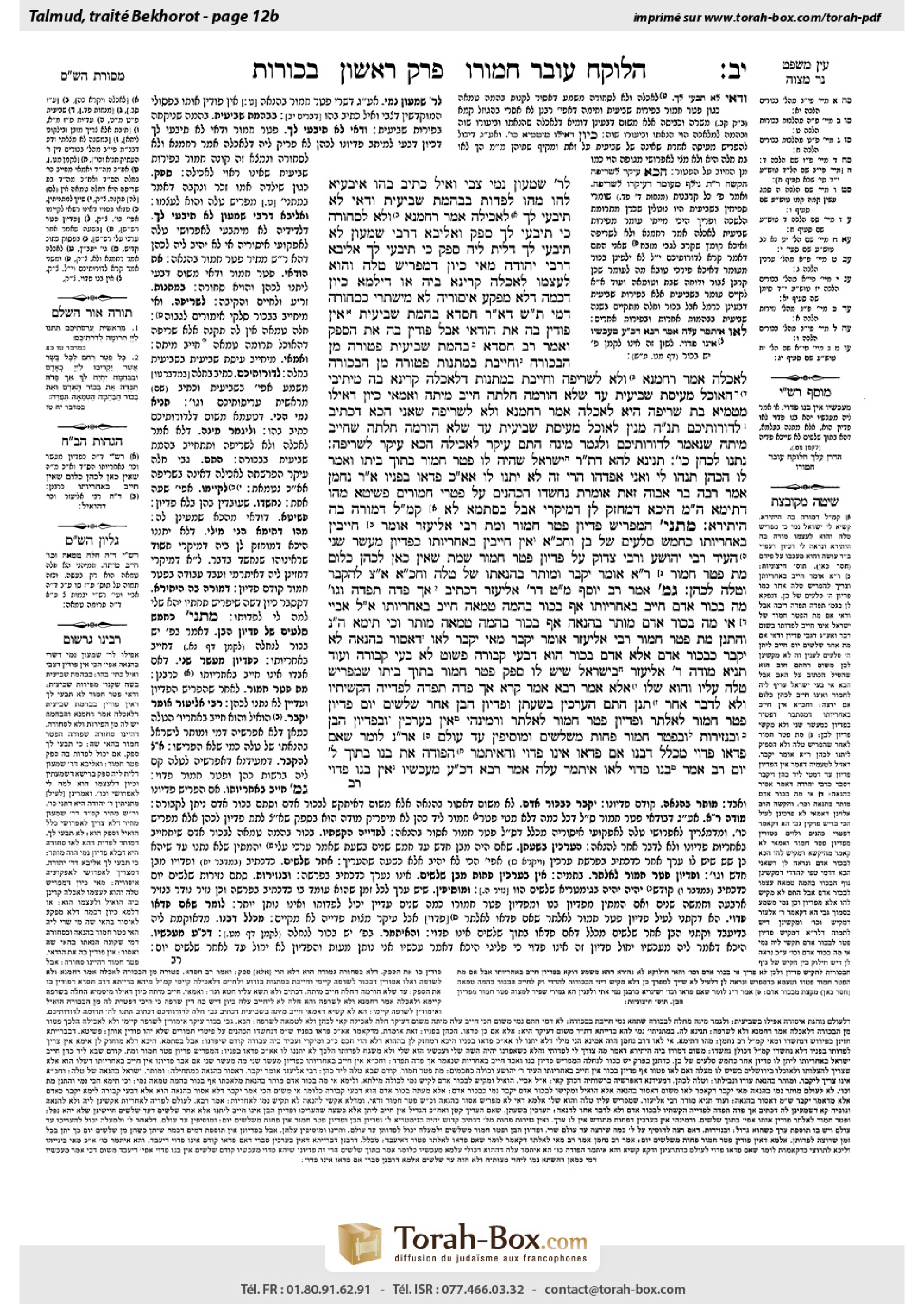
Bekhorot 12b: Talmud study for Daf Yomi
Study the Talmud for Daf Yomi with scanned pages, Hebrew text, English translations from Sefaria and AI-generated French translations.
Passage selection and English or AI-generated French translation are available where the scan has annotations. Daf Study is independent of Torah-Box and Sefaria.
Browse Bekhorot · בכורות · All tractatesBekhorot 12b text and translations
This page of Bekhorot includes the Aramaic text, an English translation and an AI-generated French translation, alongside the scan above.
בכורות י״ב ב · Aramaic and Hebrew text
לְרַבִּי שִׁמְעוֹן נָמֵי, ״צְבִי וְאַיָּל״ כְּתִיב בְּהוּ.
אִיבַּעְיָא לְהוּ: מַהוּ לִפְדּוֹת בְּבֶהֱמַת שְׁבִיעִית?
וַדַּאי — לָא תִּיבְּעֵי לָךְ, לַאֲכִילָה אָמַר רַחֲמָנָא, וְלֹא לִסְחוֹרָה. כִּי תִּיבְּעֵי לָךְ — סָפֵק.
וְאַלִּיבָּא דְּרַבִּי שִׁמְעוֹן לָא תִּיבְּעֵי לָךְ, דְּלֵית לֵיהּ סָפֵק, כִּי תִּיבְּעֵי לָךְ אַלִּיבָּא דְּרַבִּי יְהוּדָה.
מַאי כֵּיוָן דְּמַפְרֵישׁ טָלֶה וְהוּא לְעַצְמוֹ, ״לְאׇכְלָה״ קָרֵינָא בֵּיהּ, אוֹ דִילְמָא: כֵּיוָן דְּכַמָּה דְּלָא מַפְקַע אִיסּוּרֵיהּ לָא מִישְׁתְּרֵי, כִּסְחוֹרָה דָּמֵי?
תָּא שְׁמַע, דְּאָמַר רַב חִסְדָּא: בֶּהֱמַת שְׁבִיעִית אֵין פּוֹדִין בָּהּ אֶת הַוַּדַּאי, אֲבָל פּוֹדִין בָּהּ אֶת הַסָּפֵק.
וְאָמַר רַב חִסְדָּא: בֶּהֱמַת שְׁבִיעִית פְּטוּרָה מִן הַבְּכוֹרָה, וְחַיֶּיבֶת בַּמַּתָּנוֹת.
פְּטוּרָה מִן הַבְּכוֹרָה — ״לְאׇכְלָה״ אָמַר רַחֲמָנָא, וְלֹא לִשְׂרֵיפָה, וְחַיֶּיבֶת בַּמַּתָּנוֹת — דִּ״לְאָכְלָה״ קָרֵינָא בַּהּ.
מֵיתִיבִי: הָאוֹכֵל מֵעִיסַּת שְׁבִיעִית עַד שֶׁלֹּא הוּרְמָה חַלָּתָהּ — חַיָּיב מִיתָה.
וְאַמַּאי? כֵּיוָן דְּאִילּוּ מִטַּמְּיָא בַּת שְׂרֵיפָה הִיא, ״לְאׇכְלָה״ אָמַר רַחֲמָנָא, וְלֹא לִשְׂרֵיפָה!
שָׁאנֵי הָכָא, דִּכְתִיב ״לְדוֹרוֹתֵיכֶם״.
תַּנְיָא נָמֵי הָכִי: מִנַּיִן לָאוֹכֵל מֵעִיסַּת שְׁבִיעִית עַד שֶׁלֹּא הוּרְמָה חַלָּתָהּ שֶׁחַיָּיב מִיתָה — שֶׁנֶּאֱמַר: ״לְדֹרֹתֵיכֶם״.
וְלִגְמַר מִינַּהּ! הָתָם עִיקָּר לַאֲכִילָה, הָכָא עִיקָּר לִשְׂרֵיפָה.
נְתָנוֹ לְכֹהֵן כּוּ׳. תְּנֵינָא לְהָא דְּתָנוּ רַבָּנַן: יִשְׂרָאֵל שֶׁהָיָה לוֹ פֶּטֶר חֲמוֹר בְּתוֹךְ בֵּיתוֹ, וְאָמַר לוֹ הַכֹּהֵן: ״תְּנֵהוּ לִי וַאֲנִי אֶפְדֵּהוּ״ — הֲרֵי זֶה לֹא יִתְּנוּ לוֹ, אֶלָּא אִם כֵּן פְּדָאוֹ בְּפָנָיו.
אָמַר רַב נַחְמָן אָמַר רַבָּה בַּר אֲבוּהּ: זֹאת אוֹמֶרֶת נֶחְשְׁדוּ הַכֹּהֲנִים עַל פִּטְרֵי חֲמוֹרִים. פְּשִׁיטָא! מַהוּ דְּתֵימָא: הָנֵי מִילֵּי הֵיכָא דְּמַחְזַק לַן דְּמִיקְּרֵי, אֲבָל בִּסְתָמָא לָא — קָא מַשְׁמַע לַן דְּמוֹרֵה בַּהּ הֶיתֵּירָא.
מַתְנִי׳ הַמַּפְרִישׁ פִּדְיוֹן פֶּטֶר חֲמוֹר וָמֵת, רַבִּי אֱלִיעֶזֶר אוֹמֵר: חַיָּיבִין בְּאַחְרָיוּתוֹ, כַּחֲמֵשׁ סְלָעִים שֶׁל בֵּן, וַחֲכָמִים אוֹמְרִים: אֵין חַיָּיבִין בְּאַחְרָיוּתוֹ, כְּפִדְיוֹן מַעֲשֵׂר שֵׁנִי.
הֵעִיד רַבִּי יְהוֹשֻׁעַ וְרַבִּי צָדוֹק עַל פִּדְיוֹן פֶּטֶר חֲמוֹר שֶׁמֵּת, שֶׁאֵין כָּאן לַכֹּהֵן כְּלוּם. מֵת פֶּטֶר חֲמוֹר, רַבִּי אֱלִיעֶזֶר אוֹמֵר: יִקָּבֵר, וּמוּתָּר בַּהֲנָאָתוֹ שֶׁל טָלֶה. וַחֲכָמִים אוֹמְרִים: אֵין צָרִיךְ לְהִקָּבֵר, וְטָלֶה לַכֹּהֵן.
גְּמָ׳ אָמַר רַב יוֹסֵף: מַאי טַעְמָא דְּרַבִּי אֱלִיעֶזֶר? דִּכְתִיב: ״אַךְ פָּדֹה תִפְדֶּה וְגוֹ׳״, מָה בְּכוֹר אָדָם חַיָּיב בְּאַחְרָיוּתוֹ, אַף בְּכוֹר בְּהֵמָה טְמֵאָה חַיָּיב בְּאַחְרָיוּתוֹ.
אֲמַר לֵיהּ אַבָּיֵי: אִי מָה בְּכוֹר אָדָם מוּתָּר בַּהֲנָאָה, אַף בְּכוֹר בְּהֵמָה טְמֵאָה מוּתָּר! וְכִי תֵּימָא הָכִי נָמֵי, וְהָתְנַן: מֵת פֶּטֶר חֲמוֹר, רַבִּי אֱלִיעֶזֶר אוֹמֵר: יִקָּבֵר. מַאי יִקָּבֵר? לָאו דְּאָסוּר בַּהֲנָאָה?
לָא, יִקָּבֵר כִּבְכוֹר אָדָם. אֶלָּא, אָדָם בְּכוֹר הוּא דְּבָעֵי קְבוּרָה, פָּשׁוּט לָא בָּעֵי קְבוּרָה?
וְעוֹד תַּנְיָא: מוֹדֶה רַבִּי אֱלִיעֶזֶר בְּיִשְׂרָאֵל שֶׁיֵּשׁ לוֹ סְפֵק פֶּטֶר חֲמוֹר בְּתוֹךְ בֵּיתוֹ — שֶׁמַּפְרִישׁ טָלֶה עָלָיו, וְהוּא שֶׁלּוֹ!
אֶלָּא אָמַר רָבָא: אָמַר קְרָא ״אַךְ פָּדֹה תִפְדֶּה״, לִפְדִיָּיה הִקַּשְׁיתִּיו, וְלֹא לְדָבָר אַחֵר.
תְּנַן הָתָם: הָעֲרָכִין — בִּשְׁעָתָן, וּפִדְיוֹן הַבֵּן — אַחַר שְׁלֹשִׁים יוֹם, פִּדְיוֹן פֶּטֶר חֲמוֹר — לְאַלְתַּר.
וּפִדְיוֹן פֶּטֶר חֲמוֹר לְאַלְתַּר? וּרְמִינְהִי: אֵין בַּעֲרָכִין, וּבְפִדְיוֹן הַבֵּן, וּבִנְזִירוּת, וּבְפֶטֶר חֲמוֹר — פָּחוֹת מִשְּׁלֹשִׁים.
וּמוֹסִיפִין עַד עוֹלָם!
אָמַר רַב נַחְמָן: לוֹמַר שֶׁאִם פְּדָאוֹ — פָּדוּי, מִכְּלָל דִּבְנוֹ אִם פְּדָאוֹ אֵינוֹ פָּדוּי? וְהָאִיתְּמַר: הַפּוֹדֶה אֶת בְּנוֹ בְּתוֹךְ שְׁלֹשִׁים יוֹם, רַב אָמַר: בְּנוֹ פָּדוּי!
לָאו אִיתְּמַר עֲלַהּ, אָמַר רָבָא: דְּכוּלֵּי עָלְמָא ״מֵעַכְשָׁיו״ — אֵין בְּנוֹ פָּדוּי.
Bekhorot 12b · English translation
according to Rabbi Shimon as well, perhaps one cannot redeem a firstborn donkey with disqualified consecrated animals, as it is written with regard to them that they are to be treated: “Like the gazelle and like the hart” (Deuteronomy 12:15). Since a gazelle and a hart cannot be used for redemption, so too, disqualified consecrated animals cannot be used for redemption.
§ A dilemma was raised before the Sages: What is the halakha with regard to redeeming a firstborn donkey with an animal that was purchased with produce of the Sabbatical Year, which caused the sanctity of the produce to be transferred to the animal?
The Gemara clarifies the question: With regard to redeeming a donkey that has definite firstborn status with an animal that was purchased with produce of the Sabbatical Year, you should not raise the dilemma, as one certainly may not redeem it in this manner, since the owner acquires his firstborn donkey in exchange for the animal that he gives to the priest, and this is prohibited with regard to such an animal. This is because the Merciful One states with regard to the Sabbatical Year: “The rest of the land shall be for you for consumption” (Leviticus 25:6), indicating that the produce may be used for consumption but not for commerce. Rather, when should you raise the dilemma? Raise it in the case of a donkey with uncertain firstborn status.
The Gemara clarifies further: And according to the opinion of Rabbi Shimon you should not raise the dilemma, as he does not hold that redemption is necessary in the case of a donkey with uncertain firstborn status. When should you raise the dilemma? Raise it according to the opinion of Rabbi Yehuda, who holds that in such a case the owner of the donkey must designate a lamb for its redemption in order to abrogate its forbidden status, but he is not required to give it to a priest.
What is the halakha? Perhaps since he designates a lamb and it is his, we call this act of redemption “for consumption,” and it is not considered commerce if he does not give it to the priest in exchange for his donkey. Or perhaps, since as long as the lamb does not abrogate the forbidden status of the firstborn donkey it is not permitted to derive benefit from the donkey, when the owner designates the lamb as the replacement of the donkey it is tantamount to engaging in commerce with it.
The Gemara suggests: Come and hear a resolution from that which Rav Ḥisda says: One may not redeem a donkey with definite firstborn status with an animal that was purchased with produce of the Sabbatical Year, but one may redeem a donkey with uncertain firstborn status with it.
And Rav Ḥisda says an additional ruling: An animal that was purchased with produce of the Sabbatical Year is exempt from its offspring being counted a firstborn, but is obligated to have gifts of the priesthood taken from it. These are the gifts to which members of the priesthood are entitled when a non-sacred animal is slaughtered,
The Gemara explains: It is exempt from its offspring being counted a firstborn because the Merciful One states with regard to produce of the Sabbatical Year that it should be used “for consumption,” but not for burning, and portions of a kosher firstborn animal are burned on the altar. And it is obligated to have gifts of the priesthood taken from it, because we call this case “for consumption,” as the priest eats them.
The Gemara raises an objection from a mishna (Shevi’it 9:9): One who eats from dough of produce of the Sabbatical Year before its ḥalla, i.e., the portion of the dough given to the priests, has been separated, is liable to receive the punishment of death at the hand of Heaven, just like one who consumes any dough before ḥalla is separated.
But according to the opinion of Rav Ḥisda, why is dough of produce of the Sabbatical Year subject to the obligation of separating ḥalla? It should not be subject to this mitzva, since if the dough becomes ritually impure after being separated as ḥalla, it is subject to burning, and the Merciful One states: “For consumption,” but not for burning. This is similar to Rav Ḥisda’s claim that a firstborn animal that was purchased with produce of the Sabbatical Year is not subject to the obligations of firstborn status.
The Gemara answers: Here, with regard to ḥalla, it is different, as it is written: “Of the first of your dough you shall give to the Lord a portion for a gift throughout your generations” (Numbers 15:21), which indicates that all dough, including that of produce of the Sabbatical Year, is subject to the mitzva of ḥalla.
This is also taught in a baraita: From where is it derived that one who consumes dough of produce of the Sabbatical Year before its ḥalla was separated is liable to receive the punishment of death at the hand of Heaven? It is derived from a verse, as it is stated: “Throughout your generations,” which indicates the inclusion of Sabbatical Years as well. By contrast, this formulation is not used with regard to a firstborn animal. Therefore, since portions of a kosher firstborn animal are burned on the altar, an animal that was purchased with produce of the Sabbatical Year is exempt from its offspring being counted a firstborn.
The Gemara challenges: And let Rav Ḥisda derive from the halakha of ḥalla that such an animal is subject to its offspring being counted a firstborn, and that the interpretation of: “For consumption” but not for burning, is not applied. The Gemara explains: There, with regard to ḥalla, the primary purpose of the dough is for consumption, and it is burned only if it becomes impure. Here, with regard to a firstborn animal, the primary purpose of the portions that are consumed on the altar is for burning.
§ The mishna teaches: If the owner gave the firstborn donkey itself to a priest, the priest may keep it only after he designates a lamb in its stead for redemption. This language indicates that there is concern lest the priest will be negligent in redeeming it. The Gemara comments: We learn in the mishna that which the Sages taught explicitly in a baraita: In the case of an Israelite who had a firstborn donkey in his house and the priest said to him: Give it to me and I will redeem it, he may not give the donkey to the priest unless the priest redeems it in his presence.
Rav Naḥman says that Rabba bar Avuh says: That is to say that priests are suspect with regard to using firstborn donkeys without redemption. The Gemara asks: Isn’t it obvious? That is exactly what the baraita states. The Gemara explains: Rav Naḥman’s statement is necessary lest you say that this statement of the baraita applies only in a case where we have a presumption that it occasionally happens that this priest uses a firstborn donkey without redeeming it first, but in the case of an ordinary priest, there is no concern for this. Therefore, Rav Naḥman teaches us that this concern is relevant to every priest, as a priest is suspected of granting himself permission to use the firstborn donkey without first redeeming it with a lamb, as in any case the lamb will remain his.
MISHNA: In the case of one who designates a lamb for the redemption of a firstborn donkey and the lamb dies, Rabbi Eliezer says: The owner bears financial responsibility and must give the priest another lamb in its place. This is like the case of the five sela for redemption of a firstborn son, where if the money is lost before one gives it to the priest, he must give the priest another five sela. And the Rabbis say: The owner does not bear financial responsibility. This is like the case of money designated for redemption of second-tithe produce, where once the owner designates the money for redemption, the produce is desanctified.
Rabbi Yehoshua and Rabbi Tzadok testified about a lamb designated for redemption of a firstborn donkey that died, that the priest has nothing here, i.e., in such a case, as the firstborn donkey has already been redeemed, and the owner no longer bears financial responsibility for the dead lamb, in accordance with the opinion of the Rabbis. If after the lamb was designated, the firstborn donkey died, Rabbi Eliezer says: The donkey must be buried, and the owner is permitted to derive benefit from the lamb. And the Rabbis say: It does not need to be buried, and the lamb is given to the priest.
GEMARA: Rav Yosef says: What is the reason for the opinion of Rabbi Eliezer, who holds that the owner bears financial responsibility for the lamb if it is designated and dies before the priest receives it? As it is written: “Yet you shall redeem the firstborn of man, and the firstborn of non-kosher animals you shall redeem” (Numbers 18:15). It is derived from the comparison between the two cases that just as with regard to redeeming a woman’s firstborn son, the father bears financial responsibility to compensate for the five sela in the event of their loss, so too, with regard to redeeming a firstborn non-kosher animal, the owner bears financial responsibility to compensate the priest in the event of their loss.
Abaye said to him: If they are compared, then just as deriving benefit from a woman’s firstborn son is permitted if he has not yet been redeemed, so too, deriving benefit from the firstborn of a non-kosher animal should be permitted prior to redemption, including shearing and working it. And if you would say that indeed Rabbi Eliezer does permit deriving benefit from a firstborn donkey, that is difficult: But didn’t we learn in the mishna that if after the lamb was designated the firstborn donkey died, Rabbi Eliezer says: It must be buried? Now, what is the reason that it must be buried? Is it not because deriving benefit from it is prohibited?
Rav Yosef responded: No, it must be buried like a woman’s firstborn son. There is a mitzva to bury a woman’s firstborn son if he dies, and due to the comparison of the verse, the same applies to a firstborn donkey. The Gemara asks: But according to this answer, does a person who died require burial only if he is a firstborn son, while an ordinary person who is not a firstborn does not require burial? That is certainly not correct. Therefore, no such distinction should exist with regard to a donkey either.
And furthermore, Rabbi Eliezer clearly holds that deriving benefit from a firstborn donkey prior to redemption is forbidden, as it is taught in a baraita: Rabbi Eliezer concedes with regard to an Israelite who has a donkey in his house whose status as a firstborn is uncertain, that he designates a lamb for it and the lamb is his. Designating a lamb in this case is necessary only to remove the prohibition against deriving benefit from the donkey.
Rather, Rava says that although the verse compares the status of a firstborn donkey to that of a woman’s firstborn son, this is only with regard to bearing financial responsibility for the lamb, but not with regard to deriving benefit from the donkey. This is because the verse states: “Yet you shall redeem [pado tifde] the firstborn of man, and the firstborn of non-kosher animals you shall redeem.” The double verb “pado tifde” indicates that I have compared it with regard to redemption, but not with regard to another matter.
§ We learned in a baraita elsewhere: Valuations are determined based on the time of the vow. Therefore, if one vowed to consecrate the valuation of an infant who is less than one month old, he is not obligated to give any money even after the infant is one month old, as an infant less than one month old has no valuation. And with regard to redeeming a woman’s firstborn son, one must give the required sum to the priest after the infant is thirty days old, as it is stated: “And their redemption money, from a month old shall you redeem them” (Numbers 18:16). With regard to redeeming a firstborn donkey, it must be performed immediately.
The Gemara asks: And must redeeming a firstborn donkey be performed immediately? But one can raise a contradiction from another baraita: The halakhot of valuations, and of redemption of a woman’s firstborn son, and of nazirite vows, and of a firstborn donkey, do not apply to less than thirty days. In other words, the halakhot of valuations, of the redemption of a woman’s firstborn son, and of a firstborn donkey do not apply to a person or animal that is less than thirty days old, and a term of naziriteship is a minimum of thirty days.
But one may add to this amount forever. Meaning, the halakhot of valuations apply to a person of any age beyond thirty days, the redemption of a woman’s firstborn son and of a firstborn donkey apply even if the firstborn in question is already several years old, and one can vow to be a nazirite for any length of time beyond thirty days. This baraita indicates that a firstborn donkey is not redeemed immediately, but only after thirty days.
Rav Naḥman says: When the first baraita states that a firstborn donkey must be redeemed immediately, it means to say that if one redeemed it immediately, it is redeemed, although it should be redeemed only after thirty days ab initio. The Gemara asks: By inference, in the case of a woman’s firstborn son, where the first baraita states that he is redeemed after thirty days, if one redeemed him prior to that time, is he not redeemed? But wasn’t it stated: In the case of one who redeems his son within thirty days of birth, Rav says: His son is redeemed?
The Gemara responds: Wasn’t it stated with regard to that matter that Rava says: Everyone agrees that if one says within thirty days of his son’s birth that he is redeeming him from now, his son is not redeemed. Such a redemption would be effective only if he gave the money on condition that the redemption will take effect after his son turns thirty days old.
Bekhorot 12b · Traduction française (IA)
selon Rabbi Shimon également, peut-être ne peut-on pas racheter un âne premier avec des animaux consacrés inaptes, car il est écrit à leur sujet qu'ils doivent être traités ainsi : « Comme l'antilope et comme le chevreau » (Deutéronome 12:15). Puisque l'antilope et le chevreau ne peuvent être utilisés pour le rachat, de même les animaux consacrés inaptes ne peuvent non plus être utilisés pour le rachat.
§ Un dilemme a été soulevé devant les Sages : Quelle est la halakha concernant le rachat d'un âne premier avec un animal acheté à l'aide de produits de l'année sabbatique, ce qui a transféré la sanctité des produits à l'animal ?
La Guemara clarifie la question : Concernant le rachat d'un âne premier dont le statut est certain avec un animal acheté à l'aide de produits de l'année sabbatique, on ne doit pas soulever ce dilemme, car on ne peut certainement pas le racheter ainsi, car l'propriétaire acquiert son âne premier en échange de l'animal qu'il donne au prêtre, et cela est interdit concernant un tel animal. Cela est dû au fait que l'Éternel dit à propos de l'année sabbatique : « Le reste du sol sera pour vous pour la consommation » (Lévitique 25:6), indiquant que les produits peuvent être utilisés pour la consommation mais pas pour le commerce. Dans quel cas faut-il soulever ce dilemme ? Soulevez-le dans le cas d'un âne dont le statut est incertain.
La Guemara clarifie davantage : Selon l'opinion de Rabbi Shimon, on ne doit pas soulever ce dilemme, car il ne considère pas que le rachat soit nécessaire dans le cas d'un âne dont le statut est incertain. Dans quel cas faut-il soulever ce dilemme ? Soulevez-le selon l'opinion de Rabbi Yéhuda, qui considère que dans ce cas, l'propriétaire de l'âne doit désigner un agneau pour son rachat afin d'abroger son statut interdit, mais il n'est pas tenu de le donner au prêtre.
Quelle est la halakha ? Peut-être que puisque l'agneau est désigné et qu'il est à lui, on appelle cette action de rachat « pour la consommation », et cela n'est pas considéré comme du commerce si l'on ne donne pas l'agneau au prêtre en échange de son âne. Ou peut-être, puisque tant que l'agneau n'abroge pas le statut interdit de l'âne premier, il n'est pas permis d'en tirer un bénéfice, et lorsque l'propriétaire désigne l'agneau comme remplacement de l'âne, cela équivaut à un commerce avec lui.
La Guemara suggère : Venez entendre une résolution à partir de ce que Rav Ḥisda dit : On ne peut pas racheter un âne dont le statut est certain avec un animal acheté à l'aide de produits de l'année sabbatique, mais on peut racheter un âne dont le statut est incertain avec lui.
Et Rav Ḥisda dit une autre décision : Un animal acheté à l'aide de produits de l'année sabbatique est exempt de ce que ses descendants soient comptés comme premiers, mais il est tenu de donner des offrandes de la part du prêtre. Ces offrandes sont celles auxquelles les membres du clergé sont dûs lorsqu'un animal non sacré est tué,
La Guemara explique : Il est exempt de ce que ses descendants soient comptés comme premiers car l'Éternel dit à propos des produits de l'année sabbatique qu'ils doivent être utilisés « pour la consommation », mais pas pour la combustion, et des parties d'un animal premier kasher sont brûlées sur l'autel. Et il est tenu de donner des offrandes de la part du prêtre, car on appelle ce cas « pour la consommation », car le prêtre les mange.
La Guemara soulève une objection tirée d'une mitsva (Shevi’it 9:9) : Celui qui mange de la pâte de produits de l'année sabbatique avant que la ḥalla, c'est-à-dire la portion de la pâte donnée aux prêtres, n'ait été séparée, est puni de mort à la main du Ciel, tout comme celui qui consomme toute pâte avant que la ḥalla ne soit séparée.
Mais selon l'opinion de Rav Ḥisda, pourquoi la pâte des produits de l'année sabbatique est-elle soumise à l'obligation de séparer la ḥalla ? Elle ne devrait pas être soumise à cette mitsva, car si la pâte devient impure après avoir été séparée comme ḥalla, elle est soumise à la combustion, et l'Éternel dit : « Pour la consommation », mais pas pour la combustion. Cela est similaire à l'affirmation de Rav Ḥisda selon laquelle un animal premier acheté avec des produits de l'année sabbatique n'est pas soumis aux obligations du statut de premier.
La Guemara répond : Ici, concernant la ḥalla, c'est différent, car il est écrit : « De la première de votre pâte, vous donnerez au Seigneur une portion pour offrande, pour toutes vos générations » (Nombres 15:21), ce qui indique que toute pâte, y compris celle des produits de l'année sabbatique, est soumise à la mitsva de ḥalla.
Cela est également enseigné dans une baraïta : D'où est tiré que celui qui consomme de la pâte des produits de l'année sabbatique avant que la ḥalla n'ait été séparée est puni de mort à la main du Ciel ? C'est tiré d'une versette, car il est dit : « Pour toutes vos générations », ce qui indique l'inclusion des années sabbatiques également. Par contraste, cette formulation n'est pas utilisée concernant un animal premier. Ainsi, puisque des parties d'un animal premier kasher sont brûlées sur l'autel, un animal acheté avec des produits de l'année sabbatique est exempt de ce que ses descendants soient comptés comme premiers.
La Guemara conteste : Et Rav Ḥisda tire de la halakha de la ḥalla que cet animal est soumis à ce que ses descendants soient comptés comme premiers, et que l'interprétation de « Pour la consommation » mais pas pour la combustion ne s'applique pas. La Guemara explique : Là, concernant la ḥalla, le but principal de la pâte est la consommation, et elle est brûlée uniquement si elle devient impure. Ici, concernant un animal premier, le but principal des parties consommées sur l'autel est la combustion.
§ La mitsva enseigne : Si l'propriétaire a donné lui-même l'âne premier-né à un prêtre, le prêtre ne peut le garder qu'après qu'il ait désigné un agneau à sa place pour l'acheter. Cette formulation indique qu'il y a une crainte que le prêtre ne soit négligent dans l'achat. La Guemara commente : Nous apprenons dans la mitsva ce que les Sages ont explicitement enseigné dans une baraïta : Dans le cas d'un Israélite ayant un âne premier-né chez lui et le prêtre lui disant : Donnez-le-moi et je l'achèterai, il ne peut lui donner l'âne que si le prêtre l'achète devant lui.
Rav Naḥman dit que Rabba bar Avuh dit : Cela signifie que les prêtres sont suspects d'utiliser des ânes premier-nés sans les acheter. La Guemara demande : N'est-ce pas évident ? C'est exactement ce que dit la baraïta. La Guemara explique : L'affirmation de Rav Naḥman est nécessaire pour éviter de penser que cette déclaration de la baraïta s'applique uniquement dans un cas où il y a une présomption que ce prêtre utilise un âne premier-né sans l'avoir d'abord acheté, mais dans le cas d'un prêtre ordinaire, il n'y a pas de crainte à avoir à ce sujet. Ainsi, Rav Naḥman nous enseigne que cette crainte s'applique à chaque prêtre, car un prêtre est suspect de se permettre d'utiliser l'âne premier-né sans l'avoir d'abord acheté avec un agneau, car dans tous les cas l'agneau restera à lui.
MICHNA : Dans le cas d'une personne qui désigne un agneau pour l'achat d'un âne premier-né et que l'agneau meurt, Rabbi Eliezer dit : L'propriétaire assume la responsabilité financière et doit donner un autre agneau à la place. C'est comme le cas des cinq sela pour l'achat d'un premier-né humain, où si l'argent est perdu avant qu'il ne soit donné au prêtre, il doit donner un autre cinq sela. Et les Rabbins disent : L'propriétaire ne assume pas la responsabilité financière. C'est comme le cas de l'argent désigné pour l'achat des dîmes secondes, où une fois que l'propriétaire désigne l'argent pour l'achat, les produits sont désacrifiés.
Rabbi Yehoshua et Rabbi Tzadok ont témoigné sur un agneau désigné pour l'achat d'un âne premier-né qui est mort, que le prêtre n'a rien ici, c'est-à-dire, dans ce cas, comme l'âne premier-né a déjà été acheté, et l'propriétaire ne supporte plus la responsabilité financière pour l'agneau mort, conformément à l'opinion des Rabbins. Si après que l'agneau a été désigné, l'âne premier-né est mort, Rabbi Eliezer dit : L'âne doit être enterré, et l'propriétaire est autorisé à tirer un bénéfice de l'agneau. Et les Rabbins disent : Il n'a pas besoin d'être enterré, et l'agneau est donné au prêtre.
GUEMARA : Rav Yosef dit : Quel est le raisonnement de l'opinion de Rabbi Eliezer, qui affirme que l'propriétaire assume la responsabilité financière pour l'agneau si celui-ci est désigné et meurt avant que le prêtre ne le reçoive ? Comme il est écrit : « Et vous redonnerez le premier-né de l'homme, et le premier-né des animaux non-kosher vous redonnerez » (Nombres 18:15). Il est tiré de la comparaison entre les deux cas que tout comme, concernant l'achat d'un premier-né d'une femme, le père assume la responsabilité financière pour compenser les cinq sela en cas de perte, ainsi aussi, concernant l'achat d'un premier-né d'un animal non-kosher, l'propriétaire assume la responsabilité financière pour compenser le prêtre en cas de perte.
Abaye répondit à lui : Si on les compare, alors tout comme il est permis de tirer un bénéfice du premier-né d'une femme avant qu'il ne soit racheté, ainsi aussi, il devrait être permis de tirer un bénéfice du premier-né d'un animal non-kosher avant sa rachat, y compris la tonte et l'utilisation. Et si vous dites que Rabbi Eliezer permet effectivement de tirer un bénéfice du premier-né d'un âne, cela est difficile : Mais n'avons-nous pas appris dans la mitsva que si après que l'agneau a été désigné, l'âne premier-né est mort, Rabbi Eliezer dit : Il doit être enterré ? Maintenant, quelle est la raison qu'il doit être enterré ? N'est-ce pas parce que tirer un bénéfice d'ici est interdit ?
Rav Yosef répondit : Non, il doit être enterré comme le premier-né d'une femme. Il y a une mitsva d'enterrer le premier-né d'une femme si celui-ci meurt, et en raison de la comparaison du verset, la même chose s'applique au premier-né d'un âne. La Guemara demande : Mais selon cette réponse, un homme qui meurt nécessite-t-il d'être enterré uniquement s'il est un premier-né, tandis qu'un homme ordinaire qui n'est pas un premier-né n'a pas besoin d'être enterré ? Cela n'est certainement pas correct. Ainsi, il ne devrait pas y avoir de distinction non plus concernant un âne.
Et de plus, Rabbi Eliezer affirme clairement que tirer un bénéfice du premier-né d'un âne avant sa rachat est interdit, comme il est enseigné dans une baraïta : Rabbi Eliezer reconnaît concernant un Israélite ayant un âne chez lui dont le statut de premier-né est incertain, qu'il désigne un agneau pour lui et l'agneau est à lui. Désigner un agneau dans ce cas est nécessaire uniquement pour éliminer l'interdiction de tirer un bénéfice de l'âne.
Plutôt, Rava dit que bien que le verset compare le statut d'un premier-né d'un âne à celui d'un premier-né d'une femme, cela est seulement concernant la responsabilité financière pour l'agneau, mais pas concernant le bénéfice tiré de l'âne. Cela est dû au fait que le verset dit : « Et vous redonneriez [pado tifde] le premier-né de l'homme, et le premier-né des animaux non-kosher vous redonneriez. » Le double verbe « pado tifde » indique que j'ai comparé cela concernant la délivrance, mais pas concernant une autre matière.
§ Nous avons appris dans une baraïta ailleurs : Les évaluations sont déterminées selon le moment de la promesse. Ainsi, si l'on a juré de consacrer l'évaluation d'un nourrisson qui n'a pas encore un mois, il n'est pas tenu de donner d'argent même après que le nourrisson ait un mois, car un nourrisson de moins d'un mois n'a pas d'évaluation. Et concernant la délivrance d'un premier-né d'une femme, il faut donner la somme requise au prêtre après que le nourrisson ait un mois, comme il est dit : « Et leur argent d'achat, à partir d'un mois, vous redonneriez-les » (Nombres 18:16). Concernant la délivrance d'un premier-né d'un âne, cela doit être fait immédiatement.
La Guemara pose la question : Et la délivrance d’un âne premier enfant doit-elle être accomplie immédiatement ? Mais on peut établir une contradiction à partir d’un autre baraïta : Les halakhot des estimations, de la délivrance du premier enfant d’une femme, des vœux de nazir, et de l’âne premier enfant, ne s’appliquent pas à moins de trente jours. En d’autres termes, les halakhot des estimations, de la délivrance du premier enfant d’une femme, et de l’âne premier enfant ne s’appliquent pas à une personne ou à un animal ayant moins de trente jours, et la durée d’un vœu de nazir est minimale de trente jours.
Mais on peut ajouter à cette quantité à l’infini. Cela signifie que les halakhot des estimations s’appliquent à une personne de tout âge supérieur à trente jours, la délivrance du premier enfant d’une femme et de l’âne premier enfant s’applique même si l’âne en question a déjà plusieurs années, et l’on peut prendre un vœu de nazir pour toute durée supérieure à trente jours. Ce baraïta indique que l’âne premier enfant n’est pas délivré immédiatement, mais uniquement après trente jours.
Rav Naḥman dit : Lorsque le premier baraïta affirme que l’âne premier enfant doit être délivré immédiatement, cela signifie que si l’on le délivre immédiatement, il est délivré, bien qu’il devrait être délivré uniquement après trente jours ab initio. La Guemara pose la question : Par déduction, dans le cas du premier enfant d’une femme, où le premier baraïta affirme qu’il est délivré après trente jours, si l’on le délivre avant cette période, n’est-il pas délivré ? Mais n’avait-on pas dit : Dans le cas d’un homme qui délivre son fils dans les trente jours suivant sa naissance, Rav dit : Son fils est délivré ?
La Guemara répond : N’avait-on pas dit à propos de cela que Rava dit : Tout le monde convient que si l’on dit dans les trente jours suivant la naissance de son fils qu’il le délivre dès maintenant, son fils n’est pas délivré. Une telle délivrance serait efficace uniquement si l’on donnait l’argent sous condition que la délivrance prendra effet après que le fils ait atteint trente jours.
Traduction française générée par IA à partir de l’édition anglaise de Sefaria. Vérifie toujours un passage avec le texte source.
Text from Sefaria: William Davidson Edition - Vocalized Aramaic (CC BY NC); William Davidson Edition - English (CC BY NC).