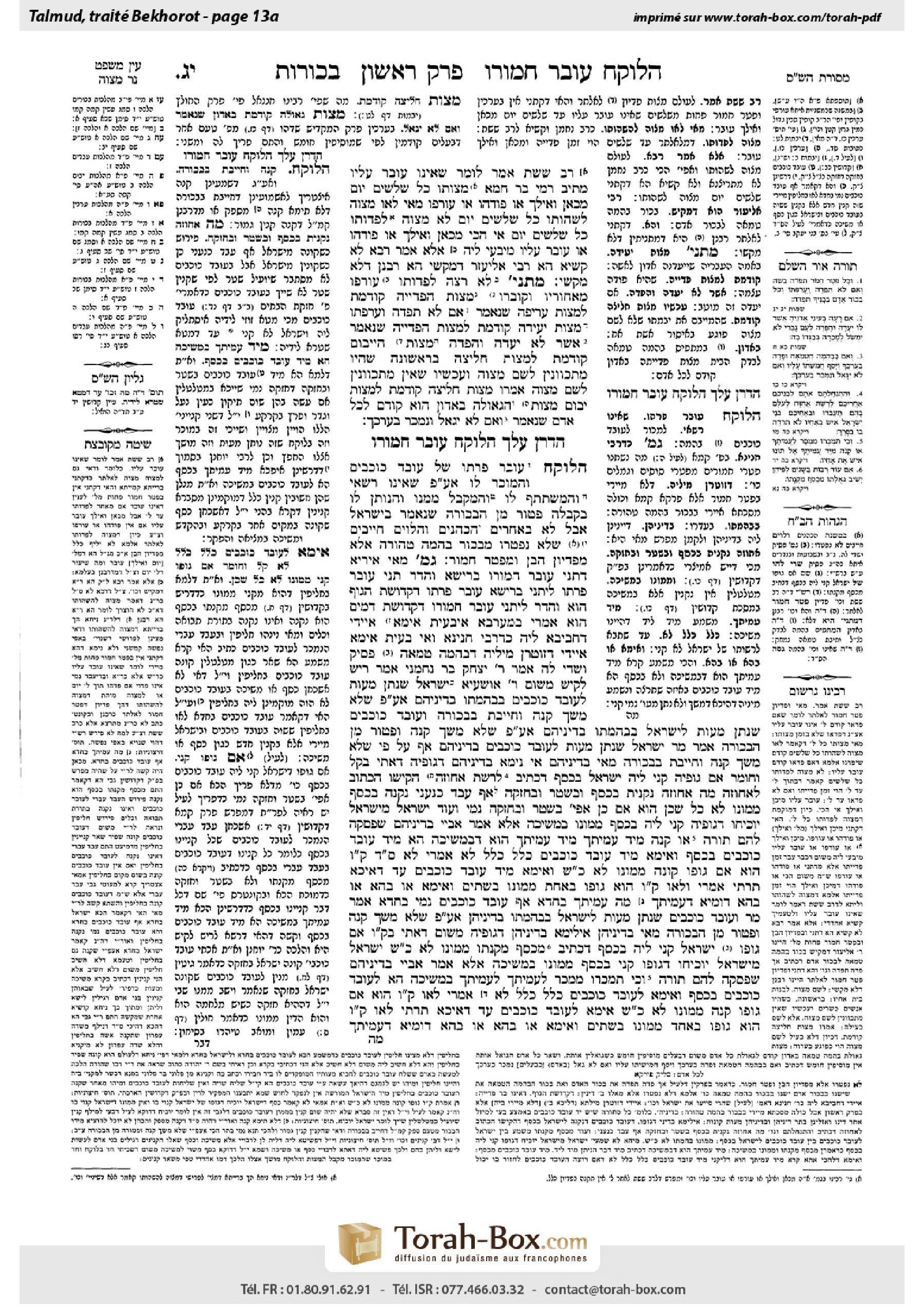
Bekhorot 13a: Talmud study for Daf Yomi
Study the Talmud for Daf Yomi with scanned pages, Hebrew text, English translations from Sefaria and AI-generated French translations.
Passage selection and English or AI-generated French translation are available where the scan has annotations. Daf Study is independent of Torah-Box and Sefaria.
Browse Bekhorot · בכורות · All tractatesBekhorot 13a text and translations
This page of Bekhorot includes the Aramaic text, an English translation and an AI-generated French translation, alongside the scan above.
בכורות י״ג א · Aramaic and Hebrew text
רַב שֵׁשֶׁת אָמַר: לוֹמַר שֶׁאֵינוֹ עוֹבֵר עָלָיו.
מֵתִיב רָמֵי בַּר חָמָא: מִצְוָתוֹ כׇּל שְׁלֹשִׁים יוֹם, מִכָּאן וְאֵילָךְ — אוֹ פּוֹדֵהוּ אוֹ עוֹרְפוֹ. מַאי לָאו מִצְוָה לְשַׁהוֹתוֹ כׇּל שְׁלֹשִׁים יוֹם? לָא, מִצְוָה לִפְדּוֹתוֹ כׇּל שְׁלֹשִׁים יוֹם.
אִי הָכִי, ״מִכָּאן וְאֵילָךְ אוֹ פּוֹדֵהוּ אוֹ עוֹבֵר עָלָיו״ מִיבְּעֵי לֵיהּ! אֶלָּא אָמַר רָבָא: לָא קַשְׁיָא, הָא רַבִּי אֱלִיעֶזֶר דְּמַקֵּשׁי, הָא רַבָּנַן דְּלָא מַקְּשִׁי.
מַתְנִי׳ לֹא רָצָה לִפְדּוֹתוֹ — עוֹרְפוֹ מֵאֲחוֹרָיו וְקוֹבְרוֹ. מִצְוַת הַפְּדִיָּיה קוֹדֶמֶת לְמִצְוַת עֲרִיפָה, שֶׁנֶּאֱמַר: ״אִם לֹא תִפְדֶּה וַעֲרַפְתּוֹ״.
מִצְוַת יְעִידָה קוֹדֶמֶת לְמִצְוַת הַפְּדִיָּיה, שֶׁנֶּאֱמַר: ״אֲשֶׁר לֹא יְעָדָהּ וְהֶפְדָּהּ״.
מִצְוַת הַיִּיבּוּם קוֹדֶמֶת לְמִצְוַת חֲלִיצָה, בָּרִאשׁוֹנָה שֶׁהָיוּ מִתְכַּוְּונִין לְשֵׁם מִצְוָה, וְעַכְשָׁיו שֶׁאֵין מִתְכַּוְּונִין לְשֵׁם מִצְוָה, אָמְרוּ: מִצְוַת חֲלִיצָה קוֹדֶמֶת לְמִצְוַת יִבּוּם.
מִצְוַת הַגְּאוּלָּה בָּאָדוֹן, הוּא קוֹדֵם לְכׇל אָדָם, שֶׁנֶּאֱמַר: ״וְאִם לֹא יִגָּאֵל וְנִמְכַּר בְּעֶרְכֶּךָ״.
הֲדַרַן עֲלָךְ הַלּוֹקֵחַ עוּבַּר חֲמוֹרוֹ.
מַתְנִי׳ הַלּוֹקֵחַ עוּבַּר פָּרָתוֹ שֶׁל נׇכְרִי, וְהַמּוֹכֵר לוֹ, אַף עַל פִּי שֶׁאֵינוֹ רַשַּׁאי, וְהַמִּשְׁתַּתֵּף לוֹ, וְהַמְקַבֵּל מִמֶּנּוּ, וְהַנּוֹתֵן לוֹ בְּקַבָּלָה — פָּטוּר מִן הַבְּכוֹרָה, שֶׁנֶּאֱמַר ״בְּיִשְׂרָאֵל״, אֲבָל לֹא בַּאֲחֵרִים.
הַכֹּהֲנִים וְהַלְוִיִּם חַיָּיבִים, שֶׁלֹּא נִפְטְרוּ מִבְּכוֹר בְּהֵמָה טְהוֹרָה, אֶלָּא מִפִּדְיוֹן הַבֵּן וּמִפֶּטֶר חֲמוֹר.
גְּמָ׳ מַאי אִירְיָא דְּתָנֵי עוּבַּר חֲמוֹרוֹ בְּרֵישָׁא, וַהֲדַר תָּנֵי עוּבַּר פָּרָתוֹ? לִיתְנֵי בְּרֵישָׁא עוּבַּר פָּרָתוֹ, דִּקְדוּשַּׁת הַגּוּף הוּא, וַהֲדַר לִיתְנֵי עוּבַּר חֲמוֹרוֹ, דִּקְדוּשַּׁת דָּמִים הוּא.
אָמְרִי בְּמַעְרְבָא: אִיבָּעֵית אֵימָא, אַיְּידֵי דַּחֲבִיבָא לֵיהּ, כִּדְרַבִּי חֲנִינָא, וְאִי בָּעֵית אֵימָא, אַיְּידֵי דְּזוּטְרָן מִילֵּיהּ דִּבְהֵמָה טְמֵאָה, פָּסֵיק וְשָׁדֵי לַהּ.
אָמַר רַבִּי יִצְחָק בַּר נַחְמָנִי אָמַר רֵישׁ לָקִישׁ מִשּׁוּם רַבִּי אוֹשַׁעְיָא: יִשְׂרָאֵל שֶׁנָּתַן מָעוֹת לְגוֹי בִּבְהֶמְתּוֹ בְּדִינֵיהֶם, אַף עַל פִּי שֶׁלֹּא מָשַׁךְ — קָנָה, וְחַיֶּיבֶת בִּבְכוֹרָה. וְגוֹי שֶׁנָּתַן מָעוֹת לְיִשְׂרָאֵל בִּבְהֶמְתּוֹ בְּדִינֵיהֶם, אַף עַל פִּי שֶׁלֹּא מָשַׁךְ — קָנָה, וּפָטוּר מִן הַבְּכוֹרָה.
אָמַר מָר: יִשְׂרָאֵל שֶׁנָּתַן מָעוֹת לְגוֹי בְּדִינֵיהֶם, אַף עַל פִּי שֶׁלֹּא מָשַׁךְ — קָנָה וְחַיֶּיבֶת בִּבְכוֹרָה.
מַאי ״בְּדִינֵיהֶם״? אִי נֵימָא בְּדִינֵיהֶם דְּגוּפֵיהּ, דְּאָתֵי בְּקַל וָחוֹמֶר: אִם גּוּפֵיהּ קָנֵי לֵיהּ יִשְׂרָאֵל בְּכֶסֶף, דִּכְתִיב ״לָרֶשֶׁת אֲחוּזָּה״,
הִקִּישׁוֹ הַכָּתוּב לַאֲחוּזָּה, מָה אֲחוּזָּה נִקְנֵית בְּכֶסֶף וּבִשְׁטָר וּבַחֲזָקָה, אַף עֶבֶד כְּנַעֲנִי נִקְנֶה בְּכֶסֶף. מָמוֹנוֹ — לֹא כׇּל שֶׁכֵּן הוּא?
אִם כֵּן, אֲפִילּוּ בִּשְׁטָר וּבַחֲזָקָה נָמֵי! וְעוֹד, יִשְׂרָאֵל מִיִּשְׂרָאֵל יוֹכִיחַו, דְּגוּפֵיהּ קָנֵי לֵיהּ בְּכֶסֶף, מָמוֹנוֹ בִּמְשִׁיכָה!
אֶלָּא אָמַר אַבָּיֵי: בְּדִינֵיהֶם שֶׁפָּסְקָה לָהֶם תּוֹרָה, ״אוֹ קָנֹה מִיַּד עֲמִיתֶךָ״ — מִיַּד עֲמִיתֶךָ הוּא דְּבִמְשִׁיכָה, הָא מִיַּד גּוֹי בְּכֶסֶף.
וְאֵימָא: מִיַּד גּוֹי — כְּלָל כְּלָל לָא! אָמְרִי: לָא סָלְקָא דַּעְתָּךְ, קַל וָחוֹמֶר הוּא — אִם גּוּפוֹ קוֹנֶה, מָמוֹנוֹ לֹא כׇּל שֶׁכֵּן?
וְאֵימָא: מִיַּד גּוֹי — עַד דְּאִיכָּא תַּרְתֵּי! אָמְרִי: וְלָאו קַל וָחוֹמֶר הוּא? גּוּפוֹ בְּאַחַת, מָמוֹנוֹ בִּשְׁתַּיִם?! וְאֵימָא: אוֹ בְּהָא אוֹ בְּהָא, דּוּמְיָא דַּ״עֲמִיתֶךָ״.
מָה ״עֲמִיתֶךָ״ בַּחֲדָא, אַף גּוֹי נָמֵי בַּחֲדָא.
אָמַר מָר: וְגוֹי שֶׁנָּתַן מָעוֹת לְיִשְׂרָאֵל בִּבְהֶמְתּוֹ בְּדִינֵיהֶן, אַף עַל פִּי שֶׁלֹּא מָשַׁךְ — קָנָה, וּפָטוּר מִן הַבְּכוֹרָה. מַאי בְּדִינֵיהֶן? אִילֵּימָא בְּדִינֵיהֶן דְּגוּפֵיהּ, מִשּׁוּם דְּאָתֵי בְּקַל וָחוֹמֶר: אִם גּוּפוֹ יִשְׂרָאֵל קָנֵי לֵיהּ בְּכֶסֶף, דִּכְתִיב ״מִכֶּסֶף מִקְנָתוֹ״, מָמוֹנוֹ לֹא כׇּל שֶׁכֵּן?
יִשְׂרָאֵל מִיִּשְׂרָאֵל יוֹכִיחַו, דְּגוּפוֹ קָנֵי בְּכֶסֶף, מָמוֹנוֹ בִּמְשִׁיכָה! אֶלָּא אָמַר אַבָּיֵי: בְּדִינֵיהֶם שֶׁפָּסְקָה לָהֶם תּוֹרָה, ״וְכִי תִמְכְּרוּ מִמְכָּר לַעֲמִיתֶךָ״ — לַעֲמִיתֶךָ בִּמְשִׁיכָה, הָא לְגוֹי בְּכֶסֶף.
וְאֵימָא: לְגוֹי כְּלָל כְּלָל לָא! אָמְרִי: לָאו קַל וָחוֹמֶר הוּא? אִם גּוּפוֹ קָנָה, מָמוֹנוֹ לֹא כׇּל שֶׁכֵּן?
אֵימָא: לְגוֹי עַד דְּאִיכָּא תַּרְתֵּי! לָאו קַל וָחוֹמֶר הוּא? גּוּפוֹ בְּאֶחָד, מָמוֹנוֹ בִּשְׁתַּיִם?!
וְאֵימָא: אוֹ בְּהָא אוֹ בְּהָא, דּוּמְיָא דַּ״עֲמִיתֶךָ״;
Bekhorot 13a · English translation
Rav Sheshet says: The mitzva of redeeming a firstborn donkey takes effect immediately after it is born, as is stated in the first baraita. The second baraita, which states that it applies only after thirty days, means to say that until that time, one does not transgress a prohibition if he has not yet performed the redemption. After thirty days, though, one transgresses a prohibition if he still has not redeemed his firstborn donkey.
Rami bar Ḥama raises an objection to Rav Sheshet from a baraita: The mitzva of a firstborn donkey applies throughout the period of thirty days from its birth; from that point forward he must either redeem it immediately or break its neck. What, does it not mean that there is a mitzva to wait to redeem it until all thirty days have passed? The Gemara answers: No, it means that there is a mitzva to redeem it throughout the period of thirty days, and after that point one has transgressed a prohibition.
The Gemara asks: If so, it should have stated: From that point forward, either he redeems it or he transgresses a prohibition, rather than stating: From that point forward he must either redeem it or break its neck. Rather, Rava says: The contradiction between the two baraitot is not difficult, as this baraita, which states that the redemption is performed after thirty days, is in accordance with the opinion of Rabbi Eliezer, who compares the redemption of a firstborn donkey to the redemption of a woman’s firstborn son, where it is stated: “From a month old shall you redeem them” (Numbers 18:16). That baraita, which states that one must perform the mitzva immediately, is in accordance with the opinion of the Rabbis, who do not compare the two mitzvot of redemption.
MISHNA: If one did not wish to redeem the firstborn donkey, he breaks its neck from behind and buries it. The mitzva of redeeming the firstborn donkey takes precedence over the mitzva of breaking the neck, as it is stated: “If you will not redeem it, then you shall break its neck” (Exodus 13:13).
The mishna proceeds to enumerate other mitzvot in which one option takes precedence over another. The mitzva of designating a Hebrew maidservant to be betrothed to her master takes precedence over the mitzva of redeeming the maidservant from her master with money, as it is stated: “If she does not please her master, who has not betrothed her to himself, then he shall let her be redeemed” (Exodus 21:8).
The mitzva of levirate marriage takes precedence over the mitzva of ḥalitza, which dissolves the levirate bond, as it is stated: “And if the man does not wish to take his brother’s wife” (Deuteronomy 25:7). The mishna adds: This was the case initially, when people would intend that their performance of levirate marriage be for the sake of the mitzva. But now that they do not intend that their performance of levirate marriage be for the sake of the mitzva, but rather for reasons such as the beauty of the yevama or for financial gain, the Sages said that the mitzva of ḥalitza takes precedence over the mitzva of levirate marriage.
With regard to a non-kosher animal that was consecrated to the Temple, the mitzva of redemption by the owner who consecrated it takes precedence over redemption by any other person, as it is stated: “And if it is of a non-kosher animal…and if it is not redeemed, it shall be sold according to your valuation” (Leviticus 27:27).
MISHNA: With regard to one who purchases the fetus of a cow that belongs to a gentile; one who sells the fetus of his cow to a gentile, even though one is not permitted to sell a large animal to a gentile; one who enters into a partnership with a gentile with regard to a cow or its fetus; one who receives a cow from a gentile to tend to it in exchange for partnership in its offspring; and one who gives his cow to a gentile in receivership, so that the gentile owns a share of the cow’s offspring; in all of these cases, one is exempt from the obligation of redeeming the firstborn offspring, as it is stated: “I sanctified to Me all the firstborn in Israel, both man and animal” (Numbers 3:13), indicating that the mitzva is incumbent upon the Jewish people, but not upon others. If the firstborn belongs even partially to a gentile, the sanctity of firstborn does not apply to it.
The mishna continues: The priests and the Levites are obligated in the mitzva, i.e., their animals have firstborn sanctity, as they were not exempted from the mitzva of the male firstborn of a kosher animal; rather, they were exempted only from redemption of the firstborn son and from the redemption of the firstborn donkey.
GEMARA: The first chapter of this tractate began with the halakhot pertaining to a firstborn donkey. The Gemara asks: Why does the tanna specifically teach the halakhot of the fetus of his donkey first, and only then teach the halakhot of the fetus of his cow? Let him first teach the halakhot of the fetus of his cow, as it is a case of inherent sanctity, i.e., the animal cannot be redeemed and is sacrificed upon the altar, and let him then teach the halakhot of the fetus of his donkey, as it is a case of sanctity that inheres in its value.
They said in the West, Eretz Yisrael: If you wish, say that the halakhot of a firstborn donkey were taught first since they are dear to the tanna, in accordance with the statement of Rabbi Ḥanina (5b) that donkeys helped the Jews when they departed from Egypt, as the Jews loaded their gold and silver on donkeys. And if you wish, say that these halakhot were taught first since the matters pertaining to a non-kosher animal are relatively few, and therefore the tanna completes its treatment and sets it aside.
§ With regard to the mishna’s discussion of sales involving Jews and gentiles, Rabbi Yitzḥak bar Naḥmani says that Reish Lakish said in the name of Rabbi Oshaya: In the case of a Jew who gave money to a gentile to buy the gentile’s animal from him according to their laws, as explained further on, even though the Jew did not pull the animal in the manner of a formal acquisition, as required by halakha, he has legally acquired it, and the Jewish owner is obligated to give the animal’s firstborn offspring to a priest. And in the case of a gentile who gave money to a Jew to buy the Jew’s animal from him according to their laws, even though the gentile did not pull the animal he has acquired it, and the Jew is therefore exempt from giving the animal’s firstborn offspring to a priest.
The Master said: In the case of a Jew who gave money to a gentile to buy the gentile’s animal from him according to their laws, even though he did not pull the animal he has legally acquired it, and the Jew is obligated to give the animal’s firstborn offspring to a priest.
The Gemara asks: What is meant by: According to their laws? If we say that it is referring to the laws relating to the purchase of a gentile’s person as a slave, i.e., the halakhot of purchasing gentiles themselves rather than the methods by which gentiles can acquire property, this must be based on the assumption that the halakha with regard to the purchase of a gentile’s animal is derived by the following a fortiori inference: If a gentile’s person is acquired by a Jew as a Canaanite slave through payment of money, as it is written: “And you may make them an inheritance for your children after you, to hold for an ancestral possession” (Leviticus 25:46), the same halakha should apply to acquiring a gentile’s property.
The Gemara elaborates: The verse thereby compares a gentile slave to an ancestral possession, i.e., land: Just as an ancestral possession is acquired by the transfer of money, or with a bill of sale, or through taking possession, so too, a Canaanite slave is acquired by the transfer of money. If this is the halakha with regard to a gentile’s person, is it not all the more so reasonable that a gentile’s property is acquired through the transfer of money?
The Gemara rejects this conclusion: If so, then according to halakha it should be possible to acquire a gentile’s property even with a bill of sale or by taking possession, which is not so. The Gemara adds: And furthermore, the halakha pertaining to a Jew purchasing goods from a Jew proves that the entire premise of the a fortiori inference is false, as he acquires a Jew’s person with money alone, but he acquires his property only by pulling. It is therefore evident that the ability to acquire one’s person with money does not indicate that his property can be purchased in the same manner.
Rather, Abaye says that the term: Their laws, is referring to their laws that the Torah prescribed for their methods of purchase, by stating: “Or buy of your counterpart’s hand” (Leviticus 25:14), which teaches that it is only from the hand of your counterpart, i.e., a Jew, that property is acquired by the formal act of acquisition of pulling. This indicates that acquiring property from the hand of a gentile is accomplished through payment of money.
The Gemara raises an objection: But one can say that it should be inferred from the verse that one cannot purchase anything at all from the hand of a gentile. The Sages said in response: That cannot enter your mind, as there is an a fortiori inference which indicates otherwise: If a Jew can purchase a gentile’s person as a slave, is it not all the more so reasonable that he can purchase a gentile’s property?
The Gemara raises another objection: But one can say that the verse teaches that whereas a Jew’s property is acquired through pulling, property purchased from the hand of a gentile is not acquired until two formal acts of acquisition have been performed, both pulling and payment of money. The Sages said in response: Isn’t it indicated otherwise by an a fortiori inference: If his person is acquired through only one act of acquisition, could it be that his property must be acquired through two acts? The Gemara further suggests: But one can say that it is derived from the verse that one can acquire property from a gentile either through this method of pulling or through that method of money. The Gemara explains: The halakha derived from the phrase “of your counterpart” must be similar to an acquisition from your counterpart:
Just as from the hand of your counterpart it is with one act, with pulling, so too, from the hand of a gentile, it is also with one act, with money.
The Gemara discusses the statement of Rabbi Oshaya. The Master said: And a gentile who gave money to a Jew to buy the Jew’s animal from him according to their laws, even though the gentile did not pull the animal he has acquired it, and the Jew is therefore exempt from giving the animal’s firstborn offspring to a priest. The Gemara clarifies: What is the meaning of according to their laws? If we say that it means: According to their laws of the person of the Jew himself, i.e., the manner in which he purchases the person of a Jew with money, and it is reasonable to say so, as it may be derived through an a fortiori inference: If a gentile acquires the body of a Jew with money, as it is written in that regard: “From the money of his purchase” (Leviticus 25:51), then with regard to the property of a Jew, is it not all the more so reasonable that the gentile can acquire it with money?
This can be rejected, as the acquisition of a Jew from a Jew will prove that the inference is not valid, as the person of a Hebrew slave one acquires with money, while the property of a Jew can be acquired only by pulling. Rather, Abaye said: That which it states, that a gentile purchases an animal with money according to their laws, means: With the acts of acquisition that the Torah prescribed to gentiles, the manner in which they acquire items from Jews, i.e., with money, as it is stated: “And if you sell a sale item to your counterpart” (Leviticus 25:14), from which it may be inferred: To your counterpart, i.e., a Jew, property is acquired by pulling, but property from the hand of a gentile is acquired with money.
The Gemara suggests: But say that the inference should be: To a gentile, not at all, i.e., neither with money nor with pulling can a gentile acquire an item from a Jew. The Sages said in response: But isn’t it an a fortiori inference to the contrary: If a gentile can purchase a Jew’s person as a slave, then is it not all the more so reasonable that he can purchase the Jew’s property?
The Gemara suggests: Say and infer as follows: To your counterpart you sell with pulling, but to a gentile you do not sell until two formal acts of acquisition have been performed: Pulling and money. The Sages said in response: But isn’t it an a fortiori inference to the contrary: If the person of a Jew is acquired with one act of acquisition, is it reasonable that his property is acquired with two acts?
The Gemara further suggests: But say that a gentile acquires property from a Jew either with this act of pulling or with that act of paying money. The Gemara explains: The acquisition of the gentile must be similar to the acquisition of your counterpart, from which it is derived:
Bekhorot 13a · Traduction française (IA)
Rav Sheshet dit : La mitsva de l'achatsar du chamel premier prend effet immédiatement après sa naissance, comme il est dit dans la première baraïta. La seconde baraïta, qui dit qu'elle s'applique seulement après trente jours, veut dire que jusqu'à ce moment, on ne commet pas un péché si l'on n'a pas encore accompli l'achatsar. Cependant, après trente jours, on commet un péché si l'on n'a pas encore accompli l'achatsar de son chamel premier.
Rami bar Ḥama éleve une objection contre Rav Sheshet à partir d'une baraïta : La mitsva du chamel premier s'applique durant la période de trente jours suivant sa naissance ; à partir de ce moment, il faut soit l'achatsar immédiatement, soit briser son cou. Qu'est-ce que cela ne signifie pas que la mitsva est d'attendre pour l'achatsar jusqu'à ce que les trente jours soient passés ? La Guemara répond : Non, cela signifie que la mitsva est d'achatsar durant la période de trente jours, et après cela, on commet un péché.
La Guemara pose la question : Si c'est ainsi, il aurait dû dire : À partir de ce moment, il faut soit l'achatsar, soit commettre un péché, plutôt que de dire : À partir de ce moment, il faut soit l'achatsar, soit briser son cou. En revanche, Rava dit : La contradiction entre les deux baraitot n'est pas difficile, car cette baraïta, qui dit que l'achatsar s'effectue après trente jours, est selon l'opinion de Rabbi Eliezer, qui compare l'achatsar du chamel premier à l'achatsar du premier fils d'une femme, où il est dit : « À partir d'un mois, vous achatsarerez » (Nombres 18:16). Cette baraïta, qui dit qu'on doit accomplir la mitsva immédiatement, est selon l'opinion des Rabbins, qui ne comparent pas les deux mitsvot d'achatsar.
MICHNA : Si l'on ne souhaite pas racheter le chamel premier, on brise son cou de dos et on le jette dans la fosse. La mitsva de racheter le chamel premier a priorité sur la mitsva de briser le cou, comme il est dit : « Si tu ne le rachètes pas, alors tu briseras son cou » (Exode 13:13).
La mishna continue par énumérer d'autres mitsvot où l'une des options a priorité sur l'autre. La mitsva de désigner une servante hébreuse pour être mariée à son maître a priorité sur la mitsva de racheter la servante à son maître avec de l'argent, comme il est dit : « Si elle ne plaît pas à son maître, qui n'a pas marié sa fille à lui, alors il la laissera racheter » (Exode 21:8).
La mitsva du mariage levirique a priorité sur la mitsva de ḥalitza, qui dissout le lien levirique, comme il est dit : « Et si l'homme ne veut pas prendre la femme de son frère » (Deutéronome 25:7). La mishna ajoute : C'était ainsi au début, lorsque les gens voulaient que leur accomplissement du mariage levirique soit pour la mitsva. Mais maintenant que les gens ne veulent pas que leur accomplissement du mariage levirique soit pour la mitsva, mais plutôt pour des raisons telles que la beauté de la yevama ou pour des gains financiers, les Sages ont dit que la mitsva de ḥalitza a priorité sur la mitsva du mariage levirique.
Concernant un animal non-kosher consacré au Temple, la mitsva de rachat par l'achatsar qui l'a consacré a priorité sur le rachat par toute autre personne, comme il est dit : « Et si c'est d'un animal non-kosher… et s'il n'est pas racheté, il sera vendu selon votre estimation » (Lévitique 27:27).
MICHNA : Concernant celui qui achète le fœtus d'une vache appartenant à un non-Juif ; celui qui vend le fœtus de sa vache à un non-Juif, même si l'on n'est pas autorisé à vendre un grand animal à un non-Juif ; celui qui entre en partenariat avec un non-Juif concernant une vache ou son fœtus ; celui qui reçoit une vache d'un non-Juif pour l'entretenir en échange d'un partage dans ses descendants ; et celui qui donne sa vache à un non-Juif en réception, de sorte que le non-Juif possède une part des descendants de la vache ; dans tous ces cas, on est exempt de l'obligation de rachat du premier-né, comme il est dit : « Je consacrai à Moi tous les premiers-nés d'Israël, hommes et animaux » (Nombres 3:13), indiquant que la mitsva incombe au peuple juif, mais pas aux autres. Si le premier-né appartient même partiellement à un non-Juif, la sanctité du premier-né ne s'applique pas à lui.
La mishna continue : Les prêtres et les Lévites sont obligés de la mitsva, c'est-à-dire que leurs animaux ont la sanctité du premier-né, comme ils n'étaient pas exemptés de la mitsva du premier-né d'un animal kasher ; plutôt, ils étaient exemptés seulement du rachat du premier-né fils et du rachat du premier-né âne.
GUEMARA : Le premier chapitre de ce traité a commencé avec les halakhot concernant un âne premier. La Guemara pose la question : Pourquoi le tanna a-t-il spécifiquement enseigné les halakhot du fœtus de son âne d'abord, et seulement ensuite les halakhot du fœtus de sa vache ? Laissons-le d'abord enseigner les halakhot du fœtus de sa vache, car c'est un cas de sanctité inhérente, c'est-à-dire que l'animal ne peut être racheté et est sacrifié sur l'autel, et puis enseigner les halakhot du fœtus de son âne, car c'est un cas de sanctité qui réside dans sa valeur.
Ils dirent à l'Ouest, en Terre d'Israël : Si tu veux, dis que les halakhot d'un âne premier ont été enseignés d'abord car ils sont chers au tanna, conformément à la déclaration de Rabbi Ḥanina (5b) que les ânes ont aidé les Juifs lorsqu'ils sont partis d'Égypte, comme les Juifs chargeaient leur or et leur argent sur les ânes. Et si tu veux, dis que ces halakhot ont été enseignés d'abord car les affaires concernant un animal non-kosher sont relativement rares, et donc le tanna a terminé son traitement et l'a mis de côté.
§ En ce qui concerne la discussion de la michna sur les ventes impliquant des Juifs et des non-Juifs, Rabbi Yitzḥak bar Naḥmani dit que Reish Lakish a dit au nom de Rabbi Oshaya : Dans le cas d’un Juif qui a donné de l’argent à un non-Juif pour acheter l’animal du non-Juif selon ses lois, comme expliqué plus loin, même si le Juif n’a pas tiré l’animal selon la méthode requise par la halakha, il a légalement acquis l’animal, et l’propriétaire juif est tenu de donner la progéniture première de l’animal à un prêtre. Et dans le cas d’un non-Juif qui a donné de l’argent à un Juif pour acheter l’animal du Juif selon ses lois, même si le non-Juif n’a pas tiré l’animal, il l’a acquis, et le Juif est donc exempt de donner la progéniture première de l’animal à un prêtre.
Le Maître dit : Dans le cas d’un Juif qui a donné de l’argent à un non-Juif pour acheter l’animal du non-Juif selon ses lois, même s’il n’a pas tiré l’animal, il a légalement acquis l’animal, et le Juif est tenu de donner la progéniture première de l’animal à un prêtre.
La Guemara pose la question : De quoi parle-t-on lorsqu’on dit : selon leurs lois ? Si l’on dit qu’il s’agit des lois relatives à l’achat d’un non-Juif comme esclave, c’est-à-dire des halakhot de l’achat des non-Juifs eux-mêmes plutôt que des méthodes par lesquelles les non-Juifs peuvent acquérir des biens, cela doit être basé sur l’hypothèse que la halakha concernant l’achat d’un animal d’un non-Juif est dérivée par une inférence a fortiori : Si un non-Juif est acquis par un Juif comme esclave cananéen par le paiement d’argent, comme il est écrit : « Et vous pouvez les rendre une héritage pour vos enfants après vous, afin qu'ils les possèdent comme une possession paternelle » (Lévitique 25:46), la même halakha devrait s’appliquer à l’acquisition d’un bien d’un non-Juif.
La Guemara développe : Le verset compare ainsi un esclave non-Juif à une possession paternelle, c’est-à-dire à la terre : Tout comme une possession paternelle est acquise par le transfert d’argent, ou par un contrat de vente, ou par la possession, de même un esclave cananéen est acquis par le transfert d’argent. Si c’est la halakha concernant un esclave non-Juif, n’est-ce pas encore plus raisonnable que l’acquisition d’un bien d’un non-Juif s’effectue par le transfert d’argent ?
La Guemara rejette cette conclusion : Si c’est ainsi, alors selon la halakha, il devrait être possible d’acquérir un bien d’un non-Juif même par un contrat de vente ou par la possession, ce qui n’est pas le cas. La Guemara ajoute : Et de plus, la halakha concernant un Juif achetant des biens d’un Juif prouve que l’ensemble de la base de l’inférence a fortiori est faux, car il acquiert la personne d’un Juif avec de l’argent seul, mais il acquiert ses biens uniquement par le tirage. Il est donc évident que la possibilité d’acquérir une personne avec de l’argent ne signifie pas que ses biens peuvent être achetés de la même manière.
Plutôt, Abaye dit que le terme : leurs lois, fait référence à leurs lois que la Torah a prescrites pour leurs méthodes d’achat, en disant : « Ou achète de la main de ton semblable » (Lévitique 25:14), ce qui enseigne que c’est seulement de la main de ton semblable, c’est-à-dire d’un Juif, que les biens sont acquis par l’acte formel de tirage. Cela indique que l’acquisition de biens de la main d’un non-Juif s’effectue par le paiement d’argent.
La Guemara soulève un objet : Mais on peut dire que l’inférence tirée du verset indique qu’on ne peut acheter aucun objet de la main d’un non-Juif. Les Sages répondent : Cela ne doit pas entrer dans votre esprit, car il existe une inférence a fortiori qui indique le contraire : Si un Juif peut acheter un non-Juif comme esclave, n’est-ce pas encore plus raisonnable qu’il puisse acheter un bien d’un non-Juif ?
La Guemara soulève une autre objection : Mais on peut dire que le verset enseigne que l’acquisition d’un bien d’un Juif s’effectue par le tirage, tandis que l’acquisition d’un bien de la main d’un non-Juif n’est pas accomplie jusqu’à deux actes formels d’acquisition, à savoir le tirage et le paiement d’argent. Les Sages répondent : N’est-ce pas indiqué autrement par une inférence a fortiori : Si sa personne est acquise par un seul acte d’acquisition, pourrait-il être que sa propriété doive être acquise par deux actes ? La Guemara suggère encore : Mais on peut dire que c’est tiré du verset que l’acquisition d’un bien d’un non-Juif peut s’effectuer par cette méthode de tirage ou par celle du paiement d’argent. La Guemara explique : La halakha dérivée du phrasé « de la main de ton semblable » doit être similaire à une acquisition de la main de ton semblable :
Juste comme de la main de ton semblable, c’est avec un seul acte, avec le tirage, de même, de la main d’un non-Juif, c’est aussi avec un seul acte, avec l’argent.
La Guemara discute la déclaration de Rabbi Oshaya. Le Maître dit : Et un non-Juif qui a donné de l’argent à un Juif pour acheter l’animal du Juif selon leurs lois, même si le non-Juif n’a pas tiré l’animal, il l’a acquis, et le Juif est donc exempt de donner la progéniture première de l’animal à un prêtre. La Guemara clarifie : De quoi parle-t-on lorsqu’on dit : selon leurs lois ? Si l’on dit que cela signifie : selon leurs lois concernant la personne du Juif lui-même, c’est-à-dire la manière dont il achète la personne d’un Juif avec de l’argent, et cela est raisonnable à dire, car il peut être dérivé par une inférence a fortiori : Si un non-Juif acquiert le corps d’un Juif avec de l’argent, comme il est écrit à ce sujet : « De l’argent de son achat » (Lévitique 25:51), alors concernant la propriété d’un Juif, n’est-ce pas encore plus raisonnable que le non-Juif puisse l’acquérir avec de l’argent ?
Cela peut être rejeté, car l'acquisition d'un Juif par un Juif prouve que l'inférence n'est pas valable, car l'acquisition d'un esclave hébreu s'effectue avec de l'argent, tandis que la propriété d'un Juif ne peut être acquise qu'avec un acte de saisie. Cependant, Abaye a dit : Ce que l'on dit, à savoir qu'un gentil achète un animal avec de l'argent selon ses lois, signifie : Avec les actes d'acquisition prescrits par la Torah pour les gentils, la manière dont ils acquièrent des choses aux Juifs, c'est-à-dire avec de l'argent, comme il est dit : « Et si tu vends un objet à ton semblable » (Lévitique 25:14), d'où on peut déduire : À ton semblable, c'est-à-dire un Juif, la propriété est acquise par saisie, mais la propriété de la main d'un gentil est acquise avec de l'argent.
La Guemara suggère : Mais disons que l'inférence devrait être : À un gentil, pas du tout, c'est-à-dire ni avec de l'argent ni avec la saisie, un gentil ne peut acquérir un objet d'un Juif. Les Sages ont répondu : Mais n'est-ce pas une inférence a fortiori dans le sens contraire : Si un gentil peut acheter la personne d'un Juif en tant qu'esclave, n'est-ce pas encore plus raisonnable qu'il puisse acheter la propriété du Juif ?
La Guemara suggère : Disons et inférons ainsi : À ton semblable tu vends par saisie, mais à un gentil tu ne vends pas avant que deux actes d'acquisition formels aient été accomplis : la saisie et l'argent. Les Sages ont répondu : Mais n'est-ce pas une inférence a fortiori dans le sens contraire : Si la personne d'un Juif est acquise avec un seul acte d'acquisition, est-il raisonnable que sa propriété soit acquise avec deux actes ?
La Guemara suggère davantage : Mais disons que le gentil acquiert une propriété du Juif soit par cet acte de saisie, soit par cet acte de paiement d'argent. La Guemara explique : L'acquisition du gentil doit être semblable à l'acquisition de ton semblable, d'où on déduit :
Traduction française générée par IA à partir de l’édition anglaise de Sefaria. Vérifie toujours un passage avec le texte source.
Text from Sefaria: William Davidson Edition - Vocalized Aramaic (CC BY NC); William Davidson Edition - English (CC BY NC).