Bekhorot 13b: Talmud study for Daf Yomi
Study the Talmud for Daf Yomi with scanned pages, Hebrew text, English translations from Sefaria and AI-generated French translations.
Passage selection and English or AI-generated French translation are available where the scan has annotations. Daf Study is independent of Torah-Box and Sefaria.
Browse Bekhorot · בכורות · All tractatesBekhorot 13b text and translations
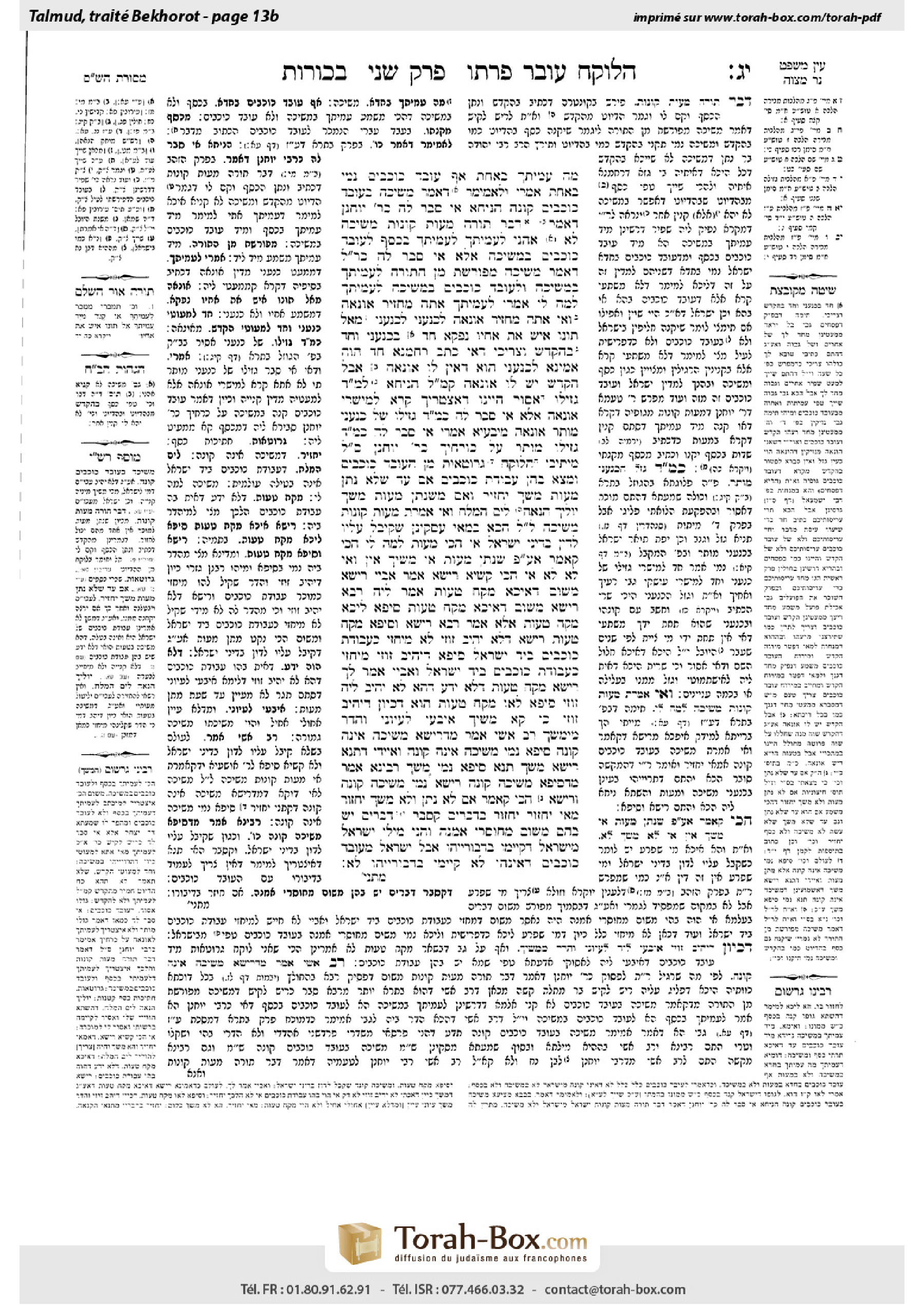
This page of Bekhorot includes the Aramaic text, an English translation and an AI-generated French translation, alongside the scan above.
בכורות י״ג ב · Aramaic and Hebrew text
מָה ״עֲמִיתֶךָ״ בְּאַחַת, אַף גּוֹי נָמֵי בְּאַחַת.
אָמְרִי: וּלְאָמֵימָר דְּאָמַר מְשִׁיכָה בְּגוֹי קוֹנָה, הָנִיחָא אִי סָבַר לַהּ כְּרַבִּי יוֹחָנָן דְּאָמַר: דְּבַר תּוֹרָה מָעוֹת קוֹנוֹת, מְשִׁיכָה לֹא, אַהֲנִי ״לַעֲמִיתֶךָ״ — לַעֲמִיתֶךָ בְּכֶסֶף, לְגוֹי בִּמְשִׁיכָה.
אֶלָּא אִי סָבַר לַהּ כְּרֵישׁ לָקִישׁ, דְּאָמַר: מְשִׁיכָה מְפוֹרֶשֶׁת מִן הַתּוֹרָה, לַעֲמִיתֶךָ בִּמְשִׁיכָה, וּלְגוֹי בִּמְשִׁיכָה, ״לַעֲמִיתֶךָ״ לְמָה לִי?
אָמְרִי: לַעֲמִיתֶךָ אַתָּה מַחְזִיר אוֹנָאָה, וְאִי אַתָּה מַחֲזִיר אוֹנָאָה לְגוֹי. לְגוֹי — מֵ״אַל תּוֹנוּ אִישׁ אֶת אָחִיו״ נָפְקָא!
חַד בְּגוֹי, וְחַד בְּהֶקְדֵּשׁ, וּצְרִיכִי, דְּאִי כְּתַב רַחֲמָנָא חַד — הֲוָה אָמֵינָא: לְגוֹי הוּא דְּאֵין לוֹ אוֹנָאָה, אֲבָל הֶקְדֵּשׁ — יֵשׁ לוֹ אוֹנָאָה, קָא מַשְׁמַע לַן.
הָנִיחָא לְמַאן דְּאָמַר גְּזֵילוֹ אָסוּר — הַיְינוּ דְּאִצְטְרִיךְ קְרָא לְמִישְׁרֵי אוֹנָאָה, אֶלָּא אִי סָבַר לַהּ כְּמַאן דְּאָמַר גְּזֵילוֹ שֶׁל גּוֹי מוּתָּר, אוֹנָאָה מִיבַּעְיָא? אָמְרִי: אִי סָבַר לַהּ כְּמַאן דְּאָמַר גְּזֵילוֹ מוּתָּר — עַל כּוּרְחָיךְ כְּרַבִּי יוֹחָנָן סְבִירָא לֵיהּ.
מֵיתִיבִי: הַלּוֹקֵחַ גְּרוּטָאוֹת מִן הַגּוֹיִם, וּמָצָא בָּהֶן עֲבוֹדָה זָרָה — אִם עַד שֶׁלֹּא נָתַן מָעוֹת מָשַׁךְ — יַחֲזִיר, וְאִם מִשֶּׁנָּתַן מָעוֹת מָשַׁךְ — יוֹלִיךְ הֲנָאָה לְיָם הַמֶּלַח.
וְאִי אָמְרַתְּ מָעוֹת קוֹנוֹת, מְשִׁיכָה לְמָה לִּי? הָכָא בְּמַאי עָסְקִינַן — שֶׁקִּיבֵּל עָלָיו לָדוּן בְּדִינֵי יִשְׂרָאֵל. אִי הָכִי, מָעוֹת לְמָה לִי? הָכִי קָאָמַר: אַף עַל פִּי שֶׁנָּתַן מָעוֹת, אִי מָשֵׁיךְ — אִין, וְאִי לָא — לָא.
אִי הָכִי, קַשְׁיָא רֵישָׁא! אָמַר אַבָּיֵי: רֵישָׁא מִשּׁוּם דְּאִיכָּא מִקָּח טָעוּת. אֲמַר לֵיהּ רָבָא: רֵישָׁא מִשּׁוּם דְּאִיכָּא מִקָּח טָעוּת, סֵיפָא לֵיכָּא מִקָּח טָעוּת?
אֶלָּא אָמַר רָבָא: רֵישָׁא וְסֵיפָא מִקָּח טָעוּת, רֵישָׁא דְּלָא יָהֵיב זוּזֵי — לָא מִיחְזֵי כַּעֲבוֹדָה זָרָה בְּיַד יִשְׂרָאֵל, סֵיפָא דְּיָהֵיב זוּזֵי — מִיחְזֵי כַּעֲבוֹדָה זָרָה בְּיַד יִשְׂרָאֵל.
וְאַבַּיֵּי אָמַר לָךְ: רֵישָׁא מִקָּח טָעוּת, דְּלָא יָדַע, דְּהָא לָא יְהַיב לֵיהּ זוּזֵי. סֵיפָא לָאו מִקָּח טָעוּת הוּא, דְּכֵיוָן דִּיהַיב זוּזֵי, כִּי קָא מָשֵׁיךְ — אִיבְּעִי לְעַיּוֹנֵי וַהֲדַר מִימְשָׁךְ.
רַב אָשֵׁי אָמַר: מִדְּרֵישָׁא מְשִׁיכָה אֵינָהּ קוֹנָה, סֵיפָא נָמֵי מְשִׁיכָה אֵינָהּ קוֹנָה, וְאַיְּידֵי דִּתְנָא רֵישָׁא ״מָשַׁךְ״, תְּנָא סֵיפָא נָמֵי ״מָשַׁךְ״.
רָבִינָא אָמַר: מִדְּסֵיפָא מְשִׁיכָה קוֹנָה, רֵישָׁא נָמֵי מְשִׁיכָה קוֹנָה, וְרֵישָׁא הָכִי קָאָמַר: אִם לֹא נָתַן וְלֹא מָשַׁךְ — יַחְזוֹר. מַאי יַחְזוֹר? יַחְזוֹר בִּדְבָרִים.
קָסָבַר: דְּבָרִים יֵשׁ בָּהֶם מִשּׁוּם מְחוּסְּרֵי אֲמָנָה, וְהָנֵי מִילֵּי — יִשְׂרָאֵל מִיִּשְׂרָאֵל, דְּקָיְימִי בְּדִבּוּרַיְיהוּ, אֲבָל יִשְׂרָאֵל מִגּוֹיִם, דְּאִינְהוּ לָא קָיְימִי בְּדִבּוּרַיְיהוּ — לָא.
Bekhorot 13b · English translation
Just as property is acquired from your counterpart through only one act of acquisition, i.e., pulling, so too, property is acquired from a gentile through only one act of acquisition, i.e., payment of money.
The Sages said: And according to the opinion of Ameimar, who says that pulling effects acquisition in the case of a gentile, this works out well if he holds in accordance with the opinion of Rabbi Yoḥanan, who says: By Torah law, money effects acquisition, but pulling does not. If Ameimar accepts Rabbi Yoḥanan’s opinion, then it can be derived from the phrase “of your counterpart” that transactions with your counterpart, i.e., a Jew, are effected through payment of money, whereas transactions with a gentile are effected by pulling.
But if Ameimar holds in accordance with the opinion of Reish Lakish, who says: The act of acquisition of pulling is explicit in the Torah, then the halakha is that transactions with your counterpart are effected by pulling, and transactions with a gentile are also effected by pulling. Accordingly, why do I need the phrase “of your counterpart”?
The Sages said in explanation: The phrase “of your counterpart” does not teach a halakha with regard to the method of acquisition. Rather, it is referring to the latter part of the verse: “And if you make a sale to your counterpart, or buy of your counterpart’s hand, a man shall not exploit his brother” (Leviticus 25:14). The verse is derived as follows: You must return the sum of exploitation to your counterpart, but you do not need to return the sum of exploitation to a gentile. The Gemara rejects this suggestion: The exemption from returning the sum of exploitation to a gentile is derived from the latter part of the verse alone: “A man shall not exploit his brother.” A gentile is not included in the category of “his brother.” Accordingly, the phrase “of your counterpart” remains extraneous.
The Gemara responds: One phrase is required to exclude a gentile, and one serves to exclude consecrated property. And both derivations are necessary, as, had the Merciful One written only one exclusionary phrase, I would say: It is with regard to transactions with a gentile that one is not subject to the prohibition of exploitation; but with regard to transactions involving consecrated property, one is subject to the prohibition of exploitation. Therefore, the other derivation teaches us that one is not subject to the prohibition of exploitation with regard to transactions involving consecrated property either.
The Gemara remarks: This works out well according to the one who says that his robbery, i.e., robbing a gentile, is prohibited, as this is the reason that a verse is necessary to permit keeping the sum of the exploitation obtained from a gentile. But if Ameimar holds in accordance with the opinion of the one who says that his robbery is permitted, is it necessary to state that one may keep the sum of the exploitation obtained from a gentile? The Gemara accepts this reasoning: The Sages said: If Ameimar holds in accordance with the opinion of the one who says that his robbery is permitted, perforce he holds in accordance with the opinion of Rabbi Yoḥanan that money effects acquisition by Torah law, and therefore the difficulty does not arise.
§ The Gemara raises an objection to the opinion that property is acquired from a gentile by monetary payment. It is taught in a baraita: With regard to one who buys broken vessels [gerutaot] made of gold or silver from the gentiles and finds among them an object of idol worship, if he pulled the object of idol worship, thereby performing an act of acquisition, before he gave the money to the gentile, he may return the object of idol worship to the gentile. But if he pulled it after he gave the money to the gentile, he may not return it. Since the idol’s status was not revoked, he must take it and cast it into the Dead Sea.
The Gemara explains the difficulty: And if you say that payment of money acquires items from gentiles, why do I need pulling in order to effect the Jew’s acquisition of the idol? The Gemara answers: Here we are dealing with a case where the gentile accepted upon himself to have this transaction adjudicated by Jewish law. The Gemara raises an objection: If so, why do I need the payment of money in order to effect the Jew’s acquisition of the idol? Pulling alone should be enough, in accordance with halakha. The Gemara explains that this is what the baraita means: Even though the Jew gave money to the gentile, the halakha still depends on the act of pulling: If he pulled the broken vessels, yes, he has acquired them, and if not, he has not acquired them.
The Gemara asks: If so, then the first clause of the baraita is difficult, as it states: If he pulled the object of idol worship before he gave the money to the gentile, he may return the object of idol worship to the gentile. Evidently, pulling alone does not effect acquisition. Abaye said in explanation: The halakha in the first clause is ruled as it is because there is a mistaken transaction, as the Jew did not wish to purchase the idol. Rava said to Abaye: You maintain that the halakha of the first clause is ruled as it is because there is a mistaken transaction. Is that to say that in the latter clause there is no mistaken transaction? After all, the Jew does not wish to purchase the idol in either case.
Rather, Rava said: The purchase in the first clause and the purchase in the latter clause are both a mistaken transaction, but in the case presented in the first clause, where the Jew did not pay him the dinars, it does not appear as though there is an object of idol worship in the possession of a Jew, and so he may return it. By contrast, in the latter clause, where the Jew did pay him the dinars, it appears as though there is an object of idol worship in the possession of a Jew, and therefore he must cast away the object rather than return it.
And Abaye could have said to you: The first clause involves a mistaken transaction, as he did not know that the idol was included, as he did not give him the dinars and therefore had not yet inspected the property being purchased. Conversely, the latter clause is not a case of a mistaken transaction, as since he already gave the dinars to the seller, when he came to pull it, he should have inspected the property and then pulled it. Since the Jew did not bother to inspect the property even after paying, the transaction is valid.
The Gemara cites two more interpretations of the baraita. Rav Ashi says: The baraita is in fact discussing a case where the transaction was subject to gentile law, according to which only monetary payment effects acquisition, and as for the aforementioned difficulty raised to the opinion of Rabbi Oshaya from the latter clause: If so, why do I need pulling in order to effect the Jew’s acquisition of the idol; pulling is not in fact required. Rather, from the fact that in the first clause, pulling does not effect acquisition, in the latter clause too, pulling does not effect acquisition. But since the first clause taught the word: Pulled, in order to teach that this method is ineffective, the latter clause also taught the word: Pulled, despite the fact that its mention is unnecessary.
Ravina said: The baraita is discussing a case where it was agreed that the transaction would be subject to Jewish law. From the fact that in the latter clause, pulling effects acquisition, in the first clause too, pulling effects acquisition. And as for the difficulty with regard to the first clause, which states that the Jew may return the item even though he already pulled it, this is what the baraita is saying: If the buyer did not give the money to the gentile and also did not pull the item, he returns the item to the seller. The Gemara adds: What does the term: Returns, mean in this context? It means that the Jew returns, i.e., reneges, on his verbal commitment. In other words, he is not required to complete the purchase despite the fact he initially agreed to do so.
The Gemara elaborates: It was necessary for the tanna to teach this explicitly, as he holds: Reneging on a verbal commitment that was unaccompanied by an act of acquisition constitutes an act of bad faith between two parties. And he holds that this statement applies only to a case where a Jew purchases an item from another Jew, as they are assumed to uphold their verbal commitments. But in a case of a Jew who purchases an item from gentiles, as they are not assumed to uphold their verbal commitments, reneging on one’s word does not constitute an act of bad faith between the parties, since neither party relies upon the commitment of the other in the first place.
Bekhorot 13b · Traduction française (IA)
Comme la propriété est acquise auprès de votre pair par un seul acte d'acquisition, à savoir le tirage, de même la propriété est acquise auprès d'un non-Juif par un seul acte d'acquisition, à savoir le paiement d'argent.
Les Sages dirent : Selon l'opinion d'Ameimar, qui affirme que le tirage acquiert la propriété dans le cas d'un non-Juif, cela s'explique bien si l'on suit l'opinion de Rabbi Yoḥanan, qui dit : Selon la Loi juive, l'argent acquiert la propriété, mais le tirage ne le fait pas. Si Ameimar accepte l'opinion de Rabbi Yoḥanan, alors on peut déduire de la phrase « de votre pair » que les transactions avec votre pair, c'est-à-dire un Juif, sont effectuées par le paiement d'argent, tandis que les transactions avec un non-Juif sont effectuées par le tirage.
Mais si Ameimar suit l'opinion de Reish Lakish, qui affirme que l'acte d'acquisition par tirage est explicite dans la Torah, alors la halakha est que les transactions avec votre pair sont effectuées par le tirage, et les transactions avec un non-Juif sont également effectuées par le tirage. Ainsi, pourquoi a-t-on besoin de la phrase « de votre pair » ?
Les Sages expliquent ainsi : La phrase « de votre pair » ne transmet pas une halakha concernant la méthode d'acquisition. Elle fait référence à la seconde partie de la versette : « Et si tu vendes à ton pair, ou achètes de la main de ton pair, un homme ne doit pas exploiter son frère » (Lévitique 25:14). La versette est dérivée comme suit : Tu dois rendre la somme de l'exploitation à ton pair, mais tu n'as pas besoin de la rendre à un non-Juif. La Guemara rejette cette suggestion : L'exemption de rendre la somme de l'exploitation à un non-Juif est dérivée uniquement de la seconde partie de la versette : « Un homme ne doit pas exploiter son frère ». Un non-Juif n'est pas inclus dans la catégorie de « son frère ». Ainsi, la phrase « de votre pair » reste inutile.
La Guemara répond : Une seule phrase est nécessaire pour exclure un non-Juif, et une autre pour exclure la propriété consacrée. Et les deux dérivation sont nécessaires, car, si Dieu avait écrit seulement une seule phrase d'exclusion, je dirais : C'est concernant les transactions avec un non-Juif que l'on n'est pas soumis à l'interdiction d'exploitation ; mais concernant les transactions impliquant la propriété consacrée, l'on est soumis à cette interdiction. Ainsi, l'autre dérivation nous apprend que l'on n'est pas soumis à l'interdiction d'exploitation concernant les transactions impliquant la propriété consacrée non plus.
La Guemara remarque : Cela s'explique bien selon celui qui dit que son vol, c'est-à-dire voler un non-Juif, est interdit, car c'est la raison pour laquelle une versette est nécessaire pour permettre de garder la somme de l'exploitation obtenue auprès d'un non-Juif. Mais si Ameimar suit l'opinion de celui qui dit que son vol est permis, est-il nécessaire de dire qu'on peut garder la somme de l'exploitation obtenue auprès d'un non-Juif ? La Guemara accepte cette raison : Les Sages dirent : Si Ameimar suit l'opinion de celui qui dit que son vol est permis, il suit nécessairement l'opinion de Rabbi Yoḥanan selon laquelle l'argent acquiert la propriété selon la Loi juive, et donc la difficulté ne se présente pas.
§ La Guemara soulève une objection contre l'opinion selon laquelle la propriété est acquise auprès d'un non-Juif par le paiement d'argent. Il est enseigné dans une baraïta : Concernant celui qui achète des objets brisés [gerutaot] en or ou en argent auprès des non-Juifs et découvre parmi eux un objet d'idolâtrie, si l'on tire l'objet d'idolâtrie, effectuant ainsi un acte d'acquisition, avant de lui avoir donné l'argent, on peut rendre l'objet d'idolâtrie au non-Juif. Mais si l'on tire l'objet après avoir donné l'argent, on ne peut pas le rendre. Puisque le statut de l'idole n'a pas été révoqué, il faut le prendre et le jeter dans la Mer Morte.
La Guemara explique la difficulté : Et si vous dites que le paiement d'argent acquiert les objets auprès des non-Juifs, pourquoi ai-je besoin du tirage pour effectuer l'acquisition du Juif sur l'idole ? La Guemara répond : Ici, nous sommes en présence d'un cas où le non-Juif a accepté de faire régler cette transaction selon la loi juive. La Guemara soulève une objection : Si c'est ainsi, pourquoi ai-je besoin du paiement d'argent pour effectuer l'acquisition du Juif sur l'idole ? Le tirage seul devrait suffire, selon la halakha. La Guemara explique que c'est ce que la baraïta signifie : Même si le Juif a donné l'argent au non-Juif, la halakha dépend toujours de l'acte de tirage : s'il a tiré les objets brisés, oui, il les a acquis, et s'il n'a pas tiré, il ne les a pas acquis.
La Guemara pose la question : Si c'est ainsi, alors la première partie de la baraïta est difficile, car elle stipule : Si il a tiré l'objet d'idolâtrie avant de lui avoir donné l'argent, il peut rendre l'objet d'idolâtrie au non-Juif. Évidemment, le tirage seul ne suffit pas à l'acquisition. Abaye explique ainsi : La halakha dans la première partie est ainsi réglée car il y a une transaction erronée, le Juif n'ayant pas souhaité acheter l'idole. Rava dit à Abaye : Vous maintenez que la halakha de la première clause est ainsi réglée en raison d'une transaction erronée. Est-ce pour dire que dans la seconde clause il n'y a pas de transaction erronée ? En effet, le Juif n'a pas souhaité acheter l'idole dans les deux cas.
Plutôt, Rava dit : Les achats dans la première clause et dans la seconde clause sont tous deux des transactions erronées, mais dans le cas présenté dans la première clause, où le Juif n'a pas payé les dinars, il ne semble pas qu'il y ait un objet d'idolâtrie dans la possession d'un Juif, et donc il peut le rendre. En revanche, dans la seconde clause, où le Juif a payé les dinars, il semble qu'il y ait un objet d'idolâtrie dans la possession d'un Juif, et donc il doit jeter l'objet plutôt que le rendre.
Et Abaye aurait pu dire à l'audience : La première clause implique une transaction erronée, car il ne savait pas que l'idole était incluse, car il n'avait pas donné les dinars et n'avait donc pas encore inspecté la propriété achetée. À l'inverse, la seconde clause n'est pas un cas de transaction erronée, car puisqu'il avait déjà donné les dinars au vendeur, lorsqu'il vint tirer l'objet, il aurait dû inspecter la propriété et ensuite tirer l'objet. Puisque le Juif n'a pas pris la peine d'inspecter la propriété même après avoir payé, la transaction est valide.
La Guemara cite deux autres interprétations de la baraïta. Rav Ashi dit : La baraïta discute en fait d'un cas où la transaction était soumise à la loi des Gentils, selon laquelle seul le paiement monétaire constitue l'acquisition, et concernant la difficulté soulevée à l'égard de l'opinion de Rabbi Oshaya à partir de la seconde clause : Si c'est ainsi, pourquoi ai-je besoin de tirer pour que l'acquisition du Juif de l'idole soit effective ; le tirage n'est pas en fait requis. Plutôt, du fait que dans la première clause, le tirage ne constitue pas une acquisition, dans la seconde clause non plus le tirage ne constitue pas une acquisition. Mais puisque la première clause a enseigné le mot : tiré, afin d'enseigner que cette méthode est inefficace, la seconde clause a également enseigné le mot : tiré, malgré le fait que sa mention n'était pas nécessaire.
Ravina dit : La baraïta discute d'un cas où il a été convenu que la transaction serait soumise à la loi juive. Du fait que dans la seconde clause, le tirage constitue une acquisition, dans la première clause également le tirage constitue une acquisition. Et concernant la difficulté concernant la première clause, qui stipule que le Juif peut rendre l'objet même s'il l'a déjà tiré, c'est ce que la baraïta dit : Si l'acheteur n'a pas donné l'argent au Gentil et n'a pas tiré l'objet, il rend l'objet au vendeur. La Guemara ajoute : Qu'entend-on par le mot : rend, dans ce contexte ? Cela signifie que le Juif rend, c'est-à-dire renonce, à son engagement verbal. En d'autres termes, il n'est pas tenu de finaliser l'achat malgré le fait qu'il ait initialement convenu de le faire.
La Guemara développe : Il était nécessaire que le tanna enseigne cela explicitement, car il considère que renoncer à un engagement verbal non accompagné d'une action d'acquisition constitue un acte de mauvaise foi entre deux parties. Et il considère que cette déclaration s'applique uniquement à un cas où un Juif achète un objet d'un autre Juif, car ils sont supposés respecter leurs engagements verbaux. Mais dans le cas d'un Juif qui achète un objet de Gentils, car ils ne sont pas supposés respecter leurs engagements verbaux, renoncer à sa parole ne constitue pas un acte de mauvaise foi entre les parties, car ni l'une ni l'autre des parties ne s'appuient sur la parole de l'autre dès le départ.
Traduction française générée par IA à partir de l’édition anglaise de Sefaria. Vérifie toujours un passage avec le texte source.
Text from Sefaria: William Davidson Edition - Vocalized Aramaic (CC BY NC); William Davidson Edition - English (CC BY NC).