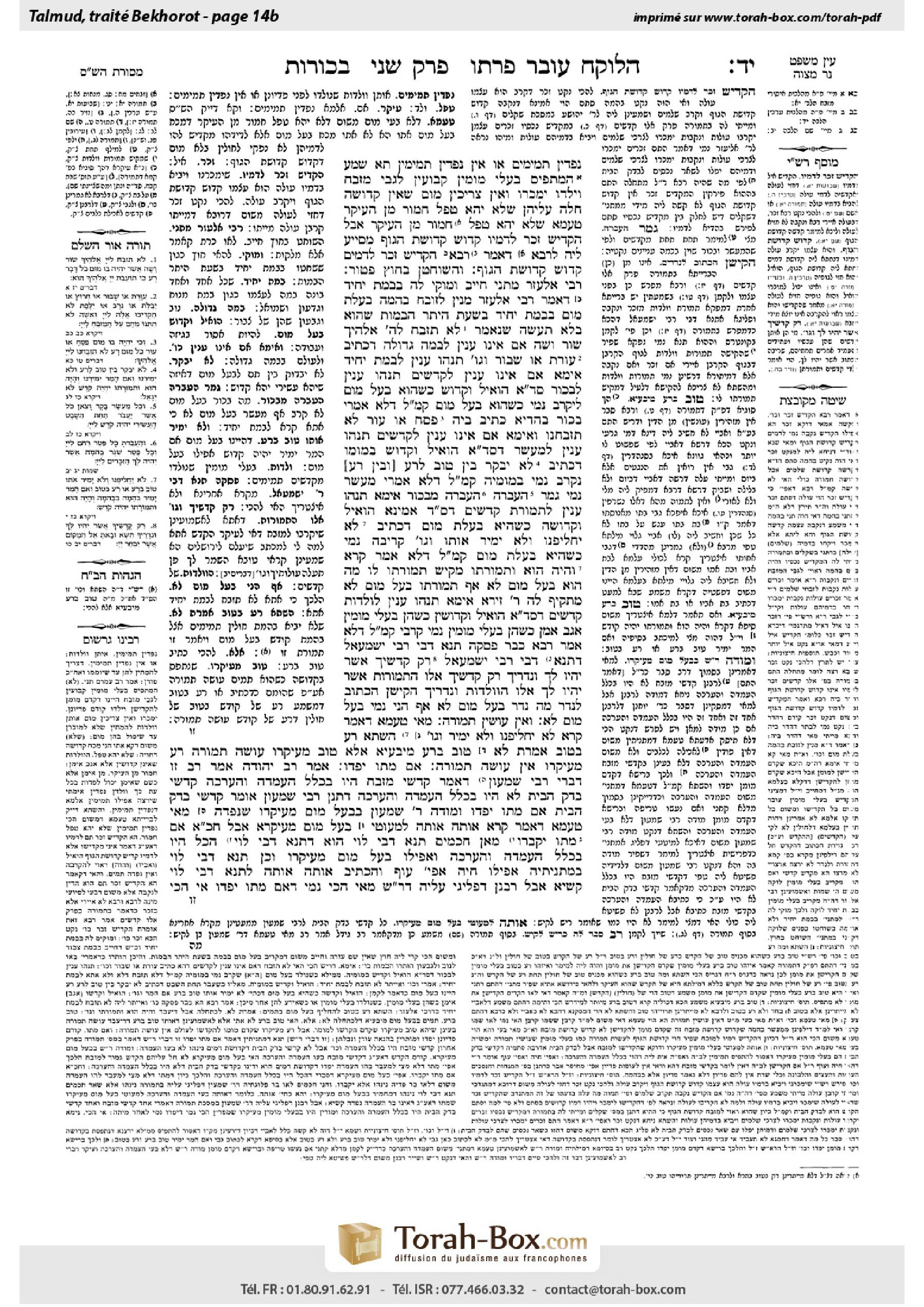
Bekhorot 14b: Talmud study for Daf Yomi
Study the Talmud for Daf Yomi with scanned pages, Hebrew text, English translations from Sefaria and AI-generated French translations.
Passage selection and English or AI-generated French translation are available where the scan has annotations. Daf Study is independent of Torah-Box and Sefaria.
Browse Bekhorot · בכורות · All tractatesBekhorot 14b text and translations
This page of Bekhorot includes the Aramaic text, an English translation and an AI-generated French translation, alongside the scan above.
בכורות י״ד ב · Aramaic and Hebrew text
נִפְדִּין תְּמִימִים אוֹ אֵין נִפְדִּין תְּמִימִין?
תָּא שְׁמַע: הַמַּתְפִּיס בַּעֲלֵי מוּמִין קְבוּעִין לְגַבֵּי מִזְבֵּחַ, וְיָלְדוּ — יִמָּכְרוּ, וְאֵין צְרִיכִין מוּם, שֶׁאֵין קְדוּשָּׁה חָלָה עֲלֵיהֶן, שֶׁלֹּא יְהֵא טָפֵל חָמוּר מִן הָעִיקָּר.
טַעְמָא, שֶׁלֹּא יְהֵא טָפֵל חָמוּר מִן הָעִיקָּר, אֲבָל הִקְדִּישׁ זָכָר לְדָמָיו — קָדוֹשׁ קְדוּשַּׁת הַגּוּף. מְסַיַּיע לֵיהּ לְרָבָא, דְּאָמַר רָבָא: הִקְדִּישׁ זָכָר לְדָמָיו — קָדוֹשׁ קְדוּשַּׁת הַגּוּף.
וְהַשּׁוֹחֲטָן בַּחוּץ פָּטוּר. רַבִּי אֶלְעָזָר מַתְנֵי ״חַיָּיב״, וּמוֹקֵי לַהּ בְּבָמַת יָחִיד.
דְּאָמַר רַבִּי אֶלְעָזָר: מִנַּיִן לַזּוֹבֵחַ בְּהֵמָה בַּעֲלַת מוּם בְּבָמַת יָחִיד בִּשְׁעַת הֶיתֵּר הַבָּמוֹת, שֶׁהוּא בְּלֹא תַעֲשֶׂה? שֶׁנֶּאֱמַר: ״לֹא תִזְבַּח לַה׳ אֱלֹהֶיךָ שׁוֹר וָשֶׂה״, אִם אֵינוֹ עִנְיָן לְבָמָה גְּדוֹלָה, דִּכְתִיב: ״עַוֶּרֶת אוֹ שָׁבוּר וְגוֹ׳״, תְּנֵהוּ עִנְיָן לְבָמַת יָחִיד.
אֵימָא: אִם אֵינוֹ עִנְיָן לְקָדָשִׁים — תְּנֵהוּ עִנְיָן לִבְכוֹר, סָלְקָא דַּעְתָּךְ אָמֵינָא: הוֹאִיל וְקָדוֹשׁ כְּשֶׁהוּא בַּעַל מוּם — לִיקְרַב נָמֵי כְּשֶׁהוּא בַּעַל מוּם, קָא מַשְׁמַע לַן דְּלָא!
אָמְרִי: בְּכוֹר בְּהֶדְיָא כְּתִיב בֵּיהּ ״פִּסֵּחַ אוֹ עִוֵּר לֹא תִזְבָּחֶנּוּ״.
וְאֵימָא: אִם אֵינוֹ עִנְיָן לְקָדָשִׁים — תְּנֵהוּ עִנְיָן לְמַעֲשֵׂר, דְּסָלְקָא דַּעְתָּךְ אָמֵינָא: הוֹאִיל וְקָדוֹשׁ בְּמוּמוֹ, דִּכְתִיב: ״לֹא יְבַקֵּר בֵּין טוֹב לָרַע״, נִקְרַב נָמֵי בְּמוּמֵיהּ, קָא מַשְׁמַע לַן דְּלָא!
אָמְרִי: מַעֲשֵׂר נָמֵי גָּמַר ״הַעֲבָרָה״ ״הַעֲבָרָה״ מִבְּכוֹר.
אֵימָא: תְּנֵהוּ עִנְיָן לִתְמוּרַת קָדָשִׁים, דְּסָלְקָא דַּעְתָּךְ אָמֵינָא: הוֹאִיל וּקְדוֹשָׁה כְּשֶׁהִיא בַּעֲלַת מוּם, דִּכְתִיב: ״לֹא יַחֲלִיפֶנּוּ וְלֹא יָמִיר אוֹתוֹ וְגוֹ׳״, קָרֵיבָה נָמֵי כְּשֶׁהִיא בַּעֲלַת מוּם, קָא מַשְׁמַע לַן דְּלָא!
אָמַר קְרָא: ״וְהָיָה הוּא וּתְמוּרָתוֹ״, מַקִּישׁ תְּמוּרָתוֹ לוֹ — מָה הוּא בַּעַל מוּם לֹא, אַף תְּמוּרָתוֹ בַּעַל מוּם לֹא.
מַתְקֵיף לַהּ רַבִּי זֵירָא: אֵימָא, תְּנֵהוּ עִנְיָן לְוַלְדוֹת קָדָשִׁים, דְּסָלְקָא דַּעְתָּךְ אָמֵינָא: הוֹאִיל וּקְדוֹשִׁין כְּשֶׁהֵן בַּעֲלֵי מוּמִין אַגַּב אִמָּן, כְּשֶׁהֵן בַּעֲלֵי מוּמִין נָמֵי קָרְבִי, קָא מַשְׁמַע לַן דְּלָא!
אָמַר רָבָא: כְּבָר פַּסְקַהּ תַּנָּא דְּבֵי רַבִּי יִשְׁמָעֵאל, דְּתָנָא דְּבֵי רַבִּי יִשְׁמָעֵאל: ״רַק קָדָשֶׁיךָ אֲשֶׁר יִהְיוּ לְךָ וּנְדָרֶיךָ״ — ״רַק קָדָשֶׁיךָ״ אֵלּוּ הַתְּמוּרוֹת, ״אֲשֶׁר יִהְיוּ לְךָ״ אֵלּוּ הַוְּולָדוֹת, ״וּנְדָרֶיךָ״ — הִקִּישָׁן הַכָּתוּב לְנֶדֶר, מָה נֶדֶר בַּעַל מוּם לֹא, אַף הָנֵי נָמֵי בַּעַל מוּם לֹא.
וְאֵין עוֹשִׂין תְּמוּרָה, מַאי טַעְמָא? דְּאָמַר קְרָא: ״לֹא יַחֲלִיפֶנּוּ וְלֹא יָמִיר וְגוֹ׳״. הַשְׁתָּא רַע בְּטוֹב אָמְרַתְּ לֹא, טוֹב בְּרָע מִיבַּעְיָא? אֶלָּא טוֹב מֵעִיקָּרוֹ עוֹשֶׂה תְּמוּרָה, רַע מֵעִיקָּרוֹ אֵין עוֹשֶׂה תְּמוּרָה.
אִם מֵתוּ יִפָּדוּ. אָמַר רַב יְהוּדָה אָמַר רַב: זוֹ דִּבְרֵי רַבִּי שִׁמְעוֹן, דְּאָמַר: קׇדְשֵׁי מִזְבֵּחַ הָיוּ בִּכְלַל הַעֲמָדָה וְהַעֲרָכָה, קׇדְשֵׁי בֶּדֶק הַבַּיִת לֹא הָיוּ בִּכְלַל הַעֲמָדָה וְהַעֲרָכָה.
דִּתְנַן, רַבִּי שִׁמְעוֹן אוֹמֵר: קׇדְשֵׁי בֶּדֶק הַבַּיִת, אִם מֵתוּ — יִפָּדוּ. וּמוֹדֶה רַבִּי שִׁמְעוֹן בְּבַעַל מוּם מֵעִיקָּרוֹ שֶׁנִּפְדֶּה. מַאי טַעְמָא? דְּאָמַר קְרָא: ״אוֹתָהּ״ ״אוֹתָהּ״ — לְמַעוֹטֵי בַּעַל מוּם מֵעִיקָּרָא.
אֲבָל חֲכָמִים אוֹמְרִים: אִם מֵתוּ — יִקָּבֵרוּ. מַאן חֲכָמִים? תָּנָא דְּבֵי לֵוִי הוּא, דְּתָנָא דְּבֵי לֵוִי: הַכֹּל הָיוּ בִּכְלַל הַעֲמָדָה וְהַעֲרָכָה, וַאֲפִילּוּ בַּעַל מוּם מֵעִיקָּרוֹ.
וְכֵן תָּנָא דְּבֵי לֵוִי בְּמַתְנִיתֵיהּ: אֲפִילּוּ חַיָּה, אֲפִילּוּ עוֹף, וְהָכְתִיב ״אוֹתָהּ״! ״אוֹתָהּ״ לְתָנָא דְּבֵי לֵוִי קַשְׁיָא.
אֲבָל רַבָּנַן דִּפְלִיגִי עֲלֵיהּ דְּרַבִּי שִׁמְעוֹן, מַאי? הָכִי נָמֵי דְּאִם מֵתוּ יִפָּדוּ? אִי הָכִי,
Bekhorot 14b · English translation
The halakha is that the offspring of an animal that possesses inherent sanctity is born sanctified, and therefore it cannot be redeemed until it develops a blemish. The Gemara asks: With regard to the offspring of an animal that possesses sanctity that inheres in its value, are they redeemed unblemished, or are they not redeemed unblemished? In other words, can they be redeemed immediately, or must one wait until they develop a blemish?
The Gemara suggests: Come and hear a proof from a baraita: With regard to one who dedicates permanently blemished animals for the altar, and those animals gave birth, their offspring may be sold in order to be redeemed and they do not require a blemish to render their sale permitted. The reason is that they are not imbued with sanctity, and that the subsidiary sanctity of the offspring should not be more stringent than the primary sanctity of the mother. Since the blemished mother can be redeemed without delay, the same applies to its offspring. This proves that the offspring of animals that possess sanctity that inheres in their value may be redeemed.
The Gemara notes: The reason that the baraita rules that the sanctity for the altar does not take effect is that the subsidiary sanctity should not be more stringent than the primary sanctity, i.e., the only reason it is not sanctified for the altar is because its sanctity is derived from its mother, which cannot be sanctified for the altar as it is blemished. But if one consecrated an unblemished male animal for its value, where there is no secondary consecration, it is sanctified with inherent sanctity. The Gemara adds that this supports the opinion of Rava, as Rava says: If one consecrated a male animal for its value, it is sanctified with inherent sanctity.
§ The mishna teaches with regard to animals whose blemish preceded their consecration: And one who slaughters them outside the Temple courtyard is exempt. The Gemara notes that Rabbi Elazar teaches the mishna as follows: And one who slaughters them outside the Temple courtyard is liable, and he interprets the mishna as referring to a case of a private altar of an individual. In other words, the mishna is not teaching that one is liable to receive karet for slaughtering an animal outside the Temple courtyard, but that he is liable to receive lashes for sacrificing a blemished animal upon a private altar.
As Rabbi Elazar says: From where is it derived that one who slaughters a blemished animal upon a private altar of an individual at a time when private altars are permitted is in violation of a prohibition? It is derived from a verse, as it is stated: “You shall not sacrifice to the Lord an ox, or a sheep, in which is a blemish” (Deuteronomy 17:1). If this verse is not referring to the matter of a great public altar, since that halakha is derived from a different verse, as it is written: “Blind or broken…you shall not sacrifice these unto the Lord” (Leviticus 22:22), apply the verse in Deuteronomy to the matter of a private altar of an individual.
The Gemara raises an objection: But one can say with regard to the verse in Deuteronomy: If this verse is not referring to the matter of regular sacrificial animals, which is derived from the verse in Leviticus, apply it to the matter of a firstborn, as it might enter your mind to say: Since a firstborn animal is sanctified even when it is a permanently blemished animal, let it also be sacrificed upon the altar when it is a blemished animal. The verse in Deuteronomy would therefore teach us that this is not the halakha, i.e., a blemished firstborn animal may not be sacrificed upon the altar. What, then, is the reason that the halakha of a private altar of an individual, rather than the halakha of firstborn animals, is derived from the verse in Deuteronomy?
The Sages said in explanation: Concerning a firstborn, the halakha is written explicitly with regard to it: “Every firstborn…if there be any blemish therein, lameness, or blindness…you shall not sacrifice it” (Deuteronomy 15:19–21). Consequently, the verse in Deuteronomy, chapter 17, cannot be referring to the halakha that a firstborn animal may not be sacrificed upon the altar, as that is already taught in chapter 15.
The Gemara inquires: But still, one can say: If the verse in chapter 17 is not referring to the matter of sacrificial animals, which is derived from the verse in Leviticus, apply it to the matter of the animal tithe, as it might enter your mind to say: Since a tithed animal is sacred even with its blemish, as it is written: “He shall not inquire whether it be good or bad” (Leviticus 27:33), let it also be sacrificed with its blemish. The verse in Deuteronomy (17:1) would therefore teach us that this is not the halakha, i.e., a blemished tithed animal may not be sacrificed upon the altar.
The Sages said in response: With regard to the animal tithe as well, it is unnecessary for the verse to teach this halakha, as it is derived from a verbal analogy between the word: Passing, mentioned with regard to tithed animals (see Leviticus 27:32), and passing mentioned with regard to the firstborn (see Exodus 13:12). Just as a blemished firstborn animal is not sacrificed upon the altar, so too, a blemished tithed animal is not sacrificed upon the altar.
The Gemara persists: But say that one should apply Deuteronomy 17:1 to the matter of animals substituted for sacrificial animals, as it might enter your mind to say: Since a substitute becomes sacred even when it is blemished, as it is written: “He shall not exchange it, nor substitute it, a good for a bad, or a bad for a good; and if he shall at all substitute animal for animal, then both it and that for which it is substituted shall be holy” (Leviticus 27:10), it may likewise be sacrificed when it is blemished. The verse in Deuteronomy would therefore teach us that this is not the halakha, as a blemished substitute cannot be sacrificed upon the altar.
The Gemara answers: The halakha with regard to a substitute is already established, as the verse states: “It and that for which it is substituted shall be holy.” The verse compares a substitute to the consecrated animal for which it was substituted: Just as the consecrated animal is not sacrificed if it is blemished, so too, its substitute is not sacrificed if it is blemished.
The Gemara presents a final objection: Rabbi Zeira objects to the claim that Deuteronomy 17:1 should be understood as referring to a private altar of an individual. Say instead that one should apply it to the matter of the offspring of sacrificial animals, as it could enter your mind to say: Since they are sacred even when they are blemished, on account of their mother, they may also be sacrificed when they are blemished. Deuteronomy 17:1 would therefore teach us that this is not the halakha.
Rava says in response: The tanna of the school of Rabbi Yishmael has already ruled that the blemished offspring of sacrificial animals cannot be sacrificed upon the altar, from a different verse. As the school of Rabbi Yishmael taught: The verse states: “Only your sacred items which you have, and your vows, you shall take, and go to the place which the Lord shall choose” (Deuteronomy 12:26). “Only your sacred items”; these are the substitutes. “Which you have”; these are the offspring. When it states: “And your vows,” the verse thereby juxtaposes animal substitutes and offspring with an animal consecrated by a vow, teaching that just as an animal consecrated by a vow is not sacrificed if it is blemished, so too, these are also not sacrificed if they are blemished. Accordingly, Deuteronomy 17:1 must be understood as referring to a private altar of an individual, as maintained by Rabbi Elazar.
§ The mishna teaches: And sacrificial animals whose blemish preceded their consecration do not render an animal that was a substitute for them sacred. The Gemara asks: What is the reason for this ruling? It is derived from a verse, as the verse states: “He shall not exchange it, nor substitute it, a good for a bad, or a bad for a good” (Leviticus 27:10). The Gemara infers: Now that you have said that substituting a bad animal for a good animal is not permitted, is it necessary to state that substituting a good animal for a bad animal is not permitted? Rather, the verse is teaching that an animal which is good at the outset renders an animal that was a subsitute for it sacred, but an animal that is bad at the outset, i.e., whose blemish preceded its consecration, does not render an animal that was a subsitute for it sacred.
§ The mishna further teaches: And if these animals died before they were redeemed, they may be redeemed and fed to dogs. Rav Yehuda says that Rav says: This is the statement of Rabbi Shimon, who says: Items consecrated to be sacrificed on the altar were included in the requirement of standing and valuation, but items with the sanctity of those consecrated for Temple maintenance, such as the red heifer, were not included in the requirement of standing and valuation. Since animals that were consecrated for the altar require standing and valuation in order to be redeemed, they cannot be redeemed after death, as it is no longer possible to stand them before the priest. Animals consecrated for the Temple maintenance, and likewise animals whose blemish preceded their consecration, do not require standing and valuation, and therefore they can be redeemed after death.
This is as we learned in a mishna (Temura 32a): Rabbi Shimon says: With regard to animals consecrated for the Temple maintenance, if they died they may be redeemed, because animals consecrated for the Temple maintenance are not included in the obligation of standing and valuation. And Rabbi Shimon concedes with regard to an animal that was blemished from the outset, i.e., before it was consecrated, that it may be redeemed even if it was consecrated for the altar. What is the reason? It is derived from a verse, as the verse states: “Then he shall stand the animal before the priest. And the priest shall appraise it” (Leviticus 27:11–12). The emphasis on “it” serves to exclude an animal that was blemished from the outset.
But the Rabbis say: With regard to both animals consecrated for the altar and animals consecrated for Temple maintenance, if they died they must be buried. The Gemara asks: Whose opinion is that of the Rabbis in the mishna? It is the opinion of the tanna of the school of Levi, as the school of Levi taught: All animals were included in the obligation of standing and valuation, even an animal that was blemished from the outset.
And similarly, the school of Levi taught in Levi’s own collection of baraitot: Even an undomesticated animal and even a bird are included in the obligation of standing and valuation, despite the fact that they can never be sacrificed upon the altar. The Gemara asks: But isn’t it written: “And the priest shall appraise it,” which is an expression of exclusion? If so, the verse must be excluding some case, at least that of an undomesticated animal or a bird. The Gemara concedes that the phrase “and the priest shall appraise it” is difficult according to the opinion of the tanna of the school of Levi.
The Gemara asks: But in light of this difficulty, according to the Rabbis who disagree with Rabbi Shimon in the mishna in Temura, what is the halakha? Is it indeed so that if animals whose blemish preceded their consecration died they may be redeemed, as derived from the word “it”? If that is so, then why did Rav say: This is the statement of Rabbi Shimon?
Bekhorot 14b · Traduction française (IA)
La halakha est que l'offspring d'un animal possédant une sanctité inhérente est né sanctifié, et par conséquent, il ne peut être racheté qu'une fois qu'il développe une tache. La Guemara pose la question : En ce qui concerne l'offspring d'un animal possédant une sanctité qui réside dans sa valeur, sont-ils rachetés sans tache, ou ne sont-ils pas rachetés sans tache ? En d'autres termes, peuvent-ils être rachetés immédiatement, ou doit-on attendre qu'ils développent une tache ?
La Guemara suggère : Viens écouter une preuve tirée d'une baraïta : En ce qui concerne celui qui consacre définitivement des animaux tachés pour l'autel, et ces animaux ont donné naissance à des petits, leurs petits peuvent être vendus afin d'être rachetés et ils n'ont pas besoin d'une tache pour que leur vente soit permise. La raison est qu'ils ne sont pas imprégnés de sanctité, et que la sanctité secondaire des petits ne devrait pas être plus exigeante que la sanctité primaire de la mère. Puisque la mère tachée peut être rachetée sans délai, la même chose s'applique à ses petits. Cela prouve que les petits d'animaux possédant une sanctité qui réside dans leur valeur peuvent être rachetés.
La Guemara note : La raison pour laquelle la baraïta déclare que la sanctité pour l'autel ne prend effet est que la sanctité secondaire ne devrait pas être plus exigeante que la sanctité primaire, c'est-à-dire que la seule raison pour laquelle elle n'est pas sanctifiée pour l'autel est que sa sanctité provient de sa mère, qui ne peut être sanctifiée pour l'autel car elle est tachée. Mais si l'on a consacré un mâle non taché pour sa valeur, où il n'y a pas de sanctification secondaire, il est sanctifié avec une sanctité inhérente. La Guemara ajoute que cela soutient l'opinion de Rava, car Rava dit : Si l'on a consacré un mâle pour sa valeur, il est sanctifié avec une sanctité inhérente.
§ La mitsna enseigne en ce qui concerne les animaux dont la tache a précédé leur consécration : Et celui qui les sacrifie en dehors du courtyard du Temple est exempt. La Guemara note que Rabbi Elazar enseigne la mitsna ainsi : Et celui qui les sacrifie en dehors du courtyard du Temple est responsable, et il interprète la mitsna comme se référant à un cas d'autel privé d'un individu. En d'autres termes, la mitsna ne enseigne pas que l'on est puni de karet pour sacrifier un animal en dehors du courtyard du Temple, mais qu'on est puni de coups de fouet pour sacrifier un animal taché sur un autel privé.
Comme Rabbi Elazar dit : D'où est-il dérivé que celui qui sacrifie un animal taché sur un autel privé d'un individu, à un moment où les autels privés sont permis, viole une interdiction ? C'est dérivé d'un verset, car il est écrit : « Vous ne sacrifierez point à l'Éternel un bœuf, ou une brebis, en laquelle il y a une tache » (Deutéronome 17:1). Si ce verset ne se réfère pas à la question des animaux sacrifiés en public, puisque cette halakha est dérivée d'un autre verset, comme il est écrit : « Aveugle ou brouillon… vous ne sacrifierez point ces choses à l'Éternel » (Lévitique 22:22), appliquez le verset de Deutéronome à la question de l'autel privé d'un individu.
La Guemara soulève une objection : Mais l'on peut dire concernant le verset de Deutéronome : Si ce verset ne se réfère pas à la question des animaux sacrifiés normalement, qui est tiré du verset de Lévitique, appliquez-le à la question des premiers-nés, car cela pourrait entrer en votre esprit de dire : Puisque les premiers-nés sont sanctifiés même s'ils sont blemis, ils peuvent être sacrifiés sur l'autel même s'ils sont blemis. Le verset de Deutéronome enseignerait donc que cela n'est pas la halakha, c'est-à-dire qu'un premier-né blemi ne peut pas être sacrifié sur l'autel. Qu'est-ce alors la raison pour laquelle la halakha de l'autel privé d'un individu, plutôt que celle des premiers-nés, est tirée du verset de Deutéronome ?
Les Sages dirent en explication : En ce qui concerne les premiers-nés, la halakha est explicitement écrite à leur sujet : « Tout premier-né… si il y a quelque blemish en lui, boiterie, ou aveuglement… vous ne le sacrifierez point » (Deutéronome 15:19–21). Par conséquent, le verset de Deutéronome, chapitre 17, ne peut pas se référer à la halakha selon laquelle un premier-né blemi ne peut pas être sacrifié sur l'autel, car celle-ci est déjà enseignée au chapitre 15.
La Guemara interroge : Mais encore, l'on peut dire : Si le verset du chapitre 17 ne se réfère pas à la question des animaux sacrifiés, qui est tiré du verset de Lévitique, appliquez-le à la question de l'animal titré, car cela pourrait entrer en votre esprit de dire : Puisque l'animal titré est sacré même avec sa blemish, comme il est écrit : « Il ne demandera pas s'il est bon ou mauvais » (Lévitique 27:33), il peut être sacrifié avec sa blemish. Le verset de Deutéronome (17:1) enseignerait donc que cela n'est pas la halakha, c'est-à-dire qu'un animal titré blemi ne peut pas être sacrifié sur l'autel.
Les Sages dirent en réponse : En ce qui concerne l'animal titré également, il n'était pas nécessaire que le verset enseigne cette halakha, car elle était dérivée d'une analogie verbale entre le mot « passage », mentionné concernant les animaux titrés (voir Lévitique 27:32), et « passage » mentionné concernant les premiers-nés (voir Exode 13:12). Tout comme un premier-né taché n'est pas sacrifié sur l'autel, de même un animal titré taché n'est pas sacrifié sur l'autel.
La Guemara persiste : Mais dites que l'on devrait appliquer Deutéronome 17:1 à la question des animaux substitués pour des animaux sacrifiés, car cela pourrait entrer en votre esprit de dire : Puisque le substitut devient sacré même s'il est taché, comme il est écrit : « Il ne remplacera pas, ni substituera, un bon par un mauvais, ou un mauvais par un bon ; et s'il substitue un animal à un autre, alors celui-ci et celui pour lequel il est substitué seront saints » (Lévitique 27:10), il peut être sacrifié même s'il est taché. Le verset de Deutéronome enseignerait donc que cela n'est pas la halakha, c'est-à-dire qu'un substitut taché ne peut pas être sacrifié sur l'autel.
La Guemara répond : La halakha concernant un substitut est déjà établie, car la Parashia dit : « Il et celui pour lequel il est substitué seront saints. » La Parashia compare un substitut à l'animal consacré pour lequel il a été substitué : Tout comme l'animal consacré n'est pas sacrifié s'il est blemi, de même son substitut n'est pas sacrifié s'il est blemi.
La Guemara présente un dernier objection : Rabbi Zéira s'oppose à l'idée que Deutéronome 17:1 doit être compris comme concernant un autel privé d'un individu. Dites plutôt qu'on doit l'appliquer à la question des descendants d'animaux sacrifiés, car il pourrait vous venir à l'esprit de dire : Puisque ces animaux sont saints même s'ils sont blemis, à cause de leur mère, ils peuvent aussi être sacrifiés s'ils sont blemis. Deutéronome 17:1 enseignerait donc que cela n'est pas la halakha.
Rava répond : Le tanna de l'école de Rabbi Yishmael a déjà décidé que les descendants blemis d'animaux sacrifiés ne peuvent pas être sacrifiés sur l'autel, d'un autre verset. Comme l'école de Rabbi Yishmael a enseigné : La Parashia dit : « Seulement vos choses saintes que vous avez, et vos vœux, vous les prendrez, et vous irez au lieu que l'Éternel aura choisi » (Deutéronome 12:26). « Seulement vos choses saintes » : ce sont les substituts. « Que vous avez » : ce sont les descendants. Lorsqu'elle dit : « Et vos vœux », la Parashia juxtapose les substituts et les descendants avec un animal consacré par un vœu, enseignant que tout comme un animal consacré par un vœu n'est pas sacrifié s'il est blemi, de même ces animaux ne sont pas sacrifiés s'ils sont blemis. Ainsi, Deutéronome 17:1 doit être compris comme concernant un autel privé d'un individu, comme le maintenait Rabbi Elazar.
§ La mitsva enseigne : Et les animaux sacrifiés dont la tache a précédé leur consécration ne rendent pas sacré l'animal qui les a substitués. La Guemara demande : Quel est le fondement de cette décision ? Il est tiré d'un verset, car la Parashia dit : « Il ne doit pas échanger, ni substituer, un bon pour un mauvais, ou un mauvais pour un bon » (Lévitique 27:10). La Guemara infère : Maintenant que vous dites que substituer un mauvais animal pour un bon animal n'est pas permis, est-ce nécessaire de dire que substituer un bon animal pour un mauvais animal n'est pas permis ? Plutôt, le verset enseigne que l'animal qui est bon au départ rend l'animal qui l'a substitué sacré, mais l'animal qui est mauvais au départ, c'est-à-dire dont la tache a précédé sa consécration, ne rend pas l'animal qui l'a substitué sacré.
§ La mitsva enseigne de plus : Et si ces animaux sont morts avant d'être rachetés, ils peuvent être rachetés et nourris aux chiens. Rav Yehuda dit que Rav dit : C'est la déclaration de Rabbi Shimon, qui dit : Les choses consacrées à être sacrifiées sur l'autel étaient incluses dans l'obligation de se tenir et d'être évaluées, mais les choses avec la sanctité de celles consacrées à l'entretien du Temple, comme la vache rousse, n'étaient pas incluses dans l'obligation de se tenir et d'être évaluées. Puisque les animaux consacrés à l'autel nécessitent de se tenir et d'être évalués pour être rachetés, ils ne peuvent pas être rachetés après leur mort, car il n'est plus possible de les tenir devant le prêtre. Les animaux consacrés à l'entretien du Temple, ainsi que les animaux dont la tache a précédé leur consécration, n'ont pas besoin de se tenir et d'être évalués, et par conséquent ils peuvent être rachetés après leur mort.
C'est ce que nous avons appris dans une mitsva (Temura 32a) : Rabbi Shimon dit : Concernant les animaux consacrés à l'entretien du Temple, s'ils meurent, ils peuvent être rachetés, car les animaux consacrés à l'entretien du Temple ne sont pas inclus dans l'obligation de se tenir et d'être évalués. Et Rabbi Shimon reconnaît concernant un animal blemi dès le départ, c'est-à-dire avant sa consécration, qu'il peut être racheté même s'il était consacré à l'autel. Quel est le fondement ? Il est tiré d'un verset, car la Parashia dit : « Il le placera devant le prêtre. Et le prêtre l'évaluera » (Lévitique 27:11–12). L'insistance sur « il » sert à exclure un animal blemi dès le départ.
Mais les Rabbins disent : Concernant les deux types d'animaux consacrés à l'autel et ceux consacrés à l'entretien du Temple, s'ils meurent, ils doivent être enterrés. La Guemara demande : De quel opinion sont les Rabbins dans la mitsva ? C'est l'opinion du tanna de l'école de Lévi, car l'école de Lévi a enseigné : Tous les animaux étaient inclus dans l'obligation de se tenir et d'être évalués, même un animal blemi dès le départ.
Et de même, l'école de Lévi a enseigné dans la collection de baraitot de Lévi : Même un animal sauvage et même un oiseau sont inclus dans l'obligation de se tenir et d'être évalués, malgré le fait qu'ils ne peuvent jamais être sacrifiés sur l'autel. La Guemara demande : Mais n'est-il pas écrit : « Et le prêtre l'évaluera », qui est une expression d'exclusion ? Si c'est le cas, le verset doit exclure un cas, au moins celui d'un animal sauvage ou d'un oiseau. La Guemara reconnaît que l'expression « et le prêtre l'évaluera » est difficile selon l'opinion du tanna de l'école de Lévi.
La Guemara demande : Mais en lumière de cette difficulté, selon les Rabbins qui s'opposent à Rabbi Shimon dans la Michna de Temura, quelle est la halakha ? Est-ce vraiment ainsi que si les animaux dont la tache a précédé leur consécration sont morts, ils peuvent être rachetés, comme tiré du mot « il » ? Si c'est ainsi, alors pourquoi Rav a-t-il dit : C'est la déclaration de Rabbi Shimon ?
Traduction française générée par IA à partir de l’édition anglaise de Sefaria. Vérifie toujours un passage avec le texte source.
Text from Sefaria: William Davidson Edition - Vocalized Aramaic (CC BY NC); William Davidson Edition - English (CC BY NC).