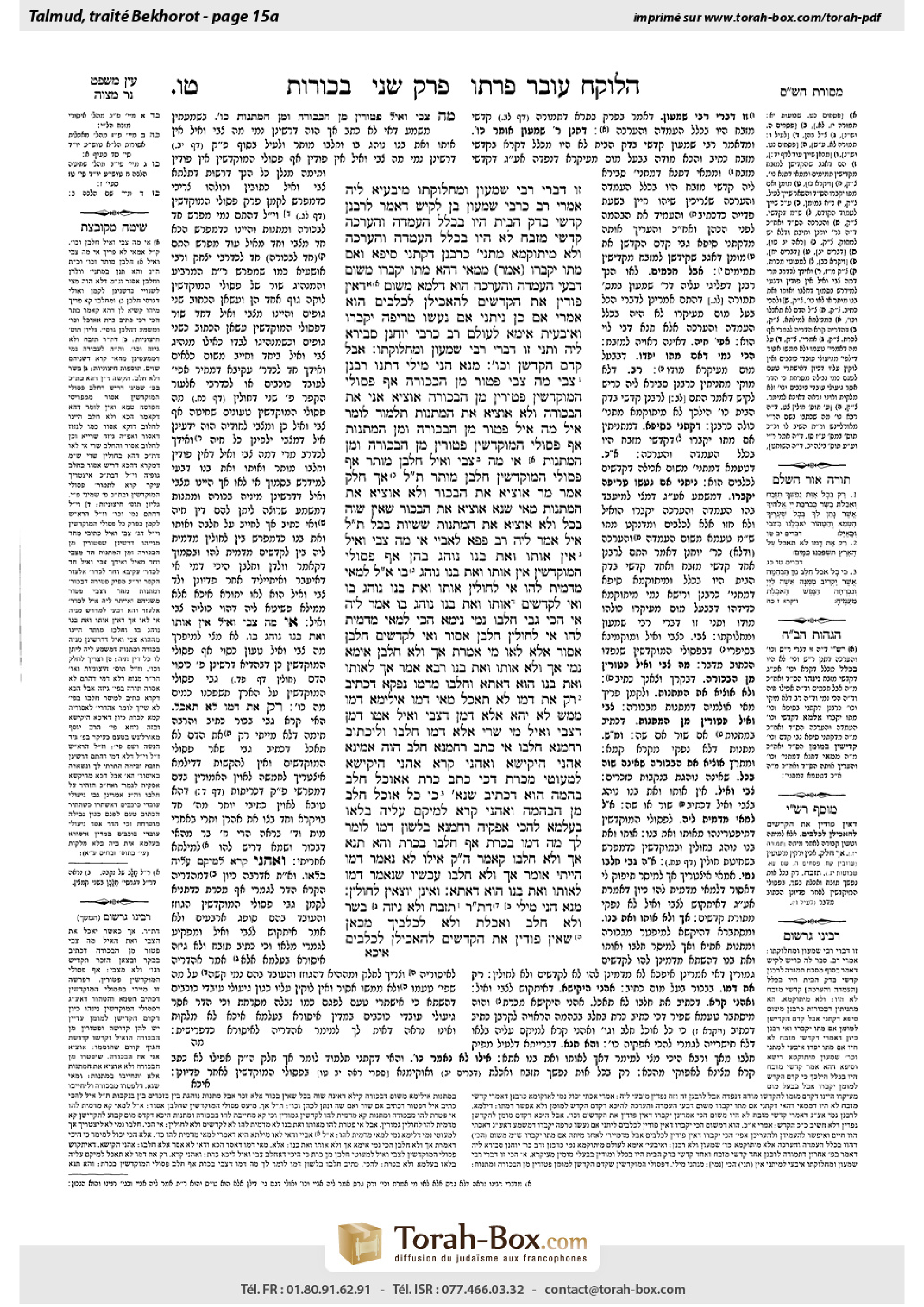
Bekhorot 15a: Talmud study for Daf Yomi
Study the Talmud for Daf Yomi with scanned pages, Hebrew text, English translations from Sefaria and AI-generated French translations.
Passage selection and English or AI-generated French translation are available where the scan has annotations. Daf Study is independent of Torah-Box and Sefaria.
Browse Bekhorot · בכורות · All tractatesBekhorot 15a text and translations
This page of Bekhorot includes the Aramaic text, an English translation and an AI-generated French translation, alongside the scan above.
בכורות י״ה א · Aramaic and Hebrew text
״זוֹ דִּבְרֵי רַבִּי שִׁמְעוֹן וּמַחְלוּקְתּוֹ״ מִיבַּעְיָא לֵיהּ!
אָמְרִי: רַב כְּרַבִּי שִׁמְעוֹן בֶּן לָקִישׁ, דְּאָמַר לְרַבָּנַן: קׇדְשֵׁי בֶּדֶק הַבַּיִת הָיוּ בִּכְלַל הַעֲמָדָה וְהַעֲרָכָה, קׇדְשֵׁי מִזְבֵּחַ לֹא הָיוּ בִּכְלַל הַעֲמָדָה וְהַעֲרָכָה, וְלָא מִיתּוֹקְמָא מַתְנִיתִין כְּרַבָּנַן, דְּקָתָנֵי סֵיפָא: וְאִם מֵתוּ יִקָּבֵרוּ.
אָמַר: מִמַּאי דְּהָא ״מֵתוּ יִקָּבֵרוּ״ מִשּׁוּם דְּבָעֵי הַעֲמָדָה וְהַעֲרָכָה הוּא? דִּלְמָא מִשּׁוּם דְּאֵין פּוֹדִין אֶת הַקֳּדָשִׁים לְהַאֲכִילָן לִכְלָבִים הוּא! אָמְרִי: אִם כֵּן, נִיתְנֵי: ״אִם נַעֲשׂוּ טְרֵיפָה יִקָּבֵרוּ״.
וְאִיבָּעֵית אֵימָא: לְעוֹלָם רַב כְּרַבִּי יוֹחָנָן סְבִירָא לֵיהּ, וּתְנִי: זוֹ דִּבְרֵי רַבִּי שִׁמְעוֹן וּמַחְלוּקְתּוֹ.
אֲבָל קָדַם הֶקְדֵּשָׁן וְכוּ׳. מְנָא הָנֵי מִילֵּי? דְּתָנוּ רַבָּנַן: ״צְבִי״, מָה צְבִי פָּטוּר מִן הַבְּכוֹרָה, אַף פְּסוּלֵי הַמּוּקְדָּשִׁין פְּטוּרִין מִן הַבְּכוֹרָה.
אוֹצִיא אֲנִי אֶת הַבְּכוֹרָה, וְלֹא אוֹצִיא אֶת הַמַּתָּנוֹת? תַּלְמוּד לוֹמַר: ״אַיָּל״, מָה אַיָּל פָּטוּר מִן הַבְּכוֹרָה וּמִן הַמַּתָּנוֹת, אַף פְּסוּלֵי הַמּוּקְדָּשִׁין פְּטוּרִין מִן הַבְּכוֹרָה וּמִן הַמַּתָּנוֹת.
אִי מָה צְבִי וְאַיָּל חֶלְבָּן מוּתָּר, אַף פְּסוּלֵי הַמּוּקְדָּשִׁין חֶלְבָּן מוּתָּר? תַּלְמוּד לוֹמַר: ״אַךְ״ — חִלֵּק.
אָמַר מָר: אוֹצִיא אֶת הַבְּכוֹר, וְלֹא אוֹצִיא אֶת הַמַּתָּנוֹת. מַאי שְׁנָא אוֹצִיא אֶת הַבְּכוֹר — שֶׁאֵין שָׁוֶה בַּכֹּל, וְלֹא אוֹצִיא אֶת הַמַּתָּנוֹת — שֶׁשָּׁווֹת בַּכֹּל. תַּלְמוּד לוֹמַר: ״אַיָּל״.
אֲמַר לֵיהּ רַב פָּפָּא לְאַבָּיֵי: אִי מָה צְבִי וְאַיָּל, אֵין אוֹתוֹ וְאֶת בְּנוֹ נוֹהֵג בָּהֶן, אַף פְּסוּלֵי הַמּוּקְדָּשִׁין אֵין אוֹתוֹ וְאֶת בְּנוֹ נוֹהֵג בּוֹ!
אֲמַר לֵיהּ: לְמַאי מְדַמֵּית לְהוּ? אִי לְחוּלִּין — ״אוֹתוֹ וְאֶת בְּנוֹ״ נוֹהֵג בּוֹ, וְאִי לְקָדָשִׁים — ״אוֹתוֹ וְאֶת בְּנוֹ״ נוֹהֵג בּוֹ!
אֲמַר לֵיהּ: אִי הָכִי, גַּבֵּי חֶלְבּוֹ נָמֵי נֵימָא הָכִי: לְמַאי מְדַמֵּית לְהוּ? אִי לְחוּלִּין — חֶלְבָּן אָסוּר, וְאִי לְקָדָשִׁים — חֶלְבָּן אָסוּר!
אֶלָּא, לָאו מִי אָמְרַתְּ ״אַךְ״ וְלֹא חֶלְבָּן? אֵימַר נָמֵי ״אַךְ״ וְלֹא אוֹתוֹ וְאֶת בְּנוֹ.
רָבָא אָמַר: ״אַךְ״ לְאוֹתוֹ וְאֶת בְּנוֹ הוּא דַּאֲתָא, וְחֶלְבּוֹ מִ״דָּמוֹ״ נָפְקָא, דִּכְתִיב: ״רַק אֶת דָּמוֹ לֹא תֹאכֵל״.
מַאי ״דָּמוֹ״? אִילֵּימָא דָּמוֹ מַמָּשׁ, לָא יְהֵא אֶלָּא דָּמָן דִּצְבִי וְאַיָּל, אַטּוּ דָּמָן דִּצְבִי וְאַיָּל מִי שְׁרֵי? אֶלָּא ״דָּמוֹ״ — חֶלְבּוֹ.
וְלִיכְתּוֹב רַחֲמָנָא ״חֶלְבּוֹ״! אִי כְּתַב רַחֲמָנָא ״חֵלֶב״, הֲוָה אָמֵינָא: אַהֲנִי הֶיקֵּישָׁא וְאַהֲנִי קְרָא.
אַהֲנִי הֶיקֵּישָׁא לְמַעוֹטֵי מִכָּרֵת, דְּכִי כְּתַב כָּרֵת — אַאוֹכֵל חֵלֶב בְּהֵמָה הוּא דִּכְתִיב, שֶׁנֶּאֱמַר: ״כִּי כׇל אוֹכֵל חֵלֶב מִן הַבְּהֵמָה״.
וְאַהֲנִי קְרָא לְמֵיקַם עֲלֵיהּ בְּלָאו בְּעָלְמָא, לְהָכִי אַפְּקֵיהּ רַחֲמָנָא בִּלְשׁוֹן ״דָּמוֹ״, לוֹמַר לָךְ: מָה דָּמוֹ בְּכָרֵת — אַף חֶלְבּוֹ בְּכָרֵת.
וְהָא תָּנָא ״אַךְ״, וְלֹא חֶלְבּוֹ, קָאָמַר!
הָכִי קָאָמַר: אִילּוּ לֹא נֶאֱמַר ״דָּמוֹ״, הָיִיתִי אוֹמֵר ״אַךְ״ — וְלֹא חֶלְבּוֹ, עַכְשָׁיו שֶׁנֶּאֱמַר ״דָּמוֹ״, לְאוֹתוֹ וְאֶת בְּנוֹ הוּא דַּאֲתָא.
וְאֵינָן יוֹצְאִין לְחוּלִּין. מְנָא הָנֵי מִילֵּי? דְּתָנוּ רַבָּנַן: ״תִּזְבַּח״ — וְלֹא גִּיזָּה, ״בָּשָׂר״ — וְלֹא חָלָב, ״וְאָכַלְתָּ״ — וְלֹא לִכְלָבֶיךָ, מִכָּאן שֶׁאֵין פּוֹדִין אֶת הַקֳּדָשִׁים לְהַאֲכִילָן לִכְלָבִים.
Bekhorot 15a · English translation
Since both Rabbi Shimon and the Rabbis agree that an animal which was blemished before it was consecrated can be redeemed, he should have said: This is the statement of Rabbi Shimon and those who disagree with him.
The Sages said in response that Rav holds in accordance with the opinion of Rabbi Shimon ben Lakish, who says: According to the Rabbis, animals consecrated for the Temple maintenance were included in the obligation of standing and valuation, whereas animals consecrated for the altar were not included in the obligation of standing and valuation. And therefore it is not possible to interpret the mishna in accordance with the opinion of the Rabbis, as the latter clause teaches: And if animals consecrated for the altar died, they must be buried even if their consecration preceded their blemish, as they are included in the obligation of standing and valuation.
The Gemara says: From where is it known that this ruling of the mishna: If they died they must be buried, is due to the fact that they require standing and valuation? Perhaps it is because one may not redeem sacrificial animals in order to feed them to dogs. The Sages said in response: If that were so, let the mishna teach: If one of them became an animal with a wound that will cause it to die within twelve months [tereifa], it must be buried. Since a tereifa can be stood before the priest, the only reason to require its burial must be due to the prohibition against redeeming a sacrificial animal in order to feed it to dogs.
And if you wish, say instead: Actually, Rav holds in accordance with the opinion of Rabbi Yoḥanan, who says that according to the Rabbis, animals consecrated for the altar were included in the obligation of standing and appraising, and therefore the mishna can be explained in accordance with the opinion of the Rabbis. And in fact Rav taught: This is the statement of Rabbi Shimon and those who disagree with him.
§ The mishna teaches: But if their consecration preceded their blemish, they are exempt from the mitzva of the firstborn and from the priestly gifts. The Gemara asks: From where are these matters derived? They are derived from a verse, as the Sages taught with regard to a verse discussing disqualified consecrated animals: “However, as you eat the gazelle and the hart, so shall you eat thereof” (Deuteronomy 12:22). Just as a gazelle is exempt from the mitzva of the firstborn, as this obligation does not apply to undomesticated animals, so too, disqualified consecrated animals are exempt from the mitzva of the firstborn.
The baraita continues: Based on this derivation, I will exclude consecrated animals that developed a blemish from the mitzva of the firstborn but I will not exclude them from the mitzva of the gifts. From where is it derived that such animals are not subject to the mitzva of the gifts either? The Gemara answers that the verse states: “However, as you eat the gazelle and the hart.” This teaches that just as a hart is exempt from the mitzva of the firstborn and from the mitzva of the gifts, so too, disqualified consecrated animals are exempt from the mitzva of the firstborn and from the mitzva of the gifts.
The Gemara asks: If so, then it follows that just as the fat of a gazelle and a hart is permitted, so too, the fat of disqualified consecrated animals should be permitted. In fact, the halakha is that the fat of disqualified consecrated animals is forbidden, like that of other domesticated animals. The baraita answers that the verse states: “However, as you eat the gazelle and the hart.” The term “however” differentiates, i.e., it serves to limit the analogy between these animals to the mitzvot of the firstborn and the gifts, and not forbidden fat.
The Gemara analyzes the baraita. The Master said: I will exclude consecrated animals that developed a blemish from the mitzva of the firstborn but I will not exclude them from the mitzva of the gifts. The Gemara asks: What is different about a firstborn that I would exclude only the mitzva of the firstborn, in the first stage of this interpretation? Why not exclude the mitzva of the gifts as well? The Gemara answers that the mitzva of the firstborn does not apply equally to all animals but only to males, and therefore I do not initially exclude the mitzva of the gifts, as they do apply equally to all domesticated animals, including females. Therefore, when the verse states “a hart” in addition to the gazelle, this is derived as teaching that disqualified consecrated animals are excluded from the mitzva of the gifts as well.
Rav Pappa said another question to Abaye: If one accepts the analogy between disqualified consecrated animals and the animals mentioned in the verse, then one can claim as follows: Just as the prohibition against slaughtering an animal itself and its offspring on the same day does not apply to a gazelle and a hart, so too, the prohibition against slaughtering an animal itself and its offspring should not apply to disqualified consecrated animals. Why does the baraita not address this issue?
Abaye said to Rav Pappa: To what are you comparing disqualified consecrated animals? If you are comparing them to non-sacred domesticated animals, the prohibition against slaughtering a mother and its offspring on the same day applies to them. And if you are comparing them to sacrificial animals, the prohibition against slaughtering an animal itself and its offspring also applies to them. Since all domesticated animals are subject to the prohibition against slaughtering a mother and its offspring, one cannot derive the exclusion of disqualified consecrated animals from this verse.
Rav Pappa said to him: If so, then with regard to its fat as well, let us state a claim like this: To what are you comparing disqualified animals? If you are comparing them to non-sacred animals, their fat is forbidden. And if you are comparing them to sacrificial animals, their fat is also forbidden. Since the prohibition of fat also applies to both consecrated and non-sacred animals, by the same reasoning there is no need for the verse to teach that the prohibition of fat applies. Nevertheless, the baraita derives this halakha from the word “however.”
Rather, didn’t you say in the baraita: “However,” but not their fat? Say also: “However,” but not a mother and its offspring. With regard to both halakhot, which apply to domesticated but not undomesticated animals, the reason that the analogy is not extended is not due to Abaye’s claim, as the juxtaposition between the animals would teach that their halakhot are the same. Instead, both exclusions are derived equally from the word “however,” which serves to differentiate disqualified consecrated animals from the gazelle and the hart both with regard to forbidden fat and with regard to the prohibition against slaughtering a mother and its offspring. Interpreting the exclusion in this manner means that disqualified consecrated animals are at least comparable to sacrificial animals in that they are excluded from the mitzva of the firstborn and the priestly gifts. Had the exclusion been interpreted with regard to the mitzva of the firstborn and the priestly gifts, disqualified consecrated animals would not be comparable to any type of animal.
The Gemara cites a different interpretation. Rava says: The word “however” comes to exclude the prohibition against slaughtering a mother and its offspring from the comparison between disqualified consecrated animals and the gazelle and hart, and the exclusion of its fat is derived from the term “its blood.” As it is written with regard to a blemished firstborn animal: “You shall eat it…as the gazelle, and as the hart. Only you shall not eat its blood” (Deuteronomy 15:22–23).
Rava elaborates: What is “its blood” referring to? If we say that it is referring to its actual blood, the Torah would not have had to state this explicitly, as even if it were merely similar to the blood of a gazelle and a hart, is that to say that anyone permits the blood of a gazelle and a hart? Since the blood of all animals is forbidden, it is already established that the blood of a blemished firstborn animal is forbidden. Rather, the term “its blood” is referring to its fat.
The Gemara challenges: But in that case, let the Merciful One write: Its fat, instead of “its blood.” The Gemara explains: If the Merciful One had written fat, I would say: The juxtaposition between disqualified consecrated animals and a gazelle and a hart is effective with regard to fat, and the verse itself is also effective, i.e., it can be derived from the juxtaposition and the verse together that the prohibition of fat applies to disqualified consecrated animals to a certain extent, but not fully.
The Gemara elaborates: The juxtaposition is effective in that it excludes one who eats the fat of consecrated animals from the punishment of excision from the World-to-Come [karet]. The reason is that when the Merciful One writes “karet,” it is written with regard to one who eats the fat of a domesticated animal, as it is stated: “For anyone who eats the fat of the domesticated animal…even the soul that eats it shall be excised from his people” (Leviticus 7:25). The juxtaposition to a gazelle and a hart would teach that the punishment of karet does not apply in the case of disqualified consecrated animals.
And at the same time the verse in Deuteronomy 15:23 would also be effective, as, if it were written: Only you shall not eat its fat, it would establish the consumption of the fat of disqualified consecrated animals as a prohibition for which one is liable merely to receive lashes. For this reason, the Merciful One expresses the prohibition against eating the fat using the language “its blood,” in order to tell you that just as consumption of its blood is punishable by karet, so too, consumption of its fat is punishable by karet. By using the term “its blood,” the Torah conveys that one is liable to receive karet for eating the fat of disqualified consecrated animals, i.e., that with regard to this particular halakha the juxtaposition does not apply at all.
Rava stated that the halakha with regard to the consumption of the fat of a disqualified consecrated animal is derived from the verse: “Only shall you not eat its blood.” The Gemara asks: But didn’t the tanna of the baraita say that the word “however” limits the juxtaposition so that disqualified consecrated animals are not included in the mitzvot of the firstborn and the gifts, but they are not excluded from the prohibition against eating its fat? How can Rava suggest a different source than the one cited in the baraita?
The Gemara answers that according to Rava, this is what the baraita is saying: Had the term “its blood” not been stated, I would have said that the word “however” teaches: But not its fat. But now that it is stated: “Its blood,” the word “however” comes to teach that the prohibition against slaughtering a mother and its offspring on the same day applies to disqualified consecrated animals.
§ The mishna teaches: And animals whose consecration preceded their blemish do not completely emerge from their sacred status and assume non-sacred status in order to be shorn and to be utilized for labor. The Gemara asks: From where are these matters derived? They are derived from a verse, as the Sages taught in a baraita with regard to a verse discussing consecrated animals that developed a blemish and were redeemed: “Notwithstanding, after all the desire of your soul, you may slaughter and eat flesh” (Deuteronomy 12:15). The term “you may slaughter” teaches that slaughtering the animal is permitted, but not shearing it. Likewise, “you may eat flesh” teaches that its meat is permitted, but not its milk. Finally, “you may eat” teaches that you may eat the meat, but you may not feed it to your dogs. From here it is derived that one may not redeem sacrificial animals in order to feed them to dogs.
Bekhorot 15a · Traduction française (IA)
Puisque Rabbi Shimon et les Sages sont d'accord sur le fait qu'un animal blemi avant sa consécration peut être racheté, il aurait dû dire : C'est la déclaration de Rabbi Shimon et ceux qui s'y opposent.
Les Sages répondirent en disant que Rav suit l'opinion de Rabbi Shimon ben Lakish, qui dit : Selon les Rabbins, les animaux consacrés à l'entretien du Temple étaient inclus dans l'obligation de se tenir et d'être évalués, tandis que ceux consacrés à l'autel ne l'étaient pas. Et donc, il n'est pas possible d'interpréter la mitsva selon l'opinion des Rabbins, car la dernière clause enseigne : Et si des animaux consacrés à l'autel mouraient, ils devaient être enterrés même si leur consécration précédait leur tache, car ils sont inclus dans l'obligation de se tenir et d'être évalués.
La Guemara dit : D'où sait-on que cette décision de la Michna : Si ils meurent, ils doivent être enterrés, est due au fait qu'ils nécessitent d'être tenus et évalués ? Peut-être parce qu'on ne peut pas racheter des animaux sacrés pour les nourrir aux chiens. Les Sages répondirent en disant : Si c'était le cas, la Michna devrait enseigner : Si l'un d'eux devient un animal blessé qui mourra dans les douze mois [tereifa], il doit être enterré. Puisque un tereifa peut être présenté devant le prêtre, la seule raison de nécessiter son enterré doit être due à l'interdiction de racheter un animal sacré pour le nourrir aux chiens.
Et si vous le souhaitez, dites plutôt : En réalité, Rav suit l'opinion de Rabbi Yoḥanan, qui dit que selon les Sages, les animaux consacrés à l'autel étaient inclus dans l'obligation de se tenir et d'être évalués, et donc la mitsva peut être expliquée selon l'opinion des Sages. Et en effet, Rav enseigna : C'est la déclaration de Rabbi Shimon et ceux qui s'y opposent.
§ La mitsna enseigne : Mais si leur consécration précède leur blemish, ils sont exemptés de la mitsva du premier-né et des dons du prêtre. La Guemara demande : D'où sont dérivés ces points ? Ils sont dérivés d'un verset, comme les Sages l'ont enseigné concernant un verset parlant d'animaux consacrés inaptes : « Cependant, comme vous mangez le gazelle et le cerf, ainsi mangerez-vous de cela » (Deutéronome 12:22). Aussi bien que le gazelle est exempté de la mitsva du premier-né, car cette obligation ne s'applique pas aux animaux sauvages, de même les animaux consacrés inaptes sont exemptés de la mitsva du premier-né.
La baraïta continue : Sur cette dérivation, je exclurai les animaux consacrés qui ont développé un blemish de la mitsva du premier-né mais je ne les exclurai pas de la mitsva des dons. D'où est dérivé le fait que ces animaux ne sont pas soumis à la mitsva des dons non plus ? La Guemara répond que le verset dit : « Cependant, comme vous mangez le gazelle et le cerf. » Cela enseigne que aussi bien que le cerf est exempté de la mitsva du premier-né et des dons, de même les animaux consacrés inaptes sont exemptés de la mitsva du premier-né et des dons.
La Guemara demande : Si c'est ainsi, alors il en découle que aussi bien que la graisse du gazelle et du cerf est permise, de même la graisse des animaux consacrés inaptes devrait être permise. En réalité, la halakha est que la graisse des animaux consacrés inaptes est interdite, comme celle des autres animaux domestiques. La baraïta répond que le verset dit : « Cependant, comme vous mangez le gazelle et le cerf. » Le terme « cependant » sert à distinguer, c'est-à-dire à limiter l'analogie entre ces animaux à la mitsva du premier-né et des dons, et non à la graisse interdite.
La Guemara analyse la baraïta. Le Maître dit : Je exclurai les animaux consacrés qui ont développé un défaut de la mitsva du premier-né mais je ne les exclurai pas de la mitsva des dons. La Guemara demande : Qu'est-ce qui diffère dans un premier-né que je puisse exclure seulement la mitsva du premier-né, dans la première étape de cette interprétation ? Pourquoi ne pas exclure la mitsva des dons également ? La Guemara répond que la mitsva du premier-né ne s'applique pas de la même manière à tous les animaux mais seulement aux mâles, et donc je ne exclurai pas initialement la mitsva des dons, car elles s'appliquent de la même manière à tous les animaux domestiques, y compris les femelles. Ainsi, lorsque le verset dit « un cerf » en plus du gazelle, cela est dérivé comme enseignant que les animaux consacrés inaptes sont également exclus de la mitsva des dons.
Rav Pappa posa une autre question à Abaye : Si l'on accepte l'analogie entre les animaux consacrés inaptes et les animaux mentionnés dans le verset, alors on peut affirmer comme suit : Aussi bien que l'interdiction de sacrifier un animal et son descendant le même jour ne s'applique pas au gazelle et au cerf, de même l'interdiction de sacrifier un animal et son descendant ne devrait pas s'appliquer aux animaux consacrés inaptes. Pourquoi la baraïta ne traite-t-elle pas ce point ?
Abaye répondit à Rav Pappa : À quoi comparez-vous les animaux consacrés inaptes ? Si vous les comparez aux animaux domestiques non sacrés, l'interdiction de sacrifier une mère et son descendant le même jour s'applique à eux. Et si vous les comparez aux animaux sacrés, l'interdiction de sacrifier un animal et son descendant s'applique à eux aussi. Puisque tous les animaux domestiques sont soumis à cette interdiction, on ne peut pas dériver l'exclusion des animaux consacrés inaptes de ce verset.
Rav Pappa dit à lui : Si c’est ainsi, alors concernant son gras également, disons une déclaration semblable : À quoi comparez-vous les animaux non conformes ? Si vous les comparez aux animaux non sacrés, leur gras est interdit. Et si vous les comparez aux animaux sacrés, leur gras est également interdit. Puisque l’interdiction du gras s’applique aussi aux animaux sacrés et non sacrés, par le même raisonnement, il n’est pas nécessaire que la Sainte Écriture enseigne que l’interdiction du gras s’applique. Cependant, la baraïta dérive cette halakha du mot « cependant ».
Plutôt, n’avez-vous pas dit dans la baraïta : « Cependant », mais pas leur gras ? Dites aussi : « Cependant », mais pas la mère et son petit. Concernant les deux halakhot qui s’appliquent aux animaux domestiques mais pas aux animaux sauvages, la raison pour laquelle l’analogie n’est pas étendue n’est pas due à l’affirmation d’Abaye, car la juxtaposition entre les animaux enseignerait que leurs halakhot sont les mêmes. Au contraire, les deux exclusions sont dérivées de manière égale du mot « cependant », qui sert à distinguer les animaux sacrés non conformes des gazelles et des cerfs, tant concernant l’interdiction du gras que concernant l’interdiction de sacrifier la mère et son petit. Interpréter l’exclusion ainsi signifie que les animaux sacrés non conformes sont au moins comparables aux animaux sacrés dans le sens où ils sont exclus de la mitsva du premier-né et des dons sacrés. Si l’exclusion avait été interprétée concernant la mitsva du premier-né et les dons sacrés, les animaux sacrés non conformes ne seraient pas comparables à tout type d’animal.
Le Guemara cite une autre interprétation. Rava dit : Le mot « cependant » vient exclure l’interdiction de sacrifier la mère et son petit de la comparaison entre les animaux sacrés non conformes et la gazelle et le cerf, et l’exclusion de leur gras est dérivée du terme « son sang ». Comme il est écrit concernant un premier-né blemi : « Vous mangerez cela… comme la gazelle, et comme le cerf. Seulement vous ne mangerez pas son sang » (Deutéronome 15:22–23).
Rava développe : Quel est « son sang » ? Si nous disons qu’il s’agit de son sang réel, la Torah n’aurait pas eu besoin de le préciser explicitement, car même si c’était simplement semblable au sang d’une gazelle et d’un cerf, cela signifierait que l’on permet le sang d’une gazelle et d’un cerf ? Puisque le sang de tous les animaux est interdit, il est déjà établi que le sang d’un premier-né blemi est interdit. Plutôt, le terme « son sang » désigne son gras.
Le Guemara conteste : Mais alors, que le Très Miséricordieux écrive : Son gras, au lieu de « son sang ». Le Guemara explique : Si le Très Miséricordieux avait écrit « son gras », je dirais : La juxtaposition entre les animaux sacrés non conformes et la gazelle et le cerf est efficace concernant le gras, et la propre phrase est également efficace, c’est-à-dire qu’elle peut être dérivée à la fois de la juxtaposition et de la phrase elle-même que l’interdiction du gras s’applique aux animaux sacrés non conformes dans une certaine mesure, mais pas entièrement.
Le Guemara développe : La juxtaposition est efficace dans la mesure où elle exclut celui qui mange le gras des animaux sacrés de la peine d’excision du monde à venir [karet]. La raison est que lorsque le Très Miséricordieux écrit « karet », il s’agit d’un cas où l’on mange le gras d’un animal domestique, comme il est dit : « Celui qui mange le gras de l’animal domestique… même l’âme qui le mange sera excisée de son peuple » (Lévitique 7:25). La juxtaposition avec la gazelle et le cerf enseignerait que la peine de karet ne s’applique pas dans le cas des animaux sacrés non conformes.
Et en même temps, la phrase de Deutéronome 15:23 serait également efficace, car si elle avait été écrite : « Seulement vous ne mangerez pas son gras », cela établirait la consommation du gras des animaux sacrés non conformes comme une interdiction pour laquelle on est puni uniquement par des coups de fouet. Pour cette raison, le Très Miséricordieux exprime l’interdiction de manger le gras en utilisant la langue « son sang », afin de vous dire que justement comme la consommation de son sang est punie par karet, ainsi la consommation de son gras est punie par karet. En utilisant le terme « son sang », la Torah indique que l’on est puni par karet pour manger le gras des animaux sacrés non conformes, c’est-à-dire que concernant cette halakha particulière, la juxtaposition ne s’applique du tout.
Rava a dit que la halakha concernant la consommation du gras d’un animal sacré non conforme est dérivée de la phrase : « Seulement vous ne mangerez pas son sang ». Le Guemara demande : Mais n’avait pas dit le tanna de la baraïta que le mot « cependant » limite la juxtaposition de sorte que les animaux sacrés non conformes ne soient pas inclus dans les mitsvot du premier-né et des dons, mais qu’ils ne soient pas exclus de l’interdiction de manger son gras ? Comment Rava peut-il suggérer une source différente de celle citée dans la baraïta ?
Le Guemara répond que selon Rava, c’est ce que dit la baraïta : Si le terme « son sang » n’avait pas été mentionné, j’aurais dit que le mot « cependant » enseigne : Mais pas son gras. Mais maintenant que ce terme est mentionné : « Son sang », le mot « cependant » vient enseigner que l’interdiction de sacrifier la mère et son petit le même jour s’applique aux animaux sacrés non conformes.
§ La Michna enseigne : Les animaux dont la consécration a eu lieu avant leur défaut ne sortent pas entièrement de leur statut sacré et ne passent pas au statut non sacré afin d'être rasés et utilisés pour le travail. La Guemara pose la question : D'où sont tirées ces choses ? Elles sont tirées d'un verset, comme les Sages l'ont enseigné dans une baraïta concernant un verset parlant d'animaux consacrés qui ont développé un défaut et ont été rachetés : « Néanmoins, après tous les désirs de votre âme, vous pouvez tuer et manger de la chair » (Deutéronome 12:15). Le terme « vous pouvez tuer » enseigne que tuer l'animal est permis, mais pas le rasage. De même, « vous pouvez manger de la chair » enseigne que sa viande est permise, mais pas son lait. Enfin, « vous pouvez manger » enseigne que vous pouvez manger la viande, mais vous ne pouvez pas nourrir l'animal à vos chiens. D'où l'on déduit que l'on ne peut pas racheter des animaux sacrés afin de les nourrir à ses chiens.
Traduction française générée par IA à partir de l’édition anglaise de Sefaria. Vérifie toujours un passage avec le texte source.
Text from Sefaria: William Davidson Edition - Vocalized Aramaic (CC BY NC); William Davidson Edition - English (CC BY NC).