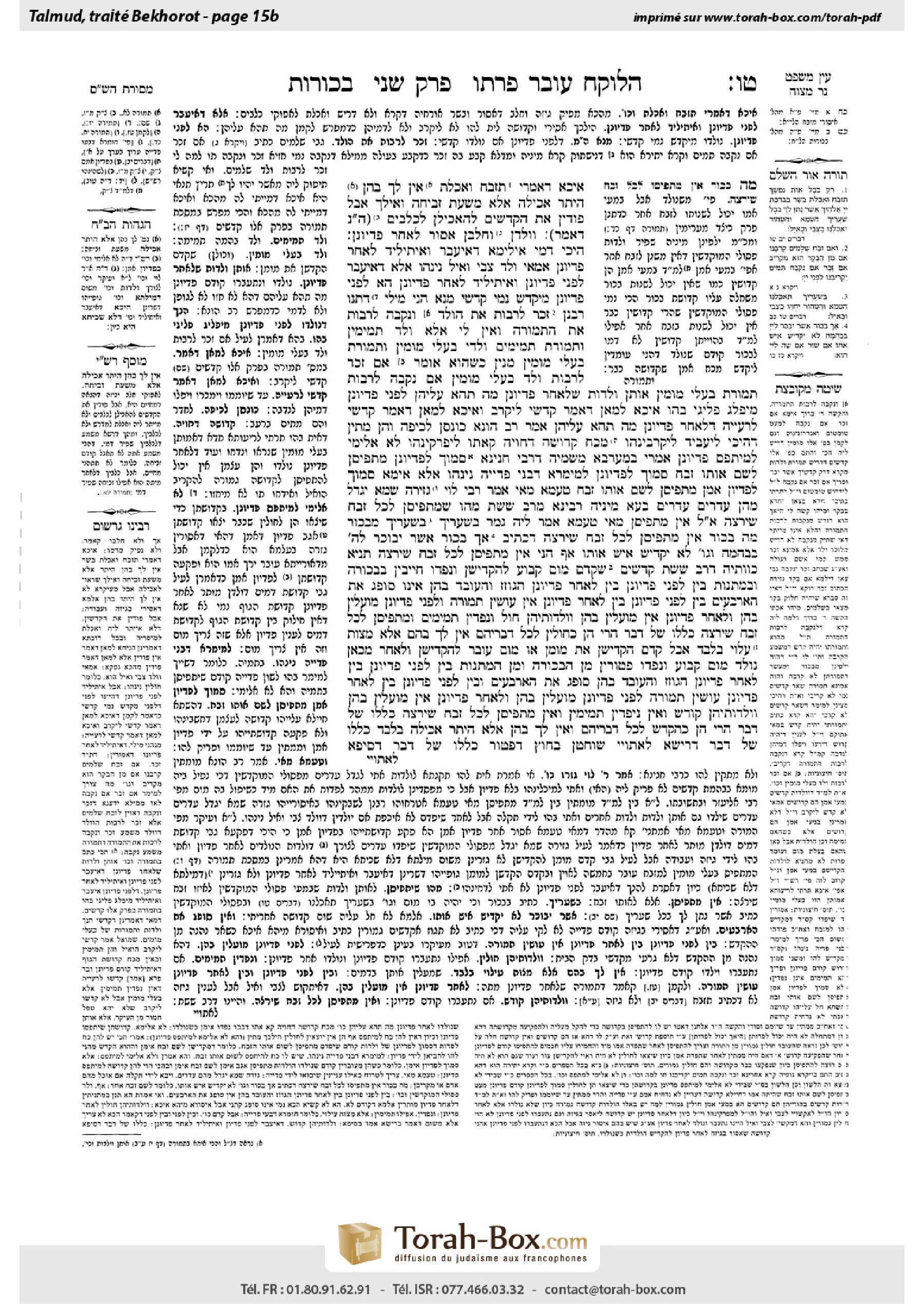
Bekhorot 15b: Talmud study for Daf Yomi
Study the Talmud for Daf Yomi with scanned pages, Hebrew text, English translations from Sefaria and AI-generated French translations.
Passage selection and English or AI-generated French translation are available where the scan has annotations. Daf Study is independent of Torah-Box and Sefaria.
Browse Bekhorot · בכורות · All tractatesBekhorot 15b text and translations
This page of Bekhorot includes the Aramaic text, an English translation and an AI-generated French translation, alongside the scan above.
בכורות י״ה ב · Aramaic and Hebrew text
אִיכָּא דְּאָמְרִי: ״תִּזְבַּח וְאָכַלְתָּ״ — אֵין לָךְ בָּהֶן הֶיתֵּר אֲכִילָה אֶלָּא מִשְּׁעַת זְבִיחָה וְאֵילָךְ, אֲבָל פּוֹדִין אֶת הַקֳּדָשִׁים לְהַאֲכִילָן לִכְלָבִים, הָכִי נָמֵי דְּאָמַר.
וּוְלָדָן וַחֲלָבָן אָסוּר לְאַחַר פִּדְיוֹנָן. הֵיכִי דָמֵי? אִילֵּימָא דְּאִיעַבַּר וְאִיתְיְלִיד לְאַחַר פִּדְיוֹנָן — אַמַּאי? וְלַד צְבִי וְאַיָּל נִינְהוּ! אֶלָּא דְּאִיעַבַּר לִפְנֵי פִּדְיוֹנָן וְאִיתְיְלִיד לְאַחַר פִּדְיוֹנָן. הָא לִפְנֵי פִּדְיוֹנָן — מִיקְדָּשׁ נָמֵי קָדְשִׁי.
מְנָא הָנֵי מִילֵּי? דְּתָנוּ רַבָּנַן: ״זָכָר״ — לְרַבּוֹת אֶת הַוָּלָד, וּ״נְקֵבָה״ — לְרַבּוֹת אֶת הַתְּמוּרָה.
וְאֵין לִי אֶלָּא וְלַד תְּמִימִין וּתְמוּרַת תְּמִימִים, וְלַדי בַּעֲלֵי מוּמִין וּתְמוּרַת בַּעֲלֵי מוּמִין מִנַּיִן? כְּשֶׁהוּא אוֹמֵר ״אִם זָכָר״ — לְרַבּוֹת וְלַד בַּעֲלֵי מוּמִין, ״אִם נְקֵבָה״ — לְרַבּוֹת תְּמוּרַת בַּעֲלֵי מוּמִין.
אוֹתָן וְלָדוֹת שֶׁלְּאַחַר פִּדְיוֹנָן, מָה תְּהֵא עֲלֵיהֶן? לִפְנֵי פִּדְיוֹנָן — מִיפְלָג פְּלִיגִי בְּהוּ, אִיכָּא לְמַאן דְּאָמַר: קָדְשִׁי לִיקְרַב, וְאִיכָּא לְמַאן דְּאָמַר: קָדְשִׁי לִרְעִיָּיה.
דִּלְאַחַר פִּדְיוֹנָן, מָה תְּהֵא עֲלֵיהֶן? אָמַר רַב הוּנָא: כּוֹנְסָן לַכִּיפָּה, וְהֵן מֵתִין. דְּהֵיכִי לֶיעְבֵּיד? לִיקְרְבִינְהוּ — מִכֹּחַ קְדוּשָּׁה דְּחוּיָה קָאָתוּ, לִיפְרְקִינְהוּ — לָא אַלִּימִי לְמִיתְפַּס פִּדְיוֹנָן.
אָמְרִי בְּמַעְרְבָא מִשְּׁמֵיהּ דְּרַבִּי חֲנִינָא: סָמוּךְ לְפִדְיוֹנָן מַתְפִּיסָן לְשֵׁם אוֹתוֹ זֶבַח. סָמוּךְ לְפִדְיוֹנָן? לְמֵימְרָא דִּבְנֵי פְּדִיָּיה נִינְהוּ? אֶלָּא אֵימָא: סָמוּךְ לְפִדְיוֹן אִמָּן מַתְפִּיסָן לְשֵׁם אוֹתוֹ זֶבַח. טַעְמָא מַאי? אָמַר רַבִּי לֵוִי: גְּזֵירָה שֶׁמָּא יְגַדֵּל מֵהֶן עֲדָרִים עֲדָרִים.
בְּעָא מִינֵּיהּ רָבִינָא מֵרַב שֵׁשֶׁת: מַהוּ שֶׁמַּתְפִּיסָן לְכׇל זֶבַח שֶׁיִּרְצֶה? אֲמַר לֵיהּ: אֵין מַתְפִּיסָן. מַאי טַעְמָא? אֲמַר לֵיהּ: גָּמַר ״בִּשְׁעָרֶיךָ״ ״בִּשְׁעָרֶיךָ״ מִבְּכוֹר, מָה בְּכוֹר אֵין מַתְפִּיסָן לְכׇל זֶבַח שֶׁיִּרְצֶה, דִּכְתִיב: ״אַךְ בְּכוֹר אֲשֶׁר יְבֻכַּר לַה׳ בִּבְהֵמָה וְגוֹ׳ לֹא יַקְדִּישׁ אִישׁ אֹתוֹ״, אַף הָנֵי אֵין מַתְפִּיסָן לְכׇל זֶבַח שֶׁיִּרְצֶה.
תַּנְיָא כְּוָותֵיהּ דְּרַב שֵׁשֶׁת: קֳדָשִׁים שֶׁקָּדַם מוּם קָבוּעַ לְהֶקְדֵּישָׁן וְנִפְדּוּ — חַיָּיבִין בַּבְּכוֹרָה וּבַמַּתָּנוֹת, בֵּין לִפְנֵי פִּדְיוֹנָן בֵּין לְאַחַר פִּדְיוֹנָן — הַגּוֹזֵז וְהָעוֹבֵד בָּהֶן אֵינוֹ סוֹפֵג אֶת הָאַרְבָּעִים, בֵּין לִפְנֵי פִּדְיוֹנָן בֵּין לְאַחַר פִּדְיוֹנָן — אֵין עוֹשִׂין תְּמוּרָה.
וְלִפְנֵי פִּדְיוֹנָן — מוֹעֲלִין בָּהֶן, וּלְאַחַר פִּדְיוֹנָן — אֵין מוֹעֲלִין בָּהֶן, וּוַלְדוֹתֵיהֶן — חוֹל, וְנִפְדִּין תְּמִימִים, וּמַתְפִּיסָן לְכׇל זֶבַח שֶׁיִּרְצֶה. כְּלָלוֹ שֶׁל דָּבָר: הֲרֵי הֵן כְּחוּלִּין לְכׇל דִּבְרֵיהֶם, אֵין לְךָ בָּהֶם אֶלָּא מִצְוַת עִלּוּי בִּלְבָד.
אֲבָל קָדַם הֶקְדֵּישָׁן אֶת מוּמָן, אוֹ מוּם עוֹבֵר לְהֶקְדֵּישָׁן, וּלְאַחַר מִכָּאן נוֹלַד מוּם קָבוּעַ וְנִפְדּוּ — פְּטוּרִין מִן הַבְּכוֹרָה וּמִן הַמַּתָּנוֹת, בֵּין לִפְנֵי פִּדְיוֹנָן בֵּין לְאַחַר פִּדְיוֹנָן. הַגּוֹזֵז וְהָעוֹבֵד בָּהֶן סוֹפֵג אֶת הָאַרְבָּעִים, וּבֵין לִפְנֵי פִּדְיוֹנָן בֵּין לְאַחַר פִּדְיוֹנָן — עוֹשִׂין תְּמוּרָה.
לִפְנֵי פִּדְיוֹנָן — מוֹעֲלִין בָּהֶן, וּלְאַחַר פִּדְיוֹנָן — אֵין מוֹעֲלִין בָּהֶן, וּוַלְדוֹתֵיהֶן קוֹדֶשׁ, וְאֵין נִיפְדִּין תְּמִימִין, וְאֵין מַתְפִּיסָן לְכׇל זֶבַח שֶׁיִּרְצֶה. כְּלָלוֹ שֶׁל דָּבָר: הֲרֵי הֵן כְּהֶקְדֵּשׁ לְכׇל דִּבְרֵיהֶם, וְאֵין לָךְ בָּהֶן אֶלָּא הֶיתֵּר אֲכִילָה בִּלְבָד.
״כְּלָלוֹ שֶׁל דָּבָר״ דְּרֵישָׁא — לְאֵתוֹיֵי שׁוֹחֲטָן בְּחוּץ דְּפָטוּר, ״כְּלָלוֹ שֶׁל דָּבָר״ דְּסֵיפָא —
Bekhorot 15b · English translation
The Gemara cites an alternative exposition. Some say that the phrase: “You may slaughter and eat,” teaches that you have permission to eat them only from the time of slaughter onward. Similarly, no benefit may be derived from them until after their slaughter. The Gemara notes: But according to this interpretation, so too, the tanna said that one may redeem sacrificial animals in order to feed them to dogs, as this prohibition is not derived from the term “you may eat.”
§ The mishna teaches with regard to sacrificial animals: And their offspring and their milk are prohibited after their redemption. The Gemara asks: What are the circumstances of the offspring’s birth? If we say that the offspring was both conceived and born after its mother’s redemption, then why would it be prohibited? After all, they are like the offspring of a gazelle or a hart, i.e., they are completely non-sacred. Rather, it must be referring to a case where the offspring was conceived prior to its mother’s redemption and born after its mother’s redemption. One can infer: But if they were born before their mothers’ redemption, not only are they not prohibited, they are also imbued with inherent sanctity.
The Gemara asks: From where is this matter, that the offspring of a sacrificial animal is imbued with inherent sanctity, derived? It is derived from a verse, as the Sages taught in a baraita with regard to the verse: “And if his offering be a sacrifice of peace offerings: If he sacrifice of the cattle, whether male or female, he shall sacrifice it without blemish before the Lord” (Leviticus 3:1), that the words “male” and “female” are extraneous, as the term “cattle” includes both. Consequently, “male” serves to include the offspring of a peace offering; “or female” serves to include the female animal that is designated as a substitute for a peace offering.
The baraita continues: And I have derived this halakha only with regard to the offspring of unblemished animals and the substitute of unblemished animals. From where do I derive that the same halakha applies to the offspring of blemished animals and the substitute of blemished animals? When the verse states: “Whether male,” this serves to include the offspring of blemished animals, in a case where its consecration preceded its blemish, and when the verse states: “Or female,” it serves to include the substitute of blemished animals.
The Gemara asks: With regard to those offspring that were born after their mother’s redemption, what will be with them, since they can be neither sacrificed nor redeemed? Before providing an answer, the Gemara notes: If they were born before their mother’s redemption, the Sages disagree with regard to the halakha. There is one who says: They are entirely consecrated, to the extent that they may be sacrificed, and there is one who says: They are consecrated to graze until a blemish befalls them so that they can be redeemed, but they may not be sacrificed.
The Gemara returns to the previous inquiry: With regard to those that were born after their mother’s redemption, what will be with them? Rav Huna says: One gathers them into a chamber, and they die of starvation. The reason is that what are we to do? Shall we sacrifice them? They cannot be sacrificed, as they received their status from the deferred sanctity of the redeemed mother, and are therefore unfit for the altar. Shall we redeem them? They cannot be redeemed, as their sanctity is not strong enough to be transferable to money for their redemption.
They said in the West, Eretz Yisrael, in the name of Rabbi Ḥanina: Immediately before their redemption, one dedicates them for the sake of the same offering for which their mother was consecrated. The Gemara asks: Immediately before their redemption? Is that to say that they are fit to be redeemed? It was established that they cannot be redeemed. Rather, say: Immediately before their mother’s redemption, one dedicates them for the sake of the same offering. The Gemara asks: What is the reason that the offspring are not simply left as they are? Rabbi Levi says: It is a rabbinic decree, lest one raise flocks and flocks of them. In other words, if the offspring are left alive in their forbidden status, there is a concern that one might eventually derive benefit from them and thereby violate a Torah prohibition.
Ravina raised a dilemma before Rav Sheshet: According to Rabbi Ḥanina, what is the halakha with regard to the following matter: Can one dedicate the unborn offspring as any offering he desires? Rav Sheshet said to him: He may not dedicate them as any offering other than that for which the mother was consecrated. Ravina asked: What is the reason? Rav Sheshet said to him: It is derived by a verbal analogy between the phrase: “Within all your gates” (Deuteronomy 12:15), and: “Within your gates” (Deuteronomy 15:22), written with regard to a firstborn. Just as one cannot dedicate a firstborn as any offering he desires, as it is written: “But the firstborn among animals, which is born as a firstborn to the Lord, no man shall sanctify it” (Leviticus 27:26), so too, one cannot dedicate these offspring as any offering he desires.
The Gemara notes: It is taught in a baraita in accordance with the opinion of Rav Sheshet: Sacrificial animals whose permanent blemish preceded their consecration and that were redeemed, are obligated in the mitzva of a firstborn, and obligated in the gifts. Whether before their redemption or after their redemption, one who shears them or utilizes them for labor does not incur the forty lashes. Similarly, whether before their redemption or after their redemption, they do not render an animal that was a substitute for them sacred.
And before their redemption, one who benefits from them is liable for misuse of consecrated property, and after their redemption, one who benefits from them is not liable for misuse of consecrated property. And their offspring are non-sacred if they were born after their mother’s redemption; and they may be redeemed while they are unblemished if they were born before their mother’s redemption; and one can dedicate the offspring as any offering he desires. The principle of the matter is that animals whose permanent blemish preceded their consecration are like non-sacred animals in all matters, and you have only the mitzva of value alone, i.e., they must be valuated and redeemed with money, unlike non-sacred animals.
The baraita continues: But if their consecration preceded their blemish, or they had a temporary blemish prior to their consecration and afterward developed a permanent blemish, and they were redeemed, they are exempt from the mitzva of the firstborn and from the gifts. Furthermore, whether before their redemption or after their redemption, one who shears them or utilizes them for labor incurs the forty lashes. And whether before their redemption or after their redemption, they render an animal that was a substitute for them sacred.
The baraita concludes: Before their redemption, one who derives benefit from them is liable for misuse of consecrated property, and after their redemption, one who derives benefit from them is not liable for misuse of consecrated property. And their offspring are sacred and may not be redeemed while they are unblemished, and one may not dedicate them as any offering he desires. The principle of the matter is that redeemed animals whose consecration preceded their permanent blemish are like redeemed sacrificial animals in all matters, and you have only the permission of consumption alone, i.e., once they have been redeemed they may be eaten. Like Rav Sheshet, this tanna rules that the offspring of animals whose consecration preceded their blemish may not be dedicated as any offering one desires.
It is accepted that whenever a tanna states: The principle of the matter, he is adding certain cases that one might have thought were excluded from the halakha in question. Accordingly, the Gemara notes that the phrase: The principle of the matter, in the former clause of the baraita, which states that that animals whose permanent blemish preceded their consecration are like non-sacred animals, serves to add the case of one who slaughters such an animal outside the Temple courtyard, teaching that he is exempt. The phrase: The principle of the matter, in the latter clause, which states that that redeemed animals whose consecration preceded their permanent blemish are like redeemed sacrificial animals in all matters,
Bekhorot 15b · Traduction française (IA)
La Guemara cite une autre interprétation. Certains disent que la phrase : « Vous pouvez sacrifier et manger », enseigne que vous avez le droit de les manger à partir du moment de leur sacrifice. De même, aucun bénéfice ne peut être tiré d'eux avant leur sacrifice. La Guemara note : Mais selon cette interprétation, de même, le tanna disait qu'on peut racheter des animaux sacrés afin de les nourrir aux chiens, car cette interdiction ne provient pas du terme « vous pouvez manger ».
§ La mitsna enseigne concernant les animaux sacrés : Et leurs descendants et leur lait sont interdits après leur rachat. La Guemara pose la question : Quelles sont les circonstances de la naissance des descendants ? Si nous disons que le descendant a été conçu et né après le rachat de sa mère, pourquoi serait-il interdit ? En effet, ils sont comme les descendants d'une gazelle ou d'un cerf, c'est-à-dire totalement non sacrés. Il faut donc dire qu'il s'agit d'un cas où le descendant a été conçu avant le rachat de sa mère et né après. On peut en déduire : Mais si ils étaient nés avant le rachat de leur mère, non seulement ils ne sont pas interdits, mais ils sont aussi sanctifiés par nature.
La Guemara pose la question : D'où est tiré ce point, que les descendants d'animaux sacrés sont sanctifiés par nature ? Il est tiré d'un verset, comme les Sages l'ont enseigné dans une baraïta concernant le verset : « Et si son offrande est un sacrifice de paix : Si il sacrifie un bétail, qu'il soit mâle ou femelle, il le sacrifiera sans tache devant l'Éternel » (Lévitique 3:1), que les mots « mâle » et « femelle » sont superflus, car le terme « bétail » inclut les deux. Ainsi, « mâle » sert à inclure les descendants d'un sacrifice de paix ; « ou femelle » sert à inclure la femelle désignée comme substitut d'un sacrifice de paix.
La baraïta continue : Et je dérive cette halakha uniquement concernant les descendants d'animaux sans tache et le substitut d'animaux sans tache. D'où dérive-t-on que la même halakha s'applique aux descendants d'animaux blemis et au substitut d'animaux blemis ? Lorsque le verset dit : « Qu'il soit mâle », cela sert à inclure les descendants d'animaux blemis, dans le cas où leur sanctification a précédé leur blemissement, et lorsque le verset dit : « Ou femelle », cela sert à à inclure le substitut d'animaux blemis.
La Guemara pose la question : Concernant ces descendants nés après le rachat de leur mère, que deviennent-ils, puisqu'ils ne peuvent être sacrifiés ni rachetés ? Avant de fournir une réponse, la Guemara note : Si ils étaient nés avant le rachat de leur mère, les Sages s'entendent sur la halakha. Il y a celui qui dit : Ils sont entièrement sanctifiés, à tel point qu'ils peuvent être sacrifiés, et celui qui dit : Ils sont sanctifiés pour paître jusqu'à ce qu'un blemissement les atteigne afin qu'ils puissent être rachetés, mais ils ne peuvent pas être sacrifiés.
La Guemara retourne à l'enquête précédente : Concernant ceux qui ont été nés après le rachat de leur mère, que deviennent-ils ? Rav Huna dit : On les rassemble dans une pièce, et ils meurent de faim. La raison est que que faire ? Sacrifier-les ? Ils ne peuvent pas être sacrifiés, car leur statut provient de la sanctité différée de leur mère rachetée, et ils sont donc inaptes à l'autel. Les racheter ? Ils ne peuvent pas être rachetés, car leur sanctité n'est pas suffisante pour être transférable en argent pour leur rachat.
On a dit en Occident, en Terre d'Israël, en nom de Rabbi Ḥanina : Immédiatement avant leur rachat, on les consacre pour la même offrande dont leur mère était sanctifiée. La Guemara pose la question : Immédiatement avant leur rachat ? Est-ce dire qu'ils sont dignes d'être rachetés ? Il a été établi qu'ils ne peuvent pas être rachetés. Plutôt, dis : Immédiatement avant le rachat de leur mère, on les consacre pour la même offrande. La Guemara pose la question : Pourquoi est-ce que les descendants ne sont pas simplement laissés tels qu'ils sont ? Rabbi Levi dit : C'est un décret rabbinique, afin que l'on ne cultive pas des troupeaux de ces descendants. En d'autres termes, si les descendants sont laissés vivants dans leur statut interdit, il y a une crainte que l'on puisse un jour en tirer un bénéfice et ainsi violer une interdiction divine.
Ravina a posé un dilemme devant Rav Sheshet : Selon Rabbi Ḥanina, quelle est la halakha concernant la chose suivante : Peut-on consacrer les descendants non nés comme toute offrande qu'on désire ? Rav Sheshet a dit à lui : Il ne peut pas les consacrer comme toute offrande qu'il désire, sauf celle pour laquelle la mère était sanctifiée. Ravina a demandé : Quelle est la raison ? Rav Sheshet a dit à lui : Cela est dérivé d'une analogie verbale entre la phrase : « Dans toutes vos villes » (Deut 12:15), et : « Dans vos villes » (Deut 15:22), écrite concernant un premier-né. Comme on ne peut pas consacrer un premier-né comme toute offrande qu'on désire, comme il est écrit : « Mais le premier-né des bêtes, qui est né comme premier-né à l'Éternel, aucun homme ne peut le sanctifier » (Lévitique 27:26), de même, on ne peut pas consacrer ces descendants comme toute offrande qu'on désire.
La Guemara note : Il est enseigné dans une baraïta selon l'opinion de Rav Sheshet : Les animaux sacrifiés dont un blemish permanent a précédé leur consécration et qui ont été rachetés, sont obligés de la Mitsva du premier-né, et obligés des dons. Quel que soit le moment du rachat, celui qui les tond ou les utilise pour le travail ne subit pas les quarante coups. De même, qu'importe le moment du rachat, ils ne rendent pas sacré un animal qui les a remplacés.
Avant leur rachat, celui qui en tire profit est responsable de l'usurpation de biens consacrés, et après leur rachat, celui qui en tire profit n'est pas responsable de l'usurpation de biens consacrés. Leurs descendants sont non sacrés s'ils sont nés après le rachat de leur mère ; ils peuvent être rachetés alors qu'ils sont sans tache s'ils sont nés avant le rachat de leur mère ; et l'on peut consacrer leurs descendants comme tout sacrifice qu'on désire. Le principe de la question est que les animaux dont la tache permanente a précédé leur consécration sont comme des animaux non sacrés en toutes choses, et on a seulement la mitsva de valeur, c'est-à-dire qu'ils doivent être évalués et rachetés avec de l'argent, contrairement aux animaux non sacrés.
La baraïta continue : Mais si leur consécration a précédé leur tache, ou s'ils avaient une tache temporaire avant leur consécration et qu'ils ont ensuite développé une tache permanente, et qu'ils ont été rachetés, ils sont exemptés de la mitsva des premiers-nés et des offrandes. De plus, qu'avant leur rachat ou après leur rachat, celui qui les tond ou les utilise pour le travail est puni de quarante coups. Et qu'avant leur rachat ou après leur rachat, ils rendent un animal qui les a remplacés sacré.
La baraïta conclut : Avant leur rachat, celui qui en tire profit est responsable de l'usurpation de biens consacrés, et après leur rachat, celui qui en tire profit n'est pas responsable de l'usurpation de biens consacrés. Leurs descendants sont sacrés et ne peuvent pas être rachetés alors qu'ils sont sans tache, et l'on ne peut pas les consacrer comme tout sacrifice qu'on désire. Le principe de la question est que les animaux rachetés dont la consécration a précédé leur tache permanente sont comme les animaux sacrés rachetés en toutes choses, et on a seulement la permission de consommation, c'est-à-dire qu'une fois rachetés, ils peuvent être mangés. Comme Rav Sheshet, ce tanna affirme que les descendants d'animaux dont la consécration a précédé leur tache ne peuvent pas être consacrés comme tout sacrifice qu'on désire.
Il est accepté que chaque fois qu'un tanna dit : Le principe de la question, il ajoute certains cas que l'on pourrait avoir pensé être exclus de la halakha en question. Ainsi, la Guemara note que la phrase : Le principe de la question, dans la première partie de la baraïta, qui dit que les animaux dont la tache permanente a précédé leur consécration sont comme les animaux non sacrés, sert à ajouter le cas de celui qui tue un tel animal en dehors du courtyard du Temple, enseignant qu'il est exempt. La phrase : Le principe de la question, dans la seconde partie, qui dit que les animaux rachetés dont la consécration a précédé leur tache permanente sont comme les animaux sacrés rachetés en toutes choses,
Traduction française générée par IA à partir de l’édition anglaise de Sefaria. Vérifie toujours un passage avec le texte source.
Text from Sefaria: William Davidson Edition - Vocalized Aramaic (CC BY NC); William Davidson Edition - English (CC BY NC).