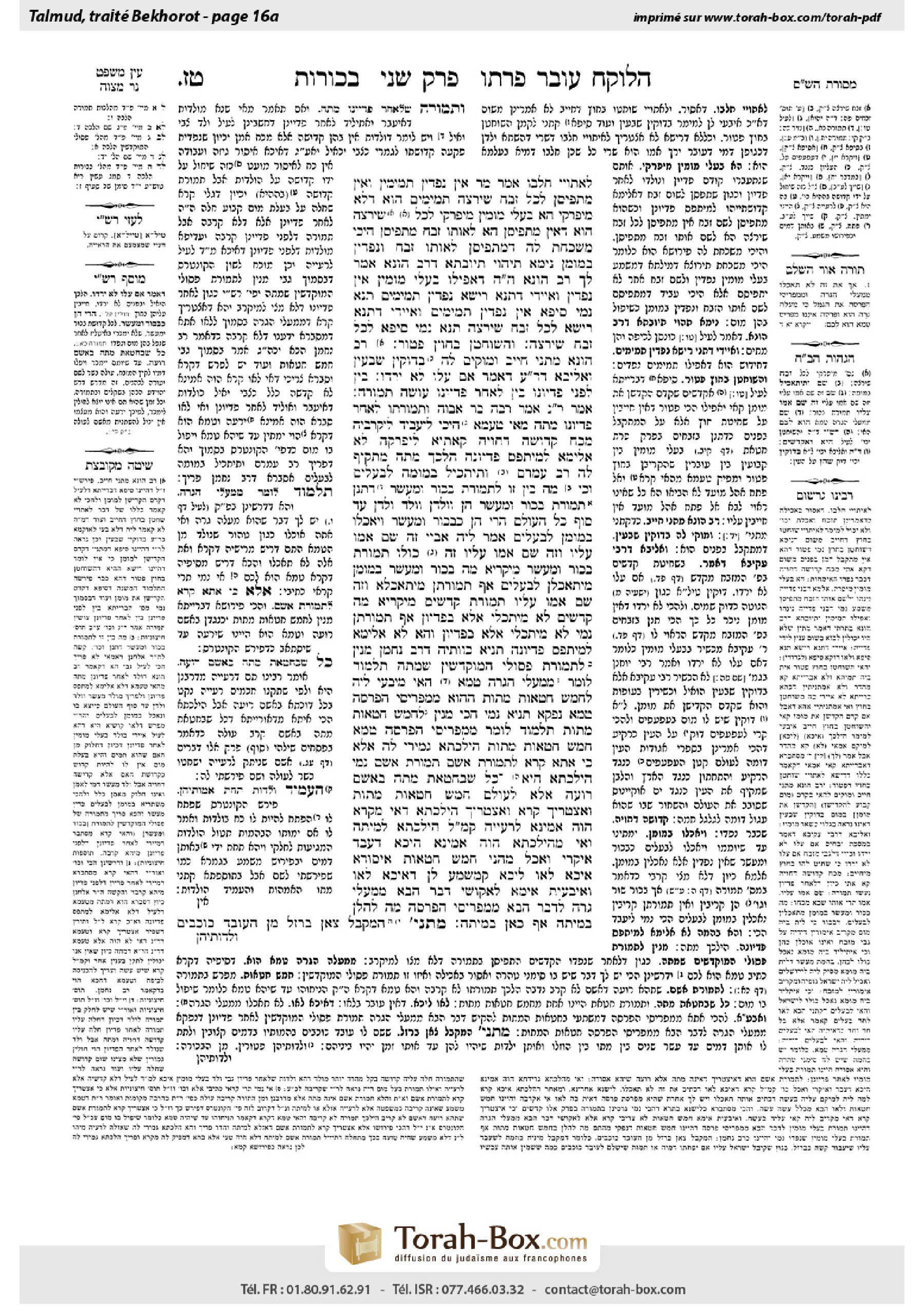
Bekhorot 16a: Talmud study for Daf Yomi
Study the Talmud for Daf Yomi with scanned pages, Hebrew text, English translations from Sefaria and AI-generated French translations.
Passage selection and English or AI-generated French translation are available where the scan has annotations. Daf Study is independent of Torah-Box and Sefaria.
Browse Bekhorot · בכורות · All tractatesBekhorot 16a text and translations
This page of Bekhorot includes the Aramaic text, an English translation and an AI-generated French translation, alongside the scan above.
בכורות י״ו א · Aramaic and Hebrew text
לְאֵתוֹיֵי חֲלָבוֹ.
אָמַר מָר: אֵין נִפְדִּין תְּמִימִין, וְאֵין מַתְפִּיסָן לְכׇל זֶבַח שֶׁיִּרְצֶה. תְּמִימִים הוּא דְּלָא מִיפַּרְקִי, הָא בַּעֲלֵי מוּמִין — מִיפַּרְקִי. לְכׇל שֶׁיִּרְצֶה הוּא דְּאֵין מַתְפִּיסָן, הָא לְאוֹתוֹ זֶבַח — מַתְפִּיסָן.
הֵיכִי מַשְׁכַּחַתְּ לַהּ? דְּמַתְפִּיסָן לְאוֹתוֹ זֶבַח, וְנִפְדִּין בְּמוּמָן. נֵימָא תֶּיהְוֵי תְּיוּבְתָּא דְּרַב הוּנָא?
אָמַר לְךָ רַב הוּנָא: הוּא הַדִּין דַּאֲפִילּוּ בַּעֲלֵי מוּמִין אֵין נִפְדִּין, וְאַיְּידֵי דִּתְנָא רֵישָׁא ״נִפְדִּין תְּמִימִים״ — תְּנָא נָמֵי סֵיפָא ״אֵין נִפְדִּין תְּמִימִים״, וְאַיְּידֵי דִּתְנָא רֵישָׁא ״לְכׇל זֶבַח שֶׁיִּרְצֶה״ — תְּנָא נָמֵי סֵיפָא ״לְכׇל זֶבַח שֶׁיִּרְצֶה״.
וְהַשּׁוֹחֲטָן בַּחוּץ פָּטוּר. רַב הוּנָא מַתְנֵי חַיָּיב, וּמוֹקֵים לַהּ בְּדוּקִין שֶׁבְּעַיִן, וְאַלִּיבָּא דְּרַבִּי עֲקִיבָא דְּאָמַר: אִם עָלוּ לֹא יֵרְדוּ.
בֵּין לִפְנֵי פִּדְיוֹנוֹ בֵּין לְאַחַר פִּדְיוֹנוֹ עוֹשֶׂה תְּמוּרָה. אָמַר רַב נַחְמָן אָמַר רַבָּה בַּר אֲבוּהּ: וּתְמוּרָתוֹ לְאַחַר פִּדְיוֹנוֹ מֵתָה. מַאי טַעְמָא? הֵיכִי לֶיעְבֵּיד? לַיקְרְבַיהּ — מִכֹּחַ קְדוּשָּׁה דְּחוּיָה קָאָתְיָא, לִיפְרְקַהּ — לָא אַלִּימָא לְמִיתְפַּס פִּדְיוֹנָהּ, הִלְכָּךְ מֵתָה.
מַתְקֵיף לַהּ רַב עַמְרָם: וְתִיתְּכִיל בְּמוּמָהּ לַבְּעָלִים! וְכִי מָה בֵּין זוֹ לִתְמוּרַת בְּכוֹר וּמַעֲשֵׂר? דִּתְנַן: תְּמוּרַת בְּכוֹר וּמַעֲשֵׂר, הֵן וּוְלָדָן וּוְלַד וְלָדָן עַד סוֹף כׇּל הָעוֹלָם — הֲרֵי הֵן כִּבְכוֹר וּמַעֲשֵׂר, וְיֵאָכְלוּ בְּמוּמָן לַבְּעָלִים!
אֲמַר לֵיהּ אַבָּיֵי: זֶה שֵׁם אִמּוֹ עָלָיו וְזֶה שֵׁם אִמּוֹ עָלָיו, זֶה כּוּלּוֹ תְּמוּרַת בְּכוֹר וּמַעֲשֵׂר מִיקַּרְיָא, מָה בְּכוֹר וּמַעֲשֵׂר בְּמוּמָן מִיתְאַכְלָן לַבְּעָלִים, אַף תְּמוּרָתָן מִיתְאַכְלָא.
וְזֶה שֵׁם אִמּוֹ עָלָיו, תְּמוּרַת קָדָשִׁים מִיקַּרְיָא, מָה קָדָשִׁים לָא מִיתַּכְלִי אֶלָּא בְּפִדְיוֹן — אַף תְּמוּרָתָן נָמֵי לָא מִיתַּכְלִי אֶלָּא בְּפִדְיוֹן, וְהָא לָא אַלִּימָא לְמִיתְפַּס פִּדְיוֹנַהּ.
תַּנְיָא כְּוָותֵיהּ דְּרַב נַחְמָן: מִנַּיִן לִתְמוּרַת פְּסוּלֵי הַמּוּקְדָּשִׁין שֶׁמֵּתָה? תַּלְמוּד לוֹמַר: ״מִמַּעֲלֵי הַגֵּרָה... טָמֵא״, הַאי מִיבְּעֵי לֵיהּ לְחָמֵשׁ חַטָּאוֹת מֵתוֹת! הָהוּא מִ״מַּפְרִיסֵי הַפַּרְסָה טָמֵא״ נָפְקָא.
תַּנְיָא נָמֵי הָכִי: מִנַּיִן לְחָמֵשׁ חַטָּאוֹת מֵתוֹת? תַּלְמוּד לוֹמַר: ״מִמַּפְרִיסֵי הַפַּרְסָה... טָמֵא״. חָמֵשׁ חַטָּאוֹת מֵתוֹת, הִילְכְתָא גְּמִירִי לַהּ, אֶלָּא כִּי אֲתָא קְרָא לִתְמוּרַת אָשָׁם.
תְּמוּרַת אָשָׁם נָמֵי הִילְכְתָא הִיא, כֹּל שֶׁבַּחַטָּאת מֵתָה — בָּאָשָׁם רוֹעֶה!
אֶלָּא, לְעוֹלָם חָמֵשׁ חַטָּאוֹת מֵתוֹת, וְאִצְטְרִיךְ קְרָא וְאִצְטְרִיךְ הִילְכְתָא, דְּאִי מִקְּרָא הֲוָה אָמֵינָא לִרְעִיָּיה, קָא מַשְׁמַע לַן הִילְכְתָא לְמִיתָה. וְאִי מֵהִילְכְתָא הֲוָה אָמֵינָא: הֵיכָא דַּעֲבַד אִיקְּרִי וַאֲכַל מֵהָנֵי חָמֵשׁ חַטָּאוֹת — אִיסּוּרָא אִיכָּא, לָאו לֵיכָּא, קָמַשְׁמַע לַן דְּאִיכָּא לָאו.
וְאִיבָּעֵית אֵימָא: לְאַקּוֹשֵׁי דָּבָר הַבָּא מִמַּעֲלֵי גֵּרָה לְדָבָר הַבָּא ״מִמַּפְרִיסֵי הַפַּרְסָה״, מָה לְהַלָּן בְּמִיתָה — אַף כָּאן בְּמִיתָה.
מַתְנִי׳ הַמְקַבֵּל צֹאן בַּרְזֶל מִן הַגּוֹי —
Bekhorot 16a · English translation
serves to include its milk in the prohibition, i.e., it is prohibited to consume milk of disqualified consecrated animals that were redeemed.
The Gemara analyzes the baraita. The Master said above: With regard to disqualified sacrificial animals whose consecration preceded their blemish, their offspring are sacred and may not be redeemed while they are unblemished, and one may not dedicate them as any offering he desires. The Gemara infers: It is only unblemished offspring that one may not redeem, which indicates that one may redeem blemished offspring. Likewise, it is only for any offering he desires that he may not dedicate the offspring, but for the same offering as the mother, one may dedicate the offspring.
The Gemara asks: How can you find a situation that includes both of these inferences? They apply in a case where one dedicates the unborn offspring as the same offering for which its mother was consecrated, and it may then be redeemed after having developed a blemish. The Gemara remarks: Shall we say that this is a conclusive refutation of the opinion of Rav Huna, who maintains that the offspring cannot be redeemed and rules that one must leave them to die?
Rav Huna could have said to you: The inferences upon which the refutation is based are false. Just as these unblemished offspring cannot be redeemed, the same is true with regard to blemished animals, as even blemished offspring cannot be redeemed. And since the former clause taught the phrase: They may be redeemed unblemished, the latter clause also taught the phrase: They may not be redeemed unblemished. And since the former clause taught: As any offering he desires, the latter clause also taught: As any offering he desires. According to Rav Huna, no inferences can be made from these rulings of the baraita because they were phrased in this manner for the sake of symmetry between its two sections, rather than to teach a specific halakha.
It is stated: And one who slaughters them outside the Temple courtyard is exempt from karet. The Gemara notes: Rav Huna taught this as: One who slaughters them outside the Temple courtyard is liable to receive karet, and he interprets it as referring to a case involving an animal with a minor blemish, such as on the cornea of the eye. And the mishna is in accordance with the opinion of Rabbi Akiva, who says: Although animals with a minor blemish may not be sacrificed ab initio, if they ascended the altar they shall not descend and are sacrificed. Since an animal with a minor blemish is potentially suitable for sacrifice, one who slaughters it outside the Temple courtyard is liable to receive karet.
The Gemara continues analyzing the baraita, which teaches: Whether before its redemption or after its redemption, an animal whose consecration preceded its blemish renders an animal that was a substitute for it sacred. Rav Naḥman says that Rabba bar Avuh says: And its substitute that was imbued with sanctity after its redemption must die. What is the reason? The Gemara explains: What are we to do? Shall we sacrifice it? It cannot be sacrificed, as it received its status from the deferred sanctity of the redeemed blemished animal and is therefore unfit for the altar. Shall we redeem it? It cannot be redeemed, as its sanctity is not strong enough to be transferable to the money for its redemption. Therefore, it must die.
Rav Amram objects to this: But let the substitute be eaten in its blemished state by the owners. After all, what is the difference between this substitute and the substitute of a firstborn or of an animal tithe offering, which may be eaten? The Gemara explains the question: As we learned in a mishna (Temura 21a): With regard to the substitute of a firstborn and of an animal tithe offering, both they, the substitutes themselves, and their offspring, and the offspring of their offspring, forever, i.e., for all future generations, are like the firstborn and the animal tithe offering, respectively, and therefore they are eaten in their blemished state by the owners. Why is the blemished substitute of a firstborn or an animal tithe permitted whereas the substitute of a disqualified consecrated animal remains forbidden?
Abaye said to Rav Amram: This one bears its mother’s name and that one bears its mother’s name, i.e., each substitute is subject to the same halakha as the animal for which it was substituted. This animal is entirely called a substitute of a firstborn or an animal tithe offering: Just as a firstborn and an animal tithe offering are eaten in their blemished state by the owners, so too, their substitute is eaten even when it is blemished.
And likewise, this substitute for a redeemed animal whose consecration preceded its blemish bears its mothers name, i.e., it is called the substitute of a sacrificial animal: Just as sacrificial animals are eaten only once they have been rendered permitted through redemption, so too, their substitutes are also eaten only through redemption. But the sanctity of this particular substitute is not strong enough to be transferable to money for its redemption, and therefore it cannot be redeemed. Consequently, it may not be eaten.
The Gemara notes that it is taught in a baraita in accordance with the opinion of Rav Naḥman: From where is it derived with regard to the substitute of disqualified consecrated animals that it must die? It is derived from a verse, as the verse states: “Nevertheless, these you shall not eat, of them that only chew the cud, or of them that only have a split hoof…it is impure to you” (Leviticus 11:4). The extraneous phrase “impure to you” indicates that there exists an animal which possesses the signs of a kosher animal but is nevertheless prohibited in consumption, and that is the substitute of a disqualified consecrated animal. The Gemara raises an objection: But isn’t that extraneous phrase necessary for the halakha of the five sin offerings that are left to die, which may not be eaten? The Gemara answers: No; that halakha is derived from the phrase: “Of them that only have a split hoof…is impure.”
The Gemara notes that this is also taught in a baraita: From where is it derived that there are five sin offerings that are left to die? The verse states: “Of them that have a split hoof…is impure to you,” which indicates that there is a second category of animals that possess the signs of a kosher animal, but that are nevertheless prohibited in consumption. The Gemara raises an objection: But isn’t the category of the five sin offerings that are left to die a halakha learned as a tradition, not from a verse? Rather, when that verse came, it came to teach that the substitute of a guilt offering may not be sacrificed and is left to graze until it develops a blemish.
The Gemara raises a further objection: The halakha of a substitute for a guilt offering is also a halakha learned as a tradition, as stated in the principle: In any case where a sin offering is left to die, a guilt offering is left to graze. Since the substitute of a sin offering is left to die, it is established by tradition that the substitute of a guilt offering is left to graze, and therefore no verse is required to teach this halakha.
The Gemara answers: Rather, the verse is actually the source for a halakha that applies to the five sin offerings left to die. And both a verse is necessary and the halakha learned as a tradition is also necessary to determine the final course of action that one should take. The Gemara elaborates: If the concept of the five sin offerings had been derived from the verse alone, I would say that the five sin offerings are left to graze. Therefore, the halakha learned through tradition teaches us that they are left to die. And if this ruling were based only on the halakha learned as a tradition, I would say: In a case where one happened to eat from one of these five sin offerings, there is a prohibition that he violated, but not a negative mitzva, for which one is liable to receive lashes. The verse therefore teaches us that there is a negative mitzva here as well.
And if you wish, say instead that the halakha of the five sin offerings left to die is in fact a halakha learned as a tradition, and therefore no verse is required for its own sake. Rather, the verse: “Of them that have a split hoof,” serves to juxtapose an item that comes, i.e., that is derived, from the mention of animals who chew their cud, referring to the substitutes of disqualified consecrated animals, with an item that comes from animals who have a split hoof, referring to the five sin offerings: Just as there, the sin offerings are left to die, so too here, the substitutes are left to die.
MISHNA: With regard to one who receives animals as part of a guaranteed investment from a gentile, i.e., the Jew receives the animals to raise them and commits to pay a fixed price at a later date even if they die or their value decreases, and the offspring born in the interim are divided between the gentile and the Jew,
Bekhorot 16a · Traduction française (IA)
sert à inclure son lait dans l'interdiction, c'est-à-dire il est interdit de consommer le lait des animaux consacrés non admissibles qui ont été rachetés.
La Guemara analyse la baraïta. Le Maître a dit plus haut : Concernant les animaux sacrés non admissibles dont la consécration a précédé leur défaut, leurs descendants sont sacrés et ne peuvent pas être rachetés tant qu'ils sont sans défaut, et l'on ne peut pas les consacrer comme offrande que l'on désire. La Guemara déduit : Ce sont seulement les descendants sans défaut que l'on ne peut pas racheter, ce qui indique que l'on peut racheter les descendants défectueux. De même, ce sont seulement pour toute offrande que l'on désire que l'on ne peut pas consacrer les descendants, mais pour la même offrande que la mère, l'on peut consacrer les descendants.
La Guemara pose la question : Comment peut-on trouver une situation qui inclut ces deux déductions ? Elles s'appliquent dans un cas où l'on consacre les descendants non nés comme la même offrande pour laquelle sa mère a été consacrée, et il peut alors être racheté après avoir développé un défaut. La Guemara remarque : Devons-nous dire que cela constitue une réfutation définitive de l'opinion de Rav Huna, qui maintient que les descendants ne peuvent pas être rachetés et établit que l'on doit les laisser mourir ?
Rav Huna aurait pu dire à l'audience : Les déductions sur lesquelles la réfutation s'appuie sont fausses. Tout comme ces descendants sans défaut ne peuvent pas être rachetés, c'est aussi le cas des animaux défectueux, car même les descendants défectueux ne peuvent pas être rachetés. Et puisque la première clause a enseigné la phrase : Ils peuvent être rachetés sans défaut, la seconde clause a aussi enseigné la phrase : Ils ne peuvent pas être rachetés sans défaut. Et puisque la première clause a enseigné : Comme toute offrande qu'il désire, la seconde clause a aussi enseigné : Comme toute offrande qu'il désire. Selon Rav Huna, aucune déduction ne peut être tirée de ces règles de la baraïta, car elles ont été formulées ainsi pour la symétrie entre ses deux sections, et non pour enseigner une halakha spécifique.
Il est dit : Et celui qui les sacrifie en dehors du courtyard du Temple est exempt de karet. La Guemara note : Rav Huna a enseigné cela comme suit : Celui qui les sacrifie en dehors du courtyard du Temple est puni de karet, et il l'interprète comme se référant à un cas impliquant un animal avec un petit défaut, tel qu'un défaut sur la cornée de l'œil. Et la mishna est en conformité avec l'opinion de Rabbi Akiva, qui dit : Bien que les animaux avec un petit défaut ne puissent pas être sacrifiés initialement, s'ils sont montés sur l'autel, ils ne descendent pas et sont sacrifiés. Puisque un animal avec un petit défaut est potentiellement admissible au sacrifice, celui qui le sacrifie en dehors du courtyard du Temple est puni de karet.
La Guemara continue d'analyser la baraïta, qui enseigne : Quel que soit le moment de sa rédemption, un animal dont la consécration a précédé son défaut rend sacré un animal qui en est le substitut. Rav Naḥman dit que Rabba bar Avuh dit : Et son substitut, qui a été sanctifié après sa rédemption, doit mourir. Quelle est la raison ? La Guemara explique : Que devons-nous faire ? Devons-nous le sacrifier ? Il ne peut pas être sacrifié, car il a reçu son statut à partir de la sanctité différée de l'animal rédemptif et défectueux, et est donc inadmissible pour l'autel. Devons-nous le racheter ? Il ne peut pas être racheté, car sa sanctité n'est pas suffisante pour être transférable à l'argent de sa rédemption. Par conséquent, il doit mourir.
Rav Amram s'oppose à cela : Mais laissez le substitut être mangé dans son état défectueux par les propriétaires. Après tout, quelle est la différence entre ce substitut et le substitut d'un premier-né ou d'un animal d'offrande, qui peut être mangé ? La Guemara explique la question : Comme nous avons appris dans une mishna (Temura 21a) : Concernant le substitut du premier-né et de l'offrande d'animal d'offrande, les substituts eux-mêmes, leurs descendants et les descendants de leurs descendants, pour toujours, c'est-à-dire pour toutes les générations futures, sont comme le premier-né et l'offrande d'animal d'offrande, respectivement, et donc ils sont mangés dans leur état défectueux par les propriétaires. Pourquoi le substitut défectueux du premier-né ou de l'offrande d'animal d'offrande est-il permis alors que le substitut de l'animal consacré non admissible reste interdit ?
Abaye a dit à Rav Amram : Celui-ci porte le nom de sa mère et celui-là porte le nom de sa mère, c'est-à-dire chaque substitut est soumis à la même halakha que l'animal pour lequel il a été substitué. Cet animal est entièrement appelé substitut d'un premier-né ou d'une offrande d'animal d'offrande : Tout comme les premiers-nés et les offrandes d'animal d'offrande sont consommés dans leur état défectueux par les propriétaires, de même leur substitut est consommé même s'il est défectueux.
Et de même, ce substitut pour un animal racheté dont la consécration a précédé son défaut porte le nom de sa mère, c'est-à-dire qu'il est appelé le substitut d'un animal sacré : tout comme les animaux sacrés sont mangés seulement après avoir été rendus permis par le rachat, de même leurs substituts sont aussi mangés seulement par le rachat. Mais la sanctité de ce substitut particulier n'est pas suffisante pour être transférable à l'argent de son rachat, et par conséquent il ne peut pas être racheté. Par conséquent, il ne peut pas être mangé.
La Guemara note que cela est enseigné dans une baraïta selon l'opinion de Rav Naḥman : d'où est tiré concernant le substitut des animaux consacrés non admissibles qu'il doit mourir ? Il est tiré d'un verset, car le verset dit : « Cependant, ceux-ci vous ne les mangerez pas, de ceux qui ruminent seulement, ou de ceux qui ont seulement un sabot fendu… ils sont impurs pour vous » (Lévitique 11:4). La phrase extrané : « impurs pour vous » indique qu'il existe un animal qui possède les signes d'un animal propre mais est néanmoins interdit à la consommation, et c'est le substitut de l'animal consacré non admissible. La Guemara soulève une objection : mais n'est-ce pas cette phrase extrané nécessaire pour la halakha des cinq offrandes de péché qui doivent mourir, qui ne peuvent pas être mangés ? La Guemara répond : non ; cette halakha est tirée de la phrase : « De ceux qui ont seulement un sabot fendu… ils sont impurs. »
La Guemara note que cela est également enseigné dans une baraïta : D'où est-il tiré que cinq sacrifices expiatoires sont laissés mourir ? La Sainte Écriture dit : « De ceux qui ont un sabot divisé… ils sont impurs pour vous », ce qui indique qu'il existe une deuxième catégorie d'animaux possédant les signes d'un animal kasher, mais qui sont toutefois interdits à la consommation. La Guemara émet une objection : N'est-ce pas que la catégorie des cinq sacrifices expiatoires laissés mourir est une halakha apprise par tradition, et non pas tirée d'un verset ? Plutôt, lorsque ce verset est venu, il est venu enseigner que le substitut d'un sacrifice de culpabilité ne peut être sacrifié et est laissé paître jusqu'à ce qu'il développe une tache.
La Guemara émet une autre objection : La halakha concernant le substitut d'un sacrifice de culpabilité est également une halakha apprise par tradition, comme indiqué dans le principe : Dans tout cas où un sacrifice expiatoire est laissé mourir, un sacrifice de culpabilité est laissé paître. Puisque le substitut d'un sacrifice expiatoire est laissé mourir, il est établi par tradition que le substitut d'un sacrifice de culpabilité est laissé paître, et par conséquent, aucun verset n'est nécessaire pour enseigner cette halakha.
La Guemara répond : Plutôt, le verset est en réalité la source d'une halakha applicable aux cinq sacrifices expiatoires laissés mourir. Et à la fois un verset est nécessaire et la halakha apprise par tradition est également nécessaire pour déterminer l'action finale à entreprendre. La Guemara développe : Si la notion des cinq sacrifices expiatoires avait été tirée du verset seul, je dirais que les cinq sacrifices expiatoires sont laissés paître. Par conséquent, la halakha apprise par tradition nous apprend qu'ils sont laissés mourir. Et si cette décision était basée uniquement sur la halakha apprise par tradition, je dirais : Dans le cas où l'on a mangé l'un de ces cinq sacrifices expiatoires, il y a une interdiction qu'on a violée, mais pas une mitsva négative, pour laquelle on est puni par des fessures. Le verset nous apprend donc que là aussi il y a une mitsva négative.
Et si vous le souhaitez, dites plutôt que la halakha concernant les cinq sacrifices expiatoires laissés mourir est en réalité une halakha apprise par tradition, et par conséquent, aucun verset n'est nécessaire pour elle-même. Plutôt, le verset : « De ceux qui ont un sabot divisé », sert à juxtaposer un objet qui vient, c'est-à-dire qui est tiré, de la mention d'animaux qui ruminent, faisant référence aux substituts des animaux consacrés non admissibles, avec un objet qui vient d'animaux ayant un sabot divisé, faisant référence aux cinq sacrifices expiatoires : Tout comme là, les sacrifices expiatoires sont laissés mourir, ainsi ici, les substituts sont laissés mourir.
MICHNA : En ce qui concerne celui qui reçoit des animaux en tant que partie d'un investissement garanti d'un non-juif, c'est-à-dire que le Juif reçoit les animaux pour les élever et s'engage à payer un prix fixe ultérieurement même s'ils meurent ou si leur valeur diminue, et les petits nés pendant l'intervalle sont partagés entre le non-juif et le Juif,
Traduction française générée par IA à partir de l’édition anglaise de Sefaria. Vérifie toujours un passage avec le texte source.
Text from Sefaria: William Davidson Edition - Vocalized Aramaic (CC BY NC); William Davidson Edition - English (CC BY NC).