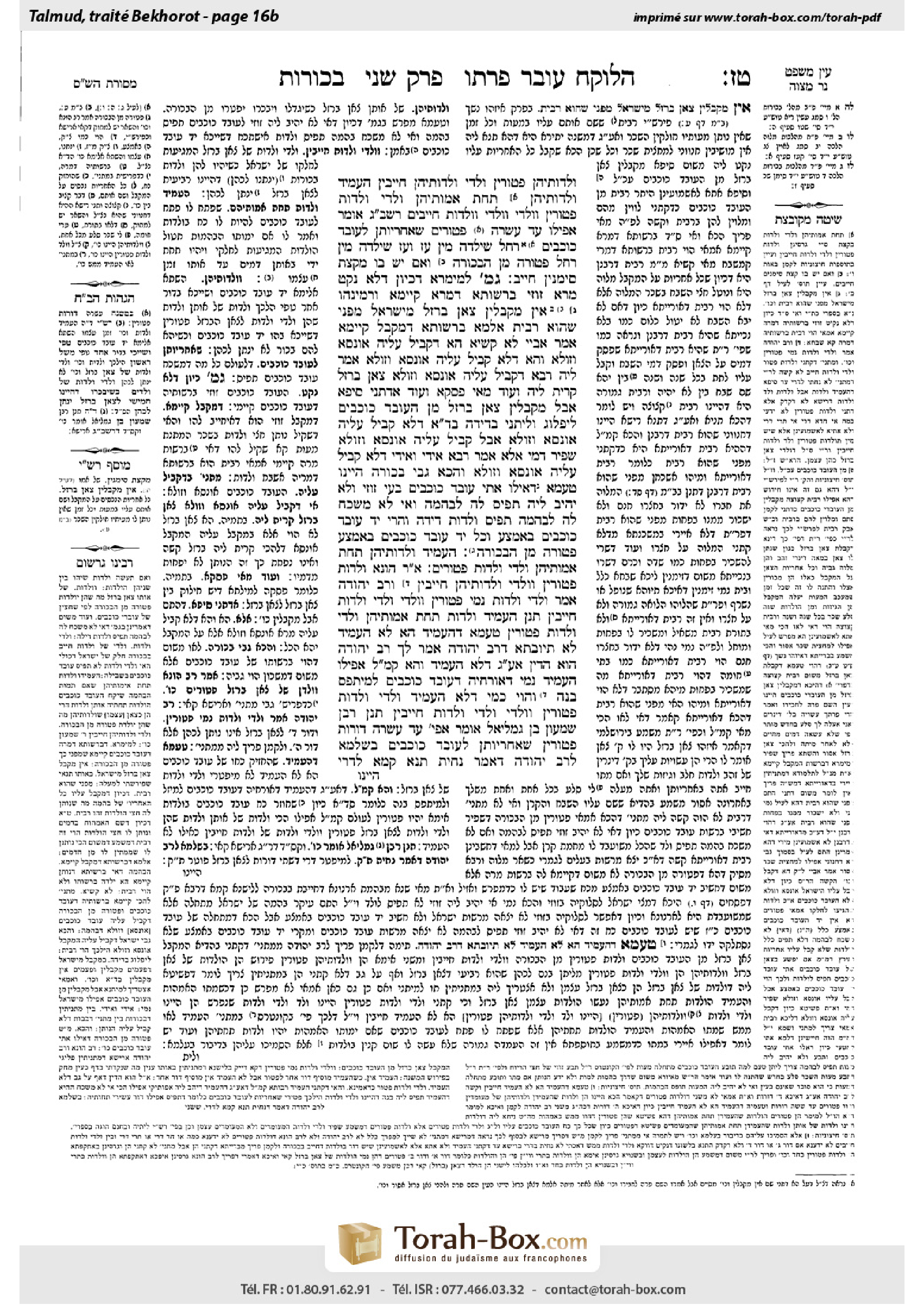
Bekhorot 16b: Talmud study for Daf Yomi
Study the Talmud for Daf Yomi with scanned pages, Hebrew text, English translations from Sefaria and AI-generated French translations.
Passage selection and English or AI-generated French translation are available where the scan has annotations. Daf Study is independent of Torah-Box and Sefaria.
Browse Bekhorot · בכורות · All tractatesBekhorot 16b text and translations
This page of Bekhorot includes the Aramaic text, an English translation and an AI-generated French translation, alongside the scan above.
בכורות י״ו ב · Aramaic and Hebrew text
וַלְדוֹתֵיהֶן פְּטוּרִין, וַלְדֵי וַלְדוֹתֵיהֶן חַיָּיבִין. הֶעֱמִיד וַלְדוֹתֵיהֶן תַּחַת אִמּוֹתֵיהֶן — וַלְדֵי וְלָדוֹת פְּטוּרִין, וּוַלְדֵי וַולְדֵי וְולָדוֹת חַיָּיבִים. רַבָּן שִׁמְעוֹן בֶּן גַּמְלִיאֵל אוֹמֵר: אֲפִילּוּ עַד עֲשָׂרָה פְּטוּרִים, שֶׁאַחְרָיוּתָן לַנׇּכְרִי.
רָחֵל שֶׁיָּלְדָה מִין עֵז, וְעֵז שֶׁיָּלְדָה מִין רָחֵל — פְּטוּרָה מִן הַבְּכוֹרָה, וְאִם יֵשׁ בּוֹ מִקְצָת סִימָנִין — חַיָּיב.
גְּמָ׳ לְמֵימְרָא, דְּכֵיוָן דְּלָא נָקֵט מָרָא זוּזֵי — בִּרְשׁוּתָא דְּמָרָא קָיְימָא?
וּרְמִינְהוּ: אֵין מְקַבְּלִין צֹאן בַּרְזֶל מִיִּשְׂרָאֵל מִפְּנֵי שֶׁהוּא רִבִּית, אַלְמָא בִּרְשׁוּתָא דִּמְקַבֵּל קָיְימָא!
אָמַר אַבָּיֵי: לָא קַשְׁיָא, הָא דְּקַבֵּיל עֲלֵיהּ אוּנְסָא וְזוֹלָא, וְהָא דְּלָא קַבֵּיל עֲלֵיהּ אוּנְסָא וְזוֹלָא.
אֲמַר לֵיהּ רָבָא: דְּקַבֵּיל עֲלֵיהּ אוּנְסָא וְזוֹלָא, ״צֹאן בַּרְזֶל״ קָרֵית לֵיהּ? וְעוֹד, מַאי פַּסְקָא?
וְעוֹד, אַדְּתָנֵי סֵיפָא אֲבָל מְקַבְּלִין צֹאן בַּרְזֶל מִן הַגּוֹי — לִיפְלוֹג וְלִיתְנֵי בְּדִידַהּ: בַּמֶּה דְּבָרִים אֲמוּרִים? דְּלָא קַבֵּיל עֲלֵיהּ אוּנְסָא וְזוֹלָא, אֲבָל קַבֵּיל עֲלֵיהּ אוּנְסָא וְזוֹלָא — שַׁפִּיר דָּמֵי!
אֶלָּא אָמַר רָבָא: אִידֵּי וְאִידֵּי דְּלָא קַבֵּיל עֲלֵיהּ אוּנְסָא וְזוֹלָא, וְהָכָא גַּבֵּי בְּכוֹרָה הַיְינוּ טַעְמָא, דְּאִילּוּ אָתֵי גּוֹי בָּעֵי זוּזֵי וְלָא יָהֵיב לֵיהּ — תָּפֵיס לַהּ לִבְהֵמָה, וְאִי לָא מַשְׁכַּח לַהּ לִבְהֵמָה — תָּפֵיס וְלָדוֹת דִּידַהּ, וַהֲרֵי יַד גּוֹי בָּאֶמְצַע, וְכֹל יַד גּוֹי בָּאֶמְצַע — פְּטוּרָה מִן הַבְּכוֹרָה.
הֶעֱמִיד וַלְדוֹתֵיהֶן תַּחַת אִמּוֹתֵיהֶן — וַלְדֵי וְלָדוֹת פְּטוּרִים. אָמַר רַב הוּנָא: וְלָדוֹת פְּטוּרִין, וַולְדֵי (ולדותיהן) [וְלָדוֹת] חַיָּיבִין. וְרַב יְהוּדָה אָמַר: וַלְדֵי וְלָדוֹת נָמֵי פְּטוּרִין, וַולְדֵי וַלְדֵי וְלָדוֹת חַיָּיבִין.
תְּנַן: הֶעֱמִיד וְלָדוֹת תַּחַת אִמּוֹתֵיהֶן — וַלְדֵי וְלָדוֹת פְּטוּרִין. טַעְמָא דְּהֶעֱמִיד, הָא לֹא הֶעֱמִיד — לָא. תְּיוּבְתָּא דְרַב יְהוּדָה!
אָמַר לָךְ רַב יְהוּדָה: הוּא הַדִּין, אַף עַל גַּב דְּלֹא הֶעֱמִיד, וְהָא קָא מַשְׁמַע לַן: אֲפִילּוּ הֶעֱמִיד נָמֵי.
דְּאוֹרְחֵיהּ דְּגוֹי לְמִיתְפַּס בְּנָהּ, וְהָוֵי כְּמִי דְּלֹא הֶעֱמִיד — וַלְדֵי וְלָדוֹת פְּטוּרִין, וַולְדֵי וַלְדֵי וְלָדוֹת חַיָּיבִין.
תְּנַן: רַבָּן שִׁמְעוֹן בֶּן גַּמְלִיאֵל אוֹמֵר: אֲפִילּוּ עַד עֲשָׂרָה דּוֹרוֹת פְּטוּרִין, שֶׁאַחְרָיוּתָן לַנׇּכְרִי. בִּשְׁלָמָא לְרַב יְהוּדָה דְּאָמַר: נָחֵית תַּנָּא קַמָּא לְדָרֵי —
Bekhorot 16b · English translation
their direct offspring are exempt from the mitzva of the firstborn if they give birth to a male, but the offspring of their direct offspring are obligated in the mitzva of the firstborn if they gave birth to a male. If the Jew established their offspring in place of their mothers for collection in case the mothers die, the offspring of their direct offspring are exempt and the offspring of the offspring of their direct offspring are obligated. Rabban Shimon ben Gamliel says: Even until ten generations, the offspring are exempt, as they all serve as a guarantee for the gentile, because if he does not receive the fixed payment for the animal, he will collect his debt from any offspring born to it or its offspring.
A ewe that gave birth to a goat of sorts and a goat that gave birth to a ewe of sorts are exempt from the mitzva of the firstborn. And if the offspring has some of the characteristics of its mother, it is obligated in the mitzva of firstborn.
GEMARA: The mishna teaches that animals given to a Jew as a guaranteed investment by a gentile are not subject to their offspring being counted a firstborn because they belong to the gentile. The Gemara suggests: Is this to say that since the owner did not yet take the money that will be owed to him, the investment itself stands in the owner’s possession, i.e., the owner is still regarded as such?
And the Gemara raises a contradiction to this conclusion from a mishna (Bava Metzia 70b): One may not accept from a Jew sheep to raise or other items to care for as a guaranteed investment, in which the terms of the transaction dictate that the one accepting the item takes upon himself complete responsibility to repay its value in the event of depreciation or loss, but receives only part of the profit. This is because it is a loan, as the principal is fixed and always returned to the owner, and any additional sum the owner receives is interest. The Gemara remarks: Evidently, the investment stands in the possession of the recipient, as otherwise it would not be considered a loan.
Abaye said: This is not difficult. This case, i.e., the mishna here, is where the gentile owner of the sheep accepts upon himself the responsibility for losses due to an accident or depreciation in the market value, and that is why the sheep are considered to still belong to him. And that case, the mishna in Bava Metzia, is where the owner did not accept upon himself responsibility for losses due to an accident or depreciation. Therefore, the guaranteed investment stands in the possession of the recipient.
Rava said to Abaye: If the owner accepted upon himself responsibility for losses due to an accident or depreciation, can you call it a guaranteed investment? This case is not a guaranteed investment, as the owner is not guaranteed to receive what he had given; rather, it is a type of joint business venture that is permitted between two Jews. And furthermore, if the term: Guaranteed investment, can refer to two different kinds of investments, then why was it stated without qualification in both mishnayot?
Rava continued: And furthermore, even if one grants that this arrangement can be called a guaranteed investment, there is another difficulty. Instead of the tanna teaching in the latter clause of the mishna in Bava Metzia: But one may accept a guaranteed investment from gentiles, let the tanna distinguish and teach within the case itself, that of accepting a guaranteed investment from a Jew. He should have taught: In what case is this statement, i.e., that one may not accept from a Jew sheep to raise or other items to care for as a guaranteed investment, said? It is in a case when the owner did not accept upon himself responsibility for losses due to an accident or depreciation, but if the owner accepted upon himself responsibility for losses due to an accident or depreciation, one may well enter into such an arrangement.
Rather, Rava rejected this explanation and said: Both this case in the mishna here and that case in Bava Metzia are discussing a situation where the owner did not accept upon himself responsibility for losses due to an accident or depreciation. And here, with regard to the firstborn, this is the reason that the offspring are exempt from the halakhot of a firstborn: Since, if the gentile comes and wants his money, and the Jew does not give it to him, the gentile will seize the animal, and if he does not find the animal he will seize the offspring, this means that the hand of a gentile is in the middle, i.e., even though the animals stand in the possession of the recipient, the gentile has some degree of ownership over the bodies of the offspring. And there is a halakha: In every case where the hand of a gentile is in the middle, the animal is exempt from the halakhot of a firstborn.
§ The mishna teaches: If the Jew established their offspring in place of their mothers for collection in case the mothers die, the offspring of their direct offspring are exempt. The Gemara cites a dispute with regard to animals involved in a guaranteed investment, in a case where the Jew did not establish their offspring in the place of their mothers. Rav Huna says: Their direct offspring are exempt, but the offspring of their direct offspring are obligated. And Rav Yehuda says: The offspring of their direct offspring are also exempt, and the offspring of the offspring of their direct offspring are obligated.
The Gemara raises an objection to the opinion of Rabbi Yehuda. We learned in the mishna: If the Jew established their offspring in place of their mothers for collection in case the mothers die, the offspring of their direct offspring are exempt. The Gemara infers: The reason they are exempt is that he established the offspring in place of their mothers; but if he did not establish them in place of their mothers, they are not exempt. This is apparently a conclusive refutation of the opinion of Rabbi Yehuda.
The Gemara answers that Rav Yehuda could have said to you: That inference is incorrect, as the same is true even though he did not establish the offspring in place of their mothers. In that case as well, the offspring of their offspring are exempt. And this is what the mishna is teaching us by stating the halakha in that manner: Even if he established the offspring in place of the mother, only the first two generations of offspring are exempt, but not all successive generations.
And it is necessary to teach this halakha that although he established the offspring in place of their mothers all successive generations are not exempt, as one might think that it is the normal manner of the gentile to seize not only the direct offspring, but her young of any generation as payment, which would mean that all successive generations are exempt. And therefore the mishna teaches that he is like one who did not establish the offspring in place of the mother, which means that the offspring of the direct offspring are exempt, but the offspring of the offspring of the direct offspring are obligated.
The Gemara raises an objection to the opinion of Rav Huna. We learned in the mishna that Rabban Shimon ben Gamliel says: Even until ten generations the offspring are exempt, as they serve as a guarantee for the gentile, because if he does not receive the fixed payment for the animal he will collect his debt from any offspring born to it or its offspring. Rabban Shimon ben Gamliel’s use of the term: Even, indicates that he disagrees with the first tanna only with regard to how many generations of offspring are exempt, but both agree that at least some generations are exempt. Granted, according to Rav Yehuda, who says that, in exempting from firstborn status, the first tanna descended to two generational levels,
Bekhorot 16b · Traduction française (IA)
Leurs descendants directs sont exemptés de la Mitsva du premier-né si elles donnent naissance à un mâle, mais les descendants des descendants directs sont obligés de la Mitsva du premier-né si elles donnent naissance à un mâle. Si le Juif a établi leurs descendants à la place de leurs mères pour la collecte en cas de décès des mères, les descendants des descendants directs sont exemptés et les descendants des descendants des descendants directs sont obligés. Rabban Shimon ben Gamliel dit : Même jusqu'à dix générations, les descendants sont exemptés, car ils servent tous de garantie pour le non-Juif, car s'il ne reçoit pas le paiement fixe pour l'animal, il collectera sa dette de tout descendant né de lui ou de ses descendants.
Une agnelle qui a donné naissance à un bouc et un bouc qui a donné naissance à une agnelle sont exemptés de la Mitsva du premier-né. Et si le descendant possède certains des caractéristiques de sa mère, il est obligé de la Mitsva du premier-né.
GUEMARA : La Michna enseigne que les animaux donnés à un Juif comme investissement garanti par un non-Juif ne sont pas soumis à la comptabilisation de leurs descendants comme premier-né, car ils appartiennent au non-Juif. La Guemara suggère : Est-ce pour dire que puisque l'propriétaire n'a pas encore reçu l'argent qui lui est dû, l'investissement lui appartient encore, c'est-à-dire que l'propriétaire est encore considéré comme tel ?
Et la Guemara soulève une contradiction avec cette conclusion à partir d'une Michna (Bava Metzia 70b) : On ne peut pas accepter de brebis d'un Juif pour les élever ou d'autres objets pour les entretenir comme investissement garanti, dans le cas où les termes de la transaction stipulent que celui qui accepte l'objet s'engage à réparer intégralement sa valeur en cas de dépréciation ou de perte, mais reçoit seulement une partie des bénéfices. C'est parce que c'est un prêt, car le principal est fixe et toujours rendu à l'owner, et toute somme supplémentaire que l'owner reçoit est un intérêt. La Guemara remarque : Évidemment, l'investissement est en possession du destinataire, car autrement il ne serait pas considéré comme un prêt.
Abaye dit : Ce n'est pas difficile. Ce cas, c'est-à-dire la Michna ici, est celui où l'owner non-Juif des brebis s'engage à assumer la responsabilité des pertes dues à un accident ou à la dépréciation du prix de marché, et c'est pourquoi les brebis sont considérées comme appartenant encore à lui. Et ce cas, la Michna dans Bava Metzia, est celui où l'owner n'a pas accepté de s'engager à assumer la responsabilité des pertes dues à un accident ou à la dépréciation. Par conséquent, l'investissement est en possession du destinataire.
Rava dit à Abaye : Si l'owner a accepté de s'engager à assumer la responsabilité des pertes dues à un accident ou à la dépréciation, pouvez-vous appeler cela un investissement garanti ? Ce cas n'est pas un investissement garanti, car l'owner n'est pas garanti de recevoir ce qu'il a donné ; plutôt, c'est un type de partenariat entre deux Juifs. Et de plus, si le terme : investissement garanti, peut désigner deux types d'investissements différents, pourquoi a-t-il été dit sans qualification dans les deux Mishnayot ?
Rava continua : Et de plus, même si l'on admet que cette disposition peut être appelée un investissement garanti, il y a une autre difficulté. Au lieu de la tanna enseignant dans la deuxième partie de la michna de Bava Metzia : Mais on peut accepter un investissement garanti d'un non-Juif, que la tanna distinguerait et enseignerait à l'intérieur du cas même, celui d'accepter un investissement garanti d'un Juif. Il devrait avoir dit : Dans quel cas cette déclaration, c'est-à-dire que l'on ne peut pas accepter de brebis d'un Juif pour les élever ou d'autres objets pour les entretenir comme investissement garanti, est-elle dite ? C'est dans le cas où l'owner n'a pas accepté de s'engager à assumer la responsabilité des pertes dues à un accident ou à la dépréciation, mais si l'owner a accepté de s'engager à assumer la responsabilité des pertes dues à un accident ou à la dépréciation, l'on peut bien entrer dans un tel arrangement.
Plutôt, Rava rejeta cette explication et dit : Les deux cas, celui de la michna ici et celui de Bava Metzia, sont discutés dans un cas où l'owner n'a pas accepté de s'engager à assumer la responsabilité des pertes dues à un accident ou à la dépréciation. Et ici, concernant le premier-né, c'est la raison pour laquelle les descendants sont exemptés des halakhot du premier-né : car, si le non-Juif vient et veut son argent, et que le Juif ne lui le donne pas, le non-Juif saisira l'animal, et s'il ne le trouve pas, il saisira les descendants, ce qui signifie que la main du non-Juif est au milieu, c'est-à-dire que même si les animaux sont en possession du destinataire, le non-Juif a un degré de propriété sur les corps des descendants. Et il y a une halakha : Dans tout cas où la main du non-Juif est au milieu, l'animal est exempt des halakhot du premier-né.
§ La Michna enseigne : Si le Juif a établi ses descendants à la place de leurs mères pour la collecte en cas de décès des mères, les descendants de ses descendants directs sont exemptés. La Guemara cite un débat concernant les animaux impliqués dans un investissement garanti, dans un cas où le Juif n'a pas établi ses descendants à la place de leurs mères. Rav Huna dit : Ses descendants directs sont exemptés, mais les descendants de ses descendants directs sont obligés. Et Rav Yehuda dit : Les descendants de ses descendants directs sont également exemptés, et les descendants des descendants de ses descendants directs sont obligés.
La Guemara soulève une objection contre l'opinion de Rabbi Yehuda. Nous avons appris dans la Michna : Si le Juif a établi ses descendants à la place de leurs mères pour la collecte en cas de décès des mères, les descendants de ses descendants directs sont exemptés. La Guemara infère : La raison pour laquelle ils sont exemptés est qu'il a établi les descendants à la place de leurs mères ; mais si il n'a pas établi les descendants à la place de leurs mères, ils ne sont pas exemptés. Cela semble être une réfutation concluante de l'opinion de Rabbi Yehuda.
La Guemara répond que Rav Yéhuda aurait pu te dire : Cette déduction est incorrecte, car cela est vrai même s'il n'a pas établi les enfants à la place de leurs mères. Dans ce cas également, les enfants des enfants sont exemptés. Et c'est ce que la mitsna nous apprend en énonçant la halakha ainsi : Même s'il a établi les enfants à la place de la mère, seulement les deux premières générations d'enfants sont exemptées, mais pas toutes les générations successives.
Il est nécessaire d'enseigner cette halakha, car même s'il a établi les enfants à la place de leurs mères, toutes les générations successives ne sont pas exemptées, car on pourrait penser que c'est la manière normale du gentil de s'emparer non seulement de l'enfant direct, mais aussi de ses petits-enfants de toute génération comme paiement, ce qui signifierait que toutes les générations successives sont exemptées. Et c'est pourquoi la mitsna enseigne qu'il est comme celui qui n'a pas établi les enfants à la place de la mère, ce qui signifie que les enfants des enfants directs sont exemptés, mais les enfants des enfants des enfants directs sont obligés.
La Guemara soulève une objection contre l'opinion de Rav Huna. Nous avons appris dans la mitsna que Rabban Shimon ben Gamliel dit : Jusqu'à dix générations, les enfants sont exemptés, car ils servent de garantie au gentil, car s'il ne reçoit pas le paiement fixe pour l'animal, il pourra récupérer sa dette à partir de tout enfant né de lui ou de ses enfants. L'emploi par Rabban Shimon ben Gamliel du terme « même » indique qu'il s'oppose au premier tanna uniquement concernant le nombre de générations d'enfants exemptés, mais les deux s'accordent sur le fait que certaines générations sont exemptées. En effet, selon Rav Yéhuda, qui dit que, en exemptant de la situation de premier-né, le premier tanna descendait à deux niveaux générationnels,
Traduction française générée par IA à partir de l’édition anglaise de Sefaria. Vérifie toujours un passage avec le texte source.
Text from Sefaria: William Davidson Edition - Vocalized Aramaic (CC BY NC); William Davidson Edition - English (CC BY NC).