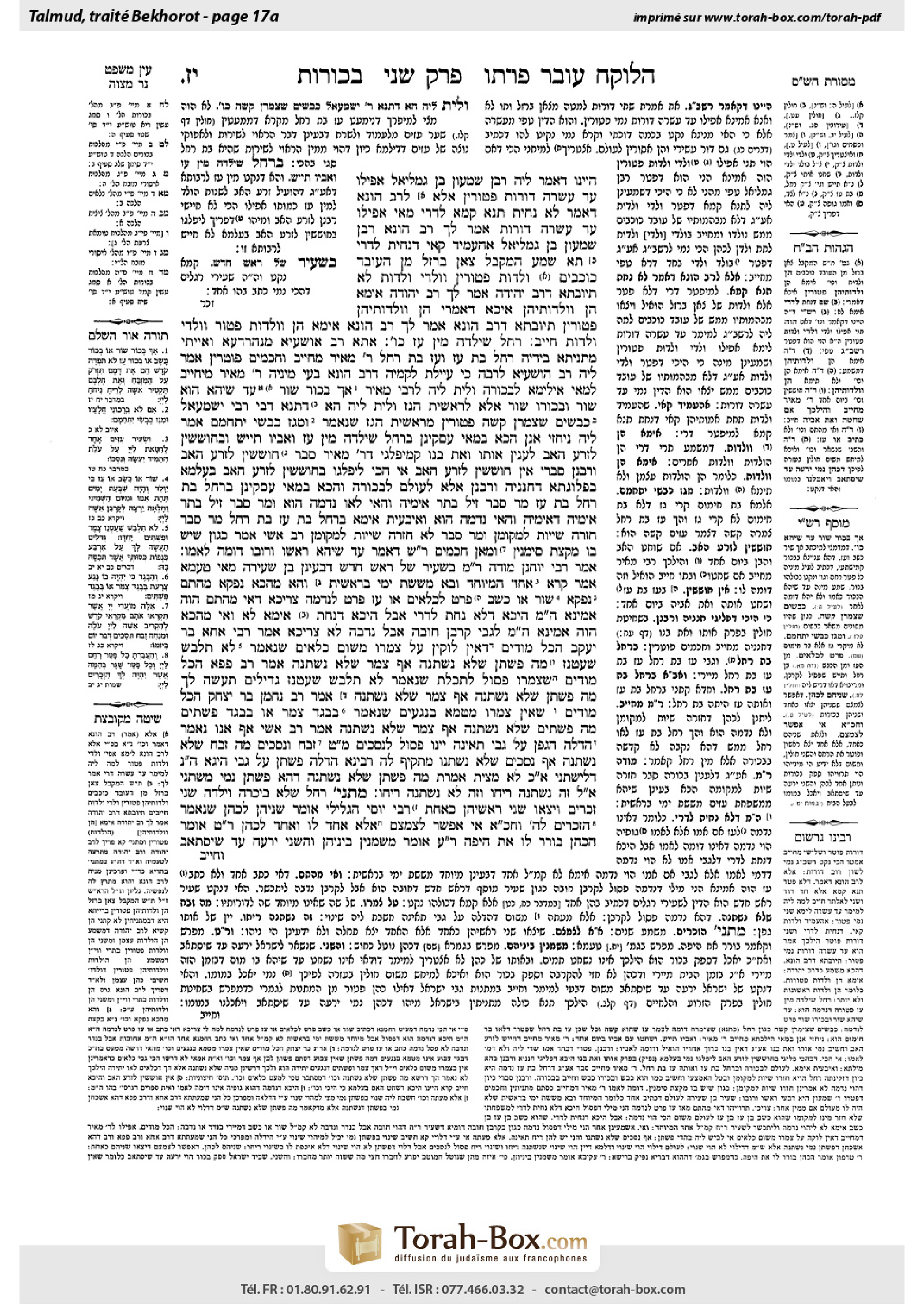
Bekhorot 17a: Talmud study for Daf Yomi
Study the Talmud for Daf Yomi with scanned pages, Hebrew text, English translations from Sefaria and AI-generated French translations.
Passage selection and English or AI-generated French translation are available where the scan has annotations. Daf Study is independent of Torah-Box and Sefaria.
Browse Bekhorot · בכורות · All tractatesBekhorot 17a text and translations
This page of Bekhorot includes the Aramaic text, an English translation and an AI-generated French translation, alongside the scan above.
בכורות י״ז א · Aramaic and Hebrew text
הַיְינוּ דַּאֲמַר לֵיהּ רַבָּן שִׁמְעוֹן בֶּן גַּמְלִיאֵל: אֲפִילּוּ עַד עֲשָׂרָה דּוֹרוֹת פְּטוּרִין. אֶלָּא לְרַב הוּנָא דְּאָמַר: לָא נָחֵית תַּנָּא קַמָּא לְדָרֵי, מַאי ״אֲפִילּוּ עַד עֲשָׂרָה דּוֹרוֹת״? אָמַר לְךָ רַב הוּנָא: רַבָּן שִׁמְעוֹן בֶּן גַּמְלִיאֵל אַ״הֶעֱמִיד״ קָאֵי דְּנָחֵית לְדָרֵי.
תָּא שְׁמַע: הַמְקַבֵּל צֹאן בַּרְזֶל מִן הַגּוֹי — וְלָדוֹת פְּטוּרִין, וַולְדֵי וְלָדוֹת לֹא. תְּיוּבְתָּא דְרַב יְהוּדָה! אָמַר לָךְ רַב יְהוּדָה, אֵימָא: הֵן וּוַלְדוֹתֵיהֶן.
אִיכָּא דְּאָמְרִי: הֵן וּוַלְדוֹתֵיהֶן פְּטוּרִין, תְּיוּבְתָּא דְּרַב הוּנָא! אָמַר לְךָ רַב הוּנָא: אֵימָא הֵן וְולָדוֹת — פָּטוּר, וַולְדֵי וְלָדוֹת — חַיָּיב.
רָחֵל שֶׁיָּלְדָה מִין עֵז כּוּ׳. אֲתָא רַב אוֹשַׁעְיָא מִנְּהַרְדְּעָא, וְאַיְיתִי מַתְנִיתָא בִּידֵיהּ: רָחֵל בַּת עֵז, וְעֵז בַּת רָחֵל — רַבִּי מֵאִיר מְחַיֵּיב, וַחֲכָמִים פּוֹטְרִין.
אֲמַר לֵיהּ רַב הוֹשַׁעְיָא לְרַבָּה: כִּי עָיְילַתְּ לְקַמֵּיהּ דְּרַב הוּנָא, בְּעִי מִינֵּיהּ: רַבִּי מֵאִיר מְחַיֵּיב לְמַאי? אִילֵימָא לִבְכוֹרָה — וְלֵית לֵיהּ לְרַבִּי מֵאִיר ״אַךְ בְּכוֹר שׁוֹר״ עַד שֶׁיְּהֵא הוּא שׁוֹר וּבְכוֹרוֹ שׁוֹר?
אֶלָּא לְרֵאשִׁית הַגֵּז, וְלֵית לֵיהּ הָא דְּתָנָא דְּבֵי רַבִּי יִשְׁמָעֵאל: כְּבָשִׂים שֶׁצַּמְרָן קָשֶׁה פְּטוּרִין מֵרֵאשִׁית הַגֵּז, שֶׁנֶּאֱמַר: ״וּמִגֵּז כְּבָשַׂי יִתְחַמָּם״?
אֲמַר לֵיהּ: נִיחְזֵי אֲנַן, הָכָא בְּמַאי עָסְקִינַן? בְּרָחֵל שֶׁיָּלְדָה מִין עֵז, וְאָבִיו תַּיִישׁ, וּבְחוֹשְׁשִׁין לְזֶרַע הָאָב לְעִנְיַן אוֹתוֹ וְאֶת בְּנוֹ קָמִיפַּלְגִי, דְּרַבִּי מֵאִיר סָבַר: חוֹשְׁשִׁין לְזֶרַע הָאָב, וְרַבָּנַן סָבְרִי: אֵין חוֹשְׁשִׁין לְזֶרַע הָאָב.
אִי הָכִי, לִיפַּלְגוּ בְּחוֹשְׁשִׁין לְזֶרַע הָאָב בְּעָלְמָא, בִּפְלוּגְתָּא דַּחֲנַנְיָה וְרַבָּנַן!
אֶלָּא, לְעוֹלָם לִבְכוֹרָה, וְהָכָא בְּמַאי עָסְקִינַן — בְּרָחֵל בַּת רָחֵל בַּת עֵז. מָר סָבַר: זִיל בָּתַר אִימֵּיהּ, וְהַאי לָאו נִדְמֶה הוּא.
וּמָר סָבַר: זִיל בָּתַר אִימַּיהּ דְּאִימֵּיהּ, וְהַאי נִדְמֶה הוּא.
וְאִיבָּעֵית אֵימָא, בְּרָחֵל בַּת עֵז בַּת רָחֵל, מָר סָבַר: חָזְרוּ שֵׂיֻיוֹת לִמְקוֹמָן, וּמָר סָבַר: לֹא חָזְרוּ שֵׂיֻיוֹת לִמְקוֹמָן.
רַב אָשֵׁי אָמַר: כְּגוֹן שֶׁיֵּשׁ בּוֹ מִקְצָת סִימָנִין, וּמַאן חֲכָמִים? רַבִּי שִׁמְעוֹן, דְּאָמַר: עַד שֶׁיְּהֵא רֹאשׁוֹ וְרוּבּוֹ דּוֹמֶה לְאִמּוֹ.
אָמַר רַבִּי יוֹחָנָן: מוֹדֶה רַבִּי מֵאִיר בְּשָׂעִיר שֶׁל רֹאשׁ חֹדֶשׁ דְּבָעֵינַן בֶּן שְׂעִירָה, מַאי טַעְמָא? אָמַר קְרָא: ״אֶחָד״ הַמְיוּחָד וּבָא מִשֵּׁשֶׁת יְמֵי בְּרֵאשִׁית.
וְהָא מֵהָכָא נָפְקָא? מֵהָתָם נָפְקָא — ״שׁוֹר אוֹ כֶשֶׂב״ — פְּרָט לְכִלְאַיִם, ״אוֹ עֵז״ — פְּרָט לְנִדְמֶה.
צְרִיכָא, דְּאִי מֵהָתָם הֲוָה אָמֵינָא: הָנֵי מִילֵּי הֵיכָא דְּלָא נְחַת לְדָרֵי, אֲבָל הֵיכָא דִּנְחַת — אֵימָא לָא. וְאִי מֵהָכָא הֲוָה אָמֵינָא: הָנֵי מִילֵּי לְגַבֵּי קׇרְבַּן חוֹבָה, אֲבָל נְדָבָה — לָא, צְרִיכָא.
אָמַר רַבִּי אַחָא בַּר יַעֲקֹב: הַכֹּל מוֹדִים דְּאֵין לוֹקִין עַל צַמְרוֹ מִשּׁוּם כִּלְאַיִם, שֶׁנֶּאֱמַר: ״לֹא תִלְבַּשׁ שַׁעַטְנֵז״, מָה פִּשְׁתָּן שֶׁלֹּא נִשְׁתַּנָּה — אַף צֶמֶר שֶׁלֹּא נִשְׁתַּנָּה.
אָמַר רַב פָּפָּא: הַכֹּל מוֹדִים שֶׁצַּמְרוֹ פָּסוּל לִתְכֵלֶת, שֶׁנֶּאֱמַר: ״לֹא תִלְבַּשׁ שַׁעַטְנֵז... גְּדִילִים תַּעֲשֶׂה לָךְ״, מָה פִּשְׁתָּן שֶׁלֹּא נִשְׁתַּנָּה — אַף צֶמֶר שֶׁלֹּא נִשְׁתַּנָּה.
אָמַר רַב נַחְמָן בַּר יִצְחָק: הַכֹּל מוֹדִים שֶׁאֵין צַמְרוֹ מִטַּמֵּא בִּנְגָעִים, שֶׁנֶּאֱמַר: ״בְּבֶגֶד צֶמֶר אוֹ בְּבֶגֶד פִּשְׁתִּים״, מָה פִּשְׁתִּים שֶׁלֹּא נִשְׁתַּנָּה — אַף צֶמֶר שֶׁלֹּא נִשְׁתַּנָּה.
אָמַר רַב אָשֵׁי: אַף אָנוּ נֹאמַר, הִדְלָה הַגֶּפֶן עַל גַּבֵּי תְּאֵינָה — יֵינוֹ פָּסוּל לִנְסָכִים. מַאי טַעְמָא? ״זֶבַח וּנְסָכִים״ — מָה זֶבַח שֶׁלֹּא נִשְׁתַּנָּה, אַף נְסָכִים שֶׁלֹּא נִשְׁתַּנּוּ.
מַתְקֵיף לַהּ רָבִינָא: הִדְלָה פִּשְׁתָּן עַל גַּבֵּי הִיגָא — הָכִי נָמֵי דְּלִישְׁתַּנֵּי? אִם כֵּן לָא מָצֵית אָמְרַתְּ ״מָה פִּשְׁתָּן שֶׁלֹּא נִשְׁתַּנָּה״, דְּהָא פִּשְׁתָּן נָמֵי מִשְׁתַּנֵּי! אֲמַר לֵיהּ: זֶה נִשְׁתַּנָּה רֵיחוֹ, וְזֶה לֹא נִשְׁתַּנָּה רֵיחוֹ.
מַתְנִי׳ רָחֵל שֶׁלֹּא בִּיכְּרָה וְיָלְדָה שְׁנֵי זְכָרִים, וְיָצְאוּ שְׁנֵי רָאשֵׁיהֶן כְּאַחַת — רַבִּי יוֹסֵי הַגְּלִילִי אוֹמֵר: שְׁנֵיהֶן לַכֹּהֵן, שֶׁנֶּאֱמַר: ״הַזְּכָרִים לַה׳״, וַחֲכָמִים אוֹמְרִים: אִי אֶפְשָׁר לְצַמְצֵם, אֶלָּא אֶחָד לוֹ וְאֶחָד לַכֹּהֵן.
רַבִּי טַרְפוֹן אוֹמֵר: הַכֹּהֵן בּוֹרֵר לוֹ אֶת הַיָּפֶה. רַבִּי עֲקִיבָא אוֹמֵר: מְשַׁמְּנִין בֵּינֵיהֶן, וְהַשֵּׁנִי יִרְעֶה עַד שֶׁיִּסְתָּאֵב.
Bekhorot 17a · English translation
this is what Rabban Shimon ben Gamliel said to him: Even until ten generations, the offspring are exempt. But according to Rav Huna, who says that the first tanna did not descend to any generational levels, what is the meaning of the phrase: Even until ten generations? The Gemara responds: Rav Huna could have said to you that the statement of Rabban Shimon ben Gamliel is referring to the second case of the mishna, where the Jew established the offspring in place of the mothers, as in that case the first tanna also descends to generational levels.
The Gemara comments: Come and hear an objection to the opinion of Rav Yehuda from the mishna: With regard to one who accepts animals as part of a guaranteed investment from a gentile, the direct offspring are exempt, and the offspring of the direct offspring are not exempt. This is apparently a conclusive refutation of the opinion of Rav Yehuda, who said that the offspring of the direct offspring are also exempt. The Gemara explains that Rav Yehuda could have said to you: I will say that the mishna means that they, the direct offspring, and their offspring are exempt. When the mishna said: The offspring are exempt, it was referring not to the offspring of the original animals given to the Jew, but to the offspring of those offspring.
The Gemara notes that there are those who say that there is a different version of this exchange: The mishna is actually written as: They, the direct offspring, and their offspring are exempt, which is apparently a conclusive refutation of the opinion of Rav Huna. The Gemara explains that Rav Huna could have said to you: One can say that the mishna means that they, i.e., the original animals given to the Jew, and their offspring are exempt. But the offspring of their direct offspring are obligated.
§ The mishna teaches: A ewe that gave birth to a goat of sorts and a goat that gave birth to a ewe of sorts are not subject to the obligation of a firstborn. Rav Oshaya came from Neharde’a and brought a baraita in his hand: With regard to an animal that has the appearance of a ewe and that was born to a goat, or a goat that was born to a ewe, Rabbi Meir deems it obligated, and the Rabbis deem it exempt.
Rav Hoshaya said to Rabba: When you go before Rav Huna, ask him: With regard to what does Rabbi Meir deem it obligated? If we say that it is with regard to the mitzva of a firstborn, that is difficult: But doesn’t Rabbi Meir agree that the verse: “But the firstborn of an ox” (Numbers 18:17), teaches that an animal is included in the mitzva of a firstborn only if it is an ox and its firstborn is an ox? In other words, the mitzva of the firstborn applies only if the offspring has the appearance of its mother.
Rather, Rabbi Meir’s ruling was with regard to the obligation of giving the first shearing of wool to the priest. The Gemara asks: But if so, doesn’t Rabbi Meir agree with that which the school of Rabbi Yishmael taught: Lambs whose fleece is tough are exempt from, i.e., not subject to giving, the first shearing of wool to the priest, as it is stated: “And if he were not warmed with the fleece of my sheep” (Job 31:20)? It is derived from this verse that only a fleece which is fit to warm a person, i.e., fleece that is soft, is classified as wool that must be given to the priest. Since the fleece of the goat-like offspring of a ewe is tough, it should be excluded from the mitzva of the first shearing.
Rabba said to Rav Hoshaya: Let us see; what are we dealing with here? We are dealing with a ewe that gave birth to a goat of sorts and its father was a goat. And they disagree as to whether or not one needs to be concerned with the offspring’s paternity in terms of the matter of the prohibition against slaughtering itself and its offspring on the same day. As Rabbi Meir holds that one needs to be concerned with its paternity, and therefore one is liable for slaughtering the male goat and its goat-like offspring in a single day, and the Rabbis hold that one need not be concerned with its paternity.
The Gemara objects: But if that is so, then let us say that they disagree on whether or not one needs to be concerned with the offspring’s paternity in general, i.e., with regard to the prohibition against slaughtering an animal and its offspring on the same day, which is the subject of the dispute of Ḥananya and the Rabbis (see Ḥullin 78b). Instead of citing a dispute in the unusual case of a ewe that gave birth to a goat of sorts, the baraita should have simply stated that Rabbi Meir agrees with the opinion of Ḥananya that the prohibition against slaughtering an animal and its offspring applies even to a father and its offspring.
Rather, Rabbi Meir’s ruling is actually with regard to the obligation of a firstborn, and here we are dealing with a ewe born to a ewe born to a goat, which means that the offspring is similar in appearance to its mother, but not to its grandmother. One Sage, Rabbi Meir, holds: Follow the appearance of an offspring’s mother to determine whether or not the mitzva of a firstborn applies, and as this offspring has the appearance of its mother, it does not have the status of an animal that resembles a different species. Accordingly, the mitzva of firstborn applies.
And one Sage, the Rabbis, holds: Follow the appearance of the mother of its mother to determine whether or not the mitzva of firstborn applies, and as this offspring does not have the appearance of its mother’s mother, it does have the status of an animal that resembles a different species. Consequently, the mitzva of firstborn does not apply.
And if you wish, say instead that we are dealing with a ewe born to a goat born to a ewe. One Sage, Rabbi Meir, holds: Its ovine nature was restored to its original state. That is, since the offspring resembles its older progenitor, the mitzva of firstborn applies. And one Sage, the Rabbis, holds: Its ovine nature was not restored to its original state, and in any case where the offspring is not like its mother, it is exempt from the mitzva of firstborn.
The Gemara cites another interpretation of the baraita. Rav Ashi says: The baraita is referring to a case where the offspring has some of the characteristics of its mother, and the opinion of Rabbi Meir is that of the mishna here, which rules that the mitzva of firstborn applies to an offspring that has some of its mother’s characteristics. And who are the Rabbis who disagree with Rabbi Meir? It is Rabbi Shimon, who says: The offspring does not have firstborn status unless its head and the majority of its body are similar to the appearance of its mother.
According to the second explanation of the baraita, Rabbi Meir maintains that a ewe born to a goat born to a ewe is counted a firstborn despite the fact that it does not resemble its mother. Rabbi Yoḥanan says: Nevertheless, Rabbi Meir concedes with regard to the goat of the New Moon offering that we require the son of a female goat. What is the reason? With regard to the New Moon offering the verse states: “And one male goat for a sin offering unto the Lord” (Numbers 28:15). The superfluous word “one” teaches that the offering must be particularly a goat, as it has been since the six days of Creation.
The Gemara asks: But is this derived from here? Isn’t it derived from there: “When a bull, or a sheep, or a goat, is brought forth” (Leviticus 22:27), as the phrase “a bull, or a sheep” serves to exclude diverse kinds, i.e., an animal born from two different species of animals, while the phrase “or a goat” serves to exclude an animal that resembles a different species?
The Gemara answers that both verses are necessary, as, had the halakha been derived only from there, the verse in Leviticus, I would say: That statement applies only where the resemblance to another species does not trace back to earlier generations, i.e., the animal does not resemble any of its progenitors, but in a case where it does trace back, I would say: No, the animal is fit for sacrifice. Therefore, it is derived from the verse in Numbers that the animal must be as it has been since the six days of Creation. And had it been derived only from here, the verse in Numbers, I would say: That statement applies only with regard to an obligatory offering, which is the subject of that verse, but in the case of a gift offering, the animal does not need to resemble its mother. Therefore, both verses are necessary.
The Gemara cites a series of statements discussing an animal that resembles another species. Rabbi Aḥa bar Yaakov says: Everyone concedes that one is not flogged due to the prohibition of diverse kinds for wearing its wool together with linen, as it is stated: “You shall not wear diverse kinds, wool and linen together” (Deuteronomy 22:11). Just as linen is a material that has not changed, so too, one is liable only for wearing wool from an animal that has not changed, i.e., an animal whose appearance does not differ from that of its progenitors.
Rav Pappa similarly says: Everyone concedes that the wool of an animal that resembles another species is unfit to be used as the sky-blue wool of ritual fringes, as it is stated: “You shall not wear diverse kinds…you shall make yourself twisted cords” (Deuteronomy 22:11–12). Just as linen is a material that has not changed, so too, only wool from an animal that has not changed may be used as the sky-blue wool.
Rav Naḥman bar Yitzḥak likewise says: Everyone concedes that its wool does not become ritually impure with leprous marks, as it is stated: “And when the mark of leprosy is in a garment, whether it be a woolen garment, or a linen garment” (Leviticus 13:47). Just as the linen of a garment has not changed, so too, only a garment made of wool from an animal that has not changed can become impure with leprous marks.
Rav Ashi says: Along these lines, we can say also that if one trellised a grapevine over a fig tree, its wine is unfit to be used for libations. What is the reason? The verse states: “An offering, and libations” (Leviticus 23:37). Just as an offering must be an animal that has not changed, so too, libations must come from wine produced by vines that were not changed.
Ravina objects to this suggestion: By that reasoning, if one trellised flax over a shrub, it should also be considered a changed product. But if so, you cannot say what Rabbi Aḥa bar Yaakov said in his earlier statement: Just as linen is a material that has not changed, as linen also changes according to Rav Ashi’s reasoning. Rav Ashi said to Ravina: With regard to this wine, its scent has changed, but with regard to that flax, its scent has not changed, and therefore its alteration is considered inconsequential.
MISHNA: In the case of a ewe that had not previously given birth, and it gave birth to two males and both their heads emerged as one, Rabbi Yosei HaGelili says: Both of them are given to the priest, as it is stated in the plural: “Every firstborn that you have of animals, the males shall be to the Lord” (Exodus 13:12). And the Rabbis say: It is impossible for two events to coincide precisely, i.e., their births were not at precisely the same time. Rather, one preceded the other, and therefore one of the males is given to the owner and one to the priest.
Rabbi Tarfon says: The priest chooses the better of the two. Rabbi Akiva says: They assess the value of the lambs between them and the priest takes the leaner of the two, as will be explained in the Gemara. And with regard to the second lamb that remains in the possession of the owner, since he may not partake of it due to its uncertain status as a firstborn, it must graze until it becomes blemished, at which point he may slaughter and eat it.
Bekhorot 17a · Traduction française (IA)
C’est ce que Rabban Shimon ben Gamliel a dit à lui : Jusqu’à dix générations, les descendants sont exemptés. Mais selon Rav Huna, qui affirme que le premier tanna n’a pas descendu à des niveaux générationnels, quelle est la signification de la phrase : Jusqu’à dix générations ? La Guemara répond : Rav Huna aurait pu te dire que la déclaration de Rabban Shimon ben Gamliel fait référence au deuxième cas de la michna, où le Juif a établi les descendants à la place des mères, comme dans ce cas le premier tanna descend également à des niveaux générationnels.
La Guemara commente : Approchez-vous et entendez une objection contre l’opinion de Rav Yehuda à partir de la michna : En ce qui concerne celui qui accepte des animaux comme partie d’un investissement garanti d’un non-Juif, les descendants directs sont exemptés, et les descendants des descendants directs ne le sont pas. Cela semble être une réfutation concluante de l’opinion de Rav Yehuda, qui affirmait que les descendants des descendants directs sont également exemptés. La Guemara explique que Rav Yehuda aurait pu te dire : Je dirais que la michna signifie que ceux-ci, les descendants directs, et leurs descendants sont exemptés. Lorsque la michna a dit : Les descendants sont exemptés, cela faisait référence non aux descendants des animaux donnés initialement au Juif, mais aux descendants de ceux-ci.
La Guemara note que certains affirment qu’il existe une version différente de ce débat : la michna est en réalité écrite comme : Ils, les descendants directs, et leurs descendants sont exemptés, ce qui semble être une réfutation concluante de l’opinion de Rav Huna. La Guemara explique que Rav Huna aurait pu te dire : On peut dire que la michna signifie que ceux-ci, c’est-à-dire les animaux donnés initialement au Juif, et leurs descendants sont exemptés. Mais les descendants de leurs descendants directs sont obligés.
§ La Michna enseigne : Une agnelle qui a donné naissance à un bouc et un bouc qui a donné naissance à une agnelle ne sont pas soumis à l’obligation du premier-né. Rav Oshaya est venu de Neharde’a et a apporté une baraïta dans sa main : En ce qui concerne un animal qui a l’apparence d’une agnelle et qui a été né d’un bouc, ou un bouc né d’une agnelle, Rabbi Meir considère qu’il est obligatoire, et les Sages considèrent qu’il est exempt.
Rav Hoshaya a dit à Rabba : Lorsque vous irez devant Rav Huna, demandez-lui : En ce qui concerne quoi Rabbi Meir considère qu’il est obligatoire ? Si nous disons que c’est en ce qui concerne la mitsva du premier-né, cela est difficile : Mais ne serait-ce pas que Rabbi Meir est d’accord avec le fait que la verset : « Mais le premier-né d’un bœuf » (Nombres 18:17), enseigne que l’animal est inclus dans la mitsva du premier-né uniquement s’il est un bœuf et que son premier-né est un bœuf ? En d’autres termes, la mitsva du premier-né s’applique uniquement si l’offspring a l’apparence de sa mère.
Plutôt, la décision de Rabbi Meir concernait l’obligation de donner la première laine de laine au prêtre. La Guemara pose la question : Mais si c’est ainsi, ne serait-ce pas que Rabbi Meir est d’accord avec ce que l’école de Rabbi Yishmael a enseigné : Les agneaux dont la laine est dure sont exemptés, c’est-à-dire ne sont pas soumis à la donnée de la première laine de laine au prêtre, comme il est dit : « Et s’il n’était pas réchauffé par la laine de mes brebis » (Job 31:20) ? Il est tiré de cette verset que seule une laine qui est adaptée à réchauffer une personne, c’est-à-dire une laine douce, est classée comme laine qui doit être donnée au prêtre. Puisque la laine du descendant bouc-like de l’agneau est dure, elle devrait être exclue de la mitsva de la première laine.
Rabba a dit à Rav Hoshaya : Voyons ; de quoi sommes-nous en train de parler ici ? Nous sommes en train de parler d’une agnelle qui a donné naissance à un bouc et dont le père était un bouc. Et ils divergent sur le fait de savoir si l’on doit s’inquiéter de la paternité du descendant en ce qui concerne la question de l’interdiction de sacrifier lui-même et son descendant le même jour. Comme Rabbi Meir considère que l’on doit s’inquiéter de sa paternité, et donc l’on est tenu responsable de sacrifier le bouc mâle et son descendant, qui ressemble à un bouc, le même jour, et les Sages considèrent que l’on ne doit pas s’inquiéter de sa paternité.
La Guemara s’oppose : Mais si c’est ainsi, alors disons qu’ils divergent sur le fait de savoir si l’on doit s’inquiéter de la paternité du descendant en général, c’est-à-dire en ce qui concerne l’interdiction de sacrifier un animal et son descendant le même jour, qui est la matière du débat entre Ḥananya et les Sages (voir Ḥullin 78b). Au lieu de citer un débat dans le cas inhabituel d’une agnelle qui a donné naissance à un bouc, la baraïta aurait dû simplement affirmer que Rabbi Meir est d’accord avec l’opinion de Ḥananya que l’interdiction de sacrifier un animal et son descendant s’applique même à un père et son descendant.
Plutôt, la décision de Rabbi Meir est en réalité concernant l’obligation du premier-né, et ici nous sommes en train de parler d’une agnelle née d’une agnelle née d’un bouc, ce qui signifie que l’offspring est semblable en apparence à sa mère, mais pas à sa grand-mère. Un Sage, Rabbi Meir, affirme : Suivez l’apparence de la mère de l’offspring pour déterminer si la mitsva du premier-né s’applique, et comme cet offspring a l’apparence de sa mère, il ne possède pas le statut d’un animal qui ressemble à une autre espèce. Ainsi, la mitsva du premier-né s’applique.
Et un Sage, les Sages, affirme : Suivez l’apparence de la mère de la mère pour déterminer si la mitsva du premier-né s’applique, et comme cet animal n’a pas l’apparence de la mère de sa mère, il possède le statut d’un animal qui ressemble à une autre espèce. Ainsi, la mitsva du premier-né ne s’applique pas.
Et si vous le souhaitez, dites plutôt que nous sommes en train de parler d’une agnelle née d’un bouc née d’une agnelle. Un Sage, Rabbi Meir, affirme : Sa nature ovine a été restaurée à son état originel. C’est-à-dire, puisque l’animal ressemble à son ancêtre plus proche, la mitsva du premier-né s’applique. Et un Sage, les Sages, affirme : Sa nature ovine n’a pas été restaurée à son état originel, et dans tout cas où l’animal n’est pas semblable à sa mère, il est exempt de la mitsva du premier-né.
La Guemara cite une autre interprétation de la baraïta. Rav Ashi dit : La baraïta fait référence à un cas où l'offspring possède certaines caractéristiques de sa mère, et l'opinion de Rabbi Meir est celle de la mishna ici, qui déclare que la mitsva du premier-né s'applique à un offspring qui possède certaines caractéristiques de sa mère. Et qui sont les Rabbins qui s'opposent à Rabbi Meir ? C'est Rabbi Shimon, qui dit : L'offspring ne possède le statut de premier-né qu'à condition que sa tête et la majorité de son corps ressemblent à l'apparence de sa mère.
Selon l'explication secondaire de la baraïta, Rabbi Meir maintient qu'une agnelle née d'une chèvre née d'une agnelle est comptée comme premier-né, même si elle ne ressemble pas à sa mère. Rabbi Yoḥanan dit : Cependant, Rabbi Meir reconnaît, en ce qui concerne la chèvre de l'offrande de la Lune nouvelle, que nous exigeons la fille d'une chèvre femelle. Quelle est la raison ? En ce qui concerne l'offrande de la Lune nouvelle, la parabole dit : « Et un bouc mâle pour un sacrifice expiatoire à l'Éternel » (Nombres 28:15). Le mot superflu « un » enseigne que l'offrande doit être particulièrement un bouc, car c'est ainsi depuis les six jours de la Création.
La Guemara pose la question : Mais est-ce tiré de là ? N'est-ce pas tiré de là : « Quand un taureau, ou une brebis, ou un bouc est né » (Lévitique 22:27), car la phrase « un taureau, ou une brebis » sert à exclure les espèces différentes, c'est-à-dire un animal né de deux espèces différentes d'animaux, tandis que la phrase « ou un bouc » sert à exclure un animal qui ressemble à une autre espèce ?
La Guemara répond que les deux versets sont nécessaires, car, si la halakha avait été tirée uniquement de là, le verset de Lévitique, je dirais : Cette déclaration s'applique uniquement dans le cas où la ressemblance à une autre espèce ne remonte pas aux générations précédentes, c'est-à-dire que l'animal ne ressemble à aucun de ses ancêtres, mais dans le cas où elle remonte, je dirais : Non, l'animal est digne d'offrande. Par conséquent, il est tiré du verset de Nombres que l'animal doit être tel qu'il a été depuis les six jours de la Création. Et si on l'avait tiré uniquement de là, le verset de Nombres, je dirais : Cette déclaration s'applique uniquement en ce qui concerne une offrande obligatoire, qui est le sujet de ce verset, mais dans le cas d'une offrande de bienfaits, l'animal n'a pas besoin de ressembler à sa mère. Par conséquent, les deux versets sont nécessaires.
La Guemara cite une série d'affirmations discutant d'un animal qui ressemble à une autre espèce. Rabbi Aḥa bar Yaakov dit : Tout le monde reconnaît que l'on n'est pas fouetté à cause de l'interdiction des espèces diverses pour porter sa laine avec la laine de lin, car il est dit : « Tu ne porteras pas des espèces diverses, la laine et le lin ensemble » (Deutéronome 22:11). Tout comme le lin est un matériau qui n'a pas changé, de même, on est puni uniquement pour porter la laine d'un animal qui n'a pas changé, c'est-à-dire un animal dont l'apparence ne diffère pas de celle de ses ancêtres.
Rav Pappa dit de même : Tout le monde reconnaît que la laine d'un animal qui ressemble à une autre espèce est inutilisable comme la laine bleue pour les franges rituelles, car il est dit : « Tu ne porteras pas des espèces diverses… tu feras des cordes tordues » (Deutéronome 22:11–12). Tout comme le lin est un matériau qui n'a pas changé, de même, seule la laine d'un animal qui n'a pas changé peut être utilisée comme la laine bleue.
Rav Naḥman bar Yitzḥak dit de même : Tout le monde reconnaît que sa laine ne devient pas impure par les marques de tumeur, car il est dit : « Et quand la marque de tumeur est dans un vêtement, que ce soit un vêtement de laine ou un vêtement de lin » (Lévitique 13:47). Tout comme le lin d'un vêtement n'a pas changé, de même, seul un vêtement fait de laine d'un animal qui n'a pas changé peut devenir impur par les marques de tumeur.
Rav Ashi dit : Dans ce sens, nous pouvons aussi dire que si l'on a trellisé une vigne sur un arbre à figues, son vin est inutilisable pour les libations. Quelle est la raison ? La parabole dit : « Une offrande, et des libations » (Lévitique 23:37). Tout comme l'offrande doit être un animal qui n'a pas changé, de même, les libations doivent provenir du vin produit par des vignes qui n'ont pas changé.
Ravina s'oppose à cette suggestion : Selon cette logique, si l'on a trellisé du lin sur un buis, il devrait aussi être considéré comme un produit changé. Mais si c'est ainsi, on ne peut pas dire ce que Rabbi Aḥa bar Yaakov a dit dans son affirmation précédente : Tout comme le lin est un matériau qui n'a pas changé, car le lin change selon la logique de Rav Ashi. Rav Ashi dit à Ravina : En ce qui concerne ce vin, son parfum a changé, mais en ce qui concerne ce lin, son parfum n'a pas changé, et par conséquent, son changement est considéré comme insignifiant.
MICHNA : Dans le cas d'une agnelle qui n'avait pas encore donné naissance, et qui a donné naissance à deux mâles et dont les têtes sont sorties comme une seule, Rabbi Yosei HaGelili dit : Les deux sont donnés au prêtre, car il est dit au pluriel : « Tout premier-né que tu auras d'animaux, les mâles seront à l'Éternel » (Exode 13:12). Et les Rabbins disent : Il est impossible que deux événements coïncident exactement, c'est-à-dire que leurs naissances n'étaient pas exactement à la même époque. Plutôt, l'une a précédé l'autre, et par conséquent, l'un des mâles est donné à l'propriétaire et l'autre au prêtre.
Rabbi Tarfon dit : Le prêtre choisit le meilleur des deux. Rabbi Akiva dit : Ils évaluent la valeur des agneaux entre eux et le prêtre prend le plus maigre des deux, comme cela sera expliqué dans la Guemara. Et en ce qui concerne l'agneau restant en possession de l'propriétaire, puisqu'il ne peut pas en consommer en raison de son statut incertain de premier-né, il doit paître jusqu'à ce qu'il devienne blemi, à ce moment-là il peut le sacrifier et le manger.
Traduction française générée par IA à partir de l’édition anglaise de Sefaria. Vérifie toujours un passage avec le texte source.
Text from Sefaria: William Davidson Edition - Vocalized Aramaic (CC BY NC); William Davidson Edition - English (CC BY NC).