Bekhorot 17b: Talmud study for Daf Yomi
Study the Talmud for Daf Yomi with scanned pages, Hebrew text, English translations from Sefaria and AI-generated French translations.
Passage selection and English or AI-generated French translation are available where the scan has annotations. Daf Study is independent of Torah-Box and Sefaria.
Browse Bekhorot · בכורות · All tractatesBekhorot 17b text and translations
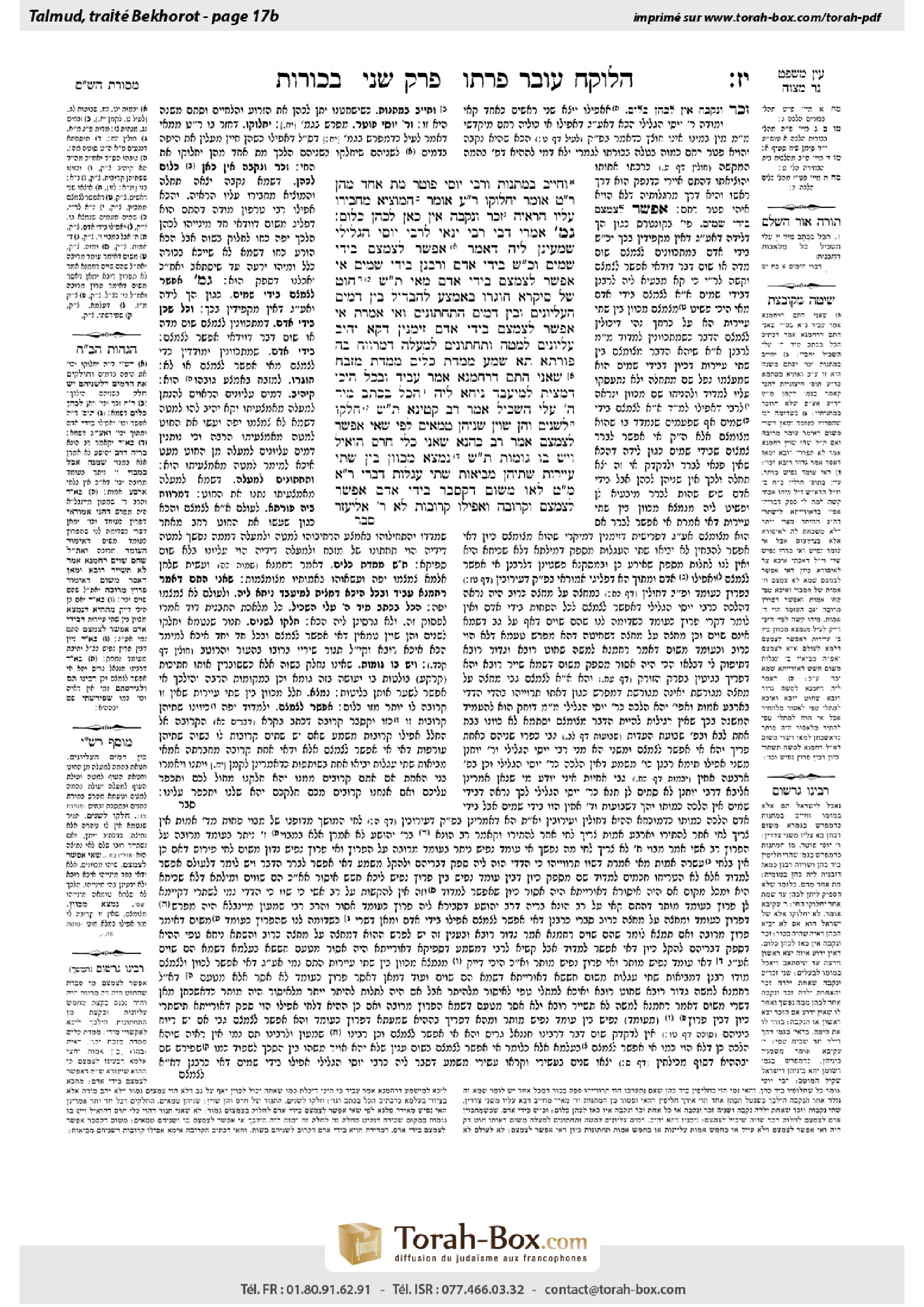
This page of Bekhorot includes the Aramaic text, an English translation and an AI-generated French translation, alongside the scan above.
בכורות י״ז ב · Aramaic and Hebrew text
וְחַיָּיב בַּמַּתָּנוֹת, וְרַבִּי יוֹסֵי פּוֹטֵר. מֵת אֶחָד מֵהֶן — רַבִּי טַרְפוֹן אוֹמֵר: יַחְלוֹקוּ, רַבִּי עֲקִיבָא אוֹמֵר: הַמּוֹצִיא מֵחֲבֵירוֹ עָלָיו הָרְאָיָה. זָכָר וּנְקֵבָה — אֵין כָּאן לַכֹּהֵן כְּלוּם.
גְּמָ׳ אָמְרִי דְּבֵי רַבִּי יַנַּאי: לְרַבִּי יוֹסֵי הַגְּלִילִי שָׁמְעִינַן לֵיהּ דְּאָמַר אֶפְשָׁר לְצַמְצֵם בִּידֵי שָׁמַיִם, וְכׇל שֶׁכֵּן בִּידֵי אָדָם, וְרַבָּנַן — בִּידֵי שָׁמַיִם אִי אֶפְשָׁר לְצַמְצֵם, בִּידֵי אָדָם מַאי?
תָּא שְׁמַע: חוּט שֶׁל סִיקְרָא חוֹגְרוֹ בָּאֶמְצַע, לְהַבְדִּיל בֵּין דָּמִים הָעֶלְיוֹנִים וּבֵין דָּמִים הַתַּחְתּוֹנִים. וְאִי אָמְרַתְּ אִי אֶפְשָׁר לְצַמְצֵם בִּידֵי אָדָם, זִימְנִין דְּקָא יָהֵיב עֶלְיוֹנִים לְמַטָּה וְתַחְתּוֹנִים לְמַעְלָה! דְּמַרְוַוח בָּהּ פּוּרְתָּא.
תָּא שְׁמַע מִמִּדַּת כֵּלִים, מִמִּדַּת מִזְבֵּחַ. שָׁאנֵי הָתָם, דְּרַחֲמָנָא אָמַר עֲבֵיד, וּבְכֹל הֵיכִי דְּמָצֵית לְמִיעְבַּד נִיחָא לֵיהּ, ״הַכֹּל בִּכְתָב מִיַּד ה׳ עָלַי הִשְׂכִּיל״.
אָמַר רַב קַטִּינָא, תָּא שְׁמַע: חִלְּקוֹ לִשְׁנַיִם וְהֵן שָׁוִין — שְׁנֵיהֶן טְמֵאִים, לְפִי שֶׁאִי אֶפְשָׁר לְצַמְצֵם. אָמַר רַב כָּהֲנָא: שָׁאנֵי כְּלִי חֶרֶס הוֹאִיל וְיֵשׁ בּוֹ גּוּמּוֹת.
תָּא שְׁמַע: נִמְצָא מְכוָּּון בֵּין שְׁתֵּי עֲיָירוֹת, שְׁתֵּיהֶן מְבִיאוֹת שְׁתֵּי עֲגָלוֹת, דִּבְרֵי רַבִּי אֱלִיעֶזֶר. מַאי טַעְמָא?
לָאו מִשּׁוּם דְּקָסָבַר בִּידֵי אָדָם אֶפְשָׁר לְצַמְצֵם, וּקְרוֹבָה — וַאֲפִילּוּ קְרוֹבוֹת?
לָא, רַבִּי אֱלִיעֶזֶר
Bekhorot 17b · English translation
And when he slaughters the animal he is obligated to have the gifts of the priesthood taken from it, i.e., the gifts that one is required to give a priest from a non-sacred animal: The foreleg, the jaw, and the maw. And Rabbi Yosei deems him exempt from giving those gifts. If one of the two born together died, Rabbi Tarfon says: The priest and the owner divide the remaining lamb. Rabbi Akiva says: Since there is uncertainty to whom it belongs, it remains in the possession of the owner, as the burden of proof rests upon the claimant. If a male and a female offspring were born together, everyone agrees that the priest has nothing here.
GEMARA: The mishna teaches that the Rabbis disagree with Rabbi Yosei HaGelili, maintaining that it is impossible for the time of twins’ births to coincide precisely. They said in the school of Rabbi Yannai: According to Rabbi Yosei HaGelili, we heard in the mishna that he says: It is possible for two events that are in the hands of Heaven to coincide precisely, and all the more so it is clear that it is possible for two events that are in human hands to coincide precisely, as they are intended to be simultaneous. But according to the Rabbis, evidently they maintain that it is impossible for two matters that are in the hands of Heaven to coincide precisely, but with regard to events that are in human hands, what is their opinion?
The Gemara suggests: Come and hear a proof from a mishna (Middot 3:1): A red line encircled the altar in the middle, to separate between the blood that must be presented on the upper part of the altar and the blood that must be presented on the lower section of the altar. And if you say that it is impossible for two matters that are in human hands to coincide precisely, i.e., that people cannot measure the precise midpoint of an area, then that line will not be precisely in the middle, which means that there will be times when the priest puts blood meant for the upper part of the altar upon the lower section, and blood meant for the lower section above. The Gemara rejects this proof: In that case, one widens the line a little so that it certainly covers the middle part of the altar.
The Gemara suggests: Come and hear a proof from the measurements of the vessels and from the measurements of the altar of the Temple. Since the Torah gives precise measurements for them, this indicates that it is possible to measure precisely. The Gemara rejects this proof as well: It is different there, as the Merciful One says: Do it, and to whatever extent you can fulfill His directives, this finds favor in His eyes, as the verse states: “All this in writing, as the Lord has made me wise by His hand upon me, even all the works of this pattern” (I Chronicles 28:19).
Rav Ketina said: Come and hear a different proof from a baraita: An earthenware vessel that became ritually impure can be purified only by being broken. If it is broken in two, the larger piece remains impure while the smaller piece becomes pure. If one divided an impure earthenware oven into two pieces and they are equal in size, both are ritually impure, because it is impossible for the two to coincide precisely, i.e., one cannot measure exactly. Rav Kahana said, in rejection of this proof: An earthenware vessel is different, since it has indentations in it, i.e., the place of the break is uneven and is therefore particularly difficult to measure precisely.
The Gemara suggests: Come and hear another proof from a mishna (Sota 45b): With regard to a case involving the heifer whose neck is broken, if the slain person was found precisely between two towns, the two towns bring two heifers between them; this is the statement of Rabbi Eliezer. What is the reason that each town must bring a heifer?
Is it not because Rabbi Eliezer holds: With regard to matters that are in human hands, it is possible for two matters to coincide precisely? And Rabbi Eliezer also holds that when the verse states, in the singular: “And it shall be that the town which is nearest to the slain man, even the elders of that town shall take a heifer of the herd” (Deuteronomy 21:3), it is not necessarily referring to only one town, but even to the two nearest towns, if they are equidistant from the corpse. If it were impossible for both towns to be measured as precisely the same distance from the corpse, they would not bring two heifers but one in partnership, stipulating that it belongs to the town that is actually closer.
The Gemara rejects this: No, Rabbi Eliezer
Bekhorot 17b · Traduction française (IA)
Et lorsqu'il sacrifie l'animal, il est tenu de faire prendre les dons de la prêtrise de celui-ci, c'est-à-dire les dons que l'on est tenu de donner à un prêtre d'un animal non sacré : le cou, la mâchoire et la gueule. Et Rabbi Yosei considère qu'il est exempt de donner ces dons. Si l'un des deux nés ensemble est mort, Rabbi Tarphon dit : Le prêtre et l'propriétaire partagent leagne restant. Rabbi Akiva dit : Puisque l'appartenance est incertaine, il reste en possession de l'propriétaire, car la charge de la preuve incombe à celui qui réclame. Si un mâle et une femelle ont été nés ensemble, tout le monde convient que le prêtre n'a rien ici.
GUEMARA : La mitsva enseigne que les Rabbins s'opposent à Rabbi Yosei HaGelili, affirmant qu'il est impossible que les naissances jumelles coïncident précisément. Ils ont dit dans l'école de Rabbi Yannai : Selon Rabbi Yosei HaGelili, nous avons entendu dans la mitsva qu'il dit : Il est possible que deux événements qui sont entre les mains de Dieu coïncident précisément, et encore plus certainement, il est clair qu'il est possible que deux événements qui sont entre les mains des hommes coïncident précisément, car ils sont conçus pour être simultanés. Mais selon les Rabbins, évidemment, ils maintiennent qu'il est impossible que deux choses qui sont entre les mains de Dieu coïncident précisément, mais concernant les événements qui sont entre les mains des hommes, quelle est leur opinion ?
La Guemara suggère : Viens écouter une preuve tirée d'une mitsva (Middot 3:1) : Une ligne rouge entourait l'autel au milieu, afin de séparer le sang qui devait être présenté sur la partie supérieure de l'autel du sang qui devait être présenté sur la partie inférieure. Et si tu dis qu'il est impossible que deux choses qui dépendent des mains des hommes coïncident précisément, c'est-à-dire que les gens ne peuvent pas mesurer précisément le milieu d'une surface, alors cette ligne ne sera pas exactement au milieu, ce qui signifie qu'il y aura des moments où le prêtre mettra du sang destiné à la partie supérieure sur la partie inférieure et du sang destiné à la partie inférieure sur la partie supérieure. La Guemara rejette cette preuve : Dans ce cas, on élargit un peu la ligne afin qu'elle couvre certainement la partie centrale de l'autel.
La Guemara suggère : Viens écouter une preuve tirée des mesures des vases et des mesures de l'autel du Temple. Puisque la Torah donne des mesures précises pour eux, cela montre qu'il est possible de mesurer précisément. La Guemara rejette cette preuve également : C'est différent là, car le Très Miséricordieux dit : Fais-le, et à la mesure où tu peux accomplir Ses commandements, cela lui plaît, comme le verset dit : « Tout cela par écrit, comme l'Éternel m'a rendu sage par Sa main sur moi, même toutes les œuvres de ce modèle » (I Chroniques 28:19).
Rav Ketina a dit : Viens écouter une autre preuve d'une baraïta : Un vase en terre devenu impur rituellement peut être purifié uniquement en étant brisé. Si on le brise en deux, la partie plus grande reste impure tandis que la partie plus petite devient pure. Si l'on a divisé un four en terre impur en deux parties et qu'elles sont de la même taille, les deux sont rituellement impures, car il est impossible que les deux coïncident précisément, c'est-à-dire qu'on ne peut mesurer exactement. Rav Kahana a dit, en rejetant cette preuve : Un vase en terre est différent, car il a des entailles, c'est-à-dire que l'endroit de la rupture est irrégulier et est donc particulièrement difficile à mesurer précisément.
La Guemara suggère : Viens écouter une autre preuve d'une mitsva (Sota 45b) : Concernant le cas de la bête dont le cou est brisé, si la personne tuée a été trouvée précisément entre deux villes, les deux villes apportent deux bêtes entre elles ; c'est la déclaration de Rabbi Eliezer. Quelle est la raison pour laquelle chaque ville doit apporter une bête ?
N'est-ce pas parce que Rabbi Eliezer considère que concernant les choses qui sont entre les mains des hommes, il est possible que deux choses coïncident précisément ? Et Rabbi Eliezer considère également que lorsque le verset dit, au singulier : « Et il arrivera que la ville la plus proche du mort, même les anciens de cette ville prendront une bête du troupeau » (Deutéronome 21:3), il ne s'agit pas nécessairement d'une seule ville, mais même des deux villes les plus proches, si elles sont à égale distance du corps. Si il était impossible que les deux villes soient mesurées comme étant précisément à la même distance du corps, elles n'apporteraient pas deux bêtes mais une en partage, stipulant qu'elle appartient à la ville qui est effectivement la plus proche.
La Guemara refuse cela : Non, Rabbi Eliezer
Traduction française générée par IA à partir de l’édition anglaise de Sefaria. Vérifie toujours un passage avec le texte source.
Text from Sefaria: William Davidson Edition - Vocalized Aramaic (CC BY NC); William Davidson Edition - English (CC BY NC).