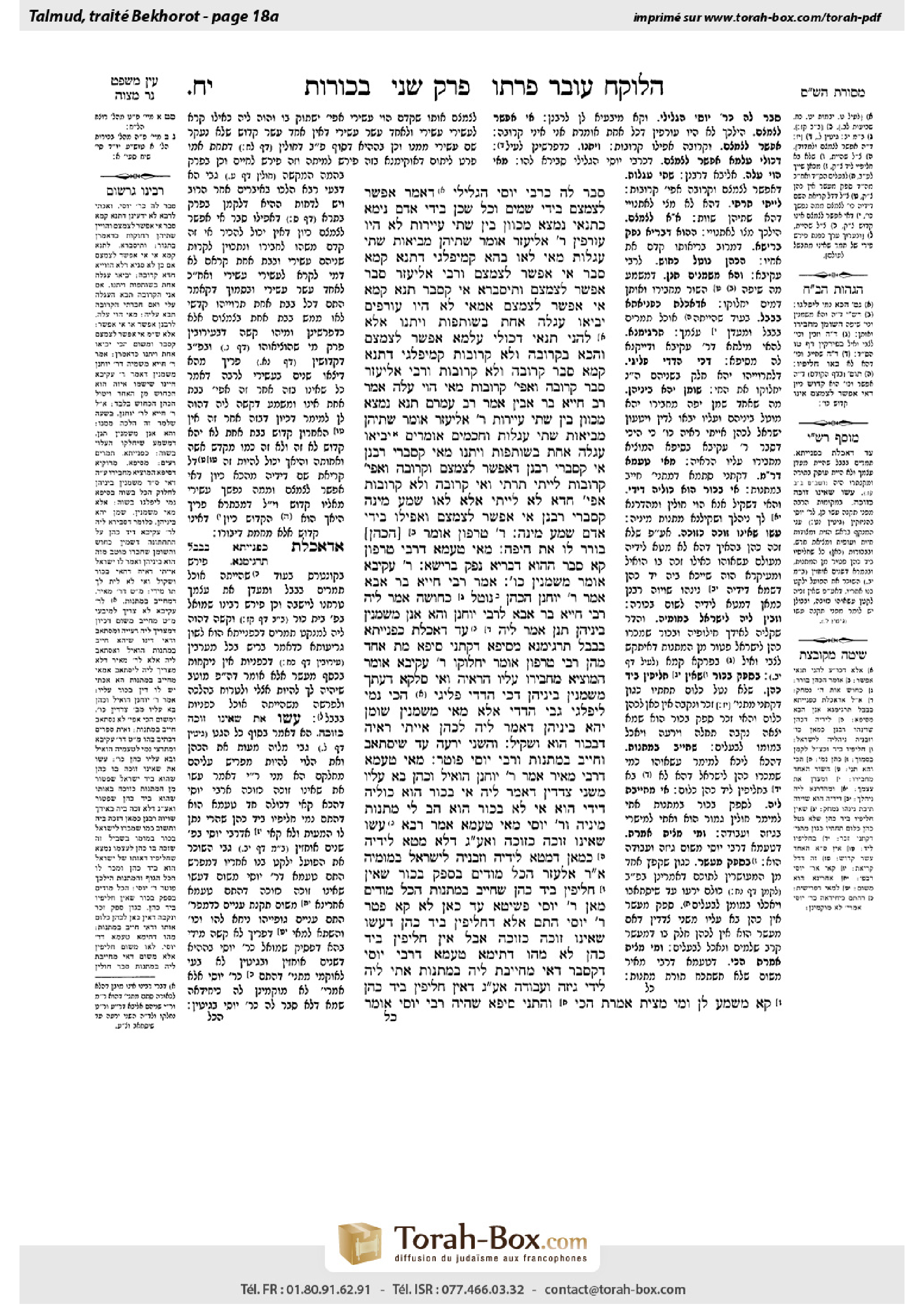
Bekhorot 18a: Talmud study for Daf Yomi
Study the Talmud for Daf Yomi with scanned pages, Hebrew text, English translations from Sefaria and AI-generated French translations.
Passage selection and English or AI-generated French translation are available where the scan has annotations. Daf Study is independent of Torah-Box and Sefaria.
Browse Bekhorot · בכורות · All tractatesBekhorot 18a text and translations
This page of Bekhorot includes the Aramaic text, an English translation and an AI-generated French translation, alongside the scan above.
בכורות י״ח א · Aramaic and Hebrew text
סָבַר לַהּ כְּרַבִּי יוֹסֵי הַגְּלִילִי, דְּאָמַר: אֶפְשָׁר לְצַמְצֵם בִּידֵי שָׁמַיִם, וְכׇל שֶׁכֵּן בִּידֵי אָדָם.
נֵימָא כְּתַנָּאֵי: נִמְצָא מְכוָּּון בֵּין שְׁתֵּי עֲיָירוֹת — לֹא הָיוּ עוֹרְפִין, רַבִּי אֱלִיעֶזֶר אוֹמֵר: שְׁתֵּיהֶן מְבִיאוֹת שְׁתֵּי עֲגָלוֹת. מַאי לָאו בְּהָא קָמִיפַּלְגִי, דְּתַנָּא קַמָּא סָבַר: אִי אֶפְשָׁר לְצַמְצֵם, וְרַבִּי אֱלִיעֶזֶר סָבַר: אֶפְשָׁר לְצַמְצֵם?
וְתִיסְבְּרַאּ? אִי קָסָבַר תַּנָּא קַמָּא אִי אֶפְשָׁר לְצַמְצֵם, אַמַּאי לֹא הָיוּ עוֹרְפִים? יָבִיאוּ עֶגְלָה אַחַת בְּשׁוּתָּפוּת, וְיִתְּנוּ!
אֶלָּא, לְהָנֵי תַּנָּאֵי דְּכוּלֵּי עָלְמָא אֶפְשָׁר לְצַמְצֵם, וְהָכָא בִּ״קְרוֹבָה״ וְלֹא קְרוֹבוֹת קָמִיפַּלְגִי, דְּתַנָּא קַמָּא סָבַר: ״קְרוֹבָה״ וְלֹא קְרוֹבוֹת, וְרַבִּי אֱלִיעֶזֶר סָבַר: ״קְרוֹבָה״ וַאֲפִילּוּ קְרוֹבוֹת.
מַאי הָוֵי עֲלַהּ? אָמַר רַב חִיָּיא בַּר אָבִין אָמַר רַב עַמְרָם: תָּנָא נִמְצָא מְכוָּּון בֵּין שְׁתֵּי עֲיָירוֹת, רַבִּי אֱלִיעֶזֶר אוֹמֵר: שְׁתֵּיהֶן מְבִיאוֹת שְׁתֵּי עֲגָלוֹת, וַחֲכָמִים אוֹמְרִים: יָבִיאוּ עֶגְלָה אַחַת בְּשׁוּתָּפוּת וְיַתְנוּ.
מַאי קָסָבְרִי רַבָּנַן? אִי קָסָבְרִי רַבָּנַן דְּאֶפְשָׁר לְצַמְצֵם, וּקְרוֹבָה — וַאֲפִילּוּ קְרוֹבוֹת, לַיְיתֵי תַּרְתֵּי! וְאִי ״קְרוֹבָה״ וְלֹא קְרוֹבוֹת, אֲפִילּוּ חֲדָא לָא לַיְיתֵי! אֶלָּא לָאו שְׁמַע מִינַּהּ קָסָבְרִי רַבָּנַן: אִי אֶפְשָׁר לְצַמְצֵם, וַאֲפִילּוּ בִּידֵי אָדָם. שְׁמַע מִינַּהּ.
רַבִּי טַרְפוֹן אוֹמֵר: בּוֹרֵר לוֹ אֶת הַיָּפֶה. מַאי טַעְמָא דְּרַבִּי טַרְפוֹן? קָא סָבַר: הָהוּא דְּבָרִיא נָפֵק בְּרֵישָׁא.
רַבִּי עֲקִיבָא אוֹמֵר: ״מְשַׁמְּנִין״ כּוּ׳. אָמַר רַבִּי חִיָּיא בַּר אַבָּא אָמַר רַבִּי יוֹחָנָן: הַכֹּהֵן נוֹטֵל כְּחוּשָׁה. אֲמַר לֵיהּ רַבִּי חִיָּיא בַּר אַבָּא לְרַבִּי יוֹחָנָן: וְהָא אֲנַן ״מְשַׁמְּנִין בֵּינֵיהֶן״ תְּנַן! אֲמַר לֵיהּ: עַד דַּאֲכַלְתְּ כַּפְנְיָיתָא בְּבָבֶל, תַּרְגֵּימְנָא מִסֵּיפָא.
דְּקָתָנֵי סֵיפָא: מֵת אֶחָד מֵהֶן, רַבִּי טַרְפוֹן אוֹמֵר: יַחְלוֹקוּ, רַבִּי עֲקִיבָא אוֹמֵר: הַמּוֹצִיא מֵחֲבֵירוֹ עָלָיו הָרְאָיָה. וְאִי סָלְקָא דַעְתָּךְ ״מְשַׁמְּנִין בֵּינֵיהֶן״ דְּכִי הֲדָדֵי פְּלִיגִי, הָכִי נָמֵי (לִיפַּלְגִי) [לִיפְלוֹג] גַּבֵּי הֲדָדֵי! אֶלָּא מַאי ״מְשַׁמְּנִין״ — שׁוֹמֶן יְהֵא בֵּינֵיהֶן, דְּאָמַר לֵיהּ לְכֹהֵן: אַיְיתִי רְאָיָה דִּבְכוֹר הוּא וּשְׁקֹיל.
וְהַשֵּׁנִי יִרְעֶה עַד שֶׁיִּסְתָּאֵב, וְחַיָּיב בְּמַתָּנוֹת, וְרַבִּי יוֹסֵי פּוֹטֵר. מַאי טַעְמָא דְּרַבִּי מֵאִיר? אָמַר רַבִּי יוֹחָנָן: הוֹאִיל וְכֹהֵן בָּא עָלָיו מִשְּׁנֵי צְדָדִין, דְּאָמַר לֵיהּ: אִי בְּכוֹר הוּא — כּוּלֵּיהּ דִּידִי הוּא, אִי לָא בְּכוֹר הוּא — הַב לִי מַתָּנוֹת מִינֵּיהּ.
וְרַבִּי יוֹסֵי מַאי טַעְמָא? אָמַר רָבָא: עָשׂוּ שֶׁאֵינוֹ זוֹכֶה כְּזוֹכֶה, וְאַף עַל גַּב דְּלָא מְטָא לִידֵיהּ כְּמַאן דִּמְטָא לִידֵיהּ, וְזַבְּנֵיהּ לְיִשְׂרָאֵל בְּמוּמֵיהּ.
אָמַר רַבִּי אֶלְעָזָר: הַכֹּל מוֹדִים בִּסְפֵק בְּכוֹר, שֶׁאֵין חֲלִיפִין בְּיַד כֹּהֵן, שֶׁחַיָּיב בְּמַתָּנוֹת.
הַכֹּל מוֹדִים מַאן? רַבִּי יוֹסֵי? פְּשִׁיטָא! עַד כָּאן לָא קָא פָטַר רַבִּי יוֹסֵי הָתָם, אֶלָּא דַּחֲלִיפִין בְּיַד כֹּהֵן, דְּעָשׂוּ שֶׁאֵינוֹ זוֹכֶה כְּזוֹכֶה, אֲבָל אֵין חֲלִיפִין בְּיַד כֹּהֵן — לָא!
מַהוּ דְּתֵימָא: טַעְמָא דְּרַבִּי יוֹסֵי, דְּקָסָבַר דְּאִי מְחַיְּיבַתְּ לֵיהּ בְּמַתָּנוֹת — אָתֵי לֵיהּ לִידֵי גִּיזָּה וַעֲבוֹדָה, אַף עַל גַּב דְּאֵין חֲלִיפִין בְּיַד כֹּהֵן, קָא מַשְׁמַע לַן.
וּמִי מָצֵית אָמְרַתְּ הָכִי? וְהָתָנֵי סֵיפָא, שֶׁהָיָה רַבִּי יוֹסֵי אוֹמֵר:
Bekhorot 18a · English translation
holds in accordance with the opinion of Rabbi Yosei HaGelili, who says: It is possible for two matters that are in the hands of Heaven to coincide precisely, and all the more so matters that are in human hands. Consequently, one cannot cite Rabbi Eliezer’s opinion in order to determine the opinion of the Rabbis.
The Gemara suggests: Let us say that this is subject to a dispute between tanna’im, as it is taught in a baraita: If the corpse of a slain person was found precisely between two towns, they would not break the heifer’s neck at all. Rabbi Eliezer says: The two towns bring two heifers between them. What, is it not correct to say that they disagree with regard to this matter, in that the first tanna holds that it is impossible for two matters to coincide precisely and Rabbi Eliezer holds that it is possible for two matters to coincide precisely?
The Gemara rejects this suggestion: And how can you understand that to be the dispute? If the first tanna holds that it is impossible for two matters to coincide precisely, why does he claim that they would not break the heifer’s neck? Let them bring one heifer in partnership and stipulate that it is brought for the town that is actually nearest.
Rather, with regard to these tanna’im, everyone agrees that it is possible for two matters to coincide precisely. And here they disagree over whether the singular form kerova in the phrase “the town which is nearest [kerova]” indicates that only the nearest town brings a heifer, and not the many nearest [kerovot] towns; as the first tanna holds that it is derived from the term “kerova” that only the nearest town brings a heifer, and not multiple kerovot; and Rabbi Eliezer holds that although the verse states “kerova,” nevertheless this includes even multiple towns that are kerovot.
The Gemara asks: What conclusion was reached about the Rabbis’ opinion with regard to whether matters in human hands can coincide precisely? Rav Ḥiyya bar Avin says that Rav Amram says: The Sages taught in a baraita: If the slain person was found precisely between two towns, Rabbi Eliezer says: The two towns bring two heifers between them; and the Rabbis say: They bring one heifer in partnership and stipulate that it is brought for the town that is nearest.
What do the Rabbis hold in this regard? If the Rabbis hold that is possible for two matters that are in human hands to coincide precisely, and the singular “kerova” includes even multiple towns, kerovot, then they should bring two heifers. And if they hold that “kerova” indicates: But not kerovot, then they should not bring even one heifer. Rather, must one not conclude from it that the Rabbis hold: It is impossible for two matters to coincide precisely, and this is true even with regard to matters that are in human hands? Indeed, conclude from it that this is so.
§ The mishna teaches that in the case of a ewe that gave birth for the first time to two male offspring whose heads emerged as one, Rabbi Tarfon says: The priest chooses the better of the two. The Gemara asks: What is the reasoning of Rabbi Tarfon? He holds that it is presumed that the healthier and better of the two emerged first, and therefore it belongs to the priest.
The mishna further teaches that Rabbi Akiva says: They assess the value of the lambs between them. Rabbi Ḥiyya bar Abba says that Rabbi Yoḥanan says: According to Rabbi Akiva, the priest takes the leaner of the two. Rabbi Ḥiyya bar Abba said to Rabbi Yoḥanan: But didn’t we learn that they assess the value of the offspring between them, which indicates that the priest and owner divide their value? Rabbi Yoḥanan said to him: While you were eating dates in Babylonia, we in Eretz Yisrael explained it based on the latter clause in the mishna.
As the latter clause teaches: If one of the two born together died, Rabbi Tarfon says: The priest and the owner divide the remaining lamb, and Rabbi Akiva says: Since there is uncertainty to whom it belongs, it remains in the possession of the owner, as the burden of proof rests upon the claimant. And if it enters your mind that when Rabbi Akiva said that they assess the value between them he meant that they divide the value between them, then in the latter clause too, let them divide the value of the remaining offspring between them instead of leaving it with the owner. Rather, what does: They assess [meshammenin] the value between them, mean? It means that the additional fat [shumman] of the better twin will be the subject of dispute between them, as the owner says to the priest: Bring a proof that the better one is the firstborn, and take it.
§ The mishna teaches: And the second lamb that remains in the possession of the owner must graze until it becomes blemished, at which point he may slaughter and eat it, and he is obligated to have the gifts of the priesthood, i.e., the foreleg, the jaw, and the maw, taken from it; and Rabbi Yosei deems him exempt from giving those gifts. The Gemara asks: What is the reasoning of Rabbi Meir, whose opinion is the ruling cited first in the mishna? Rabbi Yoḥanan says: The owner is obligated since the priest comes upon him from two sides, i.e., by force of two complementary claims, as the priest says to him: If the second lamb is in fact the firstborn, it is mine in its entirety, and if it is not the firstborn, at least give me the priestly gifts from it.
And what is the reasoning of Rabbi Yosei, who deems the owner exempt from giving the priestly gifts from the second animal? Rava says: In this particular case, the Sages rendered one who did not acquire the animal like one who acquired the animal. And therefore, even though the second lamb of the Israelite did not actually enter the priest’s possession, it is considered as though it entered the priest’s possession and he then sold it to the Israelite in its blemished state, in exchange for the lamb he received. The owner can then claim that perhaps it is the firstborn, and he already fulfilled his obligation of giving it to the priest.
§ Rabbi Elazar says: Everyone concedes in the case of an animal with uncertain firstborn status, the replacement for which is not in the possession of the priest, that it is obligated to have gifts of the priesthood taken from it. In other words, in a case where the priest receives neither offspring, e.g., when a male and female are born together, all agree that the owner must give the gifts to the priest.
The Gemara asks: When Rabbi Elazar said that everyone concedes, to whom was he referring? Was he referring to Rabbi Yosei? That seems obvious. After all, Rabbi Yosei deemed the owner exempt from giving the gifts only there, where the replacement is in the possession of the priest, as the Sages rendered one who did not acquire the animal like one who acquired the animal. But if the replacement is not in the possession of the priest, evidently Rabbi Yosei does not rule that one is exempt, as his reasoning does not apply. Why, then, is the statement of Rabbi Elazar necessary?
The Gemara answers that Rabbi Elazar’s statement is in fact necessary, lest you say that the reason Rabbi Yosei deems him exempt from giving the gifts is that he holds that if you deem him obligated in the gifts, he will assume that the animal is completely non-sacred and come to use it for shearing and labor. Consequently, even though there is no replacement in the hands of the priest, the Sages ruled that one is exempt from giving the gifts, in order to ensure that he does not violate the prohibition against shearing the animal or using it for labor. Rabbi Elazar therefore teaches us that this is not the halakha, as Rabbi Yosei agrees that one is obligated to give the priestly gifts in such circumstances.
The Gemara objects: And how can you say this? But doesn’t the latter clause of the mishna (18b) teach: As Rabbi Yosei says:
Bekhorot 18a · Traduction française (IA)
il suit selon l'opinion du Rabbi Yosei HaGelili, qui dit : Il est possible que deux affaires qui sont entre les mains du Ciel coïncident exactement, et encore davantage les affaires qui sont entre les mains des hommes. Ainsi, on ne peut invoquer l'opinion du Rabbi Eliezer afin de déterminer l'opinion des Sages.
La Guemara suggère : Disons que cela est sujet à un débat entre les tannaïm, comme il est enseigné dans une baraïta : Si le corps d'une personne tuée a été trouvé précisément entre deux villes, ils ne briseront pas le cou de la bête. Le Rabbi Eliezer dit : Les deux villes apportent deux bœufs entre elles. Qu'est-ce que cela ne signifie pas qu'ils débattent sur cette affaire, en ce sens que le premier tanna considère que deux affaires ne peuvent pas coïncider exactement et le Rabbi Eliezer considère qu'elles peuvent coïncider exactement ?
La Guemara rejette cette suggestion : Comment peux-tu comprendre cela comme un débat ? Si le premier tanna considère que deux affaires ne peuvent pas coïncider exactement, pourquoi dit-il qu'ils ne briseront pas le cou de la bête ? Laissons-les apporter un bœuf en partage et stipulent qu'il est apporté pour la ville qui est effectivement la plus proche.
En réalité, concernant ces tannaïm, tout le monde convient que deux affaires peuvent coïncider exactement. Et ici, ils débattent sur le fait que le terme singulier kerova dans la phrase « la ville la plus proche [kerova] » indique que seule la ville la plus proche apporte un bœuf, et non les multiples villes proches [kerovot] ; le premier tanna considère que le terme « kerova » indique que seule la ville la plus proche apporte un bœuf, et non plusieurs kerovot ; et le Rabbi Eliezer considère que bien que la parole dite « kerova », cela inclut même plusieurs villes qui sont kerovot.
La Guemara pose la question : Quelle conclusion a-t-on tirée concernant l'opinion des Sages concernant si des affaires entre les mains des hommes peuvent coïncider exactement ? Rav Ḥiyya bar Avin dit que Rav Amram dit : Les Sages ont enseigné dans une baraïta : Si la personne tuée a été trouvée précisément entre deux villes, le Rabbi Eliezer dit : Les deux villes apportent deux bœufs entre elles ; et les Sages disent : Ils apportent un bœuf en partage et stipulent qu'il est apporté pour la ville la plus proche.
Quelle est l'opinion des Sages à ce sujet ? Si les Sages considèrent que deux affaires entre les mains des hommes peuvent coïncider exactement, et que le terme singulier « kerova » inclut même plusieurs villes, kerovot, alors ils devraient apporter deux bœufs. Et si ils considèrent que « kerova » indique : Mais pas kerovot, alors ils ne devraient pas apporter même un bœuf. En réalité, ne devons-nous pas conclure de cela que les Sages considèrent que deux affaires ne peuvent pas coïncider exactement, et cela est vrai même concernant des affaires entre les mains des hommes ? En effet, concluez de cela que c'est ainsi.
§ La mitsva enseigne que dans le cas d'une brebis qui a donné naissance pour la première fois à deux mâles dont les têtes sont sorties comme une seule, le Rabbi Tarfon dit : Le prêtre choisit le meilleur des deux. La Guemara pose la question : Quel est le raisonnement du Rabbi Tarfon ? Il considère que c'est présupposé que le plus sain et meilleur des deux est sorti en premier, et donc il appartient au prêtre.
La mitsva enseigne également que le Rabbi Akiva dit : Ils évaluent la valeur des agneaux entre eux. Le Rabbi Ḥiyya bar Abba dit que le Rabbi Yoḥanan dit : Selon le Rabbi Akiva, le prêtre prend le plus maigre des deux. Le Rabbi Ḥiyya bar Abba a dit au Rabbi Yoḥanan : Mais n'avons-nous pas appris que l'on évalue la valeur des descendants entre eux, ce qui indique que le prêtre et l'propriétaire divisent leur valeur ? Le Rabbi Yoḥanan a dit à lui : Tandis que vous mangiez des dattes en Mésopotamie, nous en Israël avons expliqué cela sur la clause ultérieure de la mitsva.
Comme la clause ultérieure enseigne : Si l'un des deux nés ensemble est mort, le Rabbi Tarfon dit : Le prêtre et l'propriétaire divisent leagneau restant, et le Rabbi Akiva dit : Puisque c'est incertain à qui il appartient, il reste en possession de l'propriétaire, car la charge de la preuve repose sur le plaignant. Et si tu penses que lorsque le Rabbi Akiva a dit qu'ils évaluent la valeur entre eux, il voulait dire qu'ils divisent la valeur entre eux, alors dans la clause ultérieure aussi, laissez-les diviser la valeur du descendant restant entre eux plutôt que de le laisser avec l'propriétaire. En réalité, que signifie : Ils évaluent [meshammenin] la valeur entre eux ? Cela signifie que l'excès de gras [shumman] du jumeau meilleur sera la matière de débat entre eux, car l'propriétaire dit au prêtre : Apporte une preuve que le meilleur est le premier-né, et prends-le.
§ La mitsva enseigne : Et le deuxième agneau restant en possession de l'propriétaire doit paître jusqu'à ce qu'il devienne blemi, à ce moment-là il peut le sacrifier et le manger, et il est tenu de faire prendre les présents du prêtre, c'est-à-dire la cuisse, la mâchoire et la gueule, de cet agneau ; et le Rabbi Yosei considère qu'il est exempt de donner ces présents. La Guemara pose la question : Quel est le raisonnement du Rabbi Meir, dont l'opinion est la décision citée en premier dans la mitsva ? Le Rabbi Yoḥanan dit : L'propriétaire est tenu, car le prêtre vient sur lui de deux côtés, c'est-à-dire par la force de deux revendications complémentaires, comme le prêtre dit à lui : Si le deuxième agneau est effectivement le premier-né, il m'appartient entièrement, et si ce n'est pas le premier-né, au moins donne-moi les présents du prêtre de cet agneau.
Et quel est le raisonnement du Rabbi Yosei, qui considère que l'propriétaire est exempt de donner les présents du prêtre du deuxième animal ? Rava dit : Dans ce cas particulier, les Sages ont rendu celui qui n'a pas acquis l'animal comme celui qui l'a acquis. Et donc, même si le deuxième agneau de l'Israelite n'a pas réellement entré en possession du prêtre, il est considéré comme s'il avait entré en possession du prêtre et qu'il a ensuite été vendu à l'Israelite dans son état blemi, en échange de l'agneau qu'il avait reçu. L'propriétaire peut alors affirmer que peut-être c'est le premier-né, et il a déjà accompli son obligation de le donner au prêtre.
§ Rabbi Elazar dit : Tout le monde reconnaît que dans le cas d'un animal dont le statut de premier-né est incertain, et dont le remplacement n'est pas en possession du prêtre, il est tenu de donner des offrandes au prêtre. En d'autres termes, dans le cas où le prêtre ne reçoit ni descendant, par exemple lorsqu'un mâle et une femelle naissent ensemble, tout le monde convient que l'owner doit offrir les offrandes au prêtre.
La Guemara demande : Lorsque Rabbi Eléazar a dit que tout le monde reconnaît cela, à qui faisait-il référence ? Était-ce à Rabbi Yosei ? Cela semble évident. En effet, Rabbi Yosei considère que l'owner est exempt de donner les offrandes uniquement là où le remplacement est en possession du prêtre, car les Sages considèrent celui qui n'a pas acquis l'animal comme s'il l'avait acquis. Mais si le remplacement n'est pas en possession du prêtre, il est évident que Rabbi Yosei ne considère pas que l'homme soit exempt, car son raisonnement ne s'applique pas. Pourquoi, alors, la déclaration de Rabbi Eléazar est-elle nécessaire ?
La Guemara répond que la déclaration de Rabbi Eléazar est en effet nécessaire, afin que l'on ne dise pas que la raison pour laquelle Rabbi Yosei considère l'homme comme exempt de donner les offrandes est qu'il considère que si l'on considère l'homme comme tenu de donner les offrandes, il supposera que l'animal est totalement non sacré et viendra l'utiliser pour la tonte et le travail. Ainsi, même s'il n'y a pas de remplacement en main du prêtre, les Sages ont décidé que l'homme est exempt de donner les offrandes afin de garantir qu'il ne viole pas l'interdiction de tondre l'animal ou de l'utiliser pour le travail. Rabbi Eléazar nous enseigne donc que cela n'est pas la halakha, car Rabbi Yosei convient que l'homme est tenu de donner les offrandes au prêtre dans de tels cas.
La Guemara s'oppose à cela : Et comment pouvez-vous dire cela ? N'est-ce pas que la dernière partie de la mitsva (18b) enseigne : Comme le Rabbi Yosei dit :
Traduction française générée par IA à partir de l’édition anglaise de Sefaria. Vérifie toujours un passage avec le texte source.
Text from Sefaria: William Davidson Edition - Vocalized Aramaic (CC BY NC); William Davidson Edition - English (CC BY NC).