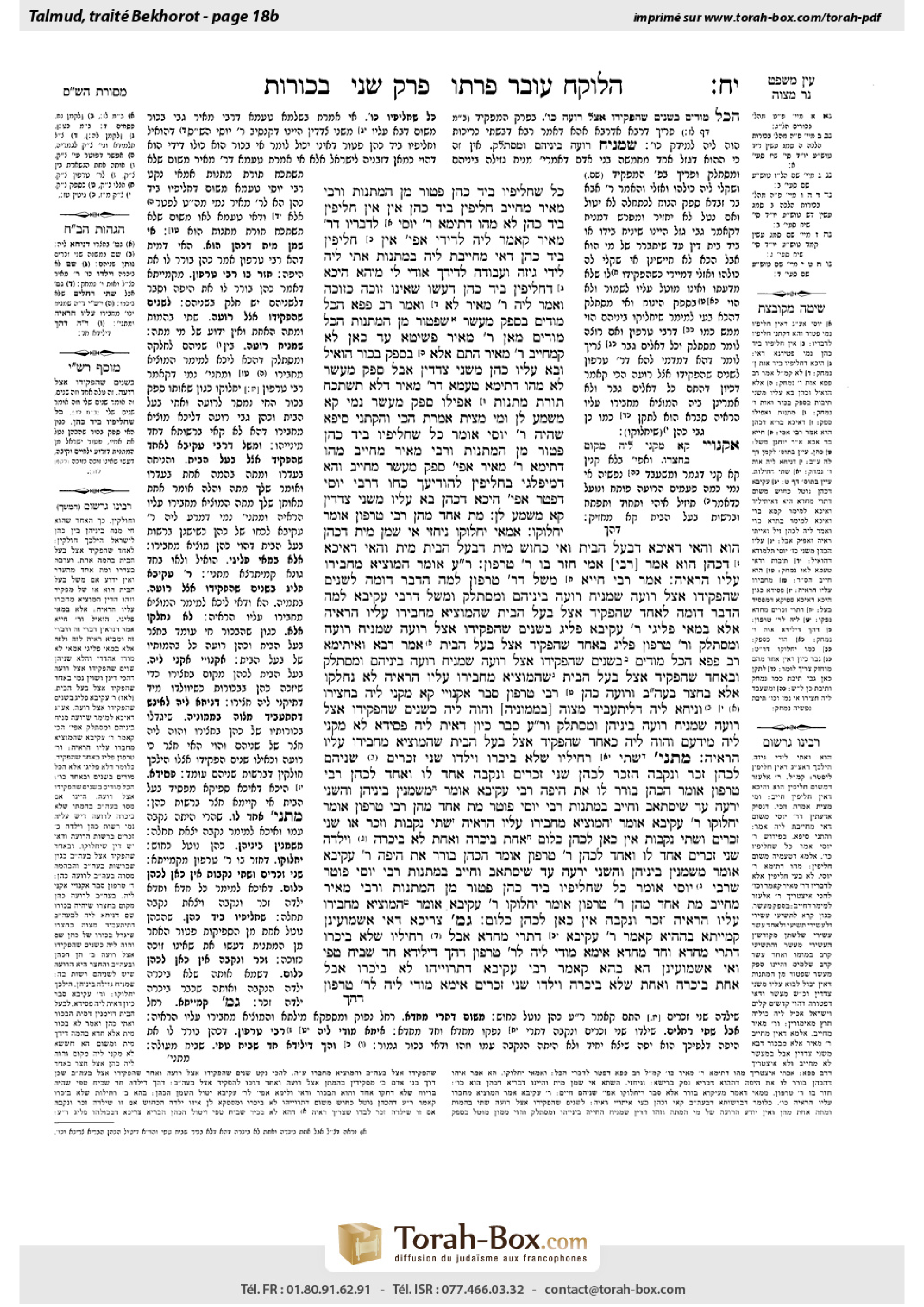
Bekhorot 18b: Talmud study for Daf Yomi
Study the Talmud for Daf Yomi with scanned pages, Hebrew text, English translations from Sefaria and AI-generated French translations.
Passage selection and English or AI-generated French translation are available where the scan has annotations. Daf Study is independent of Torah-Box and Sefaria.
Browse Bekhorot · בכורות · All tractatesBekhorot 18b text and translations
This page of Bekhorot includes the Aramaic text, an English translation and an AI-generated French translation, alongside the scan above.
בכורות י״ח ב · Aramaic and Hebrew text
כֹּל שֶׁחֲלִיפָיו בְּיַד כֹּהֵן פָּטוּר מִן הַמַּתָּנוֹת, וְרַבִּי מֵאִיר מְחַיֵּיב. חֲלִיפִין בְּיַד כֹּהֵן — אִין, אֵין חֲלִיפִין בְּיַד כֹּהֵן — לָא!
מַהוּ דְּתֵימָא: רַבִּי יוֹסֵי לִדְבָרָיו דְּרַבִּי מֵאִיר קָאָמַר לֵיהּ — לְדִידִי, אֲפִילּוּ אֵין חֲלִיפִין בְּיַד כֹּהֵן, דְּאִי מְחַיְּיבַתְּ לֵיהּ בְּמַתָּנוֹת אָתֵי לֵיהּ לִידֵי גִּיזָּה וַעֲבוֹדָה; לְדִידָךְ, אוֹדִי לִי מִיהָא הֵיכָא דַּחֲלִיפִין בְּיַד כֹּהֵן, דְּעָשׂוּ שֶׁאֵינוֹ זוֹכֶה כְּזוֹכֶה; וְאָמַר לֵיהּ רַבִּי מֵאִיר: לָא.
וְאָמַר רַב פָּפָּא: הַכֹּל מוֹדִים בִּסְפֵק מַעֲשֵׂר שֶׁפָּטוּר מִן הַמַּתָּנוֹת. ״הַכֹּל מוֹדִים״ — מַאן? רַבִּי מֵאִיר? פְּשִׁיטָא! עַד כָּאן לָא קָמְחַיֵּיב רַבִּי מֵאִיר הָתָם אֶלָּא בִּסְפֵק בְּכוֹר, הוֹאִיל וּבָא עָלָיו כֹּהֵן מִשְּׁנֵי צְדָדִין, אֲבָל סָפֵק מַעֲשֵׂר — לָא.
מַהוּ דְּתֵימָא: טַעְמָא דְּרַבִּי מֵאִיר דְּלֹא תִּשְׁתַּכַּח תּוֹרַת מַתָּנוֹת, אֲפִילּוּ סְפֵק מַעֲשֵׂר נָמֵי? קָא מַשְׁמַע לַן.
וּמִי מָצֵית אָמְרַתְּ הָכִי? וְהָקָתָנֵי סֵיפָא, שֶׁהָיָה רַבִּי יוֹסֵי אוֹמֵר: כֹּל שֶׁחֲלִיפָיו בְּיַד כֹּהֵן — פָּטוּר מִן הַמַּתָּנוֹת, וְרַבִּי מֵאִיר מְחַיֵּיב!
מַהוּ דְּתֵימָא: רַבִּי מֵאִיר אֲפִילּוּ סְפֵק מַעֲשֵׂר מְחַיַּיב, וְהָא דְּמִיפַּלְגִי בַּחֲלִיפִין — לְהוֹדִיעֲךָ כֹּחוֹ דְּרַבִּי יוֹסֵי, דְּפָטַר אֲפִילּוּ הֵיכָא דְּכֹהֵן בָּא עָלָיו מִשְּׁנֵי צְדָדִין, קָא מַשְׁמַע לַן.
מֵת אֶחָד מֵהֶן, רַבִּי טַרְפוֹן אוֹמֵר: יַחְלוֹקוּ. אַמַּאי יַחְלוֹקוּ? נִיחְזֵי: אִי שָׁמֵן מִית — דְּכֹהֵן הוּא, וְהַאי דְּאִיכָּא דְּבַעַל הַבַּיִת; וְאִי כָּחוּשׁ מִית — דְּבַעַל הַבַּיִת מִית, וְהַאי דְּאִיכָּא דְּכֹהֵן הוּא! אָמַר רַבִּי אַמֵּי: חָזַר בּוֹ רַבִּי טַרְפוֹן.
רַבִּי עֲקִיבָא אוֹמֵר: הַמּוֹצִיא מֵחֲבֵירוֹ עָלָיו הָרְאָיָה. אָמַר רַבִּי חִיָּיא: מָשָׁל דְּרַבִּי טַרְפוֹן לְמָה הַדָּבָר דּוֹמֶה? לִשְׁנַיִם שֶׁהִפְקִידוּ אֵצֶל רוֹעֶה, שֶׁמַּנִּיחַ רוֹעֶה בֵּינֵיהֶם וּמִסְתַּלֵּק.
וּמָשָׁל דְּרַבִּי עֲקִיבָא: לְמָה הַדָּבָר דּוֹמֶה? לְאֶחָד שֶׁהִפְקִיד אֵצֶל בַּעַל הַבַּיִת, שֶׁהַמּוֹצִיא מֵחֲבֵירוֹ עָלָיו הָרְאָיָה.
אֶלָּא בְּמַאי פְּלִיגִי? רַבִּי עֲקִיבָא פְּלִיג בִּשְׁנַיִם שֶׁהִפְקִידוּ אֵצֶל רוֹעֶה, שֶׁמַּנִּיחַ רוֹעֶה וּמִסְתַּלֵּק? וְרַבִּי טַרְפוֹן פְּלִיג בְּאֶחָד שֶׁהִפְקִיד אֵצֶל בַּעַל הַבַּיִת? אָמַר רָבָא, וְאִיתֵּימָא רַב פָּפָּא: הַכֹּל מוֹדִים בִּשְׁנַיִם שֶׁהִפְקִידוּ אֵצֶל רוֹעֶה — שֶׁמַּנִּיחַ רוֹעֶה בֵּינֵיהֶם וּמִסְתַּלֵּק, וּבְאֶחָד שֶׁהִפְקִיד אֵצֶל בַּעַל הַבַּיִת — שֶׁהַמּוֹצִיא מֵחֲבֵירוֹ עָלָיו הָרְאָיָה.
לֹא נֶחְלְקוּ אֶלָּא בַּחֲצַר בַּעַל הַבַּיִת, וְרוֹעֶה כֹּהֵן. רַבִּי טַרְפוֹן סָבַר: אַקְנוֹיֵי קָא מַקְנֵי לֵיהּ בַּחֲצֵירוֹ, וְנִיחָא לֵיהּ דְּלִיתְעֲבִיד מִצְוָה בְּמָמוֹנֵיהּ, וְהָוֵה לֵיהּ כִּשְׁנַיִם שֶׁהִפְקִידוּ אֵצֶל רוֹעֶה, שֶׁמַּנִּיחַ רוֹעֶה בֵּינֵיהֶן וּמִסְתַּלֵּק.
וְרַבִּי עֲקִיבָא סָבַר: כֵּיוָן דְּאִית לֵיהּ פְּסֵידָא — לָא מַקְנֵי לֵיהּ מִידַּעַם, וְהָוֵה לֵיהּ כְּאֶחָד שֶׁהִפְקִיד אֵצֶל בַּעַל הַבַּיִת, שֶׁהַמּוֹצִיא מֵחֲבֵירוֹ עָלָיו הָרְאָיָה.
מַתְנִי׳ שְׁתֵּי רְחֵילָיו שֶׁלֹּא בִּיכְּרוּ וְיָלְדוּ שְׁנֵי זְכָרִים — שְׁנֵיהֶם לַכֹּהֵן. זָכָר וּנְקֵבָה — הַזָּכָר לַכֹּהֵן. שְׁנֵי זְכָרִים וּנְקֵבָה — אֶחָד לוֹ וְאֶחָד לַכֹּהֵן. רַבִּי טַרְפוֹן אוֹמֵר: הַכֹּהֵן בּוֹרֵר לוֹ אֶת הַיָּפֶה. רַבִּי עֲקִיבָא אוֹמֵר: מְשַׁמְּנִין בֵּינֵיהֶן, וְהַשֵּׁנִי יִרְעֶה עַד שֶׁיִּסְתָּאֵב.
וְחַיָּיב בַּמַּתָּנוֹת, רַבִּי יוֹסֵי פּוֹטֵר. מֵת אֶחָד מֵהֶן, רַבִּי טַרְפוֹן אוֹמֵר: יַחְלוֹקוּ, רַבִּי עֲקִיבָא אוֹמֵר: הַמּוֹצִיא מֵחֲבֵירוֹ עָלָיו הָרְאָיָה. שְׁתֵּי נְקֵבוֹת וְזָכָר אוֹ שְׁנֵי זְכָרִים וּשְׁתֵּי נְקֵבוֹת — אֵין כָּאן לַכֹּהֵן כְּלוּם.
אַחַת בִּיכְּרָה, וְאַחַת לֹא בִּיכְּרָה, וְיָלְדָה שְׁנֵי זְכָרִים, אֶחָד לוֹ וְאֶחָד לַכֹּהֵן. רַבִּי טַרְפוֹן אוֹמֵר: הַכֹּהֵן בּוֹרֵר אֶת הַיָּפֶה. רַבִּי עֲקִיבָא אוֹמֵר: מְשַׁמְּנִין בֵּינֵיהֶן, וְהַשֵּׁנִי יִרְעֶה עַד שֶׁיִּסְתָּאֵב.
וְחַיָּיב בַּמַּתָּנוֹת. רַבִּי יוֹסֵי פּוֹטֵר, שֶׁרַבִּי יוֹסֵי אוֹמֵר: כֹּל שֶׁחֲלִיפָיו בְּיַד כֹּהֵן פָּטוּר מִן הַמַּתָּנוֹת. וְרַבִּי מֵאִיר מְחַיֵּיב. מֵת אֶחָד מֵהֶן, רַבִּי טַרְפוֹן אוֹמֵר: יַחְלוֹקוּ. רַבִּי עֲקִיבָא אוֹמֵר: הַמּוֹצִיא מֵחֲבֵירוֹ עָלָיו הָרְאָיָה. זָכָר וּנְקֵבָה — אֵין כָּאן לַכֹּהֵן כְּלוּם.
גְּמָ׳ צְרִיכָא, דְּאִי אַשְׁמוֹעִינַן קַמַּיְיתָא, בְּהַהִיא קָאָמַר רַבִּי עֲקִיבָא, דִּתְרֵי מֵחֲדָא.
אֲבָל רְחֵילָיו שֶׁלֹּא בִּיכְּרוּ, דִּתְרֵי מֵחֲדָא וְחַד מֵחֲדָא — אֵימָא מוֹדֵי לֵיהּ לְרַבִּי טַרְפוֹן, דְּהָךְ דִּילִידָא חַד שְׁבִיחַ טְפֵי.
וְאִי אַשְׁמוֹעִינַן הָא — בְּהָא קָאָמַר רַבִּי עֲקִיבָא, דְּתַרְוַיְיהוּ לֹא בִּיכְּרוּ, אֲבָל אַחַת בִּיכְּרָה וְאַחַת שֶׁלֹּא בִּיכְּרָה וְיָלְדוּ שְׁנֵי זְכָרִים — אֵימָא מוֹדֵי לֵיהּ לְרַבִּי טַרְפוֹן,
Bekhorot 18b · English translation
With regard to any animal whose replacements are in the possession of the priest, its owner is exempt from the mitzva of giving the priestly gifts, and Rabbi Meir deems him obligated to give the gifts. Evidently, in a case where the replacement is in the possession of the priest, yes, Rabbi Yosei rules that the owner is exempt from giving the gifts, but if the replacement is not in the possession of the priest, he is not exempt.
The Gemara explains that even so, Rabbi Elazar’s statement is necessary, lest you say that Rabbi Yosei was not expressing his own opinion but stated his opinion in accordance with the statement of Rabbi Meir, i.e., he said to him: In my opinion, the Israelite is exempt from giving the priestly gifts even if the replacement is not in the possession of the priest, as, if you deem him obligated in the gifts, he might think that the animal is completely non-sacred and come to use it for shearing and labor. But even according to your reasoning, at least concede to me in a case where the replacement is in the possession of the priest, that the Sages rendered one who did not acquire the animal like one who acquired the animal. And Rabbi Meir said to Rabbi Yosei: No, I do not concede in that case. Accordingly, Rabbi Elazar is teaching that Rabbi Yosei does, in fact, maintain that the reason for the Israelite’s exemption is that the replacement is in the possession of the priest.
And Rav Pappa says with regard to the dispute between Rabbi Meir and Rabbi Yosei: Everyone concedes in the case of an animal whose status as tithe is uncertain that its owner is exempt from the mitzva of the priestly gifts. The Gemara asks: When Rav Pappa says that everyone concedes, to whom is he referring? Is he referring to Rabbi Meir? That would seem obvious. After all, Rabbi Meir deemed one obligated to give the gifts only there, in the case of an animal whose status as firstborn is uncertain, since the priest comes upon the Israelite from two sides. But with regard to an animal whose status as tithe is uncertain Rabbi Meir does not rule that one is obligated, as that reasoning does not apply. Why, then, is Rav Pappa’s statement necessary?
The Gemara explains that the statement of Rav Pappa is necessary lest you say that the reason that Rabbi Meir deems him obligated in the gifts is so that the halakhic category of the gifts should not be forgotten; if so, the same would apply even in the case of an animal whose status as tithe is uncertain. Rav Pappa therefore teaches us otherwise.
The Gemara asks: And how can you say this? But doesn’t the latter clause teach: As Rabbi Yosei says: With regard to any animal whose replacements are in the possession of a priest, its owner is exempt from the mitzva of giving the priestly gifts, and Rabbi Meir deems him obligated to give the gifts. Evidently, the basis for the dispute between Rabbi Meir and Rabbi Yosei is not whether an obligation is imposed so that the halakhic category of the priestly gifts should not be forgotten, but whether the Sages rendered one who did not acquire the animal like one who acquired the animal, which means that an animal whose replacement is in the priest’s possession is not subject to the mitzva of the gifts.
The Gemara explains that Rav Pappa’s statement is necessary lest you say: Rabbi Meir deems one obligated to give the gifts even in the case of an animal whose status as tithe is uncertain, in order that the halakhic category of the gifts should not be forgotten. And as for the fact that the mishna presents their disagreement with regard to replacement animals, this serves to convey to you the far-reaching nature of the opinion of Rabbi Yosei, who deems one exempt from the mitzva of the gifts even in a case where the priest comes upon the Israelite from two sides. Rav Pappa therefore teaches us that in fact Rabbi Meir exempts one from the mitzva of the priestly gifts in the case of an animal whose tithed status is uncertain.
§ The mishna teaches: If one of the two born together died, Rabbi Tarfon says: The priest and the owner divide the remaining lamb. The Gemara asks: Why should they divide it? Let us see: According to Rabbi Tarfon, who holds that it is presumed that the healthier and better of the two emerged first, as explained earlier, if the fatter and better of the two died it should be assumed that it was the one that belonged to the priest, and this one that is left belongs to the owner. And if the leaner of the two died, it should be assumed that the animal of the owner died, and this one that is left belongs to the priest. Rabbi Ami said: In fact, Rabbi Tarfon retracted his previous ruling that the priest takes the better of the two, and instead ruled that the priest and owner divide the value of the offspring in all cases. The mishna was not emended to reflect the updated ruling.
§ The mishna teaches: In a case where two animals were born together and one of them died, Rabbi Akiva says: The living offspring remains in the possession of the owner, as the burden of proof rests upon the claimant. Rabbi Ḥiyya stated a parable that clarifies the opinion of Rabbi Tarfon, who says that the priest and the owner divide the remaining lamb: To what is this matter comparable? It is comparable to two people who each deposited a sheep with a shepherd and one of the two sheep died, and it is unclear to whom it belonged. In that case, the shepherd places the remaining sheep between them and withdraws, leaving them to divide the value of the sheep between them. Likewise, the mishna is discussing a case where the live offspring is not in the possession of either the owner or the priest, and therefore it is divided between them.
And Rabbi Ḥiyya also stated a parable that clarifies the opinion of Rabbi Akiva: To what is this matter comparable? It is comparable to one who deposited a sheep with a homeowner, who had sheep of his own, and it is unknown whose sheep died. In that case, the burden of proof rests upon the claimant. Since the remaining sheep is currently in the possession of the homeowner, the one who deposited the animal must prove that the living sheep belongs to him. Likewise, the mishna is discussing a case where the live offspring is in the possession of the owner, and therefore the burden of proof rests upon the priest.
The Gemara asks: But if Rabbi Tarfon and Rabbi Akiva are addressing different circumstances, then with regard to what matter do they disagree? Does Rabbi Akiva disagree with the conclusion in the parable mentioned with regard to Rabbi Tarfon’s opinion, of two people who each deposited a sheep with a shepherd, that the shepherd places the remaining sheep between them and withdraws? And similarly, does Rabbi Tarfon disagree with the conclusion in the case of one who deposited a sheep with a homeowner that the homeowner keeps the remaining sheep? Certainly not. Rather, Rava says, and some say it was Rav Pappa who says: Everyone concedes in the case of two who deposited sheep with a shepherd that the shepherd places it between them and withdraws, and everyone concedes in the case of one who deposited a sheep with a homeowner that the burden of proof rests upon the claimant.
Rabbi Akiva and Rabbi Tarfon disagree only where the offspring were born in the courtyard of the homeowner, and the shepherd is a priest to whom the homeowner usually gives his firstborn animals. Rabbi Tarfon holds: The homeowner transfers to the priest a portion of his courtyard so that the priest should acquire the firstborn offspring located there, because it is suitable for him that the mitzva of giving the firstborn to a priest should be performed. Therefore, the priest is considered to hold partial jurisdiction of the courtyard. And consequently, this is comparable to two people who each deposited a sheep with a shepherd and one of the two sheep died, where the shepherd places the remaining sheep between them and withdraws, leaving them to divide the value of the sheep between themselves.
And Rabbi Akiva holds: Since there is a loss to the owner in this case of uncertainty, he does not transfer anything to the priest. And as the courtyard belongs exclusively to the Israelite, this case is comparable to one who deposited a sheep with a homeowner who had sheep of his own, and it is unknown whose sheep died. The halakha in that case is that the burden of proof rests upon the claimant.
MISHNA: If one’s two ewes had not previously given birth and they gave birth to two males, both of them are given to the priest, as each is its mother’s firstborn. If one gave birth to a male and the other to a female, the male is given to the priest, as it is its mother’s firstborn. If they gave birth to two males and a female, one of the males is kept by him and one is given to the priest. Rabbi Tarfon says: The priest chooses the better of the two. Rabbi Akiva says: They assess the value of the lambs between them, and the priest takes the leaner of the two. And the second lamb must graze until it becomes blemished, at which point the owner may slaughter and eat it.
And when the owner slaughters the animal, he is obligated to have gifts of the priesthood, i.e., the foreleg, the jaw, and the maw, taken from it. Rabbi Yosei deems him exempt from giving the gifts. If one of the two born together died, Rabbi Tarfon says: The priest and the owner divide the value of the remaining lamb. Rabbi Akiva says: Since there is uncertainty to whom it belongs, it remains in the possession of the owner, as the burden of proof rests upon the claimant. If they gave birth to two females and a male or to two males and two females, the priest has nothing here, as perhaps both ewes gave birth to females first.
If one of his ewes had previously given birth and one had not previously given birth, and they gave birth to two males, one of the males is kept by him and one is given to the priest. Rabbi Tarfon says: The priest chooses the better of the two. Rabbi Akiva says: They assess the value of the lambs between them and the priest takes the leaner of the two. And the second lamb must graze until it becomes blemished, at which point he may slaughter and eat it.
And when he slaughters the animal he is obligated to have gifts of the priesthood taken from it. Rabbi Yosei deems him exempt him from giving those gifts, as Rabbi Yosei says: With regard to any animal whose replacements are in the possession of a priest, its owner is exempt from the mitzva of giving the priestly gifts. And Rabbi Meir deems him obligated to give the gifts. If one of the animals died, Rabbi Tarfon says: The priest and the owner divide the value of the remaining lamb. Rabbi Akiva says: Since there is uncertainty to whom it belongs, it remains in the possession of the owner, as the burden of proof rests upon the claimant. If a male and a female offspring were born together, everyone agrees that the priest has nothing here, as perhaps the one that had already given birth bore the male, and the one that had not given birth bore the female, in which case neither of the animals would have firstborn status.
GEMARA: This mishna and the previous mishna (17a–b) listed three cases in which Rabbi Akiva rules that the priest receives the leaner of two potentially firstborn offspring, whereas Rabbi Tarfon maintains that he receives the better of the two. The Gemara notes: It was necessary to teach each of these three cases, as, had the mishna taught only the first case, that of a single ewe that gave birth to two male offspring, one might have thought that Rabbi Akiva stated his opinion only in that case, as the two offspring came from one womb, and there is no reason to assume that the better offspring was born first.
But in the second case, that of his two ewes which had not previously given birth and which collectively gave birth to two males and a female, where two offspring came from one mother and one offspring came from one other mother, one might say that Rabbi Akiva concedes to the opinion of Rabbi Tarfon, as it can be claimed that the superior animal is this one that came from the mother that gave birth to a single offspring.
And had the mishna taught only that second case, one might have thought that Rabbi Akiva stated his opinion only in that case, as both mothers had not previously given birth. But in a case where one had previously given birth and the other one had not previously given birth, and collectively they gave birth to two male offspring, one might say that Rabbi Akiva concedes to the opinion of Rabbi Tarfon
Bekhorot 18b · Traduction française (IA)
Concernant tout animal dont les remplacements sont en possession du prêtre, son propriétaire est exempt de la mitsva de donner les dons sacrés au prêtre, et le maître Rami considère qu'il est tenu de les donner. Évidemment, dans le cas où le remplacement est en possession du prêtre, le maître Rabi Yosei considère que le propriétaire est exempt de donner les dons, mais si le remplacement n'est pas en possession du prêtre, il n'est pas exempt.
La Guemara explique que même ainsi, l'affirmation de Rabi Elazar est nécessaire, afin que l'on ne dise pas que Rabi Yosei n'exprimait pas son propre avis mais qu'il exprimait son opinion conformément à celle de Rami, c'est-à-dire qu'il lui disait : Selon mon avis, l'Israelite est exempt de donner les dons sacrés même si le remplacement n'est pas en possession du prêtre, car, si vous considérez qu'il est tenu de donner les dons, il pourrait penser que l'animal est totalement non sacré et utiliser l'animal pour la tonte et le travail. Mais même selon votre raisonnement, au moins convenez-vous avec moi dans le cas où le remplacement est en possession du prêtre, que les Sages considèrent celui qui n'a pas acquis l'animal comme celui qui l'a acquis. Et Rami dit à Rabi Yosei : Non, je ne convenais pas dans ce cas. Ainsi, Rabi Elazar enseigne que Rabi Yosei, en effet, maintient que la raison de l'exemption de l'Israelite est que le remplacement est en possession du prêtre.
Et Rav Pappa dit concernant le débat entre Rabbi Meir et Rabbi Yosei : Tout le monde reconnaît dans le cas d'un animal dont le statut de dîme est incertain que son propriétaire est exempt de la mitsva des dons sacrés au prêtre. La Guemara pose la question : Lorsque Rav Pappa dit que tout le monde reconnaît, à qui fait-il référence ? Est-ce qu'il fait référence à Rabbi Meir ? Cela semble évident. En effet, Rabbi Meir considère qu'on est tenu de donner les dons uniquement là, dans le cas d'un animal dont le statut de premier-né est incertain, car le prêtre arrive sur l'Israelite de deux côtés. Mais concernant un animal dont le statut de dîme est incertain, Rabbi Meir ne considère pas qu'on soit tenu, car cette raisonnement ne s'applique pas. Pourquoi, alors, l'affirmation de Rav Pappa est-elle nécessaire ?
La Guemara explique que l'affirmation de Rav Pappa est nécessaire afin que l'on ne dise pas que la raison pour laquelle Rabbi Meir considère qu'on est tenu de donner les dons est afin que la catégorie halakhique des dons sacrés ne soit pas oubliée ; si tel est le cas, cela s'appliquerait également dans le cas d'un animal dont le statut de dîme est incertain. Rav Pappa enseigne donc autre chose.
La Guemara pose la question : Et comment pouvez-vous dire cela ? Mais ne dit-on pas que la dernière clause enseigne : Comme Rabbi Yosei dit : Concernant tout animal dont les remplacements sont en possession d'un prêtre, son propriétaire est exempt de la mitsva de donner les dons sacrés au prêtre, et Rabbi Meir considère qu'il est tenu de les donner. Évidemment, la base du débat entre Rabbi Meir et Rabbi Yosei n'est pas si l'obligation est imposée afin que la catégorie halakhique des dons sacrés ne soit pas oubliée, mais si les Sages considèrent celui qui n'a pas acquis l'animal comme celui qui l'a acquis, ce qui signifie que l'animal dont le remplacement est en possession du prêtre n'est pas soumis à la mitsva des dons.
La Guemara explique que l'affirmation de Rav Pappa est nécessaire afin que l'on ne dise pas : Rabbi Meir considère qu'on est tenu de donner les dons même dans le cas d'un animal dont le statut de dîme est incertain, afin que la catégorie halakhique des dons ne soit pas oubliée. Et concernant le fait que la mitsna présente leur débat concernant les remplacements, cela sert à vous faire comprendre la portée de l'opinion de Rabbi Yosei, qui considère qu'on est exempt de la mitsva des dons même dans le cas où le prêtre arrive sur l'Israelite de deux côtés. Rav Pappa enseigne donc que, en effet, Rabbi Meir exemptait de la mitsva des dons sacrés dans le cas d'un animal dont le statut de dîme est incertain.
§ La mitsna enseigne : Si l'un des deux nés ensemble est mort, Rabbi Tarfon dit : Le prêtre et le propriétaire divisent leagne restant. La Guemara pose la question : Pourquoi devraient-ils le diviser ? Voyons : Selon Rabbi Tarfon, qui considère que c'est celui qui est plus sain et meilleur des deux qui est sorti en premier, comme expliqué précédemment, si le plus gras et meilleur des deux est mort, on devrait supposer qu'il appartenait au prêtre, et celui qui reste appartient au propriétaire. Et si le plus maigre des deux est mort, on devrait supposer que l'animal du propriétaire est mort, et celui qui reste appartient au prêtre. Rabbi Ami dit : En fait, Rabbi Tarfon a rétracté sa décision précédente selon laquelle le prêtre prend le meilleur des deux, et a plutôt décidé que le prêtre et le propriétaire divisent la valeur de l'offspring dans tous les cas. La mitsna n'a pas été corrigée pour refléter cette décision mise à jour.
§ La mitsna enseigne : Dans le cas où deux animaux ont été nés ensemble et l'un d'eux est mort, Rabi Akiva dit : L'animal vivant reste en possession du propriétaire, car la charge de la preuve repose sur le plaignant. Rabi Ḥiyya a établi une comparaison qui clarifie l'opinion de Rabi Tarfon, qui dit que le prêtre et le propriétaire divisent leagne restant : À quoi est-ce comparable ? C'est comparable à deux personnes qui ont chacune déposé un mouton avec un berger et l'un des deux moutons est mort, et il est incertain à qui il appartenait. Dans ce cas, le berger place le mouton restant entre eux et s'éloigne, laissant les deux diviser la valeur du mouton entre eux. De même, la mitsna parle d'un cas où l'animal vivant n'est pas en possession du propriétaire ou du prêtre, et donc il est divisé entre eux.
Et le maître Ḥiyya a également émis une comparaison qui clarifie l'opinion du maître Akiva : À quoi est-ce comparable ? C'est comparable à celui qui a déposé un mouton chez un propriétaire, qui possédait lui-même des moutons, et il est inconnu de quel mouton est mort. Dans ce cas, la charge de la preuve incombe au demandeur. Puisque le mouton vivant est actuellement en possession du propriétaire, celui qui a déposé l'animal doit prouver que le mouton vivant lui appartient. De même, la mitsna discute d'un cas où l'animal vivant est en possession du propriétaire, et donc la charge de la preuve incombe au prêtre.
La Guemara demande : Mais si les maîtres Tarfon et Akiva parlent de circonstances différentes, alors à propos de quelle question se désaccordent-ils ? Le maître Akiva désaccorde-t-il avec la conclusion de la comparaison mentionnée concernant l'opinion du maître Tarfon, à savoir deux personnes qui ont chacune déposé un mouton chez un berger, que le berger place le mouton restant entre eux et s'en va ? Et de même, le maître Tarfon désaccorde-t-il avec la conclusion du cas d'une personne qui a déposé un mouton chez un propriétaire, que le propriétaire garde le mouton restant ? Cela n'est pas le cas. Plutôt, Rava dit, et certains disent que c'était Rav Pappa qui a dit : Tout le monde reconnaît dans le cas de deux personnes qui ont déposé des moutons chez un berger que le berger les place entre eux et s'en va, et tout le monde reconnaît dans le cas d'une personne qui a déposé un mouton chez un propriétaire que la charge de la preuve incombe au demandeur.
Rabbi Akiva et Rabbi Tarfon ne s'entendent que dans le cas où les petits ont été nés dans le courtil du propriétaire, et le berger est un prêtre à qui le propriétaire donne habituellement ses premiers-nés. Rabbi Tarfon dit : Le propriétaire transfère à ce prêtre une partie de son courtil afin que le prêtre puisse acquérir les petits-nés situés là, car c'est convenable qu'on accomplisse la mitsva de donner les premiers-nés à un prêtre. Ainsi, le prêtre est considéré comme ayant une juridiction partielle sur le courtil. Et par conséquent, cela est comparable à deux personnes qui ont chacune déposé un mouton chez un berger et dont l'un des deux moutons est mort, où le berger place le mouton restant entre eux et s'en va, laissant les deux diviser la valeur du mouton entre eux.
Et Rabbi Akiva dit : Puisque c'est une perte pour le propriétaire dans ce cas d'incertitude, il ne transfère rien au prêtre. Et comme le courtil appartient exclusivement à l'Israelite, ce cas est comparable à celui qui a déposé un mouton chez un propriétaire qui possédait lui-même des moutons, et il est inconnu de quel mouton est mort. La halakha dans ce cas est que la charge de la preuve incombe au demandeur.
MICHNA : Si deux brebis de l'homme n'avaient pas encore donné naissance et qu'elles ont donné naissance à deux mâles, les deux sont donnés au prêtre, car chacun est le premier-né de sa mère. Si l'une a donné naissance à un mâle et l'autre à une femelle, le mâle est donné au prêtre, car c'est le premier-né de sa mère. Si elles ont donné naissance à deux mâles et à une femelle, l'un des mâles est gardé par lui et l'autre est donné au prêtre. Rabbi Tarfon dit : Le prêtre choisit le meilleur des deux. Rabbi Akiva dit : Ils évaluent la valeur des agneaux entre eux, et le prêtre prend le plus maigre des deux. Et l'agneau second doit paître jusqu'à ce qu'il devienne blemi, à ce moment-là l'propriétaire peut le sacrifier et le manger.
Et lorsqu'il sacrifie l'animal, il est tenu de faire offrir des dons au prêtre, c'est-à-dire les avant-bras, la mâchoire et la gueule, de l'animal. Le maître Yosei considère qu'il est exempt de donner ces offrandes. Si l'un des deux nés ensemble est mort, le maître Tarfon dit : Le prêtre et le propriétaire divisent la valeur de l'agneau restant. Le maître Akiva dit : Puisque c'est une incertitude à qui il appartient, il reste en possession du propriétaire, car la charge de la preuve incombe au demandeur. Si ils ont donné naissance à deux femelles et à un mâle ou à deux mâles et à deux femelles, le prêtre n'a rien ici, car peut-être les deux brebis ont donné naissance à des femelles d'abord.
Si l'une de ses brebis avait déjà donné naissance et l'autre n'avait pas encore donné naissance, et qu'elles ont donné naissance à deux mâles, l'un des mâles est gardé par lui et l'autre est donné au prêtre. Le maître Tarfon dit : Le prêtre choisit le meilleur des deux. Le maître Akiva dit : Ils évaluent la valeur des agneaux entre eux et le prêtre prend le plus maigre des deux. Et l'agneau second doit paître jusqu'à ce qu'il devienne blemi, à ce moment-là il peut sacrifier et manger.
Et lorsqu'il sacrifie l'animal, il est tenu de faire prendre des offrandes du prêtre de l'animal. Le maître Yosei considère qu'il est exempt de donner ces offrandes, car le maître Yosei dit : Concernant tout animal dont les remplaçants sont en possession d'un prêtre, son propriétaire est exempt de la mitsva de donner les offrandes du prêtre. Et le maître Méir considère qu'il est tenu de donner les offrandes. Si l'un des animaux est mort, le maître Tarfon dit : Le prêtre et le propriétaire divisent la valeur de l'agneau restant. Le maître Akiva dit : Puisque c'est une incertitude à qui il appartient, il reste en possession du propriétaire, car la charge de la preuve incombe au demandeur. Si un mâle et une femelle ont été nés ensemble, tout le monde convient que le prêtre n'a rien ici, car peut-être la brebis qui avait déjà donné naissance a porté le mâle, et la brebis qui n'avait pas donné naissance a porté la femelle, dans ce cas aucun des animaux n'aurait eu le statut de premier-né.
GUEMARA : Cette mitsna et la mitsna précédente (17a–b) ont listé trois cas où le maître Akiva règle que le prêtre reçoit le plus maigre des deux petits-nés potentiels, tandis que le maître Tarfon maintient qu'il reçoit le meilleur des deux. La Guemara note : Il était nécessaire d'enseigner chacun de ces trois cas, car, si la mitsna avait enseigné seulement le premier cas, celui d'une seule brebis qui a donné naissance à deux mâles, on aurait pu penser que le maître Akiva a exprimé son opinion uniquement dans ce cas, car les deux petits sont issus d'un même ventre, et il n'y a pas de raison de supposer que le meilleur des petits est né en premier.
Mais dans le deuxième cas, celui des deux brebis qui n'avaient pas encore donné naissance et qui, ensemble, ont donné naissance à deux mâles et à une femelle, où deux petits sont nés d'une même mère et un seul d'une autre mère, on pourrait dire que Rabbi Akiva reconnaît l'opinion de Rabbi Tarfon, car on pourrait affirmer que l'animal supérieur est celui qui est né de la mère qui a donné naissance à un seul petit.
Et si la michna avait enseigné uniquement ce deuxième cas, on aurait pu penser que Rabbi Akiva exprimait son opinion uniquement dans ce cas-là, puisque les deux mères n'avaient pas encore donné naissance. Mais dans un cas où l'une avait déjà donné naissance et l'autre n'avait pas encore donné naissance, et qu'ensemble elles ont donné naissance à deux petits mâles, on pourrait dire que Rabbi Akiva reconnaît l'opinion de Rabbi Tarfon.
Traduction française générée par IA à partir de l’édition anglaise de Sefaria. Vérifie toujours un passage avec le texte source.
Text from Sefaria: William Davidson Edition - Vocalized Aramaic (CC BY NC); William Davidson Edition - English (CC BY NC).