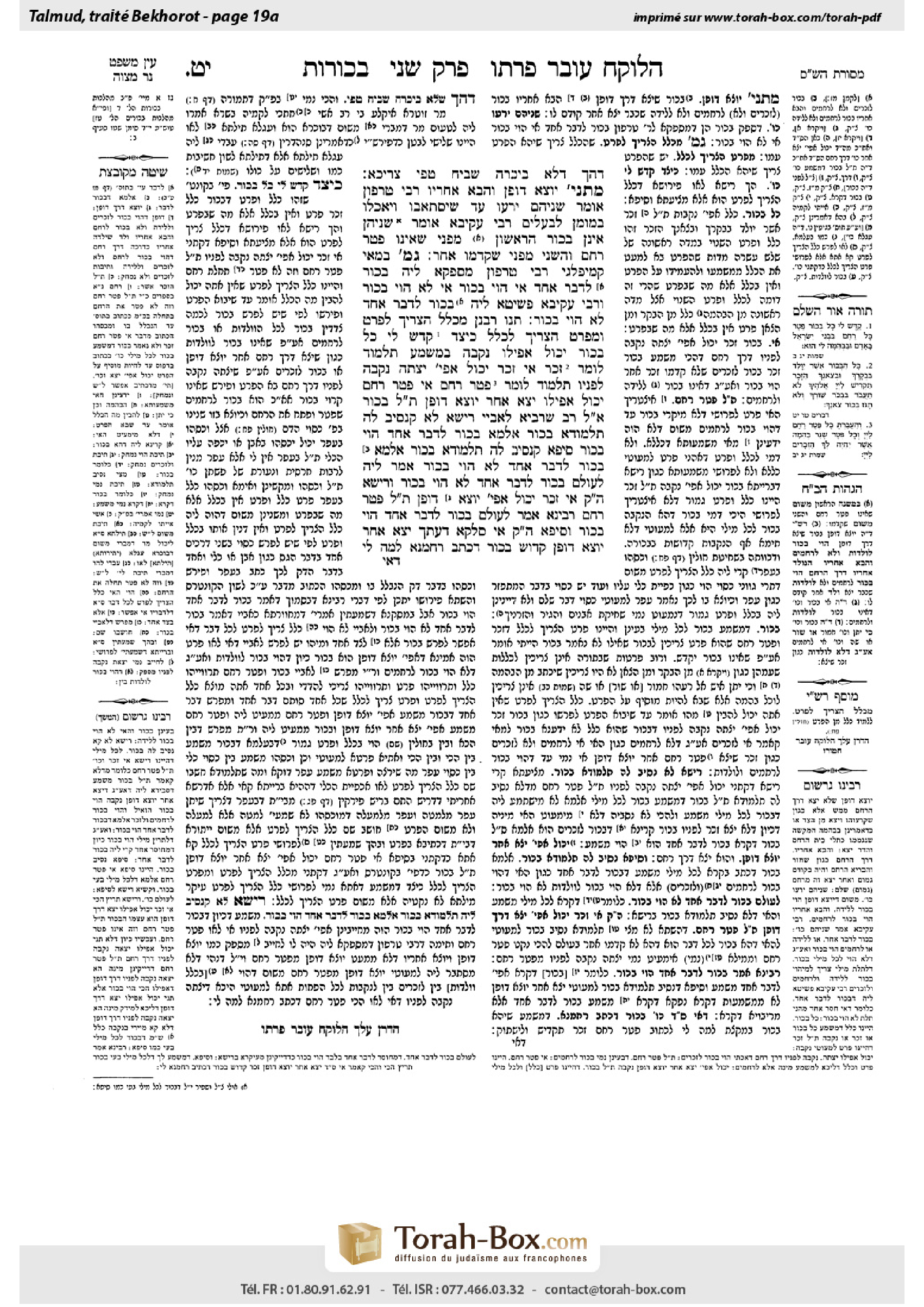
Bekhorot 19a: Talmud study for Daf Yomi
Study the Talmud for Daf Yomi with scanned pages, Hebrew text, English translations from Sefaria and AI-generated French translations.
Passage selection and English or AI-generated French translation are available where the scan has annotations. Daf Study is independent of Torah-Box and Sefaria.
Browse Bekhorot · בכורות · All tractatesBekhorot 19a text and translations
This page of Bekhorot includes the Aramaic text, an English translation and an AI-generated French translation, alongside the scan above.
בכורות י״ט א · Aramaic and Hebrew text
דְּהָךְ דְּלָא בִּיכְּרָה שְׁבִיחַ טְפֵי צְרִיכָא.
מַתְנִי׳ יוֹצֵא דּוֹפֶן וְהַבָּא אַחֲרָיו, רַבִּי טַרְפוֹן אוֹמֵר: שְׁנֵיהֶם יִרְעוּ עַד שֶׁיִּסְתָּאֲבוּ, וְיֵאָכְלוּ בְּמוּמָן לַבְּעָלִים. רַבִּי עֲקִיבָא אוֹמֵר: שְׁנֵיהֶן אֵינָן בְּכוֹר, הָרִאשׁוֹן — מִפְּנֵי שֶׁאֵינוֹ ״פֶּטֶר רֶחֶם״, וְהַשֵּׁנִי — מִפְּנֵי שֶׁקְּדָמוֹ אַחֵר.
גְּמָ׳ בְּמַאי קָמִיפַּלְגִי? רַבִּי טַרְפוֹן מְסַפְּקָא לֵיהּ: בְּכוֹר לְדָבָר אֶחָד, אִי הָוֵי בְּכוֹר אִי לָא הָוֵי בְּכוֹר, וְרַבִּי עֲקִיבָא פְּשִׁיטָא לֵיהּ: בְּכוֹר לְדָבָר אֶחָד לָא הָוֵי בְּכוֹר.
תָּנוּ רַבָּנַן: מִכְּלָל הַצָּרִיךְ לִפְרָט וּמִפְּרָט הַצָּרִיךְ לִכְלָל, כֵּיצַד? ״קַדֶּשׁ לִי כׇל בְּכוֹר״, יָכוֹל אֲפִילּוּ נְקֵבָה בַּמַּשְׁמָע? תַּלְמוּד לוֹמַר ״זָכָר״.
אִי ״זָכָר״, יָכוֹל אֲפִילּוּ יָצְתָה נְקֵבָה לְפָנָיו? תַּלְמוּד לוֹמַר: ״פֶּטֶר רֶחֶם״. אִי ״פֶּטֶר רֶחֶם״, יָכוֹל אֲפִילּוּ יָצָא אַחַר יוֹצֵא דּוֹפֶן? תַּלְמוּד לוֹמַר: ״בְּכוֹר״.
אֲמַר לֵיהּ רַב שֵׁרֵבְיָא לְאַבָּיֵי: רֵישָׁא לָא קָנָסֵיב לַהּ תַּלְמוּדָא ״בְּכוֹר״, אַלְמָא בְּכוֹר לְדָבָר אֶחָד הָוֵי בְּכוֹר. סֵיפָא קָנָסֵיב לַהּ תַּלְמוּדָא ״בְּכוֹר״, אַלְמָא בְּכוֹר לְדָבָר אֶחָד לָא הָוֵי בְּכוֹר!
אֲמַר לֵיהּ: לְעוֹלָם בְּכוֹר לְדָבָר אֶחָד לָא הָוֵי בְּכוֹר, וְרֵישָׁא הָכִי קָאָמַר: אִי זָכָר, יָכוֹל אֲפִילּוּ יוֹצֵא דּוֹפֶן? תַּלְמוּד לוֹמַר ״פֶּטֶר רֶחֶם״.
רָבִינָא אָמַר: לְעוֹלָם בְּכוֹר לְדָבָר אֶחָד הָוֵי בְּכוֹר, וְסֵיפָא הָכִי קָאָמַר: אִי סָלְקָא דַעְתָּךְ יָצָא אַחֵר יוֹצֵא דּוֹפֶן קָדוֹשׁ, ״בְּכוֹר״ דִּכְתַב רַחֲמָנָא לְמָה לִי?
Bekhorot 19a · English translation
that this offspring born to the ewe that had not previously given birth is superior. The Gemara concludes: Consequently, it was necessary to teach each case.
MISHNA: With regard to an animal born by caesarean section and the offspring that follows it, since there is uncertainty whether each is a firstborn, neither is given to the priest. Rabbi Tarfon says: Both of them must graze until they become unfit, and they may be eaten in their blemished state by their owner. Rabbi Akiva says: Neither of them is firstborn; the first because it is not the one that opens the womb (see Exodus 13:12), as this animal did not itself open the womb, and the second because the other one preceded it.
GEMARA: The Gemara asks: With regard to what do Rabbi Akiva and Rabbi Tarfon disagree? Rabbi Tarfon is uncertain with regard to an animal that is a firstborn in one aspect, e.g., first to be born or first to open the womb, whether it is considered a firstborn or whether it is not considered a firstborn. And conversely, it is obvious to Rabbi Akiva that an animal which is a firstborn in only one aspect is not considered a firstborn.
With regard to the definition of a firstborn, the Sages taught in a baraita: This halakha can be derived by means of the form of exegesis known as: From a generalization that requires a detail, and from a detail that requires a generalization. How so? The verse states: “Sanctify to Me all the firstborn, that which opens any womb among the children of Israel, both of man and of animal, it is Mine” (Exodus 13:2). Had the verse written only the generalization: “Sanctify to Me all the firstborn,” one might have thought that even a female animal is included in the category of a firstborn. Therefore, the verse states the detail: “Every firstborn male…you shall sanctify to the Lord” (Deuteronomy 15:19).
And had the verse stated only: “Every firstborn male,” one might have thought that the first male offspring of an animal has firstborn status, even in a case where a female emerged from the womb before it. Therefore, the verse states: “That which opens any womb,” to teach that only an animal that itself opens its mother’s womb can be a firstborn. And had the verse stated only: “That which opens any womb,” one might have thought that even an animal that emerged from the womb after its older sibling was born by caesarean section is considered firstborn. Therefore, the verse states: “All the firstborn,” to teach that only the first offspring can be considered a firstborn.
The Gemara analyzes the baraita. Rav Sherevya said to Abaye: In the first clause, the baraita does not cite proof from the word “firstborn” that a male born after a female is not considered a firstborn. Apparently, an animal that is a firstborn in one aspect is called a firstborn, otherwise the baraita would not have had to derive the exclusion of a male born after a female from the phrase “that which opens any womb”; it could have cited the word “firstborn.” And in the last clause, the baraita does cite proof from the word “firstborn” that an animal whose older sibling was born by caesarean section is not considered a firstborn, despite the fact that it is a firstborn in one aspect. Apparently, a firstborn in one aspect is not called a firstborn. If so, the baraita is self-contradictory.
Abaye said to Rav Sherevya: Actually, a firstborn in one aspect is not called a firstborn, and this is what the first clause is saying: Had the verse stated only: “Every firstborn male,” one might have thought that even an animal born by caesarean section is itself considered a firstborn. Therefore, the verse states: “That which opens any womb,” to teach that an animal must itself open the womb to be considered a firstborn. The word “firstborn” cannot be cited as proof that an animal born by caesarean section is not a firstborn, as such an animal was in fact born first. Therefore, the tanna cites the phrase “that which opens any womb.” Once this phrase is cited, then a male born after a female is excluded as well, despite the fact that this halakha could have been derived from the word “firstborn.”
Ravina said that there is a different explanation: Actually, a firstborn in one aspect is called a firstborn, and the halakha is not derived from the meaning of the word “firstborn” itself, but from the fact that it is superfluous. And this is what the last clause is saying: If it enters your mind that an animal which emerged from the womb after its older sibling was born by caesarean section is sanctified, why do I need the word “firstborn” that the Merciful One wrote?
Bekhorot 19a · Traduction française (IA)
que ce petit animal né de la brebis qui n'avait pas encore donné naissance est supérieur. La Guemara conclut : Par conséquent, il était nécessaire d'enseigner chaque cas.
MICHNA : Concernant un animal né par césarienne et l'animal qui suit, puisque l'incertitude existe quant à ce que chacun est un premier-né, aucun n'est donné au prêtre. Rabbi Tarfoun dit : Les deux doivent paître jusqu'à ce qu'ils deviennent imparfaits, et peuvent être mangés dans leur état imparfait par leur propriétaire. Rabbi Akiva dit : Aucun d'eux n'est un premier-né ; le premier parce qu'il n'est pas celui qui a ouvert le ventre (cf. Exode 13:12), car cet animal n'a pas lui-même ouvert le ventre, et le second parce que l'autre l'a précédé.
GUEMARA : La Guemara pose la question : Concernant quel point Rabbi Akiva et Rabbi Tarfoun s'opposent-ils ? Rabbi Tarfoun est incertain concernant un animal qui est un premier-né dans un aspect, par exemple, le premier à naître ou le premier à ouvrir le ventre, s'il est considéré comme un premier-né ou non. Et inversement, il est évident pour Rabbi Akiva qu'un animal qui est un premier-né dans un seul aspect n'est pas considéré comme un premier-né.
Concernant la définition d'un premier-né, les Sages ont enseigné dans une baraïta : Cette halakha peut être dérivée par le moyen de l'interprétation connue sous le nom de : De la généralisation qui exige un détail, et du détail qui exige une généralisation. Comment cela ? Le verset dit : « Sanctifie-moi tous les premiers-nés, celui qui ouvre tout ventre parmi les enfants d'Israël, tant d'homme que d'animal, il m'appartient » (Exode 13:2). Si le verset avait dit seulement la généralisation : « Sanctifie-moi tous les premiers-nés », on aurait pu penser que même un animal femelle est inclus dans la catégorie des premiers-nés. Par conséquent, le verset dit le détail : « Tous les premiers-nés masculins… tu les sanctifieras au Seigneur » (Deutéronome 15:19).
Et si le verset avait dit seulement : « Tous les premiers-nés masculins », on aurait pu penser que le premier petit d'un animal est considéré comme un premier-né, même dans le cas où une femelle est sortie du ventre avant lui. Par conséquent, le verset dit : « Celui qui ouvre tout ventre », pour enseigner que seul un animal qui ouvre lui-même le ventre de sa mère peut être un premier-né. Et si le verset avait dit seulement : « Celui qui ouvre tout ventre », on aurait pu penser que même un animal qui est sorti du ventre après son frère aîné né par césarienne est considéré comme un premier-né. Par conséquent, le verset dit : « Tous les premiers-nés », pour enseigner que seul le premier petit peut être considéré comme un premier-né.
La Guemara analyse la baraïta. Rav Shérevya dit à Abaye : Dans la première clause, la baraïta ne cite pas comme preuve le mot « premier-né » pour enseigner qu'un mâle né après une femelle n'est pas considéré comme un premier-né. Apparemment, un animal qui est un premier-né dans un aspect est appelé un premier-né, autrement la baraïta n'aurait pas eu besoin de dériver l'exclusion d'un mâle né après une femelle du mot « celui qui ouvre tout ventre » ; elle aurait pu citer le mot « premier-né ». Et dans la dernière clause, la baraïta cite comme preuve le mot « premier-né » pour enseigner qu'un animal dont le frère aîné a été né par césarienne n'est pas considéré comme un premier-né, malgré le fait qu'il est un premier-né dans un aspect. Apparemment, un premier-né dans un aspect n'est pas appelé un premier-né. Si tel est le cas, la baraïta est contradictoire.
Abaye dit à Rav Shérevya : En réalité, un premier-né dans un aspect n'est pas appelé un premier-né, et c'est cela que la première clause dit : Si le verset avait dit seulement : « Tous les premiers-nés masculins », on aurait pu penser que même un animal né par césarienne est considéré comme un premier-né. Par conséquent, le verset dit : « Celui qui ouvre tout ventre », pour enseigner qu'un animal doit lui-même ouvrir le ventre pour être considéré comme un premier-né. Le mot « premier-né » ne peut pas être cité comme preuve qu'un animal né par césarienne n'est pas un premier-né, car cet animal a effectivement été né en premier. Par conséquent, le tanna cite la phrase « celui qui ouvre tout ventre ». Une fois que cette phrase est citée, alors un mâle né après une femelle est exclu également, malgré le fait que cette halakha aurait pu être dérivée du mot « premier-né ».
Ravina dit qu'il y a une autre explication : En réalité, un premier-né dans un aspect est appelé premier-né, et la halakha n'est pas tirée de la signification du mot « premier-né » lui-même, mais du fait qu'il est superflu. Et c'est cela que la dernière clause indique : Si vous pensez qu'un animal qui est sorti du ventre après son frère aîné né par césarienne est sanctifié, pourquoi ai-je besoin du mot « premier-né » que l'Éternel a écrit ?
Traduction française générée par IA à partir de l’édition anglaise de Sefaria. Vérifie toujours un passage avec le texte source.
Text from Sefaria: William Davidson Edition - Vocalized Aramaic (CC BY NC); William Davidson Edition - English (CC BY NC).