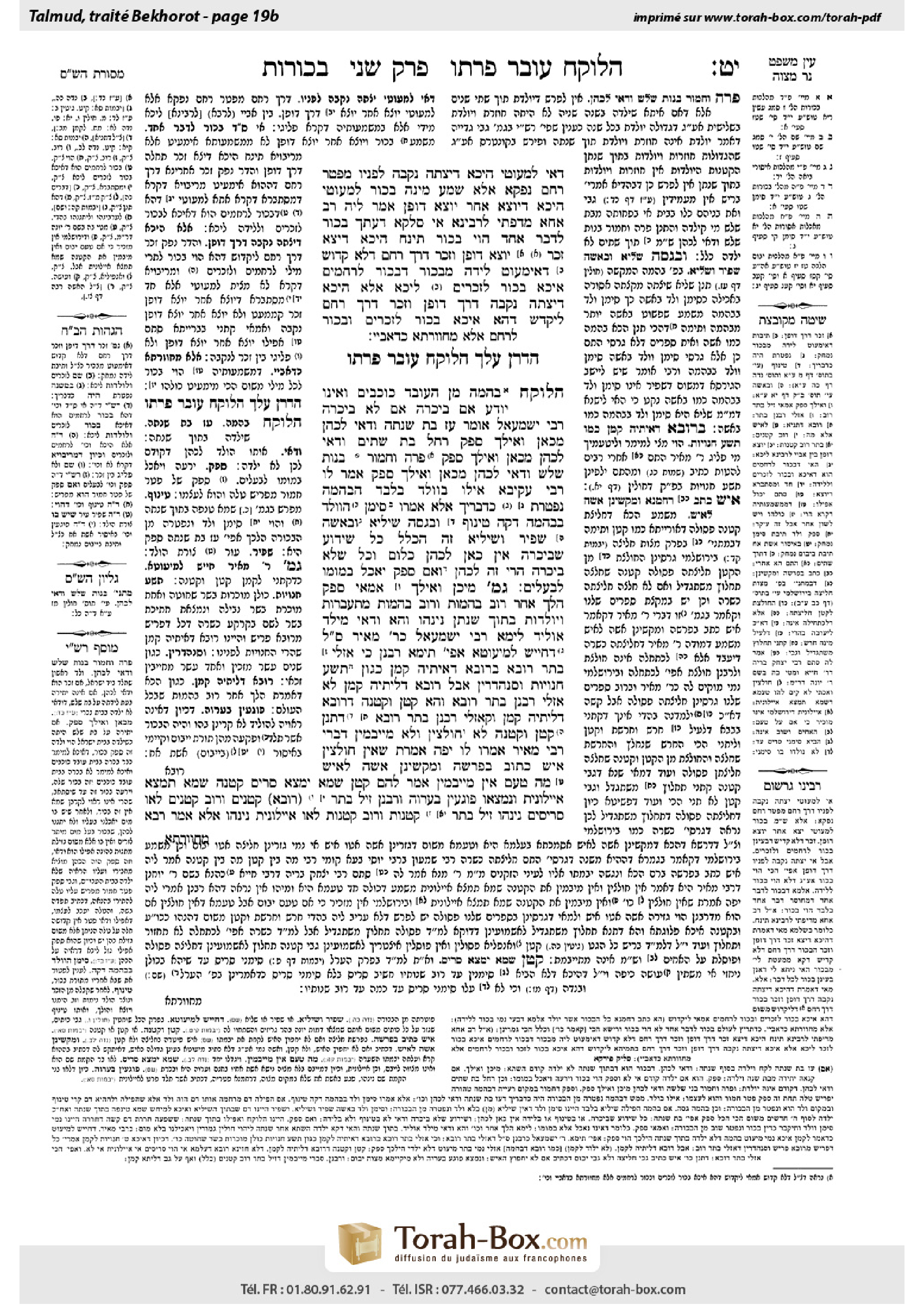
Bekhorot 19b: Talmud study for Daf Yomi
Study the Talmud for Daf Yomi with scanned pages, Hebrew text, English translations from Sefaria and AI-generated French translations.
Passage selection and English or AI-generated French translation are available where the scan has annotations. Daf Study is independent of Torah-Box and Sefaria.
Browse Bekhorot · בכורות · All tractatesBekhorot 19b text and translations
This page of Bekhorot includes the Aramaic text, an English translation and an AI-generated French translation, alongside the scan above.
בכורות י״ט ב · Aramaic and Hebrew text
אִי לְמַעוֹטֵי הֵיכָא דְּיָצְתָה נְקֵבָה לְפָנָיו — מִ״פֶּטֶר רֶחֶם״ נָפְקָא! אֶלָּא שְׁמַע מִינַּהּ ״בְּכוֹר״ לְמַעוֹטֵי הֵיכָא דְּיוֹצֵא אַחַר יוֹצֵא דּוֹפֶן.
אֲמַר לֵיהּ רַב אַחָא מִדִּפְתִּי לְרָבִינָא: אִי סָלְקָא דַעְתָּךְ בְּכוֹר לְדָבָר אֶחָד הָוֵי בְּכוֹר, תִּינַח הֵיכָא דְּיָצָא זָכָר יוֹצֵא דּוֹפֶן וְזָכָר דֶּרֶךְ רֶחֶם, דְּלָא קָדוֹשׁ, דְּאִימַּעוּט לֵידָה מִ״בְּכוֹר״, דִּבְכוֹר לִרְחָמִים אִיכָּא, בְּכוֹר לִזְכָרִים לֵיכָּא.
אֶלָּא הֵיכָא דְּיָצְתָה נְקֵבָה דֶּרֶךְ דּוֹפֶן וְזָכָר דֶּרֶךְ רֶחֶם — לִיקְדַּשׁ, דְּהָא אִיכָּא בְּכוֹר לִזְכָרִים וּבְכוֹר לְרֶחֶם! אֶלָּא מְחַוַּורְתָּא כִּדְאַבָּיֵי.
הֲדַרַן עֲלָךְ הַלּוֹקֵחַ עוּבַּר פָּרָתוֹ.
מַתְנִי׳ הַלּוֹקֵחַ בְּהֵמָה מִן הַגּוֹי, וְאֵינוֹ יוֹדֵעַ אִם בִּיכְּרָה אִם לֹא בִּיכְּרָה. רַבִּי יִשְׁמָעֵאל אוֹמֵר: עֵז בַּת שְׁנָתָהּ — וַדַּאי לַכֹּהֵן, מִכָּאן וְאֵילָךְ — סָפֵק. רָחֵל בַּת שְׁתַּיִם — וַדַּאי לַכֹּהֵן, מִכָּאן וְאֵילָךְ — סָפֵק. פָּרָה וַחֲמוֹר בְּנוֹת שָׁלֹשׁ — וַדַּאי לַכֹּהֵן, מִכָּאן וְאֵילָךְ — סָפֵק.
אָמַר לוֹ רַבִּי עֲקִיבָא: אִילּוּ בְּוָולָד בִּלְבַד הַבְּהֵמָה נִפְטֶרֶת כִּדְבָרֶיךָ, אֶלָּא אָמְרוּ: סִימָן הַוָּולָד בִּבְהֵמָה דַּקָּה — טִינּוּף, וּבַגַּסָּה — שִׁילְיָא, וּבָאִשָּׁה — שָׁפִיר וְשִׁילְיָא.
זֶה הַכְּלָל: כֹּל שֶׁיָּדוּעַ שֶׁבִּיכְּרָה — אֵין כָּאן לַכֹּהֵן כְּלוּם, וְכֹל שֶׁלֹּא בִּיכְּרָה — הֲרֵי זֶה לַכֹּהֵן, וְאִם סָפֵק — יֵאָכֵל בְּמוּמוֹ לַבְּעָלִים.
גְּמָ׳ מִיכָּן וְאֵילָךְ, אַמַּאי סָפֵק? הַלֵּךְ אַחַר רוֹב בְּהֵמוֹת, וְרוֹב בְּהֵמוֹת מִתְעַבְּרוֹת וְיוֹלְדוֹת בְּתוֹךְ שְׁנָתָן נִינְהוּ, וְהָא וַדַּאי מֵילָד אוֹלֵיד! לֵימָא רַבִּי יִשְׁמָעֵאל כְּרַבִּי מֵאִיר סְבִירָא לֵיהּ, דְּחָיֵישׁ לְמִיעוּטָא?
אֲפִילּוּ תֵּימָא רַבָּנַן, כִּי אָזְלִי בָּתַר רוּבָּא בְּרוּבָּא דְּאִיתֵיהּ קַמַּן, כְּגוֹן תֵּשַׁע חֲנוּיוֹת וְסַנְהֶדְרִין, אֲבָל רוּבָּא דְּלֵיתֵיהּ קַמַּן — לָא אָזְלִי רַבָּנַן בָּתַר רוּבָּא.
וְהָא קָטָן וּקְטַנָּה, דְּרוּבָּא דְּלֵיתֵיהּ קַמַּן, וְקָאָזְלִי רַבָּנַן בָּתַר רוּבָּא, דִּתְנַן: קָטָן וּקְטַנָּה לֹא חוֹלְצִין וְלֹא מְיַיבְּמִין, דִּבְרֵי רַבִּי מֵאִיר. אָמְרוּ לוֹ: יָפֶה אָמַרְתָּ שֶׁאֵין חוֹלְצִין, ״אִישׁ״ כָּתוּב בַּפָּרָשָׁה, וּמַקְּשִׁינַן אִשָּׁה לְאִישׁ.
מָה טַעַם אֵין מְיַיבְּמִין? אָמַר לָהֶם: קָטָן — שֶׁמָּא יִמָּצֵא סָרִיס, קְטַנָּה — שֶׁמָּא תִּמָּצֵא אַיְילוֹנִית, וְנִמְצְאוּ פּוֹגְעִין בְּעֶרְוָה.
וְרַבָּנַן, זִיל בָּתַר רוּבָּא קְטַנִּים, וְרוֹב קְטַנִּים לָאו סָרִיסִים נִינְהוּ; זִיל בָּתַר קְטַנּוֹת, וְרוֹב קְטַנּוֹת לָאו אַיְילוֹנִית נִינְהוּ!
אֶלָּא אָמַר רָבָא:
Bekhorot 19b · English translation
If it serves to exclude a case where a female emerged from the womb before it, that is derived from the phrase “that which opens any womb.” Rather, conclude from it that “firstborn” serves to exclude a case where an animal emerged from the womb after its older sibling was born by caesarean section. According to Ravina, the word “firstborn” is referring to an animal that is a firstborn even in only one aspect, but as it is extraneous it serves to exclude an animal whose older sibling was born by caesarean section.
Rav Aḥa of Difti said to Ravina: If it enters your mind that a firstborn in one aspect is called a firstborn and the derivation is based on the fact that the term “firstborn” is superfluous, that works out well in a case where a male emerged by caesarean section and then another male emerged through the womb. It stands to reason that it is not sanctified, as this birth is excluded by the word “firstborn,” as it is the firstborn of the womb, but it is not the firstborn of the males.
But in a case where a female emerged by caesarean section and afterward a male was born through the womb, let it be sanctified, as it is the firstborn of the males and the firstborn of the womb. One cannot derive the exclusions of both of these cases from the word “firstborn,” and yet the baraita indicates that even if a female was born first by caesarean section, the male born afterward is not considered the firstborn. The Gemara concludes: Rather, it is clear that the baraita must be interpreted in accordance with the explanation of Abaye, that a firstborn in one aspect is not called a firstborn.
MISHNA: In the case of one who purchases a female animal from a gentile and does not know whether it had previously given birth or whether it had not previously given birth, and after the purchase the animal gave birth to a male, Rabbi Yishmael says: If the mother was a goat within its first year the male offspring certainly is given to the priest, as it definitely never gave birth previously. From that point forward, i.e., if the mother is older than that, its offspring’s status as a firstborn is uncertain. If it was a ewe within its second year the male offspring certainly is given to the priest; from that point forward an offspring’s status is uncertain. If it was a cow or a donkey within its third year the male offspring certainly is given to the priest; from that point forward the offspring’s status is uncertain.
Rabbi Akiva said to him: Were an animal exempted only by giving birth to an offspring and in no other manner the halakha would be in accordance with your statement. But the Sages said: An indication of the offspring in a small animal is a murky discharge from the womb, which indicates the animal had been pregnant, and therefore exempts subsequent births from the mitzva of the firstborn. The indication in a large animal is the emergence of an afterbirth, and the indication in a woman is a fetal sac or an afterbirth. Since these can be produced even within a year, it cannot be assumed that an animal in its first year is definitely subject to the mitzva of the firstborn.
Rabbi Akiva continues: Rather, this is the principle: In any case where it is known that the animal had previously given birth, the priest has nothing here. And in any case where it is known that the animal had not previously given birth, that is given to the priest. And if it is uncertain, it may be eaten in its blemished state by the owner.
GEMARA: The mishna teaches that according to Rabbi Yishmael, the firstborn status of the offspring of a goat acquired from a gentile when it was more than one year old is uncertain. The Gemara asks: From that point forward, i.e., if it was bought after its first year, why is it in a state of uncertainty? One should follow the majority of animals, and as the majority of animals are impregnated and give birth within their first year, it can be assumed this animal certainly gave birth. The Gemara suggests: Shall we say Rabbi Yishmael holds in accordance with the opinion of Rabbi Meir, who says one must be concerned for the minority, i.e., he must take the minority of cases into account?
The Gemara responds: You may even say Rabbi Yishmael holds in accordance with the opinion of the Rabbis. When the Rabbis follow the majority, this is in a case of an evident majority, which is extant and can be examined. For example, in a situation where a piece of meat is found in front of nine stores selling kosher meat and one store selling non-kosher meat, and it is not known from which store it came, it may be assumed that it came from one of the stores that sells kosher meat. And similarly, the Sanhedrin reaches its decisions by a majority vote of its judges. But with regard to a non-evident majority, which is based solely upon statistical information such as the assertion that most animals become pregnant and give birth within their first year, even the Rabbis do not follow the majority.
The Gemara raises a difficulty: But the case of levirate marriage of a male minor or a female minor is dependent upon a non-evident majority, and yet the Rabbis follow the majority in their ruling. As we learned in a baraita: A male minor or a female minor may not perform the ritual through which a yavam frees a yevama of her levirate bonds [ḥalitza], nor enter into levirate marriage; this is the statement of Rabbi Meir. The Rabbis said to Rabbi Meir: You have aptly stated that they may not perform ḥalitza, since “man,” indicating an adult male, is written in the section of the Torah addressing ḥalitza (see Deuteronomy 25:7). Although an adult female is not mentioned explicitly, we juxtapose the halakha of the woman to that of the man and require that the female involved in ḥalitza must be an adult as well.
But what is the reason they may not enter into levirate marriage, with regard to which the Torah’s wording does not specifically indicate adults? Rabbi Meir said to them: In the case of a male minor I am concerned lest he is found to be a eunuch, i.e., one who is incapable of fathering children, when he grows up. Similarly, a female minor may not enter into levirate marriage lest when she grows up she is found to be a sexually underdeveloped woman [ailonit], who is incapable of bearing children. In either case the mitzva of levirate marriage does not apply, and they would be found to have encountered a forbidden relative and entered into a forbidden relationship where no mitzva applies, as the entire purpose of levirate marriage is to have children for the brother who died childless.
And the Rabbis hold: Follow the majority of male minors, and most male minors are not eunuchs; and likewise, follow the majority of female minors, and most female minors are not sexually underdeveloped women. This indicates that the Rabbis disagree with Rabbi Meir even with regard to a non-evident majority.
Rather, Rava says:
Bekhorot 19b · Traduction française (IA)
Si cela sert à exclure un cas où une femelle est née avant elle, cela provient de la phrase « ce qui ouvre tout ventre ». En réalité, on conclut plutôt que « premier-né » sert à exclure un cas où un animal est né après son frère aîné par césarienne. Selon Ravina, le mot « premier-né » fait référence à un animal qui est premier-né dans un seul aspect, mais comme il est superflu, il sert à exclure un animal dont le frère aîné est né par césarienne.
Rav Aḥa de Difti a dit à Ravina : Si vous pensez qu'un premier-né dans un seul aspect est appelé premier-né et que la dérivation s'appuie sur le fait que le terme « premier-né » est superflu, cela fonctionne bien dans le cas où un mâle est né par césarienne et ensuite un autre mâle est né par le ventre. Il est logique qu'il ne soit pas sanctifié, car cette naissance est exclue par le mot « premier-né », car c'est le premier-né du ventre, mais ce n'est pas le premier-né des mâles.
Mais dans le cas où une femelle est née par césarienne et ensuite un mâle est né par le ventre, il doit être sanctifié, car c'est le premier-né des mâles et le premier-né du ventre. On ne peut dériver les exclusions de ces deux cas à partir du mot « premier-né », et pourtant la baraïta indique que même si une femelle est née d'abord par césarienne, le mâle né après n'est pas considéré comme premier-né. La Guemara conclut : En réalité, il est clair que la baraïta doit être interprétée selon l'explication d'Abaye, selon laquelle un premier-né dans un seul aspect n'est pas appelé premier-né.
MICHNA : Dans le cas d'une personne qui achète un animal femelle d'un non-juif et ne sait pas s'il avait déjà donné naissance ou non, et après l'achat l'animal donne naissance à un mâle, Rabbi Yishmael dit : Si la mère était une chèvre dans son premier an, le petit mâle est certainement donné au prêtre, car il n'a certainement pas donné naissance auparavant. À partir de ce moment, c'est-à-dire si la mère est plus âgée, le statut de premier-né du petit est incertain. Si c'était une brebis dans son deuxième an, le petit mâle est certainement donné au prêtre ; à partir de ce moment, le statut du petit est incertain. Si c'était une vache ou un âne dans son troisième an, le petit mâle est certainement donné au prêtre ; à partir de ce moment, le statut du petit est incertain.
Rabbi Akiva a dit à lui : Si un animal est exempté uniquement par la naissance d'un petit et pas autrement, la halakha serait selon votre déclaration. Mais les Sages ont dit : L'indication du petit dans un petit animal est une émission trouble du ventre, qui indique que l'animal était enceinte, et donc exempté les naissances suivantes de la mitsva du premier-né. L'indication dans un grand animal est l'émergence d'un après-vie, et l'indication dans une femme est un sac fœtal ou un après-vie. Puisque ces signes peuvent être produits même dans un an, on ne peut pas supposer qu'un animal dans son premier an est certainement soumis à la mitsva du premier-né.
Rabbi Akiva continue : En réalité, c'est le principe suivant : Dans tout cas où il est connu que l'animal a déjà donné naissance, le prêtre n'a rien ici. Et dans tout cas où il est connu que l'animal n'a pas donné naissance auparavant, cela est donné au prêtre. Et si c'est incertain, il peut être mangé dans son état déficient par l'propriétaire.
GUEMARA : La mishna enseigne que selon Rabbi Yishmael, le statut de premier-né du petit d'une chèvre achetée d'un non-juif, lorsqu'elle est plus âgée qu'un an, est incertain. La Guemara pose une question : À partir de ce moment, c'est-à-dire si elle a été achetée après son premier an, pourquoi est-elle dans un état d'incertitude ? On devrait suivre la majorité des animaux, et comme la majorité des animaux est enceinte et donne naissance dans leur premier an, on peut supposer que cet animal a certainement donné naissance. La Guemara suggère : Devons-nous dire que Rabbi Yishmael suit l'opinion de Rabbi Meir, qui dit qu'on doit être vigilant pour la minorité, c'est-à-dire qu'on doit prendre en compte la minorité des cas ?
La Guemara répond : Vous pouvez même dire que Rabbi Yishmael suit l'opinion des Sages. Lorsque les Sages suivent la majorité, c'est dans un cas d'une majorité évidente, qui est présente et peut être examinée. Par exemple, dans un cas où un morceau de viande est trouvé devant neuf boutiques vendant de la viande kasher et une boutique vendant de la viande non kasher, et qu'on ne sait pas d'où il vient, on peut supposer qu'il vient d'une boutique qui vend de la viande kasher. De même, le Sanhédrin prend ses décisions par un vote majoritaire de ses juges. Mais concernant une majorité non évidente, qui est basée uniquement sur des informations statistiques, comme l'affirmation que la majorité des animaux deviennent enceintes et donnent naissance dans leur premier an, même les Sages ne suivent pas la majorité.
La Guemara soulève une difficulté : Mais le cas du mariage levirat d'un mineur masculin ou féminin dépend d'une majorité non évidente, et pourtant les Sages suivent la majorité dans leur décision. Comme nous avons appris dans une baraïta : Un mineur masculin ou féminin ne peut pas accomplir la cérémonie par laquelle le yavam libère la yevama de ses liens levirats [ḥalitza], ni entrer en mariage levirat ; c'est la déclaration de Rabbi Meir. Les Sages ont dit à Rabbi Meir : Vous avez raison de dire qu'ils ne peuvent pas accomplir ḥalitza, car « homme », indiquant un homme adulte, est écrit dans la section de la Torah concernant ḥalitza (voir Deutéronome 25:7). Bien qu'une femme adulte ne soit pas mentionnée explicitement, on juxtapose la halakha de la femme à celle de l'homme et exige que la femme impliquée dans ḥalitza soit également adulte.
Mais quelle est la raison pour laquelle ils ne peuvent pas entrer en mariage levirat, concernant lequel la formulation de la Torah ne spécifie pas explicitement les adultes ? Le maître Méri dit à ceux-ci : Dans le cas d'un mineur masculin, j'ai peur qu'il soit trouvé être un eunuque, c'est-à-dire quelqu'un incapable de père des enfants, lorsqu'il grandira. De même, une mineure féminine ne peut pas entrer en mariage levirat de peur qu'elle soit trouvée être une femme sexuellement sous-développée [ailonit], incapable de porter des enfants, lorsqu'elle grandira. Dans aucun cas la mitsva du mariage levirat ne s'applique, et ils seraient trouvés avoir rencontré un parent interdit et entré dans une relation interdite où aucune mitsva ne s'applique, car l'objectif principal du mariage levirat est d'avoir des enfants pour le frère décédé sans enfants.
Et les Rabbins affirment : Suivez la majorité des mineurs masculins, et la majorité des mineurs masculins n'est pas eunuque ; de même, suivez la majorité des mineures féminines, et la majorité des mineures féminines n'est pas des femmes sexuellement sous-développées. Cela montre que les Rabbins s'opposent à la position du maître Méri même concernant une majorité non évidente.
Plutôt, Rava dit :
Traduction française générée par IA à partir de l’édition anglaise de Sefaria. Vérifie toujours un passage avec le texte source.
Text from Sefaria: William Davidson Edition - Vocalized Aramaic (CC BY NC); William Davidson Edition - English (CC BY NC).