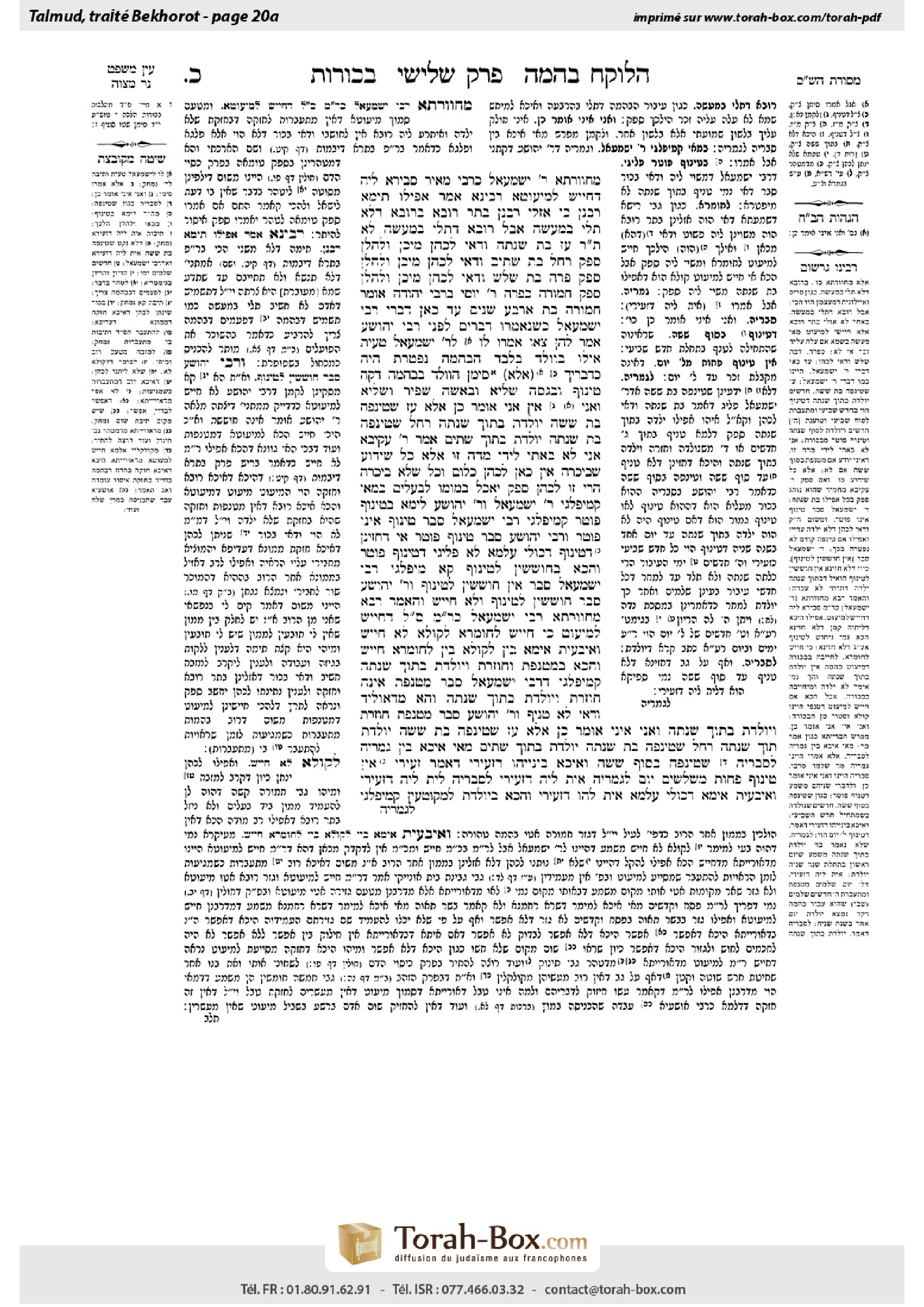
Bekhorot 20a: Talmud study for Daf Yomi
Study the Talmud for Daf Yomi with scanned pages, Hebrew text, English translations from Sefaria and AI-generated French translations.
Passage selection and English or AI-generated French translation are available where the scan has annotations. Daf Study is independent of Torah-Box and Sefaria.
Browse Bekhorot · בכורות · All tractatesBekhorot 20a text and translations
This page of Bekhorot includes the Aramaic text, an English translation and an AI-generated French translation, alongside the scan above.
בכורות כ׳ א · Aramaic and Hebrew text
מְחַוַּורְתָּא רַבִּי יִשְׁמָעֵאל כְּרַבִּי מֵאִיר סְבִירָא לֵיהּ, דְּחָיֵישׁ לְמִיעוּטָא.
רָבִינָא אָמַר: אֲפִילּוּ תֵּימָא רַבָּנַן, כִּי אָזְלִי רַבָּנַן בָּתַר רוּבָּא — בְּרוּבָּא דְּלָא תְּלֵי בְּמַעֲשֶׂה, אֲבָל רוּבָּא דִּתְלֵי בְּמַעֲשֶׂה — לָא.
תָּנוּ רַבָּנַן: עֵז בַּת שְׁנָתָהּ — וַדַּאי לַכֹּהֵן, מִיכָּן וּלְהַלָּן — סָפֵק. רָחֵל בַּת שְׁתַּיִם — וַדַּאי לַכֹּהֵן, מִיכָּן וּלְהַלָּן — סָפֵק. פָּרָה בַּת שָׁלֹשׁ — וַדַּאי לַכֹּהֵן, מִיכָּן וּלְהַלָּן — סָפֵק. חֲמוֹרָה — כְּפָרָה. רַבִּי יוֹסֵי בְּרַבִּי יְהוּדָה אוֹמֵר: חֲמוֹרָה בַּת אַרְבַּע שָׁנִים. עַד כָּאן דִּבְרֵי רַבִּי יִשְׁמָעֵאל.
כְּשֶׁנֶּאְמְרוּ דְּבָרִים לִפְנֵי רַבִּי יְהוֹשֻׁעַ, אָמַר לָהֶן: צְאוּ אִמְרוּ לוֹ לְרַבִּי יִשְׁמָעֵאל: טָעִיתָ! אִילּוּ בְּוָולָד בִּלְבַד הַבְּהֵמָה נִפְטֶרֶת — הָיָה כִּדְבָרֶיךָ, אֶלָּא סִימַן הַוָּולָד בִּבְהֵמָה דַּקָּה — טִינּוּף, וּבַגַּסָּה — שִׁלְיָא, וּבָאִשָּׁה — שָׁפִיר וְשִׁלְיָא.
וַאֲנִי אֵין אֲנִי אוֹמֵר כֵּן, אֶלָּא: עֵז שֶׁטִּינְּפָה בַּת שִׁשָּׁה — יוֹלֶדֶת בְּתוֹךְ שְׁנָתָהּ, רָחֵל שֶׁטִּינְּפָה בַּת שְׁנָתָהּ — יוֹלֶדֶת בְּתוֹךְ שְׁתַּיִם. אָמַר רַבִּי עֲקִיבָא: אֲנִי לֹא בָּאתִי לִידֵי מִדָּה זוֹ, אֶלָּא: כֹּל שֶׁיָּדוּעַ שֶׁבִּיכְּרָה — אֵין כָּאן לַכֹּהֵן כְּלוּם, וְכֹל שֶׁלֹּא בִּיכְּרָה — הֲרֵי זוֹ לַכֹּהֵן, סָפֵק — יֵאָכֵל בְּמוּמוֹ לַבְּעָלִים.
בְּמַאי קָמִיפַּלְגִי רַבִּי יִשְׁמָעֵאל וְרַבִּי יְהוֹשֻׁעַ? לֵימָא בְּטִינּוּף פּוֹטֵר קָמִיפַּלְגִי, רַבִּי יִשְׁמָעֵאל סָבַר טִינּוּף אֵינוֹ פּוֹטֵר, וְרַבִּי יְהוֹשֻׁעַ סָבַר טִינּוּף פּוֹטֵר?
אִי דַּחֲזֵינָא דְּטַינִּוף — דְּכוּלֵּי עָלְמָא לָא פְּלִיגִי דְּטִינּוּף פּוֹטֵר, וְהָכָא בְּחוֹשְׁשִׁין לְטִינּוּף קָא מִיפַּלְגִי: רַבִּי יִשְׁמָעֵאל סָבַר: אֵין חוֹשְׁשִׁין לְטִינּוּף, וְרַבִּי יְהוֹשֻׁעַ סָבַר: חוֹשְׁשִׁין לְטִינּוּף.
וְלָא חָיֵישׁ? וְהָאָמַר רָבָא: מְחַוַּורְתָּא רַבִּי יִשְׁמָעֵאל כְּרַבִּי מֵאִיר סְבִירָא לֵיהּ, דְּחָיֵישׁ לְמִיעוּט! כִּי חָיֵישׁ — לְחוּמְרָא, לְקוּלָּא — לָא חָיֵישׁ.
וְאִיבָּעֵית אֵימָא: בֵּין לְקוּלָּא בֵּין לְחוּמְרָא חָיֵישׁ, וְהָכָא בִּמְטַנֶּפֶת וְחוֹזֶרֶת וְיוֹלֶדֶת בְּתוֹךְ שְׁנָתָהּ קָמִיפַּלְגִי, דְּרַבִּי יִשְׁמָעֵאל סָבַר: מְטַנֶּפֶת אֵינָהּ חוֹזֶרֶת וְיוֹלֶדֶת בְּתוֹךְ שְׁנָתָהּ, וְהָא מִדְּאוֹלִיד — וַדַּאי לָא טַנִּיף. וְרַבִּי יְהוֹשֻׁעַ סָבַר: מְטַנֶּפֶת חוֹזֶרֶת וְיוֹלֶדֶת בְּתוֹךְ שְׁנָתָהּ.
וַאֲנִי אֵינִי אוֹמֵר כֵּן, אֶלָּא עֵז שֶׁטִּינְּפָה בַּת שִׁשָּׁה — יוֹלֶדֶת תּוֹךְ שְׁנָתָהּ, רָחֵל שֶׁטִּינְּפָה בַּת שְׁנָתָהּ — יוֹלֶדֶת בְּתוֹךְ שְׁתַּיִם. מַאי אִיכָּא בֵּין גְּמָרֵיהּ לִסְבָרֵיהּ?
שֶׁטִּינְּפָה בְּסוֹף שִׁשָּׁה, וְאִיכָּא בֵּינַיְיהוּ דִּזְעֵירִי, דְּאָמַר זְעֵירִי: אֵין טִינּוּף פָּחוֹת מִשְּׁלֹשִׁים יוֹם.
לִגְמָרֵיהּ — אִית לֵיהּ דִּזְעֵירִי, לִסְבָרֵיהּ — לֵית לֵיהּ דִּזְעֵירִי.
וְאִיבָּעֵית אֵימָא: דְּכוּלֵּי עָלְמָא אִית לְהוּ דִּזְעֵירִי, וְהָכָא — בְּיוֹלֶדֶת לִמְקוּטָּעִין קָמִיפַּלְגִי;
Bekhorot 20a · English translation
It is clear, as was suggested initially, that Rabbi Yishmael holds in accordance with the opinion of Rabbi Meir, who says that one must be concerned for the minority.
Ravina says: You may even say that Rabbi Yishmael holds in accordance with the opinion of the Rabbis. When the Rabbis follow the majority, it is with regard to a majority that is not dependent upon an action but is simply the nature of reality. But in the case of a majority that is dependent upon an action, such as the pregnancy of a young goat, which depends upon whether or not it had copulated with a male, the Rabbis do not follow the majority.
§ The Sages taught in a baraita: If one purchased a goat within its first year from a gentile and does not know whether or not it had previously given birth, the subsequent male offspring certainly is given to the priest; from that point forward an offspring’s status as a firstborn is uncertain. If it was a ewe within its second year the offspring certainly is given to the priest; from that point forward an offspring’s status as a firstborn is uncertain. If it was a cow within its third year the offspring certainly is given to the priest; from that point forward an offspring’s status as a firstborn is uncertain. If it was a donkey it is subject to the same halakha as a cow. Rabbi Yosei, son of Rabbi Yehuda, says: The offspring of a donkey within its fourth year also has the status of a firstborn. Until here is the statement of Rabbi Yishmael.
The baraita continues: When these matters were stated by the students before Rabbi Yehoshua, he said to them: Go out and say to Rabbi Yishmael: You erred. Were an animal exempted only by giving birth to an offspring and in no other manner the halakha would be in accordance with your statement. But the Rabbis said: An indication of the offspring in a small animal is a murky discharge from the womb, which exempts subsequent births from the mitzva of the firstborn. And the indication in a large animal is the emergence of an afterbirth, and the indication in a woman is a fetal sac or an afterbirth.
Rabbi Yehoshua added: That is the opinion of the Rabbis, but I myself do not say so. Rather, I hold that a goat that expelled a murky discharge from the womb at the age of six months can give birth within its first year, and a ewe that expelled a murky discharge in its first year can give birth within its second year. The Gemara will later discuss the practical difference between his opinion and the ruling that he ascribes to the Rabbis. Rabbi Akiva says: I have not arrived at this method of determining firstborn status. Rather, in any case where it is known that the animal had previously given birth, the priest has nothing here. And in any case where it is known that the animal had not previously given birth, that is given to the priest. And if it is uncertain, it may be eaten in its blemished state by the owner.
The Gemara analyzes the baraita. With regard to what matter do Rabbi Yishmael and Rabbi Yehoshua disagree? Shall we say they disagree with regard to whether or not a murky discharge from the womb exempts an animal from the mitzva of the firstborn; as Rabbi Yishmael holds that a murky discharge does not exempt an animal because it is not a sign of a birth, and Rabbi Yehoshua holds that a murky discharge exempts an animal?
The Gemara rejects this suggestion: If we actually see a murky discharge, everyone agrees that the murky discharge exempts an animal. And here, it is with regard to whether one is concerned about the possibility that an animal might have expelled a murky discharge that they disagree. Rabbi Yishmael holds that we are not concerned about a murky discharge, and it can therefore be assumed that the first offspring born after its purchase from the gentile is firstborn; and Rabbi Yehoshua holds that one is concerned about a murky discharge, and due to the uncertainty the next offspring remains with its owner.
The Gemara objects: And is it correct that Rabbi Yishmael is not concerned about the possibility that the mother might have expelled a murky discharge before giving birth to a live offspring? But doesn’t Rava say: It is clear that Rabbi Yishmael holds in accordance with the opinion of Rabbi Meir, who says one must be concerned for the minority? If so, Rabbi Yishmael should be concerned for a murky discharge as well. The Gemara explains: Where Rabbi Yishmael is concerned is when the concern leads to a stringency. But if the concern would lead to a leniency, as in this case, where it would mean that the animal born after a year is only an uncertain firstborn, he is not concerned.
And if you wish, say instead: Whether it leads to a leniency or whether it leads to a stringency Rabbi Yishmael is concerned, and here they disagree with regard to whether or not an animal can expel a murky discharge and then return to its fertile state and give birth within its first year. As Rabbi Yishmael holds: An animal that expels a murky discharge does not return to its fertile state and give birth within its first year, and accordingly, from the fact that this animal gave birth it can be concluded that it certainly did not expel a murky discharge beforehand. And Rabbi Yehoshua holds: An animal that expels a murky discharge returns to its fertile state and can give birth within its first year.
§ The baraita teaches that Rabbi Yehoshua said: That is the opinion of the Rabbis, but I myself do not say so. Rather, I hold that a goat that expelled a murky discharge from the womb at the age of six months still gives birth within its first year, while a ewe that expelled a murky discharge in its first year still gives birth within its second year. The Gemara asks: Since according to both opinions an animal that expelled a murky discharge can still give birth within a year, what difference is there between Rabbi Yehoshua’s tradition of the opinion of the Rabbis and his own reasoning?
The Gemara answers: The difference between their opinions is in a case where a goat expelled a murky discharge at the end of its first six months of life, when the seventh month began, and then gave birth before the end of its first year. And there is a difference between them with regard to the statement of Ze’eiri, as Ze’eiri says: The expulsion of a murky discharge, which is sufficient to exempt an animal from having its future offspring counted a firstborn, prevents it from being impregnated for no less than thirty days. If an animal becomes pregnant within thirty days of expelling a murky discharge, evidently that discharge was not the sign of a fetus, and therefore the offspring will have firstborn status.
In this case, as the pregnancy of a goat lasts five months and a murky discharge was expelled at the end of the sixth month, a goat that gave birth by the end of the year, i.e., twelve months, must have become pregnant within a month of the discharge. The Rabbis, whose opinion Rabbi Yehoshua cited by tradition, accept the statement of Ze’eiri, and therefore they rule that this goat, which became pregnant within a month of the discharge, is not exempt from the mitzva of the firstborn. According to Rabbi Yehoshua’s own reasoning, he does not accept the statement of Ze’eiri, which means that although this animal became pregnant within a month of the discharge, it was nevertheless exempt from the mitzva of the firstborn.
The Gemara suggests another answer: And if you wish, say that everyone accepts the statement of Ze’eiri; and here, in the case of a goat that gave birth within its first year after having expelled a murky discharge at the end of its sixth month, they disagree with regard to whether or not an animal gives birth after incomplete months, i.e., prematurely.
Bekhorot 20a · Traduction française (IA)
Il est clair, comme cela a été suggéré initialement, que Rabbi Yishmael suit l'opinion de Rabbi Meir, qui affirme qu'on doit être vigilant concernant la minorité.
Ravina dit : On peut même dire que Rabbi Yishmael suit l'opinion des Sages. Lorsque les Sages suivent la majorité, c'est en ce qui concerne une majorité qui ne dépend pas d'une action mais qui est simplement la nature de la réalité. Mais dans le cas d'une majorité dépendante d'une action, telle que la grossesse d'une jeune chèvre, qui dépend de savoir si elle a ou non copulé avec un mâle, les Sages ne suivent pas la majorité.
§ Les Sages enseignent dans une baraïta : Si l'on achète une chèvre dans sa première année auprès d'un non-Juif et qu'on ignore si elle a ou non déjà donné naissance, le petit mâle suivant est certainement donné au prêtre ; à partir de ce moment, le statut de premier-né d'un petit est incertain. Si c'était une brebis dans sa deuxième année, le petit est certainement donné au prêtre ; à partir de ce moment, le statut de premier-né d'un petit est incertain. Si c'était une vache dans sa troisième année, le petit est certainement donné au prêtre ; à partir de ce moment, le statut de premier-né d'un petit est incertain. Si c'était un âne, il est soumis à la même halakha qu'une vache. Rabbi Yosei, fils de Rabbi Yehuda, dit : Le petit d'un âne dans sa quatrième année a également le statut de premier-né. Jusqu'ici est la déclaration de Rabbi Yishmael.
La baraïta continue : Lorsque ces questions furent soulevées devant Rabbi Yehoshua, il dit aux étudiants : Sortez et dites à Rabbi Yishmael : Vous avez tort. Si un animal est exempté uniquement par la naissance d'un petit et pas autrement, la halakha serait en accord avec votre déclaration. Mais les Sages ont dit : L'indication du petit dans un petit animal est une décharge trouble du ventre, qui exempt les naissances suivantes de la mitsva du premier-né. Et l'indication dans un grand animal est l'émergence d'un après-vie, et l'indication dans une femme est un sac fœtal ou un après-vie.
Rabbi Yehoshua a ajouté : C'est l'opinion des Sages, mais je ne dis pas cela moi-même. Je considère plutôt qu'une chèvre qui a expulsé une décharge trouble du ventre à l'âge de six mois peut donner naissance dans sa première année, et une brebis qui a expulsé une décharge trouble dans sa première année peut donner naissance dans sa deuxième année. La Guemara discutera ultérieurement la différence pratique entre son opinion et la décision qu'il attribue aux Sages. Rabbi Akiva dit : Je n'ai pas encore atteint cette méthode de détermination du statut de premier-né. En tout cas où il est connu que l'animal a déjà donné naissance, le prêtre n'a rien ici. Et en tout cas où il est connu que l'animal n'a pas encore donné naissance, cela est donné au prêtre. Et si c'est incertain, il peut être mangé dans son état déficient par l'owner.
La Guemara analyse la baraïta. À propos de quelle question Rabbi Yishmael et Rabbi Yehoshua divergent-ils ? Devons-nous dire qu'ils divergent à propos de savoir si une décharge trouble du ventre exempt un animal de la mitsva du premier-né ; comme Rabbi Yishmael considère que la décharge trouble ne exempt pas un animal car ce n'est pas un signe de naissance, et Rabbi Yehoshua considère que la décharge trouble exempt un animal ?
La Guemara rejette cette suggestion : Si nous voyons effectivement une décharge trouble, tout le monde convient que la décharge trouble exempt un animal. Et ici, il s'agit de savoir si l'on est préoccupé par la possibilité qu'un animal ait expulsé une décharge trouble avant de donner naissance à un petit vivant ; Rabbi Yishmael considère que l'on n'est pas préoccupé par une décharge trouble, et donc on peut supposer que le petit né après l'achat auprès du non-Juif est un premier-né ; et Rabbi Yehoshua considère que l'on est préoccupé par une décharge trouble, et en raison de l'incertitude, le petit suivant reste avec son propriétaire.
La Guemara s'oppose à cela : Et est-ce correct que Rabbi Yishmael ne soit pas préoccupé par la possibilité que la mère ait expulsé une décharge trouble avant de donner naissance à un petit vivant ? Mais ne dit pas Rava : Il est clair que Rabbi Yishmael suit l'opinion de Rabbi Meir, qui affirme qu'on doit être préoccupé par la minorité ? Si tel est le cas, Rabbi Yishmael devrait être préoccupé par une décharge trouble également. La Guemara explique : L'endroit où Rabbi Yishmael est préoccupé est lorsque la préoccupation mène à une stricteur. Mais si la préoccupation mène à une lenienc, comme dans ce cas, où cela signifierait que l'animal né après un an est seulement un premier-né incertain, il n'est pas préoccupé.
Et si vous le souhaitez, dites plutôt : Qu'importe si cela mène à une leniencité ou à une stricteur, Rabbi Yishmael est préoccupé, et ici ils divergent à propos de savoir si un animal peut expulser une décharge trouble et puis revenir à son état fertile et donner naissance dans sa première année. Comme Rabbi Yishmael considère : Un animal qui expulse une décharge trouble ne revient pas à son état fertile et ne peut pas donner naissance dans sa première année, et donc, à partir du fait que cet animal a donné naissance, on peut conclure qu'il n'a certainement pas expulsé une décharge trouble auparavant. Et Rabbi Yehoshua considère : Un animal qui expulse une décharge trouble revient à son état fertile et peut donner naissance dans sa première année.
§ La baraïta enseigne que Rabbi Yehoshua a dit : C'est l'opinion des Sages, mais je ne dis pas cela moi-même. Je considère plutôt qu'une chèvre qui a expulsé une décharge trouble du ventre à l'âge de six mois peut encore donner naissance dans sa première année, tandis qu'une brebis qui a expulsé une décharge trouble dans sa première année peut encore donner naissance dans sa deuxième année. La Guemara demande : Puisque selon les deux opinions un animal qui a expulsé une décharge trouble peut encore donner naissance dans une année, quelle différence y a-t-il entre la tradition de Rabbi Yehoshua sur l'opinion des Sages et sa propre raisonnement ?
La Guemara répond : La différence entre leurs opinions concerne un cas où une chèvre expulsait une décharge trouble à la fin de ses six premiers mois, au début du septième mois, puis donnait naissance avant la fin de son premier an. Il y a également une différence entre eux concernant la déclaration de Zééiri, car Zééiri dit : L'expulsion d'une décharge trouble, qui est suffisante pour exempter un animal de ce que ses descendants futurs soient considérés comme des premiers-nés, empêche cet animal d'être enceinte pendant au moins trente jours. Si un animal devient enceinte à moins de trente jours après l'expulsion d'une décharge trouble, il est évident que cette décharge n'était pas le signe d'un fœtus, et donc l'animal produit sera considérés comme un premier-né.
Dans ce cas, comme la grossesse d'une chèvre dure cinq mois et qu'une décharge trouble a été expulsée à la fin du sixième mois, une chèvre qui a donné naissance avant la fin de l'année, c'est-à-dire douze mois, a dû devenir enceinte à moins d'un mois de l'expulsion de la décharge trouble. Les Sages, dont l'opinion est citée par tradition par Rabbi Yéhoshua, acceptent la déclaration de Zééiri, et donc ils décident que cette chèvre, qui est devenue enceinte à moins d'un mois de l'expulsion, n'est pas exemptée de la Mitsva des premiers-nés. Selon la propre raisonnement de Rabbi Yéhoshua, il ne accepte pas la déclaration de Zééiri, ce qui signifie que bien que cet animal ait devenu enceinte à moins d'un mois de l'expulsion, il était tout de même exempté de la Mitsva des premiers-nés.
La Guemara suggère une autre réponse : Et si vous le souhaitez, dites que tout le monde accepte la déclaration de Zééiri ; et ici, dans le cas d'une chèvre qui a donné naissance avant la fin de son premier an après avoir expulsé une décharge trouble à la fin de son sixième mois, ils s'opposent sur le fait que l'animal donne naissance après des mois incomplets, c'est-à-dire prématurément.
Traduction française générée par IA à partir de l’édition anglaise de Sefaria. Vérifie toujours un passage avec le texte source.
Text from Sefaria: William Davidson Edition - Vocalized Aramaic (CC BY NC); William Davidson Edition - English (CC BY NC).