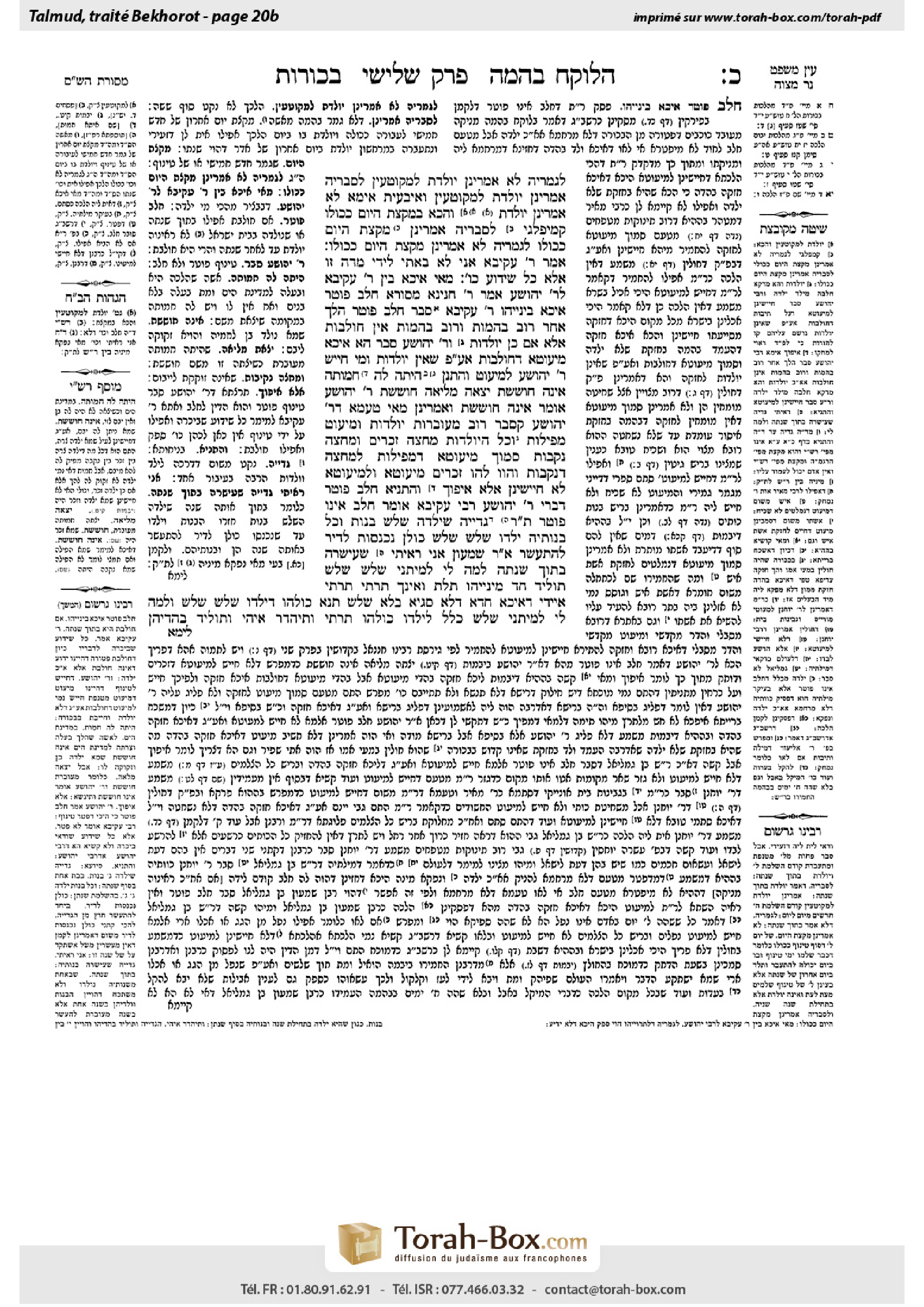
Bekhorot 20b: Talmud study for Daf Yomi
Study the Talmud for Daf Yomi with scanned pages, Hebrew text, English translations from Sefaria and AI-generated French translations.
Passage selection and English or AI-generated French translation are available where the scan has annotations. Daf Study is independent of Torah-Box and Sefaria.
Browse Bekhorot · בכורות · All tractatesBekhorot 20b text and translations
This page of Bekhorot includes the Aramaic text, an English translation and an AI-generated French translation, alongside the scan above.
בכורות כ׳ ב · Aramaic and Hebrew text
לִגְמָרֵיהּ — לָא אָמְרִינַן יוֹלֶדֶת לִמְקוּטָּעִין, לִסְבָרֵיהּ — אָמְרִינַן יוֹלֶדֶת לִמְקוּטָּעִין.
וְאִיבָּעֵית אֵימָא: לָא אָמְרִינַן יוֹלֶדֶת, וְהָכָא בְּמִקְצָת הַיּוֹם כְּכוּלּוֹ קָמִיפַּלְגִי. לִסְבָרֵיהּ — אָמְרִינַן מִקְצָת הַיּוֹם כְּכוּלּוֹ, לִגְמָרֵיהּ — לָא אָמְרִינַן מִקְצָת הַיּוֹם כְּכוּלּוֹ.
אָמַר רַבִּי עֲקִיבָא: אֲנִי לֹא בָּאתִי לִידֵי מִדָּה זוֹ, אֶלָּא כֹּל שֶׁיָּדוּעַ כּוּ׳. מַאי אִיכָּא בֵּין רַבִּי עֲקִיבָא לְרַבִּי יְהוֹשֻׁעַ?
אָמַר רַבִּי חֲנִינָא מִסּוּרָא: חָלָב פּוֹטֵר אִיכָּא בֵּינַיְיהוּ, רַבִּי עֲקִיבָא סָבַר: חָלָב פּוֹטֵר, הַלֵּךְ אַחַר רוֹב בְּהֵמוֹת, וְרוֹב בְּהֵמוֹת אֵין חוֹלְבוֹת אֶלָּא אִם כֵּן יוֹלְדוֹת, וְרַבִּי יְהוֹשֻׁעַ סָבַר: הָא אִיכָּא מִיעוּטָא דְּחוֹלְבוֹת אַף עַל פִּי שֶׁאֵין יוֹלְדוֹת.
וּמִי חָיֵישׁ רַבִּי יְהוֹשֻׁעַ לְמִיעוּט? וְהָתְנַן: הָיְתָה לָהּ חֲמוֹת — אֵינָהּ חוֹשֶׁשֶׁת, יָצְאָה מְלֵיאָה — חוֹשֶׁשֶׁת. רַבִּי יְהוֹשֻׁעַ אוֹמֵר: אֵינָהּ חוֹשֶׁשֶׁת.
וְאָמְרִינַן: מַאי טַעְמָא דְּרַבִּי יְהוֹשֻׁעַ? קָסָבַר: רוֹב מְעוּבָּרוֹת יוֹלְדוֹת, וּמִיעוּט מַפִּילוֹת, וְכׇל הַיּוֹלְדוֹת — מֶחֱצָה זְכָרִים וּמֶחֱצָה נְקֵבוֹת. סְמוֹךְ מִיעוּטָא דְּמַפִּילוֹת לְמֶחֱצָה דִּנְקֵבוֹת, וְהָווּ לְהוּ זְכָרִים מִיעוּטָא, וּלְמִיעוּטָא לָא חָיְישִׁינַן!
אֶלָּא אֵיפוֹךְ, וְהָתַנְיָא: חָלָב פּוֹטֵר, דִּבְרֵי רַבִּי יְהוֹשֻׁעַ. רַבִּי עֲקִיבָא אוֹמֵר: חָלָב אֵינוֹ פּוֹטֵר.
תָּנוּ רַבָּנַן: גְּדִיָּיה שֶׁיָּלְדָה שָׁלֹשׁ בָּנוֹת, וְכׇל בְּנוֹתֶיהָ יָלְדוּ שָׁלֹשׁ שָׁלֹשׁ — כּוּלָּן נִכְנָסוֹת לַדִּיר לְהִתְעַשֵּׂר. אָמַר רַבִּי שִׁמְעוֹן: אֲנִי רָאִיתִי שֶׁעִישְּׂרָה בְּתוֹךְ שְׁנָתָהּ. לְמָה לִי לְמִיתְנֵי שָׁלֹשׁ שָׁלֹשׁ? תּוֹלֵיד חַד מִינַּיְיהוּ תְּלָת, וְאִינָךְ תַּרְתֵּי תַּרְתֵּי!
אַיְּידֵי דְּאִיכָּא חֲדָא דְּלָא סַגִּיא בְּלָא שָׁלֹשׁ, תְּנָא כּוּלְּהוּ דְּיָלְדוּ שָׁלֹשׁ שָׁלֹשׁ. וּלְמָה לִי לְמִיתְנֵי שָׁלֹשׁ כְּלָל? לֵילְדוּ כּוּלְּהוּ תַּרְתֵּי, וְתִיהְדַּר אִיהִי וְתוֹלֵיד בַּהֲדַיְהִי!
Bekhorot 20b · English translation
According to Rabbi Yehoshua’s tradition of the opinion of the Rabbis, we do not say that an animal gives birth after incomplete months, and therefore if it gave birth within its first year it must have become pregnant within thirty days of the discharge, which means the discharge was not indicative of a fetus and does not exempt the next offspring from being counted a firstborn. According to Rabbi Yehoshua’s own reasoning, we say an animal gives birth after incomplete months, and consequently it is possible the animal became pregnant later than thirty days after the discharge and its term of pregnancy was shorter than normal. If so, the discharge does exempt the next offspring from firstborn status.
And if you wish, say that everyone accepts Ze’eiri’s statement and we do not say that an animal gives birth prematurely, and here, they disagree with regard to whether or not the halakhic status of part of the day is like an entire day: According to Rabbi Yehoshua’s reasoning we say part of the day is like an entire day, and therefore it is possible for the goat to have become pregnant on the thirtieth day after experiencing the discharge and to give birth precisely five months later, just before the year ends. According to his tradition of the opinion of the Rabbis, we do not say part of the day is like an entire day, which means that the earliest possible birth is on the first day of the second year.
The baraita taught that Rabbi Akiva says: I have not arrived at this method of determining firstborn status. Rather, in any case where it is known the animal had previously given birth, the priest has nothing here. And in any case where it is known the animal had not previously given birth, its firstborn is given to the priest. And if it is uncertain, it may be eaten in its blemished state by the owner. The Gemara asks: What difference is there in practice between the opinions of Rabbi Akiva and Rabbi Yehoshua?
Rabbi Ḥanina of Sura says: There is a difference between them in a case where the animal came into the Jew’s possession after it had already started to produce milk. They differ as to whether or not the production of milk is sufficient to exempt an animal from having its next offspring counted a firstborn. Rabbi Akiva holds: Milk exempts it, as we follow the majority of animals, and the majority of animals do not produce milk unless they have given birth. And Rabbi Yehoshua holds: Since there is a minority of animals that do produce milk even though they have not given birth, the animal that is born later is an uncertain firstborn.
The Gemara asks: And is Rabbi Yehoshua concerned for a minority? Didn’t we learn in a mishna (Yevamot 119a): If a woman’s husband passed away before she had given birth to any children and the husband had no known brothers who could perform levirate marriage, even though she has a mother-in-law who traveled overseas and may have conceivably given birth to a male who could later perform levirate marriage, she does not need to be concerned for that possibility and may marry another man without finding out if a male child had been born. But if the mother-in-law left while she was full, i.e., pregnant, the daughter-in-law must be concerned that a male might have been born. Rabbi Yehoshua says: She does not need to be concerned.
And we say: What is the reasoning of Rabbi Yehoshua? He holds the majority of pregnant women give birth to a child and a minority miscarry. And of all those who give birth, half bear males and half bear females. Combine the minority of those who miscarry with the half that give birth to females, and conclude that the males are in fact a minority, and we are not concerned for a minority. Evidently, Rabbi Yehoshua holds there is no need to be concerned for a minority.
Rather, reverse the two opinions in the mishna. And in fact it is taught in that manner in a baraita: The production of milk exempts an animal from having its offspring counted a firstborn; this is the statement of Rabbi Yehoshua. Rabbi Akiva says: The production of milk does not exempt an animal from having its offspring counted a firstborn.
§ The Sages taught in a baraita: In the case of a kid that gave birth to female triplets and all her offspring each gave birth to female triplets, all of them, i.e., the offspring and their offspring, enter the pen to be tithed. The animal tithe applies only if one owns at least ten or more animals born in the same year that are not male firstborns. Rabbi Shimon says: I saw a single kid that yielded enough offspring to be subject to the tithe within its first year of life. The Gemara asks: Why do I need the baraita to teach that each offspring gave birth to three other offspring? Let one of them give birth to three, and let the other two give birth to two each, so that there are a total of ten goats born within a single year, which are therefore subject to the tithe.
The Gemara answers: Since there is one goat in this case that would not produce a sufficient number of offspring without giving birth to three, the baraita taught a case where all three goats gave birth to three offspring each, for the sake of consistency. The Gemara asks: But why do I need to teach that any goat gave birth to three at once at all? Let all the second-generation goats give birth to two offspring, and let her, the mother of the three second-generation goats, give birth again to another goat together with them. The fact that the baraita did not teach this case indicates that a goat cannot give birth again within the same year.
Bekhorot 20b · Traduction française (IA)
Selon la tradition de Rabbi Yéhoshua concernant l'opinion des Sages, nous ne disons pas qu'un animal donne naissance après des mois incomplets, et par conséquent, si elle a donné naissance dans sa première année, cela signifie qu'elle a été enceinte trente jours après la décharge, ce qui implique que la décharge ne démontrait pas la présence d'un fœtus et ne dispense pas l'animal suivant de la qualité de premier-né. Selon la raisonnement propre à Rabbi Yéhoshua, nous disons qu'un animal donne naissance après des mois incomplets, et par conséquent, il est possible qu'il ait été enceinte plus tard que trente jours après la décharge et que sa durée de grossesse ait été plus courte que la normale. Si c'est le cas, la décharge dispense l'animal suivant de la qualité de premier-né.
Et si vous le souhaitez, dites que tout le monde accepte l'affirmation de Zé'iri et nous ne disons pas qu'un animal donne naissance prématurément, et ici, ils s'opposent quant à la question de savoir si la situation halachique d'une partie de la journée est équivalente à une journée entière : Selon la raisonnement de Rabbi Yéhoshua, nous disons qu'une partie de la journée est équivalente à une journée entière, et par conséquent, il est possible que l'agneau ait été enceinte le trentième jour après la décharge et ait donné naissance exactement cinq mois plus tard, juste avant la fin de l'année. Selon sa tradition de l'opinion des Sages, nous ne disons pas qu'une partie de la journée est équivalente à une journée entière, ce qui signifie que la date la plus tôt possible de naissance est le premier jour de l'année suivante.
La baraïta enseigne que Rabbi Akiva dit : Je n'ai pas encore atteint cette méthode de détermination de la qualité de premier-né. En effet, dans tout cas où il est connu que l'animal avait déjà donné naissance, le prêtre n'a rien ici. Et dans tout cas où il est connu que l'animal n'avait pas encore donné naissance, son premier-né est donné au prêtre. Et si c'est incertain, il peut être mangé dans son état déficient par l'propriétaire. La Guemara demande : Quelle différence y a-t-il en pratique entre les opinions de Rabbi Akiva et de Rabbi Yéhoshua ?
Rabbi Ḥanina de Sura dit : Il y a une différence entre eux dans le cas où l'animal est entré en possession du Juif après avoir déjà commencé à produire du lait. Ils diffèrent quant à savoir si la production de lait est suffisante pour exempter l'animal de devoir compter son prochain enfant comme premier-né. Rabbi Akiva considère que la production de lait exempt l'animal, car nous suivons la majorité des animaux, et la majorité des animaux ne produisent du lait qu'après avoir donné naissance. Rabbi Yéhoshua considère que, puisque certains animaux minoritaires produisent du lait même sans avoir donné naissance, l'animal né plus tard est un premier-né incertain.
La Guemara demande : Et Rabbi Yéhoshua s'occupe-t-il d'une minorité ? N'avons-nous pas appris dans une mitsva (Yévamot 119a) : Si le mari d'une femme est décédé avant qu'elle n'ait donné naissance à aucun enfant et que le mari n'avait pas de frère connu pouvant accomplir le mariage levirat, même si elle a une belle-mère qui est partie en voyage et pourrait avoir pu donner naissance à un mâle pouvant plus tard accomplir le mariage levirat, elle n'a pas besoin de s'inquiéter de cette possibilité et peut épouser un autre homme sans vérifier si un enfant mâle avait été né. Mais si la belle-mère est partie alors qu'elle était enceinte, la belle-fille doit s'inquiéter qu'un mâle ait pu être né. Rabbi Yéhoshua dit : Elle n'a pas besoin de s'inquiéter.
Et nous disons : Quel est le raisonnement de Rabbi Yéhoshua ? Il considère que la majorité des femmes enceintes donnent naissance à un enfant et que la minorité aborte. Et parmi ceux qui donnent naissance, la moitié portent des garçons et l'autre moitié des filles. Combinons la minorité d'aborts avec la moitié qui donnent naissance à des filles, et concluons que les garçons sont effectivement une minorité, et nous ne nous inquiétons pas d'une minorité. Évidemment, Rabbi Yéhoshua considère qu'il n'est pas nécessaire de s'inquiéter d'une minorité.
Plutôt, inversez les deux opinions dans la mitsna. En effet, il est enseigné ainsi dans une baraïta : La production de lait dispense l'animal de considérer son petit comme premier-né ; c'est l'affirmation de Rabbi Yéhoshua. Rabbi Akiva dit : La production de lait ne dispense pas l'animal de considérer son petit comme premier-né.
§ Les Sages ont enseigné dans une baraïta : Dans le cas d'un petit agneau qui a donné naissance à trois jumelles femelles et que toutes ses descendances ont chacune donné naissance à trois jumelles femelles, toutes, c'est-à-dire les descendances et leurs descendances, entrent dans la cour pour être tithées. La tithe de l'animal s'applique uniquement si l'on possède au moins dix ou plus d'animaux nés dans la même année qui ne sont pas des premiers-nés mâles. Rabbi Shimon dit : J'ai vu un seul petit agneau qui a produit suffisamment de descendants pour être soumis à la tithe au sein de sa première année de vie. La Guemara demande : Pourquoi ai-je besoin de la baraïta pour enseigner que chaque descendant a donné naissance à trois autres descendants ? Faisons simplement qu'un d'entre eux donne naissance à trois, et que les deux autres donnent naissance à deux chacun, de sorte qu'il y ait au total dix brebis nées dans la même année, donc soumises à la tithe.
La Guemara répond : Puisque dans ce cas il y a un seul agneau qui ne produirait pas un nombre suffisant de descendants sans donner naissance à trois, la baraïta a enseigné un cas où tous les trois agneaux ont donné naissance à trois descendants chacun, pour la cohérence. La Guemara demande : Mais pourquoi ai-je besoin d'apprendre que tout agneau a donné naissance à trois à la fois ? Faisons simplement que tous les agneaux de la deuxième génération donnent naissance à deux descendants, et que celle, la mère des trois agneaux de la deuxième génération, donne naissance à un autre agneau avec eux. Le fait que la baraïta n'ait pas enseigné ce cas indique que l'agneau ne peut pas donner naissance à nouveau dans la même année.
Traduction française générée par IA à partir de l’édition anglaise de Sefaria. Vérifie toujours un passage avec le texte source.
Text from Sefaria: William Davidson Edition - Vocalized Aramaic (CC BY NC); William Davidson Edition - English (CC BY NC).