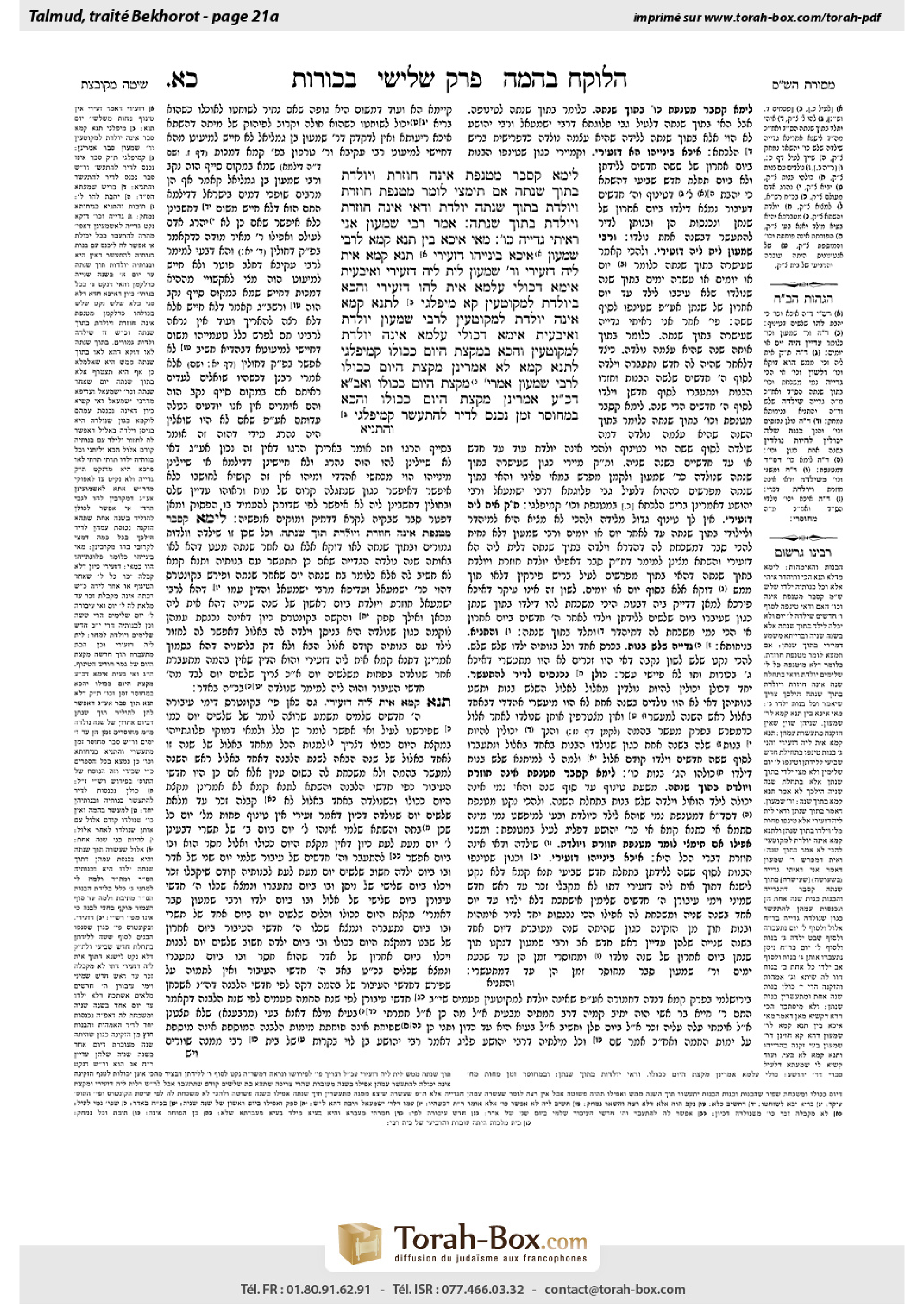
Bekhorot 21a: Talmud study for Daf Yomi
Study the Talmud for Daf Yomi with scanned pages, Hebrew text, English translations from Sefaria and AI-generated French translations.
Passage selection and English or AI-generated French translation are available where the scan has annotations. Daf Study is independent of Torah-Box and Sefaria.
Browse Bekhorot · בכורות · All tractatesBekhorot 21a text and translations
This page of Bekhorot includes the Aramaic text, an English translation and an AI-generated French translation, alongside the scan above.
בכורות כ״א א · Aramaic and Hebrew text
לֵימָא קָסָבַר: מְטַנֶּפֶת אֵינָהּ חוֹזֶרֶת וְיוֹלֶדֶת בְּתוֹךְ שְׁנָתָהּ. אִם תִּימְצֵי לוֹמַר: מְטַנֶּפֶת חוֹזֶרֶת וְיוֹלֶדֶת בְּתוֹךְ שְׁנָתָהּ — יוֹלֶדֶת וַדַּאי אֵינָהּ חוֹזֶרֶת וְיוֹלֶדֶת בְּתוֹךְ שְׁנָתָהּ.
אָמַר רַבִּי שִׁמְעוֹן: אֲנִי רָאִיתִי גְּדִיָּיה כּוּ׳. מַאי אִיכָּא בֵּין תַּנָּא קַמָּא לְרַבִּי שִׁמְעוֹן? אִיכָּא בֵּינַיְיהוּ דִּזְעֵירִי.
תַּנָּא קַמָּא אִית לֵיהּ דִּזְעֵירִי, וְרַבִּי שִׁמְעוֹן לֵית לֵיהּ דִּזְעֵירִי. וְאִיבָּעֵית אֵימָא: דְּכוּלֵּי עָלְמָא אִית לְהוּ דִּזְעֵירִי, וְהָכָא בְּיוֹלֶדֶת לִמְקוּטָּעִין קָא מִיפַּלְגִי. לְתַנָּא קַמָּא אֵינָהּ יוֹלֶדֶת לִמְקוּטָּעִין, לְרַבִּי שִׁמְעוֹן יוֹלֶדֶת.
וְאִיבָּעֵית אֵימָא, דְּכוּלֵּי עָלְמָא אֵינָהּ יוֹלֶדֶת לִמְקוּטָּעִין, וְהָכָא בְּמִקְצָת הַיּוֹם כְּכוּלּוֹ קָמִיפַּלְגִי: לְתַנָּא קַמָּא — לָא אָמְרִינַן מִקְצָת הַיּוֹם כְּכוּלּוֹ, לְרַבִּי שִׁמְעוֹן — אָמְרִינַן מִקְצָת הַיּוֹם כְּכוּלּוֹ.
וְאִיבָּעֵית אֵימָא: דְּכוּלֵּי עָלְמָא אָמְרִינַן מִקְצָת הַיּוֹם כְּכוּלּוֹ, וְהָכָא בִּמְחוּסַּר זְמַן נִכְנָס לַדִּיר לְהִתְעַשֵּׂר קָמִיפַּלְגִי,
Bekhorot 21a · English translation
Shall we say the tanna of this baraita holds that an animal that expels a murky discharge does not return to its fertile state and give birth within its first year? The Gemara rejects this suggestion: It is possible the tanna does not hold that opinion. Even if you say an animal that expels a murky discharge returns to its fertile state and gives birth within its first year, an animal that actually gave birth to a live offspring certainly does not return to its fertile state and give birth within its first year.
§ The baraita teaches that Rabbi Shimon says: I saw a single kid that yielded enough offspring to be subject to the tithe within its first year of life. By contrast, the first tanna in the baraita does not add the phrase: Within its first year of life. The Gemara asks: What difference is there between the opinion of the first tanna and that of Rabbi Shimon? The Gemara answers that there is a difference between them in a case where the second-generation goats expel a murky discharge on the first day of their seventh month, which is the seventh month of their year for animal tithe. And they disagree with regard to the statement of Ze’eiri, cited earlier, that the expulsion of a discharge which exempts an animal from having its future offspring counted a firstborn is one which prevents it from being impregnated for no less than thirty days.
The first tanna accepts the statement of Ze’eiri, and therefore he holds that in such a case the goats cannot become pregnant before the first day of the eighth month, which means they cannot give birth before the first day of the second year. And Rabbi Shimon does not accept the statement of Ze’eiri; he holds that the goats can become pregnant during the seventh month and give birth during the last month of their first year of life. And if you wish, say that everyone accepts the statement of Ze’eiri, and here they disagree with regard to whether or not an animal gives birth after incomplete months, i.e., prematurely. According to the first tanna, an animal does not give birth after incomplete months; according to Rabbi Shimon, an animal gives birth after incomplete months.
And if you wish, say that everyone accepts Ze’eiri’s statement and everyone agrees that an animal does not give birth after incomplete months, and here they disagree with regard to whether or not the halakhic status of part of the day is like an entire day. According to the first tanna, we do not say part of the day is like an entire day, which means the earliest possible birth is on the first day of the second year. According to Rabbi Shimon, we do say part of the day is like an entire day, and therefore it is possible for the goat to give birth on the last day of the first year.
And if you wish, say that everyone agrees that part of the day is like an entire day, and here they disagree with regard to whether or not an animal whose time has not yet arrived, i.e., one that is not yet seven days old, which may not be sacrificed on the altar, enters the pen to be tithed. According to the first tanna it does not enter the pen to be tithed; according to Rabbi Shimon, it does enter the pen to be tithed.
Bekhorot 21a · Traduction française (IA)
Devons-nous dire que le tanna de cette baraïta affirme qu'un animal qui expulse un dégagement trouble ne retrouve pas son état fécond et ne donne pas naissance durant son premier an ? La Guemara rejette cette suggestion : il est possible que le tanna ne partage pas cet avis. Même si vous dites qu'un animal qui expulse un dégagement trouble retrouve son état fécond et donne naissance durant son premier an, un animal qui a déjà donné naissance à un petit vivant ne retrouve certainement pas son état fécond et ne donne pas naissance durant son premier an.
§ La baraïta enseigne que Rabbi Shimon dit : J'ai vu un petit bouc qui produisait suffisamment de petits pour être soumis à l'offrande de dixième durant son premier an de vie. En revanche, le premier tanna de la baraïta ne mentionne pas la phrase : Durant son premier an de vie. La Guemara demande : Quelle différence y a-t-il entre l'avis du premier tanna et celui de Rabbi Shimon ? La Guemara répond que cette différence réside dans le cas où les petits boucs de deuxième génération expulsent un dégagement trouble le premier jour de leur septième mois, qui est le septième mois de leur année pour l'offrande de dixième. Et ils divergent concernant la déclaration de Ze’eiri, cité précédemment, selon laquelle l'expulsion d'un dégagement qui exempt un animal de ce que ses petits futurs soient comptés comme premiers-nés est celui qui l'empêche d'être impregné pendant au moins trente jours.
Le premier tanna accepte la déclaration de Ze’eiri, et donc il considère que dans ce cas les boucs ne peuvent pas devenir enceints avant le premier jour du huitième mois, ce qui signifie qu'ils ne peuvent pas donner naissance avant le premier jour de leur deuxième année. Et Rabbi Shimon ne suit pas la déclaration de Ze’eiri ; il considère que les boucs peuvent devenir enceints durant le septième mois et donner naissance durant le dernier mois de leur première année de vie. Et si vous le souhaitez, dites que tout le monde accepte la déclaration de Ze’eiri, et ici ils divergent concernant le fait que l'animal donne naissance après des mois incomplets, c'est-à-dire prématurément. Selon le premier tanna, l'animal ne donne pas naissance après des mois incomplets ; selon Rabbi Shimon, l'animal donne naissance après des mois incomplets.
Et si vous le souhaitez, dites que tout le monde accepte la déclaration de Ze’eiri et tout le monde convient que l'animal ne donne pas naissance après des mois incomplets, et ici ils divergent concernant le fait que la part d'une journée soit considérée comme une journée entière. Selon le premier tanna, nous ne disons pas que la part d'une journée est comme une journée entière, ce qui signifie que la date la plus tôt possible de naissance est le premier jour de la deuxième année. Selon Rabbi Shimon, nous disons que la part d'une journée est comme une journée entière, et donc il est possible que le bouc donne naissance le dernier jour de sa première année.
Et si vous le souhaitez, dites que tout le monde convient que la part d'une journée est comme une journée entière, et ici ils divergent concernant le fait que l'animal dont le temps n'est pas encore arrivé, c'est-à-dire celui qui n'a pas encore sept jours, qui ne peut pas être sacrifié sur l'autel, entre dans la cour pour être tenu en compte. Selon le premier tanna, il ne rentre pas dans la cour pour être tenu en compte ; selon Rabbi Shimon, il entre dans la cour pour être tenu en compte.
Traduction française générée par IA à partir de l’édition anglaise de Sefaria. Vérifie toujours un passage avec le texte source.
Text from Sefaria: William Davidson Edition - Vocalized Aramaic (CC BY NC); William Davidson Edition - English (CC BY NC).