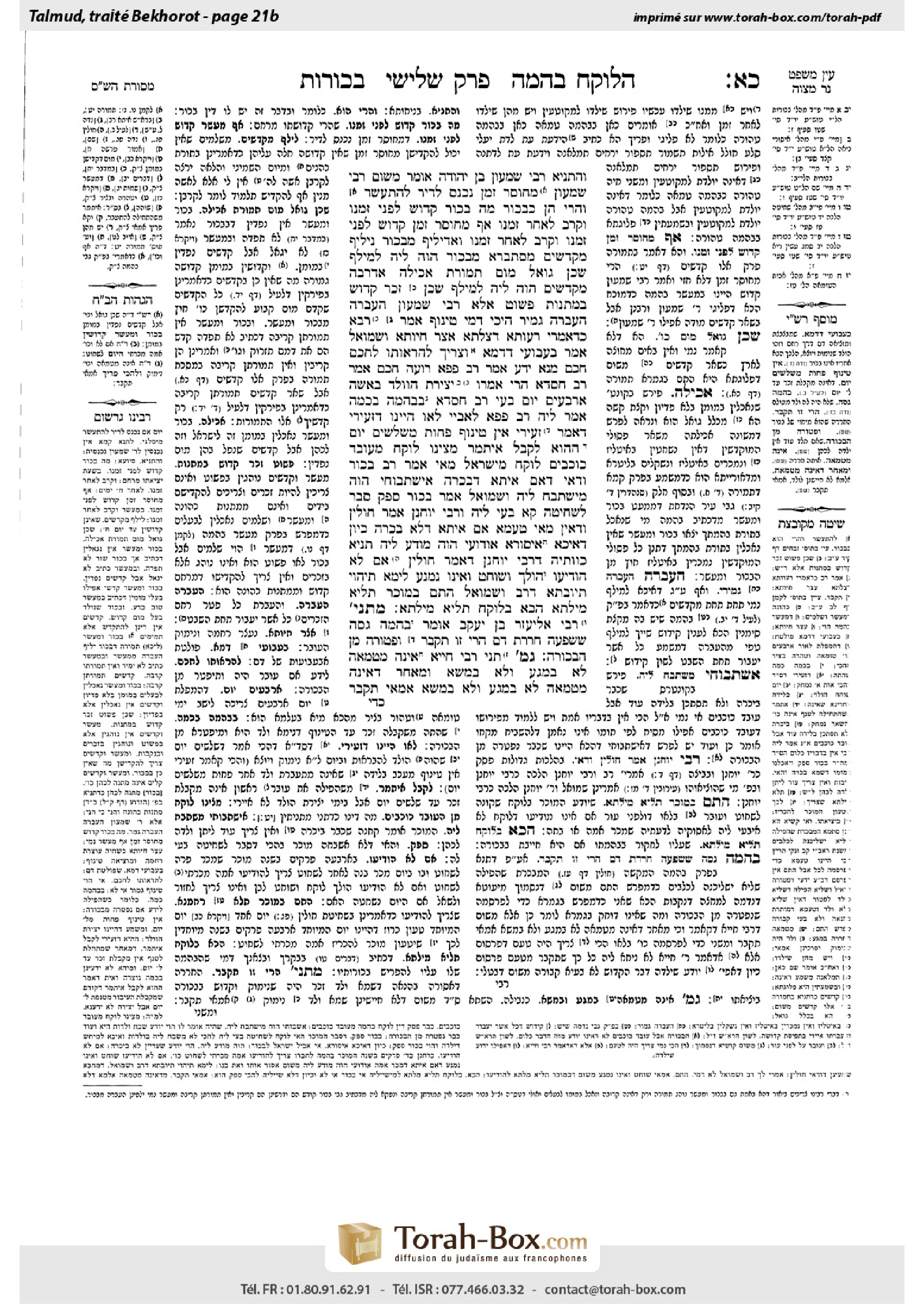
Bekhorot 21b: Talmud study for Daf Yomi
Study the Talmud for Daf Yomi with scanned pages, Hebrew text, English translations from Sefaria and AI-generated French translations.
Passage selection and English or AI-generated French translation are available where the scan has annotations. Daf Study is independent of Torah-Box and Sefaria.
Browse Bekhorot · בכורות · All tractatesBekhorot 21b text and translations
This page of Bekhorot includes the Aramaic text, an English translation and an AI-generated French translation, alongside the scan above.
בכורות כ״א ב · Aramaic and Hebrew text
וְהָתַנְיָא: רַבִּי שִׁמְעוֹן בֶּן יְהוּדָה אוֹמֵר מִשּׁוּם רַבִּי שִׁמְעוֹן: מְחוּסַּר זְמַן נִכְנָס לַדִּיר לְהִתְעַשֵּׂר, וַהֲרֵי הֵן כִּבְכוֹר — מָה בְּכוֹר קָדוֹשׁ לִפְנֵי זְמַנּוֹ וְקָרֵב לְאַחַר זְמַנּוֹ, אַף מְחוּסַּר זְמַן קָדוֹשׁ לִפְנֵי זְמַנּוֹ וְקָרֵב לְאַחַר זְמַנּוֹ.
וְאַדְּיָלֵיף מִבְּכוֹר, נֵילַיף מִקֳּדָשִׁים? מִסְתַּבְּרָא מִבְּכוֹר הֲוָה לֵיהּ לְמֵילַף, שֶׁכֵּן: גּוֹאֵל, מוּם, תְּמוּרַת, אֲכִילָה.
אַדְּרַבָּה, מִקֳּדָשִׁים הֲוָה לֵיהּ לְמֵילַף, שֶׁכֵּן זָכָר, קָדוֹשׁ, בְּמַתָּנוֹת, פָּשׁוּט. אֶלָּא רַבִּי שִׁמְעוֹן ״הַעֲבָרָה״ ״הַעֲבָרָה״ גְּמִיר.
הֵיכִי דָּמֵי טִינּוּף? אָמַר רָבָא, כִּדְאָמְרִי רָעֲוָתָא: דְּצָלְתָּא אֲצַר חֵיוְתָא. וּשְׁמוּאֵל אָמַר: בַּעְבּוּעֵי דִּדְמָא. וְצָרִיךְ לְהַרְאוֹתוֹ לְחָכָם. חָכָם מְנָא יָדַע? אָמַר רַב פָּפָּא: רוֹעֶה חָכָם.
אָמַר רַב חִסְדָּא: הֲרֵי אָמְרוּ יְצִירַת הַוָּולָד בָּאִשָּׁה אַרְבָּעִים יוֹם. בָּעֵי רַב חִסְדָּא: בִּבְהֵמָה בְּכַמָּה? אֲמַר לֵיהּ רַב פָּפָּא לְאַבָּיֵי: לָאו הַיְינוּ דִּזְעֵירִי, דְּאָמַר זְעֵירִי: אֵין טִינּוּף פָּחוֹת מִשְּׁלֹשִׁים יוֹם? הַהוּא לְקַבֵּל אִיתְּמַר.
מָצִינוּ לוֹקֵחַ מִגּוֹי, לוֹקֵחַ מִיִּשְׂרָאֵל מַאי? אָמַר רַב: בְּכוֹר וַדַּאי, דְּאִם אִיתָא דְּבִכְּרָה — אִישְׁתַּבּוֹחֵי הֲוָה מִישְׁתַּבַּח לֵיהּ.
וּשְׁמוּאֵל אָמַר: בְּכוֹר סָפֵק, סָבַר לִשְׁחִיטָה קָא בָעֵי לֵיהּ. וְרַבִּי יוֹחָנָן אָמַר: חוּלִּין וַדָּאִין, מַאי טַעְמָא? אִם אִיתָא דְּלֹא בִּכְּרָה, כֵּיוָן דְּאִיכָּא אִיסּוּרָא, אוֹדוֹעֵי הֲוָה מוֹדַע לֵיהּ.
תַּנְיָא כְּוָותֵיהּ דְּרַבִּי יוֹחָנָן, דְּאָמַר חוּלִּין: אִם לֹא הוֹדִיעוֹ — הוֹלֵךְ וְשׁוֹחֵט וְאֵינוֹ נִמְנָע. לֵימָא תֶּיהְוֵי תְּיוּבְתָּא דְּרַב וּשְׁמוּאֵל? הָתָם בְּמוֹכֵר תַּלְיָא מִילְּתָא, הָכָא בְּלוֹקֵחַ תַּלְיָא מִילְּתָא.
מַתְנִי׳ רַבִּי אֱלִיעֶזֶר בֶּן יַעֲקֹב אוֹמֵר: בְּהֵמָה גַּסָּה שֶׁשָּׁפְעָה חֲרָרַת דָּם, הֲרֵי זוֹ תִּקָּבֵר, וּפְטוּרָה מִן הַבְּכוֹרָה.
גְּמָ׳ תָּנֵי רַבִּי חִיָּיא: אֵינָהּ מְטַמְּאָה לֹא בְּמַגָּע וְלֹא בְּמַשָּׂא. וּמֵאַחַר דְּאֵינָהּ מְטַמְּאָה לֹא בְּמַגָּע וְלֹא בְּמַשָּׂא, אַמַּאי תִּקָּבֵר?
Bekhorot 21b · English translation
The Gemara adds: And in fact it is taught in a baraita that Rabbi Shimon ben Yehuda says in the name of Rabbi Shimon: An animal whose time has not yet arrived enters the pen to be tithed. And these animals are like a firstborn: Just as a firstborn is consecrated before its time and is sacrificed after its time, so too, an animal whose time has not yet arrived is consecrated before its time and sacrificed after its time.
The Gemara raises a difficulty: But rather than deriving the halakha of tithed animals from the firstborn let one derive it from sacrificial animals, which cannot be consecrated before their time arrives. The Gemara answers that it is reasonable to claim it would be appropriate for one to derive the halakha of tithed animals from the firstborn, as they have the following four aspects in common: First, unlike sacrificial animals, one cannot redeem a firstborn or a tithed animal even if it develops a blemish. Second, a blemish does not prevent them from being imbued with sanctity. Third, an animal that was rendered a substitute for a firstborn or a tithed animal is not sacrificed. Finally, they are consumed without having been redeemed, whereas other sacrificial animals must be redeemed first.
The Gemara responds: On the contrary, it would be appropriate for one to derive the halakha of tithed animals from sacrificial animals, as they have the following in common: First, unlike firstborn animals, both tithed and consecrated animals are not limited to males. Second, both are sanctified by human action rather than intrinsically consecrated. Additionally, they are not included among the gifts to the priest. Finally, both begin life as regular animals rather than as animals with the unique status of being born first. The Gemara accepts this objection: Rather, Rabbi Shimon derives the halakha from a verbal analogy between the term: “You shall pass” (Exodus 13:12), written with regard to the firstborn, and the term: “Whatsoever passes under the rod” (Leviticus 27:32), stated with regard to tithed animals.
§ The mishna teaches that a murky discharge is evidence of an offspring and exempts any future offspring from being counted a firstborn. The Gemara asks: What is considered a murky discharge that exempts future offspring from firstborn status? Rava says: As the shepherds say: A murky [detzalta] discharge from the womb is an indicator of a fetus that the animal suppressed in its womb. And Shmuel says: It is bubbles of blood. The Gemara adds: And one must show the discharge to a Sage [ḥakham] in order to determine its status. The Gemara asks: A Sage? From where would he know how to determine its nature? Rav Pappa says: The reference is to a knowledgeable [ḥakham] shepherd, who is familiar with the different types of discharge an animal can produce.
Rav Ḥisda says: They said the formation of a fetus in a woman takes forty days. Rav Ḥisda therefore asks: In an animal, how many days does it take for the fetus to form? Rav Pappa said to Abaye: Isn’t this question resolved by that which Ze’eiri said, as Ze’eiri said: A murky discharge occurs no less than thirty days after conception? The Gemara explains: No; that was stated with regard to the thirty days after expulsion of a murky discharge, during which a female does not show receptivity to a male and does not become pregnant. The Gemara leaves Rav Ḥisda’s inquiry unresolved.
§ We found that the mishna discusses the halakha of one who purchases an animal from a gentile. The Gemara asks: What is the halakha with regard to one who purchases an animal from a Jew and it is unknown whether the animal had previously given birth? Rav says: Its offspring is a definite firstborn, as if it is so that it had previously given birth to a firstborn, the owner would have boasted to the buyer about the fact that he would not have to give its offspring to a priest.
And Shmuel says: The firstborn status of its offspring is uncertain, as even if it had previously given birth the seller thinks the buyer wants it for slaughter, and therefore he does not bother informing him of its status. And Rabbi Yoḥanan says: Its offspring is certainly a non-sacred animal. What is the reason? If it is so that it had not previously given birth, since there is a prohibition involved, it can be assumed that the seller would have notified the buyer of the animal’s status.
The Gemara notes: It is taught in a baraita in accordance with the opinion of Rabbi Yoḥanan, who says the offspring is non-sacred: With regard to the prohibition against slaughtering a mother and its offspring in the same day, if the seller did not inform the buyer that the mother or offspring of the animal he is purchasing was sold earlier that day, the buyer may go and slaughter the animal and he need not refrain from doing so. Shall we say this baraita is a conclusive refutation of the opinions of Rav and Shmuel? The Gemara rejects this suggestion: There, with regard to slaughtering a mother and its offspring, the matter is dependent upon the seller, as it is his responsibility to notify the buyer. Here, in the case of a firstborn, the matter is dependent upon the buyer, and it is his responsibility to inquire about the animal’s status.
MISHNA: Rabbi Eliezer ben Ya’akov says: In the case of a large animal that expelled a mass of congealed blood, that mass must be buried. The reason is that perhaps there was a male fetus there which was consecrated as a firstborn when it emerged, and the animal is exempt from having any future offspring counted a firstborn.
GEMARA: Rabbi Ḥiyya teaches: That mass of congealed blood does not impart ritual impurity, neither through physical contact nor through carrying it. The Gemara asks: But since does not impart impurity, neither through contact nor through carrying, which indicates that it is not considered a fetus, why must it be buried?
Bekhorot 21b · Traduction française (IA)
La Guemara ajoute : En effet, il est enseigné dans une baraïta que Rabbi Shimon ben Yehuda dit au nom de Rabbi Shimon : Un animal dont le temps n’est pas encore arrivé entre dans la basse-cour pour être tenu à part. Et ces animaux sont comme les premiers-nés : Tout comme le premier-né est consacré avant son temps et est sacrifié après son temps, de même, un animal dont le temps n’est pas encore arrivé est consacré avant son temps et sacrifié après son temps.
La Guemara soulève une difficulté : Mais plutôt que d’extraire la halakha des animaux tenu à part du premier-né, on devrait l’extraire des animaux sacrés, qui ne peuvent pas être consacrés avant leur temps. La Guemara répond qu’il est raisonnable de dire qu’il serait approprié d’extraire la halakha des animaux tenu à part du premier-né, car ils partagent quatre points communs : Premièrement, contrairement aux animaux sacrés, on ne peut pas racheter un premier-né ou un animal tenu à part même s’il développe une tache. Deuxièmement, une tache ne bloque pas leur consécration. Troisièmement, un animal qui a été substitué à un premier-né ou à un animal tenu à part n’est pas sacrifié. Enfin, ils sont consommés sans avoir été rachetés, alors que les autres animaux sacrés doivent être rachetés d’abord.
La Guemara répond : Au contraire, il serait approprié d’extraire la halakha des animaux tenu à part des animaux sacrés, car ils partagent les points suivants : Premièrement, contrairement aux animaux premier-nés, à la fois les animaux tenu à part et les animaux consacrés ne sont pas limités aux mâles. Deuxièmement, ils sont consacrés par l’action humaine plutôt qu’intrinsèquement. En outre, ils ne sont pas inclus parmi les dons au prêtre. Enfin, ils commencent leur vie comme des animaux ordinaires plutôt que comme des animaux ayant le statut unique d’être nés premiers. La Guemara accepte cette objection : Plutôt, Rabbi Shimon extrait la halakha d’une analogie verbale entre le terme : « Vous passerez » (Exode 13:12), mentionné concernant le premier-né, et le terme : « Tout ce qui passe sous le bâton » (Lévitique 27:32), mentionné concernant les animaux tenu à part.
§ La mitsva enseigne que l’émission trouble est une preuve d’un enfant et exempt tout enfant futur d’être compté comme premier-né. La Guemara demande : Qu’est-ce qui est considéré comme une émission trouble qui exempt les enfants futurs du statut de premier-né ? Rava dit : Comme disent les bergers : Une émission trouble [detzalta] provenant du ventre est un indicateur d’un fœtus que l’animal a réprimé dans son ventre. Et Shmuel dit : Ce sont des bulles de sang. La Guemara ajoute : Et l’on doit montrer l’émission à un Sage [ḥakham] afin de déterminer son statut. La Guemara demande : Un Sage ? D’où sait-il déterminer sa nature ? Rav Pappa dit : Il s’agit d’un berger savant, familier avec les différents types d’émissions qu’un animal peut produire.
Rav Ḥisda dit : Ils disent que la formation d’un fœtus chez une femme prend quarante jours. Rav Ḥisda demande donc : Chez un animal, combien de jours faut-il pour que le fœtus se forme ? Rav Pappa dit à Abaye : Ce n’est pas cette question qui est résolue par ce que Ze’eiri a dit, car Ze’eiri a dit : Une émission trouble survient au moins trente jours après la conception. La Guemara explique : Non ; cela a été dit concernant les trente jours après l’émission trouble, durant lesquels une femelle ne montre pas de réceptivité envers un mâle et ne devient pas enceinte. La Guemara laisse la question de Rav Ḥisda sans réponse.
§ Nous avons trouvé que la mitsva discute de la halakha d’un qui achète un animal d’un non-juif. La Guemara demande : Quelle est la halakha concernant celui qui achète un animal d’un juif et dont on ignore si l’animal a déjà donné naissance ? Rav dit : Son descendant est un premier-né certain, comme si c’était pour qu’il ait déjà donné naissance à un premier-né, le propriétaire aurait vanté à l’acheteur le fait qu’il ne devrait pas donner son descendant au prêtre.
Et Shmuel dit : Le statut de premier-né de son descendant est incertain, car même s’il avait déjà donné naissance, le vendeur pense que l’acheteur le veut pour la boucherie, et donc il ne s’embête pas à lui faire savoir son statut. Et Rabbi Yoḥanan dit : Son descendant est certainement un animal non sacré. Quelle est la raison ? Si c’est pour qu’il n’ait pas déjà donné naissance, puisque c’est une interdiction, on peut supposer que le vendeur aurait informé l’acheteur du statut de l’animal.
La Guemara note : Il est enseigné dans une baraïta selon l’opinion de Rabbi Yoḥanan, qui dit que l’animal est non sacré : Concernant l’interdiction de sacrifier une mère et son descendant le même jour, si le vendeur n’a pas informé l’acheteur que la mère ou le descendant de l’animal qu’il achète a été vendu plus tôt dans la journée, l’acheteur peut aller sacrifier l’animal et il n’a pas besoin de s’en abstenir. Devons-nous dire que cette baraïta est une réfutation définitive des opinions de Rav et de Shmuel ? La Guemara rejette cette suggestion : Là, concernant la sacrification d’une mère et de son descendant, la question dépend du vendeur, car c’est sa responsabilité d’informer l’acheteur. Ici, dans le cas d’un premier-né, la question dépend de l’acheteur, et c’est sa responsabilité d’enquêter sur le statut de l’animal.
MICHNA : Rabbi Eliezer ben Ya’akov dit : Dans le cas d’un grand animal qui a expulsé une masse de sang coagulé, cette masse doit être enterrée. La raison est que peut-être il y avait un fœtus mâle là qui a été consacré comme premier-né lorsqu’il est sorti, et l’animal est exempt d’avoir tout enfant futur compté comme premier-né.
GUEMARA : Rabbi Ḥiyya enseigne : Cette masse de sang coagulé ne transmet pas l’impureté rituelle, ni par contact ni par transport. La Guemara demande : Mais puisqu’elle ne transmet pas l’impureté, ni par contact ni par transport, ce qui indique qu’elle n’est pas considérée comme un fœtus, pourquoi doit-elle être enterrée ?
Traduction française générée par IA à partir de l’édition anglaise de Sefaria. Vérifie toujours un passage avec le texte source.
Text from Sefaria: William Davidson Edition - Vocalized Aramaic (CC BY NC); William Davidson Edition - English (CC BY NC).