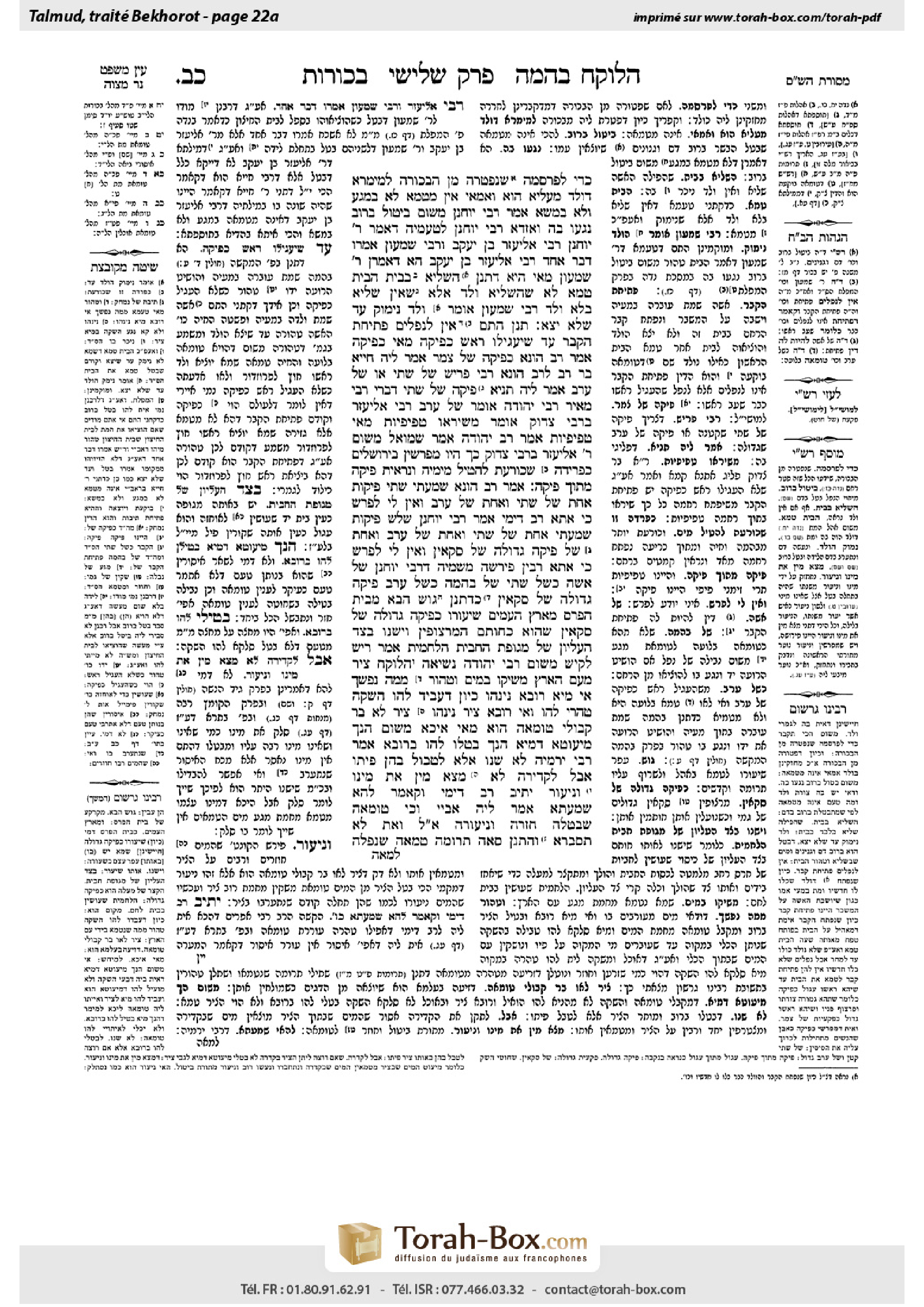
Bekhorot 22a: Talmud study for Daf Yomi
Study the Talmud for Daf Yomi with scanned pages, Hebrew text, English translations from Sefaria and AI-generated French translations.
Passage selection and English or AI-generated French translation are available where the scan has annotations. Daf Study is independent of Torah-Box and Sefaria.
Browse Bekhorot · בכורות · All tractatesBekhorot 22a text and translations
This page of Bekhorot includes the Aramaic text, an English translation and an AI-generated French translation, alongside the scan above.
בכורות כ״ב א · Aramaic and Hebrew text
כְּדֵי לְפַרְסְמָהּ שֶׁנִּפְטְרָה מִן הַבְּכוֹרָה.
לְמֵימְרָא דְּוָלָד מְעַלְּיָא הוּא, וְאַמַּאי אֵין מְטַמֵּא לֹא בְּמַגָּע וְלֹא בְּמַשָּׂא? אָמַר רַבִּי יוֹחָנָן: מִשּׁוּם בִּיטּוּל בְּרוֹב נָגְעוּ בָּהּ.
וְאַזְדָּא רַבִּי יוֹחָנָן לְטַעְמֵיהּ, דְּאָמַר רַבִּי יוֹחָנָן: רַבִּי אֱלִיעֶזֶר בֶּן יַעֲקֹב וְרַבִּי שִׁמְעוֹן אָמְרוּ דָּבָר אֶחָד, רַבִּי אֱלִיעֶזֶר בֶּן יַעֲקֹב — הָא דַּאֲמַרַן.
רַבִּי שִׁמְעוֹן מַאי הִיא? דִּתְנַן: הַשִּׁלְיָא בַּבַּיִת — הַבַּיִת טָמֵא. לֹא שֶׁהַשִּׁלְיָא וָלָד, אֶלָּא שֶׁאֵין שִׁלְיָא בְּלֹא וָלָד. רַבִּי שִׁמְעוֹן אוֹמֵר: וָלָד נִימּוֹק עַד שֶׁלֹּא יָצָא.
תְּנַן הָתָם: אֵין לִנְפָלִים פְּתִיחַת הַקֶּבֶר, עַד שֶׁיַּעֲגִילוּ רֹאשׁ כְּפִיקָּה. מַאי כְּפִיקָּה? אָמַר רַב הוּנָא: כְּפִיקָּה שֶׁל צֶמֶר. אֲמַר לֵיהּ חִיָּיא בַּר רַב לְרַב הוּנָא: רַבִּי, פָּרֵישׁ שֶׁל שְׁתִי אוֹ שֶׁל עֵרֶב?
אֲמַר לֵיהּ: תַּנְיָא: פִּיקָּה שֶׁל שְׁתִי, דִּבְרֵי רַבִּי מֵאִיר. רַבִּי יְהוּדָה אוֹמֵר: שֶׁל עֵרֶב. רַבִּי אֱלִיעֶזֶר בְּרַבִּי צָדוֹק אוֹמֵר: מִשֶּׁיֵּרָאוּ טְפִיפִיּוֹת. מַאי טְפִיפִיּוֹת? אָמַר רַב יְהוּדָה אָמַר שְׁמוּאֵל מִשּׁוּם רַבִּי אֱלִיעֶזֶר בְּרַבִּי צָדוֹק: כָּךְ הָיוּ מְפָרְשִׁין בִּירוּשָׁלַיִם: כִּפְרֵידָה שֶׁכּוֹרַעַת לְהַטִּיל מֵימֶיהָ, וְנִרְאֵית פִּיקָּה מִתּוֹךְ פִּיקָּה.
אָמַר רַב הוּנָא: שָׁמַעְתִּי שְׁתֵּי פִּיקוֹת, אַחַת שֶׁל שְׁתִי וְאַחַת שֶׁל עֵרֶב, וְאֵין לִי לְפָרֵשׁ. כִּי אֲתָא רַב דִּימִי אָמַר רַבִּי יוֹחָנָן: שָׁלֹשׁ פִּיקוֹת שָׁמַעְתִּי, אַחַת שֶׁל שְׁתִי וְאַחַת שֶׁל עֵרֶב וְאַחַת שֶׁל פִּיקָּה גְּדוֹלָה שֶׁל סַקָּאִין, וְאֵין לִי לְפָרֵשׁ. כִּי אֲתָא רָבִין פֵּירְשַׁהּ מִשְּׁמֵיהּ דְּרַבִּי יוֹחָנָן: שֶׁל אִשָּׁה כְּשֶׁל שְׁתִי, שֶׁל בְּהֵמָה כְּשֶׁל עֵרֶב.
פִּיקָּה גְּדוֹלָה שֶׁל סַקָּאִין, כְּדִתְנַן: גּוּשׁ הַבָּא מִבֵּית הַפְּרָס, מֵאֶרֶץ הָעַמִּים — שִׁיעוּרוֹ כְּפִיקָּה גְּדוֹלָה שֶׁל סַקָּאִין, שֶׁהוּא כְּחוֹתַם הַמַּרְצוּפִין, וְיֶשְׁנוֹ בְּצַד הָעֶלְיוֹן שֶׁל מְגוּפַת הֶחָבִית הַלַּחְמִית.
אָמַר רֵישׁ לָקִישׁ מִשּׁוּם רַבִּי יְהוּדָה נְשִׂיאָה: הַלּוֹקֵחַ צִיר מֵעַם הָאָרֶץ — מַשִּׁיקוֹ בְּמַיִם, וְטָהוֹר.
מִמָּה נַפְשָׁךְ, אִי מַיָּא רוּבָּא נִינְהוּ — כֵּיוָן דְּעָבֵיד לְהוּ הַשָּׁקָה טָהֲרִי לְהוּ, וְאִי רוּבָּא צִיר נִינְהוּ — צִיר לָא בַּר קַבּוֹלֵי טוּמְאָה הוּא. מַאי אִיכָּא — מִשּׁוּם הָנָךְ מִיעוּטָא דְּמַיָּא, הָנָךְ בָּטְלוּ לְהוּ בְּרוּבָּא.
אָמַר רַבִּי יִרְמְיָה: לֹא שָׁנוּ אֶלָּא לִטְבּוֹל בָּהֶן פִּיתּוֹ, אֲבָל לִקְדֵירָה — לֹא, מָצָא מִין אֶת מִינוֹ וְנֵיעוֹר. יָתֵיב רַב דִּימִי וְקָאָמַר לְהָא שְׁמַעְתָּא. אֲמַר לֵיהּ אַבָּיֵי: וְכִי טוּמְאָה שֶׁבָּטְלָה חָזְרָה וְנֵיעוֹרָה? אֲמַר לֵיהּ: וְאַתְּ לָא תִּסְבְּרַהּ? וְהָתְנַן: סְאָה תְּרוּמָה טְמֵאָה שֶׁנָּפְלָה
Bekhorot 22a · English translation
The Gemara answers: It must be buried in order to publicize that the animal is exempt from having its future offspring counted a firstborn.
The Gemara notes with regard to the ruling of the mishna that the animal is exempt from having any future offspring counted as firstborn: That is to say that the expelled mass is a full-fledged offspring. But if so, why doesn’t it impart ritual impurity, neither through physical contact nor through carrying? Rabbi Yoḥanan says: It is due to the halakhic nullification of a forbidden substance in a majority of permitted substances that the Sages touched upon it, in order to exclude it from impurity through contact or carrying. In other words, the fetus is in fact considered a full-fledged offspring, but it is does not impart impurity because it is nullified by the rest of the congealed mass.
The Gemara comments: And Rabbi Yoḥanan follows his line of reasoning in this regard, as Rabbi Yoḥanan says: Rabbi Eliezer ben Yaakov and Rabbi Shimon both said the same thing, i.e., they both issued rulings based on the same principle. The relevant statement of Rabbi Eliezer ben Yaakov is that which we said previously, i.e., that the expelled mass does not impart ritual impurity because the fetus is nullified by the majority.
And what is the statement of Rabbi Shimon to which Rabbi Yoḥanan was referring? It is as we learned in a mishna (Nidda 18a): If a woman miscarried and the afterbirth is in the house, the house is impure. The reason is not that the afterbirth itself has the status of an offspring, but that there is no afterbirth without an offspring within it, even if it is undetected. Rabbi Shimon says: The offspring disintegrated before it emerged with the afterbirth. Consequently, the house is not rendered impure, because the disintegrated fetus is nullified by the majority.
§ The Gemara continues discussing the ritual impurity imparted by a fetus. We learned in a mishna elsewhere (Oholot 7:4): If a fetus dies in its mother’s womb, it imparts ritual impurity from when the womb opens. Yet deceased fetuses do not impart ritual impurity in this manner even during the opening of the womb, until the head of the fetus is round like the size of a skein [pika] of yarn. The Gemara asks: What is the meaning of: Like a skein? Rav Huna said: It means like a skein of woolen yarn. Ḥiyya bar Rav said to Rav Huna: My teacher, explain your statement: Were you referring to a skein of warp threads or a skein of the thicker woof threads?
Rav Huna said to him: It is taught in a baraita (Tosefta, Oholot 8:5): Deceased fetuses do not impart ritual impurity until the head of the fetus is the size of a skein of warp threads; this is the statement of Rabbi Meir. Rabbi Yehuda says: The head must be the size of a skein of woof threads. Rabbi Eliezer, son of Rabbi Tzadok, says: The fetus imparts ritual impurity from the time that tefifiyot are seen near the opening of the womb. The Gemara asks: What are tefifiyot? Rav Yehuda says that Shmuel says in the name of Rabbi Eliezer, son of Rabbi Tzadok: This is how they would explain it in Jerusalem: Tefifiyot are like the folds of skin that form when a mule bends down to urinate, and the area near the womb appears as a skein emerging from within a skein.
Rav Huna says: I heard two different halakhot with regard to skeins: One involves a skein of warp threads and the other one involves a skein of woof threads, and I do not have the knowledge to explain to which matter these halakhot refer. When Rav Dimi came to Babylonia from Eretz Yisrael, he said that Rabbi Yoḥanan said: With regard to skeins, I heard three different halakhot: One involves a skein of warp threads, and one a skein of woof threads, and one a large skein used by sack makers, and I do not have the knowledge to explain to which matter these halakhot refer. When Ravin came to Babylonia from Eretz Yisrael, he explained this in the name of Rabbi Yoḥanan: To impart ritual impurity, the head of a fetus in the womb of a woman must be the size of a skein of warp threads, and the head of an animal fetus must be the size of a skein of woof threads.
As for the halakha involving a large skein used by sack makers, it is as we learned in a baraita (Tosefta, Kelim Bava Metzia 7:1): For it to impart ritual impurity, a clod of earth that comes from an area in which uncertainty exists concerning the location of a grave or a corpse [beit haperas], or from the land of the gentile nations, must be of the measure of a large skein used by sack makers, the size of which is like the seal of large sacks [martzofin]. And an item of this size is also found on the top side of the seal of a Bethlehem jug.
§ Reish Lakish says in the name of Rabbi Yehuda Nesia: One who purchases fish brine from one who is unreliable with regard to ritual impurity [am ha’aretz], who must purify it due to the concern that it was rendered impure while in the seller’s possession, brings it into contact with the water of a ritual bath so that the water touches the brine, and it is thereby rendered pure.
Reish Lakish explains: The brine is pure whichever way you look at it: If water is the majority of the brine mixture, once he brought the brine into contact with the ritual bath, the water in the brine mixture became pure and the impurity of the brine is nullified by the majority of pure water. And if the majority is the brine excreted by the fish itself it is also pure, as brine alone is not susceptible to ritual impurity. Consequently, what impurity is there? Any impurity is due only to that minority of water in the mixture, and that water is nullified by the majority of brine.
Rabbi Yirmeya says: The Sages taught that one should use that method of purification only if he wishes to dip his bread in the brine. But for cooking in a pot with other water this method is not effective, as the liquid of the type that was nullified, i.e., the water in the brine, found its own type, the water in the pot, and is revived in its impure state, as the water which was previously only a minority of the mixture is now the majority. Rav Dimi was sitting and saying this halakha. Abaye said to Rav Dimi: But does nullified impurity return and revive in its impure state? Rav Dimi said to him: And you, do you not hold that this is the halakha? But didn’t we learn in a mishna (Teruma 5:2): With regard to a se’aof impure teruma that fell
Bekhorot 22a · Traduction française (IA)
La Guemara répond : Il faut l'enterrer afin de faire savoir que l'animal est exempt de ce que ses descendants futurs soient comptés comme premier-né.
La Guemara note concernant la décision de la Michna que l'animal est exempt de ce que ses descendants futurs soient comptés comme premier-né : Cela signifie que la masse expulsée est un enfant plein de vie. Mais si c'est le cas, pourquoi ne transmet-elle pas la souillure rituelle, ni par contact ni par transport ? Rabbi Yoḥanan dit : C'est en raison de la nullification halachique d'une substance interdite dans la majorité des substances permises que les Sages ont touché à cette masse, afin de l'exclure de la souillure par contact ou transport. En d'autres termes, le fœtus est effectivement considéré comme un enfant plein de vie, mais il ne transmet pas la souillure car il est nullifié par le reste de la masse congelée.
La Guemara commente : Et Rabbi Yoḥanan suit cette ligne de raisonnement, comme Rabbi Yoḥanan dit : Rabbi Eliezer ben Yaakov et Rabbi Shimon ont tous deux dit la même chose, c'est-à-dire qu'ils ont tous deux rendu des décisions fondées sur le même principe. La déclaration pertinente de Rabbi Eliezer ben Yaakov est celle que nous avons dite précédemment, c'est-à-dire que la masse expulsée ne transmet pas la souillure rituelle car le fœtus est nullifié par la majorité.
Et quelle est la déclaration de Rabbi Shimon à laquelle Rabbi Yoḥanan faisait référence ? C'est celle que nous avons apprise dans une mitsna (Nidda 18a) : Si une femme a eu un avortement et que la masse postnatale est dans la maison, la maison est impure. La raison n'est pas que la masse postnatale elle-même ait le statut d'enfant, mais que la masse postnatale ne peut exister sans un enfant à l'intérieur, même s'il n'est pas détecté. Rabbi Shimon dit : L'enfant s'est désintégré avant de sortir avec la masse postnatale. Par conséquent, la maison n'est pas rendue impure, car le fœtus désintégré est nullifié par la majorité.
§ La Guemara continue de discuter de la souillure rituelle transmise par un fœtus. Nous avons appris dans une mitsna ailleurs (Oholot 7:4) : Si un fœtus meurt dans le ventre de sa mère, il transmet la souillure rituelle à partir du moment où le ventre s'ouvre. Cependant, les fœtus morts ne transmettent pas la souillure rituelle de cette manière même pendant l'ouverture du ventre, jusqu'à ce que la tête du fœtus soit de la taille d'un nœud [pika] de laine. La Guemara demande : Quelle est la signification de : comme un nœud ? Rav Huna dit : Cela signifie comme un nœud de laine. Chiyya bar Rav demande à Rav Huna : Mon maître, explique ta déclaration : Tu faisais référence à un nœud de fils de tissage ou à un nœud de fils de tissage plus épais ?
Rav Huna répond à lui : C'est ce qui est enseigné dans une baraïta (Tosefta, Oholot 8:5) : Les fœtus morts ne transmettent pas la souillure rituelle jusqu'à ce que la tête du fœtus soit de la taille d'un nœud de fils de tissage ; c'est la déclaration de Rabbi Meir. Rabbi Yehuda dit : La tête doit être de la taille d'un nœud de fils de tissage plus épais. Rabbi Eliezer, fils de Rabbi Tzadok, dit : Le fœtus transmet la souillure rituelle dès que les tefifiyot sont vus près de l'ouverture du ventre. La Guemara demande : Quels sont les tefifiyot ? Rav Yehuda dit que Shmuel dit en nom de Rabbi Eliezer, fils de Rabbi Tzadok : C'est ainsi qu'ils l'expliquaient à Jérusalem : Les tefifiyot sont comme les plis de peau qui se forment lorsque un mulet se baisse pour uriner, et la zone près du ventre apparaît comme un nœud sortant d'un nœud.
Rav Huna dit : J'ai entendu deux halakhot différentes concernant les boules de fil : une concerne une boule de fils de tissage et l'autre une boule de fils de tissage plus épais, et je n'ai pas la connaissance pour expliquer à quel cas ces halakhot se réfèrent. Lorsque Rav Dimi est venu à Babylone depuis la Terre d'Israël, il a dit que Rabbi Yoḥanan a dit : Concernant les boules de fil, j'ai entendu trois halakhot différentes : une concerne une boule de fils de tissage, une autre une boule de fils de tissage plus épais, et une autre une grande boule utilisée par les fabricants de sacs, et je n'ai pas la connaissance pour expliquer à quel cas ces halakhot se réfèrent. Lorsque Ravin est venu à Babylone depuis la Terre d'Israël, il a expliqué cela en nom de Rabbi Yoḥanan : Pour transmettre la souillure rituelle, la tête d'un fœtus dans le ventre d'une femme doit être de la taille d'une boule de fils de tissage, et la tête d'un fœtus d'animaux doit être de la taille d'une boule de fils de tissage plus épais.
Concernant la halakha concernant un grand nœud utilisé par les fabricants de sacs, c'est celui que nous avons appris dans une baraïta (Tosefta, Kelim Bava Metzia 7:1) : Pour transmettre la souillure rituelle, un morceau de terre provenant d'une zone où il y a une incertitude concernant la localisation d'un tombeau ou d'un cadavre [beit haperas], ou du territoire des nations païennes, doit être de la taille d'un grand nœud utilisé par les fabricants de sacs, dont la taille est comparable à celle du sceau des grands sacs [martzofin]. Et un objet de cette taille est aussi trouvé sur le côté supérieur du sceau d'un tonnelet de Béthléem.
§ Reish Lakish dit en nom de Rabbi Yehuda Nesia : Celui qui achète du sel de poisson auprès d'une personne peu fiable concernant la souillure rituelle [am ha’aretz], qui doit le purifier en raison de la crainte qu'il ait été souillé pendant la possession du vendeur, le fait entrer en contact avec l'eau du mikvé afin que l'eau touche le sel, et il est ainsi rendu pur.
Reish Lakish explique : Le sel est pur, qu'on le considère d'une manière ou d'une autre : Si l'eau est la majorité du mélange de sel, une fois qu'on a fait entrer le sel en contact avec le mikvé, l'eau du mélange de sel est devenue pure et la souillure du sel est nullifiée par la majorité d'eau pure. Et si la majorité est le sel excrété par le poisson lui-même, il est aussi pur, car le sel seul n'est pas susceptible de souillure rituelle. Par conséquent, quelle souillure y a-t-il ? Toute souillure provient uniquement de cette minorité d'eau dans le mélange, et cette eau est nullifiée par la majorité de sel.
Rabbi Yirmeya dit : Les Sages enseignèrent que l'on doit utiliser cette méthode de purification uniquement si l'on souhaite tremper son pain dans la saumure. Mais pour la cuisson dans une marmite avec d'autres eaux, cette méthode n'est pas efficace, car l'eau du type qui a été annulé, c'est-à-dire l'eau de la saumure, a trouvé son propre type, l'eau de la marmite, et est revenue dans son état impur, car l'eau qui était auparavant une minorité du mélange est maintenant la majorité. Rav Dimi était assis et disait cette halakha. Abaye dit à Rav Dimi : Mais l'impureté annulée revient-elle et se réveille-t-elle dans son état impur ? Rav Dimi dit à lui : Et vous, ne tenez-vous pas que c'est la halakha ? Mais n'avons-nous pas appris dans une mitsva (Terouma 5:2) : En ce qui concerne une se'a d'impure terouma qui est tombée
Traduction française générée par IA à partir de l’édition anglaise de Sefaria. Vérifie toujours un passage avec le texte source.
Text from Sefaria: William Davidson Edition - Vocalized Aramaic (CC BY NC); William Davidson Edition - English (CC BY NC).