Bekhorot 23a: Talmud study for Daf Yomi
Study the Talmud for Daf Yomi with scanned pages, Hebrew text, English translations from Sefaria and AI-generated French translations.
Passage selection and English or AI-generated French translation are available where the scan has annotations. Daf Study is independent of Torah-Box and Sefaria.
Browse Bekhorot · בכורות · All tractatesBekhorot 23a text and translations
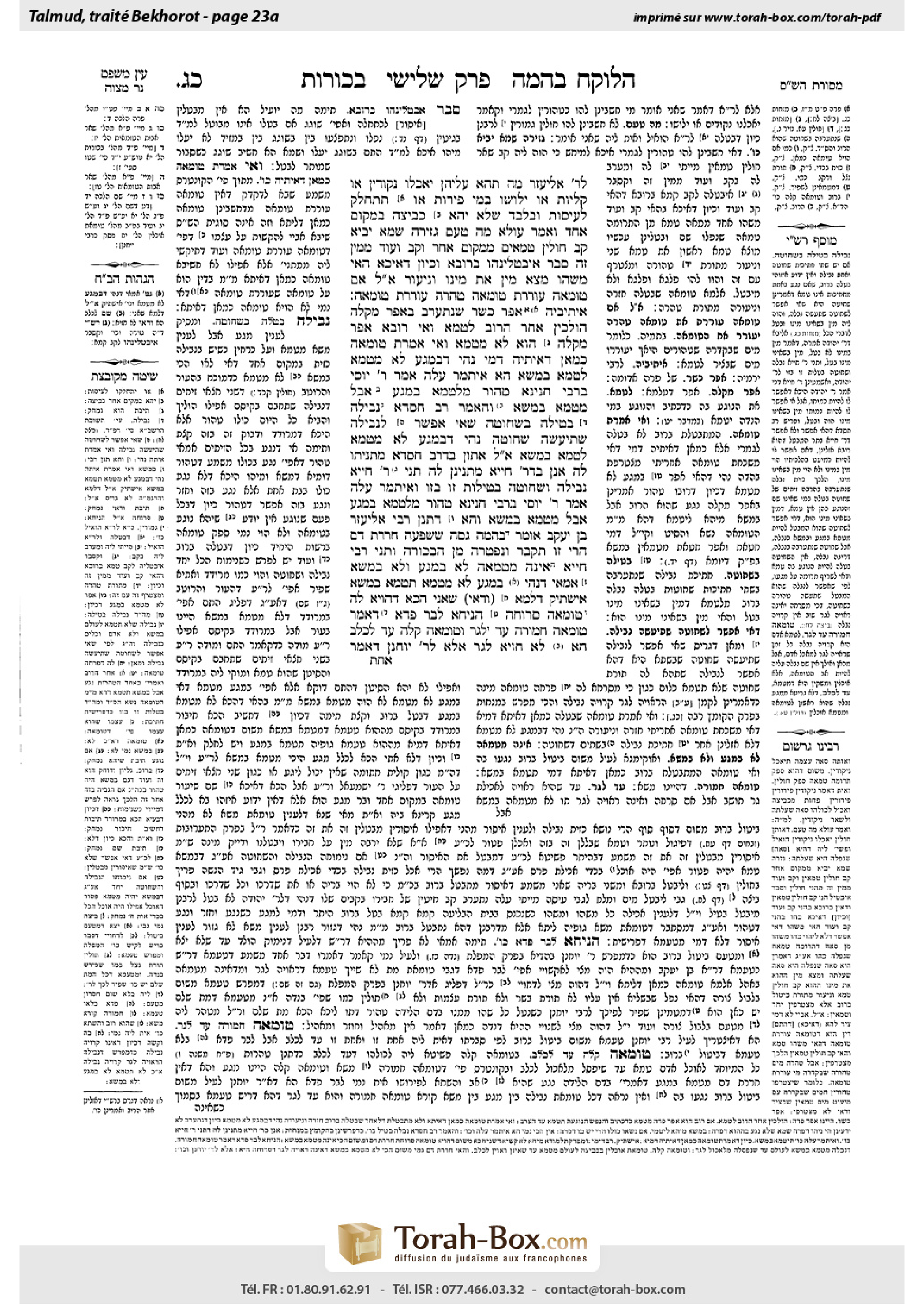
This page of Bekhorot includes the Aramaic text, an English translation and an AI-generated French translation, alongside the scan above.
בכורות כ״ג א · Aramaic and Hebrew text
לְרַבִּי אֱלִיעֶזֶר מָה תְּהֵא עֲלֵיהֶן? יֹאכְלוּ נִקּוּדִין, אוֹ קְלָיוֹת, אוֹ יִלּוֹשׁוּ בְּמֵי פֵירוֹת, אוֹ תִּתְחַלֵּק לְעִיסּוֹת, וּבִלְבַד שֶׁלֹּא יְהֵא כְּבֵיצָה בְּמָקוֹם אֶחָד. וְאָמַר עוּלָּא: מָה טַעַם? גְּזֵירָה שֶׁמָּא יָבִיא קַב חוּלִּין טְמֵאִים מִמָּקוֹם אַחֵר וְקַב וְעוֹד מִמִּין זֶה, סָבַר אֱיבַטְּלִינְהוּ בְּרוּבָּא, וְכֵיוָן דְּאִיכָּא הַאי מַשֶּׁהוּ — מָצָא מִין אֶת מִינוֹ וְנֵיעוֹר.
אֲמַר לֵיהּ: אִם טוּמְאָה עוֹרֶרֶת טוּמְאָה, טׇהֳרָה עוֹרֶרֶת טוּמְאָה?
אֵיתִיבֵיהּ: אֵפֶר כָּשֵׁר שֶׁנִּתְעָרֵב בְּאֵפֶר מִקְלֶה, הוֹלְכִין אַחַר הָרוֹב לְטַמֵּא, וְאִי רוּבָּא אֵפֶר מִקְלֶה הוּא — לָא מְטַמֵּא. וְאִי אָמְרַתְּ: טוּמְאָה כְּמַאן דְּאִיתֵיהּ דָּמֵי, נְהִי דִּבְמַגָּע לָא מְטַמֵּא — לְטַמֵּא בְּמַשָּׂא!
הָא אִיתְּמַר עֲלַהּ, אָמַר רַבִּי יוֹסֵי בְּרַבִּי חֲנִינָא: טָהוֹר מִלְּטַמֵּא בְּמַגָּע, אֲבָל מְטַמֵּא בְּמַשָּׂא.
וְהָאָמַר רַב חִסְדָּא: נְבֵילָה בְּטֵילָה בִּשְׁחוּטָה, שֶׁאִי אֶפְשָׁר לִנְבֵילָה שֶׁתֵּיעָשֶׂה שְׁחוּטָה. נְהִי דִּבְמַגָּע לָא מְטַמֵּא, לְטַמֵּא בְּמַשָּׂא!
אֲמַר לֵיהּ: אַתּוּן בִּדְרַב חִסְדָּא מַתְנִיתוּ לַהּ, אֲנַן בִּדְרַבִּי חִיָּיא מַתְנֵינַן לַהּ. תָּנֵי רַבִּי חִיָּיא: נְבֵילָה וּשְׁחוּטָה בְּטֵילוֹת זוֹ בָּזוֹ, וְאִיתְּמַר עֲלַהּ, אָמַר רַבִּי יוֹסֵי בְּרַבִּי חֲנִינָא: טָהוֹר מִלְּטַמֵּא בְּמַגָּע, אֲבָל מְטַמֵּא בְּמַשָּׂא.
וְהָא דִּתְנַן: רַבִּי אֱלִיעֶזֶר בֶּן יַעֲקֹב אוֹמֵר: בְּהֵמָה גַּסָּה שֶׁשָּׁפְעָה חֲרָרַת דָּם — הֲרֵי זוֹ תִּקָּבֵר, וְנִפְטְרָה מִן הַבְּכוֹרָה. וְתָנֵי רַבִּי חִיָּיא: אֵינָהּ מְטַמְּאָה לֹא בְּמַגָּע וְלֹא בְּמַשָּׂא. אַמַּאי? דִּנְהִי בְּמַגָּע לָא מְטַמֵּא, תְּטַמֵּא בְּמַשָּׂא! אִישְׁתִּיק.
דִּלְמָא, וַדַּאי שָׁאנֵי הָכָא, דְּהָוְיָא לַהּ טוּמְאָה סְרוּחָה. הָנִיחָא לְבַר פְּדָא, דְּאָמַר: טוּמְאָה חֲמוּרָה עַד לְגֵר, וְטוּמְאָה קַלָּה עַד לְכֶלֶב, הָא לָא חַזְיָא לְגֵר. אֶלָּא לְרַבִּי יוֹחָנָן דְּאָמַר:
Bekhorot 23a · English translation
according to Rabbi Eliezer, what will be with them? Let them be eaten dry or roasted, or kneaded with fruit juice, or divided into small batches, provided that there is not an egg-bulk of volume in a single batch. And Ulla says: What is the reason that the mixture may not be allowed to come in contact with water, despite the fact that it is entirely non-sacred? It is a rabbinic decree, lest one bring a kav of non-sacred, impure produce from some other place and take a kav and a little more from this mixture. Then he will think to himself: I will nullify the kav of impure produce with the majority of pure produce from the mixture. But since there is some amount of impure produce in the mixture, the type that was nullified found its own type and is revived in its impure state.
Abaye said to Rav Dimi: That proof is not conclusive. Even if impurity revives impurity, as in the case of teruma where the kav of produce is impure, why should it be assumed that purity revives impurity, as is suggested with regard to the fish brine, where the water in the pot is pure?
Abaye raised an objection to the opinion of Rabbi Yirmeya from a mishna (Para 9:7): If the ashes of a red heifer, which impart ritual impurity to the priests involved in its ritual and are fit for sprinkling on someone impure with impurity imparted by a corpse, became intermingled with regular burned ashes, we follow the majority in order to determine whether or not the mixture is impure. And therefore, if the majority is composed of the regular burned ashes, the mixture does not impart impurity. Abaye explains the objection: And if you say nullified impurity is considered like an item that is nevertheless present in the mixture and can be revived, then although the mixture does not impart impurity through physical contact as it is assumed that one touches the majority, let it impart impurity through carrying due to the ashes of the red heifer.
Rav Dimi responded: In fact, it was stated with regard to that mishna that Rabbi Yosei, son of Rabbi Ḥanina, says: The mixture is pure in the sense that it does not impart impurity through contact, but it does impart impurity through carrying.
Abaye responded: But doesn’t Rav Ḥisda say: If meat from an animal carcass, which imparts ritual impurity, was mixed with the meat of a slaughtered animal, the meat from the carcass is nullified by the meat of the slaughtered animal in the event that the ritually pure meat constitutes a majority. The reason is that it is impossible for a carcass to become a slaughtered animal, i.e., a ritually slaughtered animal can never have the status of a carcass with regard to impurity. Abaye explains the difficulty: Granted that it does not impart impurity through contact, but if the impurity is considered present to some extent let the mixture impart impurity through carrying.
Rav Dimi said to Abaye: You learned the mishna according to the interpretation of Rav Ḥisda, but we learned it according to the interpretation of Rabbi Ḥiyya, as Rabbi Ḥiyya teaches: With regard to meat from an animal carcass and meat from a slaughtered animal, one nullifies the other, depending on the majority. And it was stated with regard to this ruling that Rabbi Yosei, son of Rabbi Ḥanina, says: If the majority is from a slaughtered animal the mixture is pure in the sense that it does not impart impurity through contact, but it does impart impurity through carrying.
Abaye raised another difficulty: And that which we learned in our mishna contradicts your opinion, as Rabbi Eliezer ben Yaakov says: In the case of a large animal that expelled a mass of congealed blood, that mass must be buried, and the animal is exempt from having any future offspring counted a firstborn. And Rabbi Ḥiyya teaches with regard to this ruling: That mass does not impart ritual impurity, neither through physical contact nor through carrying. But why? If Rav Dimi is correct, then granted it does not impart impurity through contact, but let it nevertheless impart impurity through carrying. Rav Dimi was silent in response.
The Gemara asks: Why was Rav Dimi silent? Perhaps the halakha is different here, as it is decayed impurity, since an animal carcass that has rotted does not impart impurity at all. The Gemara comments: This works out well according to the opinion of bar Padda, who says: An item with severe ritual impurity, such as that of a nonviable newborn, imparts impurity to substances until it is rotted to the degree that it is no longer fit to be consumed by a gentile who observes certain mitzvot [ger toshav], who is permitted to consume it; but an item with light impurity, which transmits impurity only by contact, imparts impurity to substances until it is no longer fit to be eaten by a dog. And as this congealed mass is not fit to be eaten by a ger toshav it does not impart impurity. But according to Rabbi Yoḥanan, who says:
Bekhorot 23a · Traduction française (IA)
Selon le maître Eliezer, que fera-t-on avec eux ? Qu'on les mange secs ou grillés, ou qu'on les mélange avec du jus de fruit, ou qu'on les divise en petites quantités, à condition qu'il n'y ait pas un volume équivalent à un œuf dans une seule quantité. Et Ulla dit : Pourquoi la mixture ne peut-elle pas entrer en contact avec l'eau, malgré le fait qu'elle est entièrement non sacrée ? C'est une décision rabbinique, afin qu'on ne ramène pas un kav de produit non sacré, impur, d'un autre lieu et qu'on prenne un kav et un peu plus de cette mixture. Puis il pensera : Je vais annuler le kav de produit impur avec la majorité de produit pur de la mixture. Mais puisque quelque chose de produit impur est dans la mixture, le type annulé retrouve son propre type et est réveillé dans son état impur.
Abaye dit à Rav Dimi : Ce témoignage n'est pas concluant. Même si l'impureté réveille l'impureté, comme dans le cas de la terouma où le kav de produit est impur, pourquoi supposer que la pureté réveille l'impureté, comme suggéré dans le cas du sel de poisson, où l'eau du pot est pure ?
Abaye souleva une objection contre l'opinion de Rabbi Yirmeya, à partir d'une mitsva (Para 9:7) : Si les cendres d'une vache rousse, qui transmettent l'impureté rituelle aux prêtres impliqués dans sa cérémonie et qui sont adaptées à l'aspersion sur quelqu'un impur avec l'impureté transmise par un cadavre, se sont mêlées aux cendres ordinaires brûlées, nous suivons la majorité pour déterminer si la mixture est impure. Et donc, si la majorité est composée des cendres ordinaires brûlées, la mixture ne transmet pas l'impureté. Abaye explique l'objection : Et si vous dites que l'impureté annulée est considérée comme un objet présent dans la mixture et pouvant être réveillé, alors même que la mixture ne transmet pas l'impureté par contact, comme on suppose qu'on touche la majorité, qu'elle transmette l'impureté par transport à cause des cendres de la vache rousse.
Rav Dimi répondit : En fait, il a été dit à propos de cette mitsna que Rabbi Yosei, fils de Rabbi Ḥanina, dit : La mixture est pure au sens où elle ne transmet pas l'impureté par contact, mais elle transmet l'impureté par transport.
Abaye répondit : Mais ne dit-on pas que Rav Ḥisda : Si la viande d'un cadavre, qui transmet l'impureté rituelle, s'est mêlée à la viande d'un animal sacrifié, la viande du cadavre est annulée par la viande de l'animal sacrifié, si la viande rituellement pure constitue la majorité. La raison est que la viande d'un cadavre ne peut pas devenir un animal sacrifié, c'est-à-dire qu'un animal sacrifié ne peut jamais avoir le statut de cadavre en ce qui concerne l'impureté. Abaye explique la difficulté : Bien que cela ne transmette pas l'impureté par contact, si l'impureté est considérée comme présente en partie, qu'elle transmette l'impureté par transport.
Rav Dimi dit à Abaye : Vous avez appris la mitsna selon l'interprétation de Rav Ḥisda, mais nous l'avons apprise selon l'interprétation de Rabbi Ḥiyya, comme Rabbi Ḥiyya enseigne : En ce qui concerne la viande d'un cadavre et la viande d'un animal sacrifié, l'une est annulée par l'autre selon la majorité. Et il a été dit à propos de cette décision que Rabbi Yosei, fils de Rabbi Ḥanina, dit : Si la majorité est de l'animal sacrifié, la mixture est pure au sens où elle ne transmet pas l'impureté par contact, mais elle transmet l'impureté par transport.
Abaye souleva une autre difficulté : Et ce que nous avons appris dans notre mitsna contredit votre opinion, comme Rabbi Eliezer ben Yaakov dit : Dans le cas d'un grand animal qui a expulsé une masse de sang congelé, cette masse doit être enterrée, et l'animal est exempt de compter ses descendants futurs comme premier-né. Et Rabbi Ḥiyya enseigne à propos de cette décision : Cette masse ne transmet pas l'impureté rituelle, ni par contact ni par transport. Mais pourquoi ? Si Rav Dimi a raison, alors bien qu'elle ne transmette pas l'impureté par contact, qu'elle transmette tout de même l'impureté par transport. Rav Dimi resta silencieux.
Le Guemara demande : Pourquoi Rav Dimi a-t-il resté silencieux ? Peut-être que la halakha est différente ici, car c'est une impureté en décomposition, car un cadavre d'animal qui a pourri ne transmet pas l'impureté du tout. Le Guemara commente : Cela s'aligne bien selon l'opinion de bar Padda, qui dit : Un objet avec une impureté rituelle sévère, comme celle d'un nouveau-né non viable, transmet l'impureté aux substances jusqu'à ce qu'il soit pourri à tel point qu'il ne soit plus adapté à être mangé par un ger toshav, qui est autorisé à le consommer ; mais un objet avec une impureté légère, qui transmet l'impureté uniquement par contact, transmet l'impureté aux substances jusqu'à ce qu'il ne soit plus adapté à être mangé par un chien. Et comme cette masse congelée n'est pas adaptée à être mangée par un ger toshav, elle ne transmet pas l'impureté. Mais selon Rabbi Yoḥanan, qui dit :
Traduction française générée par IA à partir de l’édition anglaise de Sefaria. Vérifie toujours un passage avec le texte source.
Text from Sefaria: William Davidson Edition - Vocalized Aramaic (CC BY NC); William Davidson Edition - English (CC BY NC).