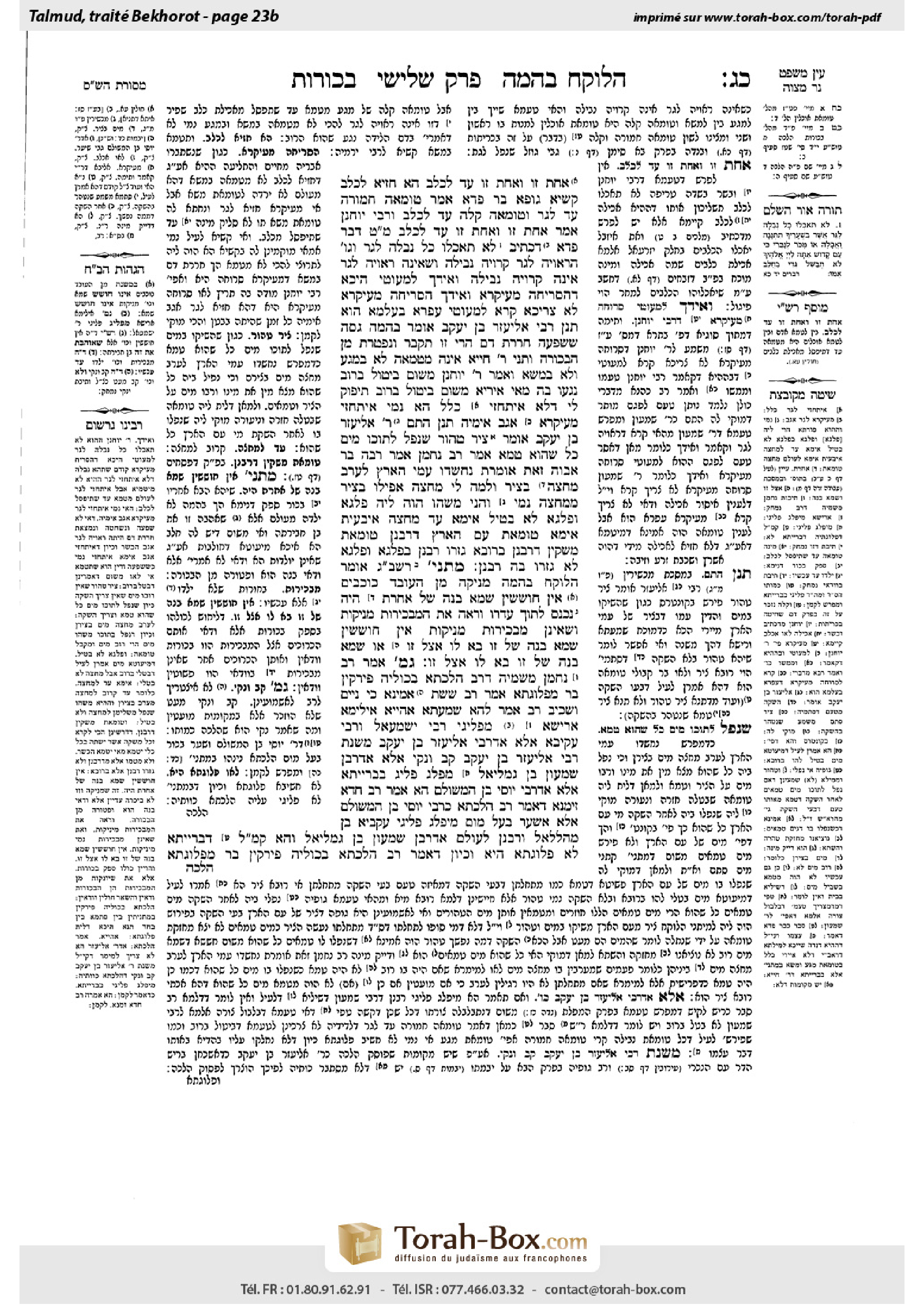
Bekhorot 23b: Talmud study for Daf Yomi
Study the Talmud for Daf Yomi with scanned pages, Hebrew text, English translations from Sefaria and AI-generated French translations.
Passage selection and English or AI-generated French translation are available where the scan has annotations. Daf Study is independent of Torah-Box and Sefaria.
Browse Bekhorot · בכורות · All tractatesBekhorot 23b text and translations
This page of Bekhorot includes the Aramaic text, an English translation and an AI-generated French translation, alongside the scan above.
בכורות כ״ג ב · Aramaic and Hebrew text
אַחַת זוֹ וְאַחַת זוֹ עַד לְכֶלֶב, הָא חַזְיָא לְכֶלֶב! קַשְׁיָא.
גּוּפָא, בַּר פְּדָא אָמַר: טוּמְאָה חֲמוּרָה עַד לְגֵר, וְטוּמְאָה קַלָּה עַד לְכֶלֶב. וְרַבִּי יוֹחָנָן אָמַר: אַחַת זוֹ וְאַחַת זוֹ עַד לְכֶלֶב. מַאי טַעְמָא דְּבַר פְּדָא? דִּכְתִיב: ״לֹא תֹאכְלוּ כׇל נְבֵלָה לְגֵר וְגוֹ׳״, הָרְאוּיָה לַגֵּר קְרוּיָה ״נְבֵילָה״, וְשֶׁאֵינָהּ רְאוּיָה לַגֵּר אֵינָהּ קְרוּיָה ״נְבֵילָה״.
וְאִידַּךְ? לְמַעוֹטֵי הֵיכָא דְּהִסְרִיחָה מֵעִיקָּרָא. וְאִידַּךְ? הִסְרִיחָה מֵעִיקָּרָא לָא צְרִיכָא קְרָא לְמַעוֹטֵי, עַפְרָא בְּעָלְמָא הוּא.
תְּנַן: רַבִּי אֱלִיעֶזֶר בֶּן יַעֲקֹב אוֹמֵר: בְּהֵמָה גַּסָּה שֶׁשָּׁפְעָה חֲרָרַת דָּם, הֲרֵי זוֹ תִּקָּבֵר, וְנִפְטֶרֶת מִן הַבְּכוֹרָה. וְתָנֵי רַבִּי חִיָּיא: אֵינָהּ מְטַמְּאָה לֹא בְּמַגָּע וְלֹא בְּמַשָּׂא. וְאָמַר רַבִּי יוֹחָנָן: מִשּׁוּם בִּיטּוּל בְּרוֹב נָגְעוּ בָּהּ.
מַאי אִירְיָא מִשּׁוּם בִּיטּוּל בְּרוֹב? תִּיפּוֹק לִי דְּלָא אִיתְחֲזִי כְּלָל! הָא נָמֵי אִיתְחֲזִי מֵעִיקָּרָא אַגַּב אִימֵּיהּ.
תְּנַן הָתָם: רַבִּי אֱלִיעֶזֶר בֶּן יַעֲקֹב אוֹמֵר: צִיר טָהוֹר שֶׁנָּפַל לְתוֹכוֹ מַיִם כׇּל שֶׁהוּא — טָמֵא. אָמַר רַב נַחְמָן אָמַר רַבָּה בַּר אֲבוּהּ: זֹאת אוֹמֶרֶת נֶחְשְׁדוּ עַמֵּי הָאָרֶץ לְעָרֵב מֶחֱצָה בַּצִּיר. וּלְמָה לִי מֶחֱצָה? אֲפִילּוּ בְּצִיר מִמֶּחֱצָה נָמֵי! וְהָנֵי מַשֶּׁהוּ — הָוֵה לֵיהּ פַּלְגָא, וּפַלְגָא לָא בְּטִיל.
אֵימָא: עַד מֶחֱצָה. אִיבָּעֵית אֵימָא: טוּמְאַת עַם הָאָרֶץ דְּרַבָּנַן, טוּמְאַת מַשְׁקִין דְּרַבָּנַן. בְּרוּבָּא גְּזַרוּ רַבָּנַן, בְּפַלְגָא וּפַלְגָא לָא גְּזַרוּ בַּהּ רַבָּנַן.
מַתְנִי׳ רַבָּן שִׁמְעוֹן בֶּן גַּמְלִיאֵל אוֹמֵר: הַלּוֹקֵחַ בְּהֵמָה מְנִיקָה מִן הַגּוֹי — אֵין חוֹשְׁשִׁין שֶׁמָּא בְּנָהּ שֶׁל אַחֶרֶת הָיָה. נִכְנָס לְתוֹךְ עֶדְרוֹ וְרָאָה אֶת הַמַּבְכִּירוֹת מְנִיקוֹת, וְשֶׁאֵינָן מַבְכִּירוֹת מְנִיקוֹת — אֵין חוֹשְׁשִׁין שֶׁמָּא בְּנָהּ שֶׁל זוֹ בָּא לוֹ אֵצֶל זוֹ, אוֹ שֶׁמָּא בְּנָהּ שֶׁל זוֹ בָּא לוֹ אֵצֶל זוֹ.
גְּמָ׳ אָמַר רַב נַחְמָן מִשְּׁמֵיהּ דְּרַב: הִלְכְתָא בְּכוּלֵּיהּ פִּירְקִין, בַּר מִפְּלוּגְתָּא. אָמַר רַב שֵׁשֶׁת: אָמֵינָא כִּי נָיֵים וְשָׁכֵיב רַב אָמַר לְהָא שְׁמַעְתָּא! אַהֵיָיא? אִילֵּימָא אַרֵישָׁא — (מפליגי) [מִיפְלָג פְּלִיגִי] רַבִּי יִשְׁמָעֵאל וְרַבִּי עֲקִיבָא!
אֶלָּא אַדְּרַבִּי אֱלִיעֶזֶר בֶּן יַעֲקֹב — מִשְׁנַת רַבִּי אֱלִיעֶזֶר בֶּן יַעֲקֹב ״קַב וְנָקִי״.
אֶלָּא אַדְּרַבָּן שִׁמְעוֹן בֶּן גַּמְלִיאֵל מִפְלָג פְּלִיג בְּבָרַיְיתָא! אֶלָּא אַדְּרַבִּי יוֹסֵי בֶּן הַמְשׁוּלָּם — הָא אָמַר רַב חֲדָא זִימְנָא, דְּאָמַר רַב: הִלְכְתָא כְּרַבִּי יוֹסֵי בֶּן הַמְשׁוּלָּם! אֶלָּא אַשְּׂעַר בַּעַל מוּם מִיפְלָג פְּלִיגִי עֲקַבְיָא בֶּן מַהֲלַלְאֵל וְרַבָּנַן!
לְעוֹלָם אַדְּרַבָּן שִׁמְעוֹן בֶּן גַּמְלִיאֵל, וְהָא קָא מַשְׁמַע לַן: דְּבָרַיְיתָא לָא פְּלוּגְתָּא הִיא.
וְכֵיוָן דְּאָמַר רַב: הִלְכְתָא בְּכוּלֵּיהּ פִּירְקִין בַּר מִפְּלוּגְתָּא,
Bekhorot 23b · English translation
Both this one and that one, i.e., items of both forms of impurity, impart impurity until they are no longer fit to be eaten by a dog, it poses a difficulty to the opinion of Rabbi Yirmeya, as this mass is fit for a dog. The Gemara concludes: Indeed, it is difficult.
The Gemara discusses the matter itself. Bar Padda says: An item with severe ritual impurity imparts impurity to substances until it is no longer fit to be eaten by a ger toshav, but an item with light impurity imparts impurity to substances until it is no longer fit to be eaten by a dog. And Rabbi Yoḥanan says: Both this one and that one impart impurity until they are no longer fit to be eaten by a dog. The Gemara asks: What is the reason for the ruling of bar Padda? As it is written: “You shall not eat of any animal carcass; you may give it to the ger who is within your gates” (Deuteronomy 14:21). Bar Padda understands from this verse that an item which is fit for a ger toshav is called an animal carcass, and that which is not fit for a ger toshav is not called an animal carcass.
The Gemara asks: And with regard to the other Sage, Rabbi Yoḥanan, how does he interpret that verse? He maintains that it serves to exclude a carcass that was decayed from the outset, e.g., if the flesh started to decompose while the animal was still alive, due to severe injury. But if the carcass was initially edible and later decayed, it continues to impart ritual impurity provided it is fit for a dog. The Gemara asks: And with regard to the other Sage, bar Padda, how does he respond to this claim? A verse is not necessary to exclude such a case where the carcass was decayed from the outset, as it is merely like dust and obviously does not impart impurity.
We learned in our mishna that Rabbi Eliezer ben Ya’akov says: In the case of a large animal that expelled a mass of congealed blood, that mass must be buried, and the animal is exempt from having any future offspring counted a firstborn. And Rabbi Ḥiyya teaches: That mass of congealed blood does not impart ritual impurity, neither through physical contact nor through carrying. And Rabbi Yoḥanan says: It is due to the halakhic nullification of a forbidden substance in a majority of permitted substances that the Sages touched upon it, in order to exclude it from impurity through contact or carrying.
The Gemara asks: Why did Rabbi Yoḥanan say this halakha is due specifically to the nullification of a substance in a mixture by the majority of the mixture? Let one derive the halakha from the fact that the mass is not fit for consumption at all, and it never was. The Gemara explains: This too was initially fit by virtue of its mother, i.e., if one had slaughtered the mother before the embryo was discharged it would have been edible as part of the mother.
We learned in a mishna elsewhere (Makhshirin 6:3) that Rabbi Eliezer ben Yaakov says: Ritually pure brine, taken from an am ha’aretz, into which any amount of water fell is rendered impure. Rav Naḥman says that Rabba bar Avuh says: That is to say that amei ha’aretz are suspected of mixing half a portion of water in the brine, which means that when the additional water falls in, the nullified impurity in the brine is revived by it and renders the entire mixture impure. The Gemara asks: But why do I need to say they are suspected of mixing precisely half a portion of water? Even if they mix in less than half, the brine will also be rendered impure upon contact with the added water, as that small amount combined with slightly less than half a portion of water constitutes half the mixture, and half a mixture is not nullified by the other half.
The Gemara answers: Say instead that an am ha’aretz is suspected of mixing in water until it constitutes slightly less than half the mixture. And if you wish, say instead: The impurity of foods belonging to an am ha’aretz applies by rabbinic law and the impurity of liquids also applies by rabbinic law. Accordingly, the impurity of the brine in this case is due to two separate rabbinic decrees. Where the majority is water the Sages decreed the brine is impure, but in a case where half the mixture is pure fish brine and half is water the Sages did not decree that the brine is impure.
MISHNA: Rabban Shimon ben Gamliel says: In the case of one who purchases a nursing female animal from a gentile, he does not need to be concerned, i.e., take into account the possibility, that perhaps it was nursing the offspring of another animal. Rather, the buyer may assume it had previously given birth. In the case of one who enters amid his flock and sees mother animals that gave birth for the first time that were nursing, and also sees mother animals that gave birth not for the first time that were also nursing, he does not need to be concerned that perhaps the offspring of this animal came to that animal to be nursed, or that perhaps the offspring of that animal came to this animal to be nursed.
GEMARA: Rav Naḥman said in the name of Rav: The halakha is in accordance with the opinion of the anonymous tanna in the mishnayot throughout the whole chapter, except where there is a difference of opinion recorded in that mishna. Rav Sheshet says: I say Rav was dozing or sleeping when he said this halakha. After all, to which mishna is this referring? If we say it is referring to the first mishna in the chapter (19b) then his ruling does not apply, as Rabbi Yishmael and Rabbi Akiva disagree in that mishna.
Rather, you will say it is referring to the ruling of Rabbi Eliezer ben Yaakov (21b). This is also problematic, since it is already known that the halakha is in accordance with his opinion, as there is an established principle that the teaching of Rabbi Eliezer ben Ya’akov measures only a kav but is clean and accurate, and therefore the halakha is in accordance with his opinions.
Rather, you will say it is referring to the statement of Rabban Shimon ben Gamliel in the mishna here. That is also difficult, as there is a tanna who disagrees, in the baraita cited on 24a. Rather, you will say that it is referring to the statement of Rabbi Yosei ben HaMeshullam in the next mishna (24b). But didn’t Rav already say this one time? As Rav said: The halakha is in accordance with the opinion of Rabbi Yosei ben HaMeshullam. Rather, you will say that it is referring to the matter of the hair of a blemished firstborn discussed in the mishna on 25b. But that case too is subject to a dispute, as Akavya ben Mahalalel and the Rabbis disagree in that mishna.
The Gemara answers: Actually, Rav’s statement is referring to the statement of Rabban Shimon ben Gamliel here, and Rav teaches us this: That if a mishna is contradicted by a dissenting opinion cited in a baraita it is not considered a dispute, and the halakha therefore follows the opinion of Rabban Shimon ben Gamliel.
The Gemara asks: But once Rav said the halakha is in accordance with the opinion of the anonymous tanna in the mishnayot throughout the whole chapter except where there is a difference of opinion,
Bekhorot 23b · Traduction française (IA)
Les deux, c'est-à-dire les objets des deux formes d'impureté, transmettent l'impureté jusqu'à ce qu'ils ne soient plus comestibles pour un chien, ce qui pose un problème pour l'opinion de Rabbi Yirmeya, puisque cette masse est comestible pour un chien. La Guemara conclut : En effet, c'est difficile.
La Guemara discute de cette question. Bar Padda dit : Un objet souillé d'impureté grave transmet l'impureté aux substances jusqu'à ce qu'il ne soit plus comestible pour un ger toshav, mais un objet souillé d'impureté légère transmet l'impureté aux substances jusqu'à ce qu'il ne soit plus comestible pour un chien. Et Rabbi Yoḥanan dit : Les deux, c'est-à-dire les deux, transmettent l'impureté jusqu'à ce qu'ils ne soient plus comestibles pour un chien. La Guemara demande : Quelle est la raison de la décision de Bar Padda ? Comme il est écrit : « Vous ne mangerez aucun cadavre d'animal ; vous pouvez le donner au ger qui est dans vos portes » (Deutéronome 14:21). Bar Padda en tire la conclusion que l'objet qui est comestible pour un ger toshav est appelé un cadavre d'animal, et que celui qui ne l'est pas n'est pas appelé un cadavre d'animal.
La Guemara demande : Et concernant l'autre Sage, Rabbi Yoḥanan, comment interprète-t-il cette versette ? Il maintient que cette versette sert à exclure un cadavre déjà pourri depuis le début, c'est-à-dire si la chair a commencé à se décomposer alors que l'animal était encore vivant, en raison d'une grave blessure. Mais si le cadavre était initialement comestible et s'est ensuite pourri, il continue à transmettre l'impureté rituelle tant qu'il est comestible pour un chien. La Guemara demande : Et concernant l'autre Sage, Bar Padda, comment répond-il à cette affirmation ? Une versette n'est pas nécessaire pour exclure un tel cas où le cadavre était pourri depuis le début, car il est simplement comme de la poussière et ne transmet clairement pas l'impureté.
Nous avons appris dans notre mitsna que Rabbi Eliezer ben Ya’akov dit : Dans le cas d'un grand animal qui a expulsé une masse de sang congelé, cette masse doit être enterrée, et l'animal est exempt de l'incorporation de tout descendant futur comme premier-né. Et Rabbi Ḥiyya enseigne : Cette masse de sang congelé ne transmet pas l'impureté rituelle, ni par contact ni par transport. Et Rabbi Yoḥanan dit : C'est en raison de la nullification halakhique d'une substance interdite dans une majorité de substances permises que les Sages ont touché à cela, afin d'exclure cette impureté par contact ou transport.
La Guemara demande : Pourquoi Rabbi Yoḥanan dit-il que cette halakha est spécifiquement due à la nullification d'une substance dans un mélange par la majorité du mélange ? Laissez plutôt déduire cette halakha du fait que cette masse n'est pas comestible du tout, et ne l'a jamais été. La Guemara explique : Cela aussi était initialement comestible en raison de sa mère, c'est-à-dire si l'on avait sacrifié la mère avant que l'embryon ne soit expulsé, il aurait été comestible comme partie de la mère.
Nous avons appris dans une mitsna ailleurs (Makhshirin 6:3) que Rabbi Eliezer ben Yaakov dit : L'eau de mer rituellement pure, prise d'un am ha’aretz, dans laquelle tombe toute quantité d'eau, devient impure. Rav Naḥman dit que Rabba bar Avuh dit : Cela signifie que les amei ha’aretz sont suspects de mélanger la moitié d'une portion d'eau dans l'eau de mer, ce qui signifie que lorsque l'eau supplémentaire tombe, l'impureté nullifiée dans l'eau de mer est réveillée par elle et rend le mélange entier impur. La Guemara demande : Mais pourquoi ai-je besoin de dire qu'ils sont suspects de mélanger précisément la moitié d'une portion d'eau ? Même si ils mélangent moins que la moitié, l'eau de mer deviendra impure en contact avec l'eau ajoutée, car cette petite quantité combinée avec légèrement moins que la moitié du mélange constitue la moitié du mélange, et la moitié d'un mélange n'est pas nullifiée par l'autre moitié.
La Guemara répond : Dites plutôt que l'am ha’aretz est suspecté de mélanger de l'eau jusqu'à ce qu'il constitue légèrement moins que la moitié du mélange. Et si vous le souhaitez, dites plutôt : L'impureté des aliments appartenant à un am ha’aretz s'applique selon la loi rabbinique et l'impureté des liquides s'applique également selon la loi rabbinique. Ainsi, l'impureté de la saumure dans ce cas est due à deux décisions distinctes de la loi rabbinique. Lorsque la majorité est de l'eau, les Sages ont décrété que la saumure est impure, mais dans un cas où la moitié du mélange est de la saumure pure et l'autre moitié est de l'eau, les Sages n'ont pas décrété que la saumure est impure.
MICHNA : Rabban Shimon ben Gamliel dit : Dans le cas d'une femelle allaitante achetée chez un non-Juif, il n'a pas besoin de s'inquiéter, c'est-à-dire de prendre en compte la possibilité que peut-être elle ait allaité un autre animal. Le vendeur peut supposer qu'elle a déjà donné naissance. Dans le cas d'une personne qui entre au milieu de son troupeau et voit des mères qui ont donné naissance pour la première fois qui allaitent, et aussi des mères qui n'ont pas donné naissance pour la première fois qui allaitent également, il n'a pas besoin de s'inquiéter que peut-être l'animal de ce bétail est venu s'allaiter à cet animal, ou que peut-être l'animal de cet animal est venu s'allaiter à ce bétail.
GUEMARA : Rav Naḥman a dit en nom de Rav : La halakha est selon l'opinion du tanna anonyme dans les mitsvot tout au long du chapitre, sauf là où il y a un désaccord enregistré dans cette mitsva. Rav Sheshet dit : Je dis que Rav était endormi ou endormi quand il a dit cette halakha. En effet, à quelle mitsva fait-il référence ? Si nous disons qu'il fait référence à la première mitsva du chapitre (19b), alors son jugement ne s'applique pas, car Rabbi Yishmael et Rabbi Akiva divergent dans cette mitsva.
Plutôt, vous direz qu'il fait référence à la décision de Rabbi Eliezer ben Yaakov (21b). Cela est également problématique, car il est déjà connu que la halakha suit son opinion, car il y a un principe établi selon lequel l'enseignement de Rabbi Eliezer ben Yaakov mesure seulement un kav, mais est propre et précis, et donc la halakha suit son opinion.
Plutôt, vous direz qu'il s'agit de la déclaration de Rabban Shimon ben Gamliel dans la mitsva ici. Cela est également difficile, car il y a un tanna qui s'y oppose, dans la baraïta citée sur 24a. Plutôt, vous direz qu'il s'agit de la déclaration de Rabbi Yosei ben HaMeshullam dans la mitsva suivante (24b). Mais n'a-t-il pas déjà dit cela une fois ? Comme Rav a dit : La halakha suit l'opinion de Rabbi Yosei ben HaMeshullam. Plutôt, vous direz qu'il s'agit de la question de la chevel d'un premier-né blemi discutée dans la mitsva sur 25b. Mais ce cas non plus n'est pas sans contestation, car Akavya ben Mahalalel et les Rabbins s'y opposent dans cette mitsva.
Le Guemara répond : En réalité, la déclaration de Rav s'applique à la déclaration de Rabban Shimon ben Gamliel ici, et Rav nous enseigne cela : Que si une mitsva est contredite par une opinion divergente citée dans une baraïta, cela ne constitue pas un désaccord, et la halakha suit donc l'opinion de Rabban Shimon ben Gamliel.
Le Guemara demande : Mais une fois que Rav a dit que la halakha suit l'opinion du tanna anonyme dans les mitsvot tout au long du chapitre sauf là où il y a un désaccord,
Traduction française générée par IA à partir de l’édition anglaise de Sefaria. Vérifie toujours un passage avec le texte source.
Text from Sefaria: William Davidson Edition - Vocalized Aramaic (CC BY NC); William Davidson Edition - English (CC BY NC).