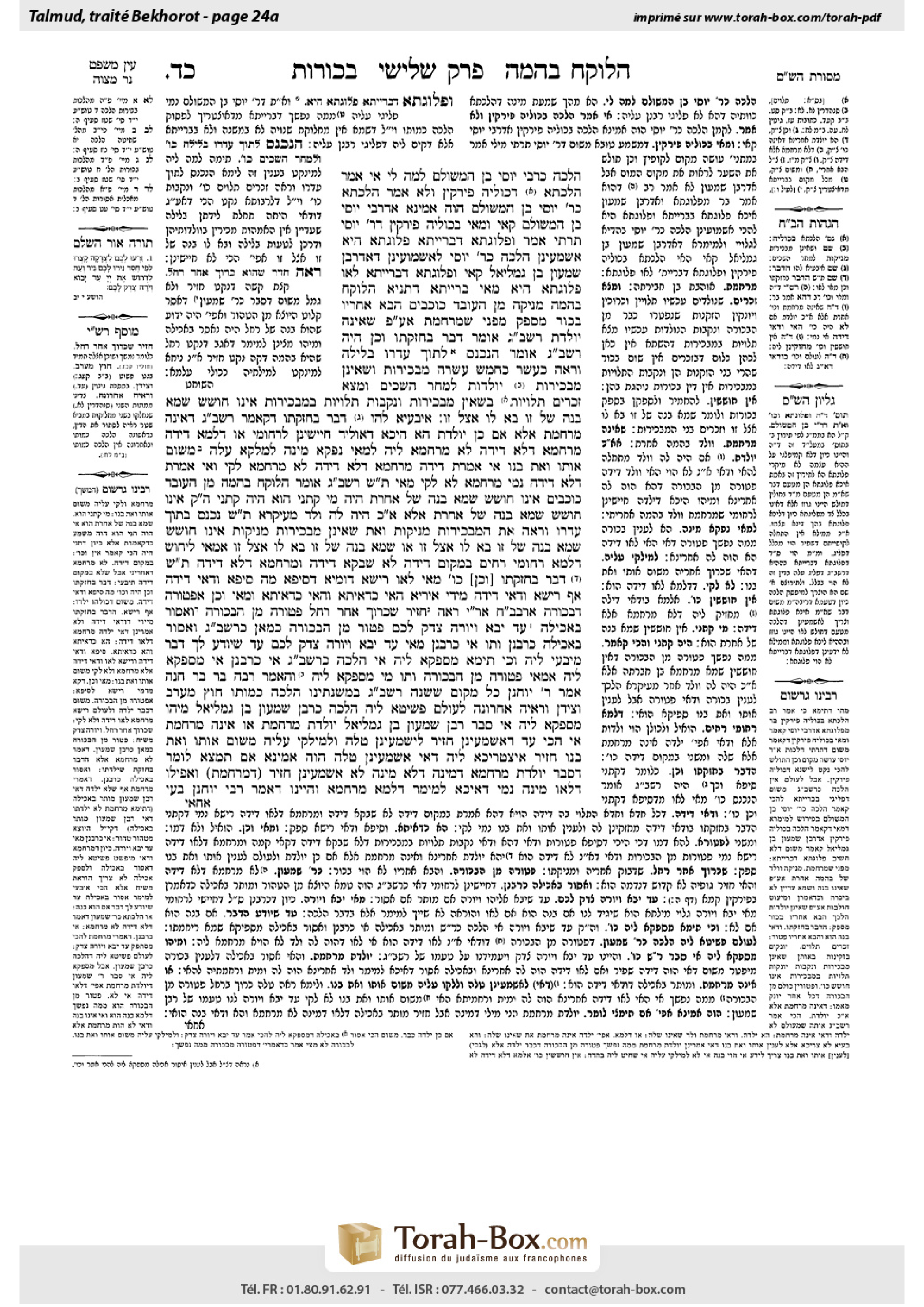
Bekhorot 24a: Talmud study for Daf Yomi
Study the Talmud for Daf Yomi with scanned pages, Hebrew text, English translations from Sefaria and AI-generated French translations.
Passage selection and English or AI-generated French translation are available where the scan has annotations. Daf Study is independent of Torah-Box and Sefaria.
Browse Bekhorot · בכורות · All tractatesBekhorot 24a text and translations
This page of Bekhorot includes the Aramaic text, an English translation and an AI-generated French translation, alongside the scan above.
בכורות כ״ד א · Aramaic and Hebrew text
הֲלָכָה כְּרַבִּי יוֹסֵי בֶּן הַמְשׁוּלָּם לְמָה לִי?
אִי אָמַר הִלְכְתָא דְּכוּלֵּיהּ פִּירְקִין, וְלָא אָמַר הִלְכְתָא כְּרַבִּי יוֹסֵי בֶּן הַמְשׁוּלָּם, הֲוָה אָמֵינָא: אַדְּרַבִּי יוֹסֵי בֶּן הַמְשׁוּלָּם קָאֵי, וּמַאי ״בְּכוּלֵּיהּ פִּירְקִין״? דְּרַבִּי יוֹסֵי תַּרְתֵּי אָמַר, וּפְלוּגְתָּא דְּבָרַיְיתָא פְּלוּגְתָּא הִיא.
אַשְׁמְעִינַן הֲלָכָה כְּרַבִּי יוֹסֵי — לְאַשְׁמוֹעִינַן דְּאַדְּרַבָּן שִׁמְעוֹן בֶּן גַּמְלִיאֵל קָאֵי, וּפְלוּגְתָּא דְּבָרַיְיתָא לָאו פְּלוּגְתָּא הִיא.
מַאי בָּרַיְיתָא? דְּתַנְיָא: הַלּוֹקֵחַ בְּהֵמָה מְנִיקָה מִן הַגּוֹי, הַבָּא אַחֲרָיו בְּכוֹר מִסָּפֵק, מִפְּנֵי שֶׁמְּרַחֶמֶת אַף עַל פִּי שֶׁאֵינָהּ יוֹלֶדֶת. רַבָּן שִׁמְעוֹן בֶּן גַּמְלִיאֵל אוֹמֵר: דָּבָר בְּחֶזְקָתוֹ.
וְכֵן הָיָה רַבָּן שִׁמְעוֹן בֶּן גַּמְלִיאֵל אוֹמֵר: הַנִּכְנָס לְתוֹךְ עֶדְרוֹ בַּלַּיְלָה וְרָאָה כְּעֶשֶׂר כַּחֲמֵשׁ עֶשְׂרֵה, מַבְכִּירוֹת וְשֶׁאֵינָן מַבְכִּירוֹת, יוֹלְדוֹת, לְמָחָר הִשְׁכִּים וּמָצָא זְכָרִים (תְּלוּיוֹת) [תְּלוּיִין] בְּשֶׁאֵין מַבְכִּירוֹת, וּנְקֵבוֹת תְּלוּיוֹת בְּמַבְכִּירוֹת — אֵינוֹ חוֹשֵׁשׁ שֶׁמָּא בְּנָהּ שֶׁל זוֹ בָּא לוֹ אֵצֶל זוֹ.
אִיבַּעְיָא לְהוּ: דָּבָר בְּחֶזְקָתוֹ דְּקָאָמַר רַבָּן שִׁמְעוֹן בֶּן גַּמְלִיאֵל, דְּאֵינָהּ מְרַחֶמֶת אֶלָּא אִם כֵּן יוֹלֶדֶת — הָא הֵיכָא דְּאוֹלִיד חָיְישִׁינַן לְרַחוֹמֵי, אוֹ דִלְמָא: דִּידַהּ מְרַחֲמָא, דְּלָא דִּידַהּ לָא מְרַחֲמָא לֵיהּ?
לְמַאי נָפְקָא מִינַּהּ? לְמִלְקֵא עֲלַהּ מִשּׁוּם ״אוֹתוֹ וְאֶת בְּנוֹ״. אִי אָמְרַתְּ דִּידַהּ מְרַחֲמָא, דְּלָא דִּידַהּ לָא מְרַחֲמָא — לָקֵי, וְאִי אָמְרַתְּ דְּלָא דִּידַהּ נָמֵי מְרַחֲמָא — לָא לָקֵי.
מַאי? תָּא שְׁמַע, רַבָּן שִׁמְעוֹן בֶּן גַּמְלִיאֵל אוֹמֵר: הַלּוֹקֵחַ בְּהֵמָה מִן הַגּוֹי — אֵינוֹ חוֹשֵׁשׁ שֶׁמָּא בְּנָהּ שֶׁל אַחֶרֶת הָיָה. מִי קָתָנֵי ״הוּא״? ״הָיָה״ קָתָנֵי! הָכִי קָאָמַר: אֵינוֹ חוֹשֵׁשׁ שֶׁמָּא בְּנָהּ שֶׁל אַחֶרֶת, אֶלָּא אִם כֵּן הָיָה לָהּ וָלָד מֵעִיקָּרָא.
תָּא שְׁמַע: נִכְנַס בְּתוֹךְ עֶדְרוֹ וְרָאָה אֶת הַמַּבְכִּירוֹת מְנִיקוֹת, וְאֶת שֶׁאֵינָן מַבְכִּירוֹת מְנִיקוֹת — אֵינוֹ חוֹשֵׁשׁ שֶׁמָּא בְּנָהּ שֶׁל זוֹ בָּא לוֹ אֵצֶל זוֹ, אוֹ שֶׁמָּא בְּנָהּ שֶׁל זוֹ בָּא לוֹ אֵצֶל זוֹ.
אַמַּאי? לֵיחוּשׁ דִּלְמָא רַחוֹמֵי רַחֵים! בִּמְקוֹם דִּידַהּ, לָא שָׁבְקָא דִּידַהּ וּמְרַחֲמָא דְּלָא דִּידַהּ.
תָּא שְׁמַע: דָּבָר בְּחֶזְקָתוֹ כּוּ׳. מַאי לָאו רֵישָׁא דּוּמְיָא דְּסֵיפָא? מָה סֵיפָא וַדַּאי דִּידַהּ, אַף רֵישָׁא וַדַּאי דִּידַהּ.
מִידֵּי אִירְיָא? הַאי כִּדְאִיתֵאּ, וְהַאי כִּדְאִיתֵאּ. וּמַאי ״וְכֵן״? אַפְּטוּרָה דִּבְכוֹרָה.
אָמַר רַבָּה בַּר בַּר חָנָה אָמַר רַבִּי יוֹחָנָן: רָאָה חֲזִיר שֶׁכָּרוּךְ אַחַר רָחֵל, פְּטוּרָה מִן הַבְּכוֹרָה, וְאָסוּר בַּאֲכִילָה ״עַד יָבֹא וְיוֹרֶה צֶדֶק לָכֶם״.
פָּטוּר מִן הַבְּכוֹרָה — כְּמַאן? כְּרַבָּן שִׁמְעוֹן בֶּן גַּמְלִיאֵל, וְאָסוּר בַּאֲכִילָה — כְּרַבָּנַן.
וְתוּ, אִי כְּרַבָּנַן, מַאי ״עַד יָבֹא וְיוֹרֶה צֶדֶק לָכֶם״? ״עַד שֶׁיִּוָּדַע לְךָ דָּבָר״ מִיבְּעֵי לֵיהּ!
וְכִי תֵּימָא: מְסַפְּקָא לֵיהּ אִי הֲלָכָה כְּרַבָּן שִׁמְעוֹן בֶּן גַּמְלִיאֵל אִי כְּרַבָּנַן, אִי מְסַפְּקָא לֵיהּ — אַמַּאי פְּטוּרָה מִן הַבְּכוֹרָה? וְתוּ: מִי מְסַפְּקָא לֵיהּ? וְהָאָמַר רַבָּה בַּר בַּר חָנָה אָמַר רַבִּי יוֹחָנָן: כׇּל מָקוֹם שֶׁשָּׁנָה רַבָּן שִׁמְעוֹן בֶּן גַּמְלִיאֵל בְּמִשְׁנָתֵינוּ — הֲלָכָה כְּמוֹתוֹ, חוּץ מֵעָרֵב, וְצַיְדָן, וּרְאָיָה אַחֲרוֹנָה!
לְעוֹלָם פְּשִׁיטָא לֵיהּ הֲלָכָה כְּרַבָּן שִׁמְעוֹן בֶּן גַּמְלִיאֵל, מִיהוּ מְסַפְּקָא לֵיהּ אִי סָבַר רַבָּן שִׁמְעוֹן בֶּן גַּמְלִיאֵל יוֹלֶדֶת מְרַחֶמֶת, אוֹ אֵינָהּ מְרַחֶמֶת. אִי הָכִי, עַד דְּאַשְׁמְעִינַן חֲזִיר, לַישְׁמְעִינַן טָלֶה, וּלְמִילְקֵי עֲלֵיהּ מִשּׁוּם ״אוֹתוֹ וְאֶת בְּנוֹ״!
חֲזִיר אִיצְטְרִיכָא לֵיהּ, דְּאִי אַשְׁמְעִינַן טָלֶה, הֲוָה אָמֵינָא: אִם תִּמְצָא לוֹמַר דְּסָבַר יוֹלֶדֶת מְרַחֲמָא — דְּמִינַהּ, דְּלָא מִינַהּ — לָא. אַשְׁמְעִינַן חֲזִיר, דִּמְרַחֶמֶת, וַאֲפִילּוּ דְּלָאו מִינַהּ נָמֵי, דְּאִיכָּא לְמֵימַר דִּלְמָא מְרַחֲמָא.
וְהַיְינוּ דְּאָמַר רַבִּי יוֹחָנָן: בָּעֵי
Bekhorot 24a · English translation
why do I need him to state that the halakha is in accordance with the opinion of Rabbi Yosei ben HaMeshullam?
The Gemara explains: Had Rav said only that the halakha is in accordance with the opinion of the anonymous tanna in the mishnayot throughout the whole chapter, but did not say explicitly that the halakha is in accordance with the opinion of Rabbi Yosei ben HaMeshullam, I would say: Rav is referring specifically to the opinion of Rabbi Yosei ben HaMeshullam. And what is the meaning of the phrase: Throughout the whole chapter, which indicates he is speaking of more than one case? This is referring to the fact that Rabbi Yosei said two separate statements in the chapter. And this would indicate with regard to Rav’s statement that if a mishna is contradicted by a dissenting opinion cited in a baraita, that is considered a dispute.
Rav taught that the halakha is in accordance with the opinion of Rabbi Yosei in order to teach us that his statement with regard to the whole chapter is referring to the opinion of Rabban Shimon ben Gamliel, and with regard to Rav’s statement, if a mishna is contradicted by a dissenting opinion cited in a baraita, that is not considered a dispute.
What is the baraita mentioned previously? As it is taught in a baraita: In the case of one who purchases a nursing female animal from a gentile, the young that is born after the offspring currently being nursed is treated as a firstborn due to the uncertainty whether it is the animal’s offspring, because an animal might be merciful and nurse another animal even though it has not given birth at all. Rabban Shimon ben Gamliel says: The matter stands in its presumptive status, i.e., the nursing animal is assumed to be the mother of the nursing offspring.
The baraita continues: And similarly, Rabban Shimon ben Gamliel would say: One who enters amid his flock at night and sees about ten or about fifteen animals, some of whose offspring is a firstborn and others whose offspring is not a firstborn, and all were giving birth, and on the next day he arose and found that the male young were nursing from the mothers whose offspring is not a firstborn, and the female young were nursing from the mothers whose offspring is a firstborn, he does not need to be concerned that perhaps the young of this mother came to nurse from that mother. Rather, he may assume that each animal is nursing its own offspring.
A dilemma was raised before the Sages: What is the precise meaning of the phrase: The matter stands in its presumptive status, which Rabban Shimon ben Gamliel stated? Does this mean that an animal does not show mercy unless it has given birth, and consequently, in a case where the animal has given birth we are concerned for the possibility that it might be merciful and nurse an offspring that is not its own? Or perhaps it means that an animal might be merciful only toward its own offspring, but it does not show mercy to an animal that is not its own?
The Gemara asks: What difference is there in practice based on this distinction? Either way the nursing animal is assumed to have given birth and its future offspring will not be considered a firstborn. The Gemara answers that there is a difference with regard to whether or not one is flogged for slaughtering it due to violating the prohibition against slaughtering a mother and its offspring on the same day. If you say an animal is merciful only toward its own offspring but is not merciful toward an animal that is not its own, then one is flogged if he deliberately slaughters an animal and the offspring that it is nursing. But if you say it is also merciful toward an animal that is not its own, then one is not flogged in such a case.
The Gemara returns to its initial inquiry. What is the precise meaning of Rabban Shimon ben Gamliel’s statement? Come and hear a proof from the mishna, as Rabban Shimon ben Gamliel says: In the case of one who purchases a nursing female animal from a gentile, he does not need to be concerned lest the offspring currently being nursed was the offspring of another animal. Evidently, Rabban Shimon ben Gamliel holds that an animal nurses only its own offspring. The Gemara rejects this proof: Does the mishna teach that one does not need to be concerned that perhaps it is the offspring of another animal? No, it teaches that one does not need to be concerned that perhaps it was the offspring of another animal, and this is what it is saying: Whichever way you look at it, the next offspring is not a firstborn, as one does not need to be concerned that perhaps it was the offspring of another animal that it is nursing, as it would not nurse unless it already had an offspring initially.
The Gemara suggests: Come and hear a proof from the continuation of the mishna: In the case of one who enters amid his flock and sees mother animals that gave birth for the first time that were nursing, and also sees mother animals that gave birth not for the first time that were also nursing, he does not need to be concerned that perhaps the offspring of this animal came to that animal to be nursed, or that perhaps the offspring of that animal came to this animal to be nursed.
The Gemara explains the proof: But why not? Let us be concerned that perhaps the nursing animal is merciful toward an offspring that is not its own. Evidently, Rabban Shimon ben Gamliel holds that an animal nurses only its own offspring, even if it had previously given birth. The Gemara rejects this proof: Even if an animal does show mercy toward offspring that is not its own, in a place where it has its own offspring, it does not set aside its own offspring and show mercy toward offspring that is not its own.
The Gemara further suggests: Come and hear a proof from Rabban Shimon ben Gamliel’s statement in the baraita: If one purchases a nursing animal from a gentile, the matter stands in its presumptive status. From the phrase: And similarly, in the continuation of the baraita, the Gemara infers: What, is it not so that the first clause is similar to the latter clause? Just as in the latter clause the nursing young is certainly considered to be the nursing animal’s own offspring, so too, in the first clause it is certainly considered to be the nursing animal’s own offspring, despite the fact that the animal mother might have given birth previously.
The Gemara rejects this suggestion: Are the cases comparable? This first clause of the baraita stands as it is and that second clause of the baraita stands as it is, i.e., they are referring to different cases. In the second clause, where all the offspring are standing before their mothers, it is certain that each mother will nurse only its own child. Conversely, in the first clause it is uncertain whether that child is its own. But if so, what is the meaning of the phrase: And similarly? It means both clauses state that the nursing animal is exempt from having its future offspring counted a firstborn, since even if that offspring is not the mother’s, the mother would not nurse it unless it had previously given birth.
The Gemara analyzes a similar case. Rabba bar bar Ḥana says that Rabbi Yoḥanan says: If one saw a young animal resembling a pig that was trailing after a ewe, the ewe is exempt from having its future offspring counted a firstborn. And the pig-like animal is forbidden for consumption “until he comes and instructs righteousness to you” (Hosea 10:12), i.e., until Elijah the prophet arrives and determines the halakha.
The Gemara raises a difficulty with regard to Rabba bar bar Ḥana’s statement: On the one hand, the ewe is exempt from having its future offspring counted a firstborn, which is in accordance with the opinion of Rabban Shimon ben Gamliel that an animal that nurses from another is presumed to be its offspring. But on the other hand, the pig-like animal is forbidden for consumption, which is in accordance with the opinion of the Rabbis that an animal might nurse the young of another.
And furthermore, if the halakha is in accordance with the opinion of the Rabbis, and there is a concern with regard to the identity of the mother of the offspring, what is the reason for citing the verse: “Until he comes and instructs righteousness to you”? By citing it, the baraita is indicating that the status of the pig-like animal is a halakhic uncertainty that can be resolved only by Elijah the prophet. Instead, it should have stated: Until the matter becomes known to you, in reference to the empirical uncertainty as to whether the pig-like animal is the offspring of the ewe.
And if you would say that it is uncertain whether the halakha is in accordance with the opinion of Rabban Shimon ben Gamliel or in accordance with the opinion of the Rabbis, that cannot be correct: If that matter is uncertain, then why is the ewe exempt from having its future offspring counted a firstborn? And furthermore, is this question of whose opinion is accepted as the halakha an uncertainty at all? But doesn’t Rabba bar bar Ḥana say that Rabbi Yoḥanan says: Wherever Rabban Shimon ben Gamliel taught a halakha in the corpus of our Mishna the halakha is in accordance with his opinion, except for the following three cases: The responsibility of the guarantor (see Bava Batra 174a), and the incident that occurred in the city of Tzaidan (see Gittin 74a), and the dispute with regard to evidence in the final disagreement (see Sanhedrin 31a)?
The Gemara answers: Actually, it is obvious to Rabba bar bar Ḥana that the halakha is in accordance with the opinion of Rabban Shimon ben Gamliel. But it is uncertain if Rabban Shimon ben Gamliel holds that an animal that has given birth might be merciful toward offspring that is not its own, or if he holds that it is not merciful toward the offspring of another. The Gemara rejects this claim: If that is so, instead of teaching a case involving an animal with the appearance of a pig, he should have taught the more common case of a mother ewe nursing a baby lamb. And accordingly, rather than inquiring with regard to the prohibition against eating a non-kosher animal, he should have inquired as to whether or not one is flogged for it due to violating the prohibition against slaughtering a mother and its offspring on the same day.
The Gemara explains: It was necessary for Rabba bar bar Ḥana to teach the case of a pig, as, had he taught a case involving a lamb, I would say: Even if you say that Rabban Shimon ben Gamliel holds that an animal that has given birth might be merciful toward the offspring of another, this is so only with regard to its own species, but with regard to an animal that is not of its own species, it would not show mercy and would not nurse the offspring. Therefore, Rabba bar bar Ḥana teaches us the case of a pig, to convey that an animal might be merciful, and this is also true even where the offspring is not of its own species, as it could be said that perhaps the animal was merciful in such a case as well.
And this is the meaning of that which Rabba bar bar Ḥana said that Rabbi Yoḥanan said: A dilemma was raised
Bekhorot 24a · Traduction française (IA)
Pourquoi ai-je besoin qu'il indique que la halakha suit l'opinion de Rabbi Yosei ben HaMeshullam ?
La Guemara explique : Si Rav avait dit seulement que la halakha suit l'opinion du tanna anonyme dans les mishnayot tout au long du chapitre, sans préciser explicitement que la halakha suit l'opinion de Rabbi Yosei ben HaMeshullam, je dirais : Rav fait référence spécifiquement à l'opinion de Rabbi Yosei ben HaMeshullam. Et que signifie la phrase : « tout au long du chapitre », qui indique qu'il parle de plus d'un cas ? Cela fait référence au fait que Rabbi Yosei a dit deux déclarations distinctes dans le chapitre. Et cela indique concernant l'affirmation de Rav que si une mishna est contredite par une opinion divergente citée dans une baraïta, cela est considéré comme un désaccord.
Rav enseignait que la halakha suit l'opinion de Rabbi Yosei afin de nous apprendre que sa déclaration concernant tout le chapitre fait référence à l'opinion de Rabban Shimon ben Gamliel, et concernant l'affirmation de Rav, si une mishna est contredite par une opinion divergente citée dans une baraïta, cela n'est pas considéré comme un désaccord.
Quelle est la baraïta mentionnée précédemment ? Comme il est enseigné dans une baraïta : Dans le cas d'une personne qui achète un animal femelle allaitant d'un non-Juif, le petit né après l'offspring actuellement allaitant est considéré comme un premier-né en raison de l'incertitude quant à savoir s'il est l'offspring de l'animal, car un animal peut être miséricordieux et allaiter un autre animal même s'il n'a pas encore donné naissance. Rabban Shimon ben Gamliel dit : La question reste dans son statut présomptif, c'est-à-dire que l'animal allaitant est supposé être la mère de l'offspring allaitant.
La baraïta continue : Et de même, Rabban Shimon ben Gamliel dit : Celui qui entre au milieu de son troupeau la nuit et voit environ dix ou quinze animaux, certains dont l'offspring est un premier-né et d'autres dont l'offspring n'est pas un premier-né, et tous ont donné naissance, et le lendemain il se lève et découvre que les petits mâles allaitent des mères dont l'offspring n'est pas un premier-né, et les petits femelles allaitent des mères dont l'offspring est un premier-né, il n'a pas besoin de s'inquiéter du fait que peut-être le jeune de cette mère est venu allaiter celle-ci. Il peut plutôt supposer que chaque animal allaitine son propre offspring.
Un dilemme a été soulevé devant les Sages : Quelle est la signification exacte de la phrase : "La chose est dans son statut présomptif", que Rabban Shimon ben Gamliel a affirmé ? Ce que cela signifie-t-il : qu'un animal ne montre pas de miséricorde à moins qu'il ait donné naissance, et par conséquent, dans le cas où l'animal a donné naissance, nous nous inquiétons du fait qu'il puisse être miséricordieux et allaiter un petit qui n'est pas le sien ? Ou bien cela signifie-t-il que l'animal peut être miséricordieux uniquement envers son propre petit, mais ne montre pas de miséricorde envers un animal qui n'est pas le sien ?
La Guemara demande : Quelle différence pratique y a-t-il selon cette distinction ? Quelle que soit la situation, l'animal allaitant est supposé avoir donné naissance et son petit futur ne sera pas considéré comme premier-né. La Guemara répond que la différence réside dans le fait de savoir si l'on est fouetté pour avoir tué cet animal en raison de la violation de l'interdiction de tuer une mère et son petit le même jour. Si vous dites que l'animal est miséricordieux uniquement envers son propre petit mais pas envers un animal qui n'est pas le sien, alors l'on est fouetté si l'on tue délibérément un animal et le petit qu'il allaitait. Mais si vous dites qu'il est également miséricordieux envers un animal qui n'est pas le sien, alors l'on n'est pas fouetté dans ce cas.
La Guemara revient à son questionnement initial. Quelle est la signification exacte de l'affirmation de Rabban Shimon ben Gamliel ? Venez écouter une preuve tirée de la mitsna, car Rabban Shimon ben Gamliel dit : Dans le cas d'une personne qui achète une femelle allaitant d'un non-Juif, il n'a pas besoin de s'inquiéter que le petit actuellement allaité soit le petit d'un autre animal. Évidemment, Rabban Shimon ben Gamliel considère que l'animal allaitant ne nourrit que ses propres petits. La Guemara rejette cette preuve : La mitsna enseigne-t-elle que l'on n'a pas besoin de s'inquiéter que ce soit le petit d'un autre animal ? Non, elle enseigne que l'on n'a pas besoin de s'inquiéter que ce soit le petit d'un autre animal, et c'est ce qu'elle dit : Quel que soit le point de vue, le petit suivant n'est pas un premier-né, car l'on n'a pas besoin de s'inquiéter que ce soit le petit d'un autre animal qu'il allaitait, car il ne nourrirait pas sans avoir d'abord eu un petit initial.
La Guemara suggère : Venez écouter une preuve tirée de la continuation de la Michna : Dans le cas d'une personne qui entre au milieu de son troupeau et voit des mères qui ont donné naissance pour la première fois et qui allaitent, ainsi que des mères qui n'ont pas donné naissance pour la première fois et qui allaitent également, il n'a pas besoin de s'inquiéter que le petit de cet animal vienne chez cet animal pour être allaité, ou que le petit de cet animal vienne chez cet animal pour être allaité.
La Guemara explique la preuve : Mais pourquoi pas ? Laissons-nous inquiéter que l'animal allaitant puisse être miséricordieux envers un petit qui n'est pas le sien. Évidemment, Rabban Shimon ben Gamliel considère que l'animal allaitant ne nourrit que ses propres petits, même s'il a déjà donné naissance. La Guemara rejette cette preuve : Même si un animal montre de la miséricorde envers un petit qui n'est pas le sien, dans un lieu où il a ses propres petits, il ne met pas de côté ses propres petits pour montrer de la miséricorde envers un petit qui n'est pas le sien.
La Guemara suggère également de venir écouter une preuve tirée de la déclaration de Rabban Shimon ben Gamliel dans la baraïta : Si l'on achète un animal allaitant d'un non-Juif, la situation demeure dans son statut présomptif. D'après la phrase : « Et de même », dans la continuation de la baraïta, la Guemara déduit : Qu'est-ce que cela signifie, n'est-ce pas que la première clause est semblable à la seconde clause ? Tout comme, dans la seconde clause, le petit allaitant est certainement considéré comme le fils de l'animal allaitant, de même, dans la première clause, il est certainement considéré comme le fils de l'animal allaitant, malgré le fait que la mère pourrait avoir donné naissance précédemment.
La Guemara rejette cette suggestion : Les cas sont-ils comparables ? La première clause de la baraïta est telle qu'elle est, et la seconde clause de la baraïta est telle qu'elle est, c'est-à-dire qu'ils font référence à des cas différents. Dans la seconde clause, où tous les petits sont présents devant leurs mères, il est certain que chaque mère nourrira uniquement son propre enfant. À l'inverse, dans la première clause, il est incertain que ce petit soit le sien. Mais si tel est le cas, quelle est la signification de la phrase : « Et de même » ? Cela signifie que les deux clauses affirment que l'animal allaitant est exempt de ce que ses futurs petits soient considérés comme des premiers-nés, car même si ce petit n'est pas le sien, la mère ne le nourrirait pas à moins qu'elle n'ait déjà donné naissance.
La Guemara analyse un cas similaire. Rabba bar bar Ḥana dit que Rabbi Yoḥanan dit : Si l'on voit un petit animal ressemblant à un porc qui suit une brebis, la brebis est exemptée de ce que ses futurs petits soient considérés comme des premiers-nés. Et l'animal ressemblant à un porc est interdit à la consommation « jusqu'à ce qu'il vienne et instruise la justice auprès de vous » (Osée 10:12), c'est-à-dire jusqu'à ce que le prophète Elie arrive et détermine la halakha.
La Guemara soulève une difficulté concernant la déclaration de Rabba bar bar Ḥana : D'une part, la brebis est exemptée de ce que ses futurs petits soient considérés comme des premiers-nés, ce qui est conforme à l'opinion de Rabban Shimon ben Gamliel selon laquelle un animal qui a été allaité par un autre est présomptivement considéré comme son propre enfant. D'autre part, l'animal ressemblant à un porc est interdit à la consommation, ce qui est conforme à l'opinion des Rabbins selon laquelle un animal peut nourrir le petit d'un autre.
Et de plus, si la halakha suit l'opinion des Rabbins et qu'il y a une préoccupation concernant l'identité de la mère des petits, quelle est la raison de citer la phrase : « Jusqu'à ce qu'il vienne et instruise la justice auprès de vous » ? En citant cette phrase, la baraïta indique que le statut de l'animal ressemblant à un porc est une incertitude halakhique qui ne peut être résolue qu'avec le prophète Elie. Au lieu de cela, elle aurait dû dire : Jusqu'à ce que la question soit connue, en référence à l'incertitude empirique concernant si l'animal ressemblant à un porc est le fils de la brebis.
Et si vous dites que la halakha est incertaine entre l'opinion de Rabban Shimon ben Gamliel et celle des Rabbins, cela ne peut pas être correct : Si cette question est incertaine, pourquoi la brebis est-elle exemptée de ce que ses futurs petits soient considérés comme des premiers-nés ? Et de plus, cette question de savoir quelle opinion est retenue comme halakha est-elle une incertitude ? Mais n'a-t-il pas dit Rabba bar bar Ḥana que Rabbi Yoḥanan dit : Partout où Rabban Shimon ben Gamliel a enseigné une halakha dans le corpus de notre Michna, la halakha suit son opinion, sauf dans les trois cas suivants : La responsabilité du garant (voir Bava Batra 174a), et l'incident survenu dans la ville de Tzaidan (voir Gittin 74a), et le débat concernant les preuves dans le dernier désaccord (voir Sanhedrin 31a) ?
La Guemara répond : En réalité, il est évident pour Rabba bar bar Ḥana que la halakha suit l'opinion de Rabban Shimon ben Gamliel. Mais il est incertain si Rabban Shimon ben Gamliel considère qu'un animal qui a donné naissance peut être miséricordieux envers un petit qui n'est pas le sien, ou s'il ne l'est pas. La Guemara rejette cette affirmation : Si c'est ainsi, au lieu d'enseigner un cas d'un animal ressemblant à un porc, il aurait dû enseigner le cas plus courant d'une brebis nourrissant un petit agneau. Et ainsi, au lieu de poser la question concernant l'interdiction de manger un animal non-kosher, il aurait dû poser la question concernant la flagellation en cas de violation de l'interdiction de sacrifier une mère et son petit le même jour.
La Guemara explique : Il était nécessaire pour Rabba bar bar Ḥana d'enseigner le cas du porc, car, s'il avait enseigné un cas d'un agneau, je dirais : Même si vous dites que Rabban Shimon ben Gamliel considère qu'un animal qui a donné naissance peut être miséricordieux envers le petit d'un autre, cela est vrai uniquement concernant sa propre espèce, mais concernant un animal qui n'est pas de sa propre espèce, il ne montrerait pas de miséricorde et ne nourrirait pas le petit. Par conséquent, Rabba bar bar Ḥana nous enseigne le cas du porc pour nous faire comprendre qu'un animal peut être miséricordieux, et cela est vrai même lorsque le petit n'est pas de sa propre espèce, car on pourrait dire que l'animal a pu montrer de la miséricorde dans un tel cas.
Et c'est la signification de ce que Rabba bar bar Ḥana a dit que Rabbi Yoḥanan a dit : Un dilemme a été soulevé
Traduction française générée par IA à partir de l’édition anglaise de Sefaria. Vérifie toujours un passage avec le texte source.
Text from Sefaria: William Davidson Edition - Vocalized Aramaic (CC BY NC); William Davidson Edition - English (CC BY NC).