Bekhorot 25a: Talmud study for Daf Yomi
Study the Talmud for Daf Yomi with scanned pages, Hebrew text, English translations from Sefaria and AI-generated French translations.
Passage selection and English or AI-generated French translation are available where the scan has annotations. Daf Study is independent of Torah-Box and Sefaria.
Browse Bekhorot · בכורות · All tractatesBekhorot 25a text and translations
This page of Bekhorot includes the Aramaic text, an English translation and an AI-generated French translation, alongside the scan above.
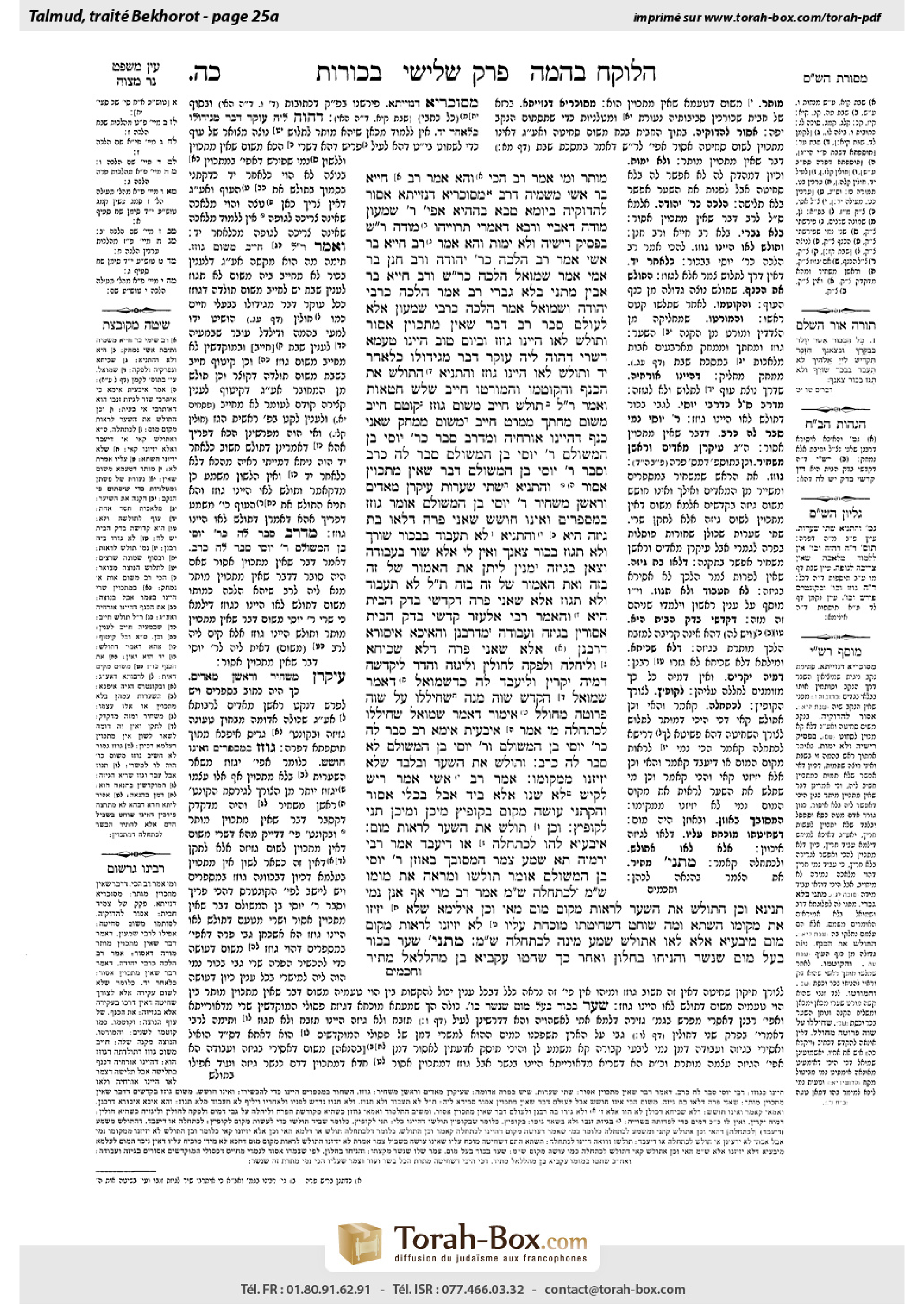
בכורות כ״ה א · Aramaic and Hebrew text
מוּתָּר.
וּמִי אָמַר רַב הָכִי? וְהָא אָמַר רַב חִיָּיא בַּר אָשֵׁי מִשְּׁמֵיהּ דְּרַב: מְסוֹכַרְיָא דְּנַזְיָיתָא אָסוּר לְהַדּוֹקַיהּ בְּיוֹמָא טָבָא!
בְּהָהִיא, אֲפִילּוּ רַבִּי שִׁמְעוֹן מוֹדֶה, דְּאַבָּיֵי וְרָבָא דְּאָמְרִי תַּרְוַיְיהוּ: מוֹדֶה רַבִּי שִׁמְעוֹן בִּפְסִיק רֵישֵׁיהּ וְלָא יְמוּת.
וְהָא אָמַר רַב חִיָּיא בַּר אָשֵׁי אָמַר רַב: הֲלָכָה כְּרַבִּי יְהוּדָה, וְרַב חָנָן בַּר אַמֵּי אָמַר שְׁמוּאֵל: הֲלָכָה כְּרַבִּי שִׁמְעוֹן, וְרַב חִיָּיא בַּר אָבִין מַתְנֵי בְּלָא גַּבְרֵי: רַב אָמַר הֲלָכָה כְּרַבִּי יְהוּדָה, וּשְׁמוּאֵל אָמַר הֲלָכָה כְּרַבִּי שִׁמְעוֹן!
אֶלָּא, לְעוֹלָם סָבַר רַב: דָּבָר שֶׁאֵין מִתְכַּוֵּין אָסוּר, וְתוֹלֵשׁ לָאו הַיְינוּ גּוֹזֵז, וּבְיוֹם טוֹב הַיְינוּ טַעְמָא דִּשְׁרֵי — דְּהָוֵה לֵיהּ עוֹקֵר דָּבָר מִגִּידּוּלוֹ כִּלְאַחַר יָד.
וְתוֹלֵשׁ לָאו הַיְינוּ גּוֹזֵז? וְהָתַנְיָא: הַתּוֹלֵשׁ אֶת הַכָּנָף, וְהַקּוֹטְמוֹ, וְהַמּוֹרְטוֹ — חַיָּיב שָׁלֹשׁ חַטָּאוֹת. וְאָמַר רֵישׁ לָקִישׁ: תּוֹלֵשׁ — חַיָּיב מִשּׁוּם גּוֹזֵז, קוֹטֵם — חַיָּיב מִשּׁוּם מְחַתֵּךְ, מְמָרֵט — חַיָּיב מִשּׁוּם מְמַחֵק! שָׁאנֵי כָּנָף, דְּהַיְינוּ אוֹרְחֵיהּ.
וּמִדְּרַב סָבַר כְּרַבִּי יוֹסֵי בֶּן הַמְשׁוּלָּם, רַבִּי יוֹסֵי בֶּן הַמְשׁוּלָּם סָבַר לַהּ כְּרַב, וְסָבַר רַבִּי יוֹסֵי בֶּן הַמְשׁוּלָּם דָּבָר שֶׁאֵין מִתְכַּוֵּין אָסוּר?
וְהָתַנְיָא: שְׁתֵּי שְׂעָרוֹת — עִיקָּרָן מַאֲדִים, וְרֹאשָׁן מַשְׁחִיר, רַבִּי יוֹסֵי בֶּן הַמְשׁוּלָּם אוֹמֵר: גּוֹזֵז בְּמִסְפָּרַיִם, וְאֵינוֹ חוֹשֵׁשׁ.
שָׁאנֵי פָּרָה, דְּלָאו בַּת גִּיזָּה הִיא. וְהָתַנְיָא: ״לֹא תַעֲבֹד בִּבְכֹר שׁוֹרֶךָ וְלֹא תָגֹז בְּכוֹר צֹאנֶךָ״, וְאֵין לִי אֶלָּא שׁוֹר בַּעֲבוֹדָה וְצֹאן בְּגִיזָּה, מִנַּיִן לִיתֵּן אֶת הָאָמוּר שֶׁל זֶה בָּזֶה וְאֶת הָאָמוּר שֶׁל זֶה בָּזֶה? תַּלְמוּד לוֹמַר: ״לֹא תַעֲבֹד... וְלֹא תָגֹז״!
אֶלָּא, שָׁאנֵי פָּרָה, דְּקׇדְשֵׁי בֶּדֶק הַבַּיִת הִיא. וְהָאָמַר רַבִּי אֶלְעָזָר: קׇדְשֵׁי בֶּדֶק הַבַּיִת אֲסוּרִין בְּגִיזָּה וַעֲבוֹדָה! מִדְּרַבָּנַן. וְהָאִיכָּא אִיסּוּרָא דְּרַבָּנַן! אֶלָּא, שָׁאנֵי פָּרָה דְּלָא שְׁכִיחָא.
וְלִיחַלַּהּ וְלַפְּקַהּ לְחוּלִּין, וְלִיגֻזַּהּ וַהֲדַר לַיקְדְּשַׁהּ! דָּמֶיהָ יְקָרִין. וְלֶיעְבַּד לָהּ כְּדִשְׁמוּאֵל, דְּאָמַר שְׁמוּאֵל: הֶקְדֵּשׁ שָׁוֶה מָנֶה שֶׁחִילְּלוֹ עַל שָׁוֶה פְּרוּטָה מְחוּלָּל! אֵימוֹר דְּאָמַר שְׁמוּאֵל שֶׁחִילְּלוֹ, לְכִתְחִלָּה מִי אָמַר?
אִיבָּעֵית אֵימָא: רַב סָבַר לַהּ כְּרַבִּי יוֹסֵי בֶּן הַמְשׁוּלָּם, וְרַבִּי יוֹסֵי בֶּן הַמְשׁוּלָּם לָא סָבַר לַהּ כְּרַב.
וְתוֹלֵשׁ אֶת הַשֵּׂעָר, וּבִלְבַד שֶׁלֹּא יְזִיזֶנּוּ מִמְּקוֹמוֹ. אָמַר רַב אָשֵׁי אָמַר רֵישׁ לָקִישׁ: לֹא שָׁנוּ אֶלָּא בַּיָּד, אֲבָל בִּכְלִי — אָסוּר. וְהָקָתָנֵי: עוֹשֶׂה מָקוֹם בְּקוֹפִיץ מִיכָּן וּמִיכָּן! תְּנִי: ״לְקוֹפִיץ״.
וְכֵן תּוֹלֵשׁ אֶת הַשֵּׂעָר לִרְאוֹת מוּם. אִיבַּעְיָא לְהוּ: לְכַתְּחִלָּה אוֹ דִיעֲבַד? אָמַר רַבִּי יִרְמְיָה: תָּא שְׁמַע, צֶמֶר הַמְסוּבָּךְ בָּאוֹזֶן — רַבִּי יוֹסֵי בֶּן הַמְשׁוּלָּם אוֹמֵר: תּוֹלְשׁוֹ וּמַרְאֶה אֶת מוּמוֹ. שְׁמַע מִינַּהּ לְכַתְּחִלָּה, שְׁמַע מִינַּהּ.
אָמַר רַב מָרִי: אַף אֲנַן נָמֵי תְּנֵינָא, וְכֵן הַתּוֹלֵשׁ אֶת הַשֵּׂעָר לִרְאוֹת מְקוֹם מוּם. מַאי ״וְכֵן״? אִילֵּימָא שֶׁלֹּא (יָזִיזוּ אֶת) [יְזִיזֶנּוּ מִ]מְּקוֹמוֹ — הַשְׁתָּא וּמָה שׁוֹחֵט, דִּשְׁחִיטָתוֹ מוֹכַחַת עָלָיו, לֹא יְזִיזֶנּוּ — לִרְאוֹת מְקוֹם מוּם מִיבַּעְיָא?
אֶלָּא לָאו אַתּוֹלֵשׁ? שְׁמַע מִינַּהּ לְכַתְּחִלָּה, שְׁמַע מִינַּהּ.
מַתְנִי׳ שְׂעַר בְּכוֹר בַּעַל מוּם שֶׁנָּשַׁר, וְהִנִּיחוֹ בַּחַלּוֹן, וְאַחַר כָּךְ שְׁחָטוֹ — עֲקַבְיָא בֶּן מַהֲלַלְאֵל מַתִּיר,
Bekhorot 25a · English translation
it is permitted to pluck the hair in order to facilitate proper slaughter.
The Gemara raises a difficulty: And does Rav actually say this? But doesn’t Rav Ḥiyya bar Ashi say in the name of Rav: In the case of this cloth stopper of a barrel [mesokhrayya denazyata], it is prohibited to insert it tightly into the spout of the barrel on a Festival, because in the process liquid will be squeezed from the cloth, and squeezing liquids is prohibited on Shabbat and Festivals? Apparently, Rav prohibits even unintentional actions, and it follows that it is prohibited to clear hair with a cleaver on a Festival, as one will unintentionally pluck out some hair.
The Gemara explains: In that case of the stopper, even the lenient authority, Rabbi Shimon, concedes that it is prohibited, as Rava and Abaye both say: Rabbi Shimon concedes that an unintentional act is prohibited if it falls under the category known as: Cut off its head and will it not die, i.e., when a prohibited labor is the inevitable consequence of an unintentional act. In the case of the cloth stopper, some water will inevitably be squeezed out.
The Gemara objects to the claim that Rav agrees with the opinion of Rabbi Shimon that a regular unintentional act is permitted: But doesn’t Rav Ḥiyya bar Ashi say that Rav says: The halakha is in accordance with the opinion of Rabbi Yehuda, and Rav Ḥanan bar Ami says that Shmuel says: The halakha is in accordance with the opinion of Rabbi Shimon. And Rav Ḥiyya bar Avin teaches Rav and Shmuel’s rulings without mentioning either man, neither Rabbi Ḥiyya bar Ashi nor Rav Ḥanan bar Ami, and says: Rav says the halakha is in accordance with the opinion of Rabbi Yehuda, and Shmuel says the halakha is in accordance with the opinion of Rabbi Shimon.
Rather, actually Rav holds that an unintentional act is prohibited, and he permits plucking the hair of a firstborn because he maintains that plucking is not considered a form of shearing. And this is the reason he permits clearing the hair with a cleaver on a Festival, because it is considered uprooting an item from its place of growth in an unusual manner, and performing a prohibited labor in an unusual manner is not prohibited by Torah law.
The Gemara raises a difficulty: And can it be claimed that plucking is not considered a form of shearing? But isn’t it taught in a baraita: One who unwittingly plucks a large feather from the wing of a bird on Shabbat, and one who snips the tip of the feather, and one who pulls out the thin threads that constitute the feather is obligated to bring three sin offerings, one for each transgression. And Reish Lakish says, in explanation: One who plucks the wing is liable due to the labor of shearing. One who snips the tip of the feather is liable due to the labor of cutting. And one who pulls out the threads is liable due to the labor of smoothing. The Gemara explains: Plucking a wing is different from plucking hair, as that is the normal method employed to remove feathers.
The Gemara comments: And from the fact that Rav holds in accordance with the opinion of Rabbi Yosei ben HaMeshullam that plucking is not considered shearing, it can be inferred that Rabbi Yosei ben HaMeshullam holds in accordance with the opinion of Rav that an unintentional act is prohibited. The Gemara asks: And does Rabbi Yosei ben HaMeshullam hold that an unintentional act is prohibited?
But isn’t it taught in a baraita: With regard to a red heifer, which is rendered unfit if it possesses two black hairs, that had two hairs whose roots were red but whose tops were black, Rabbi Yosei ben HaMeshullam says: One shears the tops with scissors, and he need not be concerned that he is violating the prohibition against shearing a consecrated animal. Apparently, the reason is that he does not intend to shear the red heifer but only to render it fit. This indicates that Rabbi Yosei ben HaMeshullam holds an unintentional act is permitted.
The Gemara answers: A red heifer is different, as it is not subject to the prohibition against shearing a consecrated animal because it does not have wool, and that is why it is permitted to cut the tops of its hairs. The Gemara raises a difficulty: But isn’t it taught in a baraita: The verse states: “You shall do no work with the firstborn of your ox, and you shall not shear the firstborn of your flock” (Deuteronomy 15:19). I have derived only that a firstborn ox may not be used for labor and that a firstborn sheep may not be used for shearing. From where is it derived to apply what is said about that animal to this one, and what is said about this animal to that one? The verse states: “You shall do no work…and you shall not shear.” The term “and” indicates the two parts of the verse apply to both animals. Evidently, the act of shearing does apply to an ox, including a red heifer.
Rather, the red heifer is different, as it has the sanctity of items consecrated for Temple maintenance, and therefore the prohibitions that apply to offerings do not necessarily apply to it. The Gemara raises a difficulty: But doesn’t Rabbi Elazar say it is prohibited to shear or perform labor with items consecrated for Temple maintenance? The Gemara answers: That prohibition applies by rabbinic law. The Gemara retorts: But that does not resolve the difficulty, as there is nevertheless still a prohibition by rabbinic law. Why, then, did Rabbi Yosei ben HaMeshullam deem it permitted for one to shear the tops of its hairs with scissors? The Gemara accepts this objection: Rather, the red heifer is different, as it is uncommon, and Rabbi Yosei ben HaMeshullam therefore maintains that the prohibition by rabbinic law was not applied to this case.
The Gemara challenges: But let the owner desacralize the heifer and render it non-sacred, and shear it, and then consecrate it again. The Gemara explains it is unreasonable to demand he desacralize it, as its price is expensive, and it would take an exceptionally large sum of money to desacralize it. The Gemara challenges: But let him act in accordance with the statement of Shmuel, as Shmuel says: A consecrated animal worth one hundred dinars that one desacralized upon the value of one peruta is desacralized. The Gemara explains: You can say that Shmuel said that he has successfully desacralized the animal, but did he say an animal may be desacralized in this manner ab initio? The Gemara therefore concludes that Rabbi Yosei ben HaMeshullam deems it permitted for one to cut the tops of a red heifer’s hairs because it is an uncommon case.
And if you wish, say instead that although Rav holds in accordance with the opinion of Rabbi Yosei ben HaMeshullam, Rabbi Yosei ben HaMeshullam does not hold in accordance with the opinion of Rav.
§ The mishna teaches: One who is slaughtering a firstborn clears space with a cleaver from here and from there, on either side of the neck, although he thereby plucks out the hair. He may clear space in this manner provided that he does not move the hair from its place. Rav Ashi says that Reish Lakish says: They taught that this is permitted only if one plucks the hair by hand, but if he does it with a tool it is prohibited, as it appears as though he is shearing the firstborn. The Gemara asks: But isn’t it taught that one may clear space with a cleaver from here and from there on either side of the neck? The Gemara answers: Teach it as: One may clear space with his hands for a cleaver, but he may not clear space with a cleaver.
The mishna further teaches: And likewise, one plucks the hair to enable one of the Sages to examine the place of a blemish. A dilemma was raised before the Sages: Is this permitted ab initio, or only after the fact? Rabbi Yirmeya said: Come and hear a baraita: If there is wool that is entangled in a firstborn’s ear, and it is obscuring a blemish that must be examined, Rabbi Yosei ben HaMeshullam says: One plucks the wool and shows the animal’s blemish to a Sage in order to determine whether it is permitted to slaughter the animal outside the Temple. One can conclude from the baraita that it is permitted ab initio. The Gemara affirms: Indeed, conclude from it that this is so.
The Gemara corroborates its conclusion. Rav Mari said: We learn in the mishna as well: And likewise, one plucks the hair to examine the place of a blemish. What is the mishna referring to in its comparison: And likewise? If we say it is referring to the mishna’s ruling that when one slaughters a firstborn he may not move the plucked hair from its place, then the second halakha is unnecessary. Now that it is taught that if, when one comes to slaughter the animal, where its imminent slaughter renders it evident that he does not intend to shear it, but nevertheless he may not remove the hair, is it necessary to teach that one may not remove the plucked hair in order to examine the place of a blemish?
Rather, isn’t the mishna’s comparison referring to the fact that it is permitted to pluck the hair ab initio? Just as it is permitted to pluck the hair for the purpose of slaughtering the animal, so too, it is permitted to pluck the hair in order to examine a blemish. Conclude from it that it is permitted ab initio. The Gemara affirms: Indeed, conclude from it that this is so.
MISHNA: With regard to the hair of a blemished firstborn animal that shed from the animal, and which one placed in a compartment for safekeeping, and thereafter he slaughtered the animal; given that after the animal dies he is permitted to derive benefit from the hair the animal had on its body when it died, what is the halakhic status of hair that shed from the animal while it was alive? Akavya ben Mahalalel deems its use permitted,
Bekhorot 25a · Traduction française (IA)
il est permis de tirer les cheveux afin de faciliter une bonne immolation.
La Guemara soulève un doute : Et Rav dit-il vraiment cela ? Mais n’est-ce pas que Rav Hiyah bar Ashi, dans le nom de Rav, dit : Dans le cas de ce bouchon de tonneau [mesokhrayya denazyata], il est interdit d’y insérer hermétiquement le bouchon dans le robinet du tonneau pendant un festival, car lors du processus, de l’eau sera écrasée du tissu, et écraser des liquides est interdit le Sabbat et les fêtes ? Apparemment, Rav interdit même les actions involontaires, et il en découle que l’on ne doit pas dégager les cheveux avec un couteau pendant un festival, car l’on arracherait involontairement quelques cheveux.
La Guemara explique : Dans ce cas du bouchon, même l’autorité leniente, Rabbi Shimon, reconnaît qu’il est interdit, car Rava et Abaye disent tous les deux : Rabbi Shimon reconnaît qu’une action involontaire est interdite si elle relève de la catégorie connue sous le nom de : Coupe sa tête et ne mourra-t-il pas, c’est-à-dire lorsque l’acte interdit est une conséquence inévitable d’une action involontaire. Dans le cas du bouchon en tissu, de l’eau sera inévitablement écrasée.
La Guemara s’oppose à l’affirmation que Rav s’accorde avec l’opinion de Rabbi Shimon qui permet une action involontaire : Mais n’est-ce pas que Rav Hiyah bar Ashi dit que Rav dit : La halakha suit l’opinion de Rabbi Yéhuda, et Rav Hanan bar Ami dit que Shmuel dit : La halakha suit l’opinion de Rabbi Shimon. Et Rav Hiyah bar Avin enseigne les décisions de Rav et de Shmuel sans mentionner aucun d’entre eux, ni Rabbi Hiyah bar Ashi ni Rav Hanan bar Ami, et dit : Rav dit que la halakha suit l’opinion de Rabbi Yéhuda, et Shmuel dit que la halakha suit l’opinion de Rabbi Shimon.
En réalité, Rav considère qu’une action involontaire est interdite, et il permet de tirer les cheveux du premier-né car il considère que tirer n’est pas considéré comme une tonte. C’est la raison pour laquelle il permet de dégager les cheveux avec un couteau pendant un festival, car cela est considéré comme arracher un objet de son lieu de croissance d’une manière inhabituelle, et accomplir un travail interdit d’une manière inhabituelle n’est pas interdit par la Loi divine.
La Guemara soulève un doute : Et peut-on affirmer que tirer n’est pas considéré comme une tonte ? Mais n’est-ce pas enseigné dans une baraïta : Celui qui arrache involontairement une grande plume d’un oiseau le Sabbat, et celui qui coupe la pointe de la plume, et celui qui tire les fils fins qui composent la plume est tenu de présenter trois offrandes expiatoires, une pour chaque transgression. Et Reish Lakish dit, en explication : Celui qui arrache la queue est responsable du travail de tonte. Celui qui coupe la pointe de la plume est responsable du travail de coupure. Et celui qui tire les fils est responsable du travail de lissage. La Guemara explique : Arracher une queue est différent d’arracher des cheveux, car c’est la méthode normale pour retirer des plumes.
La Guemara commente : Et du fait que Rav suit l’opinion de Rabbi Yosei ben HaMeshullam qui considère que tirer n’est pas considéré comme une tonte, on peut en déduire que Rabbi Yosei ben HaMeshullam suit l’opinion de Rav que les actions involontaires sont interdites. La Guemara demande : Et Rabbi Yosei ben HaMeshullam considère-t-il que les actions involontaires sont interdites ?
Mais n’est-ce pas enseigné dans une baraïta : Concernant une vache rouge, qui devient impure si elle possède deux cheveux noirs, celle qui avait deux cheveux dont les racines étaient rouges mais dont les pointes étaient noires, Rabbi Yosei ben HaMeshullam dit : On taille les pointes avec des ciseaux, et il n’a pas à crainre de violer l’interdiction de tondre un animal consacré. Apparemment, la raison est qu’il ne veut pas tondre la vache rouge mais seulement la rendre propre. Cela indique que Rabbi Yosei ben HaMeshullam considère que les actions involontaires sont permises.
La Guemara répond : La vache rouge est différente, car elle n’est pas soumise à l’interdiction de tondre un animal consacré car elle n’a pas de laine, et c’est pourquoi il est permis de couper les pointes de ses cheveux. La Guemara soulève un doute : Mais n’est-ce pas enseigné dans une baraïta : La parole dit : « Tu ne feras aucun travail avec le premier-né de ton bœuf, et tu ne tondras pas le premier-né de ton troupeau » (Deutéronome 15:19). J’ai déduit seulement que le premier-né de bœuf ne doit pas être utilisé pour le travail et que le premier-né de troupeau ne doit pas être tondu. D’où vient qu’on applique ce qui est dit à cet animal à celui-ci, et ce qui est dit à cet animal à celui-ci ? La parole dit : « Tu ne feras aucun travail… et tu ne tondras pas ». Le terme « et » indique que les deux parties de la parole s’appliquent aux deux animaux. Évidemment, l’acte de tondre s’applique à un bœuf, y compris à une vache rouge.
En réalité, la vache rouge est différente, car elle possède la sanctité des objets consacrés à l’entretien du Temple, et par conséquent les interdits qui s’appliquent aux offrandes ne s’appliquent pas nécessairement à elle. La Guemara soulève un doute : Mais n’est-ce pas que Rabbi Eléazar dit qu’il est interdit de tondre ou d’accomplir un travail avec des objets consacrés à l’entretien du Temple ? La Guemara répond : Cette interdiction s’applique par la loi rabbinique. La Guemara rétorque : Mais cela ne résout pas le doute, car il y a tout de même une interdiction par la loi rabbinique. Pourquoi, alors, Rabbi Yosei ben HaMeshullam considère-t-il qu’il est permis de tailler les pointes de ses cheveux avec des ciseaux ? La Guemara accepte ce doute : En réalité, la vache rouge est différente, car elle est rare, et Rabbi Yosei ben HaMeshullam maintient donc que l’interdiction par la loi rabbinique n’a pas été appliquée à ce cas.
La Guemara pose un défi : Mais que l'propriétaire désacrifie la bêta et la rende non sacrée, qu'il la tond, puis qu'il la sacrifie à nouveau. La Guemara explique que cela n'est pas raisonnable de demander qu'il la désacrifie, car sa valeur est élevée, et il faudrait une somme exceptionnellement importante pour la désacrifier. La Guemara pose un défi : Mais qu'il agisse selon la déclaration de Shmuel, car Shmuel dit : Un animal sacrifié d'une valeur de cent dinars que l'on désacrifie à la valeur d'une perute est désacrifié. La Guemara explique : On peut dire que Shmuel a dit qu'il a réussi à désacrifier l'animal, mais a-t-il dit qu'un animal peut être désacrifié ainsi dès le début ? La Guemara conclut donc que Rabbi Yosei ben HaMeshullam considère comme permis de couper les poils de la tête de la bêta rouge, car c'est un cas rare.
Et si vous le souhaitez, dites plutôt que bien que Rav suive l'opinion de Rabbi Yosei ben HaMeshullam, Rabbi Yosei ben HaMeshullam ne suit pas l'opinion de Rav.
§ La mitsva enseigne : Celui qui sacrifie un premier-né fait de la place avec un couteau d'ici et d'ailleurs, des deux côtés du cou, bien qu'il enlève ainsi les poils. Il peut faire de la place ainsi à condition qu'il ne déplace pas les poils de leur place. Rav Ashi dit que Reish Lakish dit : Ils ont enseigné que cela est permis uniquement si l'on arrache les poils à la main, mais s'il le fait avec un outil, cela est interdit, car cela semble comme si l'on tondait le premier-né. La Guemara pose la question : Mais n'est-il pas enseigné que l'on peut faire de la place avec un couteau d'ici et d'ailleurs des deux côtés du cou ? La Guemara répond : Apprenez-le ainsi : On peut faire de la place avec ses mains pour un couteau, mais on ne peut pas faire de la place avec un couteau.
La mitsna enseigne également : Et de même, l'on arrache les poils afin que l'un des Sages examine la place d'une imperfection. Un dilemme a été soulevé devant les Sages : Cette action est-elle permise dès le début, ou uniquement après coup ? Rabbi Yirmeya a dit : Venez entendre une baraïta : Si des poils sont enroulés dans l'oreille d'un premier-né et obscurcissent une imperfection à examiner, Rabbi Yosei ben HaMeshullam dit : On arrache les poils et on montre l'imperfection de l'animal à un Sage afin de déterminer s'il est permis de sacrifier l'animal en dehors du Temple. On peut conclure de la baraïta qu'il est permis dès le début. La Guemara confirme : En effet, concluez-en ainsi que cela est vrai.
La Guemara confirme sa conclusion. Rav Mari a dit : Nous apprenons également dans la mitsna : Et de même, l'on arrache les poils afin d'examiner la place d'une imperfection. À quoi la mitsna fait-elle référence dans sa comparaison : Et de même ? Si nous disons qu'elle fait référence à la décision de la mitsna selon laquelle lorsqu'on sacrifie un premier-né, on ne doit pas déplacer les poils arrachés de leur place, alors la deuxième halakha est inutile. Maintenant que cela est enseigné que si, lorsqu'on vient sacrifier l'animal, où sa prochaine sacrifice rend clair qu'on n'a pas l'intention de le tondre, mais malgré cela on ne doit pas retirer les poils, est-il nécessaire d'enseigner que l'on ne doit pas retirer les poils arrachés afin d'examiner la place d'une imperfection ?
Plutôt, n'est-ce pas la comparaison de la mitsna qui fait référence au fait qu'il est permis d'arracher les poils dès le début ? Tout comme il est permis d'arracher les poils à la fin de la sacrifice, de même il est permis d'arracher les poils afin d'examiner une imperfection. Concluez-en ainsi qu'il est permis dès le début. La Guemara confirme : En effet, concluez-en ainsi que cela est vrai.
MICHNA : Concernant les poils d'un premier-né blemi qui avaient été éjectés de l'animal et que l'on avait placés dans une pièce pour les garder en sécurité, et ensuite l'on avait sacrifié l'animal ; étant donné que, après la mort de l'animal, on est autorisé à tirer profit des poils que l'animal avait sur son corps lorsqu'il est mort, quelle est la statut halakhique des poils qui avaient été éjectés de l'animal pendant qu'il était vivant ? Akavya ben Mahalalel considère qu'il est permis d'en tirer profit,
Traduction française générée par IA à partir de l’édition anglaise de Sefaria. Vérifie toujours un passage avec le texte source.
Text from Sefaria: William Davidson Edition - Vocalized Aramaic (CC BY NC); William Davidson Edition - English (CC BY NC).