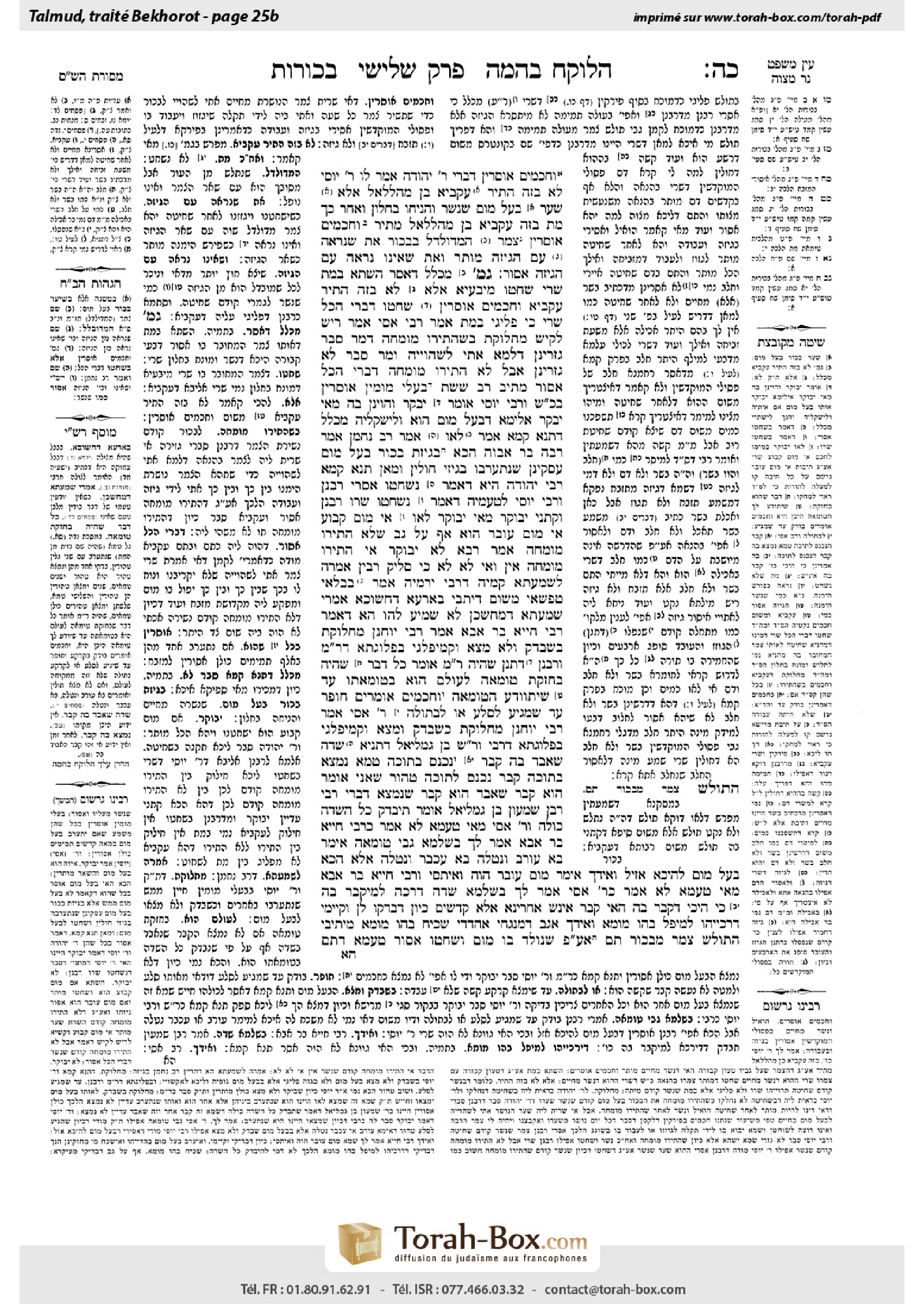
Bekhorot 25b: Talmud study for Daf Yomi
Study the Talmud for Daf Yomi with scanned pages, Hebrew text, English translations from Sefaria and AI-generated French translations.
Passage selection and English or AI-generated French translation are available where the scan has annotations. Daf Study is independent of Torah-Box and Sefaria.
Browse Bekhorot · בכורות · All tractatesBekhorot 25b text and translations
This page of Bekhorot includes the Aramaic text, an English translation and an AI-generated French translation, alongside the scan above.
בכורות כ״ה ב · Aramaic and Hebrew text
וַחֲכָמִים אוֹסְרִין, דִּבְרֵי רַבִּי יְהוּדָה. אָמַר לוֹ רַבִּי יוֹסֵי: לֹא בָּזֶה הִתִּיר עֲקַבְיָא בֶּן מַהֲלַלְאֵל, אֶלָּא שְׂעַר בַּעַל מוּם שֶׁנָּשַׁר וְהִנִּיחוֹ בַּחַלּוֹן וְאַחַר כָּךְ מֵת — בָּזֶה עֲקַבְיָא בֶּן מַהֲלַלְאֵל מַתִּיר וַחֲכָמִים אוֹסְרִין.
צֶמֶר הַמְדוּלְדָּל בַּבְּכוֹר, אֶת שֶׁנִּרְאֶה עִם הַגִּיזָּה — מוּתָּר, וְאֶת שֶׁאֵינוֹ נִרְאֶה עִם הַגִּיזָּה — אָסוּר.
גְּמָ׳ מִכְּלָל דְּאָסַר, הַשְׁתָּא בְּמֵת — שָׁרֵי, שְׁחָטוֹ מִיבַּעְיָא?
אֶלָּא, לֹא בָּזֶה הִתִּיר עֲקַבְיָא וַחֲכָמִים אוֹסְרִין, שְׁחָטוֹ — דִּבְרֵי הַכֹּל שְׁרֵי, כִּי פְּלִיגִי בְּמֵת.
אָמַר רַבִּי אַסִּי אָמַר רֵישׁ לָקִישׁ: מַחְלוֹקֶת בְּשֶׁהִתִּירוֹ מוּמְחֶה, דְּמָר סָבַר: גָּזְרִינַן דִּלְמָא אָתֵי לְשַׁהוֹיֵיהּ, וּמָר סָבַר: לָא גָּזְרִינַן, אֲבָל לֹא הִתִּירוֹ מוּמְחֶה — דִּבְרֵי הַכֹּל אָסוּר.
מֵתִיב רַב שֵׁשֶׁת: בַּעֲלֵי מוּמִין אוֹסְרִין בְּכׇל שֶׁהוּא, וְרַבִּי יוֹסֵי אוֹמֵר: יְבַקֵּר.
וְהָוֵינַן בַּהּ: מַאי ״יְבַקֵּר״? אִלֵּימָא דְּבַעַל מוּם הוּא, וְלִישְׁקְלֵיהּ — מִכְּלָל דְּתַנָּא קַמָּא אָמַר לָאו?
אָמַר רַב נַחְמָן אָמַר רַבָּה בַּר אֲבוּהּ: הָכָא בְּגִיזַּת בְּכוֹר בַּעַל מוּם עָסְקִינַן, שֶׁנִּתְעָרְבוּ בְּגִיזֵּי חוּלִּין. וּמַאן תַּנָּא קַמָּא? רַבִּי יְהוּדָה הִיא, דְּאָמַר: נִשְׁחֲטוּ — אָסְרִי רַבָּנַן. וְרַבִּי יוֹסֵי לְטַעְמֵיהּ, דְּאָמַר: נִשְׁחֲטוּ — שָׁרוּ רַבָּנַן.
וְקָתָנֵי: ״יְבוּקַּר״, מַאי ״יְבוּקַּר״? לָאו אִי ״מוּם קָבוּעַ״ אִי ״מוּם עוֹבֵר״ הוּא, אַף עַל גַּב שֶׁלֹּא הִתִּירוֹ מוּמְחֶה.
אָמַר רָבָא: לֹא; יְבוּקַּר, אִי הִתִּירוֹ מוּמְחֶה — אִין, וְאִי לָא — לָא.
כִּי סְלֵיק רָבִין, אַמְרַהּ לִשְׁמַעְתָּא קַמֵּיהּ דְּרַבִּי יִרְמְיָה. אֲמַר: בַּבְלָאֵי טַפְשָׁאֵי, מִשּׁוּם דְּיָתְבִי בְּאַרְעָא דַּחֲשׁוֹכָא אָמְרִי שְׁמַעְתָּא דִּמְחַשְּׁכָן! לָא שְׁמִיעַ לְהוּ הָא דְּאָמַר רַבִּי חִיָּיא בַּר אַבָּא אָמַר רַבִּי יוֹחָנָן: מַחְלוֹקֶת בְּשֶׁבָּדַק וְלֹא מָצָא.
וְקָמִיפַּלְגִי בִּפְלוּגְתָּא דְּרַבִּי מֵאִיר וְרַבָּנַן, דִּתְנַן, שֶׁהָיָה רַבִּי מֵאִיר אוֹמֵר: כׇּל דָּבָר שֶׁהָיָה בְּחֶזְקַת טוּמְאָה — לְעוֹלָם הוּא בְּטוּמְאָתוֹ, עַד שֶׁתִּיוָּודַע הַטּוּמְאָה.
וַחֲכָמִים אוֹמְרִים: חוֹפֵר עַד שֶׁמַּגִּיעַ לְסֶלַע אוֹ לִבְתוּלָה.
רַבִּי אַסִּי אָמַר רַבִּי יוֹחָנָן: מַחְלוֹקֶת כְּשֶׁבָּדַק וּמָצָא, וְקָמִיפַּלְגִי בִּפְלוּגְתָּא דְּרַבִּי וְרַבָּן שִׁמְעוֹן בֶּן גַּמְלִיאֵל.
דְּתַנְיָא: שָׂדֶה שֶׁאָבַד בָּהּ קֶבֶר, נִכְנָס בְּתוֹכָהּ — טָמֵא. נִמְצָא בְּתוֹכָהּ קֶבֶר, נִכְנָס לְתוֹכָהּ — טָהוֹר, שֶׁאֲנִי אוֹמֵר: הוּא קֶבֶר שֶׁאָבַד הוּא קֶבֶר שֶׁנִּמְצָא, דִּבְרֵי רַבִּי. רַבָּן שִׁמְעוֹן בֶּן גַּמְלִיאֵל אוֹמֵר: תִּיבָּדֵק כׇּל הַשָּׂדֶה כּוּלָּהּ.
וְרַבִּי אַסִּי, מַאי טַעְמָא לָא אָמַר כְּרַבִּי חִיָּיא בַּר אַבָּא? אָמַר לָךְ: בִּשְׁלָמָא גַּבֵּי טוּמְאָה, אֵימַר בָּא עוֹרֵב וּנְטָלָהּ, בָּא עַכְבָּר וּנְטָלָהּ, אֶלָּא הָכָא — בַּעַל מוּם לְהֵיכָא אָזֵיל? וְאִידַּךְ? אֵימַר מוּם עוֹבֵר הֲוָה וְאִיתַּסִּי.
וְרַבִּי חִיָּיא בַּר אַבָּא מַאי טַעְמָא לָא אָמַר כְּרַבִּי אַסִּי? אָמַר לָךְ: בִּשְׁלָמָא שָׂדֶה, דִּרְכַּהּ לְמִיקְבַּר בַּהּ, כִּי הֵיכִי דִּקְבַר בָּהּ הַאי — קְבַר אִינָשׁ אַחֲרִינָא. אֶלָּא קָדָשִׁים, כֵּיוָן דִּבְדִקִי לַן וְקָיְימִי, דִּרְכַּיְיהוּ לְמִיפַּל בְּהוּ מוּמָא? וְאִידַּךְ — אַגַּב דִּמְנַגְּחִי אַהֲדָדֵי, שְׁכִיחַ בְּהוּ מוּמָא.
מֵיתִיבִי: הַתּוֹלֵשׁ צֶמֶר מִבְּכוֹר תָּם, אַף עַל פִּי שֶׁנּוֹלַד בּוֹ מוּם וּשְׁחָטוֹ — אָסוּר. טַעְמָא דְּתָם,
Bekhorot 25b · English translation
and the Rabbis deem its use prohibited; this is the statement of Rabbi Yehuda. Rabbi Yosei said to him: It was not with regard to that case that Akavya ben Mahalalel deemed use of the wool permitted. Rather, it was in the case of the hair of a blemished firstborn animal that shed from the animal which one placed in a compartment and thereafter the animal died. It was in that case that Akavya ben Mahalalel deems use of the wool permitted, and the Rabbis deem its use prohibited even after its death.
With regard to wool that is dangling from a firstborn animal, i.e., which was not completely shed, that which appears to be part of the fleece is permitted when the animal is shorn after its death, and that which does not appear to be part of the fleece is prohibited.
GEMARA: Rabbi Yosei’s statement, that it was not with regard to the case where the animal was slaughtered that Akavya ben Mahalalel deemed use of the wool permitted, apparently indicates by inference that Akavya ben Mahalalel deemed use of the wool prohibited if the animal was slaughtered. This is difficult: Now that it has been taught that use of the detached wool of a dead firstborn is permitted, despite the fact that the attached hair must be buried, is it necessary to teach that detached wool is permitted in a case where one slaughtered the animal, where the use of the attached hair is permitted?
Rather, Rabbi Yosei means that it was not in that case that Akavya deemed use of the detached wool permitted while the Rabbis deem it prohibited, since if he slaughtered the animal, everyone agrees that use of the wool is permitted. They disagree in a case where the detached wool came from a dead animal that was not slaughtered.
Rabbi Asi says that Reish Lakish says: The dispute applies in a case where an expert deemed the animal permitted for slaughter due to a blemish before the wool was shed, as one Sage, the Rabbis, holds that we decree that use of the wool the animal sheds is prohibited, lest one come to postpone its slaughter in order to collect the wool that it sheds. The Rabbis wanted a blemished firstborn to be slaughtered as soon as possible, lest one shear it or use it for labor, both of which are prohibited by Torah law. And one Sage, Akavya ben Mahalalel, holds that we do not issue such a decree. But in a case where an expert did not deem the animal permitted for slaughter before its wool was shed, all agree that use of the wool is prohibited, even after the animal died or was slaughtered.
Rav Sheshet raises an objection from a baraita: Blemished animals that become intermingled with unblemished animals render the entire group of animals prohibited in any ratio, even if there was only one blemished animal. Since blemished animals may not be sacrificed, and it is impossible to distinguish them from the unblemished animals, none may be sacrificed on the altar. And Rabbi Yosei says: Let the matter be investigated.
Rav Sheshet continues: And we discussed it, and inquired: What did Rabbi Yosei mean when he said: Let the matter be investigated? Shall we say he meant that one should search for the blemished animal and remove it from the group, so that the other animals may be slaughtered on the altar? This is difficult, as in that case, by inference, the first tanna said that in such a case the remaining unblemished animals are still not permitted. This cannot be so, as there is no reason to deem the remaining animals prohibited once the blemished animal has been removed.
And Rav Naḥman says that Rabba bar Avuh says: Here we are dealing with a case of the shearings of a blemished firstborn, whose detached wool became intermingled with non-sacred wool. And who is the first tanna, who holds that all the wool is prohibited? It is Rabbi Yehuda, who says in the mishna here that if the firstborn were slaughtered, the Rabbis deem use of their wool prohibited. And Rabbi Yosei conforms to his line of reasoning, as he says: If the firstborn were slaughtered, the Rabbis deem use of their wool permitted.
Rav Sheshet explains his objection to the interpretation of Reish Lakish: And it is taught that Rabbi Yosei says: Let the matter be investigated. What does he mean when he says: Let the matter be investigated? Does this not mean that an expert examines the animal to determine whether it is a permanent blemish, in which case the intermingled wool is permitted, or whether it is a temporary blemish and the use of the wool is prohibited? If so, Rabbi Yosei holds that wool shed from a firstborn is permitted even though it was shed before the expert deemed the blemish to be permanent and the animal permitted for slaughter. This contradicts the interpretation of Reish Lakish.
Rava said in response: No, Rabbi Yosei meant that the matter should be investigated to determine if an expert had deemed the firstborn permitted for slaughter before its wool was shed. If he did, then yes, the wool is permitted; and if not, it is not permitted.
The Gemara relates: When Ravin ascended from Babylonia to Eretz Yisrael, he stated this halakha, including Rav Naḥman’s interpretation of the baraita, in the presence of Rabbi Yirmeya. Rabbi Yirmeya said: Foolish Babylonians! Because they dwell in a dark land, they state halakhot that are dim. Did they not hear that which Rabbi Ḥiyya bar Abba says that Rabbi Yoḥanan says: That mishna is dealing with the animals themselves, not their wool, and the dispute between the first tanna and Rabbi Yosei is with regard to a case where one examined the flock and did not find the blemished animal?
And they disagree with regard to the issue that is the subject of the dispute between Rabbi Meir and the Rabbis. As we learned in a mishna (Pesaḥim 10a) that Rabbi Meir would say: Any object that was held in the presumptive status of ritual impurity, e.g., it is certain that there was a grave in a particular field, that place forever remains in its ritual impurity, even if it was excavated and the source of impurity was not found, until it becomes known to you the location of the ritual impurity, and then the rest of the field is permitted. The assumption is that the impurity was not found because the search was not conducted properly.
And the Rabbis say: He continues digging until he reaches bedrock or virgin soil, under which there is certainly no ritual impurity. If he searched this extensively and failed to discover any impurity, it is evidently no longer there. Similarly, in the case of the baraita, the dispute is whether or not failure to locate the blemished animal constitutes sufficient reason to conclude that it is no longer intermingled with the rest of the flock. Accordingly, the first tanna holds in accordance with the opinion of Rabbi Meir while Rabbi Yosei holds in accordance with the opinion of the Rabbis.
The Gemara cites another version of Rabbi Yoḥanan’s interpretation of the baraita: Rabbi Asi says that Rabbi Yoḥanan says: The dispute is with regard to a case where he examined the flock and found the blemished animal, and they disagree with regard to the issue that is the subject of the dispute between Rabbi Yehuda HaNasi and Rabban Shimon ben Gamliel.
This is as it is taught in a baraita: With regard to a field in which a grave was lost, one who enters it becomes impure due to the possibility that he passed over the grave and thereby contracted ritual impurity. If a grave was subsequently found in it, one who enters the field not in the place of the found grave remains pure, as I say: The grave that was lost is the grave that was found. This is the statement of Rabbi Yehuda HaNasi. Rabban Shimon ben Gamliel says: Let the entire field be examined before ruling that one who enters it remains pure. Similarly, in the baraita concerning the intermingled blemished and unblemished animals, the first tanna holds in accordance with the opinion of Rabban Shimon ben Gamliel, while Rabbi Yosei holds in accordance with the opinion of Rabbi Yehuda HaNasi.
The Gemara asks: And Rabbi Asi, what is the reason he did not state the explanation of Rabbi Ḥiyya bar Abba? Rabbi Asi could have said to you: Granted, with regard to impurity one can say the impure object might no longer be there, as perhaps a raven came and took it or a mouse came and took it. But here, with regard to a blemished animal that became intermingled with unblemished animals, where could the blemished animal have gone? The Gemara asks: And how would the other amora, Rabbi Ḥiyya bar Abba, respond to this claim? He would say the blemish was a temporary blemish and it was healed, which is why there is no longer a blemished animal among the flock.
And as for Rabbi Ḥiyya bar Abba, what is the reason he did not state the explanation of Rabbi Asi? Rabbi Ḥiyya bar Abba could have said to you: Granted, in the case of a field it is normal for people to be buried in it, and therefore Rabban Shimon ben Gamliel claims that just as this person was buried in it, so too, another person might have been buried there. Therefore, there is no reason to assume the grave that was found is the grave that was lost. But with regard to sacrificial animals, once they were examined and they are found to be whole, is it normal for them to suddenly develop a blemish? In such a case even the first tanna would not deem the animals prohibited, as it can be assumed they found the only blemished one. And what would the other amora, Rabbi Asi, say in response? Since they gore each other, the development of a blemish is in fact common among them.
Rabbi Asi earlier said in the name of Reish Lakish that both Akavya ben Mahalalel and the Rabbis agree that if an expert did not deem the firstborn permitted for slaughter before its wool was shed, use of the wool is prohibited. The Gemara raises an objection from a baraita: With regard to one who plucks the wool from an unblemished firstborn, even though it later developed a blemish and the owner then slaughtered it, use of the wool is prohibited. The Gemara infers: The reason this is the halakha is that the animal was unblemished.
Bekhorot 25b · Traduction française (IA)
et les Sages déclarent qu'utiliser ce type de laine est interdit ; c'est la déclaration du Rabbi Yéhuda. Le Rabbi Yosei répondit à lui : Ce n'était pas à propos de ce cas que le fils d'Akavya ben Mahalalel considérait l'utilisation de la laine comme permise. En réalité, c'était dans le cas des poils d'un premier-né blemi qui tombaient d'un animal que l'on avait placé dans une enceinte, et ensuite l'animal mourut. C'était dans ce cas précis que le fils d'Akavya ben Mahalalel considérait l'utilisation de la laine comme permise, et les Sages considéraient qu'utiliser cette laine était interdit même après sa mort.
Concernant la laine qui pend d'un premier-né, c'est-à-dire celle qui n'a pas été entièrement tombée, celle qui semble faire partie de la fourrure est permise lorsqu'on rasle l'animal après sa mort, et celle qui ne semble pas faire partie de la fourrure est interdite.
GUEMARA : La déclaration du Rabbi Yosei, selon laquelle ce n'était pas à propos du cas où l'animal était tué que le fils d'Akavya ben Mahalalel considérait l'utilisation de la laine comme permise, semble indiquer par l'inférence que le fils d'Akavya ben Mahalalel considérait l'utilisation de la laine comme interdite si l'animal était tué. Cela pose un problème : maintenant qu'il a été enseigné que l'utilisation de la laine détachée d'un premier-né mort est permise, malgré le fait que les poils attachés doivent être enterrés, est-il nécessaire d'enseigner que la laine détachée est permise dans le cas où l'animal a été tué, où l'utilisation des poils attachés est permise ?
En réalité, le Rabbi Yosei veut dire que ce n'était pas dans ce cas précis que le fils d'Akavya considérait l'utilisation de la laine détachée comme permise alors que les Sages la considéraient comme interdite, car si l'animal était tué, tout le monde convient que l'utilisation de la laine est permise. Ils s'entendent seulement dans le cas où la laine détachée provenait d'un animal mort qui n'avait pas été tué.
Le Rabbi Asi dit que le Reish Lakish dit : Le débat s'applique à un cas où un expert a considéré que l'animal était permis à la bête de sacrifice en raison d'une imperfection avant que la laine ne tombe, car un Sage, les Rabbins, affirment que nous décrétons que l'utilisation de la laine que l'animal perd est interdite, de peur que l'on ne retarde son sacrifice afin de recueillir la laine qu'il perd. Les Rabbins souhaitaient que le premier-né blemi soit sacrifié aussi tôt que possible, de peur qu'on le rasle ou qu'on l'utilise pour un travail, ce qui est interdit par la Torah. Et un Sage, Akavya ben Mahalalel, affirme que nous ne décrétons pas une telle chose. Mais dans un cas où un expert n'avait pas considéré que l'animal était permis à la bête de sacrifice avant que la laine ne tombe, tout le monde convient que l'utilisation de la laine est interdite, même après la mort de l'animal ou après son sacrifice.
Rav Sheshet soulève un objet à partir d'une baraïta : Les animaux blemis qui se mêlent aux animaux non blemis rendent toute la troupe interdite, même si seuls un seul animal blemi est présent. Puisque les animaux blemis ne peuvent pas être sacrifiés, et qu'il est impossible de les distinguer des animaux non blemis, aucun ne peut être sacrifié sur l'autel. Et le Rabbi Yosei dit : Examinez la question.
Rav Sheshet continue : Et nous avons discuté de cela, et nous avons interrogé : De quoi le Rabbi Yosei voulait-il dire lorsqu'il disait : Examinez la question ? Voulait-il dire qu'on devrait chercher l'animal blemi et le retirer du groupe, de sorte que les autres animaux puissent être sacrifiés sur l'autel ? Cela pose un problème, car cela implique par l'inférence que le premier tanna affirmait que les animaux restants non blemis étaient encore interdits. Cela ne peut pas être vrai, car il n'y a pas de raison de considérer les animaux restants comme interdits une fois que l'animal blemi a été retiré.
Et Rav Naḥman dit que Rabba bar Avuh dit : Nous traitons ici du cas des laines de premier-né blemi, dont la laine détachée s'est mêlée à des laines non sacrées. Et qui est le premier tanna, qui considère que toute la laine est interdite ? C'est le Rabbi Yéhuda, qui dit dans la mishna ici que si le premier-né avait été sacrifié, les Sages considèrent l'utilisation de sa laine comme interdite. Et le Rabbi Yosei suit sa ligne de raisonnement, car il dit : Si le premier-né avait été sacrifié, les Sages considèrent l'utilisation de sa laine comme permise.
Rav Sheshet explique son objection à l'interprétation du Reish Lakish : Et il est enseigné que le Rabbi Yosei dit : Examinez la question. De quoi veut-il dire lorsqu'il dit : Examinez la question ? Voulait-il dire qu'un expert examine l'animal pour déterminer s'il s'agit d'une imperfection permanente, dans ce cas la laine mêlée est permise, ou d'une imperfection temporaire, dans ce cas l'utilisation de la laine est interdite ? Si c'est ainsi, le Rabbi Yosei considère que la laine tombée d'un premier-né est permise même si elle est tombée avant que l'expert n'ait déterminé que l'imperfection était permanente et que l'animal était permis à la bête de sacrifice. Cela contredit l'interprétation du Reish Lakish.
Rava répondit à cela : Non, le Rabbi Yosei voulait dire que la question devait être examinée pour déterminer si un expert avait estimé que le premier-né était permis à la bête de sacrifice avant que sa laine ne soit dépouillée. Si oui, alors la laine est permise ; et si non, elle ne l'est pas.
La Guemara rapporte : Lorsque Ravin est monté de Babylone vers la Terre d'Israël, il a déclaré cette halakha, y compris l'interprétation de Rav Naḥman sur la baraïta, devant le Rabbi Yirmeya. Le Rabbi Yirmeya a dit : Des babiloniens bêtes ! Puisqu'ils habitent dans un pays sombre, ils affirment des halakhot qui sont obscures. N'ont-ils pas entendu ce que le Rabbi Ḥiyya bar Abba dit que le Rabbi Yoḥanan dit : Cette mishna traite des animaux eux-mêmes, pas de leur laine, et le débat entre le premier tanna et le Rabbi Yosei concerne un cas où l'on a examiné la troupe et n'a pas trouvé l'animal blemi ?
Et ils divergent sur la question qui est l'objet du débat entre le maître Méri et les maîtres. Comme nous l'avons appris dans une mitsva (Pessa'him 10a) que le maître Méri disait : Tout objet qui était dans le statut présomptif d'impureté rituelle, par exemple, il est certain qu'il y avait une tombe dans un champ particulier, ce lieu demeure toujours dans son impureté rituelle, même s'il a été excavé et que la source d'impureté n'a pas été trouvée, jusqu'à ce que vous connaissiez la localisation de l'impureté rituelle, et alors le reste du champ est permis. L'hypothèse est que l'impureté n'a pas été trouvée parce que la recherche n'a pas été menée correctement.
Et les maîtres disent : Il continue à creuser jusqu'à ce qu'il atteigne le roc ou le sol vierge, sous lequel il est certain qu'il n'y a pas d'impureté rituelle. Si l'on a recherché cela de manière approfondie et qu'on n'a pas découvert d'impureté, il est évident qu'elle n'y est plus. De même, dans le cas de la baraïta, le débat porte sur le fait que l'absence de localisation de l'animal blemmé constitue-t-il une raison suffisante pour conclure qu'il n'est plus mélangé avec le reste du troupeau. Ainsi, le premier tanna suit l'opinion du maître Méri tandis que Rabbi Yosei suit l'opinion des maîtres.
La Guemara cite une autre version de l'interprétation de Rabbi Yoḥanan sur la baraïta : Rabbi Asi dit que Rabbi Yoḥanan dit : Le débat porte sur un cas où l'on a examiné le troupeau et trouvé l'animal blemmé, et ils divergent sur la question qui est l'objet du débat entre Rabbi Yehuda HaNasi et Rabban Shimon ben Gamliel.
C'est ce que l'on enseigne dans une baraïta : concernant un champ où une tombe a été perdue, celui qui entre dedans devient impur en raison de la possibilité qu'il ait traversé la tombe et donc contracté l'impureté rituelle. Si une tombe a été ultérieurement trouvée dans ce champ, celui qui entre dans le champ, mais pas à l'endroit de la tombe trouvée, reste pur, car je dis : la tombe perdue est la tombe trouvée. C'est l'opinion de Rabbi Yehuda HaNasi. Rabban Shimon ben Gamliel dit : on doit examiner l'ensemble du champ avant de décider que celui qui entre reste pur. De même, dans la baraïta concernant les animaux blemmis mélangés avec les animaux non blemmis, le premier tanna suit l'opinion de Rabban Shimon ben Gamliel, tandis que Rabbi Yosei suit l'opinion de Rabbi Yehuda HaNasi.
La Guemara pose la question : Et Rabbi Asi, pourquoi n'a-t-il pas mentionné l'explication de Rabbi Ḥiyya bar Abba ? Rabbi Asi aurait pu dire à vous : certes, concernant l'impureté, on peut dire que l'objet impur n'est plus là, car peut-être un corbeau est venu le prendre ou une souris est venue le prendre. Mais ici, concernant un animal blemmé qui s'est mélangé avec des animaux non blemmis, où l'animal blemmé aurait-il pu aller ? La Guemara pose la question : Et comment l'autre amora, Rabbi Ḥiyya bar Abba, répondrait-il à cette allégation ? Il dirait que la blemme était une blemme temporaire et qu'elle a guéri, ce qui est la raison pour laquelle il n'y a plus d'animal blemmé dans le troupeau.
Et concernant Rabbi Ḥiyya bar Abba, pourquoi n'a-t-il pas mentionné l'explication de Rabbi Asi ? Rabbi Ḥiyya bar Abba aurait pu dire à vous : Bien sûr, dans le cas d'un champ, il est normal que des gens y soient enterrés, et donc Rabban Shimon ben Gamliel affirme que justement cette personne a été enterrée là, donc une autre personne pourrait aussi l'être. Ainsi, il n'y a pas de raison d'assumer que la tombe trouvée est la tombe perdue. Mais concernant les animaux sacrifiés, une fois qu'ils ont été examinés et qu'ils sont trouvés entiers, est-il normal qu'ils développent soudainement une tache ? Dans ce cas même le premier tanna ne considérerait pas les animaux comme interdits, car on peut supposer qu'ils ont trouvé l'unique animal taché. Et que dirait l'autre amora, Rabbi Asi, en réponse ? Comme ils s'entre-déchirent, le développement d'une tache est en effet courant parmi eux.
Rabbi Asi avait dit plus tôt en nom de Reish Lakish que tant Akavya ben Mahalalel que les Rabbins s'accordent sur le fait que si un expert n'a pas considéré le premier-né comme permis à la boucherie avant que ses poils ne soient tombés, l'utilisation des poils est interdite. La Guemara soulève une objection à partir d'une baraïta : Concernant celui qui arrache les poils d'un premier-né non taché, même s'il développe ultérieurement une tache et que l'propriétaire le sacrifie alors, l'utilisation des poils est interdite. La Guemara infère : La raison pour laquelle c'est la halakha est que l'animal était non taché.
Traduction française générée par IA à partir de l’édition anglaise de Sefaria. Vérifie toujours un passage avec le texte source.
Text from Sefaria: William Davidson Edition - Vocalized Aramaic (CC BY NC); William Davidson Edition - English (CC BY NC).