Bekhorot 26a: Talmud study for Daf Yomi
Study the Talmud for Daf Yomi with scanned pages, Hebrew text, English translations from Sefaria and AI-generated French translations.
Passage selection and English or AI-generated French translation are available where the scan has annotations. Daf Study is independent of Torah-Box and Sefaria.
Browse Bekhorot · בכורות · All tractatesBekhorot 26a text and translations
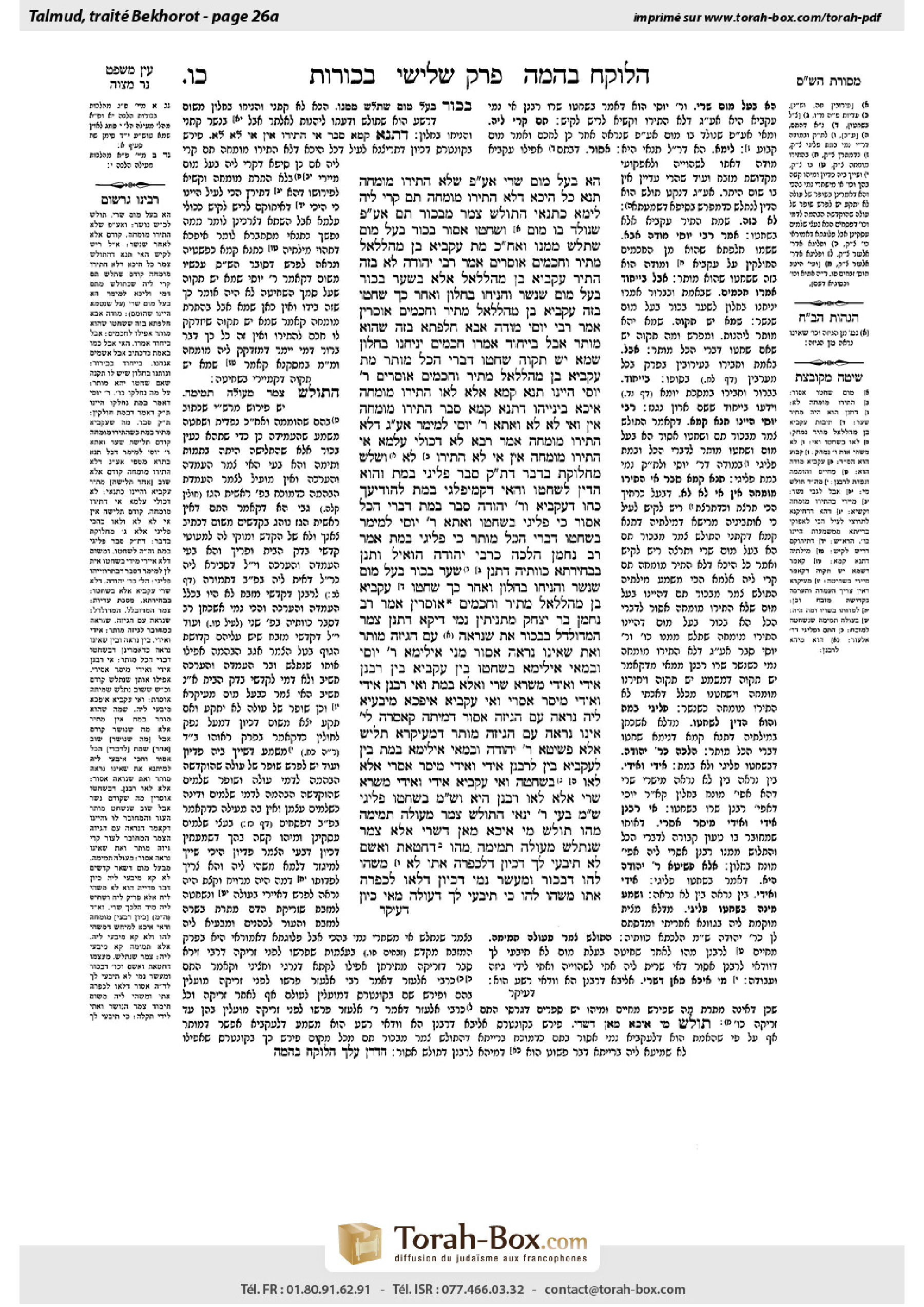
This page of Bekhorot includes the Aramaic text, an English translation and an AI-generated French translation, alongside the scan above.
בכורות כ״ו א · Aramaic and Hebrew text
הָא בַּעַל מוּם שְׁרֵי, אַף עַל פִּי שֶׁלֹּא הִתִּירוּ מוּמְחֶה! תַּנָּא: כֹּל הֵיכָא דְּלֹא הִתִּירוֹ מוּמְחֶה — תָּם קָרֵי לֵיהּ.
לֵימָא כְּתַנָּאֵי: הַתּוֹלֵשׁ צֶמֶר מִבְּכוֹר תָּם, אַף עַל פִּי שֶׁנּוֹלַד בּוֹ מוּם וּשְׁחָטוֹ — אָסוּר. בְּכוֹר בַּעַל מוּם שֶׁתָּלַשׁ מִמֶּנּוּ, וְאַחַר כָּךְ מֵת — עֲקַבְיָא בֶּן מַהֲלַלְאֵל מַתִּיר, וַחֲכָמִים אוֹסְרִים. אָמַר רַבִּי יְהוּדָה: לֹא בָּזֶה הִתִּיר עֲקַבְיָא בֶּן מַהֲלַלְאֵל, אֶלָּא בִּשְׂעַר בְּכוֹר בַּעַל מוּם שֶׁנָּשַׁר וְהִנִּיחוֹ בַּחַלּוֹן, וְאַחַר כָּךְ שְׁחָטוֹ — בָּזֶה עֲקַבְיָא בֶּן מַהֲלַלְאֵל מַתִּיר, וַחֲכָמִים אוֹסְרִין.
אָמַר רַבִּי יוֹסֵי: מוֹדֶה אַבָּא חֲלַפְתָּא בְּזֶה שֶׁהוּא מוּתָּר, אֲבָל בְּיִיחוּד אָמְרוּ חֲכָמִים: יַנִּיחֶנּוּ בַּחַלּוֹן, שֶׁמָּא יֵשׁ תִּקְוָה. שְׁחָטוֹ — דִּבְרֵי הַכֹּל מוּתָּר, מֵת — עֲקַבְיָא בֶּן מַהֲלַלְאֵל מַתִּיר וַחֲכָמִים אוֹסְרִים.
רַבִּי יוֹסֵי — הַיְינוּ תַּנָּא קַמָּא! אֶלָּא לָאו הִתִּירוֹ מוּמְחֶה אִיכָּא בֵּינַיְיהוּ?
דְּתַנָּא קַמָּא סָבַר: הִתִּירוֹ מוּמְחֶה — אִין, וְאִי לָא — לָא, וַאֲתָא רַבִּי יוֹסֵי לְמֵימַר: אַף עַל גַּב דְּלֹא הִתִּירוֹ מוּמְחֶה!
אָמַר רָבָא: לָא, דְּכוּלֵּי עָלְמָא אִי הִתִּירוֹ מוּמְחֶה — אִין, אִי לֹא הִתִּירוֹ — לָא, וְשָׁלֹשׁ מַחְלוֹקוֹת בַּדָּבָר, דְּתַנָּא קַמָּא סָבַר: פְּלִיגִי בְּמֵת, וְהוּא הַדִּין לִשְׁחָטוֹ, וְהַאי דְּקָמִיפַּלְגִי בְּמֵת — לְהוֹדִיעֲךָ כֹּחוֹ דַּעֲקַבְיָא.
וְרַבִּי יְהוּדָה סָבַר: בְּמֵת — דִּבְרֵי הַכֹּל אָסוּר, כִּי פְּלִיגִי — בִּשְׁחָטוֹ, וַאֲתָא רַבִּי יוֹסֵי לְמֵימַר: בִּשְׁחָטוֹ — דִּבְרֵי הַכֹּל מוּתָּר, כִּי פְּלִיגִי — בְּמֵת.
אָמַר רַב נַחְמָן: הֲלָכָה כְּרַבִּי יְהוּדָה, הוֹאִיל וּתְנַן בִּבְחִירָתָא כְּוָותֵיהּ, דִּתְנַן: שְׂעַר בְּכוֹר בַּעַל מוּם שֶׁנָּשַׁר וְהִנִּיחוֹ בַּחַלּוֹן, וְאַחַר כָּךְ שְׁחָטוֹ — עֲקַבְיָא בֶּן מַהֲלַלְאֵל מַתִּיר, וַחֲכָמִים אוֹסְרִין.
אָמַר רַב נַחְמָן בַּר יִצְחָק: מַתְנִיתִין נָמֵי דַּיְקָא, דִּתְנַן: צֶמֶר הַמְדוּלְדָּל בַּבְּכוֹר, אֶת שֶׁנִּרְאֶה עִם הַגִּיזָּה — מוּתָּר, וְאֶת שֶׁאֵינוֹ נִרְאֶה — אָסוּר.
מַנִּי? אִילֵּימָא רַבִּי יוֹסֵי; וּבְמַאי? אִילֵימָא בִּשְׁחָטוֹ — בֵּין עֲקַבְיָא בֵּין רַבָּנַן, אִידֵּי וְאִידֵּי מִשְׁרָא שָׁרֵי!
וְאֶלָּא בְּמֵת? וְאִי רַבָּנַן — אִידֵּי וְאִידֵּי מֵיסָר אָסְרִי, וְאִי עֲקַבְיָא — אִיפְּכָא מִיבַּעְיָא לֵיהּ: נִרְאֶה עִם הַגִּיזָּה — אָסוּר, דְּמִיתָה קָאָסְרָה לֵיהּ; אֵינוֹ נִרְאֶה עִם הַגִּיזָּה — מוּתָּר, דְּמֵעִיקָּרָא תְּלִישׁ!
אֶלָּא פְּשִׁיטָא רַבִּי יְהוּדָה, וּבְמַאי? אִילֵימָא בְּמֵת — בֵּין לַעֲקַבְיָא בֵּין לְרַבָּנַן, אִידֵּי וְאִידֵּי מֵיסָר אָסְרִי!
אֶלָּא לָאו בִּשְׁחָטוֹ? וְאִי עֲקַבְיָא — אִידֵּי וְאִידֵּי מִשְׁרָא שָׁרֵי! אֶלָּא לָאו רַבָּנַן הִיא? וּשְׁמַע מִינַּהּ: בִּשְׁחָטוֹ פְּלִיגִי. שְׁמַע מִינַּהּ.
בָּעֵי רַבִּי יַנַּאי: הַתּוֹלֵשׁ צֶמֶר מֵעוֹלָה תְּמִימָה, מַהוּ? תּוֹלֵשׁ? מִי אִיכָּא מַאן דְּשָׁרֵי? אֶלָּא, צֶמֶר שֶׁנִּתְלַשׁ מֵעוֹלָה תְּמִימָה, מַהוּ?
דְּחַטָּאת וְאָשָׁם לָא תִּיבְּעֵי לָךְ, דְּכֵיוָן דִּלְכַפָּרָה אָתוּ — לָא מְשַׁהוּ לְהוּ. דִּבְכוֹר וּמַעֲשֵׂר נָמֵי, דְּכֵיוָן דְּלָאו לְכַפָּרָה אָתוּ — מְשַׁהוּ לְהוּ. כִּי תִּיבְּעֵי לָךְ דְּעוֹלָה, מַאי? כֵּיוָן
Bekhorot 26a · English translation
But in the case of a blemished firstborn, use of its wool is permitted, even though an expert did not deem the animal permitted for slaughter. This contradicts the statement of Rabbi Asi. The Gemara answers: It is possible that the tanna of that baraita calls the animal unblemished wherever an expert did not yet deem the firstborn permitted for slaughter, even if it was physically blemished.
The Gemara remarks: Let us say that the interpretation of Reish Lakish is the subject of a dispute between tanna’im, as the baraita states: With regard to one who plucks the wool from an unblemished firstborn, even though it later developed a blemish and the owner slaughtered it, use of the wool is prohibited. In the case of a blemished firstborn from which one plucked wool, and it subsequently died, Akavya ben Mahalalel deems the wool permitted and the Rabbis deem it prohibited. Rabbi Yehuda said: It was not with regard to that case that Akavya ben Mahalalel deemed use of the wool permitted. Rather, it was in a case of the hair of a blemished firstborn animal that shed from the animal and one placed the hair in a compartment, and thereafter one slaughtered the animal. In that case Akavya ben Mahalalel deems use of the wool permitted, and the Rabbis deem its use prohibited.
The baraita continues: Rabbi Yosei says: My father, Ḥalafta, concedes to Akavya ben Mahalalel in this case of a slaughtered firstborn that use of the wool is permitted. Indeed [aval], the Rabbis said explicitly: One places it in a compartment, as perhaps there is a hope that use of the wool will ultimately be permitted, since if he slaughters the animal all agree that use of the wool is permitted. But if the animal dies by other means, Akavya ben Mahalalel deems use of the wool permitted and the Rabbis deem it prohibited.
The Gemara raises a difficulty: If that is the explanation of their dispute, the opinion of Rabbi Yosei is identical to the opinion of the first tanna in the baraita, as both hold that use of the wool of a slaughtered blemished firstborn is permitted and the dispute between Akavya ben Mahalalel and the Rabbis applies to a case where the animal dies by other means. Rather, is it not correct to say the dispute between them concerns the requirement that an expert deem the animal permitted for slaughter?
The Gemara elaborates: As the first tanna holds: If an expert deemed the animal permitted before its wool was shed, then yes, use of the wool is permitted after the animal has been slaughtered; but if not, then use of the wool is not permitted. And Rabbi Yosei comes to say that even in a case where an expert did not deem the firstborn permitted for slaughter before its wool was shed, use of the wool is still permitted. If so, the interpretation of Reish Lakish is the subject of the dispute between the first tanna and Rabbi Yosei: The first tanna agrees with that opinion and Rabbi Yosei rejects it.
Rava said: No, the interpretation of Reish Lakish is not the subject of their dispute, as everyone agrees that if an expert deemed the animal permitted before its wool was shed, then yes, use of the wool is permitted, but if an expert did not deem the animal permitted beforehand then the use of its wool is not permitted. And there are three disputes concerning this matter, as the first tanna holds: Akavya ben Mahalalel and the Rabbis disagree with regard to a case where the firstborn died, and the same is true, i.e., they disagree, in a case where he slaughtered it. And the reason that the first tanna states they disagree specifically in a case where it died is to convey to you the far-reaching nature of the opinion of Akavya, i.e., that he deems use of the wool permitted even if the animal was not slaughtered.
And Rabbi Yehuda holds: With regard to a firstborn that died, all, i.e., Akavya ben Mahalalel and the Rabbis, agree that use of the wool is prohibited, and when they disagree it is with regard to a case where the owner slaughtered the animal. And Rabbi Yosei comes to say: Where he slaughtered it, all agree that use of the wool is permitted, and when they disagree it is with regard to a case where the animal died.
Rav Naḥman says: The halakha is in accordance with the opinion of Rabbi Yehuda, since we learned a mishna in our preferred tractate in accordance with his opinion. As we learned in a mishna (Eduyyot 5:6): In the case of the hair of a blemished firstborn animal that shed from the animal and one placed the hair in a compartment, and thereafter he slaughtered the animal, Akavya ben Mahalalel deems use of the wool permitted and the Rabbis deem its use prohibited even after the animal’s death.
Rav Naḥman bar Yitzḥak says: The mishna is also precisely formulated so that this conclusion can be inferred, as we learned in the latter clause of the mishna: With regard to wool that was not completely shed which is dangling from a firstborn animal, that which appears to be part of the fleece is permitted when the animal is shorn after its death, and that which does not appear to be part of the fleece is prohibited.
Rav Naḥman bar Yitzḥak explains the proof: In accordance with whose opinion is this ruling? If we say it is in accordance with the opinion of Rabbi Yosei, that is difficult: But in what case did he issue this ruling? If we say it was in a case where he slaughtered it that cannot be correct, as whether the halakha follows the opinion of Akavya or whether it follows the opinion of the Rabbis, in both this case of wool that appears to be part of the fleece and that case where it does not, the use of the wool is permitted.
Rather, if one says this is referring to a case where the animal died, that too is difficult. But that cannot be correct either, since if the halakha is in accordance with the Rabbis, then both this wool and that wool are prohibited. And if the halakha is in accordance with Akavya, then the mishna should have stated the opposite ruling: If the dangling wool appears to be part of the fleece it is prohibited, as the death of the animal renders it prohibited because it is considered attached to the animal; if it does not appear to be part of the fleece it is permitted, as it was considered detached from the beginning, before the animal died.
Rather, it is obvious that this clause of the mishna is in accordance with the opinion of Rabbi Yehuda. And in what case does the mishna’s ruling apply? If we say it is referring to a case where the animal died, then whether the halakha is in accordance with the opinion of Akavya or whether it is in accordance with the opinion of the Rabbis, in both this case of wool that appears to be part of the fleece and that case where it does not, the use of the wool is prohibited.
Rather, is it not referring to a case where he slaughtered the animal? And consequently, if the mishna is in accordance with the opinion of Akavya, then in both this case of wool that appears to be part of the fleece and that case where it does not, use of the wool is permitted. Rather, is it not correct to say the mishna is in accordance with the opinion of the Rabbis? And accordingly, one may conclude from it that Akavya and the Rabbis disagree in a case where he slaughtered the animal? The Gemara affirms: Indeed, conclude from it that this is so.
§ Rabbi Yannai raises a dilemma: With regard to one who plucks wool from an unblemished burnt offering which was later slaughtered, what is the halakha? The Gemara expresses surprise: If one intentionally violates a prohibition and plucks the wool from an unblemished consecrated animal, is there anyone who deems it permitted? All agree that use of the wool is prohibited in such a case. Rather, Rabbi Yannai’s question was: With regard to wool that was torn out by itself from an unblemished burnt offering, what is the halakha?
The Gemara elaborates: Do not raise the dilemma concerning the wool of a sin offering and a guilt offering. Since these offerings come for atonement the owner does not keep them longer than necessary, and therefore there is no reason to deem the wool prohibited. Likewise, with regard to the wool of a firstborn and an animal tithe offering there is also no dilemma. Since they do not come for atonement one might keep them longer than necessary, and therefore the wool is prohibited in order to prevent one from violating the prohibition against shearing the animal or using it for labor. Rather, when you raise the dilemma, it is with regard to the wool of a burnt offering. What is the halakha? Does one say that since
Bekhorot 26a · Traduction française (IA)
Mais dans le cas d'un premier-né brouillé, l'utilisation de sa laine est permise, même si un expert n'a pas jugé l'animal propre à la bête. Cela contredit l'opinion de Rabbi Asi. La Guemara répond : Il est possible que le tanna de ce baraïta considère l'animal comme non brouillé chaque fois qu'un expert n'a pas encore déclaré le premier-né propre à la bête, même s'il était physiquement brouillé.
La Guemara remarque : Disons que l'interprétation de Reish Lakish est l'objet d'un débat entre les tannaïm, comme le baraïta dit : Concernant celui qui arrache la laine d'un premier-né non brouillé, même s'il développe plus tard une brouille et que l'propriétaire le sacrifie, l'utilisation de la laine est interdite. Dans le cas d'un premier-né brouillé d'où l'on a arraché la laine, et qu'il meurt ensuite, Akavya ben Mahalalel considère la laine comme permise et les Rabbins comme interdite. Rabbi Yehuda dit : Ce n'était pas à propos de ce cas que Akavya ben Mahalalel considérait l'utilisation de la laine comme permise. Mais plutôt, c'était dans le cas des poils d'un premier-né brouillé qui tombaient de l'animal et que l'on avait mis dans une compartiment, et ensuite l'animal était sacrifié. Dans ce cas, Akavya ben Mahalalel considère l'utilisation de la laine comme permise, et les Rabbins comme interdite.
Le baraïta continue : Rabbi Yosei dit : Mon père, Ḥalafta, reconnaît Akavya ben Mahalalel dans ce cas d'un premier-né sacrifié, l'utilisation de la laine est permise. En effet, les Rabbins ont dit explicitement : On le met dans une compartiment, car peut-être il y a une espérance que l'utilisation de la laine sera finalement permise, car si l'on sacrifie l'animal, tous conviennent que l'utilisation de la laine est permise. Mais si l'animal meurt d'une autre manière, Akavya ben Mahalalel considère l'utilisation de la laine comme permise et les Rabbins comme interdite.
La Guemara soulève une difficulté : Si c'est l'explication de leur débat, l'opinion de Rabbi Yosei est identique à celle du premier tanna du baraïta, car les deux considèrent que l'utilisation de la laine d'un premier-né sacrifié est permise et que le débat entre Akavya ben Mahalalel et les Rabbins s'applique à un cas où l'animal meurt d'une autre manière. Plutôt, n'est-ce pas correct de dire que le débat entre eux concerne la nécessité qu'un expert déclare l'animal acceptable pour la bête ?
La Guemara développe : Comme le premier tanna considère : Si un expert a déclaré l'animal acceptable avant que la laine ne tombe, alors oui, l'utilisation de la laine est permise après que l'animal ait été sacrifié ; mais si non, alors l'utilisation de la laine n'est pas permise. Et Rabbi Yosei vient dire que même dans le cas où un expert n'a pas déclaré le premier-né acceptable pour la bête avant que la laine ne tombe, l'utilisation de la laine est toujours permise. Si c'est ainsi, l'interprétation de Reish Lakish est l'objet du débat entre le premier tanna et Rabbi Yosei : le premier tanna est d'accord avec cette opinion et Rabbi Yosei la rejette.
Rava dit : Non, l'interprétation de Reish Lakish n'est pas l'objet de leur débat, car tout le monde convient que si un expert a déclaré l'animal acceptable avant que la laine ne tombe, alors oui, l'utilisation de la laine est permise, mais si un expert n'a pas déclaré l'animal acceptable auparavant, alors l'utilisation de sa laine n'est pas permise. Et il y a trois débats concernant cette affaire, comme le premier tanna considère : Akavya ben Mahalalel et les Rabbins s'opposent dans le cas où le premier-né meurt, et c'est pareil, c'est-à-dire qu'ils s'opposent, dans le cas où il est sacrifié. Et la raison pour laquelle le premier tanna dit qu'ils s'opposent spécifiquement dans le cas où il meurt est pour vous faire comprendre la portée de l'opinion d'Akavya, c'est-à-dire qu'il considère l'utilisation de la laine comme permise même si l'animal n'a pas été sacrifié.
Et Rabbi Yehuda affirme : Concernant un premier-né qui est mort, tous, c'est-à-dire Akavya ben Mahalalel et les Rabbins, s'accordent sur le fait que l'utilisation de la laine est interdite, et lorsqu'ils divergent, c'est concernant le cas où l'owner a tué l'animal. Et Rabbi Yosei vient dire : Lorsqu'il a été tué, tous s'accordent sur le fait que l'utilisation de la laine est permise, et lorsqu'ils divergent, c'est concernant le cas où l'animal est mort.
Rav Naḥman dit : La halakha suit l'opinion de Rabbi Yehuda, car nous avons appris une mitsva dans notre tractate préféré conformément à son opinion. Comme nous avons appris dans une mitsva (Eduyyot 5:6) : Dans le cas des poils d'un premier-né brouillé qui tombaient de l'animal et que l'on avait mis les poils dans une compartiment, et ensuite l'animal a été tué, Akavya ben Mahalalel considère l'utilisation de la laine comme permise et les Rabbins considèrent son utilisation comme interdite même après la mort de l'animal.
Rav Naḥman bar Yitzḥak dit : La mitsva est aussi formulée de manière précise afin que cette conclusion puisse être inférée, comme nous avons appris dans la dernière partie de la mitsva : Concernant la laine qui n'était pas complètement tombée et qui pendait d'un premier-né, celle qui semble faire partie de la laine est permise quand l'animal est rasé après sa mort, et celle qui ne semble pas faire partie de la laine est interdite.
Rav Naḥman bar Yitzḥak explique la preuve : Selon l'opinion de qui est ce jugement ? Si nous disons qu'il suit l'opinion de Rabbi Yosei, cela est difficile : Mais dans quel cas a-t-il émis ce jugement ? Si nous disons qu'il était dans un cas où il l'a immolé, cela ne peut pas être correct, car si la halakha suit l'opinion d'Akavya ou celle des Rabbins, dans ce cas de laine qui semble faire partie de la laine et dans ce cas où elle ne le fait pas, l'utilisation de la laine est permise.
Plutôt, si l'on dit que cela se réfère à un cas où l'animal est mort, cela aussi est difficile. Mais cela ne peut pas être correct non plus, car si la halakha suit l'opinion des Rabbins, alors à la fois ce laine et celle-là sont interdites. Et si la halakha suit l'opinion d'Akavya, alors la mitsva devrait avoir énoncé une décision contraire : si la laine pendante semble faire partie de la fourrure, elle est interdite, car la mort de l'animal la rend interdite, car elle est considérée comme attachée à l'animal ; si elle ne semble pas faire partie de la fourrure, elle est permise, car elle était considérée comme détachée dès le début, avant que l'animal ne meure.
Plutôt, il est évident que cette clause de la mitsva suit l'opinion de Rabbi Yéhuda. Et dans quel cas la décision de la mitsva s'applique-t-elle ? Si nous disons qu'il s'agit d'un cas où l'animal est mort, alors que la halakha suit l'opinion d'Akavya ou que la halakha suit l'opinion des Rabbins, dans les deux cas, que ce soit pour cette laine qui semble faire partie de la fourrure ou pour celle qui ne semble pas faire partie de la fourrure, l'utilisation de la laine est interdite.
Plutôt, ne s'agit-il pas d'un cas où l'animal a été sacrifié ? Et par conséquent, si la mitsva suit l'opinion d'Akavya, alors dans les deux cas, que ce soit pour cette laine qui semble faire partie de la fourrure ou pour celle qui ne semble pas faire partie de la fourrure, l'utilisation de la laine est permise. Plutôt, ne serait-il pas correct de dire que la mitsva suit l'opinion des Rabbins ? Et par conséquent, on peut conclure de cela que Akavya et les Rabbins sont en désaccord dans un cas où l'animal a été sacrifié ? La Guemara affirme : En effet, concluez de cela que c'est ainsi.
§ Rabbi Yannai soulève un dilemme : Concernant celui qui arrache une laine d'un holocauste sans tache qui a ensuite été sacrifié, quelle est la halakha ? La Guemara exprime une surprise : Si l'on viole intentionnellement une interdiction et qu'on arrache la laine d'un animal consacré sans tache, y a-t-il quelqu'un qui considère cela comme permis ? Tout le monde convient que l'utilisation de la laine est interdite dans ce cas. Plutôt, la question de Rabbi Yannai était : Concernant une laine qui s'est détachée d'elle-même d'un holocauste sans tache, quelle est la halakha ?
La Guemara développe : Ne soulève pas ce dilemme concernant la laine d'un sacrifice expiatoire et d'un sacrifice de culpabilité. Car ces offrandes sont pour l'atonement, et l'owner ne les conserve pas plus longtemps que nécessaire, et par conséquent, il n'y a pas de raison de considérer la laine comme interdite. De même, concernant la laine du premier-né et de l'offrande de terouma, il n'y a pas de dilemme non plus. Car ils ne sont pas pour l'atonement, on pourrait les conserver plus longtemps que nécessaire, et par conséquent, la laine est interdite afin d'empêcher l'infraction de l'interdiction de tailler l'animal ou d'en faire usage. Plutôt, lorsque tu soulèves ce dilemme, il s'agit de la laine d'un holocauste. Quelle est la halakha ? Dit-on que puisque
Traduction française générée par IA à partir de l’édition anglaise de Sefaria. Vérifie toujours un passage avec le texte source.
Text from Sefaria: William Davidson Edition - Vocalized Aramaic (CC BY NC); William Davidson Edition - English (CC BY NC).