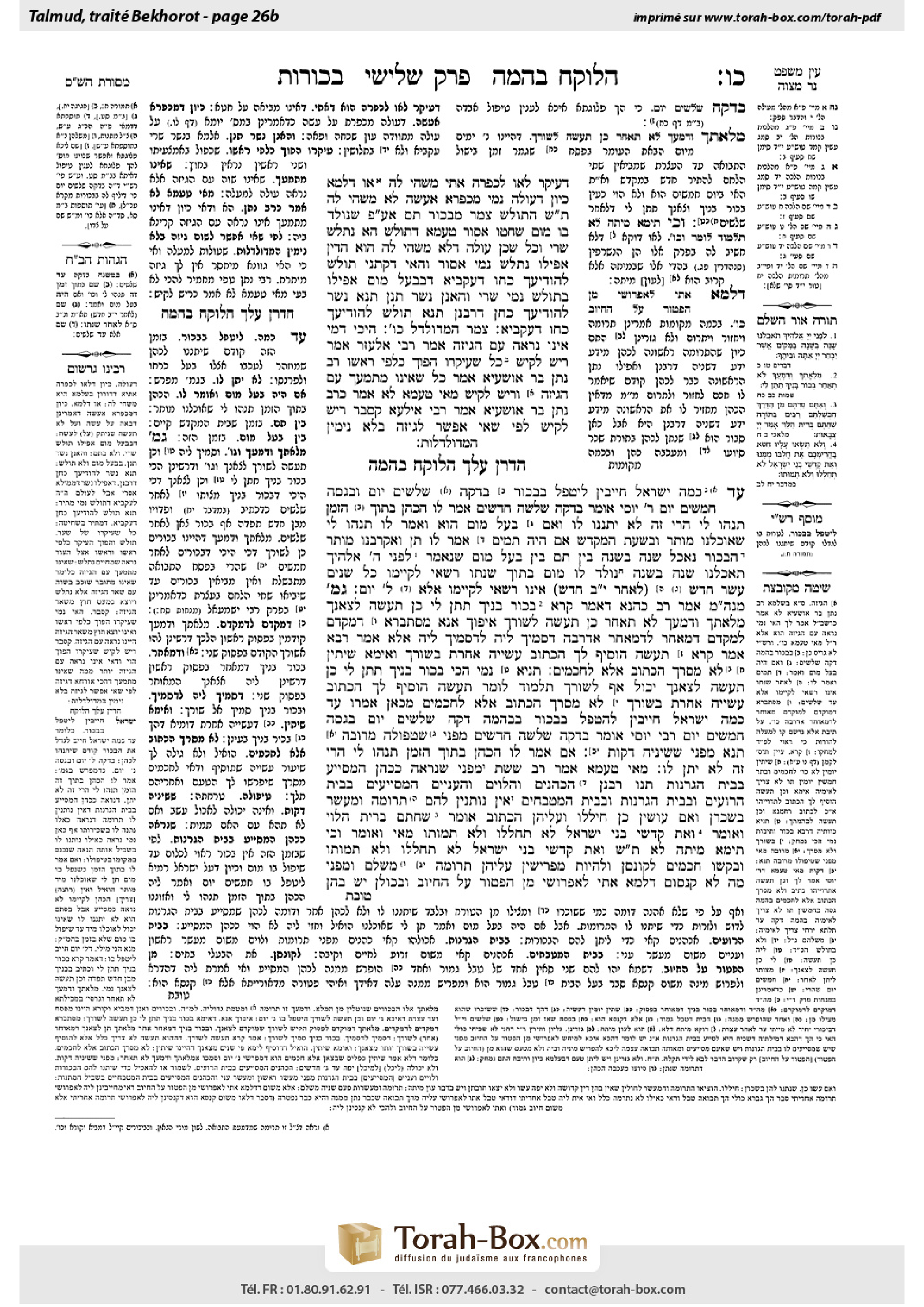
Bekhorot 26b: Talmud study for Daf Yomi
Study the Talmud for Daf Yomi with scanned pages, Hebrew text, English translations from Sefaria and AI-generated French translations.
Passage selection and English or AI-generated French translation are available where the scan has annotations. Daf Study is independent of Torah-Box and Sefaria.
Browse Bekhorot · בכורות · All tractatesBekhorot 26b text and translations
This page of Bekhorot includes the Aramaic text, an English translation and an AI-generated French translation, alongside the scan above.
בכורות כ״ו ב · Aramaic and Hebrew text
דְּעִיקַּר לָאו לְכַפָּרָה אָתֵי — מְשַׁהֵי לַהּ, אוֹ דִלְמָא, כֵּיוָן דְּעוֹלָה נָמֵי מְכַפְּרָא אַעֲשֵׂה — לָא מְשַׁהֵי לַהּ?
תָּא שְׁמַע: הַתּוֹלֵשׁ צֶמֶר מִבְּכוֹר תָּם, אַף עַל פִּי שֶׁנּוֹלַד בּוֹ מוּם, שְׁחָטוֹ — אָסוּר. טַעְמָא דְּתוֹלֵשׁ, הָא נִתְלַשׁ — שָׁרֵי, וְכׇל שֶׁכֵּן עוֹלָה דְּלָא מְשַׁהֵי לַהּ!
הוּא הַדִּין אֲפִילּוּ נִתְלַשׁ נָמֵי אָסוּר, וְהַאי דְּקָתָנֵי ״תּוֹלֵשׁ״ לְהוֹדִיעֲךָ כֹּחוֹ דַּעֲקַבְיָא, דִּבְבַעַל מוּם אֲפִילּוּ בְּתוֹלֵשׁ נָמֵי שָׁרֵי.
וְהָאֲנַן ״נָשַׁר״ תְּנַן! תְּנָא ״נָשַׁר״ לְהוֹדִיעֲךָ כֹּחָן דְּרַבָּנַן, תְּנָא ״תּוֹלֵשׁ״ לְהוֹדִיעֲךָ כֹּחוֹ דַּעֲקַבְיָא.
צֶמֶר הַמְדוּלְדָּל כּוּ׳. הֵיכִי דָּמֵי ״אֵינוֹ נִרְאֶה עִם הַגִּיזָּה״? אָמַר רַבִּי אֶלְעָזָר אָמַר רֵישׁ לָקִישׁ: כֹּל שֶׁעִיקָּרוֹ הָפוּךְ כְּלַפֵּי רֹאשׁוֹ. רַב נָתָן בַּר אוֹשַׁעְיָא אָמַר: כֹּל שֶׁאֵינוֹ מִתְמַעֵךְ עִם הַגִּיזָּה.
וְרֵישׁ לָקִישׁ, מַאי טַעְמָא לָא אָמַר כְּרַב נָתָן בַּר אוֹשַׁעְיָא? אָמַר רַבִּי אִילְעָא: קָסָבַר רֵישׁ לָקִישׁ, לְפִי שֶׁאִי אֶפְשָׁר לַגִּיזָּה בְּלֹא נִימִין הַמְדוּלְדָּלוֹת.
הֲדַרַן עֲלָךְ הַלּוֹקֵחַ בְּהֵמָה.
מַתְנִי׳ עַד כַּמָּה יִשְׂרָאֵל חַיָּיבִין לִיטַּפֵּל בִּבְכוֹר? בַּדַּקָּה — שְׁלֹשִׁים יוֹם, וּבַגַּסָּה — חֲמִשִּׁים יוֹם. רַבִּי יוֹסֵי אוֹמֵר: בַּדַּקָּה — שְׁלֹשָׁה חֳדָשִׁים. אָמַר לוֹ הַכֹּהֵן בְּתוֹךְ הַזְּמַן: ״תְּנֵהוּ לִי״ — הֲרֵי זֶה לֹא יִתְּנֶנּוּ לוֹ. וְאִם בַּעַל מוּם הוּא, וְאָמַר לוֹ: ״תְּנֵהוּ לִי שֶׁאוֹכְלֶנּוּ״ — מוּתָּר. וּבִשְׁעַת הַמִּקְדָּשׁ, אִם הָיָה תָּמִים, אָמַר לוֹ: ״תֵּן [לִי] וְאַקְרִיבֶנּוּ״ — מוּתָּר.
הַבְּכוֹר נֶאֱכָל שָׁנָה בְּשָׁנָה, בֵּין תָּם בֵּין בַּעַל מוּם, שֶׁנֶּאֱמַר: ״לִפְנֵי ה׳ אֱלֹהֶיךָ תֹאכְלֶנּוּ שָׁנָה בְשָׁנָה״. נוֹלַד לוֹ מוּם בְּתוֹךְ שְׁנָתוֹ — רַשַּׁאי לְקַיְּימוֹ כׇּל שְׁנֵים עָשָׂר חֹדֶשׁ. לְאַחַר שְׁנֵים עָשָׂר חֹדֶשׁ — אֵינוֹ רַשַּׁאי לְקַיְּימוֹ אֶלָּא שְׁלֹשִׁים יוֹם.
גְּמָ׳ מְנָהָנֵי מִילֵּי? אָמַר רַב כָּהֲנָא: דְּאָמַר קְרָא ״בְּכוֹר בָּנֶיךָ תִּתֶּן לִּי״, ״כֵּן תַּעֲשֶׂה לְצֹאנֶךָ״.
״מְלֵאָתְךָ וְדִמְעֲךָ לֹא תְאַחֵר״, ״כֵּן תַּעֲשֶׂה לְשׁוֹרְךָ״.
אֵיפוֹךְ אֲנָא! מִסְתַּבְּרָא דְּמַקְדַּם לְמַקְדַּם, דִּמְאַחַר לְדִמְאַחַר. אַדְּרַבָּה, דִּסְמִיךְ לֵיהּ לְדִסְמִיךְ לֵיהּ!
אֶלָּא אָמַר רָבָא: אָמַר קְרָא ״תַּעֲשֶׂה״, הוֹסִיף לְךָ הַכָּתוּב עֲשִׂיָּיה אַחֶרֶת בְּשׁוֹרְךָ.
וְאֵימָא: שִׁיתִּין! לֹא מְסָרְךָ הַכָּתוּב אֶלָּא לַחֲכָמִים.
תַּנְיָא נָמֵי הָכִי: ״בְּכוֹר בָּנֶיךָ תִּתֶּן לִי״, ״כֵּן תַּעֲשֶׂה לְצֹאנֶךָ״ — יָכוֹל אַף לְשׁוֹרְךָ? תַּלְמוּד לוֹמַר: ״תַּעֲשֶׂה״ — הוֹסִיף לְךָ הַכָּתוּב עֲשִׂיָּיה אַחֶרֶת בְּשׁוֹרְךָ, לֹא מְסָרְךָ הַכָּתוּב אֶלָּא לַחֲכָמִים.
מִכָּאן אָמְרוּ: עַד כַּמָּה יִשְׂרָאֵל חַיָּיבִין לְהִטַּפֵּל בִּבְכוֹר? בִּבְהֵמָה דַּקָּה — שְׁלֹשִׁים יוֹם, בְּגַסָּה — חֲמִשִּׁים יוֹם. רַבִּי יוֹסֵי אוֹמֵר: בַּדַּקָּה — שְׁלֹשָׁה חֳדָשִׁים, מִפְּנֵי שֶׁטִּפּוּלָהּ מְרוּבָּה. תָּנָא: מִפְּנֵי שֶׁשִּׁינֶּיהָ דַּקּוֹת.
אִם אָמַר לוֹ הַכֹּהֵן בְּתוֹךְ הַזְּמַן ״תְּנֵהוּ לִי״, הֲרֵי זֶה לֹא יִתֵּן לוֹ. מַאי טַעְמָא? אָמַר רַב שֵׁשֶׁת: מִפְּנֵי שֶׁנִּרְאֶה כְּכֹהֵן הַמְסַיֵּיעַ בְּבֵית הַגֳּרָנוֹת.
תָּנוּ רַבָּנַן: הַכֹּהֲנִים וְהַלְוִיִּם וְהָעֲנִיִּים הַמְסַיְּיעִים בְּבֵית הָרוֹעִים, וּבְבֵית הַגֳּרָנוֹת, וּבְבֵית הַמִּטְבָּחַיִם — אֵין נוֹתְנִין לָהֶם תְּרוּמָה וּמַעֲשֵׂר בִּשְׂכָרָן, וְאִם עוֹשִׂין כֵּן חִילֵּלוּ, וַעֲלֵיהֶן הַכָּתוּב אוֹמֵר: ״שִׁחַתֶּם בְּרִית הַלֵּוִי״, וְאוֹמֵר: ״וְאֶת קׇדְשֵׁי בְנֵי יִשְׂרָאֵל לֹא תְחַלְּלוּ וְלֹא תָמוּתוּ״.
מַאי ״וְאוֹמֵר״? וְכִי תֵּימָא: מִיתָה לָא — תָּא שְׁמַע: ״וְאֶת קׇדְשֵׁי בְנֵי יִשְׂרָאֵל לֹא תְחַלְּלוּ וְלֹא תָמוּתוּ״.
וּבִקְּשׁוּ חֲכָמִים לְקוֹנְסָן, וְלִהְיוֹת מַפְרִישִׁין עֲלֵיהֶן תְּרוּמָה מִשָּׁלֵם, וּמִפְּנֵי מָה לֹא קְנָסוּם? דִּלְמָא אָתֵי לְאַפְרוֹשֵׁי מִן הַפְּטוּר עַל הַחִיּוּב.
וּבְכוּלָּן יֵשׁ בָּהֶן
Bekhorot 26b · English translation
being brought for atonement is not its primary function, there is a concern that one might keep it? Or perhaps, since a burnt offering also effects atonement for neglecting to perform a positive mitzva, one does not keep the animal longer than necessary.
The Gemara suggests: Come and hear a resolution from a baraita: With regard to one who plucks the wool from an unblemished firstborn, even though it later developed a blemish and the owner then slaughtered it, use of the wool is prohibited. The Gemara infers: The reason use of the wool is prohibited is because he plucks it. But if it was torn out not by human intervention it is permitted. And this is correct all the more so with regard to a burnt offering, where one does not keep the animal any longer than necessary.
The Gemara rejects this proof: Actually, the same is true even if the wool of an unblemished firstborn animal was torn out by some other means; it is also prohibited. And the reason that the baraita teaches the halakha using the term: One who plucks, is to convey to you the far-reaching nature of the opinion of Akavya ben Mahalalel, as he maintains that in the case of a blemished animal, discussed in the latter clause of the baraita, even if one plucks the wool it is permitted. Since the latter clause discusses a case where one plucked the wool himself, it is inferred that the former clause discusses the same situation.
The Gemara asks: But didn’t we learn in the mishna that the hair was shed rather than plucked? The Gemara explains that the mishna taught a case where the hair of the blemished animal was shed in order to convey to you the far-reaching nature of the opinion of the Rabbis, who deem the wool prohibited even in such a case. Conversely, the baraita taught a case where one plucks the hair in order to convey to you the far-reaching nature of the opinion of Akavya.
§ The mishna teaches that it is permitted to derive benefit from wool that is dangling from a firstborn but was not completely shed if it appears to be part of the fleece when the animal is shorn after death, but otherwise it is prohibited. The Gemara inquires: What is considered: That which does not appear to be part of the fleece? Rabbi Elazar says that Reish Lakish says: This includes any strand of wool whose root is overturned and is facing toward the top, i.e., outward. Rav Natan bar Oshaya says: This includes any strand of wool that is not compressed together with the rest of the fleece, i.e., it sticks out when the fleece is pressed down.
And what is the reason Reish Lakish did not state his explanation in accordance with the opinion of Rav Natan bar Oshaya, whose explanation is the more straightforward meaning of the phrase: That which does not appear to be part of the fleece? Rabbi Ile’a says: Reish Lakish holds that the Sages did not deem strands of wool that are not compressed together with the rest of the fleece prohibited, because it is impossible for there to be fleece without dangling hairs. If Rav Natan bar Oshaya’s explanation were accepted, it would never be permitted to use such fleece of a dead firstborn animal. Consequently, Reish Lakish explains the statement of the mishna in a more lenient manner.
MISHNA: Until when must an Israelite tend to and raise a firstborn animal before giving it to the priest? With regard to a small animal, e.g., a sheep or goat, it is thirty days, and with regard to a large animal, e.g., cattle, it is fifty days. Rabbi Yosei says: With regard to a small animal, it is three months. If the priest said to the owner within that period: Give it to me, that owner may not give it to him. And if it is a blemished firstborn and the priest said to him: Give it to me so I may eat it, it is permitted for the owner to give it to him. And at the time that the Temple is standing, if it is unblemished and the priest said to him: Give it to me and I will sacrifice it, it is permitted for the owner to give it to him.
The firstborn animal is eaten year by year, i.e., within its first year, whether it is blemished or whether it is unblemished, as it is stated: “You shall eat it before the Lord your God year by year” (Deuteronomy 15:20). If a blemish developed within its first year, it is permitted for the owner to maintain the animal for the entire twelve months. If a blemish developed after twelve months have passed, it is permitted for the owner to maintain the animal for only thirty days.
GEMARA: The mishna teaches that an Israelite must raise a firstborn animal for thirty or fifty days, depending on the type of animal, before giving it to a priest. The Gemara asks: From where are these matters derived? Rav Kahana said: They are derived from a verse, as the verse states: “You shall not delay to offer of the fullness of your harvest, and of the outflow of your presses; you shall give to Me your firstborn sons. So you shall do with your oxen, and with your sheep; seven days it shall be with its mother, on the eighth day you shall give it to Me” (Exodus 22:28–29). The second part of verse 28 is juxtaposed to the second animal mentioned in verse 29. This juxtaposition teaches that just as a firstborn son is redeemed when he is thirty days old (Numbers 18:16), so too a sheep is given to the priest only when it is thirty days old.
The verses also state: “You shall not delay the fullness of your harvest, and of the outflow of your presses…So you shall do with your oxen” (Exodus 22:28–29). Just as the first fruits are brought on the festival of Shavuot, fifty days after Passover, so too the firstborn oxen are given to a priest when they are fifty days old. Here, the first part of verse 28 is juxtaposed with the first animal mentioned in verse 29.
The Gemara challenges: If these verses are the source, one can reverse the cases and derive that a firstborn ox must be given to the priest after thirty days, and a firstborn sheep after fifty days. The Gemara explains: It stands to reason that the time period that is alluded to earlier in the first verse corresponds to the animal that is mentioned earlier in the second verse, while the time period that is alluded to later in the first verse corresponds to the animal that is mentioned later in the second verse. The Gemara rejects this: On the contrary, it stands to reason that the time period that is alluded to closer to the mention of an animal should correspond to the animal, i.e., oxen, that is closest to it.
Rather, Rava says that the halakha of both a firstborn sheep and a firstborn ox are juxtaposed with the halakha of a firstborn child, which teaches that both require at least thirty days. But since the verse states: “So you shall do with your oxen” (Exodus 22:29), the verse adds an extra act of doing for you in the case of your oxen. In other words, the verse requires that the owner take care of an ox for additional time before giving it to the priest.
The Gemara challenges: But if so, one can say that the owner must care for the ox an additional thirty days, making a total of sixty days. From where is the total of fifty days derived? The Gemara answers: The interpretation of the verse with regard to the exact amount of time was given only to the Sages, and they determined that the owner must take care of his ox for fifty days.
This is also taught in a baraita: “You shall not delay to offer of the fullness of your harvest, and of the outflow of your presses; you shall give to Me your firstborn sons. So you shall do with your oxen, and with your sheep; seven days it shall be with its mother; on the eighth day you shall give it to Me” (Exodus 22:28–29). One might have thought that this time period, i.e., thirty days, applies also to your oxen. Therefore, the verse states: “You shall do.” The verse adds an extra act of doing for you in the case of your oxen, and the interpretation of the verse was given only to the Sages.
From here the Sages stated: Until when must an Israelite tend to and raise a firstborn animal before handing it to the priest? With regard to a small animal, e.g., a sheep or goat, it is thirty days, and with regard to a large animal, e.g., cattle, it is fifty days. Rabbi Yosei says: With regard to a small animal, it is three months, because its tending is extensive, i.e., a great deal of work and effort are required in order to raise it before it can be given to a priest. A tanna taught that so much effort is required to raise a sheep because its teeth are small and it cannot eat most foods.
§ The mishna teaches: If the priest said to the owner within that period: Give it to me, that owner may not give it to him. The Gemara asks: What is the reason? Rav Sheshet says: Because such a priest appears like a priest who assists at the threshing floor so that he can be given teruma. Since this arrangement benefits the owner of the firstborn, as he is spared the effort of taking care of the animal throughout this period, it is as though this priest has paid for the right to receive the firstborn, which is prohibited.
The Sages taught in a baraita: With regard to the priests, the Levites, and the poor people who assist in the home of the shepherd, or at the threshing floor, or in the slaughterhouse, one may not give them teruma or tithe as their wages. And if one did so, he desecrated the sanctity of the item. And with regard to them the verse states: “But you are turned aside out of the way; you have caused many to stumble in the law; you have corrupted the covenant of Levi, says the Lord of hosts” (Malachi 2:8). And another verse states: “And you shall bear no sin by it, seeing that you have set apart the best from it; and you shall not desecrate the sacred items of the children of Israel, that you shall not die” (Numbers 18:32).
The Gemara asks: What is the reason that the Gemara cites the second verse introduced with the phrase: And another verse states? The Gemara answers: And if you would say that the first verse indicates merely that teruma and tithe become desecrated, but one who does this is not punished by death, come and hear the second verse cited by the Gemara: “And you shall not desecrate the sacred items of the children of Israel, that you shall not die” (Numbers 18:32).
The baraita continues: And the Sages wished to penalize those who gave teruma or tithe to the priests, Levites, or poor people who helped them, and to require them to separate in their place complete teruma, so that the owners of the produce would not benefit from their improper actions. And for what reason did the Sages not penalize them? Perhaps they would mistakenly think that the produce has not yet been tithed at all, and they would come to separate teruma and tithes from it when it is actually exempt produce, as by Torah law it has already had its tithes removed. They might then separate teruma and tithes from it on behalf of produce to which the obligation of separating tithes still applies, i.e., regular untithed produce.
The baraita adds: And in all of these cases, although it is prohibited to give the teruma and tithe to a priest or Levite as his wages, nevertheless there is
Bekhorot 26b · Traduction française (IA)
Ce que l'on apporte comme holocauste n'est pas son fonction principal, il y a une crainte que l'on conserve l'animal. Ou peut-être, puisque l'holocauste permet aussi d'expier l'oubli d'une mitsva positive, on ne conserve l'animal que le temps nécessaire.
La Guemara suggère : Viens écouter une résolution tirée d'une baraïta : Concernant celui qui arrache la laine d'un premier-né intact, même si elle développe plus tard une tache et que l'propriétaire l'abat alors, l'utilisation de la laine est interdite. La Guemara déduit : La raison pour laquelle l'utilisation de la laine est interdite est parce qu'il l'a arrachée. Mais si elle est sortie sans intervention humaine, elle est permise. Et cela est encore plus vrai concernant l'holocauste, où l'on ne conserve l'animal que le temps nécessaire.
La Guemara rejette cette preuve : En réalité, cela est vrai même si la laine d'un premier-né intact est sortie par un autre moyen ; elle est également interdite. Et la raison pour laquelle la baraïta enseigne la halakha en utilisant le terme : celui qui arrache, est pour te faire comprendre la portée de l'opinion d'Akavya ben Mahalalel, car il affirme que dans le cas d'un animal taché, mentionné dans la dernière partie de la baraïta, même si l'on arrache la laine, elle est permise. Puisque la dernière partie discute d'un cas où l'on a arraché la laine lui-même, il est déduit que la première partie discute de la même situation.
La Guemara pose la question : Mais n'avons-nous pas appris dans la Michna que la laine était tombée plutôt qu'arrachée ? La Guemara explique que la Michna enseignait un cas où la laine de l'animal taché était tombée afin de te faire comprendre la portée de l'opinion des Rabbins, qui considèrent la laine interdite même dans ce cas. À l'inverse, la baraïta enseignait un cas où l'on arrachait la laine afin de te faire comprendre la portée de l'opinion d'Akavya.
§ La Michna enseigne que l'on peut tirer un bénéfice de la laine qui pend d'un premier-né mais qui n'est pas complètement tombée si elle semble faire partie de la fourrure lorsqu'on l'arrache après la mort de l'animal, mais autrement elle est interdite. La Guemara pose la question : Qu'est-ce qui est considéré comme : celui qui ne semble pas faire partie de la fourrure ? Rabbi Elazar dit que Reish Lakish dit : Cela inclut toute touffe de laine dont la racine est renversée et qui est orientée vers le haut, c'est-à-dire vers l'extérieur. Rav Natan bar Oshaya dit : Cela inclut toute touffe de laine qui n'est pas compressée avec le reste de la fourrure, c'est-à-dire qui sort lorsque la fourrure est pressée.
Et pourquoi Reish Lakish n'a-t-il pas exprimé son explication conformément à l'opinion de Rav Natan bar Oshaya, dont l'explication correspond à la signification plus directe de la phrase : celui qui ne semble pas faire partie de la fourrure ? Rabbi Ile’a dit : Reish Lakish considère que les Sages n'ont pas considéré comme interdite la laine qui n'est pas compressée avec le reste de la fourrure, car il est impossible d'avoir une fourrure sans poils pendants. Si l'explication de Rav Natan bar Oshaya était acceptée, il ne serait jamais permis d'utiliser la fourrure d'un premier-né mort. Par conséquent, Reish Lakish explique l'affirmation de la Michna d'une manière plus clémente.
MICHNA : Jusqu'à quel âge doit un Israélite soigner et élever un premier-né avant de le donner au prêtre ? Concernant un petit animal, par exemple un agneau ou une chèvre, il est trente jours, et concernant un grand animal, par exemple un bœuf, il est cinquante jours. Rabbi Yosei dit : Concernant un petit animal, il est trois mois. Si le prêtre dit à l'propriétaire pendant cette période : Donne-le-moi, cet propriétaire ne peut pas lui donner. Et si c'est un premier-né taché et que le prêtre dit à lui : Donne-le-moi pour que je le mange, il est permis à l'propriétaire de lui donner. Et lorsqu'il y a un Temple, si c'est un premier-né intact et que le prêtre dit à lui : Donne-le-moi et je le sacrifierai, il est permis à l'propriétaire de lui donner.
Le premier-né est mangé année après année, c'est-à-dire durant sa première année, qu'il soit taché ou non, comme il est dit : « Vous mangerez devant le Seigneur votre Dieu année par année » (Deutéronome 15:20). Si une tache s'est développée durant sa première année, il est permis à l'propriétaire de garder l'animal pendant les douze mois entiers. Si une tache s'est développée après que les douze mois eurent passé, il est permis à l'propriétaire de garder l'animal pendant seulement trente jours.
GUEMARA : La Michna enseigne qu'un Israélite doit élever un premier-né pendant trente ou cinquante jours, selon le type d'animal, avant de le donner à un prêtre. La Guemara pose la question : D'où sont dérivés ces enseignements ? Rav Kahana dit : Ils sont dérivés d'un verset, car le verset dit : « Vous ne retarderez pas l'abondance de votre récolte, et de l'écoulement de vos pressoirs ; vous donnerez à Moi vos premiers-nés. Ainsi faites-vous avec vos bœufs, et avec vos brebis ; sept jours il restera avec sa mère, le huitième jour vous le donnerez à Moi » (Exode 22:28–29). La deuxième partie du verset 28 est juxtaposée avec l'animal mentionné dans le verset 29. Cette juxtaposition enseigne que tout comme un premier-né est racheté lorsqu'il a trente jours (Nombres 18:16), de même une brebis est donnée au prêtre seulement lorsqu'elle a trente jours.
Les versets disent aussi : « Vous ne retarderez pas l'abondance de votre récolte, et de l'écoulement de vos pressoirs… Ainsi faites-vous avec vos bœufs » (Exode 22:28–29). Tout comme les premiers fruits sont apportés lors de la fête de Shavuot, cinquante jours après Pessah, de même les premiers-nés de bœufs sont donnés au prêtre lorsqu'ils ont cinquante jours. Ici, la première partie du verset 28 est juxtaposée avec l'animal mentionné dans le verset 29.
La Guemara pose un défi : Si ces versets sont la source, on pourrait inverser les cas et déduire que l'animal premier-né de bœuf doit être donné au prêtre après trente jours, et l'animal premier-né de mouton après cinquante jours. La Guemara explique : Il est logique que la période mentionnée plus tôt dans le premier verset corresponde à l'animal mentionné plus tôt dans le second verset, tandis que la période mentionnée plus tard dans le premier verset corresponde à l'animal mentionné plus tard dans le second verset. La Guemara rejette cette interprétation : Au contraire, il est logique que la période mentionnée plus près de la mention d'un animal corresponde à l'animal, c'est-à-dire aux bœufs, qui est le plus proche de lui.
Au contraire, Rava dit que la halakha concernant les animaux premier-nés de mouton et de bœuf est juxtaposée avec la halakha concernant l'enfant premier-né, ce qui enseigne que les deux nécessitent au moins trente jours. Cependant, puisque le verset dit : « Ainsi tu feras avec tes bœufs » (Exode 22:29), le verset ajoute une action supplémentaire pour toi dans le cas de tes bœufs. En d'autres termes, le verset exige que l'propriétaire prenne soin du bœuf pendant une période supplémentaire avant de le donner au prêtre.
La Guemara pose un défi : Mais si c'est ainsi, on pourrait dire que l'propriétaire doit prendre soin du bœuf pendant trente jours supplémentaires, ce qui ferait un total de soixante jours. D'où vient le total de cinquante jours ? La Guemara répond : L'interprétation du verset concernant la durée exacte a été donnée uniquement aux Sages, et ils ont décidé que l'propriétaire doit prendre soin de son bœuf pendant cinquante jours.
Cela est également enseigné dans une baraïta : « Tu ne retarderas pas à offrir de la pleine récolte de tes fruits, et de l'écoulement de tes pressoirs ; tu donneras à Moi tes premiers-nés. Ainsi tu feras avec tes bœufs, et avec tes moutons ; sept jours il restera avec sa mère ; le huitième jour tu le donneras à Moi » (Exode 22:28–29). On pourrait penser que cette période, c'est-à-dire trente jours, s'applique également à tes bœufs. Par conséquent, le verset dit : « Tu feras. » Le verset ajoute une action supplémentaire pour toi dans le cas de tes bœufs, et l'interprétation du verset a été donnée uniquement aux Sages.
D'où les Sages ont déclaré : Jusqu'à quel moment un Israélite doit-il prendre soin et élever un animal premier-né avant de le donner au prêtre ? Concernant un petit animal, par exemple un mouton ou un agneau, il est de trente jours, et concernant un grand animal, par exemple les bœufs, il est de cinquante jours. Rabbi Yosei dit : Concernant un petit animal, il est de trois mois, car son éducation est étendue, c'est-à-dire qu'un grand effort et travail sont requis pour l'élever avant de le donner au prêtre. Un tanna a enseigné que tant d'effort est requis pour élever un mouton car ses dents sont petites et il ne peut manger la plupart des aliments.
§ La mitsva enseigne : Si le prêtre dit à l'propriétaire pendant cette période : Donne-le-moi, cet propriétaire ne peut pas lui donner. La Guemara pose une question : Quelle est la raison ? Rav Sheshet dit : Parce que ce prêtre semble être un prêtre qui assiste au moulin pour qu'il puisse être donné la terouma. Puisque cette disposition bénéficie à l'propriétaire du premier-né, car il est épargné l'effort de prendre soin de l'animal pendant cette période, cela semble que ce prêtre ait payé le droit de recevoir le premier-né, ce qui est interdit.
Les Sages ont enseigné dans une baraïta : Concernant les prêtres, les Lévites et les pauvres qui assistent dans la maison du berger, ou au moulin, ou dans la boucherie, on ne peut pas leur donner la terouma ou la dîme comme salaire. Et si l'on a fait cela, on a profané la sainteté de l'objet. Et concernant eux, le verset dit : « Mais vous êtes détournés de la voie ; vous avez fait tomber beaucoup dans la loi ; vous avez corrompu la sainte alliance de Lévi, dit l'Éternel des armées » (Malachie 2:8). Et un autre verset dit : « Et tu ne porteras pas le péché par cela, car tu as séparé le meilleur de cela ; et tu ne profaneras pas les choses saintes des enfants d'Israël, afin que tu ne meures pas » (Nombres 18:32).
La Guemara pose une question : Quelle est la raison que la Guemara cite le second verset introduit par la phrase : « Et un autre verset dit » ? La Guemara répond : Et si tu dis que le premier verset indique seulement que la terouma et la dîme deviennent profanées, mais que celui qui le fait n'est pas puni par la mort, viens écouter le second verset cité par la Guemara : « Et tu ne profaneras pas les choses saintes des enfants d'Israël, afin que tu ne meures pas » (Nombres 18:32).
La baraïta continue : Et les Sages souhaitaient punir ceux qui donnaient la terouma ou la dîme aux prêtres, aux Lévites ou aux pauvres qui les assistaient, et exiger qu'ils séparent en leur lieu la terouma complète, afin que les propriétaires des produits ne bénéficient pas de leurs actions incorrectes. Et pourquoi les Sages n'ont-ils pas puni ? Peut-être qu'ils penseraient que les produits n'ont pas encore été tithés du tout, et ils viendraient à séparer la terouma et la dîme de ceux-ci quand ils sont en réalité des produits exemptés, car selon la loi divine ils ont déjà eu leurs dîmes retirées. Ils pourraient alors séparer la terouma et la dîme de ceux-ci au nom de des produits pour lesquels l'obligation de séparer des dîmes est encore applicable, c'est-à-dire des produits non tithés normaux.
La baraïta ajoute : Et dans tous ces cas, bien que ce soit interdit de donner la terouma et la dîme à un prêtre ou un Lévi comme salaire, néanmoins il y a
Traduction française générée par IA à partir de l’édition anglaise de Sefaria. Vérifie toujours un passage avec le texte source.
Text from Sefaria: William Davidson Edition - Vocalized Aramaic (CC BY NC); William Davidson Edition - English (CC BY NC).