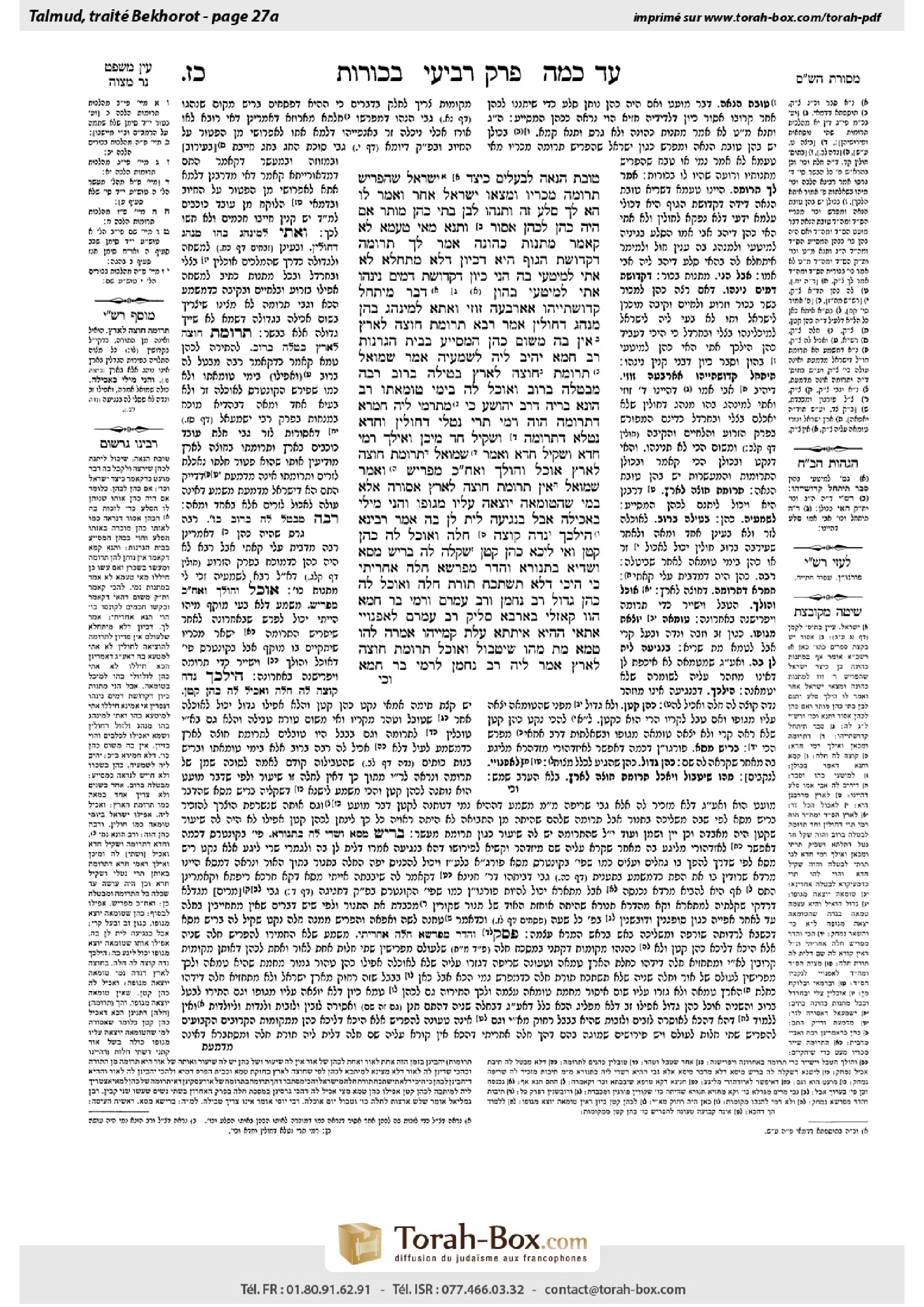
Bekhorot 27a: Talmud study for Daf Yomi
Study the Talmud for Daf Yomi with scanned pages, Hebrew text, English translations from Sefaria and AI-generated French translations.
Passage selection and English or AI-generated French translation are available where the scan has annotations. Daf Study is independent of Torah-Box and Sefaria.
Browse Bekhorot · בכורות · All tractatesBekhorot 27a text and translations
This page of Bekhorot includes the Aramaic text, an English translation and an AI-generated French translation, alongside the scan above.
בכורות כ״ז א · Aramaic and Hebrew text
טוֹבַת הֲנָאָה לַבְּעָלִים.
כֵּיצַד? יִשְׂרָאֵל שֶׁהִפְרִישׁ תְּרוּמָה מִכִּרְיוֹ, וּמְצָאוֹ יִשְׂרָאֵל אַחֵר, וְאָמַר לוֹ: ״הֵא לְךָ סֶלַע זֶה, וּתְנֵהוּ לְבֶן בִּתִּי כֹּהֵן״ — מוּתָּר. אִם הָיָה כֹּהֵן לְכֹהֵן — אָסוּר.
וְתַנָּא מַאי טַעְמָא לָא קָאָמַר מַתְּנוֹת כְּהוּנָּה? אָמַר לָךְ: תְּרוּמָה, דִּקְדוּשַּׁת הַגּוּף הִיא, דְּכֵיוָן דְּלָא מִתַּחֲלָא — לָא אָתֵי לְמִיטְעֵי בַּהּ.
הָנֵי, כֵּיוָן דִּקְדוּשַּׁת דָּמִים נִינְהוּ, אָתֵי לְמִיטְעֵי בְּהוֹן, דְּבַר מִיתַּחַל קְדוּשְׁתַּיְיהוּ אַאַרְבְּעָה זוּזֵי, וְאָתֵא לְמִינְהַג בְּהֹן מִנְהָג דְּחוּלִּין.
אָמַר רָבָא: תְּרוּמַת חוּצָה לָאָרֶץ — אֵין בָּהּ מִשּׁוּם כֹּהֵן הַמְסַיֵּיעַ בְּבֵית הַגְּרָנוֹת. רַב חָמָא יָהֵיב לֵיהּ לְשַׁמָּעֵיהּ.
אָמַר שְׁמוּאֵל: תְּרוּמַת חוּצָה לָאָרֶץ — בְּטֵילָה בְּרוֹב. רַבָּה מְבַטְּלָהּ בְּרוֹב, וְאוֹכֵל לָהּ בִּימֵי טוּמְאָתוֹ.
רַב הוּנָא בְּרֵיהּ דְּרַב יְהוֹשֻׁעַ, כִּי מִתְרְמֵי לֵיהּ חַמְרָא דִּתְרוּמָה, הֲוָה רָמֵי תְּרֵי נַטְלֵי דְּחוּלִּין וַחֲדָא נַטְלָא דִּתְרוּמָה, וְשָׁקֵיל חַד. מִיכָּן וְאֵילָךְ, רָמֵי חֲדָא וְשָׁקֵיל חֲדָא.
וְאָמַר שְׁמוּאֵל: תְּרוּמַת חוּצָה לָאָרֶץ, אוֹכֵל וְהוֹלֵךְ, וְאַחַר כָּךְ מַפְרִישׁ.
וְאָמַר שְׁמוּאֵל: אֵין תְּרוּמַת חוּצָה לָאָרֶץ אֲסוּרָה אֶלָּא בְּמִי שֶׁהַטּוּמְאָה יוֹצְאָה עָלָיו מִגּוּפוֹ, וְהָנֵי מִילֵּי בַּאֲכִילָה, אֲבָל בִּנְגִיעָה — לֵית לַן בַּהּ.
אָמַר רָבִינָא: הִילְכָּךְ, נִדָּה קוֹצָה חַלָּה, וְאוֹכֵל לָהּ כֹּהֵן קָטָן, וְאִי לֵיכָּא כֹּהֵן קָטָן — שָׁקְלָה לַהּ בְּרֵישׁ מַסָּא, וְשָׁדְיָא בְּתַנּוּרָא, וַהֲדַר מַפְרְשָׁא חַלָּה אַחֲרִיתִי, כִּי הֵיכִי דְּלֹא תִּשְׁתַּכַּח תּוֹרַת חַלָּה, וְאוֹכֵל לָהּ כֹּהֵן גָּדוֹל.
רַב נַחְמָן וְרַב עַמְרָם וְרָמֵי בַּר חָמָא הֲווֹ קָאָזְלִי בְּאַרְבָּא, סְלֵיק רַב עַמְרָם לְאִפְּנוֹיֵי, אֲתַאי הָהִיא אִיתְּתָא עַלַּת קַמַּיְיהוּ, אֲמַרָה לְהוּ: טְמֵא מֵת מַהוּ שֶׁיִּטְבּוֹל וְאוֹכֵל תְּרוּמַת חוּצָה לָאָרֶץ? אֲמַר לֵיהּ רַב נַחְמָן לְרָמֵי בַּר חָמָא:
Bekhorot 27a · English translation
the benefit of discretion for the owners of the produce, i.e., benefit accrued from the option of giving teruma and tithes to any priest or Levite of their choosing.
The baraita continues: How so? With regard to an Israelite who separated teruma from his pile of grain, and another Israelite found him and said to him: Take this sela coin for yourself and give the teruma and tithes to my daughter’s son who is a priest, it is permitted. But if it was a priest who gave the sela coin for the right to give the teruma and tithes to another priest, it is prohibited. Priests may not pay for the gifts that they receive.
The Gemara asks: And according to the tanna of this baraita, what is the reason that he does not state that the owners also have the benefit of discretion with regard to the gifts of the priesthood, i.e., the foreleg, jaw, and maw, which must be given to the priest from every non-sacred animal that one slaughters? Why does he mention teruma alone? The Gemara answers that he could have said to you: In the case of teruma, which has inherent sanctity, and which therefore cannot be redeemed, the priest will not come to err with it and treat it as though it has no sanctity, even if the owner receives payment for it.
By contrast, with regard to these gifts of the priesthood, since they have sanctity that inheres in their value, which means that once the priest has received them he may sell them, the priest might come to err with them by saying that the sanctity that they have can be redeemed with four zuz, i.e., the one sela, and he might come to treat them in the manner that one treats non-sacred food. This would be a mistake, as a priest must eat his priestly gifts in a dignified manner, i.e., roasted and with seasoning (see Ḥullin 132b).
§ On a related topic, Rava says: Teruma from outside of Eretz Yisrael does not have any prohibition due to a priest assisting at the threshing floor. The Sages decreed that one must separate teruma from produce grown in certain places outside of Eretz Yisrael. Yet, the halakhot governing this teruma are not as stringent as those that apply to teruma from produce grown within Eretz Yisrael. Consequently, one may give such teruma to a priest for helping at the threshing floor. In support of this claim, the Gemara relates that Rav Ḥama gave teruma from outside of Eretz Yisrael to his servant, who was a priest, as his wages.
With regard to teruma from outside of Eretz Yisrael, Shmuel says: Teruma from outside of Eretz Yisrael that became mixed with non-sacred produce is nullified in a majority, unlike ordinary teruma, which requires one hundred parts of non-sacred produce to nullify it. The Gemara relates that Rabba, who was a priest, would nullify his teruma from outside of Eretz Yisrael in a majority ab initio and eat it during his days of impurity. Both of these acts are prohibited in the case of teruma from produce grown in Eretz Yisrael.
The Gemara relates: Rav Huna, son of Rav Yehoshua, when he would happen to have wine of teruma from produce grown outside of Eretz Yisrael, would pour two jugs of non-sacred wine and one jug of teruma wine into a vat in order to nullify the teruma wine, and then take out one jug’s worth of wine to drink. Having done so, from here onward every time he received more teruma wine grown outside of Eretz Yisrael, he would pour one jug of teruma wine into the same vat, which still contained two jugs’ worth of wine, and take out one jug’s worth of wine.
And Shmuel further says: Teruma from produce grown outside of Eretz Yisrael does not need to be separated before one eats the produce. Rather, one may proceed to eat and afterward separate the teruma from the remainder.
And Shmuel also says: Teruma from outside of Eretz Yisrael is prohibited only to a member of a priestly household whose impurity comes from his body, e.g., a man who experiences a seminal emission or a menstruating woman. It is not prohibited to a priest who came into contact with a corpse, an animal carcass, or the carcass of a creeping animal. And this statement, that such teruma is forbidden to one whose impurity comes from his body, applies only with regard to eating it. But with regard to touching teruma from outside of Eretz Yisrael, we have no problem with it.
Ravina says: Therefore, a menstruating woman, whose impurity comes from her body, may separate ḥalla from dough outside of Eretz Yisrael, and a minor priest, who has never experienced a seminal emission and is therefore ritually pure, may eat it. And if there is no minor priest available, she takes the ḥalla with the top of a skewer [massa] and throws it in the oven, and then separates another piece from the dough as ḥalla, not because it is necessary but so that the halakhic category of ḥalla should not be forgotten. And an adult priest may eat it, even if he is ritually impure.
The Gemara relates that Rav Naḥman, Rav Amram, and Rami bar Ḥama were traveling in a ferry. Rav Amram went to relieve himself. A certain woman came before Rav Naḥman and Rami bar Ḥama and said to them: In the case of one who is impure through contact with a corpse, what is the halakha with regard to whether he may immerse himself in a ritual bath and partake of teruma from outside of Eretz Yisrael? Rav Naḥman said to Rami bar Ḥama:
Bekhorot 27a · Traduction française (IA)
le bénéfice de la discrétion pour les propriétaires des produits, c'est-à-dire le bénéfice découlant de l'option de donner la terouma et les dîmes à tout prêtre ou lévite de leur choix.
La baraïta continue : Comment cela se passe-t-il ? En ce qui concerne un Israélite qui a séparé la terouma de son tas de céréales, et un autre Israélite le trouve et lui dit : Prends cette sela et donne la terouma et les dîmes à mon fils, qui est un prêtre, c'est permis. Mais si c'était un prêtre qui donnait la sela pour le droit de donner la terouma et les dîmes à un autre prêtre, c'est interdit. Les prêtres ne peuvent pas payer pour les dons qu'ils reçoivent.
La Guemara pose la question : Et selon le tanna de cette baraïta, quelle est la raison pour laquelle il ne dit pas que les propriétaires ont également le bénéfice de la discrétion concernant les dons du sacerdoce, c'est-à-dire la cuisse, la mâchoire et la gueule, qui doivent être donnés au prêtre de chaque animal non sacré que l'on abat ? Pourquoi mentionne-t-il uniquement la terouma ? La Guemara répond qu'il aurait pu te dire : Dans le cas de la terouma, qui a une sanctité intrinsèque et qui ne peut donc être rachetée, le prêtre ne viendra pas à se tromper avec elle et la traiter comme si elle n'avait pas de sanctité, même si le propriétaire reçoit une rémunération.
Par contraste, concernant ces dons du sacerdoce, puisque leur sanctité réside dans leur valeur, ce qui signifie que, une fois que le prêtre les a reçus, il peut les vendre, le prêtre pourrait se tromper en disant que la sanctité qu'ils ont peut être rachetée avec quatre zuz, c'est-à-dire une sela, et il pourrait les traiter comme des aliments non sacrés. Cela serait une erreur, car un prêtre doit manger ses dons sacerdotaux de manière digne, c'est-à-dire grillés et aromatisés (voir Ḥullin 132b).
§ Sur un sujet lié, Rava dit : La terouma provenant en dehors de la Terre d'Israël n'a pas de prohibition liée à un prêtre aidant au moulin. Les Sages ont décrété qu'on doit séparer la terouma des produits cultivés dans certains lieux en dehors de la Terre d'Israël. Cependant, les halakhot régissant cette terouma ne sont pas aussi strictes que celles applicables à la terouma provenant de produits cultivés à l'intérieur de la Terre d'Israël. Par conséquent, on peut donner cette terouma à un prêtre pour l'aider au moulin. En soutien de cette affirmation, la Guemara rapporte que Rav Ḥama a donné de la terouma en dehors de la Terre d'Israël à son serviteur, qui était un prêtre, comme salaire.
Concernant la terouma provenant en dehors de la Terre d'Israël, Shmuel dit : La terouma provenant en dehors de la Terre d'Israël qui s'est mélangée à des produits non sacrés est annulée par majorité, contrairement à la terouma ordinaire, qui exige cent parties de produits non sacrés pour l'annuler. La Guemara rapporte que Rabba, qui était un prêtre, annulait sa terouma en dehors de la Terre d'Israël par majorité dès le début et la mangeait pendant ses jours d'impureté. Ces deux actes sont interdits dans le cas de la terouma provenant de produits cultivés à l'intérieur de la Terre d'Israël.
La Guemara rapporte : Rav Huna, fils de Rav Yehoshua, lorsqu'il possédait du vin de terouma provenant de produits cultivés en dehors de la Terre d'Israël, versait deux seaux de vin non sacré et un seau de vin de terouma dans un tonneau afin d'annuler le vin de terouma, puis prenait un seau de vin pour boire. Ayant fait cela, à partir de ce moment, chaque fois qu'il recevait plus de vin de terouma cultivé en dehors de la Terre d'Israël, il versait un seau de vin de terouma dans le même tonneau, qui contenait encore deux seaux de vin, et prenait un seau de vin pour boire.
Et Shmuel ajoute : La terouma provenant de produits cultivés en dehors de la Terre d'Israël n'a pas besoin d'être séparée avant de manger les produits. On peut manger d'abord et séparer la terouma du reste après.
Et Shmuel dit aussi : La terouma en dehors de la Terre d'Israël est interdite uniquement à un membre d'une famille sacerdotale dont l'impureté provient de son corps, c'est-à-dire un homme qui a une émission sémencière ou une femme en période de ménstruation. Elle n'est pas interdite à un prêtre qui a été en contact avec un cadavre, un cadavre d'animaux ou un cadavre d'un animal rampant. Et cette déclaration, selon laquelle cette terouma est interdite à celui dont l'impureté provient de son corps, s'applique uniquement en ce qui concerne son ingestion. En ce qui concerne le toucher de la terouma en dehors de la Terre d'Israël, nous n'avons pas de problème.
Ravina dit : Par conséquent, une femme en période de ménstruation, dont l'impureté provient de son corps, peut séparer la ḥalla de la pâte en dehors de la Terre d'Israël, et un petit prêtre, qui n'a jamais eu d'émission sémencière et est donc rituellement pur, peut la manger. Et si aucun petit prêtre n'est disponible, elle prend la ḥalla avec le haut d'une pique [massa] et la jette dans le four, puis sépare une autre partie de la pâte comme ḥalla, non parce que c'est nécessaire, mais afin que la catégorie halakhique de ḥalla ne soit pas oubliée. Et un prêtre adulte peut la manger, même s'il est impur.
La Guemara rapporte que Rav Naḥman, Rav Amram et Rami bar Ḥama voyageaient en bateau. Rav Amram est allé se soulager. Une certaine femme est venue devant Rav Naḥman et Rami bar Ḥama et leur a dit : En ce qui concerne celui qui est impur en raison de son contact avec un cadavre, quelle est la halakha concernant la possibilité qu'il puisse se baigner dans un bain rituel et manger de la terouma en dehors de la Terre d'Israël ? Rav Naḥman a dit à Rami bar Ḥama :
Traduction française générée par IA à partir de l’édition anglaise de Sefaria. Vérifie toujours un passage avec le texte source.
Text from Sefaria: William Davidson Edition - Vocalized Aramaic (CC BY NC); William Davidson Edition - English (CC BY NC).