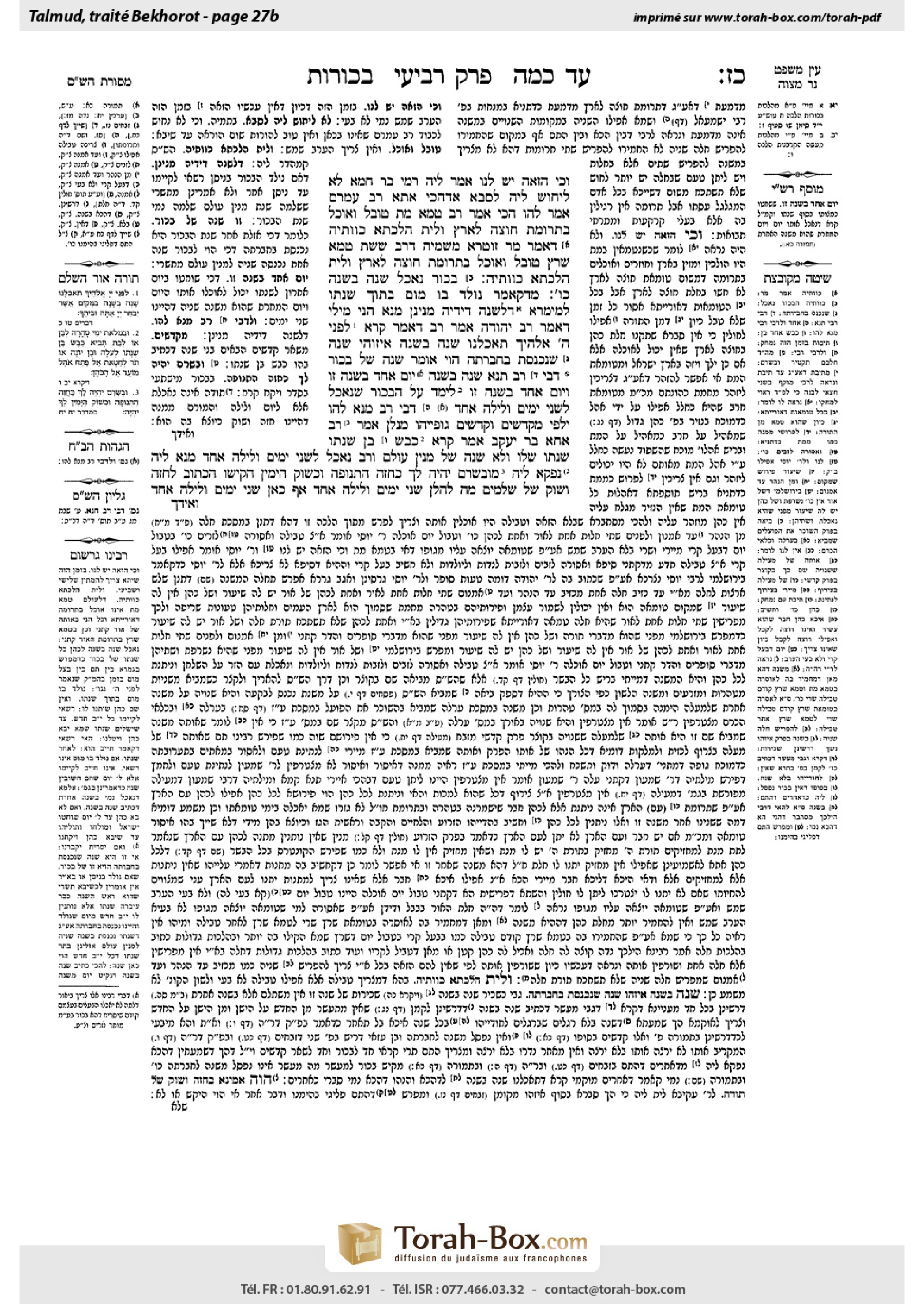
Bekhorot 27b: Talmud study for Daf Yomi
Study the Talmud for Daf Yomi with scanned pages, Hebrew text, English translations from Sefaria and AI-generated French translations.
Passage selection and English or AI-generated French translation are available where the scan has annotations. Daf Study is independent of Torah-Box and Sefaria.
Browse Bekhorot · בכורות · All tractatesBekhorot 27b text and translations
This page of Bekhorot includes the Aramaic text, an English translation and an AI-generated French translation, alongside the scan above.
בכורות כ״ז ב · Aramaic and Hebrew text
וְכִי הַזָּאָה יֵשׁ לָנוּ? אֲמַר לֵיהּ רָמֵי בַּר חָמָא: לָא לֵיחוּשׁ לֵיהּ לְסָבָא. אַדְּהָכִי אֲתָא רַב עַמְרָם, אֲמַר לְהוּ: הָכִי אָמַר רַב: טְמֵא מֵת טוֹבֵל וְאוֹכֵל בִּתְרוּמַת חוּצָה לָאָרֶץ.
וְלֵית הִלְכְתָא כְּוָותֵיהּ, דְּאָמַר מָר זוּטְרָא מִשְּׁמֵיהּ דְּרַב שֵׁשֶׁת: טְמֵא שֶׁרֶץ טוֹבֵל וְאוֹכֵל בִּתְרוּמַת חוּצָה לָאָרֶץ, וְלֵית הִלְכְתָא כְּוָותֵיהּ.
בְּכוֹר נֶאֱכָל שָׁנָה בְּשָׁנָה כּוּ׳. מִדְּקָאָמַר ״נוֹלַד בּוֹ מוּם בְּתוֹךְ שְׁנָתוֹ״, לְמֵימְרָא דִּלְשָׁנָה דִּידֵיהּ מָנֵינַן. מְנָא הָנֵי מִילֵּי?
דְּאָמַר רַב יְהוּדָה אָמַר רַב, דְּאָמַר קְרָא: ״לִפְנֵי ה׳ אֱלֹהֶיךָ תֹאכְלֶנּוּ שָׁנָה בְשָׁנָה״, אֵיזוֹהִי שָׁנָה שֶׁנִּכְנֶסֶת בַּחֲבֶרְתָּהּ? הֱוֵי אוֹמֵר: שָׁנָה שֶׁל בְּכוֹר.
דְּבֵי רַב תָּנָא: ״שָׁנָה בְּשָׁנָה״ — יוֹם אֶחָד בְּשָׁנָה זוֹ, וְיוֹם אֶחָד בְּשָׁנָה זוֹ, לִימֵּד עַל הַבְּכוֹר שֶׁנֶּאֱכָל לִשְׁנֵי יָמִים וְלַיְלָה אֶחָד.
דְּבֵי רַב, מְנָא לְהוּ? יָלְפִי מִקֳּדָשִׁים, וְקָדָשִׁים גּוּפַיְיהוּ מְנָלַן? אָמַר רַב אַחָא בַּר יַעֲקֹב: אָמַר קְרָא ״כֶּבֶשׂ בֶּן שְׁנָתוֹ״ — שְׁנָתוֹ שֶׁלּוֹ, וְלֹא שָׁנָה שֶׁל מִנְיַן עוֹלָם.
וְרַב, נֶאֱכָל לִשְׁנֵי יָמִים וְלַיְלָה אֶחָד, מְנָא לֵיהּ? נָפְקָא לֵיהּ מֵ״וּבְשָׂרָם יִהְיֶה לָּךְ כַּחֲזֵה הַתְּנוּפָה וּכְשׁוֹק הַיָּמִין״ — הִקִּישׁוֹ הַכָּתוּב לְחָזֶה וָשׁוֹק שֶׁל שְׁלָמִים: מָה לְהַלָּן שְׁנֵי יָמִים וְלַיְלָה אֶחָד, אַף כָּאן שְׁנֵי יָמִים וְלַיְלָה אֶחָד.
Bekhorot 27b · English translation
But do we have sprinkling of the ashes of the red heifer? Since without such sprinkling one remains impure after contact with a corpse, how does it help to immerse in a ritual bath? Rami bar Ḥama said to him: Shouldn’t Rav Naḥman be concerned for the opinion of the old man, i.e., Rav Amram? Wouldn’t it be better to wait until he returns before answering? Meanwhile, Rav Amram came back. He said to them that this is what Rav says: One who became impure with impurity imparted by a corpse may immerse and partake of teruma from produce grown outside of Eretz Yisrael.
The Gemara comments: But the halakha is not in accordance with his opinion. Mar Zutra said in the name of Rav Sheshet: One who became impure through contact with the carcass of a creeping animal may immerse in a ritual bath and partake of teruma from produce grown outside of Eretz Yisrael. But the halakha is not in accordance with his opinion.
§ The mishna teaches: The firstborn animal is eaten year by year, i.e., within its first year, whether it is blemished or unblemished. The Gemara comments: From the fact that the mishna says: If a blemish developed within its first year, rather than within the first year, that is to say that we count according to its year, not by the calendar year. In other words, the year is calculated from the day of the animal’s birth. From where is this matter derived?
It is derived from a verse, as Rav Yehuda says that Rav says that the verse states: “You shall eat it before the Lord your God, year by year [shana beshana] in the place that the Lord shall choose, you and your household” (Deuteronomy 15:20). The phrase “shana beshana,” which can also be translated as: A year in a year, indicates that the verse is referring to one year that enters another year. Which type of year enters another year? You must say that this is speaking of the year of the firstborn animal, which enters the following calendar year, since if the animal is born in the middle of the year, its first year includes part of the subsequent calendar year.
The school of Rav taught that there is a different halakha derived from the phrase “year by year.” This phrase indicates that it may be eaten on one day of this year and one day of that next year. The verse thereby taught with regard to an unblemished firstborn animal, which is sacrificed in the Temple, that it is eaten for two days and one night, like a peace offering.
The Gemara asks: From where does the school of Rav derive the halakha that a firstborn must be eaten within its own year and that its year is not calculated according to the calendar year? They derive it from the halakha of other sacrificial animals, whose age is counted from their birth rather than by the calendar year. And with regard to the other sacrificial animals themselves, from where do we derive that their age is counted from their birth? Rav Aḥa bar Yaakov says that the verse states: “And when the days of her purification are fulfilled, for a son or for a daughter, she shall bring a lamb in its first year for a burnt offering, and a pigeon or a dove for a sin offering, to the door of the Tent of Meeting, to the priest” (Leviticus 12:6). This description of the lamb is referring to its own year, and not a year of the counting of the world.
The Gemara asks: And Rav, from where does he derive that a firstborn is eaten for two days and one night? The Gemara answers: He derives it from a verse in which Moses spoke to Aaron and his sons with regard to eating the firstborn: “And their flesh shall be yours, as the breast of waving and as the right thigh, it shall be yours” (Numbers 18:18). The verse thereby juxtaposed the halakha of the firstborn with the breast and thigh of a peace offering. Just as there, it may be eaten for two days and one night, as stated explicitly in a verse (see Leviticus 7:16), so too here, a firstborn may be eaten for two days and one night.
Bekhorot 27b · Traduction française (IA)
Mais avons-nous le jetage des cendres de la vache rouge ? Car sans ce jetage, une personne demeure impure après avoir touché un cadavre, comment l'immerger dans un mikvé peut-il aider ? Rami bar Ḥama dit à lui : Ne devrait pas Rav Naḥman s'inquiéter de l'opinion de l'homme âgé, c'est-à-dire de Rav Amram ? Ne serait-il pas préférable d'attendre qu'il revienne avant de répondre ? En attendant, Rav Amram est revenu. Il a dit à eux que c'est ce que Rav dit : Celui qui est devenu impur par l'impureté transmise par un cadavre peut s'immerger et consommer la terouma provenant de productions cultivées en dehors de la Terre d'Israël.
La Guemara commente : Mais la halakha ne suit pas son opinion. Mar Zutra, en nom de Rav Sheshet, dit : Celui qui est devenu impur par contact avec le cadavre d'un animal rampant peut s'immerger dans un mikvé et consommer la terouma provenant de productions cultivées en dehors de la Terre d'Israël. Mais la halakha ne suit pas son opinion.
§ La Michna enseigne : L'animal premier est mangé année après année, c'est-à-dire dans son premier année, qu'il soit blemi ou non blemi. La Guemara commente : D'après le fait que la Michna dit : Si une blemie s'est développée pendant son premier année, plutôt que pendant le premier année, c'est-à-dire que nous comptons selon son année, pas selon l'année civile. En d'autres termes, l'année est calculée depuis la naissance de l'animal. D'où cette matière est-elle dérivée ?
Elle est dérivée d'un verset, comme Rav Yehuda dit que Rav dit que le verset stipule : « Vous mangerez [le premier-né] devant l'Éternel votre Dieu, année par année [shana beshana] au lieu que l'Éternel choisira, vous et votre maison » (Deutéronome 15:20). La phrase « shana beshana », qui peut aussi être traduite par : Une année dans une année, indique que le verset fait référence à une année qui entre dans une autre année. Quel type d'année entre dans une autre année ? Vous devez dire que cela parle de l'année du premier-né, qui entre dans l'année civile suivante, car si l'animal est né au milieu de l'année, son premier année inclut une partie de l'année civile suivante.
L'école de Rav enseigne qu'il y a une autre halakha dérivée de la phrase « année par année ». Cette phrase indique qu'il peut être mangé un jour de cette année et un jour de l'année suivante. Le verset a ainsi enseigné concernant un premier-né non blemi, qui est sacrifié dans le Temple, qu'il est mangé pendant deux jours et une nuit, comme un sacrifice de paix.
La Guemara pose la question : D'où l'école de Rav dérive-t-elle la halakha selon laquelle un premier-né doit être mangé dans son propre année et que son année n'est pas calculée selon l'année civile ? Ils la dérivent de la halakha des autres animaux sacrés, dont l'âge est compté depuis leur naissance plutôt que selon l'année civile. Et concernant ces autres animaux sacrés eux-mêmes, d'où dérivons-nous que leur âge est compté depuis leur naissance ? Rav Aḥa bar Yaakov dit que le verset stipule : « Et lors que les jours de sa purification sont accomplis, pour un fils ou pour une fille, elle apportera un bélier de son premier année pour un holocauste, et une colombe ou un pigeon pour un sacrifice expiatoire, à la porte du Tenta de Rencontre, au prêtre » (Lévitique 12:6). Cette description du bélier fait référence à son propre année, et non à une année du compte du monde.
La Guemara pose la question : Et Rav, d'où dérive-t-il que le premier-né est consommé pendant deux jours et une nuit ? La Guemara répond : Il le dérive d'un verset dans lequel Moïse a parlé à Aaron et à ses fils concernant la consommation du premier-né : « Et leur chair sera la vôtre, comme la poitrine de la dédicace et comme le flanc droit, elle sera la vôtre » (Nombres 18:18). Le verset a ainsi juxtaposé la halakha du premier-né avec la poitrine et le flanc d'un sacrifice de paix. Aussi bien là-bas, il peut être mangé pendant deux jours et une nuit, comme cela est explicitement mentionné dans un verset (voir Lévitique 7:16), ainsi que ici, un premier-né peut être mangé pendant deux jours et une nuit.
Traduction française générée par IA à partir de l’édition anglaise de Sefaria. Vérifie toujours un passage avec le texte source.
Text from Sefaria: William Davidson Edition - Vocalized Aramaic (CC BY NC); William Davidson Edition - English (CC BY NC).