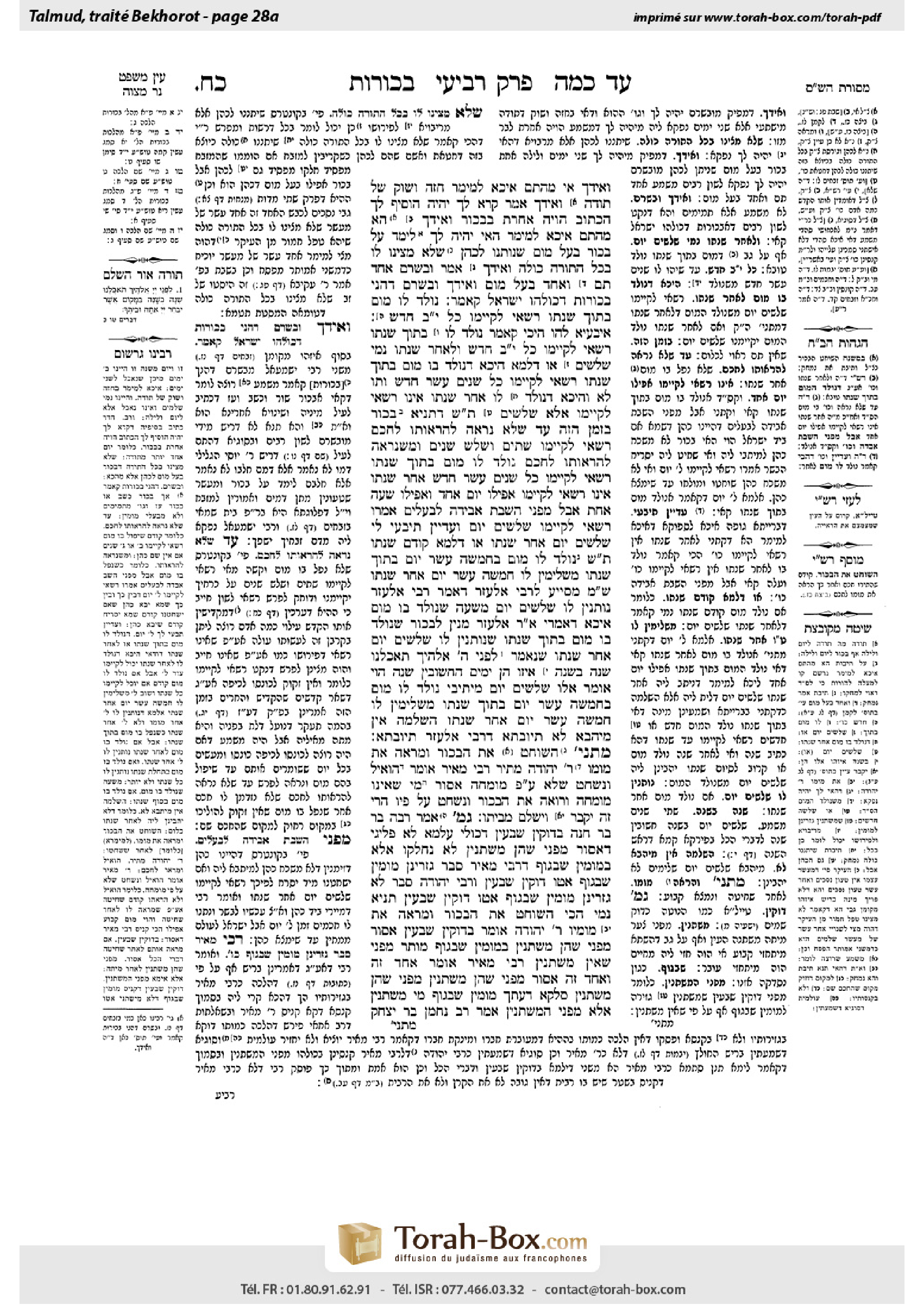
Bekhorot 28a: Talmud study for Daf Yomi
Study the Talmud for Daf Yomi with scanned pages, Hebrew text, English translations from Sefaria and AI-generated French translations.
Passage selection and English or AI-generated French translation are available where the scan has annotations. Daf Study is independent of Torah-Box and Sefaria.
Browse Bekhorot · בכורות · All tractatesBekhorot 28a text and translations
This page of Bekhorot includes the Aramaic text, an English translation and an AI-generated French translation, alongside the scan above.
בכורות כ״ח א · Aramaic and Hebrew text
וְאִידַּךְ, אִי מֵהָתָם אִיכָּא לְמֵימַר חָזֶה וָשׁוֹק שֶׁל תּוֹדָה.
וְאִידַּךְ, אָמַר קְרָא: ״לְךָ יִהְיֶה״ — הוֹסִיף לְךָ הַכָּתוּב הֲוָיָה אַחֶרֶת בִּבְכוֹר.
וְאִידַּךְ, הָא מֵהָתָם אִיכָּא לְמֵימַר: הַאי ״יִהְיֶה לָּךְ״ — לִימֵּד עַל בְּכוֹר בַּעַל מוּם שֶׁנּוֹתְנוֹ לְכֹהֵן, שֶׁלֹּא מָצִינוּ לוֹ בְּכׇל הַתּוֹרָה כּוּלָּהּ.
וְאִידַּךְ, אָמַר ״וּבְשָׂרָם״ — אֶחָד תָּם וְאֶחָד בַּעַל מוּם, וְאִידַּךְ — ״וּבְשָׂרָם״ דְּהָנֵי בְּכוֹרוֹת דְּכוּלְּהוּ יִשְׂרָאֵל קָאָמַר.
נוֹלַד לוֹ מוּם בְּתוֹךְ שְׁנָתוֹ, רַשַּׁאי לְקַיְּימוֹ כׇּל שְׁנֵים עָשָׂר חֹדֶשׁ. אִיבַּעְיָא לְהוּ: הֵיכִי קָאָמַר? נוֹלַד לוֹ בְּתוֹךְ שְׁנָתוֹ, רַשַּׁאי לְקַיְּימוֹ כׇּל שְׁנֵים עָשָׂר חֹדֶשׁ, וּלְאַחַר שְׁנָתוֹ נָמֵי שְׁלֹשִׁים? אוֹ דִלְמָא: הֵיכָא דְּנוֹלַד בּוֹ מוּם בְּתוֹךְ שְׁנָתוֹ, רַשַּׁאי לְקַיְּימוֹ כׇּל שְׁנֵים עָשָׂר חֹדֶשׁ וְתוּ לָא, וְהֵיכָא דְּנוֹלַד לוֹ אַחַר שְׁנָתוֹ, אֵינוֹ רַשַּׁאי לְקַיְּימוֹ אֶלָּא שְׁלֹשִׁים?
תָּא שְׁמַע, דְּתַנְיָא: בְּכוֹר בִּזְמַן הַזֶּה, עַד שֶׁלֹּא נִרְאָה לְהַרְאוֹתוֹ לֶחָכָם — רַשַּׁאי לְקַיְּימוֹ שְׁתַּיִם וְשָׁלֹשׁ שָׁנִים, וּמִשֶּׁנִּרְאָה לְהַרְאוֹתוֹ לֶחָכָם, נוֹלַד לוֹ מוּם בְּתוֹךְ שְׁנָתוֹ — רַשַּׁאי לְקַיְּימוֹ כׇּל שְׁנֵים עָשָׂר חֹדֶשׁ.
אַחַר שְׁנָתוֹ אֵינוֹ רַשַּׁאי לְקַיְּימוֹ אֲפִילּוּ יוֹם אֶחָד, וַאֲפִילּוּ שָׁעָה אַחַת. אֲבָל מִפְּנֵי הֲשָׁבַת אֲבֵידָה לַבְּעָלִים, אָמְרוּ: רַשַּׁאי לְקַיְּימוֹ שְׁלֹשִׁים יוֹם.
וַעֲדַיִין תִּיבְּעֵי לִי: שְׁלֹשִׁים יוֹם אַחַר שְׁנָתוֹ, אוֹ דִלְמָא קוֹדֶם שְׁנָתוֹ?
תָּא שְׁמַע: נוֹלַד לוֹ מוּם בַּחֲמִשָּׁה עָשָׂר יוֹם בְּתוֹךְ שְׁנָתוֹ, מַשְׁלִימִין לוֹ חֲמִשָּׁה עָשָׂר יוֹם אַחַר שְׁנָתוֹ. שְׁמַע מִינַּהּ, מְסַיַּיע לְרַבִּי אֶלְעָזָר, דְּאָמַר רַבִּי אֶלְעָזָר: נוֹתְנִין לוֹ שְׁלֹשִׁים יוֹם מִשָּׁעָה שֶׁנּוֹלַד בּוֹ מוּם.
אִיכָּא דְּאָמְרִי, אָמַר רַבִּי אֶלְעָזָר: מִנַּיִן לִבְכוֹר שֶׁנּוֹלַד בּוֹ מוּם בְּתוֹךְ שְׁנָתוֹ שֶׁנּוֹתְנִין לוֹ שְׁלֹשִׁים יוֹם אַחַר שְׁנָתוֹ? שֶׁנֶּאֱמַר: ״לִפְנֵי ה׳ אֱלֹהֶיךָ תֹאכְלֶנּוּ שָׁנָה בְשָׁנָה״, (אֵיזוֹ) [אֵילּוּ] הֵן יָמִים הַחֲשׁוּבִין שָׁנָה — הֱוֵי אוֹמֵר אֵלּוּ שְׁלֹשִׁים יוֹם.
מֵיתִיבִי: נוֹלַד לוֹ מוּם בַּחֲמִשָּׁה עָשָׂר יוֹם בְּתוֹךְ שְׁנָתוֹ — מַשְׁלִימִין לוֹ חֲמִשָּׁה עָשָׂר יוֹם אַחַר שְׁנָתוֹ. הַשְׁלָמָה — אִין, מֵיהֲבָא — לָא! תְּיוּבְתָּא דְּרַבִּי אֶלְעָזָר, תְּיוּבְתָּא.
מַתְנִי׳ הַשּׁוֹחֵט אֶת הַבְּכוֹר וּמַרְאֶה אֶת מוּמוֹ — רַבִּי יְהוּדָה מַתִּיר, רַבִּי מֵאִיר אוֹמֵר: הוֹאִיל וְנִשְׁחַט שֶׁלֹּא עַל פִּי מוּמְחֶה — אָסוּר. מִי שֶׁאֵינוֹ מוּמְחֶה וְרוֹאֶה אֶת הַבְּכוֹר, וְנִשְׁחַט עַל פִּיו — הֲרֵי זֶה יִקָּבֵר, וִישַׁלֵּם מִבֵּיתוֹ.
גְּמָ׳ אָמַר רַבָּה בַּר בַּר חָנָה: בְּדוּקִּין שֶׁבָּעַיִן — דְּכוּלֵּי עָלְמָא לָא פְּלִיגִי דְּאָסוּר, מִפְּנֵי שֶׁהֵן מִשְׁתַּנִּין. לֹא נֶחְלְקוּ אֶלָּא בְּמוּמִין שֶׁבַּגּוּף, דְּרַבִּי מֵאִיר סָבַר: גָּזְרִינַן מוּמִין שֶׁבַּגּוּף אַטּוּ דּוּקִּין שֶׁבָּעַיִן, וְרַבִּי יְהוּדָה סָבַר: לָא גָּזְרִינַן מוּמִין שֶׁבַּגּוּף אַטּוּ דּוּקִּין שֶׁבָּעַיִן.
תַּנְיָא נָמֵי הָכִי: הַשּׁוֹחֵט אֶת הַבְּכוֹר וּמַרְאֶה אֶת מוּמָיו — רַבִּי יְהוּדָה אוֹמֵר: בְּדוּקִּין שֶׁבְּעַיִן אָסוּר, מִפְּנֵי שֶׁהֵן מִשְׁתַּנִּין, בְּמוּמִין שֶׁבַּגּוּף מוּתָּר, מִפְּנֵי שֶׁאֵין מִשְׁתַּנִּין. רַבִּי מֵאִיר אוֹמֵר: אֶחָד זֶה וְאֶחָד זֶה אָסוּר, מִפְּנֵי שֶׁהֵן מִשְׁתַּנִּין. מִפְּנֵי שֶׁהֵן מִשְׁתַּנִּין סָלְקָא דַּעְתָּךְ? מוּמִין שֶׁבַּגּוּף מִי מִשְׁתַּנִּין?! אֶלָּא מִפְּנֵי הַמִּשְׁתַּנִּין.
אָמַר רַב נַחְמָן בַּר יִצְחָק:
Bekhorot 28a · English translation
And the other ones, i.e., the Sages from the school of Rav, why don’t they derive the halakha that a firstborn is eaten for two days and one night from that verse? The Gemara answers that if it were derived from there, it would be possible to say that the verse is comparing the halakha of a firstborn to the breast and thigh of a thanks offering, which are eaten for only one day and night.
The Gemara asks: And the other one, Rav Yehuda, citing Rav, how does he respond to this? The verse states: “And their flesh shall be yours, as the breast of waving and as the right thigh, it shall be yours” (Numbers 18:18). The verse adds another mention of a form of the term being in the second phrase: “It shall be yours,” to teach that the priest has an additional day to eat a firstborn animal, i.e., that it is compared to the breast and thigh of a peace offering, not to that of a thanks offering.
The Gemara asks: And the other ones, the Sages from the school of Rav, how do they respond to this claim? The Gemara answers: With regard to the inference from there, it is possible to say that this phrase: “It shall be yours,” teaches with regard to a blemished firstborn that the owner must give it to the priest. This derivation is necessary, as we have not found this halakha that a blemished firstborn is given to a priest stated explicitly anywhere in the entire Torah.
The Gemara asks: And the other one, Rav Yehuda, citing Rav, from where does he derive that a blemished firstborn is given to a priest? The verse states: “And their flesh shall be yours,” in the plural, i.e., both an unblemished firstborn and a blemished firstborn. The Gemara asks: And the other ones, the Sages from the school of Rav, how do they respond? The Gemara answers that they would claim that the term “and their flesh” is written in the plural not because it is referring to blemished animals, but because it is said in reference to those firstborn animals of all the Israelites.
§ The mishna teaches: If a blemish developed within its first year, it is permitted for the owner to maintain the animal for the entire twelve months; if a blemish developed after twelve months have passed, it is permitted for the owner to maintain the animal for only thirty days. A dilemma was raised before the Sages: With regard to what case is the mishna speaking? Does the mishna mean that if a blemish developed within the animal’s first year, the owner is permitted to maintain the animal for the entire twelve months, and after the animal’s first year also for another thirty days? Or perhaps the mishna is referring to two different situations, i.e., in a case where the blemish developed within the animal’s first year the owner is permitted to maintain the animal for the entire twelve months, but nothing more; and in a case where it developed a blemish after one year, he is permitted to maintain it for only thirty days.
The Gemara suggests: Come and hear, as it is taught in a baraita: With regard to a firstborn in the present time, when there is no Temple and the animal cannot be brought as an offering, until it has developed a blemish that can be shown to an expert, it is permitted for the owner to maintain the animal for two or three years. But once the animal develops a blemish that can be shown to an expert, if the blemish developed within its first year, it is permitted for the owner to maintain it for the entire twelve months.
The baraita continues: After the animal’s first year, the owner does not have permission to maintain it even for one day, or even one hour. But due to the mitzva of returning a lost item to the owners, i.e., to give the owner time to find a priest and give him the animal, the Sages said: The owner is permitted to maintain the animal for thirty days. The Gemara assumes that in its latter clause the baraita is still addressing a blemish that developed in the first year. If so, the thirty days evidently apply in such a case.
The Gemara asks: But still, let the dilemma be raised with regard to that baraita itself: Are the thirty days granted in a case where the animal develops a blemish after its first year? Or perhaps these thirty days are granted if it develops a blemish before the end of its first year. In other words, when the baraita states: After its first year, this can be interpreted as referring to an animal whose blemish developed only then, or to one that had a blemish earlier and subsequently reached the end of its first year.
The Gemara suggests: Come and hear a baraita: If the animal developed a blemish on the fifteenth day within its first year, i.e., fifteen days before the end of its year, one completes for it fifteen days after its year. Conclude from this baraita that the owner may maintain a firstborn for an additional thirty days if it develops the blemish during its first year. The Gemara adds that this supports the opinion of Rabbi Elazar, as Rabbi Elazar says: With regard to an animal that developed a blemish toward the end of its year, one gives the owner thirty days from the time that the animal developed a blemish.
There are those who say that Rabbi Elazar says: From where is it derived with regard to a firstborn animal that developed a blemish during its first year that one gives the owner thirty days after its year? It is derived from a verse, as it is stated: “You shall eat it before the Lord your God year by year in the place that the Lord shall choose, you and your household” (Deuteronomy 15:20). It is derived from here that it may be eaten for one year and for another year. Which are the days that are considered to be a significant part of a year? You must say these are thirty days, which in certain respects are considered a complete year. This indicates that such a firstborn may be eaten for up to thirty days beyond the first twelve months.
According to this version of the discussion, the Gemara raises an objection: It is taught in a baraita that if the animal developed a blemish on the fifteenth day within its year, i.e., fifteen days before the end of its year, one completes for it fifteen days after its year. This indicates that with regard to completing a total of thirty days from the time the animal developed the blemish, yes, the owner may continue to maintain the animal in such a case. But if the blemish developed earlier, the baraita does not give him an extra thirty days beyond the conclusion of the year. The Gemara concludes: The refutation of the opinion of Rabbi Elazar is indeed a conclusive refutation.
MISHNA: In the case of one who slaughters the firstborn animal and only then shows its blemish to an expert to determine whether it is a blemish, and it was established by the expert that it is in fact a blemish that renders its slaughter permitted, Rabbi Yehuda deems it permitted for a priest to derive benefit from the firstborn. Rabbi Meir says: Since it was slaughtered not according to the ruling of an expert, it is prohibited. In a case involving one who is not an expert, and he examined the firstborn animal and it was slaughtered on the basis of his ruling, that animal must be buried, and the non-expert must pay compensation to the priest from his property.
GEMARA: Rabba bar bar Ḥana says: The dispute in the mishna between Rabbi Meir and Rabbi Yehuda does not apply in the case of a blemish on the cornea of the eye. In that situation everyone agrees that the animal is prohibited, because such blemishes in the eye change after the animal’s death, which means that there is no way of determining at that late stage whether it had been a permanent blemish or a temporary one. They disagree only with regard to blemishes that are on the animal’s body, which do not change after death. As Rabbi Meir holds that we issue a decree prohibiting the animal in the case of blemishes that are on the animal’s body due to the case of blemishes on the cornea, and Rabbi Yehuda holds that we do not issue a decree with regard to blemishes that are on the animal’s body due to the case of blemishes on the cornea.
This is also taught in a baraita: In the case of one who slaughters a firstborn animal and afterward shows its blemishes to an expert, Rabbi Yehuda says: If the blemish is on the cornea of the eye the animal is prohibited, because such blemishes change. But in the case of blemishes on its body the animal is permitted, because these blemishes do not change. Rabbi Meir says: Both this, blemishes on the eye, and that, blemishes on the body, are prohibited because they change. The Gemara inquires: Could it enter your mind that blemishes on the body are prohibited because they change? Do blemishes on the body change after the death of the animal? Rather, the blemishes on the body are prohibited due to a decree based on the case of blemishes on the cornea, which change.
Rav Naḥman bar Yitzḥak says:
Bekhorot 28a · Traduction française (IA)
Et les autres, c'est-à-dire les Sages de la maison de Rav, pourquoi ne déduisent-ils pas la halakha selon laquelle un premier-né est consommé pendant deux jours et une nuit à partir de cette versette ? La Guemara répond que si elle était déduite à partir de là, on pourrait dire que la versette compare la halakha du premier-né au sein et à la cuisse d'un holocauste, qui sont consommés pendant un seul jour et une nuit.
La Guemara pose la question : Et l'autre, Rav Yéhuda, citant Rav, comment répond-il à cela ? La versette dit : « Et leur chair sera à toi, comme le sein de la prière et comme la cuisse droite, elle sera à toi » (Nombres 18 : 18). La versette ajoute une autre mention de la forme du terme dans la seconde phrase : « Elle sera à toi », afin d'enseigner que le prêtre a un jour supplémentaire pour manger un animal premier-né, c'est-à-dire qu'il est comparé au sein et à la cuisse d'un sacrifice de paix, et non à celui d'un holocauste.
La Guemara pose la question : Et les autres, les Sages de la maison de Rav, comment répondent-ils à cette affirmation ? La Guemara répond : En ce qui concerne l'inférence à partir de là, on peut dire que cette phrase : « Elle sera à toi », enseigne concernant un premier-né blemi que l'owner doit le donner au prêtre. Cette déduction est nécessaire, car nous n'avons pas trouvé explicitement dans toute la Torah cette halakha selon laquelle un premier-né blemi est donné au prêtre.
La Guemara pose la question : Et l'autre, Rav Yehuda, citant Rav, d'où déduit-il que le premier-né blemi est donné au prêtre ? La versette dit : « Et leur chair sera à toi », au pluriel, c'est-à-dire à la fois un premier-né non blemi et un premier-né blemi. La Guemara pose la question : Et les autres, les Sages de la maison de Rav, comment répondent-ils ? La Guemara répond qu'ils affirmeraient que le terme « et leur chair » est au pluriel non parce qu'il fait référence aux animaux blemis, mais parce qu'il est dit en référence aux premiers-nés de tous les Israélites.
§ La michna enseigne : Si une imperfection s'est développée pendant les douze premiers mois, l'owner est autorisé à maintenir l'animal pendant les douze mois entiers ; si une imperfection s'est développée après que les douze mois se soient écoulés, l'owner est autorisé à maintenir l'animal pendant seulement trente jours. Un dilemme a été soulevé devant les Sages : À quel cas la michna fait-elle référence ? La michna signifie-t-elle que si une imperfection s'est développée pendant les douze premiers mois de l'animal, l'owner est autorisé à maintenir l'animal pendant les douze mois entiers, et après les douze mois encore trente jours ? Ou peut-être la michna fait-elle référence à deux situations différentes, c'est-à-dire, dans un cas où une imperfection s'est développée pendant les douze premiers mois de l'animal, l'owner est autorisé à maintenir l'animal pendant les douze mois entiers, mais pas plus ; et dans un cas où une imperfection s'est développée après un an, il est autorisé à maintenir l'animal pendant seulement trente jours.
La Guemara suggère : Viens écouter, car il est enseigné dans une baraïta : Concernant un premier-né à l'époque actuelle, où il n'y a pas de Temple et que l'animal ne peut être offert en sacrifice, jusqu'à ce qu'il développe une imperfection que l'on peut montrer à un expert, l'owner est autorisé à maintenir l'animal pendant deux ou trois ans. Mais une fois que l'animal développe une imperfection que l'on peut montrer à un expert, si l'imperfection s'est développée pendant les douze premiers mois, l'owner est autorisé à maintenir l'animal pendant les douze mois entiers.
La baraïta continue : Après les douze mois de l'animal, l'owner n'a pas le droit de le maintenir même pendant une seule journée ou une seule heure. Mais en raison de la mitsva de rendre un objet perdu à son propriétaire, c'est-à-dire pour donner au propriétaire le temps de trouver un prêtre et de lui donner l'animal, les Sages ont dit : L'owner est autorisé à maintenir l'animal pendant trente jours. La Guemara suppose que dans sa dernière phrase, la baraïta continue à parler d'une imperfection développée pendant les douze premiers mois. Si c'est le cas, les trente jours s'appliquent clairement à ce cas.
La Guemara pose la question : Mais encore, laissez ce dilemme être soulevé concernant cette même baraïta : Les trente jours sont-ils accordés dans le cas où l'animal développe une imperfection après ses douze mois ? Ou peut-être ces trente jours sont-ils accordés si l'imperfection s'est développée avant la fin de ses douze mois. En d'autres termes, lorsque la baraïta dit : Après ses douze mois, cela peut être interprété comme faisant référence à un animal dont l'imperfection s'est développée à ce moment-là, ou à un animal qui avait une imperfection plus tôt et qui a ensuite atteint la fin de ses douze mois.
La Guemara suggère : Viens écouter une baraïta : Si l'animal a développé une imperfection le quinzième jour pendant ses douze premiers mois, c'est-à-dire quinze jours avant la fin de son année, on lui accorde quinze jours après la fin de son année. On conclut de cette baraïta que l'propriétaire peut maintenir un premier-né pendant trente jours supplémentaires si l'imperfection s'est développée pendant ses douze premiers mois. La Guemara ajoute que cela soutient l'opinion de Rabbi Eléazar, car Rabbi Eléazar dit : Concernant un animal qui a développé une imperfection vers la fin de son année, on donne à l'propriétaire trente jours à partir du moment où l'imperfection s'est développée.
Certains disent que Rabbi Eléazar dit : D'où est-il déduit concernant un animal premier-né qui a développé une imperfection pendant ses douze premiers mois que l'on donne à l'propriétaire trente jours après la fin de son année ? Il est déduit d'une versette, car il est dit : « Vous mangerez cela devant l'Éternel votre Dieu, année par année, dans le lieu que l'Éternel choisira, vous et votre maison » (Deutéronome 15 : 20). Il est déduit d'ici que cela peut être mangé pendant une année et une autre année. Quels sont les jours considérés comme faisant partie d'une année ? Vous devez dire que ce sont trente jours, qui, dans certains aspects, sont considérés comme une année complète. Cela indique que ce premier-né peut être mangé jusqu'à trente jours après les douze premiers mois.
Selon cette version du débat, la Guemara émet une objection : Il est enseigné dans une baraïta que si l'animal développe une imperfection le quinzième jour de son année, c'est-à-dire quinze jours avant la fin de son année, on lui accorde quinze jours après la fin de son année. Cela indique que, concernant la période totale de trente jours à partir du moment où l'animal développe l'imperfection, oui, le propriétaire peut continuer à maintenir l'animal dans ce cas. Mais si l'imperfection s'est développée plus tôt, la baraïta ne lui accorde pas trente jours supplémentaires après la fin de l'année. La Guemara conclut : La réfutation de l'opinion de Rabbi Eléazar est effectivement une réfutation concluante.
MICHNA : Dans le cas d'une personne qui sacrifie un animal premier né et ne montre ensuite que son imperfection à un expert pour déterminer s'il s'agit d'une imperfection, et que l'expert a établi qu'il s'agit effectivement d'une imperfection qui rend son sacrifice permis, Rabbi Yéhuda considère que cela est permis pour un prêtre d'en tirer un bénéfice. Rabbi Méir dit : Puisque le sacrifice a eu lieu sans suivre la décision de l'expert, il est interdit. Dans le cas d'une personne non expert, qui a examiné l'animal premier né et l'a sacrifié sur la base de sa décision, cet animal doit être enterré, et le non-expert doit verser une compensation au prêtre à partir de ses biens.
GUEMARA : Rabba bar bar Ḥana dit : Le débat dans la mishna entre Rabbi Méir et Rabbi Yéhuda ne s'applique pas au cas d'une imperfection sur la cornée de l'œil. Dans ce cas, tout le monde s'accorde sur le fait que l'animal est interdit, car ces imperfections dans l'œil changent après la mort de l'animal, ce qui signifie qu'il n'y a aucun moyen de déterminer à ce stade tardif si elles étaient permanentes ou temporaires. Ils ne s'entendent que concernant les imperfections sur le corps de l'animal, qui ne changent pas après la mort. Comme Rabbi Méir considère que nous émettons un décret interdisant l'animal dans le cas d'imperfections sur le corps de l'animal en raison du cas d'imperfections sur la cornée, et Rabbi Yéhuda considère que nous ne nous fondons pas sur un décret concernant les imperfections sur le corps de l'animal en raison du cas d'imperfections sur la cornée.
Cela est également enseigné dans une baraïta : Dans le cas d'une personne qui sacrifie un animal premier né et montre ensuite ses imperfections à un expert, Rabbi Yéhuda dit : Si l'imperfection est sur la cornée de l'œil, l'animal est interdit, car ces imperfections changent. Mais dans le cas d'imperfections sur son corps, l'animal est permis, car ces imperfections ne changent pas. Rabbi Méir dit : Les deux, les imperfections sur l'œil et celles sur le corps, sont interdites, car elles changent. La Guemara demande : Pourriez-vous penser que les imperfections sur le corps sont interdites car elles changent ? Les imperfections sur le corps changent-elles après la mort de l'animal ? Plutôt, les imperfections sur le corps sont interdites en raison d'un décret fondé sur le cas d'imperfections sur la cornée, qui changent.
Rav Naḥman bar Yitzḥak dit :
Traduction française générée par IA à partir de l’édition anglaise de Sefaria. Vérifie toujours un passage avec le texte source.
Text from Sefaria: William Davidson Edition - Vocalized Aramaic (CC BY NC); William Davidson Edition - English (CC BY NC).