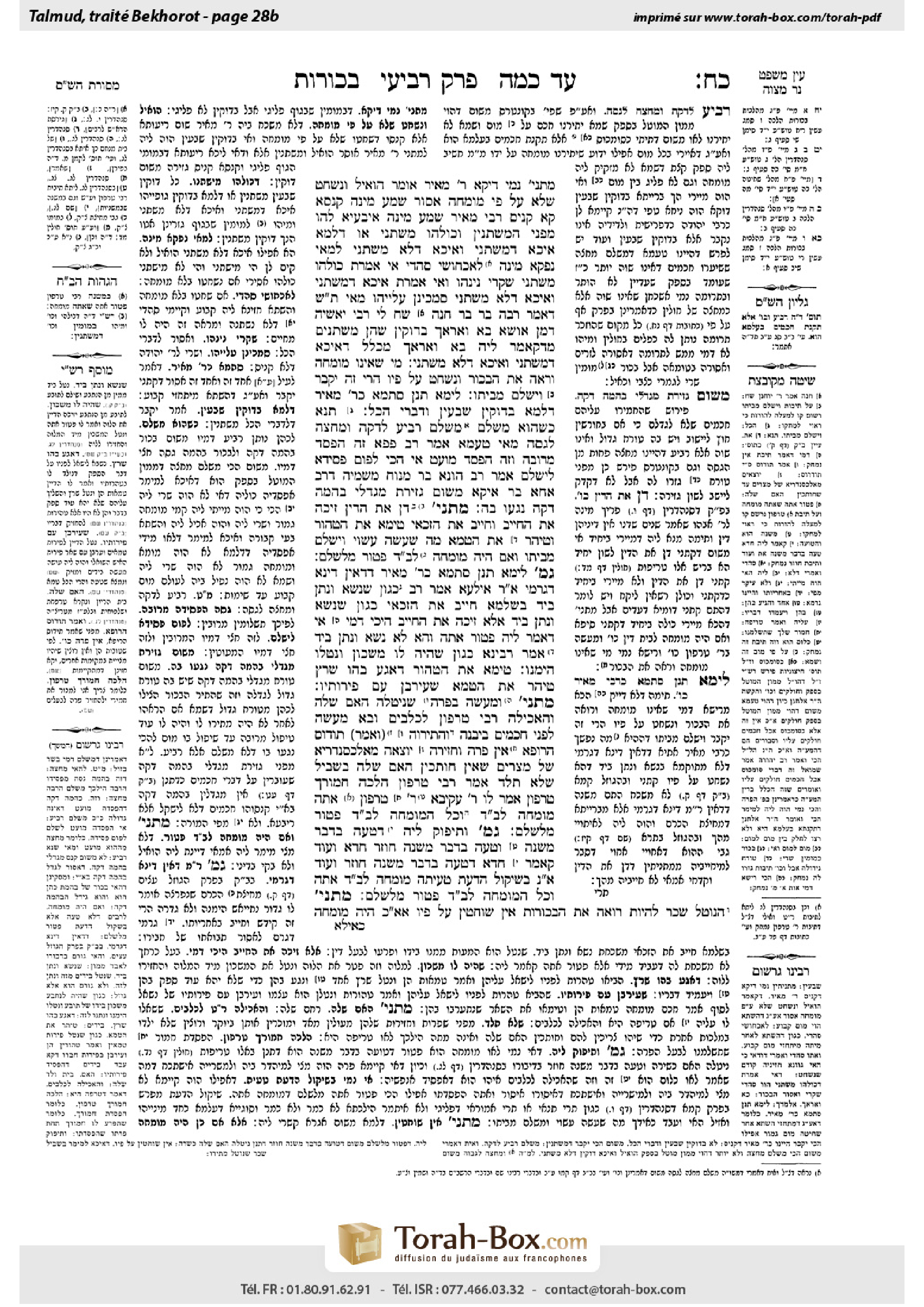
Bekhorot 28b: Talmud study for Daf Yomi
Study the Talmud for Daf Yomi with scanned pages, Hebrew text, English translations from Sefaria and AI-generated French translations.
Passage selection and English or AI-generated French translation are available where the scan has annotations. Daf Study is independent of Torah-Box and Sefaria.
Browse Bekhorot · בכורות · All tractatesBekhorot 28b text and translations
This page of Bekhorot includes the Aramaic text, an English translation and an AI-generated French translation, alongside the scan above.
בכורות כ״ח ב · Aramaic and Hebrew text
מַתְנִיתִין נָמֵי דַּיְקָא, רַבִּי מֵאִיר אוֹמֵר: הוֹאִיל וְנִשְׁחַט שֶׁלֹּא עַל פִּי מוּמְחֶה אָסוּר. שְׁמַע מִינַּהּ קְנָסָא קָא קָנֵיס רַבִּי מֵאִיר, שְׁמַע מִינַּהּ.
אִיבַּעְיָא לְהוּ: מִפְּנֵי הַמִּשְׁתַּנִּין — דְּכוּלְּהוּ מִשְׁתַּנִּי, אוֹ דִלְמָא אִיכָּא דְּמִשְׁתַּנֵּי וְאִיכָּא דְּלָא מִשְׁתַּנֵּי?
לְמַאי נָפְקָא מִינַּהּ? לְאַכְחוֹשֵׁי סָהֲדִי. אִי אָמְרַתְּ: כּוּלְּהוּ מִשְׁתַּנִּי — שַׁקָּרֵי נִינְהוּ, וְאִי אָמְרַתְּ: אִיכָּא דְּמִשְׁתַּנֵּי וְאִיכָּא דְּלָא מִשְׁתַּנֵּי — סָמְכִינַן עֲלַיְיהוּ. מַאי?
תָּא שְׁמַע, דְּאָמַר רַבָּה בַּר בַּר חָנָה: שָׂח לִי רַבִּי יֹאשִׁיָּה דְּמִן אוּשָׁא, בֹּא וְאַרְאֶךָּ בְּדוּקִּין שֶׁהֵן מִשְׁתַּנִּים. מִדְּקָאָמַר לֵיהּ ״בֹּא וְאַרְאֶךָּ״, מִכְּלָל דְּאִיכָּא דְּמִשְׁתַּנֵּי וְאִיכָּא דְּלָא מִשְׁתַּנֵּי.
מִי שֶׁאֵינוֹ מוּמְחֶה, וְרָאָה אֶת הַבְּכוֹר וְנִשְׁחַט עַל פִּיו, הֲרֵי זֶה יִקָּבֵר, וִישַׁלֵּם מִבֵּיתוֹ. לֵימָא תְּנַן סְתָמָא כְּרַבִּי מֵאִיר? דִּלְמָא בְּדוּקִּין שֶׁבָּעַיִן, וְדִבְרֵי הַכֹּל.
תָּנָא: כְּשֶׁהוּא מְשַׁלֵּם — מְשַׁלֵּם רְבִיעַ לַדַּקָּה, וּמֶחֱצָה לַגַּסָּה. מַאי טַעְמָא? אָמַר רַב פָּפָּא: זֶה הֶפְסֵד מְרוּבֶּה, וְזֶה הֶפְסֵד מוּעָט.
אִי הָכִי, לְפוּם פְּסֵידָא לִישַׁלֵּם! אָמַר רַב הוּנָא בַּר מָנוֹחַ מִשְּׁמֵיהּ דְּרַב אַחָא בַּר אִיקָא: מִשּׁוּם גְּזֵירַת מְגַדְּלֵי בְּהֵמָה דַּקָּה נָגְעוּ בָּהּ.
מַתְנִי׳ דָּן אֶת הַדִּין, זִיכָּה אֶת הַחַיָּיב וְחִיֵּיב אֶת הַזַּכַּאי, טִימֵּא אֶת הַטָּהוֹר וְטִיהֵר אֶת הַטָּמֵא — מַה שֶּׁעָשָׂה עָשׂוּי, וִישַׁלֵּם מִבֵּיתוֹ. וְאִם הָיָה מוּמְחֶה לְבֵית דִּין — פָּטוּר מִלְּשַׁלֵּם.
גְּמָ׳ לֵימָא תְּנַן סְתָמָא כְּרַבִּי מֵאִיר, דְּדָאֵין דִּינָא דִּגְרָמֵי? אָמַר רַבִּי אִילְעָא אָמַר רַב: כְּגוֹן שֶׁנָּשָׂא וְנָתַן בַּיָּד.
בִּשְׁלָמָא חִיֵּיב אֶת הַזַּכַּאי — כְּגוֹן שֶׁנָּשָׂא וְנָתַן בַּיָּד, אֶלָּא זִיכָּה אֶת הַחַיָּיב הֵיכִי דָּמֵי? אִי דַּאֲמַר לֵיהּ ״פָּטוּר אַתָּה״ — וְהָא לֹא נָשָׂא וְנָתַן בַּיָּד! אָמַר רָבִינָא: כְּגוֹן שֶׁהָיָה לוֹ מַשְׁכּוֹן וּנְטָלוֹ הֵימֶנּוּ.
טִימֵּא אֶת הַטָּהוֹר — דְּאַגַּע בְּהוּ שֶׁרֶץ, טִיהֵר אֶת הַטָּמֵא — שֶׁעֵירְבָן עִם פֵּירוֹתָיו.
מַתְנִי׳ וּמַעֲשֶׂה בְּפָרָה שֶׁנִּיטְּלָה הָאֵם שֶׁלָּהּ, וְהֶאֱכִילָהּ רַבִּי טַרְפוֹן לִכְלָבִים, וּבָא מַעֲשֶׂה לִפְנֵי חֲכָמִים בְּיַבְנֶה, וְהִתִּירוּהָ.
וְאָמַר תּוֹדוֹס הָרוֹפֵא: אֵין פָּרָה וַחֲזִירָה יוֹצְאָה מֵאֲלֶכְּסַנְדְּרִיָּא שֶׁל מִצְרַיִם, שֶׁאֵין חוֹתְכִין הָאֵם שֶׁלָּהּ, בִּשְׁבִיל שֶׁלֹּא תֵּלֵד.
אָמַר רַבִּי טַרְפוֹן: הָלְכָה חֲמוֹרְךָ טַרְפוֹן! אָמַר לוֹ רַבִּי עֲקִיבָא: רַבִּי טַרְפוֹן, אַתָּה מוּמְחֶה לְבֵית דִּין, וְכׇל הַמּוּמְחֶה לְבֵית דִּין פָּטוּר מִלְּשַׁלֵּם.
גְּמָ׳ וְתִיפּוֹק לֵיהּ, דְּטָעָה בִּדְבַר מִשְׁנָה, וְטָעָה בִּדְבַר מִשְׁנָה חוֹזֵר!
חֲדָא וְעוֹד קָאָמַר: חֲדָא — דְּטָעָה בִּדְבַר מִשְׁנָה חוֹזֵר, וְעוֹד — אִי נָמֵי בְּשִׁיקּוּל הַדַּעַת טָעִיתָה, מוּמְחֶה לְבֵית דִּין אַתָּה, וְכׇל הַמּוּמְחֶה לְבֵית דִּין פָּטוּר מִלְּשַׁלֵּם.
מַתְנִי׳ הַנּוֹטֵל שָׂכָר לִהְיוֹת רוֹאֶה אֶת הַבְּכוֹרוֹת — אֵין שׁוֹחֲטִין עַל פִּיו, אֶלָּא אִם כֵּן הָיָה מוּמְחֶה.
Bekhorot 28b · English translation
The mishna is also precisely formulated, as it states that Rabbi Meir says: Since it was slaughtered not according to the ruling of an expert, it is prohibited. Conclude from this wording that Rabbi Meir penalizes him for not showing it to an expert. In other words, this indicates that the animal is deemed prohibited as a penalty. It is not due to any uncertainty, as blemishes on the body do not change after death, but it is due to a rabbinic decree. The Gemara comments: Conclude from it that the mishna should be understood as Rabba bar bar Ḥana explained.
A dilemma was raised before the Sages: The baraita states: Due to the blemishes on the cornea, which change. But does this mean that all blemishes on the cornea of the eye definitely change after the death of the animal? Or perhaps there are some that change after death and there are others that do not change.
The Gemara asks: What is the practical difference of this dilemma? The Gemara explains: The difference is with regard to contradicting witnesses who claim that the animal had the identical blemishes in its eye when it was alive. If you say that all corneas change after the death of the animal, they are liars. But if you say that there are some that change after death and there are others that do not change, the court relies on such witnesses. Therefore, what is the resolution of the dilemma?
The Gemara answers: Come and hear a baraita, as Rabba bar bar Ḥana says: Rabbi Yoshiya from Usha told me: Come and I will show you the corneas that change. Since he said to him: Come and I will show you those that change, one can conclude by inference there are some corneas that change after death and there are others that do not change.
§ The mishna teaches: In a case involving one who is not an expert, and he examined the firstborn animal and it was slaughtered on the basis of his ruling, that animal must be buried, and the non-expert must pay compensation to the priest from his property. The Gemara asks: Shall we say that we learned the unattributed mishna in accordance with the opinion of Rabbi Meir, who deems a firstborn animal forbidden in all cases where it was not slaughtered based on the ruling of an expert? The Gemara rejects this suggestion: No; perhaps this is referring only to a case where there was a blemish on the cornea of the eye, which changes after the death of the animal, and everyone agrees with the ruling of the mishna in such a case.
§ The Sages taught in a baraita: When one pays the priest for a firstborn that became forbidden, he pays one-quarter of the value of a small animal, i.e., a sheep or goat, or half of the value of a large animal, i.e., a bull. The Gemara asks: What is the reason for this discrepancy? Rav Pappa says: The loss of this bull is a relatively great loss, and the loss of that sheep or goat is a small loss.
The Gemara raises a difficulty: If so, let him pay in accordance with the actual loss incurred. In other words, if he paid the same proportion of the value of a sheep or goat, he would still be paying less than half the value of a bull. Rav Huna bar Manoaḥ says in the name of Rav Aḥa bar Ika: The Sages touched upon it and determined that he should pay only one-quarter, due to the decree against those who raise small livestock in Eretz Yisrael, as these animals cause damage to the land. As a result, such animals may be raised only in specific areas, which means the priest was spared exertion, and therefore the Sages required one to pay only one-quarter of the value.
MISHNA: If a judge issued a judgment and erred, so that he exempted a liable party or found an innocent party liable, or if he ruled that a pure item is impure or ruled that an impure item is pure, and by doing so he caused a litigant a monetary loss, then what he did is done, i.e., the judgment stands, and the judge must pay damages from his home, i.e., from his personal funds. And if the judge was an expert for the court, he is exempt from liability to pay.
GEMARA: The mishna teaches that a judge who errs must pay compensation for the damage he caused. The Gemara suggests: Shall we say that we learned the unattributed mishna in accordance with the opinion of Rabbi Meir, who rules that there is liability for damage caused by indirect action? Rabbi Ile’a says that Rav says: This is referring to a case where a judge took the item in question from one litigant and gave it to the other litigant with his hand, and therefore he directly caused the damage.
The Gemara raises a difficulty: Granted, the case where he finds an innocent party liable is in a case where the judge took the item in question from the innocent party and gave it to the other litigant with his hand. But what are the circumstances of his giving the item from one to another with regard to the clause of: He exempts a liable party? It is if the judge said to the litigant only: You are exempt from liability to pay, but the judge did not take the item in question from one litigant and give it to the other litigant with his hand. Ravina said: It is referring to a case where the lender had collateral from the borrower, and the judge took it from him and gave it back to the other party.
In the case of: He ruled that a pure item is impure, how could he cause a loss with his own hands? It is where he had the litigant’s ritually pure item touch a creeping animal to emphasize that he believes it was already impure, and he thereby imparted impurity to it. In the case of: He ruled that an impure item is pure, how could he cause a loss with his own hands? It is where he mixed this impure produce of the litigant’s with the litigant’s ritually pure produce, and he thereby caused all of the produce to be considered impure. When an expert judge later rules that that produce is actually impure, the result is that the entire mixture contains impure produce, and the judge caused this damage directly.
MISHNA: Apropos the previous mishna, which taught that a judge who was an expert for the court and who erred is exempt from payment, this mishna teaches: There was an incident involving a cow whose womb was removed, and when Rabbi Tarfon was consulted he ruled that it is an animal with a wound that will cause it to die within twelve months [tereifa], which is forbidden for consumption. And based on the ruling of Rabbi Tarfon, the questioner fed it to the dogs. And the incident came before the Sages of the court in Yavne, and they ruled that such an animal is permitted and is not a tereifa.
And Theodosius [Todos] the doctor said: A cow or pig does not emerge from Alexandria of Egypt unless the residents sever its womb so that it will not give birth in the future. The breeds of cows and pigs in Alexandria were of exceptional quality and the people of Alexandria did not want them reproduced elsewhere. The fact that these animals lived long lives after their wombs were removed proves that the hysterectomy did not render them tereifot.
Upon hearing this, Rabbi Tarfon said: Your donkey is gone, Tarfon, as he believed he was required to compensate the owner for the cow that he ruled to be a tereifa. Rabbi Akiva said to him: Rabbi Tarfon, you are an expert for the court, and any expert for the court is exempt from liability to pay.
GEMARA: The Gemara asks: But let Rabbi Akiva derive his ruling from the fact that Rabbi Tarfon erred concerning a matter that appears in the Mishna, as the ruling permitting an animal whose womb has been removed is recorded in a mishna (see Ḥullin 54a), and with regard to anyone who erred concerning a matter that appears in the Mishna, the decision is revoked, as this is considered an obvious mistake. In other words, Rabbi Tarfon’s decision was not binding, and therefore when the owner fed the cow to the dogs, he acted on the basis of a ruling with no validity and thereby caused his own loss.
The Gemara answers: Rabbi Akiva states one reason and adds another reason. One reason is that in the case of one who errs in a matter that appears in the Mishna, the decision is revoked. Another reason is that even if you erred in a deliberation, you are a judge accepted as an expert for the public, and any judge accepted as an expert for the public is exempt from liability to pay.
MISHNA: In the case of an individual who takes payment to be one who examines firstborn animals to determine whether they are blemished, one may not slaughter the firstborn on the basis of his ruling, unless he was an expert
Bekhorot 28b · Traduction française (IA)
La mitsva est également formulée avec précision, car elle indique que Rabbi Meir dit : Puisque l'animal a été sacrifié sans conformité à la décision d'un expert, il est interdit. Concluez de cette formulation que Rabbi Meir punit celui qui n'a pas montré l'animal à un expert. En d'autres termes, cela indique que l'animal est considéré comme interdit en tant que sanction. Ce n'est pas en raison d'une incertitude, car les défauts du corps ne changent pas après la mort, mais c'est en raison d'un décret rabbinique. La Guemara commente : Concluez-en que la mitsva doit être comprise comme Rabba bar bar Ḥana a expliqué.
Un dilemme a été soulevé devant les Sages : La baraïta dit : En raison des défauts de la cornée, qui changent. Mais cela signifie-t-il que tous les défauts de la cornée de l'œil changent après la mort de l'animal ? Ou peut-être qu'il y a certains qui changent après la mort et d'autres qui ne changent pas.
La Guemara demande : Quelle est la différence pratique de ce dilemme ? La Guemara explique : La différence est en ce qui concerne les témoins contradictoires qui affirment que l'animal avait les mêmes défauts dans l'œil lorsqu'il était vivant. Si vous dites que toutes les cornées changent après la mort de l'animal, ils sont menteurs. Mais si vous dites qu'il y a certaines qui changent après la mort et d'autres qui ne changent pas, le tribunal se base sur ces témoins. Ainsi, quelle est la résolution de ce dilemme ?
La Guemara répond : Venez écouter une baraïta, car Rabba bar bar Ḥana dit : Rabbi Yoshiya d'Usha m'a dit : Venez, je vous montrerai les cornées qui changent. Puisqu'il a dit : Venez, je vous montrerai celles qui changent, on peut conclure par déduction qu'il y a certaines cornées qui changent après la mort et d'autres qui ne changent pas.
§ La mitsva enseigne : Dans un cas où une personne n'est pas un expert, et qu'il a examiné l'animal prématuré et qu'il a été sacrifié sur la base de son jugement, cet animal doit être enterré, et l'expert non qualifié doit payer une compensation au prêtre à partir de ses biens. La Guemara demande : Devons-nous dire que nous avons appris la mitsva non attribuée conformément à l'opinion de Rabbi Meir, qui considère un animal prématuré comme interdit dans tous les cas où il n'a pas été sacrifié sur la décision d'un expert ? La Guemara rejette cette suggestion : Non ; peut-être que cela fait référence uniquement à un cas où il y avait un défaut sur la cornée de l'œil, qui change après la mort de l'animal, et que tout le monde est d'accord avec le jugement de la mitsva dans ce cas.
§ Les Sages ont enseigné dans une baraïta : Lorsqu'on paie le prêtre pour un animal prématuré devenu interdit, on paie un quart de la valeur d'un petit animal, c'est-à-dire un mouton ou une chèvre, ou la moitié de la valeur d'un grand animal, c'est-à-dire un taureau. La Guemara demande : Quelle est la raison de cette différence ? Rav Pappa dit : La perte de ce taureau est une perte relativement grande, et la perte de ce mouton ou de cette chèvre est une perte petite.
La Guemara soulève une difficulté : Si c'est ainsi, qu'il paie selon la perte réelle subie. En d'autres termes, si on paie la même proportion de la valeur d'un mouton ou d'une chèvre, on paie encore moins que la moitié de la valeur d'un taureau. Rav Huna bar Manoaḥ dit en nom de Rav Aḥa bar Ika : Les Sages ont abordé cela et ont décidé qu'il devait payer seulement un quart, en raison du décret contre ceux qui élèvent des petits animaux en Terre d'Israël, car ces animaux causent des dommages au sol. En conséquence, ces animaux peuvent être élevés uniquement dans des zones spécifiques, ce qui signifie que le prêtre était épargné de l'effort, et donc les Sages ont exigé de payer seulement un quart de la valeur.
MICHNA : Si un juge a rendu un jugement et s'est trompé, de sorte qu'il a exempté une partie coupable ou a trouvé une partie innocente coupable, ou s'il a jugé qu'un objet pur est impur ou qu'un objet impur est pur, et en le faisant il a causé à un litige une perte financière, alors ce qu'il a fait est fait, c'est-à-dire que le jugement est valide, et le juge doit payer des dommages à partir de ses biens, c'est-à-dire de ses fonds personnels. Et si le juge était un expert pour le tribunal, il est exempt de responsabilité de payer.
GUEMARA : La mitsva enseigne que le juge qui s'est trompé doit payer une compensation pour le dommage qu'il a causé. La Guemara suggère : Devons-nous dire que nous avons appris la mitsva non attribuée conformément à l'opinion de Rabbi Meir, qui déclare qu'il y a responsabilité pour un dommage causé par une action indirecte ? Rabbi Ile’a dit que Rav dit : Cela fait référence à un cas où le juge a pris l'objet en question d'un litige et l'a donné à l'autre litige avec sa main, et donc il a directement causé le dommage.
La Guemara soulève une difficulté : Admettons que le cas où il trouve une partie innocente coupable est un cas où le juge a pris l'objet en question de la partie innocente et l'a donné à l'autre litigant avec sa main. Mais quels sont les circonstances de son don de l'objet d'un à l'autre concernant la clause de : Il exempt une partie coupable ? C'est si le juge a dit à la partie litigante seulement : Vous êtes exempt de responsabilité à payer, mais le juge n'a pas pris l'objet en question d'un litigant et ne l'a pas donné à l'autre litigant avec sa main. Ravina a dit : Cela fait référence à un cas où le prêteur avait une garantie du prêteur, et le juge l'a prise de lui et l'a rendue à l'autre partie.
Dans le cas de : Il a jugé qu'un objet pur est impur, comment a-t-il pu causer un préjudice avec ses propres mains ? C'est lorsque l'objet rituellement pur de la partie litigante a touché un animal rampant pour souligner qu'il croyait qu'il était déjà impur, et il a ainsi transmis l'impureté à cet objet. Dans le cas de : Il a jugé qu'un objet impur est pur, comment a-t-il pu causer un préjudice avec ses propres mains ? C'est lorsque l'objet impur de la partie litigante a été mélangé avec les produits rituellement purs de la partie litigante, et il a ainsi rendu tous les produits considérés comme impurs. Lorsqu'un juge expert a ensuite jugé que ces produits sont effectivement impurs, le résultat est que l'ensemble du mélange contient des produits impurs, et le juge a causé ce préjudice directement.
MICHNA : Concernant la précédente mishna, qui enseignait que tout juge qui est un expert pour le tribunal et qui commet une erreur est exempté de paiement, cette mishna enseigne : Il y avait un cas concernant une vache dont l'utérus avait été retiré, et lorsqu'on consulta Rabbi Tarfon, il déclara qu'il s'agissait d'un animal blessé qui mourrait dans les douze mois [tereifa], ce qui est interdit à la consommation. Et en se basant sur la décision de Rabbi Tarfon, le questionneur nourrit la vache aux chiens. Et l'incident fut porté devant les Sages du tribunal de Yavne, et ils décidèrent que cet animal est permis et n'est pas tereifa.
Et Theodosius [Todos] le médecin dit : Une vache ou un porc ne sort pas d'Alexandrie d'Égypte sans que les habitants retirent son utérus afin qu'elle ne donne plus naissance à l'avenir. Les races de vaches et de porcs d'Alexandrie étaient d'une qualité exceptionnelle et les habitants d'Alexandrie ne voulaient pas qu'ils soient reproduits ailleurs. Le fait que ces animaux vécurent longtemps après que leur utérus avait été retiré prouve que l'hystérectomie ne les rendait pas tereifot.
En entendant cela, Rabbi Tarfon dit : Votre âne est parti, Tarfon, car il croyait être tenu de compenser l'propriétaire pour la vache qu'il avait jugée tereifa. Rabbi Akiva lui dit : Rabbi Tarfon, vous êtes un expert pour le tribunal, et tout expert pour le tribunal est exempté de responsabilité à payer.
GUEMARA : La Guemara pose la question : Mais laissez Rabbi Akiva déduire sa décision du fait que Rabbi Tarfon s'était trompé concernant une matière qui figure dans la Michna, car la décision permettant un animal dont l'utérus a été retiré est enregistrée dans une mishna (voir Ḥullin 54a), et concernant toute personne qui s'est trompée concernant une matière qui figure dans la Michna, la décision est annulée, car cela est considéré comme une erreur évidente. En d'autres termes, la décision de Rabbi Tarfon n'était pas contraignante, et donc lorsque l'propriétaire nourrit la vache aux chiens, il agissait sur la base d'une décision sans validité et causait ainsi sa propre perte.
La Guemara répond : Rabbi Akiva énonce une raison et ajoute une autre raison. Une raison est que dans le cas d'une personne qui s'est trompée concernant une matière qui figure dans la Michna, la décision est annulée. Une autre raison est que même si vous avez commis une erreur dans une délibération, vous êtes un juge accepté comme expert pour le public, et tout juge accepté comme expert pour le public est exempté de responsabilité à payer.
MICHNA : Dans le cas d'une personne qui accepte de recevoir un paiement pour examiner les animaux premiers-nés afin de déterminer s'ils sont blemis, on ne peut pas sacrifier les premiers-nés sur la base de son jugement, sauf s'il était un expert
Traduction française générée par IA à partir de l’édition anglaise de Sefaria. Vérifie toujours un passage avec le texte source.
Text from Sefaria: William Davidson Edition - Vocalized Aramaic (CC BY NC); William Davidson Edition - English (CC BY NC).