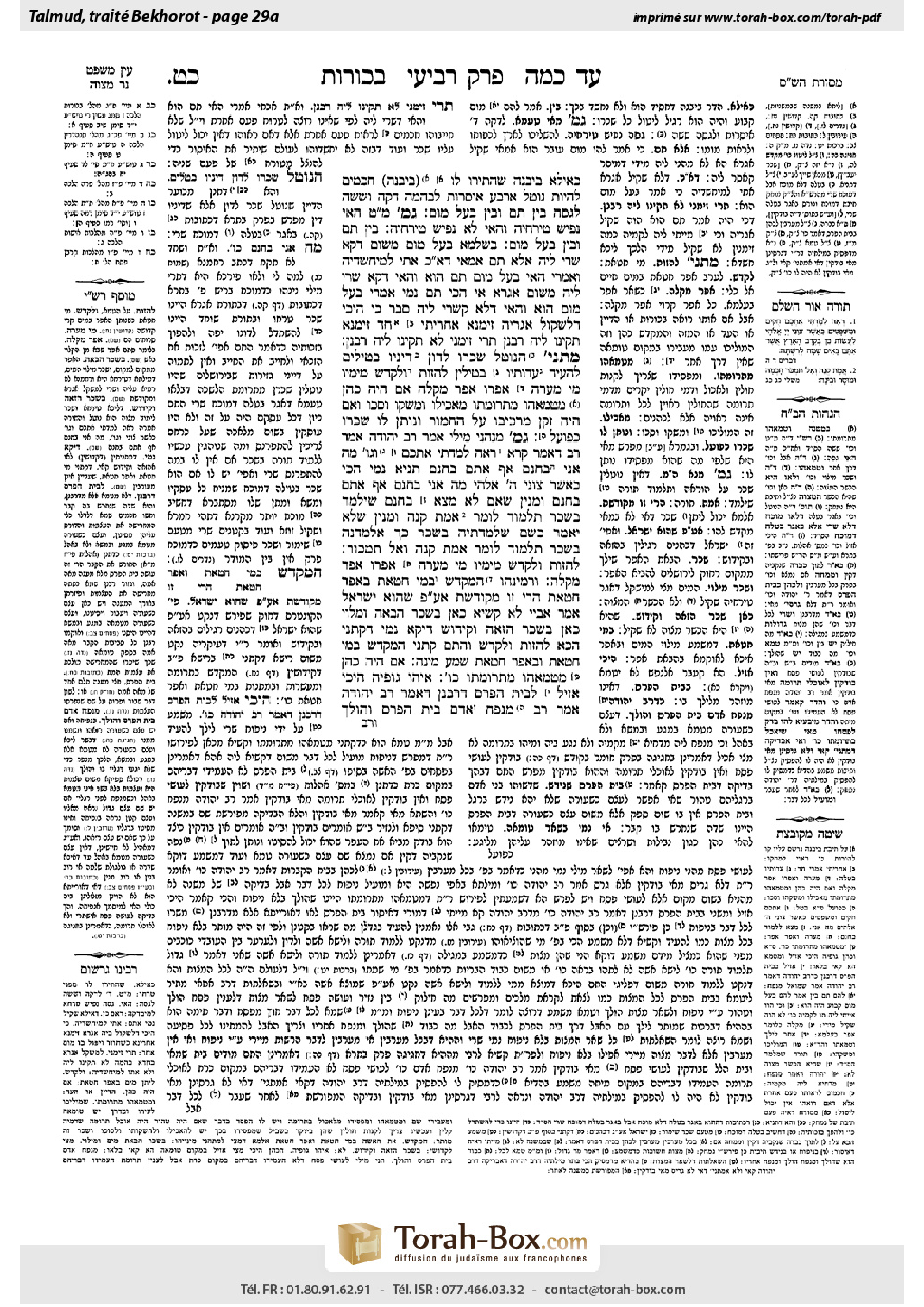
Bekhorot 29a: Talmud study for Daf Yomi
Study the Talmud for Daf Yomi with scanned pages, Hebrew text, English translations from Sefaria and AI-generated French translations.
Passage selection and English or AI-generated French translation are available where the scan has annotations. Daf Study is independent of Torah-Box and Sefaria.
Browse Bekhorot · בכורות · All tractatesBekhorot 29a text and translations
This page of Bekhorot includes the Aramaic text, an English translation and an AI-generated French translation, alongside the scan above.
בכורות כ״ט א · Aramaic and Hebrew text
כְּאִילָא בְּיַבְנֶה, שֶׁהִתִּירוּ לוֹ (בְּיַבְנֶה) חֲכָמִים לִהְיוֹת נוֹטֵל אַרְבַּע אִיסָּרוֹת לִבְהֵמָה דַּקָּה, וְשִׁשָּׁה לְגַסָּה, בֵּין תָּם וּבֵין בַּעַל מוּם.
גְּמָ׳ מַאי טַעְמָא? הַאי נְפִישׁ טִירְחֵיהּ, וְהַאי לָא נְפִישׁ טִירְחֵיהּ.
בֵּין תָּם וּבֵין בַּעַל מוּם. בִּשְׁלָמָא בַּעַל מוּם — מִשּׁוּם דְּקָא שָׁרֵי לֵיהּ, אֶלָּא תָּם אַמַּאי? דְּאִם כֵּן, אָתֵי לְמִיחְשְׁדֵיהּ, וְאָמְרִי: הַאי בַּעַל מוּם תָּם הוּא, וְהַאי דְּקָא שָׁרֵי לֵיהּ — מִשּׁוּם אַגְרָא.
אִי הָכִי, תָּם נָמֵי אָמְרִי: בַּעַל מוּם הוּא, וְהַאי דְּלָא קָשָׁרֵי לֵיהּ סָבַר כִּי הֵיכִי דְּלִשְׁקוֹל אַגְרֵיהּ זִימְנָא אַחֲרִיתִי! חַד זִימְנָא תַּקִּינוּ לֵיה רַבָּנַן, תְּרֵי זִימְנֵי לָא תַּקִּינוּ לֵיה רַבָּנַן.
מַתְנִי׳ הַנּוֹטֵל שְׂכָרוֹ לָדוּן — דִּינָיו בְּטֵילִים, לְהָעִיד — עֵדוֹתָיו בְּטֵילִין, לְהַזּוֹת וּלְקַדֵּשׁ — מֵימָיו מֵי מְעָרָה, אֶפְרוֹ אֵפֶר מִקְלֶה.
אִם הָיָה כֹּהֵן, מְטַמְּאֵהוּ מִתְּרוּמָתוֹ — מַאֲכִילוֹ וּמַשְׁקוֹ וְסָכוֹ, וְאִם הָיָה זָקֵן — מַרְכִּיבוֹ עַל הַחֲמוֹר, וְנוֹתֵן לוֹ שְׂכָרוֹ כְּפוֹעֵל.
גְּמָ׳ מְנָהָנֵי מִילֵּי? אָמַר רַב יְהוּדָה אָמַר רַב, דְּאָמַר קְרָא: ״רְאֵה לִמַּדְתִּי אֶתְכֶם וְגוֹ׳״, מָה אֲנִי בְּחִנָּם — אַף אַתֶּם בְּחִנָּם.
תַּנְיָא נָמֵי הָכִי: ״כַּאֲשֶׁר צִוַּנִי ה׳ אֱלֹהָי״ — מָה אֲנִי בְּחִנָּם, אַף אַתֶּם בְּחִנָּם. וּמִנַּיִן שֶׁאִם לֹא מָצָא בְּחִנָּם שֶׁיְּלַמֵּד בְּשָׂכָר? תַּלְמוּד לוֹמַר: ״אֱמֶת קְנֵה״. וּמִנַּיִן שֶׁלֹּא יֹאמַר: כְּשֵׁם שֶׁלְּמַדְתִּיהָ בְּשָׂכָר כָּךְ אֲלַמְּדֶנָּה בְּשָׂכָר? תַּלְמוּד לוֹמַר: ״אֱמֶת קְנֵה וְאַל תִּמְכֹּר״.
לְהַזּוֹת וּלְקַדֵּשׁ — מֵימָיו מֵי מְעָרָה, אֶפְרוֹ אֵפֶר מִקְלֶה. וּרְמִינְהוּ: הַמְקַדֵּשׁ בְּמֵי חַטָּאת בְּאֵפֶר חַטָּאת — הֲרֵי זוֹ מְקוּדֶּשֶׁת, אַף עַל פִּי שֶׁהוּא יִשְׂרָאֵל!
אָמַר אַבָּיֵי: לָא קַשְׁיָא — כָּאן בִּשְׂכַר הֲבָאָה וּמִלּוּי, כָּאן בִּשְׂכַר הַזָּאָה וְקִידּוּשׁ.
דַּיְקָא נָמֵי, דְּקָתָנֵי הָכָא ״לְהַזּוֹת וּלְקַדֵּשׁ״, וְהָתָם קָתָנֵי ״הַמְקַדֵּשׁ בְּמֵי חַטָּאת וּבְאֵפֶר חַטָּאת״, שְׁמַע מִינַּהּ.
אִם הָיָה כֹּהֵן מְטַמְּאֵהוּ מִתְּרוּמָתוֹ כּוּ׳. אִיהוּ גּוּפֵיהּ הֵיכִי אָזֵיל?
לְבֵית הַפְּרָס דְּרַבָּנַן, דְּאָמַר רַב יְהוּדָה אָמַר רַב: מְנַפֵּחַ אָדָם בֵּית הַפְּרָס וְהוֹלֵךְ.
Bekhorot 29a · English translation
like Ila in Yavne, whom the Sages in Yavne permitted to take a wage of four issar for issuing a ruling concerning a small animal and six issar for issuing a ruling concerning a large animal. They permitted this provided that he would be paid whether it turned out that the firstborn was unblemished or whether it was blemished.
GEMARA: The Gemara asks: What is the reason that the Sages in Yavne said that Ila could take a wage of four issar for issuing a ruling concerning a small animal but six issar for issuing a ruling concerning a large animal? The Gemara answers: Examining this one, a firstborn of a large animal, for blemishes involves great effort; but examining that one, the firstborn of a small animal, does not involve such great effort.
§ The mishna teaches that one like Ila may take his wages provided that he would be paid whether it turns out that the firstborn is unblemished or whether it is blemished. The Gemara inquires: Granted, if the animal is blemished he takes his wages, because he deems the animal permitted to be slaughtered and eaten; but if he examined an unblemished animal, why does he take his wages? The Gemara answers that if so, i.e., if he would be paid for examining only a blemished animal, people would come to suspect him and say that this animal that he declared to be blemished is in fact unblemished, and he declared it blemished and thereby deemed it permitted to be eaten only due to the fact that he wanted to claim his wages.
The Gemara challenges: If so, then in a situation where the examiner is paid either way, people might also state a similar claim with regard to one who rules that it is an unblemished animal. They may suspect that this animal is really blemished, and the reason that this expert did not deem it permitted is that he holds that it is preferable for him to declare it unblemished so that he can collect his wages another time, when he examines it later and declares it blemished. The Gemara answers: The Sages of Yavne instituted an ordinance that he may take his wages for examining a firstborn once, but the Sages did not institute that he may take his wages twice for examining the same animal. Since he will not get paid a second time for the same animal, he has no incentive to declare it unblemished if it has a blemish.
MISHNA: In the case of one who takes his wages to judge cases, his rulings are void. In the case of one who takes wages to testify, his testimonies are void. With regard to one who takes wages to sprinkle the purification waters of the red heifer upon one who contracted impurity imparted by a corpse, and one who takes wages to sanctify those waters, the halakhic status of his water is that of cave water, and the status of his ashes is that of mere burnt ashes.
Although taking actual wages is prohibited, if the one examining the firstborn, or the judge, or the witness, was a priest, and the one who requires his services rendered him impure and prevented him from partaking of his teruma, that person must provide the priest with food, drink, and oil for smearing on his body from his own non-sacred property. And likewise if the one examining the firstborn, or the judge, or the witness, was an elderly person, the one who requires his services transports him on a donkey. And in all these cases, although it is prohibited to take wages, the one who requires his services gives him his wages like the wages of a laborer, as he was unable to perform his usual labor that day.
GEMARA: The mishna teaches that the rulings of one who takes wages to judge cases are void. The Gemara asks: From where is this matter, that a judge may not be paid for his rulings, derived? Rav Yehuda says that Rav says that it is derived from a verse, as the verse states: “Behold, I have taught you statutes and ordinances, as the Lord my God commanded me, that you should do so in the midst of the land that you are going in to possess” (Deuteronomy 4:5). This teaches that just as I, Moses, learned the word of God for free, so too, you learned it from me for free, and this is also how you should act with all future generations.
This halakha is also taught in a baraita: “Behold, I have taught you statutes and ordinances, as the Lord my God commanded me” (Deuteronomy 4:5). Just as I learned from God for free, so too, you learned from me for free. And from where is it derived that if one cannot find someone to teach him for free that he should learn even by giving payment? The verse states: “Buy the truth, and do not sell it; also wisdom, and instruction, and understanding” (Proverbs 23:23). And from where is it derived that one should not say: Just as I learned by giving payment, so too, I will teach it by receiving payment? The verse states: “Buy the truth, and do not sell it.”
The mishna teaches: With regard to one who takes wages to sprinkle the purification waters of the red heifer, and one who takes wages to sanctify those waters, the halakhic status of his water is that of cave water, and the status of his ashes is that of mere burnt ashes. This indicates that one may not derive any benefit from the water or ashes of the red heifer. And the Gemara raises a contradiction from a mishna (Kiddushin 58a): With regard to one who betroths a woman with the water of purification, or with the ashes of purification, she is betrothed, and this is the halakha even if the man betrothing her is an Israelite, not a priest or a Levite. This indicates that one may derive benefit from the waters or ashes of purification.
Abaye said: This is not difficult, since there, the mishna in Kiddushin is referring to one who betroths a woman with the value of the payment for bringing the ashes from afar and filling the vessel with the purification water, for which it is permitted to accept payment. Performing this act for the woman is comparable to giving her an item of value, since she will not have to pay someone to bring and fill the vessel for her. Here, the mishna is referring to payment for the actual sprinkling and sanctifying of the ashes.
The Gemara comments: According to this answer, the language of the two mishnayot is also precise, as it teaches here: To sprinkle, or: To sanctify, indicating that he receives payment for the actual sprinkling and sanctification; and it teaches there, in the mishna in Kiddushin, that she is betrothed with the water of purification or with the ashes of purification, which indicates that the water and ashes have not yet been mixed together. The Gemara affirms: Learn from it that this is the correct explanation of the mishnayot.
§ The mishna teaches: Although taking wages is prohibited, if the one examining the firstborn, or the judge, or the witness, was a priest, and the one who required his services rendered him impure and prevented him from partaking of his teruma, he must provide the priest with food, drink, and oil. The Gemara asks: But he himself, the priest, how was he permitted to go to a place that caused him to become impure? It is prohibited for a priest to render himself ritually impure.
The Gemara answers that this is referring to a case where he went to an area in which uncertainty exists concerning the location of a grave or a corpse [beit haperas], into which it is prohibited by rabbinic law for a priest to enter. As Rav Yehuda says that Rav says: A person who passes through a beit haperas may blow on the dust before taking each step, which would expose any bone beneath the dust, and walk. A priest may rely on that method of examination and enter the field.
Bekhorot 29a · Traduction française (IA)
comme Ila à Yavne, que les Sages de Yavne autorisèrent à percevoir une rémunération de quatre issar pour émettre un avis concernant un petit animal et six issar pour émettre un avis concernant un grand animal. Ils autorisèrent cela à condition qu'il soit rémunéré qu'il s'agisse du premier-né étant sans tache ou taché.
GUEMARA : La Guemara pose la question : Quel est le motif pour lequel les Sages de Yavne dirent que Ila pouvait percevoir une rémunération de quatre issar pour émettre un avis concernant un petit animal mais six issar pour émettre un avis concernant un grand animal ? La Guemara répond : Examinant ce premier-né d'un grand animal, les taches impliquent un grand effort ; mais examinant celui-ci, le premier-né d'un petit animal, cela ne comporte pas un tel effort.
§ La mitsva enseigne que celui qui est comme Ila peut percevoir sa rémunération à condition qu'il soit rémunéré qu'il s'agisse du premier-né étant sans tache ou taché. La Guemara interroge : Cela est évident, si l'animal est taché il perçoit sa rémunération, car il considère l'animal comme permis à être tué et mangé ; mais s'il examine un animal sans tache, pourquoi perçoit-il sa rémunération ? La Guemara répond que si tel était le cas, c'est-à-dire s'il était rémunéré uniquement pour examiner un animal taché, les gens pourraient le soupçonner et dire que cet animal qu'il a déclaré taché est en réalité sans tache, et qu'il l'a déclaré taché afin de le considérer comme permis à être mangé uniquement en raison du fait qu'il voulait percevoir sa rémunération.
La Guemara conteste : Si tel est le cas, alors dans un cas où l'examinateur est rémunéré indifféremment, les gens pourraient aussi émettre une telle allégation concernant celui qui déclare que l'animal est sans tache. Ils pourraient soupçonner que cet animal est en réalité taché, et la raison pour laquelle cet expert n'a pas déclaré qu'il est permis est qu'il considère que c'est préférable pour lui de le déclarer sans tache afin de pouvoir percevoir sa rémunération à nouveau lorsqu'il l'examinera plus tard et le déclarera taché. La Guemara répond : Les Sages de Yavne instituèrent un règlement selon lequel il peut percevoir sa rémunération pour examiner un premier-né une seule fois, mais les Sages n'ont pas institué qu'il puisse percevoir sa rémunération deux fois pour examiner le même animal. Puisqu'il ne recevra pas de rémunération une seconde fois pour le même animal, il n'a pas d'incentif à déclarer qu'il est sans tache si l'animal est taché.
MICHNA : Dans le cas d'une personne qui perçoit sa rémunération pour juger des affaires, ses décisions sont nulles. Dans le cas d'une personne qui perçoit sa rémunération pour témoigner, ses témoignages sont nulles. Concernant une personne qui perçoit sa rémunération pour asperger les eaux de purification de la bête rouge sur une personne contractant l'impureté due à un cadavre, et une personne qui perçoit sa rémunération pour sanctifier ces eaux, le statut halakhique de ses eaux est celui des eaux de grotte, et le statut de ses cendres est celui de cendres simples.
Bien que l'acceptation de salaire soit interdite, si l'examinateur du premier-né, ou le juge, ou le témoin, était un prêtre, et que la personne qui exigeait ses services l'avait rendu impur et l'avait empêché de consommer sa terouma, cette personne devait fournir au prêtre de la nourriture, de la boisson et de l'huile pour le frotter sur son corps à partir de ses biens non sacrés. De même, si l'examinateur du premier-né, ou le juge, ou le témoin, était un vieillard, la personne qui exigeait ses services le transportait sur un âne. Et dans tous ces cas, bien que l'acceptation de salaire soit interdite, la personne qui exigeait ses services lui donnait sa rémunération comme celle d'un ouvrier, car il n'avait pas pu effectuer son travail habituel ce jour-là.
GUEMARA : La mitsva enseigne que les décisions d'une personne qui perçoit un salaire pour juger sont nulles. La Guemara pose la question : D'où cette matière, que un juge ne peut pas être rémunéré pour ses décisions, est-elle dérivée ? Rav Yehuda dit que Rav dit que cela est dérivé d'un verset, car le verset stipule : « Voici, j'ai appris à toi des statutes et des ordonnances, comme l'Éternel mon Dieu m'a commandé, afin que tu le fasses au milieu de la terre que tu entreras posséder » (Deutéronome 4:5). Cela enseigne que tout comme moi, Moïse, j'ai appris la parole d'Éternel gratuitement, ainsi tu as appris de moi gratuitement, et c'est ainsi que tu dois agir avec toutes les générations futures.
Cette halakha est également enseignée dans une baraïta : « Voici, j'ai appris à toi des statutes et des ordonnances, comme l'Éternel mon Dieu m'a commandé » (Deutéronome 4:5). Tout comme j'ai appris de l'Éternel gratuitement, ainsi tu as appris de moi gratuitement. D'où est dérivé le fait que si l'on ne peut trouver quelqu'un pour enseigner gratuitement, on doit apprendre même en payant ? Le verset stipule : « Achète la vérité, et ne la vends pas ; aussi la sagesse, et l'enseignement, et la compréhension » (Proverbes 23:23). D'où est dérivé le fait qu'on ne doit pas dire : Tout comme j'ai appris en payant, ainsi je vais enseigner en recevant une rémunération ? Le verset stipule : « Achète la vérité, et ne la vends pas. »
La mitsva enseigne : Concernant une personne qui perçoit une rémunération pour asperger les eaux de purification de la bête rouge, et une personne qui perçoit une rémunération pour sanctifier ces eaux, le statut halakhique de ses eaux est celui des eaux de grotte, et le statut de ses cendres est celui de cendres simples. Cela indique qu'on ne peut pas tirer aucun bénéfice des eaux ou des cendres de la bête rouge. Et la Guemara soulève une contradiction à partir d'une mitsva (Kiddushin 58a) : Concernant une personne qui fiance une femme avec les eaux de purification, ou avec les cendres de purification, elle est fiancée, et c'est la halakha même si l'homme qui la fiance est un Israélite, pas un prêtre ou un Lévi. Cela indique qu'on peut tirer un bénéfice des eaux ou des cendres de purification.
Abaye dit : Ce n'est pas difficile, car là, la mitsva de Kiddushin fait référence à une personne qui fiance une femme avec la valeur du paiement pour ramener les cendres d'ailleurs et remplir le récipient avec les eaux de purification, car il est permis d'accepter une rémunération. Effectuer cet acte pour la femme est comparable à lui donner un objet de valeur, car elle ne devra pas payer quelqu'un pour ramener et remplir le récipient pour elle. Ici, la mitsva fait référence à la rémunération pour l'aspersion et la sanctification des cendres.
La Guemara commente : Selon cette réponse, la formulation des deux mitsvot est aussi précise, car elle enseigne ici : « Asperger, ou : Sanctifier », indiquant qu'il est récompensé pour l'aspersion et la sanctification réelles ; et elle enseigne là, dans la mitsva de Kiddushin, qu'elle est fiancée avec l'eau de purification ou avec les cendres de purification, ce qui indique que l'eau et les cendres n'ont pas encore été mélangés. La Guemara affirme : Apprends-en que c'est l'explication correcte des mitsvot.
§ La mitsva enseigne : Bien que prendre desgages soit interdit, si celui qui examine le premier-né, ou le juge, ou le témoin, était un prêtre, et que celui qui a requis ses services l'ait rendu impur et l'ait empêché de consommer sa terouma, il doit lui fournir de la nourriture, de la boisson et de l'huile. La Guemara demande : Mais lui-même, le prêtre, comment était-il autorisé à aller dans un lieu qui l'a rendu impur ? Il est interdit à un prêtre de se rendre impur rituellement.
La Guemara répond que cela fait référence à un cas où il est allé dans une zone où il y a une incertitude concernant la localisation d'un tombeau ou d'un cadavre [beit haperas], dans laquelle il est interdit par la loi rabbinique à un prêtre d'entrer. Comme Rav Yéhuda dit que Rav dit : Une personne qui traverse un beit haperas peut souffler sur la poussière avant de prendre chaque pas, ce qui révélerait toute ossement sous la poussière, et marcher. Un prêtre peut compter sur cette méthode d'examen et entrer dans le champ.
Traduction française générée par IA à partir de l’édition anglaise de Sefaria. Vérifie toujours un passage avec le texte source.
Text from Sefaria: William Davidson Edition - Vocalized Aramaic (CC BY NC); William Davidson Edition - English (CC BY NC).