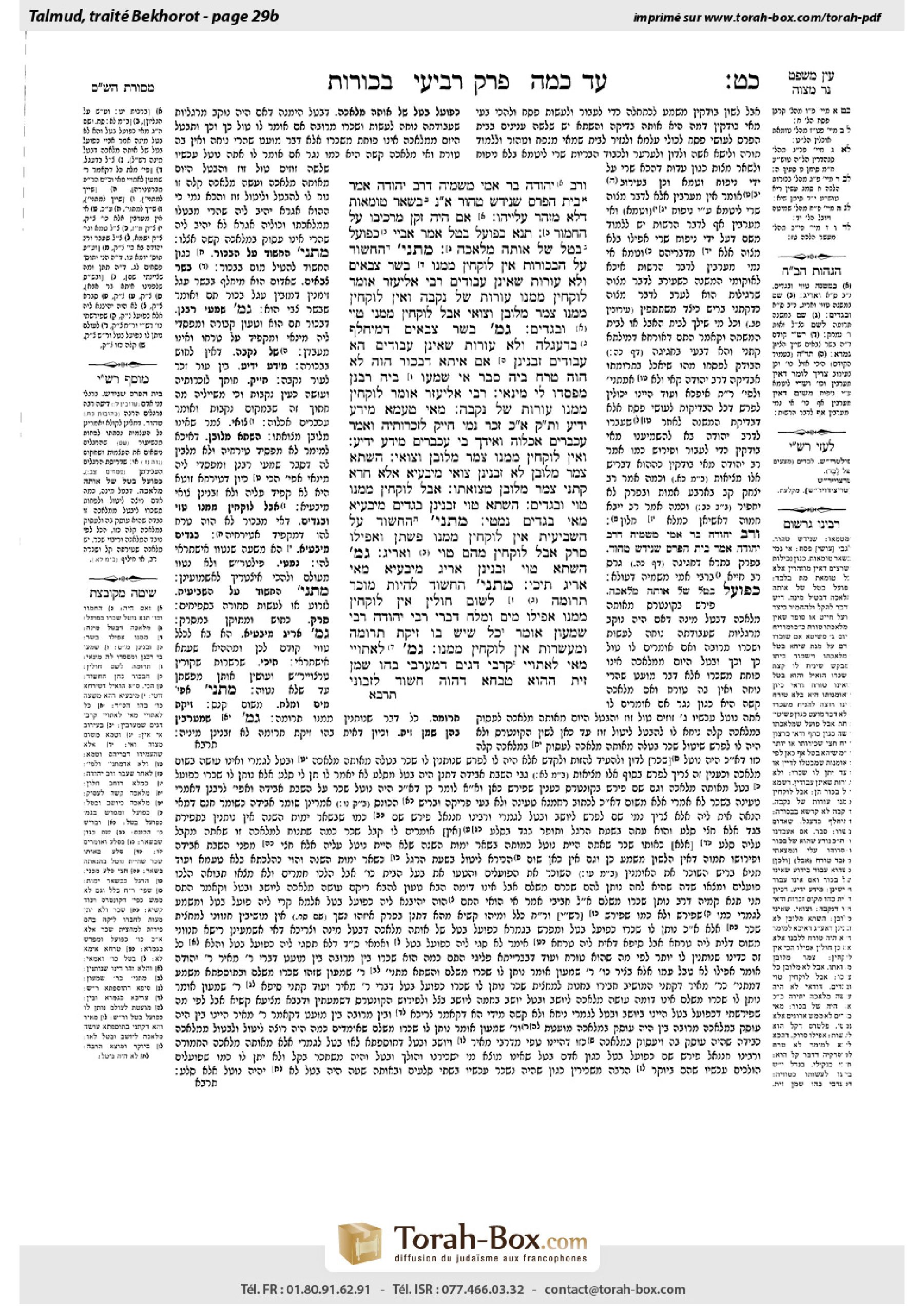
Bekhorot 29b: Talmud study for Daf Yomi
Study the Talmud for Daf Yomi with scanned pages, Hebrew text, English translations from Sefaria and AI-generated French translations.
Passage selection and English or AI-generated French translation are available where the scan has annotations. Daf Study is independent of Torah-Box and Sefaria.
Browse Bekhorot · בכורות · All tractatesBekhorot 29b text and translations
This page of Bekhorot includes the Aramaic text, an English translation and an AI-generated French translation, alongside the scan above.
בכורות כ״ט ב · Aramaic and Hebrew text
וְרַב יְהוּדָה בַּר אַמֵּי מִשְּׁמֵיהּ דְּרַב יְהוּדָה אָמַר: בֵּית הַפְּרָס שֶׁנִּידַּשׁ טָהוֹר.
אִי נָמֵי: בִּשְׁאָר טוּמְאוֹת, דְּלָא מַזְהַר עֲלַיְיהוּ.
אִם הָיָה זָקֵן — מַרְכִּיבוֹ עַל הַחֲמוֹר. תְּנָא: כְּפוֹעֵל בָּטֵל. אָמַר אַבָּיֵי: כְּפוֹעֵל בָּטֵל שֶׁל אוֹתָהּ מְלָאכָה.
מַתְנִי׳ הֶחָשׁוּד עַל הַבְּכוֹרוֹת, אֵין לוֹקְחִין מִמֶּנּוּ בְּשַׂר צְבָאִים, וְלֹא עוֹרוֹת שֶׁאֵינָן עֲבוּדִים. רַבִּי אֱלִיעֶזֶר אוֹמֵר: לוֹקְחִין מִמֶּנּוּ עוֹרוֹת שֶׁל נְקֵבָה, וְאֵין לוֹקְחִין מִמֶּנּוּ צֶמֶר מְלוּבָּן וְצוֹאִי, אֲבָל לוֹקְחִין מִמֶּנּוּ טְוִי וּבְגָדִים.
גְּמָ׳ בְּשַׂר צְבָאִים. דְּמִיחַלַּף בִּדְעֶגְלָה.
וְלֹא עוֹרוֹת שֶׁאֵינָן עֲבוּדִים. הָא עֲבוּדִים זָבְנִינַן. אִם אִיתָא דִּבְכוֹר הֲוָה — לָא הֲוָה טָרַח בֵּיהּ, סָבַר: אִי שָׁמְעוּ בֵּיהּ רַבָּנַן מַפְסְדוּ לֵיהּ מִינַּאי.
רַבִּי אֱלִיעֶזֶר אוֹמֵר: לוֹקְחִין מִמֶּנּוּ עוֹרוֹת שֶׁל נְקֵבָה. מַאי טַעְמָא? מִידָּע יְדִיעַ.
וְתַנָּא קַמָּא, אִם כֵּן, זָכָר נָמֵי חָיֵיק לְזַכְרוּתֵיהּ וְאָמַר ״עַכְבָּרִים אַכְלוּהּ״, וְאִידַּךְ — בֵּי עַכְבָּרִים מִידָּע יְדִיעַ.
וְאֵין לוֹקְחִין מִמֶּנּוּ צֶמֶר מְלוּבָּן וְצוֹאִי, הַשְׁתָּא צֶמֶר מְלוּבָּן לָא זָבְנִינַן, צוֹאִי מִיבַּעְיָא? אֶלָּא, חֲדָא קָתָנֵי: צֶמֶר מְלוּבָּן מִצּוֹאָתוֹ.
אֲבָל לוֹקְחִין מִמֶּנּוּ טְוִי וּבְגָדִים. הַשְׁתָּא טְוִי זָבְנִינַן, בְּגָדִים מִיבַּעְיָא? מַאי בְּגָדִים? נַמְטֵי.
מַתְנִי׳ הֶחָשׁוּד עַל הַשְּׁבִיעִית — אֵין לוֹקְחִין מִמֶּנּוּ פִּשְׁתָּן, וַאֲפִילּוּ סְרָק, אֲבָל לוֹקְחִין מֵהֶם טְוִי וְאָרִיג.
גְּמָ׳ הַשְׁתָּא טְוִי זָבְנִינַן, אָרִיג מִיבַּעְיָא? מַאי ״אָרִיג״? תִּיכֵּי.
מַתְנִי׳ הֶחָשׁוּד לִהְיוֹת מוֹכֵר תְּרוּמָה לְשׁוּם חוּלִּין — אֵין לוֹקְחִין מִמֶּנּוּ אֲפִילּוּ מַיִם וָמֶלַח, דִּבְרֵי רַבִּי יְהוּדָה. רַבִּי שִׁמְעוֹן אוֹמֵר: כֹּל שֶׁיֵּשׁ בּוֹ זִיקַּת תְּרוּמָה וּמַעַשְׂרוֹת אֵין לוֹקְחִין מִמֶּנּוּ.
גְּמָ׳ לְאֵתוֹיֵי מַאי? לְאֵתוֹיֵי קִרְבֵי דָגִים, דִּמְעָרְבִי בְּהוּ שֶׁמֶן זַיִת.
הָהוּא טַבָּחָא דַּהֲוָה חָשׁוּד לְזַבּוֹנֵי
Bekhorot 29b · English translation
And Rav Yehuda bar Ami says in the name of Rav Yehuda: A beit haperas that has been trodden underfoot, thereby creating a path, is pure, and one no longer needs to be concerned about bones, as the entire prohibition is a stringency by rabbinic law. Nevertheless, a priest who walks through such a field may not partake of teruma until he has purified himself.
Alternatively, the Gemara suggests that the mishna is referring to a case where the priest becomes impure with other forms of impurity, with regard to which priests are not admonished. A priest is prohibited from becoming impure only through contact with a corpse. Yet, he may not partake of teruma if he becomes impure even in any other manner.
§ The mishna teaches: If the one examining the firstborn, or the judge, or the witness, was an elderly person, the one who required his services transports him on a donkey. And in all these cases, although it is prohibited to take wages, the one who required his services gives him his wages like the wages of a laborer, as he was unable to perform his usual labor that day. The Sages taught (Tosefta, Bava Metzia 4:11): The owner gives him his wage as if he were an idle laborer. Abaye says: It means that he is paid as a laborer who is idle from that typical labor of his from which he is kept idle. In other words, he must receive the amount of money a person would be willing to accept to refrain from his current occupation and engage in the actions discussed in the mishna. This calculation accounts for both the degree of difficulty of his steady employment and the amount of his remuneration.
MISHNA: In the case of one who is suspect with regard to firstborn animals of slaughtering them and selling their meat when it is prohibited to do so, one may neither purchase meat from him, including even deer meat, nor may one purchase from him hides that are not tanned. Rabbi Eliezer says: One may purchase hides of female animals from him, as the halakhot of firstborn animals are in effect only with regard to males. And one may not purchase bleached or dirty wool from him. But one may purchase spun thread from him, and all the more so may one purchase garments from him.
GEMARA: The mishna teaches that one may not purchase from him even deer meat. The Gemara explains that the reason is that it could be confused with meat of a calf, as they are similar in appearance.
The mishna teaches: Nor may one purchase from him hides that are not tanned. The Gemara infers from here that we may purchase tanned hides from one who is suspect with regard to firstborn animals. The reason is that if it is so that it is a hide of a firstborn, he would not make such an effort with it to tan it. This is because he would think: If the Sages hear that this hide is from a firstborn, they will cause me a loss by confiscating it from me.
The mishna teaches that Rabbi Eliezer says: One may purchase hides of female animals from him, as the halakhot of firstborn animals are in effect only with regard to males. The Gemara asks: What is the reason? People know the difference between the hide of a male animal and the hide of a female animal, due to the differences in anatomy.
The Gemara asks: But if so, according to the first tanna, why is it prohibited to purchase hides of female animals from one who is suspect with regard to firstborn animals? The Gemara answers that the first tanna claims as follows: If so, i.e., if it is permitted to purchase hides of female animals, one might also come to sell hides of male animals, as he will sever the male reproductive organ and say that mice ate this part of the hide. The Gemara asks: And the other, Rabbi Eliezer, why is he not concerned that one might cut off that part of the hide and sell it as the hide of a female? The Gemara answers that Rabbi Eliezer maintains that the place of the mice is known, i.e., one can tell by looking at the hide whether it was eaten by mice or cut with a knife.
§ The mishna teaches: And one may not purchase bleached or dirty wool from him. The Gemara asks: Now that the mishna has taught that we may not purchase bleached wool from him, despite the fact he has expended effort in bleaching it, which indicates that it is not from a firstborn, is it necessary to teach that one may not purchase dirty wool from him? The Gemara answers: Rather, the tanna is teaching one case here, that of wool that was bleached and cleaned from its dirt.
The mishna teaches: But one may purchase spun thread from him, and all the more so one may purchase garments from him. The Gemara asks: Now that the mishna has taught that we may purchase spun thread from one who is suspect with regard to firstborn, is it necessary to teach that one may purchase garments? The Gemara answers: What does the mishna mean which it says: Garments? It is referring to felt [namtei] garments, which are not made of spun thread.
MISHNA: In the case of one who is suspect with regard to the Sabbatical Year, i.e., of sowing or engaging in commerce with Sabbatical-Year produce, one may not purchase flax from him, and this applies even to combed flax, in which much labor and exertion was invested. But one may purchase spun thread and woven fabric from such individuals.
GEMARA: The Gemara asks: Now that the mishna has taught that we may purchase spun thread from one who is suspect with regard to the Sabbatical Year, is it necessary to teach the case of woven fabric? The Gemara answers: What does the mishna mean when it says: Woven? It means wool woven into chains, which is not spun.
MISHNA: In the case of one who is suspect with regard to selling teruma under the guise of non-sacred produce, one may not purchase even water and salt from him; this is the statement of Rabbi Yehuda. Rabbi Shimon says: One may not purchase from him any item that has relevance to teruma and tithes. However, one may purchase water and salt from him, as teruma and tithes do not apply to them.
GEMARA: The Gemara asks: What is added by Rabbi Shimon’s statement that one may not purchase any item that has relevance to teruma and tithes from one who is suspect with regard to selling teruma? The Gemara answers: Rabbi Shimon’s statement serves to add fish innards to this prohibition, as people mix olive oil with them, and it might be oil of teruma.
The Gemara relates: There was a certain butcher who was suspected of selling
Bekhorot 29b · Traduction française (IA)
Et Rav Yéhuda bar Ami dit en nom de Rav Yéhuda : Un beit haperas qui a été foulé, créant ainsi un chemin, est pur, et l'on n'a plus besoin de s'inquiéter des os, car l'interdiction totale est une stricte loi rabbinique. Cependant, un prêtre qui marche dans un tel champ ne peut pas consommer la terouma jusqu'à ce qu'il se soit purifié.
D'une autre manière, la Guemara suggère que la mitsna fait référence à un cas où le prêtre devient impur par d'autres formes d'impureté, concernant lesquelles les prêtres ne sont pas admonestés. Le prêtre est interdit de devenir impur uniquement par contact avec un cadavre. Cependant, il ne peut pas consommer la terouma s'il devient impur même par un autre moyen.
§ La mitsna enseigne : Si celui qui examine le premier-né, ou le juge, ou le témoin, était un vieillard, celui qui a besoin de ses services le transporte sur un âne. Et dans tous ces cas, bien que ce soit interdit de prendre des salaires, celui qui a besoin de ses services lui donne son salaire comme celui d'un ouvrier, car il n'était pas en mesure de faire son travail habituel ce jour-là. Les Sages ont enseigné (Tosefta, Bava Métsia 4:11) : L'owner lui donne son salaire comme s'il était un ouvrier inactif. Abaye dit : Cela signifie qu'il est payé comme un ouvrier qui est inactif de son travail habituel, duquel il est empêché. En d'autres termes, il doit recevoir la somme d'argent qu'une personne accepterait pour se désengager de son occupation actuelle et s'engager dans les actions évoquées dans la mitsna. Ce calcul tient compte à la fois de la difficulté de son emploi habituel et de sa rémunération.
MICHNA: Dans le cas d'une personne soupçonnée concernant les premiers-nés, qui tue des animaux et vend leur viande lorsqu'il est interdit de le faire, on ne peut ni acheter de viande de lui, y compris même la viande de cerf, ni acheter des peaux non tannées. Rabbi Éliezer dit : On peut acheter des peaux d'animaux femelles de lui, car les halakhot des premiers-nés s'appliquent uniquement aux mâles. Et on ne peut pas acheter de laine blanchie ou sale de lui. Mais on peut acheter du fil tissé de lui, et encore davantage on peut acheter des vêtements de lui.
GUÉMARAH : La mitsva enseigne que l'on ne peut pas acheter de viande de lui, même la viande de cerf. La Guemara explique que la raison est qu'il pourrait être confondu avec la viande d'un veau, car ils sont semblables en apparence.
La mitsva enseigne : On ne peut pas non plus acheter des peaux non tannées de lui. La Guemara déduit de cela que nous pouvons acheter des peaux tannées d'une personne soupçonnée concernant les premiers-nés. La raison est que s'il s'agit d'une peau de premier-né, il ne ferait pas d'effort pour la tanner. Cela est dû au fait qu'il penserait : Si les Sages apprennent que cette peau vient d'un premier-né, ils causeront à moi une perte en la confisquant.
La Michna enseigne que Rabbi Éliezer dit : On peut acheter des peaux d'animaux femelles de lui, car les halakhot des premiers-nés s'appliquent uniquement aux mâles. La Guemara demande : Quelle est la raison ? Les gens savent la différence entre la peau d'un animal mâle et celle d'une femelle, en raison des différences anatomiques.
La Guemara demande : Mais si c'est ainsi, selon le premier tanna, pourquoi est-il interdit d'acheter des peaux d'animaux femelles d'une personne soupçonnée concernant les premiers-nés ? La Guemara répond que le premier tanna affirme comme suit : Si c'est ainsi, c'est-à-dire si l'on peut acheter des peaux d'animaux femelles, l'on pourrait aussi vendre des peaux de mâles, car il tranchera l'organe reproducteur masculin et dira que des rats ont mangé cette partie de la peau. La Guemara demande : Et l'autre, Rabbi Éliezer, pourquoi n'est-il pas inquiet que l'on puisse couper cette partie de la peau et la vendre comme celle d'une femelle ? La Guemara répond que Rabbi Éliezer maintient que l'endroit où les rats sont connus, c'est-à-dire qu'on peut savoir en regardant la peau si elle a été mangée par des rats ou tranchée avec un couteau.
§ La Michna enseigne : On ne peut pas acheter de laine blanchie ou sale de lui. La Guemara demande : Maintenant que la Michna a enseigné que l'on ne peut pas acheter de laine blanchie de lui, malgré le fait qu'il ait dépensé un effort pour la blanchir, ce qui indique qu'il ne s'agit pas d'un premier-né, est-il nécessaire d'enseigner que l'on ne peut pas acheter de laine sale de lui ? La Guemara répond : Plutôt, le tanna enseigne un cas ici, celui de la laine blanchie et nettoyée de sa saleté.
La mitsva enseigne : Mais on peut acheter du fil tissé de lui, et encore davantage on peut acheter des vêtements de lui. La Guemara demande : Maintenant que la mitsva a enseigné que l'on peut acheter du fil tissé d'une personne soupçonnée concernant les premiers-nés, est-il nécessaire d'enseigner le cas des vêtements ? La Guemara répond : Que signifie la mitsva qui dit : des vêtements ? Elle fait référence aux vêtements en tissu de laine, qui ne sont pas faits de fil tissé.
MITSVA : Dans le cas d'une personne soupçonnée concernant l'année sabbatique, c'est-à-dire de semer ou d'engager dans le commerce avec les produits de l'année sabbatique, l'on ne peut pas acheter du lin de lui, et cela s'applique même au lin râpé, dans lequel beaucoup de travail et d'effort ont été investis. Mais l'on peut acheter du fil tissé et des tissus tissés de tels individus.
GUÉMARAH : La Guemara demande : Maintenant que la mitsva a enseigné que l'on peut acheter du fil tissé d'une personne soupçonnée concernant l'année sabbatique, est-il nécessaire d'enseigner le cas des tissus tissés ? La Guemara répond : Que signifie la mitsva lorsqu'elle dit : tissus ? Elle fait référence à la laine tissée en chaînes, qui n'est pas tissée.
MICHNA : Dans le cas d'une personne soupçonnée en ce qui concerne la vente de terouma sous prétexte de produits non sacrés, on ne peut pas acheter même de l'eau et du sel auprès de lui ; c'est la déclaration de Rabbi Yéhuda. Rabbi Shimon dit : On ne peut pas acheter auprès de lui tout objet ayant une relation avec la terouma et les dîmes. Cependant, on peut acheter de l'eau et du sel auprès de lui, car la terouma et les dîmes ne s'appliquent pas à eux.
GUEMARA : La Guemara pose la question : Quel est l'apport de la déclaration du Rabbi Simon selon laquelle on ne peut pas acheter un objet ayant un lien avec la terouma et les dîmes auprès d'une personne soupçonnée d'avoir vendu de la terouma ? La Guemara répond : La déclaration du Rabbi Simon sert à ajouter les entrailles de poisson à cette interdiction, car les gens mélangent de l'huile d'olive avec celles-ci, et cela pourrait être de l'huile de terouma.
La Guemara relate : Il y avait un boucher particulier soupçonné de vendre
Traduction française générée par IA à partir de l’édition anglaise de Sefaria. Vérifie toujours un passage avec le texte source.
Text from Sefaria: William Davidson Edition - Vocalized Aramaic (CC BY NC); William Davidson Edition - English (CC BY NC).