Bekhorot 30a: Talmud study for Daf Yomi
Study the Talmud for Daf Yomi with scanned pages, Hebrew text, English translations from Sefaria and AI-generated French translations.
Passage selection and English or AI-generated French translation are available where the scan has annotations. Daf Study is independent of Torah-Box and Sefaria.
Browse Bekhorot · בכורות · All tractatesBekhorot 30a text and translations
This page of Bekhorot includes the Aramaic text, an English translation and an AI-generated French translation, alongside the scan above.
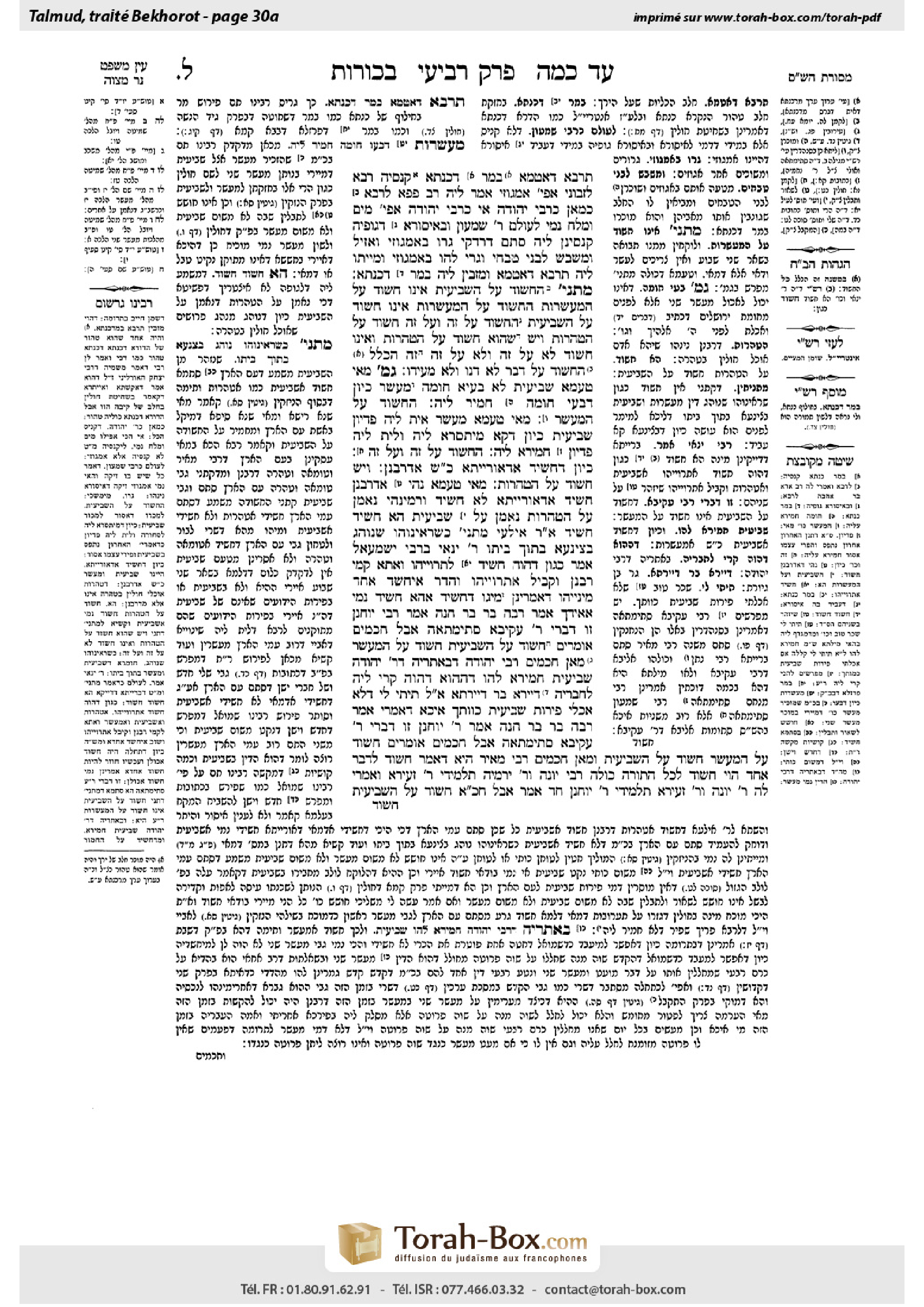
בכורות ל׳ א · Aramaic and Hebrew text
תַּרְבָּא דְּאַטְמָא בְּמַר דְּכַנְתָּא, קַנְסֵיהּ רָבָא לְזַבּוֹנֵי אֲפִילּוּ אַמְגּוֹזֵי. אֲמַר לֵיהּ רַב פָּפָּא לְרָבָא: כְּמַאן? כְּרַבִּי יְהוּדָה? אִי כְּרַבִּי יְהוּדָה, אֲפִילּוּ מַיִם וָמֶלַח נָמֵי!
לְעוֹלָם רַבִּי שִׁמְעוֹן, וּבְאִיסּוּרָא דְּגוּפֵיהּ קָנְסִינַן לֵיהּ. סְתָם דַּרְדְּקֵי גְּרוּ בְּאַמְגּוֹזֵי, וְאָזֵיל וּמְשַׁבֵּשׁ לִבְנֵי טַבָּחֵי, וְגָרֵי לְהוּ בְּאַמְגּוֹזֵי, וּמַיְיתוּ לֵיהּ תַּרְבָּא דְּאַטְמָא, וּמְזַבֵּין לֵיהּ בְּמַר דְּכַנְתָּא.
מַתְנִי׳ הֶחָשׁוּד עַל הַשְּׁבִיעִית — אֵינוֹ חָשׁוּד עַל הַמַּעַשְׂרוֹת, הֶחָשׁוּד עַל הַמַּעַשְׂרוֹת — אֵינוֹ חָשׁוּד עַל הַשְּׁבִיעִית. הֶחָשׁוּד עַל זֶה וְעַל זֶה — חָשׁוּד עַל הַטְּהָרוֹת, וְיֵשׁ שֶׁהוּא חָשׁוּד עַל הַטְּהָרוֹת — וְאֵינוֹ חָשׁוּד לֹא עַל זֶה וְלֹא עַל זֶה. זֶה הַכְּלָל: הֶחָשׁוּד עַל דָּבָר — לֹא דָּנוֹ וְלֹא מְעִידוֹ.
גְּמָ׳ מַאי טַעְמָא? שְׁבִיעִית לָא בָּעֲיָא חוֹמָה, מַעֲשֵׂר — כֵּיוָן דְּבָעֵי חוֹמָה, חֲמִיר לֵיהּ.
הֶחָשׁוּד עַל הַמַּעֲשֵׂר. מַאי טַעְמָא? מַעֲשֵׂר אִית לֵיהּ פִּדְיוֹן, שְׁבִיעִית — כֵּיוָן דְּקָא מִיתַּסְרָא לֵיהּ וְלֵית לֵיהּ פִּדְיוֹן — חֲמִירָא לֵיהּ.
הֶחָשׁוּד עַל זֶה וְעַל זֶה. כֵּיוָן דַּחֲשִׁיד אַדְּאוֹרָיְיתָא, כׇּל שֶׁכֵּן אַדְּרַבָּנַן.
וְיֵשׁ חָשׁוּד עַל הַטְּהָרוֹת. מַאי טַעְמָא? נְהִי אַדְּרַבָּנַן חֲשִׁיד, אַדְּאוֹרָיְיתָא לָא חֲשִׁיד. וּרְמִינְהִי: נֶאֱמָן עַל הַטְּהָרוֹת — נֶאֱמָן עַל שְׁבִיעִית, הָא חֲשִׁיד — חֲשִׁיד!
אָמַר רַבִּי אִילְעַי: מַתְנִיתִין כְּשֶׁרְאִינוּהוּ שֶׁנּוֹהֵג בְּצִינְעָא בְּתוֹךְ בֵּיתוֹ.
רַבִּי יַנַּאי בְּרַבִּי יִשְׁמָעֵאל אָמַר: כְּגוֹן דַּהֲוָה חֲשִׁיד לְתַרְוַיְיהוּ, וַאֲתָא קַמֵּי רַבָּנַן וְקַבֵּיל אַתַּרְוַיְיהוּ, וַהֲדַר אִיחֲשַׁד אַחַד מִינַּיְיהוּ, דְּאָמְרִינַן: מִיגּוֹ דַּחֲשִׁיד אַהָא — חֲשִׁיד נָמֵי אַאִידַּךְ.
אָמַר רַבָּה בַּר בַּר חָנָה אָמַר רַבִּי יוֹחָנָן: זוֹ דִּבְרֵי רַבִּי עֲקִיבָא סְתִימְתָּאָה, אֲבָל חֲכָמִים אוֹמְרִים: חָשׁוּד עַל הַשְּׁבִיעִית — חָשׁוּד עַל הַמַּעֲשֵׂר.
מַאן חֲכָמִים? רַבִּי יְהוּדָה, דִּבְאַתְרֵיהּ דְּרַבִּי יְהוּדָה שְׁבִיעִית חֲמִירָא לְהוּ, דְּהָהוּא דַּהֲוָה קָרֵי לֵיהּ לְחַבְרֵיהּ ״דַּיָּירָא בַּר דַּיָּירְתָּא״, אֲמַר לֵיהּ: תֵּיתֵי לִי דְּלָא אֲכַלִי פֵּירוֹת שְׁבִיעִית כְּוָותָךְ.
אִיכָּא דְּאָמְרִי, אָמַר רַבָּה בַּר בַּר חָנָה אָמַר רַבִּי יוֹחָנָן: זוֹ דִּבְרֵי רַבִּי עֲקִיבָא סְתִימְתָּאָה, אֲבָל חֲכָמִים אוֹמְרִים: חָשׁוּד עַל הַמַּעֲשֵׂר חָשׁוּד עַל הַשְּׁבִיעִית. וּמַאן חֲכָמִים? רַבִּי מֵאִיר הִיא, דְּאָמַר: חָשׁוּד לְדָבָר אֶחָד הָוֵי חָשׁוּד לְכׇל הַתּוֹרָה כּוּלָּהּ.
רַבִּי יוֹנָה וְרַבִּי יִרְמְיָה תַּלְמִידֵי רַבִּי זְעֵירָא, וְאָמְרִי לַהּ רַבִּי יוֹנָה וְרַבִּי זְעֵירָא תַּלְמִידֵי רַבִּי יוֹחָנָן, חַד אָמַר: אֲבָל חֲכָמִים אוֹמְרִים חָשׁוּד עַל הַשְּׁבִיעִית
Bekhorot 30a · English translation
fat of the kidney adjacent to the thigh, which is forbidden, in place of fat of the intestines, which is permitted. Rava penalized him and prohibited him even from selling nuts. Rav Pappa said to Rava: In accordance with which opinion in the mishna is your ruling? It must be in accordance with the opinion of Rabbi Yehuda. If it is in accordance with the opinion of Rabbi Yehuda, then you should prohibit this butcher from selling even water and salt.
Rava replied: Actually, my ruling is in accordance with the opinion of Rabbi Shimon, who holds that one is suspected only about those items that are related to the prohibition in question. And we are in fact penalizing him with regard to items related to the prohibition itself. How so? Ordinary children are enticed by nuts, and that individual went and misled the children of butchers and enticed them with nuts, and they brought him fat of the kidney that is adjacent to the thigh, and he sold it as though it were fat of the intestines.
MISHNA: One who is suspect with regard to the Sabbatical Year is not suspect with regard to tithes; and likewise, one who is suspect with regard to tithes is not suspect with regard to the Sabbatical Year. One who is suspect with regard to this, the Sabbatical Year, or with regard to that, tithes, is suspect with regard to selling ritually impure foods as though they were ritually pure items. But there are those who are suspect with regard to ritually pure items who are not suspect with regard to this, the Sabbatical Year, nor with regard to that, tithes. This is the principle with regard to these matters: Anyone who is suspect with regard to a specific matter may neither adjudicate cases nor testify in cases involving that matter.
GEMARA: The mishna teaches that one who is suspect with regard to the Sabbatical Year is not suspect with regard to tithes. The Gemara asks: What is the reason? One is not required to eat produce of the Sabbatical Year within the wall of Jerusalem, and therefore he treats it lightly. As for second tithe, since one is required to eat it only within the wall of Jerusalem, it is possible that it seems more stringent for him, and therefore he is not suspect, despite the suspicions with regard to produce of the Sabbatical Year.
The mishna teaches: One who is suspect with regard to tithe is not suspect with regard to the Sabbatical Year. The Gemara asks: What is the reason? The Gemara answers: Since there is redemption for tithes, one might treat them lightly. As for produce of the Sabbatical Year, since it is always prohibited to him and there is no redemption of it, it is possible that it seems more stringent for him, and therefore he is not suspect.
The mishna teaches: One who is suspect with regard to this, the Sabbatical Year, or with regard to that, tithes, is suspect with regard to selling ritually impure foods as though they were ritually pure items. The Gemara explains: Since he is suspect with regard to matters that apply by Torah law, all the more so that he is suspect with regard to matters that are by rabbinic law. Eating non-sacred food in a state of ritual purity is an ordinance of the Sages; it does not apply by Torah law. Consequently, he is certainly not trusted with regard to that matter.
The mishna teaches: But there are those who are suspect with regard to ritually pure items who are not suspect with regard to this, the Sabbatical Year, or with regard to that, tithes. The Gemara asks: What is the reason? Granted, he is suspect with regard to prohibitions that are by rabbinic law, but he is not suspect with regard to prohibitions that are by Torah law. And the Gemara raises a contradiction from a baraita: If one is trusted with regard to ritually pure items he is trusted with regard to produce of the Sabbatical Year. It can be inferred from here that if he is suspect with regard to ritually pure items he is likewise suspect with regard to produce of the Sabbatical Year.
Rabbi Ilai says: The mishna is referring to a case where they saw him practicing stringencies with regard to produce of the Sabbatical Year and tithes privately, within his home. Since he himself is known to be trustworthy in these matters in private, he is not suspected of violating these prohibitions in his business, despite his lack of trustworthiness with regard to ritual purity.
Rabbi Yannai, son of Rabbi Yishmael, said that there is an alternative answer: The baraita is referring to a case where one was suspect with regard to both ritually pure items and produce of the Sabbatical Year, and he came before the Sages and accepted upon himself that he would observe both of them, and afterward he was suspected with regard to one of them. The reason for the halakha here is that we say: Since he is suspect with regard to this one of them, he is also suspect with regard to the other one. Although one of the prohibitions is more stringent than the other, the court has seen that he cannot be trusted to keep his word about either of them.
§ The mishna teaches: One who is suspect with regard to the Sabbatical Year is not suspect with regard to tithes. Rabba bar bar Ḥana says that Rabbi Yoḥanan says: This is the statement of Rabbi Akiva, the unattributed. Most unattributed statements of tanna’im were formulated by Rabbi Akiva’s students and reflect his opinions. But the Rabbis say: One who is suspect with regard to produce of the Sabbatical Year is suspect with regard to tithe.
The Gemara asks: Who are the Sages referred to here as the Rabbis? It is Rabbi Yehuda, as in Rabbi Yehuda’s locale they considered produce of the Sabbatical Year an especially stringent prohibition. Therefore, if a resident of that place was suspect with regard to the Sabbatical Year, he was certainly not trusted with regard to tithes. As in that locale, if a certain person would call another: A convert, son of a female convert, wishing to insult him, that person would say to him in reply: I have a blessing coming to me, as I do not eat produce of the Sabbatical Year like you do. This indicates that the accusation of eating produce of the Sabbatical Year was a great insult, since they treated the Sabbatical Year stringently.
There are those who say that Rabba bar bar Ḥana says that Rabbi Yoḥanan says: This is the statement of Rabbi Akiva, the unattributed. But the Rabbis say: One who is suspect with regard to tithe is suspect with regard to produce of the Sabbatical Year. And who are the Sages referred to here as the Rabbis? It is Rabbi Meir, who says: One who is suspect with regard to one matter is suspect with regard to the entire Torah.
The Gemara relates that Rabbi Yona and Rabbi Yirmeya, who were students of Rabbi Zeira, disagreed about this matter. And some say that it was Rabbi Yona and Rabbi Zeira, students of Rabbi Yoḥanan, who disagreed. One said: But the Rabbis say that one who is suspect with regard to produce of the Sabbatical Year
Bekhorot 30a · Traduction française (IA)
La graisse du rein adjacente à la cuisse, qui est interdite, en lieu et place de la graisse des intestines, qui est permise. Rava a sanctionné cela et l’a interdit même de vendre des noix. Rav Pappa a dit à Rava : Selon quelle opinion de la Michna est votre décision ? Il doit être selon l’opinion de Rabbi Yéhuda. Si c’est selon l’opinion de Rabbi Yéhuda, alors vous devriez interdire ce boucher de vendre même de l’eau et du sel.
Rava a répondu : En réalité, ma décision est selon l’opinion de Rabbi Shimon, qui affirme qu’on soupçonne seulement ceux qui sont liés à l’interdiction en question. Et nous sanctionnons effectivement en ce qui concerne les choses liées à l’interdiction elle-même. Comment cela ? Les enfants ordinaires sont attirés par les noix, et cette personne est allée tromper les enfants des bouchers et attirer leurs enfants avec des noix, et ils lui ont apporté la graisse du rein adjacente à la cuisse, et il l’a vendue comme si c’était la graisse des intestines.
MICHNA : Celui qui est suspect concernant la année sainte n’est pas suspect concernant les dîmes ; de même, celui qui est suspect concernant les dîmes n’est pas suspect concernant la année sainte. Celui qui est suspect concernant cela, la année sainte, ou concernant cela, les dîmes, est suspect concernant la vente de choses impures comme si elles étaient pures. Mais il y a ceux qui sont suspects concernant les choses pures qui ne sont pas suspects concernant cela, la année sainte, ni concernant cela, les dîmes. C’est le principe concernant ces choses : Tout celui qui est suspect concernant une affaire particulière ne doit ni juger ni témoigner concernant cette affaire.
GUEMARA : La mitsva enseigne que celui qui est suspect concernant la année sainte n’est pas suspect concernant les dîmes. La Guemara demande : Quel est la raison ? On ne doit pas manger les produits de la année sainte à l’intérieur des murs de Jérusalem, et donc il les traite avec légèreté. En ce qui concerne la dîme secondaire, puisqu’on doit manger celle-ci uniquement à l’intérieur des murs de Jérusalem, il est possible qu’elle semble plus stricte pour lui, et donc il n’est pas suspect, malgré les soupçons concernant les produits de la année sainte.
La mitsva enseigne : Celui qui est suspect concernant les dîmes n’est pas suspect concernant la année sainte. La Guemara demande : Quel est la raison ? La Guemara répond : Puisqu’il y a un rachat des dîmes, on pourrait les traiter avec légèreté. En ce qui concerne les produits de la année sainte, puisqu’il est toujours interdit à lui et qu’il n’y a pas de rachat, il est possible qu’il semble plus stricte pour lui, et donc il n’est pas suspect.
La mitsva enseigne : Celui qui est suspect concernant cela, la année sainte, ou concernant cela, les dîmes, est suspect concernant la vente de choses impures comme si elles étaient pures. La Guemara explique : Puisqu’il est suspect concernant des affaires qui s’appliquent par la Loi divine, encore plus qu’il est suspect concernant des affaires qui s’appliquent par la Loi rabbinique. Manger des aliments non sacrés dans un état de pureté rituelle est une ordonnance des Sages ; cela ne s’applique pas par la Loi divine. Ainsi, il n’est certainement pas digne de confiance concernant cette affaire.
La mitsva enseigne : Mais il y a ceux qui sont suspects concernant les choses pures qui ne sont pas suspects concernant cela, l'année sabbatique, ni concernant cela, les dîmes. La Guemara demande : Quelle est la raison ? Bien qu'il soit suspect concernant des interdits qui sont établis par la Loi rabbinique, il n'est pas suspect concernant des interdits qui sont établis par la Loi divine. Et la Guemara soulève une contradiction à partir d'une baraïta : Si l'on est digne de confiance concernant les choses pures, on est digne de confiance concernant les produits de l'année sabbatique. On peut en déduire ici que si l'on est suspect concernant les choses pures, on l'est également concernant les produits de l'année sabbatique.
Rabbi Ilai dit : La mitsva fait référence à un cas où ils l'ont vu pratiquer des stringences concernant les produits de l'année sabbatique et les dîmes en privé, à l'intérieur de sa maison. Puisqu'il est connu pour être digne de confiance en ces affaires en privé, il n'est pas suspect de violer ces interdits en affaire, malgré son manque de confiance concernant la pureté rituelle.
Rabbi Yannai, fils de Rabbi Yishmael, a dit qu'il y a une autre réponse : La baraïta fait référence à un cas où l'on était suspect concernant les choses pures et les produits de l'année sabbatique, et il est venu devant les Sages et s'est engagé à observer les deux, et ensuite il a été suspect concernant l'un d'eux. La raison de cette halakha est que nous disons : Puisqu'il est suspect concernant l'un d'eux, il est également suspect concernant l'autre. Bien qu'un des interdits soit plus strict que l'autre, le tribunal a vu qu'il ne peut pas être digne de confiance à garder sa promesse concernant l'un ou l'autre.
§ La mitsva enseigne : Celui qui est suspect concernant l'année sabbatique n'est pas suspect concernant les dîmes. Rabba bar bar Ḥana dit que Rabbi Yoḥanan dit : C'est la déclaration de Rabbi Akiva, non attribuée. La plupart des déclarations non attribuées des tannaïm ont été formulées par les élèves de Rabbi Akiva et reflètent ses opinions. Mais les Rabbins disent : Celui qui est suspect concernant les produits de l'année sabbatique est suspect concernant les dîmes.
La Guemara pose la question : De quels Sages s'agit-il ici lorsqu'on mentionne les Rabbins ? C'est Rabbi Yéhuda, car dans la région de Rabbi Yéhuda, les produits de l'année sabbatique étaient considérés comme une interdiction particulièrement stricte. Ainsi, si un résident de cette région était suspect concernant l'année sabbatique, il ne pouvait pas être considéré comme fiable concernant les dîmes. Dans cette région, si une personne disait à une autre : « Un converti, fils d'une femme convertie », pour l'insulter, celui-ci répondait : « J'ai une bénédiction qui m'attend, car je ne mange pas les produits de l'année sabbatique comme toi. » Cela montre que l'accusation d'avoir mangé des produits de l'année sabbatique était une insulte grave, car ils traitaient l'année sabbatique de manière stricte.
Certains disent que Rabba bar bar Ḥana dit que Rabbi Yoḥanan dit : C'est la déclaration de Rabbi Akiva, sans attribution. Mais les Rabbins disent : Celui qui est suspect concernant les dîmes est suspect concernant les produits de l'année sabbatique. Et de quels Sages s'agit-il ici lorsqu'on mentionne les Rabbins ? C'est Rabbi Méir, qui dit : Celui qui est suspect concernant une seule chose est suspect concernant toute la Torah.
La Guemara rapporte que Rabbi Yona et Rabbi Yirméya, élèves de Rabbi Zéria, étaient en désaccord à ce sujet. Et certains disent que c'était Rabbi Yona et Rabbi Zéria, élèves de Rabbi Yoḥanan, qui étaient en désaccord. L'un disait : Mais les Rabbins disent que celui qui est suspect concernant les produits de l'année sabbatique
Traduction française générée par IA à partir de l’édition anglaise de Sefaria. Vérifie toujours un passage avec le texte source.
Text from Sefaria: William Davidson Edition - Vocalized Aramaic (CC BY NC); William Davidson Edition - English (CC BY NC).