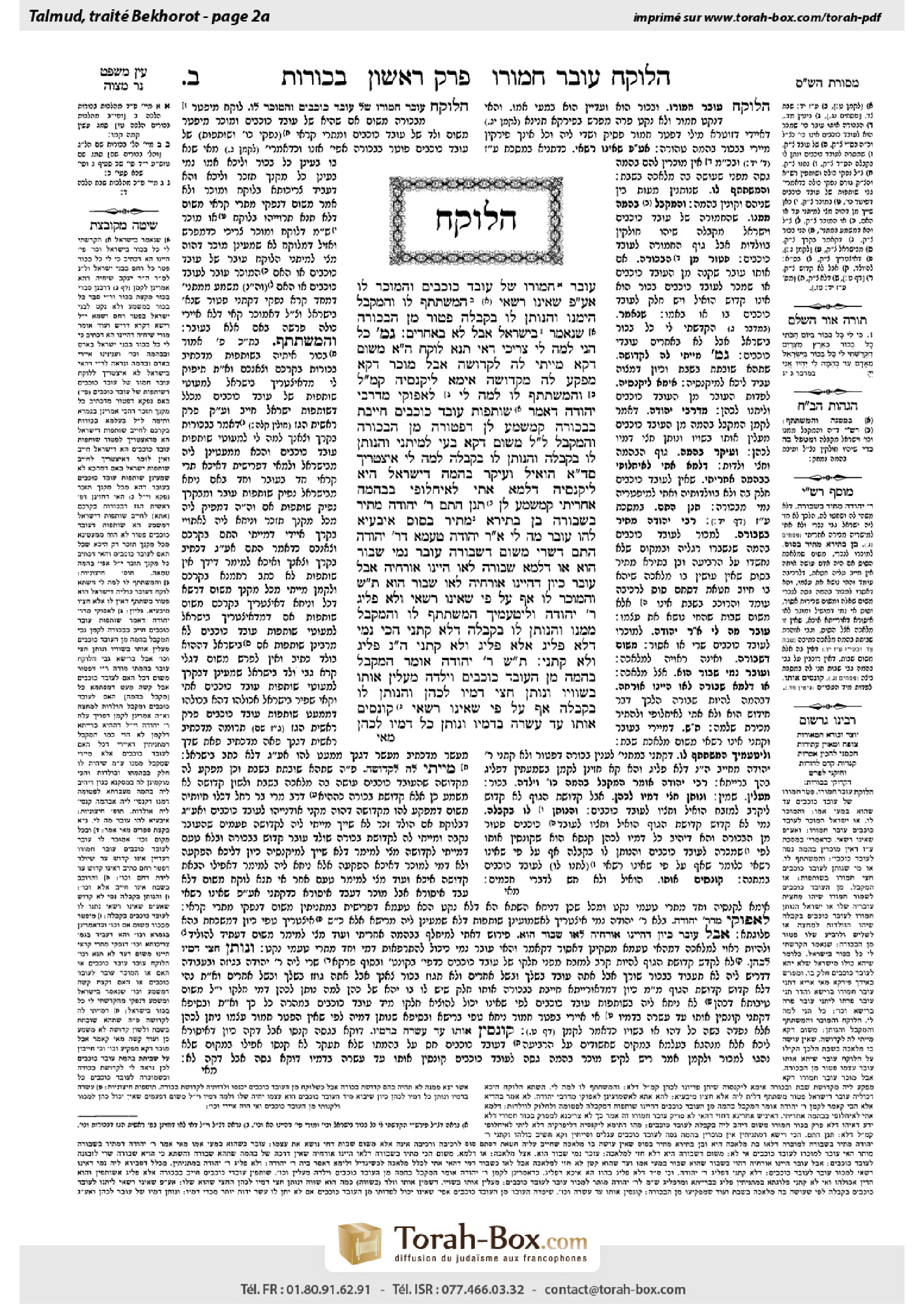
Bekhorot 2a: Talmud study for Daf Yomi
Study the Talmud for Daf Yomi with scanned pages, Hebrew text, English translations from Sefaria and AI-generated French translations.
Passage selection and English or AI-generated French translation are available where the scan has annotations. Daf Study is independent of Torah-Box and Sefaria.
Browse Bekhorot · בכורות · All tractatesBekhorot 2a text and translations
This page of Bekhorot includes the Aramaic text, an English translation and an AI-generated French translation, alongside the scan above.
בכורות ב׳ א · Aramaic and Hebrew text
מַתְנִי׳ הַלּוֹקֵחַ עוּבַּר חֲמוֹרוֹ שֶׁל נָכְרִי, וְהַמּוֹכֵר לוֹ, אַף עַל פִּי שֶׁאֵינוֹ רַשַּׁאי, הַמִּשְׁתַּתֵּף לוֹ, וְהַמְקַבֵּל הֵימֶנּוּ, וְהַנּוֹתֵן לוֹ בְּקַבָּלָה — פָּטוּר מִן הַבְּכוֹרָה, שֶׁנֶּאֱמַר: ״בְּיִשְׂרָאֵל״, אֲבָל לֹא בַּאֲחֵרִים.
גְּמָ׳ כׇּל הָנֵי לְמָה לִי?
צְרִיכִי, דְּאִי תְּנָא לוֹקֵחַ — הֲוָה אָמֵינָא מִשּׁוּם דְּקָא מַיְיתֵי לַהּ לִקְדוּשָּׁה, אֲבָל מוֹכֵר דְּקָא מַפְקַע לַהּ מִקְּדוּשָּׁה — אֵימָא לִיקְנְסֵיהּ, קָא מַשְׁמַע לַן.
וְהַמִּשְׁתַּתֵּף לוֹ, לְמָה לִי? לְאַפּוֹקֵי מִדְּרַבִּי יְהוּדָה, דְּאָמַר: שׁוּתָּפוּת גּוֹיִ חַיֶּיבֶת בִּבְכוֹרָה, קָמַשְׁמַע לַן דִּפְטוּרָה מִן הַבְּכוֹרָה.
וְהַמְקַבֵּל, לְמָה לִי? מִשּׁוּם דְּקָא בָּעֵי לְמִיתְנֵי וְהַנּוֹתֵן לוֹ בְּקַבָּלָה.
וְהַנּוֹתֵן לוֹ בְּקַבָּלָה, לְמָה לִי? אִיצְטְרִיךְ, סָלְקָא דַּעְתָּךְ אָמֵינָא: הוֹאִיל וְעִיקַּר בְּהֵמָה דְּיִשְׂרָאֵל הִיא, לִיקְנְסֵיהּ, דִּלְמָא אָתֵי לְאִיחַלּוֹפֵי בִּבְהֵמָה אַחֲרִיתִי, קָמַשְׁמַע לַן.
תְּנַן הָתָם: רַבִּי יְהוּדָה מַתִּיר בַּשְּׁבוּרָה, בֶּן בְּתִירָא מַתִּיר בַּסּוּס.
אִיבַּעְיָא לְהוּ: עוּבָּר מָה לִי אָמַר רַבִּי יְהוּדָה? טַעְמָא דְּרַבִּי יְהוּדָה הָתָם דְּשָׁרֵי, מִשּׁוּם דִּשְׁבוּרָה, עוּבָּר נָמֵי שָׁבוּר הוּא. אוֹ דִלְמָא: שְׁבוּרָה לָאו הַיְינוּ אוֹרְחֵיהּ, אֲבָל עוּבָּר, כֵּיוָן דְּהַיְינוּ אוֹרְחֵיהּ, לָאו שָׁבוּר הוּא?
תָּא שְׁמַע: וְהַמּוֹכֵר לוֹ, אַף עַל פִּי שֶׁאֵינוֹ רַשַּׁאי. וְלָא פְּלִיג רַבִּי יְהוּדָה.
וְלִיטַעְמָיךְ, הַמִּשְׁתַּתֵּף לוֹ, וְהַמְקַבֵּל מִמֶּנּוּ, וְהַנּוֹתֵן לוֹ בְּקַבָּלָה, דְּלָא קָתָנֵי — הָכִי נָמֵי דְּלָא פְּלִיג?
אֶלָּא — פְּלִיג, וְלָא קָתָנֵי. הָכָא נָמֵי — פְּלִיג, וְלָא קָתָנֵי.
תָּא שְׁמַע: רַבִּי יְהוּדָה אוֹמֵר, הַמְקַבֵּל בְּהֵמָה מִן הַגּוֹי וְיָלְדָה — מַעֲלִין אוֹתוֹ בְּשׇׁוְויוֹ, וְנוֹתֵן חֲצִי דָּמָיו לַכֹּהֵן. וְהַנּוֹתֵן לוֹ בְּקַבָּלָה, אַף עַל פִּי שֶׁאֵינוֹ רַשַּׁאי — קוֹנְסִים אוֹתוֹ עַד עֲשָׂרָה בְּדָמָיו, וְנוֹתֵן כׇּל דָּמָיו לַכֹּהֵן.
Bekhorot 2a · English translation
MISHNA: With regard to one who purchases the fetus of a donkey that belongs to a gentile, and one who sells the fetus of his donkey to a gentile although he is not permitted to sell a large animal to a gentile, and one who enters into a partnership with a gentile in ownership of a donkey or its fetus, and one who receives a donkey from a gentile in order to care for it in exchange for partnership in its offspring, and one who gives his donkey to a gentile in receivership, in all of these cases the donkeys are exempt from the obligations of firstborn status, i.e., they do not have firstborn status and are not redeemed, as it is stated: “I sanctified to Me all the firstborn in Israel, both man and animal” (Numbers 3:13), indicating that the mitzva is incumbent upon the Jewish people, but not upon others. If the firstborn belongs even partially to a gentile, it does not have firstborn status.
GEMARA: The Gemara asks: Why do I need all these examples in the mishna to demonstrate the principle that a firstborn donkey must belong exclusively to a Jew for the obligations of firstborn status to apply?
The Gemara explains: All of these examples are necessary. As, had the tanna taught that a donkey is exempt from the obligations of firstborn status only in the case where a Jew purchases a fetus from a gentile, I would say that this is because the Jew brings it to a state of sanctity in that it will not be worked on Shabbat. But in the case where a Jew sells the fetus of his donkey to a gentile, where he abrogates its state of sanctity, I would say that the Sages should penalize him [likneseih] for his actions by rendering the fetus subject to the obligations of firstborn status. Therefore, the mishna teaches us that it is exempt from these obligations.
And why do I need the mishna to state the case of one who enters into a partnership with a gentile? The case is necessary to exclude the opinion of Rabbi Yehuda, who says: An animal owned in partnership with a gentile is obligated, i.e., subject to accounting its offspring a firstborn. Therefore, the mishna teaches us that it is exempt from its offspring being counted a firstborn.
And why do I need the mishna to state that the fetus does not have firstborn status in the case of one who receives a donkey from a gentile in exchange for partnership in its offspring? This halakha is already included in the previous one. The Gemara answers: It is because the tanna wants to teach in the parallel case of: And one who gives his donkey to a gentile in receivership, that its offspring does not have firstborn status.
And why do I need the case of one who gives his donkey to a gentile in receivership to be stated? It was necessary, because it might enter your mind to say that since the primary animal belongs to the Jew, the Sages should penalize him by treating the offspring as a firstborn and requiring it to be redeemed, lest this case be confused with another case of an animal that the Jew puts in the care of a gentile where the gentile does not own rights to the offspring, and the offspring is counted a firstborn. Therefore, the mishna teaches us that he is not penalized.
§ The Gemara cites a discussion where the mishna is used as a proof: We learned in a mishna elsewhere (Avoda Zara 14b) with regard to the prohibition against selling large livestock to a gentile due to concern that it will be worked on Shabbat: Rabbi Yehuda deems the sale of a damaged animal permitted because it is incapable of performing labor, and ben Beteira deems the sale of a horse for riding permitted, because riding a horse on Shabbat is not prohibited by Torah law.
A dilemma was raised before the Sages: With regard to a fetus, what would Rabbi Yehuda say to me about selling it to a gentile? Is the reason that Rabbi Yehuda deems selling the animal permitted there because it is damaged and it cannot work, and a fetus is also damaged in the sense that it cannot work? Or, perhaps it is permitted to sell a damaged animal because that is not its natural state; it is defective and is therefore not included in the prohibition against selling large livestock. But with regard to a fetus, since that is its natural state, and it will become capable of working after growing up, perhaps it is not considered damaged, as it is not defective.
The Gemara suggests: Come and hear a resolution to the dilemma from the mishna: And one who sells the fetus of his donkey to a gentile, his donkey is exempt from the obligations of firstborn status, although the owner is not permitted to do so. And Rabbi Yehuda does not disagree and claim that he may sell it. Apparently, Rabbi Yehuda agrees that it is prohibited to sell the fetus of one’s animal to a gentile.
The Gemara rejects the resolution: And according to your reasoning, concerning the other cases in the mishna, namely, one who enters into a partnership with a gentile, and one who receives a donkey from a gentile in exchange for partnership in its offspring, and one who gives his donkey to a gentile in receivership, with regard to which the mishna does not teach that Rabbi Yehuda disagrees, so too does this indicate that he does not disagree with the ruling in the mishna in these cases? That is impossible, as Rabbi Yehuda holds that an animal subject to a partnership between a Jew and gentile is subject to accounting its offspring a firstborn, as is evident from a baraita that will soon be cited.
Rather, clearly Rabbi Yehuda does disagree, but the mishna does not teach his opinion. Here too, with regard to selling the fetus, he disagrees, but the mishna does not teach his opinion.
The Gemara suggests: Come and hear a resolution from a baraita: Rabbi Yehuda says that in the case of one who receives an animal from a gentile in order to care for it and receives some of the offspring in exchange for his work, and it gave birth to a firstborn, they assess its value, and the Jew gives half of its value to the priest to redeem his portion, which is sanctified by the firstborn status. And in the case of one who gives the gentile an animal in receivership even though he is not permitted to do so, the Sages penalize him by requiring that he purchase the gentile’s portion of the animal for up to ten times its value, and he gives all of its value to the priest.
Bekhorot 2a · Traduction française (IA)
MICHNA : Concernant celui qui achète le fœtus d'un âne appartenant à un non-Juif, et celui qui vend le fœtus de son âne à un non-Juif, bien qu'il ne soit pas autorisé à vendre un grand animal à un non-Juif, et celui qui entre en partage avec un non-Juif dans la propriété d'un âne ou de son fœtus, et celui qui reçoit un âne d'un non-Juif afin de le garder en échange d'une part dans ses descendants, et celui qui donne son âne à un non-Juif en réception, dans tous ces cas, les ânes sont exemptés des obligations de statut de premier-né, c'est-à-dire qu'ils n'ont pas de statut de premier-né et ne sont pas rachetés, comme il est dit : « Je consacrai à Moi tous les premiers-nés d'Israël, hommes et bêtes » (Nombres 3:13), indiquant que la mitsva incombe au peuple juif, mais pas aux autres. Si le premier-né appartient même partiellement à un non-Juif, il n'a pas de statut de premier-né.
GUEMARA : La Guemara demande : Pourquoi ai-je besoin de tous ces exemples dans la Michna pour démontrer le principe que l'âne premier-né doit appartenir exclusivement à un Juif pour que les obligations de statut de premier-né s'appliquent ?
La Guemara explique : Tous ces exemples sont nécessaires. Car, si le tanna avait enseigné que l'âne est exempté des obligations de statut de premier-né uniquement dans le cas où un Juif achète un fœtus à un non-Juif, je dirais que c'est parce que le Juif le met dans un état de sanctité en ce qu'il ne sera pas travaillé le sabbat. Mais dans le cas où un Juif vend le fœtus de son âne à un non-Juif, où il annule son état de sanctité, je dirais que les Sages devraient le pénaliser [likneseih] pour ses actions en rendant le fœtus sujet aux obligations de statut de premier-né. Ainsi, la Michna nous apprend que cela est exempté.
Et pourquoi ai-je besoin de la Michna pour énoncer le cas d'une personne qui entre en partage avec un non-Juif ? Ce cas est nécessaire pour exclure l'opinion de Rabbi Yehuda, qui dit : Un animal possédé en partage avec un non-Juif est tenu, c'est-à-dire soumis à l'identification de ses descendants comme premier-né. Ainsi, la Michna nous apprend qu'il est exempté de l'obligation de compter ses descendants comme premier-né.
Et pourquoi ai-je besoin de la Michna pour énoncer le cas où l'on reçoit un âne d'un non-Juif en échange d'une part dans ses descendants ? Cette halakha est déjà incluse dans le précédent. La Guemara répond : C'est parce que le tanna veut enseigner dans le cas parallèle : Et celui qui donne son âne à un non-Juif en réception, que ses descendants n'ont pas de statut de premier-né.
Et pourquoi ai-je besoin du cas où l'on donne son âne à un non-Juif en réception ? Il était nécessaire, car il pourrait entrer en vous l'idée de dire que puisque l'animal principal appartient au Juif, les Sages devraient le pénaliser en traitant les descendants comme premier-né et en exigeant leur rachat, de peur que ce cas ne soit confondu avec un autre cas d'animal que le Juif place en charge d'un non-Juif où ce dernier n'a pas de droits sur les descendants, et les descendants sont comptés comme premier-né. Ainsi, la Michna nous apprend qu'il n'est pas pénalisé.
§ La Guemara cite une discussion où la Michna est utilisée comme preuve : Nous avons appris dans une Michna ailleurs (Avoda Zara 14b) concernant l'interdiction de vendre des grands animaux à un non-Juif en raison de la crainte qu'ils soient travaillés le sabbat : Rabbi Yehuda considère la vente d'un animal abîmé comme permise, car il ne peut pas effectuer un travail, et ben Beteira considère la vente d'un cheval pour monter comme permise, car monter un cheval le sabbat n'est pas interdit par la Loi divine.
Un dilemme a été soulevé devant les Sages : Concernant un fœtus, que dirait Rabbi Yehuda à propos de sa vente à un non-Juif ? Est-ce que la raison pour laquelle Rabbi Yehuda considère la vente de l'animal comme permise là est que l'animal est abîmé et ne peut pas travailler, et un fœtus est également abîmé dans le sens où il ne peut pas travailler ? Ou, peut-être est-il permis de vendre un animal abîmé parce que cela n'est pas son état naturel ; il est déficient et n'est donc pas inclus dans l'interdiction de vendre des grands animaux. Mais concernant un fœtus, puisque c'est son état naturel, et qu'il deviendra capable de travailler après avoir grandi, peut-être il n'est pas considéré comme abîmé, car il n'est pas déficient.
La Guemara suggère : Viens écouter une résolution au dilemme à partir de la Michna : Et celui qui vend le fœtus de son âne à un non-Juif, son âne est exempté des obligations de statut de premier-né, bien que l'propriétaire ne soit pas autorisé à le faire. Et Rabbi Yehuda ne s'y oppose pas et ne dit pas qu'il puisse le vendre. Apparemment, Rabbi Yehuda accepte que ce soit interdit de vendre le fœtus de son animal à un non-Juif.
La Guemara rejette cette résolution : Et selon votre raisonnement, concernant les autres cas de la Michna, à savoir celui qui entre en partage avec un non-Juif, et celui qui reçoit un âne d'un non-Juif en échange d'une part dans ses descendants, et celui qui donne son âne à un non-Juif en réception, concernant lesquels la Michna ne nous apprend pas que Rabbi Yehuda s'y oppose, de même cela indique-t-il qu'il ne s'y oppose pas dans ces cas ? Cela est impossible, car Rabbi Yehuda considère qu'un animal soumis à un partage entre un Juif et un non-Juif est soumis à l'inscription de ses descendants comme premier-né, comme on le voit d'une baraïta qui sera bientôt citée.
Plutôt, clairement Rabbi Yehuda s'y oppose, mais la Michna ne nous apprend pas son opinion. Ici aussi, concernant la vente du fœtus, il s'y oppose, mais la Michna ne nous apprend pas son opinion.
La Guemara suggère : Viens entendre une déclaration d'une baraïta : Rabbi Yéhuda dit que dans le cas d'une personne qui reçoit un animal d'un non-juif afin de le garder et qui reçoit en échange de son travail certains de ses petits, et qu'il a donné naissance à un premier-né, on évalue la valeur de l'animal, et le Juif donne la moitié de sa valeur au prêtre pour racheter sa part, qui est sanctifiée par le statut de premier-né. Et dans le cas d'une personne qui donne un animal en garde à un non-juif même s'il n'est pas autorisé à le faire, les Sages pénalisent en exigeant qu'il achète la part du non-juif de l'animal jusqu'à dix fois sa valeur, et il donne toute sa valeur au prêtre.
Traduction française générée par IA à partir de l’édition anglaise de Sefaria. Vérifie toujours un passage avec le texte source.
Text from Sefaria: William Davidson Edition - Vocalized Aramaic (CC BY NC); William Davidson Edition - English (CC BY NC).