Chullin 142a: Talmud study for Daf Yomi
Study the Talmud for Daf Yomi with scanned pages, Hebrew text, English translations from Sefaria and AI-generated French translations.
Passage selection and English or AI-generated French translation are available where the scan has annotations. Daf Study is independent of Torah-Box and Sefaria.
Browse Chullin · חולין · All tractatesChullin 142a text and translations
This page of Chullin includes the Aramaic text, an English translation and an AI-generated French translation, alongside the scan above.
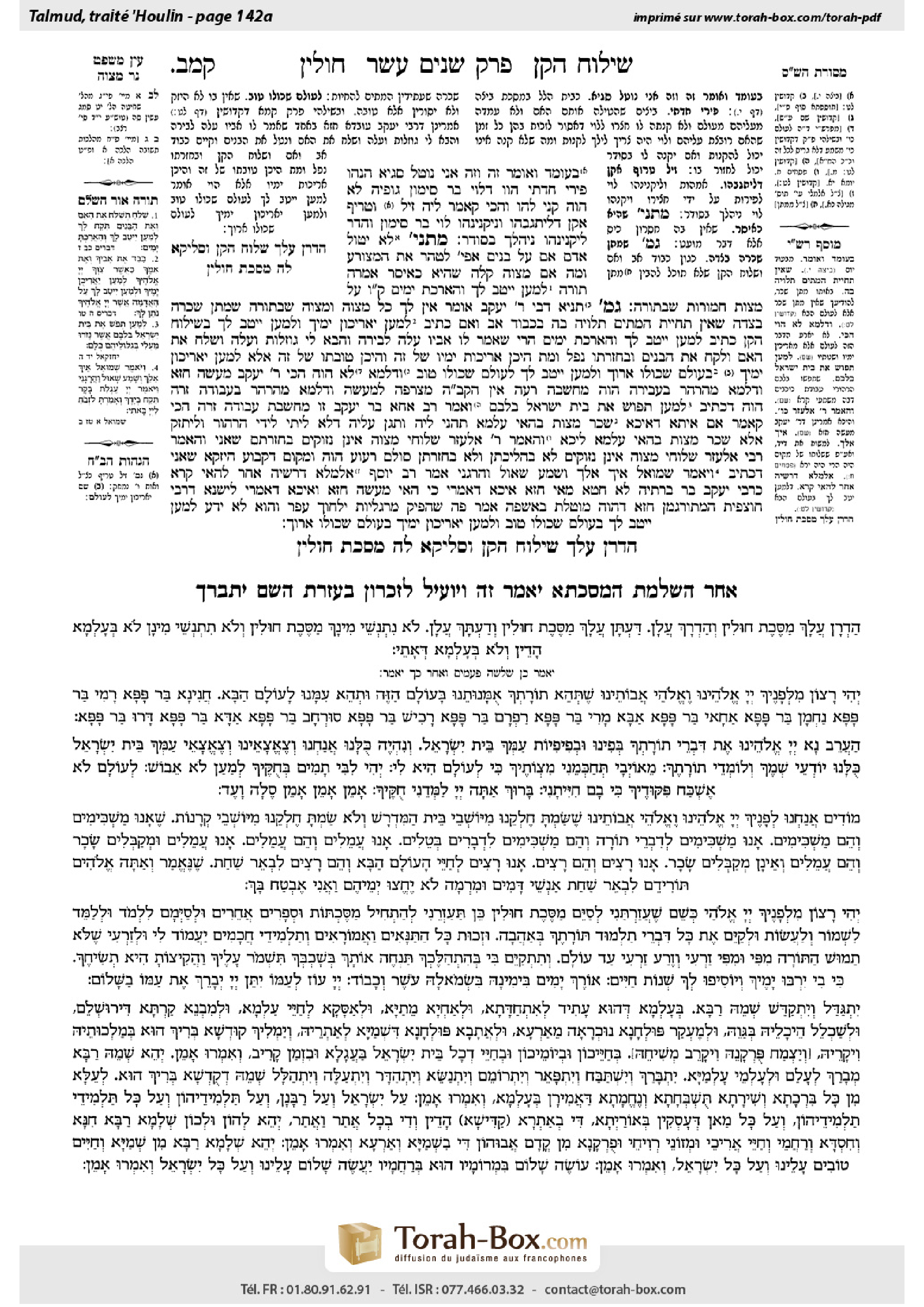
חולין קמ״ב א · Aramaic and Hebrew text
בְּעוֹמֵד וְאוֹמֵר ״זֶה וְזֶה אֲנִי נוֹטֵל״ סַגִּיא! הָנְהוּ פֵּירֵי חַדְתֵי הֲווֹ, דְּלֵוִי בַּר סִימוֹן גּוּפֵיהּ לָא הֲוָה קָנֵי לְהוּ, וְהָכִי קָאָמַר לֵיהּ: זִיל וּטְרוֹף אַקַּן, דְּלִיתְגַּבְהוּ וְנִיקְנִינְהוּ לֵוִי בַּר סִימוֹן, וַהֲדַר לַיקְנִינְהוּ נִיהֲלָךְ בְּסוּדָר.
מַתְנִי׳ לֹא יִטּוֹל אָדָם אֵם עַל בָּנִים, אֲפִילּוּ לְטַהֵר אֶת הַמְצוֹרָע. וּמָה אִם מִצְוָה קַלָּה, שֶׁהִיא כְּאִיסָּר, אָמְרָה תּוֹרָה ״לְמַעַן יִיטַב לָךְ וְהַאֲרַכְתָּ יָמִים״, קַל וָחוֹמֶר עַל מִצְוֹת חֲמוּרוֹת שֶׁבַּתּוֹרָה.
גְּמָ׳ תַּנְיָא, רַבִּי יַעֲקֹב אוֹמֵר: אֵין לְךָ כׇּל מִצְוָה וּמִצְוָה שֶׁבַּתּוֹרָה שֶׁמַּתַּן שְׂכָרָהּ בְּצִדָּהּ, שֶׁאֵין תְּחִיַּית הַמֵּתִים תְּלוּיָה בָּהּ. בְּכִבּוּד אָב וָאֵם כְּתִיב: ״לְמַעַן יַאֲרִיכֻן יָמֶיךָ וּלְמַעַן יִיטַב לָךְ״, בְּשִׁילּוּחַ הַקֵּן כְּתִיב: ״לְמַעַן יִיטַב לָךְ וְהַאֲרַכְתָּ יָמִים״.
הֲרֵי שֶׁאָמַר לוֹ אָבִיו: עֲלֵה לַבִּירָה וְהָבֵא לִי גּוֹזָלוֹת! וְעָלָה, וְשִׁלַּח אֶת הָאֵם וְלָקַח אֶת הַבָּנִים, וּבַחֲזָרָתוֹ נָפַל וָמֵת. הֵיכָן אֲרִיכוּת יָמָיו שֶׁל זֶה? וְהֵיכָן טוֹבָתוֹ שֶׁל זֶה? אֶלָּא ״לְמַעַן יַאֲרִיכוּן יָמֶיךָ״ – בְּעוֹלָם שֶׁכּוּלּוֹ אָרוֹךְ, ״וּלְמַעַן יִיטַב לָךְ״ – לְעוֹלָם שֶׁכּוּלּוֹ טוֹב.
וְדִלְמָא לָא הֲוָה הָכִי? רַבִּי יַעֲקֹב מַעֲשֶׂה חֲזָא! וְדִלְמָא מְהַרְהֵר בַּעֲבֵירָה הֲוָה? מַחְשָׁבָה רָעָה אֵין הַקָּדוֹשׁ בָּרוּךְ הוּא מְצָרְפָהּ לְמַעֲשֶׂה.
וְדִלְמָא מְהַרְהֵר בַּעֲבוֹדָה זָרָה הֲוָה, דִּכְתִיב: ״לְמַעַן תְּפֹשׂ אֶת בֵּית יִשְׂרָאֵל בְּלִבָּם״, וְאָמַר רַב אַחָא בַּר יַעֲקֹב: זוֹ מַחְשֶׁבֶת עֲבוֹדָה זָרָה.
הָכִי קָאָמַר: אִם אִיתָא דְּאִיכָּא שְׂכַר מִצְוֹת בְּהַאי עָלְמָא, תַּהֲנֵי לֵיהּ וְתַגֵּן עֲלֵיהּ דְּלָא לֵיתֵי לִידֵי הִרְהוּר וְלִיתַּזַּק, אֶלָּא שְׂכַר מִצְוֹת בְּהַאי עָלְמָא לֵיכָּא. וְהָאָמַר רַבִּי אֶלְעָזָר: שְׁלוּחֵי מִצְוָה אֵינָן נִזּוֹקִים! בַּחֲזָרָתָם שָׁאנֵי.
וְהָאָמַר רַבִּי אֶלְעָזָר: שְׁלוּחֵי מִצְוָה אֵינָן נִזּוֹקִים, לֹא בַּהֲלִיכָתָן וְלֹא בַּחֲזָרָתָן! סוּלָּם רָעוּעַ הֲוָה, וּמָקוֹם דְּקָבוּעַ הֶיזֵּקָא שָׁאנֵי, דִּכְתִיב: ״וַיֹּאמֶר שְׁמוּאֵל אֵיךְ אֵלֵךְ וְשָׁמַע שָׁאוּל וַהֲרָגָנִי״.
אָמַר רַב יוֹסֵף: אִלְמָלֵא דַּרְשֵׁיהּ אַחֵר לְהַאי קְרָא כְּרַבִּי יַעֲקֹב בַּר בְּרַתֵּיה – לָא חֲטָא. מַאי חֲזָא? אִיכָּא דְּאָמְרִי: כִּי הַאי מַעֲשֶׂה חֲזָא, וְאִיכָּא דְּאָמְרִי: לִישָּׁנָא דְּרַבִּי חוּצְפִּית הַמְתוּרְגְּמָן חֲזָא, דַּהֲוָה מוּטֶּלֶת בָּאַשְׁפָּה. אָמַר: פֶּה שֶׁהֵפִיק מַרְגָּלִיּוֹת יִלְחוֹךְ עָפָר?! וְהוּא לָא יָדַע ״לְמַעַן יִיטַב לְךָ״ – בְּעוֹלָם שֶׁכּוּלּוֹ טוֹב, ״וּלְמַעַן יַאֲרִיכוּן יָמֶיךָ״ – בְּעוֹלָם שֶׁכּוּלּוֹ אָרוֹךְ.
הֲדַרַן עֲלָךְ שִׁילּוּחַ הַקֵּן, וּסְלִיקָא לַהּ מַסֶּכֶת חוּלִּין.
Chullin 142a · English translation
because by standing on the eve of the Festival and saying: This bird and that bird I will take on the Festival, he would have effected sufficient preparation for their use on the Festival. The Gemara responds: These, the offspring and the eggs, were new produce, which Levi bar Simon himself had not yet acquired. And this is what Shmuel was saying to him: Go and bang on the nest so that the mothers will rise up, and Levi bar Simon will have then acquired the young in the nest, and consequently, he may then transfer ownership to you through acquisition by means of a cloth.
MISHNA: A person may not take the mother bird with the offspring even if he takes the mother for use as part of the ritual to purify the leper. The mishna compares the reward for performing the mitzva of sending away the mother bird from the nest to the reward for performing other mitzvot: And if with regard to the sending away of the mother bird, which is a mitzva whose performance is simple, as it entails a loss of no more than an issar, i.e., the value of the mother bird, the Torah says: “That it may be well with you, and that you may prolong your days” (Deuteronomy 22:7), it may be derived by a fortiori inference that the reward is no less for the fulfillment of the mitzvot in the Torah whose performance is demanding.
GEMARA: The school of Rabbi Ya’akov taught that Rabbi Ya’akov says: There is not a single mitzva written in the Torah whose reward is stated alongside it, which is not dependent on a belief in the resurrection of the dead, i.e., the reward is actually bestowed in the World-to-Come, after the resurrection of the dead. How so? With regard to honoring one’s father and mother, it is written: “That your days may be long, and that it may go well with you” (Deuteronomy 5:16). With regard to the sending away of the mother bird from the nest, it is written: “That it may be well with you, and that you may prolong your days” (Deuteronomy 22:7).
Despite this, it occurred that there was one whose father said to him: Climb to the top of the building and bring me fledglings; and he climbed to the top of the building and sent away the mother bird and took the offspring, thereby simultaneously fulfilling the mitzva to send away the mother bird from the nest and the mitzva to honor one’s parents, but as he returned he fell and died. Where is the length of days of this one? And where is the goodness of the days of this one? Rather, the verse “that your days may be long” is referring to the world that is entirely long, and “that it may be well with you” means in the world where all is well.
The Gemara suggests: But perhaps this incident described by Rabbi Ya’akov never occurred. It is possible that everyone who performs these mitzvot is rewarded in this world, and the situation described by Rabbi Ya’akov never happened. The Gemara answers: Rabbi Ya’akov himself saw an incident of this kind. The Gemara suggests: But perhaps that man was contemplating sin at the time, and he was punished for his thoughts. The Gemara responds: There is a principle that the Holy One, Blessed be He, does not link a bad thought to an action, i.e., one is not punished for thoughts alone.
The Gemara objects: But perhaps the son was contemplating idol worship at the time, as it is written with regard to idol worship: “So I may take the house of Israel in their own heart” (Ezekiel 14:5), and Rav Aḥa bar Ya’akov says: This is referring to punishment for the thought of performing idol worship.
The Gemara responds: This is what Rabbi Ya’akov was saying after witnessing the incident mentioned above: If it is so that there is reward for performance of mitzvot in this world, it should be effective for the son and protect him so that he not come to contemplate idol worship and be harmed. Rather, one must conclude that there is no reward for performance of mitzvot in this world. The Gemara asks: But didn’t Rabbi Elazar say: Those on the path to perform a mitzva are not susceptible to harm? How is it possible that this individual, who was sent by his father to perform a mitzva, could have died? The Gemara answers: When they return it is different, as after one has performed the mitzva, one is susceptible to harm.
The Gemara asks: But didn’t Rabbi Elazar say: Those on the path to perform a mitzva are not susceptible to harm, neither when they are on their way to perform the mitzva nor when they are returning from performing the mitzva? The Gemara answers: In that case, it was a rickety ladder on which the son ascended and descended, and a place where danger is established is different, and even those on the path to perform a mitzva are susceptible to harm. This is apparent from the incident where the prophet Samuel traveled to anoint David as king in place of Saul, as it is written: “And Samuel said: How can I go? If Saul hears of it, he will kill me” (I Samuel 16:2). Although Samuel was on the path to perform a mitzva, he feared that harm would befall him from established dangers.
Rav Yosef said: Had Aḥer, literally Other, the appellation of the former Sage Elisha ben Avuya, interpreted homiletically this aforementioned verse: “That it may go well with you” (Deuteronomy 5:16), as referring to the World-to-Come, as did Rabbi Ya’akov, the son of his daughter, he would not have sinned. The Gemara asks: What did Aḥer see that led him to heresy? Some say that he saw an incident like this one witnessed by Rabbi Ya’akov, and some say that he saw the tongue of Rabbi Ḥutzpit the disseminator, which was cast in a garbage dump after he was executed by the government. Aḥer said: Will a mouth that produced pearls of wisdom lick the dust? But he did not know that the phrase “that it may be well with you” means in the world where all is well, and that the phrase “that your days may be long” is referring to the world that is entirely long.
Chullin 142a · Traduction française (IA)
car il aurait ainsi accompli une préparation suffisante pour l'usage de ces oiseaux pendant le festival. La Guemara répond : ces oiseaux et leurs œufs étaient de nouveaux produits, que Levi bar Simon lui-même n'avait pas encore acquis. Et c'est ce que Shmuel disait à lui : va frapper le nid afin que les mères s'éveillent, et Levi bar Simon aura alors acquis les petits dans le nid, et par conséquent, il pourra alors transférer la propriété à toi par acquisition à l'aide d'un tissu.
MICHNA : Une personne ne peut pas prendre l'oiseau père avec ses petits, même s'il prend l'oiseau père pour l'utiliser dans la cérémonie de purification du lépreux. La Michna compare la récompense de l'accomplissement de la Mitsva de l'expulsion de l'oiseau père du nid à la récompense de l'accomplissement d'autres Mitsvot : et si, concernant l'expulsion de l'oiseau père, qui est une Mitsva dont l'accomplissement est simple, car elle entraîne une perte de moins d'un issar, c'est-à-dire la valeur de l'oiseau père, la Torah dit : « afin que cela te soit bien, et que tu prolonges tes jours » (Deutéronome 22:7), on peut en déduire par un raisonnement par analogie que la récompense n'est pas moindre pour l'accomplissement des Mitsvot de la Torah dont l'accomplissement est exigeant.
GUEMARA : La maison de Rabbi Ya'akov enseignait que Rabbi Ya'akov disait : il n'y a pas une seule Mitsva écrite dans la Torah dont la récompense est mentionnée à côté, qui ne dépende de la croyance dans la résurrection des morts, c'est-à-dire la récompense est en réalité donnée dans le Monde à Venir, après la résurrection des morts. Comment cela se passe-t-il ? Concernant l'honneur de ses parents, il est écrit : « afin que tes jours soient longs, et que cela te soit bien » (Deutéronome 5:16). Concernant l'expulsion de l'oiseau père du nid, il est écrit : « afin que cela te soit bien, et que tu prolonges tes jours » (Deutéronome 22:7).
Malgré cela, il s'est produit qu'un homme avait un père qui lui disait : monte au sommet du bâtiment et apporte-moi des petits oiseaux ; et il monta au sommet du bâtiment, expulsa l'oiseau père et prit les petits, accomplissant ainsi simultanément la Mitsva d'expulser l'oiseau père du nid et la Mitsva d'honorer ses parents, mais lorsqu'il revenait, il tomba et mourut. Où sont les jours longs de cette personne ? Et où sont les jours bienfaisants de cette personne ? Plutôt, la phrase « afin que tes jours soient longs » fait référence au monde qui est entièrement long, et « afin que cela te soit bien » signifie dans le monde où tout est bien.
La Guemara suggère : mais peut-être que l'incident décrit par Rabbi Ya'akov n'a jamais eu lieu. Il est possible que tout celui qui accomplit ces Mitsvot soit récompensé dans ce monde, et que la situation décrite par Rabbi Ya'akov n'ait jamais eu lieu. La Guemara répond : Rabbi Ya'akov lui-même a vu un incident de ce genre. La Guemara suggère : mais peut-être que cet homme était en train de penser à un péché à ce moment-là, et il a été puni pour ses pensées. La Guemara répond : il y a un principe selon lequel le Saint, le Très Haut, ne relie pas une mauvaise pensée à une action, c'est-à-dire qu'on n'est pas puni pour les pensées seul.
La Guemara s'oppose : mais peut-être que le fils pensait à l'idolâtrie à ce moment-là, car il est écrit concernant l'idolâtrie : « afin que je prenne la maison d'Israël dans son propre cœur » (Ezéchiel 14:5), et Rav Acha bar Ya'akov dit : cela fait référence à la punition pour la pensée de commettre l'idolâtrie.
La Guemara répond : c'est ce que Rabbi Yaakov disait après avoir vu l'incident mentionné ci-dessus : si c'est ainsi que la récompense de l'accomplissement des Mitsvot est effective dans ce monde, elle devrait protéger le fils afin qu'il ne vienne pas à penser à l'idolâtrie et à être blessé. Plutôt, on doit conclure qu'il n'y a pas de récompense pour l'accomplissement des Mitsvot dans ce monde. La Guemara demande : mais n'a-t-il pas dit Rabbi Eléazar : ceux qui marchent sur le chemin d'accomplir une Mitsva ne sont pas sujets à la souffrance ? Comment est-il possible que cet individu, qui était envoyé par son père à accomplir une Mitsva, puisse mourir ? La Guemara répond : lorsqu'ils retournent, c'est différent, car après avoir accompli la Mitsva, on est sujet à la souffrance.
La Guemara demande : mais n'a-t-il pas dit Rabbi Eléazar : ceux qui marchent sur le chemin d'accomplir une Mitsva ne sont pas sujets à la souffrance, ni lorsqu'ils marchent vers l'accomplissement de la Mitsva ni lorsqu'ils retournent d'accomplir la Mitsva ? La Guemara répond : dans ce cas, il y avait une échelle instable sur laquelle le fils montait et descendait, et un lieu où le danger est établi est différent, et même ceux qui marchent sur le chemin d'accomplir une MitsVa sont sujets à la souffrance. Cela est évident de l'incident où le prophète Samuel voyageait pour animer David comme roi à la place de Saül, car il est écrit : « Et Samuel dit : comment puis-je aller ? Si Saül apprend cela, il me tuera » (I Samuel 16:2). Bien que Samuel fût sur le chemin d'accomplir une Mitsva, il redoutait que la souffrance lui arrive à cause des dangers établis.
Rav Yosef dit : si Acher, littéralement Autre, l'appellation du sage Elisha ben Avuya, avait interprété homématiquement cette versette mentionnée précédemment : « afin que cela te soit bien » (Deutéronome 5:16), comme faisant référence au Monde à Venir, comme le faisait Rabbi Ya'akov, le fils de sa fille, il ne serait pas tombé en péché. La Guemara demande : qu'avait vu Acher qui l'a conduit à l'hérésie ? Certains disent qu'il avait vu un incident semblable à celui vu par Rabbi Ya'akov, et d'autres disent qu'il avait vu la langue de Rabbi Ḥutzpit le diffuseur, qui avait été jetée dans un tas de déchets après avoir été exécuté par l'État. Acher dit : une bouche qui a produit des perles de sagesse léchera-t-elle la poussière ? Mais il ne savait pas que la phrase « afin que cela te soit bien » signifie dans le monde où tout est bien, et que la phrase « afin que tes jours soient longs » fait référence au monde qui est entièrement long.
Traduction française générée par IA à partir de l’édition anglaise de Sefaria. Vérifie toujours un passage avec le texte source.
Text from Sefaria: William Davidson Edition - Vocalized Aramaic (unknown); William Davidson Edition - English (CC BY NC).