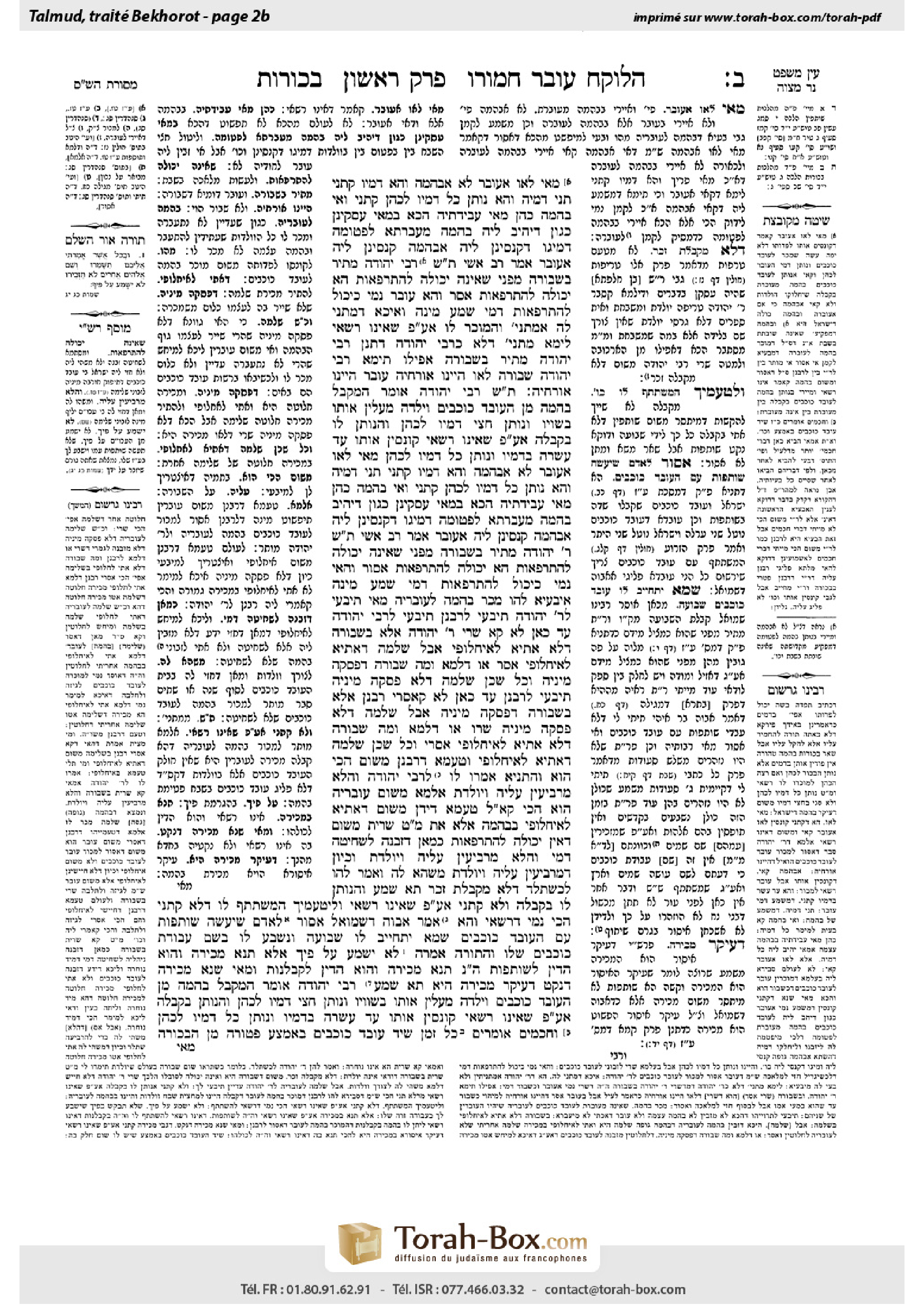
Bekhorot 2b: Talmud study for Daf Yomi
Study the Talmud for Daf Yomi with scanned pages, Hebrew text, English translations from Sefaria and AI-generated French translations.
Passage selection and English or AI-generated French translation are available where the scan has annotations. Daf Study is independent of Torah-Box and Sefaria.
Browse Bekhorot · בכורות · All tractatesBekhorot 2b text and translations
This page of Bekhorot includes the Aramaic text, an English translation and an AI-generated French translation, alongside the scan above.
בכורות ב׳ ב · Aramaic and Hebrew text
מַאי לָאו אַעוּבָּר? לָא, אַבְּהֵמָה.
וְהָא ״דָּמָיו״ קָתָנֵי! תְּנִי ״דָּמֶיהָ״. וְהָא ״נוֹתֵן כׇּל דָּמָיו לַכֹּהֵן״ קָתָנֵי, וְאִי בְּהֵמָה — כֹּהֵן מַאי עֲבִידְתֵּיהּ? הָכָא בְּמַאי עָסְקִינַן — כְּגוֹן דְּיָהֵיב לֵיהּ בְּהֵמָה מְעַבַּרְתָּא לְפַטּוֹמַהּ, דְּמִיגּוֹ דְּקָנְסִינַן לֵיהּ אַבְּהֵמָה, קָנְסִינַן לֵיהּ אַעוּבָּר.
אָמַר רַב אָשֵׁי: תָּא שְׁמַע, רַבִּי יְהוּדָה מַתִּיר בַּשְּׁבוּרָה, מִפְּנֵי שֶׁאֵינָהּ יְכוֹלָה לְהִתְרַפְּאוֹת. הָא יְכוֹלָה לְהִתְרַפְּאוֹת — אָסַר, וְהָא עוּבָּר נָמֵי כְּיָכוֹל לְהִתְרַפְּאוֹת דָּמֵי. שְׁמַע מִינַּהּ.
וְאִיכָּא דְּמַתְנֵי לַהּ אַמַּתְנִיתִין, וְהַמּוֹכֵר לוֹ, אַף עַל פִּי שֶׁאֵינוֹ רַשַּׁאי. לֵימָא מַתְנִיתִין דְּלָא כְּרַבִּי יְהוּדָה, דִּתְנַן: רַבִּי יְהוּדָה מַתִּיר בַּשְּׁבוּרָה!
אֲפִילּוּ תֵּימָא רַבִּי יְהוּדָה — שְׁבוּרָה, לָאו הַיְינוּ אוֹרְחֵיהּ; עוּבָּר, הַיְינוּ אוֹרְחֵיהּ.
תָּא שְׁמַע: רַבִּי יְהוּדָה אוֹמֵר: הַמְקַבֵּל בְּהֵמָה מִן הַגּוֹי וְיָלְדָה — מַעֲלִין אוֹתוֹ בְּשׇׁוְיוֹ, וְנוֹתֵן חֲצִי דָּמָיו לַכֹּהֵן. וְהַנּוֹתֵן לוֹ בְּקַבָּלָה, אַף עַל פִּי שֶׁאֵינוֹ רַשַּׁאי — קוֹנְסִין אוֹתוֹ עַד עֲשָׂרָה בְּדָמָיו, וְנוֹתֵן כׇּל דָּמָיו לַכֹּהֵן. מַאי לָאו אַעוּבָּר? לָא, אַבְּהֵמָה.
וְהָא דָּמָיו קָתָנֵי! תְּנִי ״דָּמֶיהָ״. וְהָא ״נוֹתֵן כָּל דָּמָיו לַכֹּהֵן״ קָתָנֵי, וְאִי בְּהֵמָה — כֹּהֵן מַאי עֲבִידְתֵּיהּ? הָכָא בְּמַאי עָסְקִינַן — כְּגוֹן דְּיָהֵיב בְּהֵמָה מְעַבַּרְתָּא לְפַטּוֹמַהּ, דְּמִיגּוֹ דְּקָנְסִינַן לֵיהּ אַבְּהֵמָה — קָנְסִינַן לֵיהּ אַעוּבָּר.
אָמַר רַב אָשֵׁי, תָּא שְׁמַע: רַבִּי יְהוּדָה מַתִּיר בַּשְּׁבוּרָה, מִפְּנֵי שֶׁאֵינָהּ יְכוֹלָה לְהִתְרַפְּאוֹת. הָא יְכוֹלָה לְהִתְרַפְּאוֹת — אָסוּר, וְהַאי נָמֵי כְּיָכוֹל לְהִתְרַפְּאוֹת דָּמֵי. שְׁמַע מִינַּהּ.
אִיבַּעְיָא לְהוּ: מָכַר בְּהֵמָה לְעוּבָּרֶיהָ, מַאי? תִּיבְּעֵי לְרַבִּי יְהוּדָה, תִּיבְּעֵי לְרַבָּנַן.
תִּיבְּעֵי לְרַבִּי יְהוּדָה: עַד כָּאן לָא קָא שָׁרֵי רַבִּי יְהוּדָה אֶלָּא בִּשְׁבוּרָה, דְּלָא אָתְיָא לְאִיחַלּוֹפֵי, אֲבָל שְׁלֵמָה דְּאָתְיָא לְאִיחַלּוֹפֵי — אָסַר.
אוֹ דִלְמָא, וּמָה שְׁבוּרָה דִּפְסַקָה מִינֵּיהּ, וְכׇל שֶׁכֵּן שְׁלֵמָה דְּלָא פְּסַקָה מִינֵּיהּ?
תִּיבְּעֵי לְרַבָּנַן: עַד כָּאן לָא קָאָסְרִי רַבָּנַן אֶלָּא בִּשְׁבוּרָה, דִּפְסַקָה מִינֵּיהּ, אֲבָל שְׁלֵמָה דְּלָא פְּסַקָה מִינֵּיהּ — שָׁרוּ.
אוֹ דִלְמָא: וּמָה שְׁבוּרָה דְּלָא אָתְיָא לְאִיחַלּוֹפֵי — אָסְרִי, וְכׇל שֶׁכֵּן שְׁלֵמָה דְּאָתְיָא לְאִיחַלּוֹפֵי.
וְטַעְמָא דְרַבָּנַן מִשּׁוּם הָכִי הוּא? וְהָתַנְיָא: אָמְרוּ לוֹ לְרַבִּי יְהוּדָה: וַהֲלֹא מַרְבִּיעִין עָלֶיהָ וְיוֹלֶדֶת! אַלְמָא מִשּׁוּם עוּבָּרֶיהָ הוּא.
הָכִי קָאָמְרִי לֵיהּ: טַעְמָא דִידַן מִשּׁוּם דְּאָתְיָא לְאִיחַלּוֹפֵי בִּבְהֵמָה, אֶלָּא אַתְּ, מַאי טַעְמָא שָׁרֵית? מִשּׁוּם דְּאֵין יְכוֹלָה לְהִתְרַפְּאוֹת, כְּמַאן דְּזַבְּנַהּ לִשְׁחִיטָה דָּמֵי.
וַהֲלֹא מַרְבִּיעִין עָלֶיהָ וְיוֹלֶדֶת, וְכֵיוָן דְּמַרְבִּיעִין עָלֶיהָ וְיוֹלֶדֶת — מְשַׁהֵא לַהּ!
וַאֲמַר לְהוּ: לִכְשֶׁתֵּלֵד, דְּלֹא מְקַבֶּלֶת זָכָר.
תָּא שְׁמַע, וְהַנּוֹתֵן לוֹ בְּקַבָּלָה, וְלָא קָתָנֵי: ״אַף עַל פִּי שֶׁאֵינוֹ רַשַּׁאי״!
וְלִיטַעְמָיךְ, הַמִּשְׁתַּתֵּף לוֹ דְּלָא קָתָנֵי, הָכִי נָמֵי דְּרַשַּׁאי? וְהָא אָמַר אֲבוּהּ דִּשְׁמוּאֵל: אָסוּר לְאָדָם שֶׁיַּעֲשֶׂה שׁוּתָּפוּת עִם הַגּוֹי, שֶׁמָּא יִתְחַיֵּיב לוֹ שְׁבוּעָה וְנִשְׁבָּע לוֹ בְּשֵׁם עֲבוֹדָה זָרָה שֶׁלּוֹ, וְהַתּוֹרָה אָמְרָה: ״לֹא יִשָּׁמַע עַל פִּיךָ״!
אֶלָּא, תְּנָא מְכִירָה, וְהוּא הַדִּין לְשׁוּתָּפוּת. הָכִי נָמֵי, תְּנָא מְכִירָה וְהוּא הַדִּין לְקַבְּלָנוּת. וּמַאי שְׁנָא מְכִירָה דְּנָקֵט? דְּעִיקָּר מְכִירָה הִיא.
תָּא שְׁמַע: רַבִּי יְהוּדָה אוֹמֵר, הַמְקַבֵּל בְּהֵמָה מִן הַגּוֹי וְיָלְדָה — מַעֲלִין אוֹתוֹ בְּשׇׁוְויוֹ, וְנוֹתֵן חֲצִי דָּמָיו לַכֹּהֵן. וְהַנּוֹתֵן בְּקַבָּלָה, אַף עַל פִּי שֶׁאֵינוֹ רַשַּׁאי — קוֹנְסִין אוֹתוֹ עַד עֲשָׂרָה בְּדָמָיו, וְנוֹתֵן כָּל דָּמָיו לַכֹּהֵן.
וַחֲכָמִים אוֹמְרִים: כׇּל זְמַן שֶׁיַּד הַגּוֹי בָּאֶמְצַע — פְּטוּרָה מִן הַבְּכוֹרָה.
Bekhorot 2b · English translation
What, is it not referring to the fetus when the baraita states that he is not permitted to sell it? The Gemara responds: No, it is referring to the animal itself that he may not sell to the gentile, and that is why he is penalized.
The Gemara asks: But doesn’t the baraita teach: The Sages penalize him up to ten times its value [damav], in masculine form, indicating that it is referring to the fetus and not the mother? The Gemara responds: Teach the following wording in the baraita: The Sages penalize him up to ten times its value [dameha], in feminine form. The Gemara asks: But doesn’t it teach: He gives all of its value to the priest? And if it is referring to the animal and not the firstborn, what is the relevance of the priest? The Gemara answers: Here we are dealing with a case where the Jew gave the gentile a pregnant animal to fatten it in order to divide the profits as well as the offspring. Since we penalize him for selling the animal in a prohibited manner, we penalize him with regard to the fetus as well.
Rav Ashi says: Come and hear a resolution from a baraita: Rabbi Yehuda deems the sale to a gentile of a damaged animal permitted, because it is incapable of being cured. This statement indicates that if it is capable of being cured, Rabbi Yehuda deems its sale prohibited. And a fetus is also similar to one who is able to be cured, as it ultimately will be capable of working. Learn from it that Rabbi Yehuda deems the sale of a fetus to a gentile prohibited.
And there are those who teach this discussion as referring to the statement in the mishna: With regard to one who sells the fetus of his donkey to a gentile, although he is not permitted to sell a large animal to a gentile, it is exempt from the obligations of firstborn status. The discussion then proceeded as follows: Let us say that the mishna is not in accordance with the opinion of Rabbi Yehuda, as we learned in a mishna (Avoda Zara 14b): Rabbi Yehuda deems the sale of a damaged animal permitted because it is incapable of performing labor. The halakha is presumably the same with regard to a fetus, which is also not capable of performing labor.
The Gemara responds: You may even say that it is in accordance with the opinion of Rabbi Yehuda, as it is permitted to sell a damaged animal because that is not its natural state; it is defective and is therefore not included in the prohibition against selling large livestock. But with regard to a fetus, since it is in its natural state, and will become capable of working after growing up, perhaps it is not considered damaged, as it is not defective.
The Gemara suggests: Come and hear another proof from a baraita: Rabbi Yehuda says that in the case of one who receives an animal from a gentile to care for and receives a portion of the offspring in exchange for his work, and it gave birth to a firstborn, they assess its value, and the Jew gives half of its value to the priest to redeem his portion, which is sanctified by the firstborn status. And in the case of one who gives the gentile an animal in receivership even though he is not permitted to do so, the Sages penalize him by requiring that he purchase the gentile’s portion of the animal for up to ten times its value, and he gives all of its value to the priest. What, is it not referring to the fetus when the baraita states that he is not permitted to sell it? The Gemara responds: No, it is referring to the animal itself that he may not sell to the gentile, and that is why he is penalized.
The Gemara asks: But doesn’t the baraita teach: The Sages penalize him up to ten times its value [damav], in masculine form, indicating that it is referring to the fetus and not the mother? The Gemara responds: Teach the following wording in the baraita: The Sages penalize him up to ten times its value [dameha], in feminine form. The Gemara asks: But doesn’t it teach: He gives all of its value to the priest? And if it is referring to the animal and not the firstborn, what is the relevance of the priest? The Gemara answers: Here we are dealing with a case where the Jew gave the gentile a pregnant animal to fatten it in order to divide the profits as well as the offspring. Since we penalize him for selling the animal in a prohibited manner, we penalize him with regard to the fetus as well.
Rav Ashi says: Come and hear a resolution from a baraita: Rabbi Yehuda deems the sale to a gentile of a damaged animal permitted, because it is incapable of being cured. This statement indicates that if it is capable of being cured, Rabbi Yehuda deems its sale prohibited. And this fetus is also similar to one who is able to be cured, as it ultimately will be capable of working. Learn from it that Rabbi Yehuda deems the sale of a fetus to a gentile prohibited.
§ A dilemma was raised before the Sages concerning the prohibition against selling large livestock to a gentile: In the case of a Jew who sold an animal to a gentile only with regard to rights to its fetuses, but retained ownership of the animal itself, what is the halakha concerning the permissibility of the sale? The Gemara clarifies: Let the dilemma be raised according to the opinion of Rabbi Yehuda, who permits the sale of a damaged animal, and let the dilemma be raised according to the opinion of the Rabbis, who dispute that ruling.
The Gemara elaborates: Let the dilemma be raised according to the opinion of Rabbi Yehuda, as follows: Perhaps Rabbi Yehuda permits only the sale of a damaged animal, as people will not come to confuse this animal with a healthy animal, which is prohibited for sale to a gentile, as they are visibly different. But in the case of one who sells an unblemished animal with regard to the rights to its fetuses, which people may come to confuse with the case of selling the animal entirely and consider that sale permitted as well, Rabbi Yehuda deems the sale prohibited.
Or perhaps Rabbi Yehuda would claim that in the case of a damaged animal, which is separated from him in its entirety in the sale, the sale is permitted, and all the more so with regard to the sale of an unblemished animal with regard to the rights to its fetuses, where the animal is not entirely separated from him, as he did not sell the actual animal, the sale is permitted.
Likewise, the dilemma can be raised according to the opinion of the Rabbis: Perhaps the Rabbis deemed the sale prohibited only in a case of a damaged animal, as the animal is separated from him. But in the case of an unblemished animal that is sold only with regard to the fetuses, where it is not separated from him, and there is no concern that people will mistakenly sell the entire animal to a gentile, they deem the sale permitted.
Or perhaps the Rabbis would claim that in the case of a damaged animal, which people will not come to confuse with the case of an unblemished animal, the Rabbis deem the sale prohibited, and all the more so they would prohibit selling an unblemished animal with regard to the rights to its fetuses, which people may come to confuse with the case of selling an unblemished animal in its entirety.
The Gemara asks: And is the reason of the opinion of the Rabbis due to that concern that people may confuse the sale of a damaged animal with the sale of an unblemished animal in its entirety? But isn’t it taught in a baraita that the Rabbis said to Rabbi Yehuda: But why do you hold that is it permitted to sell a damaged animal? Don’t they breed it with another animal, and it gives birth to offspring, which will then be owned by a gentile? Apparently, the reason the Rabbis prohibit the sale is due to the animal’s fetuses. If so, they should prohibit selling large livestock to a gentile with regard to the fetuses as well.
The Gemara answers: This is not truly the Rabbis’ opinion. Rather, this is what they were saying to Rabbi Yehuda: Our reason for prohibiting the sale of a damaged animal is because people might come to confuse this case with the sale of an unblemished animal. But you, what is the reason that you permit selling a damaged animal? It is because the animal is incapable of being cured, and you therefore consider it similar to one who sold an animal explicitly for slaughter, which is permitted.
But actually it is not similar to that case, as don’t they breed a damaged animal with another animal, and it gives birth? And since they breed it and it gives birth, the gentile will delay its slaughter. Others may then mistakenly believe that selling large livestock for purposes other than slaughter is permitted.
And Rabbi Yehuda said to the Rabbis in response: When a damaged animal actually gives birth, I will concern myself with this possibility. Practically, this concern may be disregarded, as such an animal cannot breed with a male. In any event, no proof may be brought from this baraita concerning the opinion of the Rabbis concerning selling an animal with regard to the rights to its fetuses.
The Gemara suggests: Come and hear a proof from the mishna, where it states: And in the case of one who gives his donkey to a gentile in receivership, meaning that he divides the offspring with him in exchange for caring for the animal, the donkey is exempt from the obligations of firstborn status. This case is identical to that of selling an animal with regard to the rights to its fetuses, and the mishna does not teach: Although he is not permitted to do so. Apparently such a sale is permitted.
The Gemara responds: But according to your reasoning, with regard to that which the mishna states: One who enters into a partnership with a gentile, where it also does not teach: Although he is not permitted to do so, so too, should it be derived that it is permitted to enter into such a partnership? But doesn’t Shmuel’s father say: It is prohibited for a person to enter into a partnership with a gentile lest their joint ventures lead them to quarrel and his gentile partner will be obligated to take an oath to him and he will take an oath in the name of his object of idol worship; and the Torah states: “Neither let it be heard out of your mouth” (Exodus 23:13), which includes causing a gentile to take an oath in the name of an idol.
Rather, the tanna taught that a sale to a gentile is not permitted, and the same is true for the case of a partnership. So too, the tanna taught that a sale to a gentile is prohibited, and the same is true for a case of receivership. The Gemara asks: And what is different about the case of selling that the tanna cited the prohibition specifically in that case? The Gemara answers that the primary prohibition is that of selling the animal to a gentile.
The Gemara suggests: Come and hear a resolution to the dilemma of whether selling an animal to a gentile with regard to the rights to its fetuses is permitted from a baraita: Rabbi Yehuda says that in the case of one who receives an animal from a gentile to care for and receives a portion of the offspring in exchange for his work, and it gave birth to a firstborn, they assess its value, and the Jew gives half of its value to the priest to redeem his portion, which is considered to have the sanctity of a firstborn. And in the case of one who gives the gentile an animal in receivership even though he is not permitted to do so, the Sages penalize him by requiring that he purchase the gentile’s portion of the animal for up to ten times its value, and he gives all of its value to the priest.
And the Rabbis say: As long as the ownership of the gentile is involved, in that he possesses at least partial ownership of the mother or the fetus, the animal is exempt from its offspring being counted a firstborn.
Bekhorot 2b · Traduction française (IA)
Qu'est-ce que cela signifie, lorsqu'il s'agit du fœtus, lorsque la baraïta dit qu'il n'est pas permis de le vendre ? La Guemara répond : Non, il s'agit de l'animal lui-même, qu'il ne peut pas vendre au non-Juif, et c'est pourquoi il est puni.
La Guemara pose la question : Mais ne dit pas la baraïta : Les Sages pénalisent jusqu'à dix fois sa valeur [dameha], au féminin. La Guemara pose alors la question : Mais ne dit-elle pas : Il donne toute sa valeur au prêtre ? Et si elle s'agit de l'animal et non du premier-né, à quoi sert le prêtre ? La Guemara répond : Ici, nous parlons d'un cas où un Juif a donné à un non-Juif un animal enceinte pour qu'il le fasse grossir afin de partager les profits ainsi que les petits. Puisque nous pénalisons la vente de l'animal dans un mode interdit, nous pénalisons également la vente du fœtus.
Rav Ashi dit : Viens écouter une résolution tirée d'une baraïta : Rabbi Yehuda considère la vente d'un animal abîmé à un non-Juif comme permise, car il ne peut être guéri. Cette déclaration indique que si l'animal peut être guéri, Rabbi Yehuda considère sa vente comme interdite. Et le fœtus est également semblable à celui qui peut être guéri, car il finira par être capable de travailler. Apprends-en que Rabbi Yehuda considère la vente d'un fœtus à un non-Juif comme interdite.
Et certains enseignent cette discussion comme faisant référence à l'affirmation de la michna : Concernant celui qui vend le fœtus de son âne à un non-Juif, bien qu'il ne soit pas permis de vendre un grand animal à un non-Juif, il est exempt des obligations du premier-né. La discussion s'est alors déroulée ainsi : Disons que la michna ne suit pas l'opinion de Rabbi Yehuda, comme nous l'avons appris dans une michna (Avoda Zara 14b) : Rabbi Yehuda considère la vente d'un animal abîmé comme permise, car il ne peut pas travailler. La halakha est probablement la même concernant un fœtus, qui n'est pas non plus capable de travailler.
La Guemara répond : Tu peux même dire qu'il s'agit de l'opinion de Rabbi Yehuda, car il est permis de vendre un animal abîmé, car cela n'est pas son état naturel ; il est déficient et n'est donc pas inclus dans l'interdiction de vendre des grands animaux. Mais concernant un fœtus, puisqu'il est dans son état naturel, et qu'il deviendra capable de travailler après avoir grandi, peut-être qu'il n'est pas considéré comme abîmé, car il n'est pas déficient.
La Guemara suggère : Viens écouter une autre preuve tirée d'une baraïta : Rabbi Yehuda dit que dans le cas d'une personne qui reçoit un animal d'un non-Juif pour le garder et reçoit une part des petits en échange de son travail, et qu'il a donné naissance à un premier-né, on évalue sa valeur, et le Juif donne la moitié de sa valeur au prêtre pour racheter sa part, qui est sanctifiée par le statut de premier-né. Et dans le cas d'une personne qui donne à un non-Juif un animal en réception même s'il n'est pas permis de le faire, les Sages pénalisent en exigeant qu'il achète la part du non-Juif de l'animal jusqu'à dix fois sa valeur, et il donne toute sa valeur au prêtre. Qu'est-ce que cela signifie, lorsqu'il s'agit du fœtus, lorsque la baraïta dit qu'il n'est pas permis de le vendre ? La Guemara répond : Non, il s'agit de l'animal lui-même qu'il ne peut pas vendre au non-Juif, et c'est pourquoi il est pénalisé.
La Guemara pose la question : Mais ne dit-elle pas la baraïta : Les Sages pénalisent jusqu'à dix fois sa valeur [damav], au masculin, indiquant qu'il s'agit du fœtus et non de la mère ? La Guemara répond : Apprends la formulation suivante dans la baraïta : Les Sages pénalisent jusqu'à dix fois sa valeur [dameha], au féminin. La Guemara pose alors la question : Mais ne dit-elle pas : Il donne toute sa valeur au prêtre ? Et si elle s'agit de l'animal et non du premier-né, à quoi sert le prêtre ? La Guemara répond : Ici, nous parlons d'un cas où un Juif a donné à un non-Juif un animal enceinte pour qu'il le fasse grossir afin de partager les profits ainsi que les petits. Puisque nous pénalisons la vente de l'animal dans un mode interdit, nous pénalisons également la vente du fœtus.
Rav Ashi dit : Viens écouter une résolution tirée d'une baraïta : Rabbi Yehuda considère la vente d'un animal abîmé à un non-Juif comme permise, car il ne peut être guéri. Cette déclaration indique que si l'animal peut être guéri, Rabbi Yehuda considère sa vente comme interdite. Et ce fœtus est également semblable à celui qui peut être guéri, car il finira par être capable de travailler. Apprends-en que Rabbi Yehuda considère la vente d'un fœtus à un non-Juif comme interdite.
§ Un dilemme a été soulevé devant les Sages concernant l'interdiction de vendre des grands animaux à un non-Juif : Dans le cas d'un Juif qui a vendu un animal à un non-Juif uniquement concernant les droits aux fœtus, mais a conservé la propriété de l'animal lui-même, quelle est la halakha concernant la permissibilité de la vente ? La Guemara clarifie : Fais soulever ce dilemme selon l'opinion de Rabbi Yehuda, qui permet la vente d'un animal abîmé, et fais-le soulever selon l'opinion des Sages, qui contestent cette décision.
La Guemara développe : Fais soulever ce dilemme selon l'opinion de Rabbi Yehuda, comme suit : Peut-être que Rabbi Yehuda permet uniquement la vente d'un animal abîmé, car les gens ne confondront pas cet animal avec un animal sain, qui est interdit de vente à un non-Juif, car ils sont visiblement différents. Mais dans le cas d'une personne qui vend un animal sans défaut concernant les droits aux fœtus, qui peut être confondu avec le cas de la vente de l'animal entier et être considéré comme permis, Rabbi Yehuda considère la vente comme interdite.
Peut-être que Rabbi Yéhuda affirmerait que dans le cas d'un animal abîmé, qui est séparé entièrement de lui lors de la vente, la vente est permise, et encore plus encore concernant la vente d'un animal sans défaut en ce qui concerne les droits sur ses fœtus, où l'animal n'est pas entièrement séparé de lui, car il n'a pas vendu l'animal lui-même, la vente est permise.
De même, cette difficulté peut être soulevée selon l'opinion des Rabbins : Peut-être que les Rabbins considèrent la vente interdite uniquement dans le cas d'un animal abîmé, car l'animal est séparé de lui. Mais dans le cas d'un animal sans défaut vendu uniquement en ce qui concerne ses fœtus, où il n'est pas séparé de lui, et où il n'y a pas de crainte que les gens vendent par erreur l'animal entier à un non-Juif, ils considèrent la vente comme permise.
Peut-être que les Rabbins affirmeraient que dans le cas d'un animal abîmé, où les gens ne confondent pas ce cas avec celui d'un animal sans défaut, les Rabbins considèrent la vente comme interdite, et encore plus encore ils interdiraient la vente d'un animal sans défaut en ce qui concerne les droits sur ses fœtus, où les gens pourraient confondre ce cas avec celui de la vente d'un animal sans défaut en entier.
La Guemara pose la question : Et la raison de l'opinion des Rabbins est-elle due à la crainte que les gens puissent confondre la vente d'un animal abîmé avec la vente d'un animal sans défaut en entier ? Mais n'est-il pas enseigné dans une baraïta que les Rabbins dirent à Rabbi Yéhuda : Pourquoi tiens-tu que la vente est permise ? Ne sont-ils pas enclins à le faire reproduire avec un autre animal, ce qui donnerait naissance à des petits, qui seraient alors possédés par un non-Juif ? Apparemment, la raison pour laquelle les Rabbins interdisent la vente est liée aux fœtus de l'animal. Si c'est le cas, ils devraient aussi interdire la vente de grandes bêtes à un non-Juif en ce qui concerne les fœtus.
La Guemara répond : Ce n'est pas véritablement l'opinion des Rabbins. Plutôt, c'est ce que les Rabbins dirent à Rabbi Yéhuda : Notre raison pour interdire la vente d'un animal abîmé est que les gens puissent confondre ce cas avec la vente d'un animal sans défaut. Mais toi, quelle est la raison pour laquelle tu permets la vente d'un animal abîmé ? C'est parce que l'animal ne peut être guéri, et tu considères donc que c'est semblable à celui qui vend un animal explicitement pour l'abattre, ce qui est permis.
Mais en réalité, ce n'est pas semblable à ce cas, car ne font-ils pas reproduire un animal abîmé avec un autre animal, ce qui donnerait naissance à des petits ? Et puisque l'on reproduit et qu'il donne naissance, le non-Juif retardera son abattage. D'autres pourraient alors penser à tort que la vente de grandes bêtes à d'autres fins que l'abattage est permise.
Et Rabbi Yéhuda répondit aux Rabbins : Lorsqu'un animal abîmé donne effectivement naissance, je m'occuperai de cette possibilité. En pratique, cette possibilité peut être négligée, car un tel animal ne peut pas se reproduire avec un mâle. En tout cas, aucune preuve ne peut être tirée de cette baraïta concernant l'opinion des Rabbins concernant la vente d'un animal en ce qui concerne les droits sur ses fœtus.
La Guemara suggère : Viens écouter une preuve dans la mitsna, où il est dit : Et dans le cas d'une personne qui donne son âne à un non-Juif en réception, c'est-à-dire qu'il partage les petits avec lui en échange de l'entretien de l'animal, l'âne est exempt des obligations de premier-né. Ce cas est identique à celui de la vente d'un animal en ce qui concerne les droits sur ses fœtus, et la mitsna ne dit pas : Bien qu'il ne soit pas permis de le faire. Apparemment, telle vente est permise.
La Guemara répond : Mais selon votre raisonnement, concernant ce que la mitsna dit : Celui qui entre en partenariat avec un non-Juif, où il ne dit pas : Bien qu'il ne soit pas permis de le faire, devrait-il être déduit que ce type de partenariat est permis ? Mais ne dit pas le père de Shmuel : Il est interdit à une personne d'entrer en partenariat avec un non-Juif de peur que leurs entreprises conjointes mènent à des querelles et que son partenaire non-Juif soit tenu de jurer à son égard et qu'il jure au nom de son objet d'idolâtrie ; et la Torah dit : « Ni ne soit entendu de ta bouche » (Exode 23:13), ce qui inclut de faire jurer un non-Juif au nom d'un idole.
Plutôt, le tanna enseigna que la vente à un non-Juif n'est pas permise, et c'est pareil pour le cas d'une part de propriété. De même, le tanna enseigna que la vente à un non-Juif est interdite, et c'est pareil pour le cas d'une réception. La Guemara pose la question : Et qu'y a-t-il de différent dans le cas de la vente que le tanna cita l'interdiction spécifiquement dans ce cas ? La Guemara répond que l'interdiction principale est celle de vendre l'animal à un non-Juif.
La Guemara suggère : Viens écouter une résolution à la difficulté concernant la permission de vendre un animal à un non-Juif en ce qui concerne les droits sur ses fœtus à partir d'une baraïta : Rabbi Yéhuda dit que dans le cas d'une personne qui reçoit un animal d'un non-Juif pour l'entretien et reçoit une part des petits en échange de son travail, et qu'il a donné naissance à un premier-né, on évalue sa valeur, et le Juif donne la moitié de sa valeur au prêtre pour racheter sa part, ce qui est considéré comme ayant la sanctité d'un premier-né. Et dans le cas d'une personne qui donne à un non-Juif un animal en réception même s'il n'est pas permis de le faire, les Sages pénalisent en exigeant qu'il achète la part du non-Juif de l'animal jusqu'à dix fois sa valeur, et il donne toute sa valeur au prêtre.
Et les Rabbins disent : Tant que la propriété du non-Juif est impliquée, c'est-à-dire qu'il possède au moins une part de la mère ou du fœtus, l'animal est exempt de la comptabilisation de ses petits comme premier-né.
Traduction française générée par IA à partir de l’édition anglaise de Sefaria. Vérifie toujours un passage avec le texte source.
Text from Sefaria: William Davidson Edition - Vocalized Aramaic (CC BY NC); William Davidson Edition - English (CC BY NC).