Bekhorot 3a: Talmud study for Daf Yomi
Study the Talmud for Daf Yomi with scanned pages, Hebrew text, English translations from Sefaria and AI-generated French translations.
Passage selection and English or AI-generated French translation are available where the scan has annotations. Daf Study is independent of Torah-Box and Sefaria.
Browse Bekhorot · בכורות · All tractatesBekhorot 3a text and translations
This page of Bekhorot includes the Aramaic text, an English translation and an AI-generated French translation, alongside the scan above.
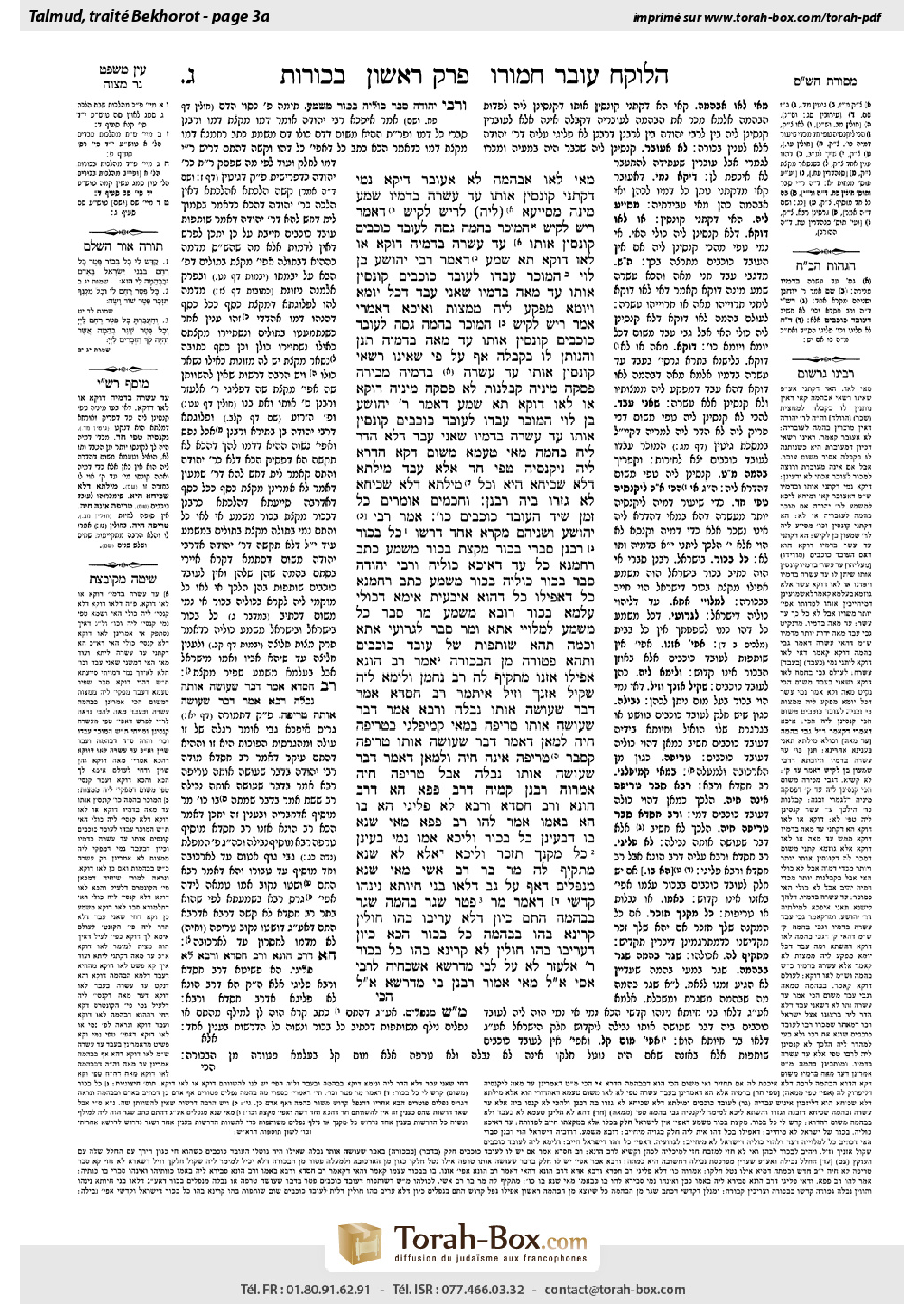
בכורות ג׳ א · Aramaic and Hebrew text
מַאי לָאו אַבְּהֵמָה? לָא, אַעוּבָּר.
דַּיְקָא נָמֵי דְּקָתָנֵי: קוֹנְסִין אוֹתוֹ עַד עֲשָׂרָה בְּדָמָיו, שְׁמַע מִינַּהּ.
מְסַיְּיעָא לֵיהּ לְרֵישׁ לָקִישׁ, דְּאָמַר רֵישׁ לָקִישׁ: הַמּוֹכֵר בְּהֵמָה גַּסָּה לְגוֹי — קוֹנְסִין אוֹתוֹ עַד עֲשָׂרָה בְּדָמֶיהָ.
דַּוְקָא אוֹ לָאו דַּוְקָא? תָּא שְׁמַע, דְּאָמַר רַבִּי יְהוֹשֻׁעַ בֶּן לֵוִי: הַמּוֹכֵר עַבְדּוֹ לְגוֹי — קוֹנְסִין אוֹתוֹ עַד מֵאָה בְּדָמָיו! שָׁאנֵי עֶבֶד, דְּכׇל יוֹמָא וְיוֹמָא מַפְקַע לֵיהּ מִמִּצְוֹת.
וְאִיכָּא דְּאָמְרִי, אָמַר רֵישׁ לָקִישׁ: הַמּוֹכֵר בְּהֵמָה גַּסָּה לְגוֹי — קוֹנְסִין אוֹתוֹ עַד מֵאָה בְּדָמֶיהָ. תְּנַן: וְהַנּוֹתֵן לוֹ בְּקַבָּלָה, אַף עַל פִּי שֶׁאֵינוֹ רַשַּׁאי — קוֹנְסִין אוֹתוֹ עַד עֲשָׂרָה בְּדָמֶיהָ!
מְכִירָה — פָּסְקָה מִינֵּיהּ, קַבְּלָנוּת — לָא פָּסְקָה מִינֵּיהּ.
דַּוְקָא אוֹ לָאו דַּוְקָא? תָּא שְׁמַע, דְּאָמַר רַבִּי יְהוֹשֻׁעַ בֶּן לֵוִי: הַמּוֹכֵר עַבְדּוֹ לְגוֹי — קוֹנְסִין אוֹתוֹ עַד עֲשָׂרָה בְּדָמָיו! שָׁאנֵי עֶבֶד, דְּלָא הָדַר לֵיהּ.
בְּהֵמָה מַאי טַעְמָא? מִשּׁוּם דְּקָא הָדְרָא לֵיהּ, נִיקְנְסֵיהּ טְפֵי חַד! אֶלָּא, עֶבֶד — מִילְּתָא דְלָא שְׁכִיחָא הִיא, וְכׇל מִילְּתָא דְלָא שְׁכִיחָא לָא גְּזַרוּ בֵּיהּ רַבָּנַן.
וַחֲכָמִים אוֹמְרִים: כׇּל זְמַן שֶׁיַּד הַגּוֹי כּוּ׳. אָמַר רַבִּי יְהוֹשֻׁעַ: וּשְׁנֵיהֶם מִקְרָא אֶחָד דָּרְשׁוּ, ״כׇּל בְּכוֹר״.
רַבָּנַן סָבְרִי: ״בְּכוֹר״ — מִקְצָת בְּכוֹר מַשְׁמַע, כְּתַב רַחֲמָנָא ״כׇּל״ — עַד דְּאִיכָּא כּוּלֵּיהּ. וְרַבִּי יְהוּדָה סָבַר: ״בְּכוֹר״ — כּוּלֵּיהּ בְּכוֹר מַשְׁמַע, כְּתַב רַחֲמָנָא ״כׇּל״ — דַּאֲפִילּוּ כׇּל דְּהוּא.
אִיבָּעֵית אֵימָא, דְּכוּלֵּי עָלְמָא ״בְּכוֹר״ רוּבָּא מַשְׁמַע, מָר סָבַר: ״כׇּל״ מַשְׁמַע לְמַלּוֹיֵי אֲתָא, וּמָר סָבַר: לְגָרוֹעֵי אֲתָא.
וְכַמָּה תְּהֵא שׁוּתָּפוּת שֶׁל גּוֹי, וּתְהֵא פְּטוּרָה מִן הַבְּכוֹרָה? אָמַר רַב הוּנָא: אֲפִילּוּ אׇזְנוֹ. מַתְקֵיף לַהּ רַב נַחְמָן: וְלֵימָא לֵיהּ: ״שְׁקֵיל אׇזְנָךְ וְזִיל״!
אִיתְּמַר, רַב חִסְדָּא אָמַר: דָּבָר שֶׁעוֹשֶׂה אוֹתוֹ נְבֵלָה, וְרָבָא אָמַר: דָּבָר שֶׁעוֹשֶׂה אוֹתוֹ טְרֵיפָה.
בְּמַאי קָמִיפַּלְגִי? בִּטְרֵיפָה חַיָּה. לְמַאן דְּאָמַר דָּבָר שֶׁעוֹשֶׂה אוֹתוֹ טְרֵיפָה — קָסָבַר טְרֵיפָה אֵינָהּ חַיָּה, וּלְמַאן דְּאָמַר דָּבָר שֶׁעוֹשֶׂה אוֹתוֹ נְבֵלָה — אֲבָל טְרֵיפָה חַיָּה.
אַמְרוּהָ רַבָּנַן קַמֵּיהּ דְּרַב פָּפָּא: הָא דְּרַב הוּנָא, וְרַב חִסְדָּא וְרָבָא — לָא פְּלִיגִי, הָא בּוֹ, הָא בְּאִמּוֹ.
אֲמַר לְהוּ רַב פָּפָּא: מַאי שְׁנָא בּוֹ, דְּבָעֵינַן ״כׇּל בְּכוֹר״ וְלֵיכָּא? אִמּוֹ נָמֵי בָּעֵינַן ״כׇּל מִקְנְךָ תִּזָּכָר״ וְלֵיכָּא! אֶלָּא, לָא שְׁנָא.
מַתְקֵיף לַהּ מָר בַּר רַב אָשֵׁי: מַאי שְׁנָא מִנְּפָלִים, דְּאַף עַל גַּב דְּלָאו בְּנֵי חִיּוּתָא נִינְהוּ קָדְשִׁי, דְּאָמַר מָר: ״פֶּטֶר שֶׁגֶר בְּהֵמָה״ — שֶׁגֶר בִּבְהֵמָה!
הָתָם, כֵּיוָן דְּלָא עָרִיבוּ בְּהוּ חוּלִּין — קָרֵינָא בְּהוּ בִּבְהֵמָה ״כָּל בְּכוֹר״, הָכָא, כֵּיוָן דְּעָרִיבוּ בְּהוּ חוּלִּין — לָא קָרֵינָא בְּהוּ ״כׇּל בְּכוֹר״.
רַבִּי אֶלְעָזָר לָא עַל לְבֵי מִדְרְשָׁא, אַשְׁכְּחֵיהּ לְרַבִּי אַסִּי, אֲמַר לֵיהּ: מַאי אֲמוּר רַבָּנַן בֵּי מִדְרְשָׁא? אֲמַר לֵיהּ:
Bekhorot 3a · English translation
What, is the baraita not referring to the animal when it prohibits giving it in receivership? If so, the baraita prohibits giving it to the gentile in exchange for half the rights to future fetuses, and certainly giving the gentile rights to all the future fetuses would be forbidden. The Gemara responds: No, it is referring to a case of an existing fetus, as the animal is pregnant, and therefore it is prohibited to sell it. It is permitted to sell to a gentile an animal that is not yet pregnant, for the rights to the fetuses alone.
The Gemara comments: The language of the baraita is also precise, as it teaches: The Sages penalize him up to ten times its value [damav], in masculine form, indicating that it is referring to the fetus and not the mother. The Gemara affirms: Learn from it that this is correct, and it cannot be proven from the baraita that it is forbidden to sell rights to a future fetus to a gentile.
The Gemara comments that the language of the baraita: The Sages penalize him up to ten times its value, supports the opinion of Reish Lakish, as Reish Lakish says: In the case of one who sells large livestock to a gentile, the Sages penalize him, requiring him to repurchase it from the gentile for up to ten times its value.
The Gemara asks: Does the phrase: For up to ten times its value, mean specifically this amount and no more, or does it not mean specifically this amount? The Gemara suggests: Come and hear a proof from that which Rabbi Yehoshua ben Levi says: In the case of one who sells his Canaanite slave to a gentile, the Sages penalize him, requiring him to repurchase the slave from the gentile for up to one hundred times its value. It is therefore evident that the phrase: For up to ten times its value, is not precise. The Gemara responds: A slave is different, as each day that he works for the gentile, the gentile restricts him from performing mitzvot. Therefore, one who sells a slave is penalized more severely than one who sells his animal to a gentile.
And there are those who say that there is another version of the previous discussion: Reish Lakish says that in the case of one who sells large livestock to a gentile, the Sages penalize him, requiring him to repurchase it from the gentile for up to one hundred times its value. We learned in a baraita: And in the case of one who gives the gentile an animal in receivership even though he is not permitted to do so, the Sages penalize him by requiring that he purchase the gentile’s portion of the animal for up to ten times its value. This contradicts the statement of Reish Lakish.
The Gemara responds: The penalties in these two cases are not the same, as in a case of a sale, the animal is entirely separated from the Jew, while in the case of receivership, it is not entirely separated from him, as the animal still belongs to the Jew. Therefore, the penalty in this case is not as severe.
The Gemara asks: Does the amount of one hundred times its value stated by Reish Lakish mean specifically this amount and no more, or does it not mean specifically this amount? The Gemara suggests: Come and hear a proof from that which Rabbi Yehoshua ben Levi says: In the case of one who sells his Canaanite slave to a gentile, the Sages penalize him, requiring him to repurchase the slave from the gentile for up to ten times its value. Apparently, the number one hundred is not meant literally. The Gemara responds: A slave is different, since the Sages already penalized the owner in that the slave does not return to him. Since the slave will be emancipated once the master redeems him, it may be that the Sages would not penalize him to such a great extent.
The Gemara challenges: Rather, what is the reason that he is penalized in the case of an animal more so than in the case of a slave? Is it because of the fact that it returns to him? If so, he should be penalized only one additional amount. If the difference is that an animal returns to its owners and a slave does not, then the difference in penalties should be reflective of this, and he should have to purchase the animal for no more than eleven times its value. Rather, the Gemara offers a different distinction: The sale of a slave is an uncommon matter, and the Sages did not issue a decree with regard to an uncommon matter. Therefore, one cannot compare the penalty in the case of selling a slave to the penalty in the case of selling an animal.
§ A previously cited baraita (2b) states that if one receives an animal from a gentile to care for and receives a portion of the offspring in exchange, Rabbi Yehuda holds that the Jew’s portion is sanctified with firstborn status. And the Rabbis say that as long as the ownership of the gentile is involved, i.e., he owns a portion of the firstborn animal, it does not have firstborn status. Rabbi Yehoshua said: And both of them interpreted the same one verse in accordance with their opinions. The verse states: “Sanctify to Me all the firstborn, whatever opens the womb, among the children of Israel” (Exodus 13:2).
The Rabbis hold that the words “the firstborn, whatever opens the womb, among the children of Israel” indicate that even when a Jew owns part of the firstborn, it is subject to the obligations of firstborn status. Therefore, the Merciful One wrote: “All the firstborn,” which teaches that it is not subject to the obligations of firstborn status unless the entire animal is owned by a Jew. And Rabbi Yehuda holds that the words “the firstborn, whatever opens the womb, among the children of Israel” indicate that only if the entire firstborn is owned by a Jew would it be subject to the obligations of firstborn status. Therefore, the Merciful One wrote the word “all” to demonstrate that even if any amount of the animal belongs to a Jew, it has firstborn status.
If you wish, say instead that everyone agrees that the words “the firstborn, whatever opens the womb, among the children of Israel” indicate that if the majority of the animal belongs to the Jew, it is subject to the obligations of firstborn status. One Sage, i.e., the Rabbis, holds that the word “all” indicates that it comes to fill the Jewish portion of ownership, meaning that it has firstborn status only if the entire animal belongs to a Jew. And one Sage, i.e., Rabbi Yehuda, holds that the word “all” comes to detract from the necessary Jewish ownership, indicating that the animal has firstborn status even if it is partially owned by a Jew.
§ The Gemara asks: And according to the Rabbis, how much should the gentile’s partnership in the animal be in order for it to be exempt from being counted a firstborn? Rav Huna says: It is sufficient even if the gentile owns only its ear. Rav Naḥman objects to this: Let the animal have firstborn status, and let the priest say to the gentile: Take your ear and go, as a blemished firstborn animal belongs to the priesthood.
It was stated that the amora’im engaged in a dispute concerning this question: Rav Ḥisda says that if the gentile is a partner in an item, i.e., a part of the body, that renders the animal a carcass, meaning if that limb were removed the animal would die immediately, the animal is exempt from the obligations of firstborn status. And Rava says it is exempt if the gentile is a partner in an item that if removed renders the animal a tereifa, meaning the animal will die but not immediately.
The Gemara asks: With regard to what principle do they disagree? The Gemara answers that they disagree about whether a tereifa can live for an extended period of time. According to the one who says that a gentile’s partnership in an item that renders the animal a tereifa exempts him from the obligations of firstborn status, it is because he holds that a tereifa cannot live, and therefore the gentile owns an essential portion of the animal. And according to the one who says that the gentile must be a partner in an item that renders the animal a carcass, this is because he holds that it cannot live without this part, but a tereifa can live for an extended period of time without those missing limbs.
The Sages said before Rav Pappa: That which Rav Huna said, that even if the gentile’s share of the animal is only its ear it does not have firstborn status, and that which Rav Ḥisda and Rava said, that the animal does not have firstborn status only if the gentile is a partner in the primary limbs of the body on which its life is dependent, do not disagree. This ruling of Rav Huna is referring to it, i.e., the fetus, while that ruling of Rav Ḥisda and Rava is referring to its mother.
Rav Pappa said to them: What is different about the case of the fetus, where owning a portion of its ear exempts the Jew from the obligations of firstborn status? It is because we require the fulfillment of the verse “all the firstborn,” i.e., that all of it be owned by the Jew, and that is not the case. If so, with regard to its mother as well we require the fulfillment of the verse: “From all your livestock you shall take the males” (Exodus 34:19), which also indicates that all the livestock, including the mother, must belong to the Jew, and this is not the case. Rather, there is no difference, and they disagree both in the case of the fetus and in that of the mother.
Mar bar Rav Ashi objects to this: Why does gentile partnership in an essential limb of the fetus exempt the Jew from the obligations of firstborn status? In what way is this animal different from non-viable newborns, which are sacred even though they are not viable? As the Master said in reference to the verse: “Every firstborn that emerges from [sheger] an animal” (Exodus 13:12), any fetus that dwells [shegar] inside an animal, i.e., inside the mother’s womb, even one that is non-viable, is also sanctified as a firstborn.
The Gemara responds: There, in the case of non-viable newborns, since there is no non-sacred element mixed in with them, we apply to the animal the phrase “all the firstborn.” But here, in the case where a gentile owns a portion of the fetuses, since a non-sacred element is mixed in with them, we do not apply to them the phrase: “all the firstborn.”
The Gemara relates that one day Rabbi Elazar did not enter the study hall. Rabbi Elazar then found Rabbi Asi, and said to him: What did the Sages say in the study hall? Rabbi Asi said to him:
Bekhorot 3a · Traduction française (IA)
Qu'est-ce que la baraïta ne parle pas de l'animal lorsqu'elle interdit de le confier en réception ? Si c'est le cas, la baraïta interdit de le donner au non-Juif en échange de la moitié des droits sur les fœtus futurs, et certainement de lui donner les droits sur tous les fœtus futurs serait interdit. La Guemara répond : Non, elle parle d'un fœtus existant, car l'animal est enceinte, et donc il est interdit de le vendre. Il est permis de vendre à un non-Juif un animal qui n'est pas encore enceinte, car les droits sur les fœtus sont seuls concernés.
La Guemara commente : La formulation de la baraïta est aussi précise, car elle enseigne : Les Sages pénalisent jusqu'à dix fois sa valeur [damav], au masculin, indiquant qu'il s'agit du fœtus et non de la mère. La Guemara affirme : Apprends-en que c'est correct, et il ne peut pas être prouvé à partir de la baraïta que la vente des droits sur un fœtus futur à un non-Juif est interdite.
La Guemara commente que la formulation de la baraïta : Les Sages pénalisent jusqu'à dix fois sa valeur, soutient l'opinion de Réish Lakish, car Réish Lakish dit : Dans le cas d'une vente de grandes bêtes à un non-Juif, les Sages pénalisent, exigeant qu'il les rachète au non-Juif jusqu'à dix fois sa valeur.
La Guemara pose la question : La phrase : Jusqu'à dix fois sa valeur, signifie-t-elle spécifiquement cette quantité et pas plus, ou ne signifie-t-elle pas spécifiquement cette quantité ? La Guemara suggère : Viens écouter une preuve à partir de ce que Rabbi Yéhoshua ben Lévi dit : Dans le cas d'une vente de son esclave cananéen à un non-Juif, les Sages pénalisent, exigeant qu'il le rachète à ce dernier jusqu'à cent fois sa valeur. Il est donc évident que la phrase : Jusqu'à dix fois sa valeur, n'est pas précise. La Guemara répond : L'esclave est différent, car chaque jour qu'il travaille pour le non-Juif, ce dernier le restreint de faire des mitsvot. Ainsi, celui qui vend un esclave est pénalisé plus sévèrement que celui qui vend son animal à un non-Juif.
Et il y a ceux qui disent qu'il existe une autre version de cette discussion précédente : Réish Lakish dit que dans le cas d'une vente de grandes bêtes à un non-Juif, les Sages pénalisent, exigeant qu'il les rachète au non-Juif jusqu'à cent fois sa valeur. Nous avons appris dans une baraïta : Et dans le cas d'une vente d'un animal en réception même si l'on n'est pas autorisé à le faire, les Sages pénalisent en exigeant qu'il achète la part du non-Juif de l'animal jusqu'à dix fois sa valeur. Cela contredit l'affirmation de Réish Lakish.
La Guemara répond : Les pénalités dans ces deux cas ne sont pas les mêmes, car dans le cas d'une vente, l'animal est entièrement séparé du Juif, tandis que dans le cas de la réception, il n'est pas entièrement séparé du Juif, car l'animal appartient toujours au Juif. Ainsi, la pénalité dans ce cas n'est pas aussi sévère.
La Guemara pose la question : La quantité de cent fois sa valeur mentionnée par Réish Lakish signifie-t-elle spécifiquement cette quantité et pas plus, ou ne signifie-t-elle pas spécifiquement cette quantité ? La Guemara suggère : Viens écouter une preuve à partir de ce que Rabbi Yéhoshua ben Lévi dit : Dans le cas d'une vente de son esclave cananéen à un non-Juif, les Sages pénalisent, exigeant qu'il le rachète à ce dernier jusqu'à dix fois sa valeur. Apparemment, le nombre cent n'est pas littéralement voulu. La Guemara répond : L'esclave est différent, car les Sages ont déjà pénalisé l'owner en ce que l'esclave ne revient pas à lui. Puisque l'esclave sera libéré une fois que le maître le rachète, il est possible que les Sages ne pénalisent pas autant.
La Guemara conteste : Plutôt, quelle est la raison pour laquelle il est pénalisé dans le cas d'un animal plus que dans le cas d'un esclave ? Est-ce à cause du fait qu'il revient à lui ? Si c'est le cas, il devrait être pénalisé seulement une fois de plus. Si la différence est que l'animal revient à son propriétaire et l'esclave ne le fait pas, alors la différence de pénalité devrait refléter cela, et il devrait avoir à acheter l'animal pour pas plus de onze fois sa valeur. Plutôt, la Guemara propose une autre distinction : La vente d'un esclave est une affaire rare, et les Sages n'ont pas émis un décret concernant une affaire rare. Ainsi, on ne peut pas comparer la pénalité dans le cas de la vente d'un esclave à celle dans le cas de la vente d'un animal.
§ Une baraïta précédemment citée (2b) affirme que si l'on reçoit un animal d'un non-Juif pour le garder et reçoit une part des descendants en échange, Rabbi Yéhuda considère que la part du Juif est sanctifiée avec le statut de premier-né. Et les Rabbins disent que tant que la propriété du non-Juif est impliquée, c'est-à-dire qu'il possède une part du premier-né, il ne possède pas le statut de premier-né. Rabbi Yéhoshua dit : Et les deux ont interprété la même verset selon leurs opinions. Le verset dit : « Sanctifie-moi tous les premiers-nés, tout ce qui ouvre le ventre, parmi les enfants d'Israël » (Exode 13:2).
Les Rabbins considèrent que les mots « les premiers-nés, tout ce qui ouvre le ventre, parmi les enfants d'Israël » indiquent que même lorsque le Juif possède une part du premier-né, il est soumis aux obligations du premier-né. Ainsi, le Très Miséricordieux a écrit : « Tous les premiers-nés », ce qui enseigne qu'il n'est soumis aux obligations du premier-né qu'à condition que l'animal entier appartienne à un Juif. Et Rabbi Yéhuda considère que les mots « les premiers-nés, tout ce qui ouvre le ventre, parmi les enfants d'Israël » indiquent que seul si le premier-né entier appartient à un Juif, il est soumis aux obligations du premier-né. Ainsi, le Très Miséricordieux a écrit le mot « tous » pour démontrer que même si une partie de l'animal appartient à un Juif, il possède le statut de premier-né.
Si l'on veut, disons plutôt que tout le monde convient que les mots « le premier-né, ce qui ouvre le ventre, parmi les enfants d'Israël » indiquent que si la majorité de l'animal appartient au Juif, il est soumis aux obligations du premier-né. Un Sage, c'est-à-dire les Rabbins, affirme que le mot « tous » indique qu'il faut remplir la part juive de propriété, c'est-à-dire qu'il est premier-né uniquement si l'animal entier appartient à un Juif. Et un autre Sage, c'est-à-dire Rabbi Yéhuda, affirme que le mot « tous » sert à diminuer la propriété juive nécessaire, indiquant que l'animal est premier-né même s'il est partiellement possédé par un Juif.
§ Le Guemara pose la question : Et selon les Rabbins, jusqu'à quel point la part du gentil dans l'animal doit-il être pour qu'il soit exempt de la comptabilité comme premier-né ? Rav Huna dit : Il suffit même si le gentil possède seulement son oreille. Rav Naḥman s'oppose à cela : Faisons de l'animal un premier-né, et que le prêtre dise au gentil : Prends ton oreille et va, car un premier-né blemi appartient au clergé.
On a dit que les amora’im ont eu un débat sur cette question : Rav Ḥisda dit que si le gentil est partenaire dans un objet, c'est-à-dire une partie du corps, qui rend l'animal un cadavre, c'est-à-dire que si cette partie était retirée l'animal mourrait immédiatement, l'animal est exempt des obligations du premier-né. Et Rava dit qu'il est exempt si le gentil est partenaire dans un objet qui, s'il est retiré, rend l'animal un tereifa, c'est-à-dire que l'animal mourra mais pas immédiatement.
La Guemara pose la question : Sur quel principe se déroule leur désaccord ? La Guemara répond qu'ils discutent sur le fait qu'un tereifa puisse vivre pendant une longue période. Selon celui qui dit qu'un gentil ayant une part dans un objet qui rend l'animal un tereifa l'exempte des obligations du premier-né, c'est parce qu'il considère qu'un tereifa ne peut pas vivre, et donc le gentil possède une part essentielle de l'animal. Et selon celui qui dit que le gentil doit être partenaire dans un objet qui rend l'animal un cadavre, c'est parce qu'il considère qu'il ne peut pas vivre sans cette partie, mais un tereifa peut vivre pendant une longue période sans ces membres manquants.
Les Sages dirent devant Rav Pappa : Ce que Rav Huna a dit, que même si la part du gentil dans l'animal est seulement son oreille, il n'est pas premier-né, et ce que Rav Ḥisda et Rava ont dit, que l'animal n'est pas premier-né que si le gentil est partenaire dans les membres principaux du corps sur lesquels sa vie dépend, ne sont pas en désaccord. Cette décision de Rav Huna se réfère à cela, c'est-à-dire au fœtus, tandis que celle de Rav Ḥisda et Rava se réfère à sa mère.
Rav Pappa dit à eux : Qu'est-ce qui diffère dans le cas du fœtus, où la possession d'une partie de son oreille exempt le Juif des obligations du premier-né ? C'est parce que nous exigeons la réalisation de la parole « tous les premiers-nés », c'est-à-dire que tout doit appartenir au Juif, et cela n'est pas le cas. Si tel est le cas, concernant sa mère également nous exigeons la réalisation de la parole : « Tu prendras tous tes bêtes mâles » (Exode 34:19), qui indique également que toutes les bêtes, y compris la mère, doivent appartenir au Juif, et cela n'est pas le cas. Plutôt, il n'y a pas de différence, et ils sont en désaccord à la fois dans le cas du fœtus et dans celui de la mère.
Mar bar Rav Ashi s'oppose à cela : Pourquoi la participation d'un gentil dans un membre essentiel du fœtus exempt-elle le Juif des obligations du premier-né ? Dans quelle mesure cet animal est-il différent des nouveaux-nés non viables, qui sont sacrés même s'ils ne sont pas viables ? Comme le Maître a dit en référence à la parole : « Tout premier-né qui sort d'un animal » (Exode 13:12), tout fœtus qui demeure [shegar] dans un animal, c'est-à-dire dans le ventre de la mère, même un non-viable, est aussi sanctifié comme premier-né.
Le Guemara répond : Là, dans le cas des nouveaux-nés non viables, puisque aucun élément non sacré n'est mélangé avec eux, nous appliquons à l'animal la phrase « tous les premiers-nés ». Mais ici, dans le cas où un gentil possède une part des fœtus, puisque des éléments non sacrés sont mélangés avec eux, nous n'appliquons pas à eux la phrase : « tous les premiers-nés ».
Le Guemara rapporte que un jour Rabbi Elazar n'a pas entré dans la salle de study. Rabbi Elazar a ensuite trouvé Rabbi Asi, et lui a dit : Qu'est-ce que les Sages ont dit dans la salle de study ? Rabbi Asi lui a dit :
Traduction française générée par IA à partir de l’édition anglaise de Sefaria. Vérifie toujours un passage avec le texte source.
Text from Sefaria: William Davidson Edition - Vocalized Aramaic (CC BY NC); William Davidson Edition - English (CC BY NC).