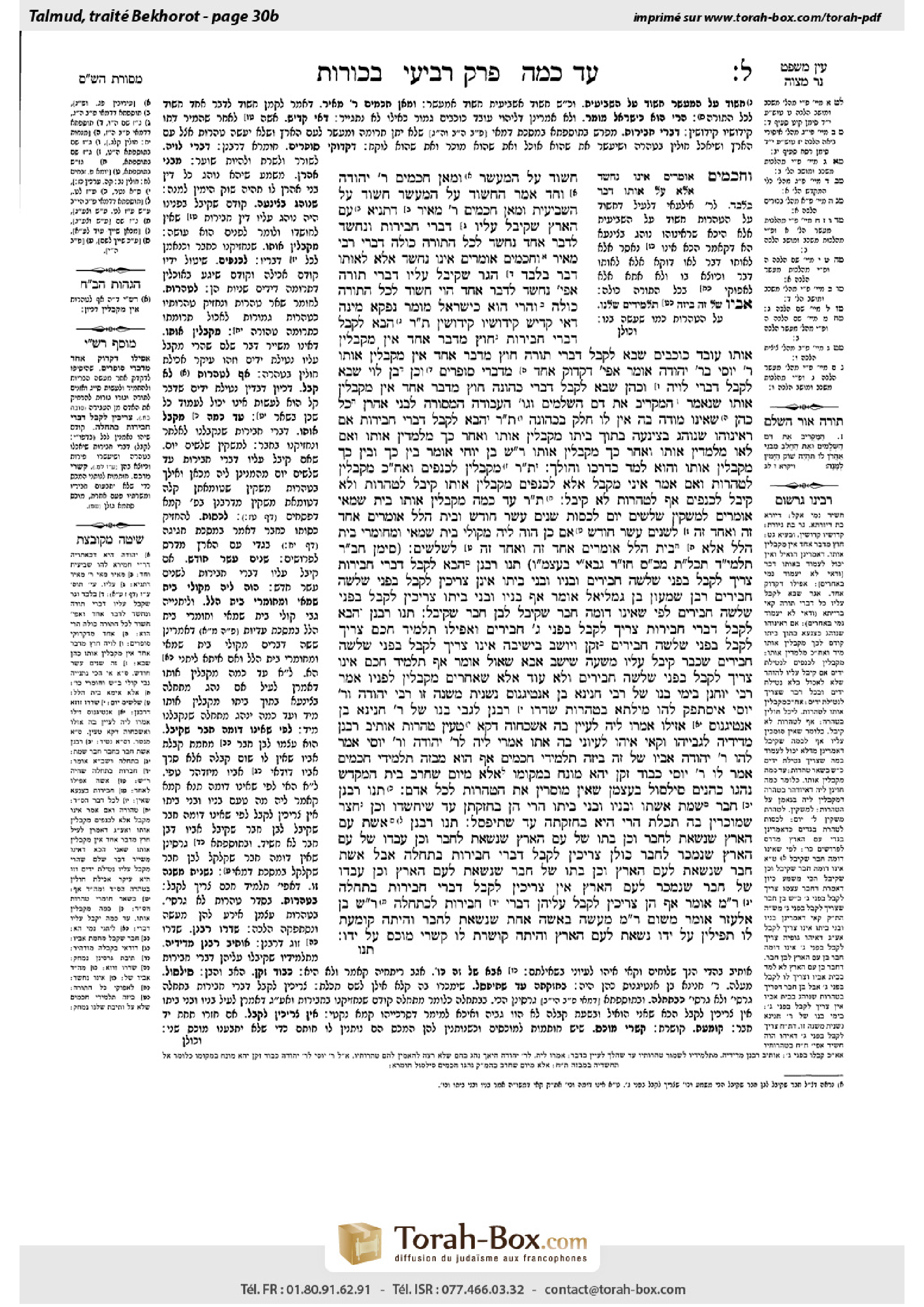
Bekhorot 30b: Talmud study for Daf Yomi
Study the Talmud for Daf Yomi with scanned pages, Hebrew text, English translations from Sefaria and AI-generated French translations.
Passage selection and English or AI-generated French translation are available where the scan has annotations. Daf Study is independent of Torah-Box and Sefaria.
Browse Bekhorot · בכורות · All tractatesBekhorot 30b text and translations
This page of Bekhorot includes the Aramaic text, an English translation and an AI-generated French translation, alongside the scan above.
בכורות ל׳ ב · Aramaic and Hebrew text
חָשׁוּד עַל הַמַּעֲשֵׂר, וּמַאן חֲכָמִים? רַבִּי יְהוּדָה, וְחַד אָמַר: הֶחָשׁוּד עַל הַמַּעֲשֵׂר חָשׁוּד עַל הַשְּׁבִיעִית, וּמַאן חֲכָמִים? רַבִּי מֵאִיר.
דְּתַנְיָא: עַם הָאָרֶץ שֶׁקִּיבֵּל עָלָיו דִּבְרֵי חֲבֵירוּת, וְנֶחְשַׁד לְדָבָר אֶחָד — נֶחְשַׁד לְכׇל הַתּוֹרָה כּוּלָּהּ, דִּבְרֵי רַבִּי מֵאִיר. וַחֲכָמִים אוֹמְרִים: אֵינוֹ נֶחְשָׁד אֶלָּא לְאוֹתוֹ דָּבָר בִּלְבַד.
הַגֵּר שֶׁקִּיבֵּל עָלָיו דִּבְרֵי תוֹרָה, אֲפִילּוּ נֶחְשַׁד לְדָבָר אֶחָד — הָוֵי חָשׁוּד לְכׇל הַתּוֹרָה כּוּלָּהּ, וַהֲרֵי הוּא כְּיִשְׂרָאֵל מְשׁוּמָּד. נָפְקָא מִינַּהּ, דְּאִי קַדֵּישׁ — קִידּוּשָׁיו קִידּוּשִׁין.
תָּנוּ רַבָּנַן: הַבָּא לְקַבֵּל דִּבְרֵי חֲבֵירוּת, חוּץ מִדָּבָר אֶחָד — אֵין מְקַבְּלִין אוֹתוֹ. גּוֹי שֶׁבָּא לְקַבֵּל דִּבְרֵי תוֹרָה, חוּץ מִדָּבָר אֶחָד — אֵין מְקַבְּלִין אוֹתוֹ. רַבִּי יוֹסֵי בְּרַבִּי יְהוּדָה אוֹמֵר: אֲפִילּוּ דִּקְדּוּק אֶחָד מִדִּבְרֵי סוֹפְרִים.
וְכֵן בֶּן לֵוִי שֶׁבָּא לְקַבֵּל דִּבְרֵי לְוִיָּה, וְכֹהֵן שֶׁבָּא לְקַבֵּל דִּבְרֵי כְהוּנָּה, חוּץ מִדָּבָר אֶחָד — אֵין מְקַבְּלִין אוֹתוֹ, שֶׁנֶּאֱמַר: ״הַמַּקְרִיב אֶת דַּם הַשְּׁלָמִים וְגוֹ׳״, הָעֲבוֹדָה הַמְּסוּרָה לִבְנֵי אַהֲרֹן, כׇּל כֹּהֵן שֶׁאֵינוֹ מוֹדֶה בָּהּ — אֵין לוֹ חֵלֶק בַּכְּהוּנָּה.
תָּנוּ רַבָּנַן: הַבָּא לְקַבֵּל דִּבְרֵי חֲבֵירוּת, אִם רְאִינוּהוּ שֶׁנּוֹהֵג בְּצִינְעָה בְּתוֹךְ בֵּיתוֹ — מְקַבְּלִין אוֹתוֹ, וְאַחַר כָּךְ מְלַמְּדִין אוֹתוֹ. וְאִם לָאו — מְלַמְּדִין אוֹתוֹ, וְאַחַר כָּךְ מְקַבְּלִין אוֹתוֹ. רַבִּי שִׁמְעוֹן בֶּן יוֹחַי אוֹמֵר: בֵּין כָּךְ וּבֵין כָּךְ מְקַבְּלִין אוֹתוֹ, וְהוּא לָמֵד כְּדַרְכּוֹ וְהוֹלֵךְ.
תָּנוּ רַבָּנַן: מְקַבְּלִין לִכְנָפַיִם, וְאַחַר כָּךְ מְקַבְּלִין לִטְהָרוֹת, וְאִם אָמַר: ״אֵינִי מְקַבֵּל אֶלָּא לִכְנָפַיִם״ — מְקַבְּלִין אוֹתוֹ. קִיבֵּל לַטְּהָרוֹת וְלֹא קִיבֵּל לַכְּנָפַיִם — אַף לַטְּהָרוֹת לֹא קִיבֵּל.
תָּנוּ רַבָּנַן: עַד כַּמָּה מְקַבְּלִין אוֹתוֹ? בֵּית שַׁמַּאי אוֹמְרִים: לְמַשְׁקִין — שְׁלֹשִׁים יוֹם, לִכְסוּת — שְׁנֵים עָשָׂר חוֹדֶשׁ. וּבֵית הִלֵּל אוֹמְרִים: אֶחָד זֶה וְאֶחָד זֶה — לִשְׁנֵים עָשָׂר חוֹדֶשׁ.
אִם כֵּן, הָוֵה לֵיהּ מִקּוּלֵּי בֵּית שַׁמַּאי וּמֵחוּמְרֵי בֵּית הִלֵּל, אֶלָּא בֵּית הִלֵּל אוֹמְרִים: אֶחָד זֶה וְאֶחָד זֶה לִשְׁלשִׁים.
(סִימָן: חָבֵר, תַּלְמִיד, תְּכֵלֶת, מֶכֶס, חָזַר, גַּבַּאי, בְּעַצְמוֹ).
תָּנוּ רַבָּנַן: הַבָּא לְקַבֵּל דִּבְרֵי חֲבֵירוּת — צָרִיךְ לְקַבֵּל בִּפְנֵי שְׁלֹשָׁה חֲבֵירִים, וּבָנָיו וּבְנֵי בֵּיתוֹ אֵינָן צְרִיכִין לְקַבֵּל בִּפְנֵי שְׁלֹשָׁה חֲבֵירִים. רַבָּן שִׁמְעוֹן בֶּן גַּמְלִיאֵל אוֹמֵר: אַף בָּנָיו וּבְנֵי בֵיתוֹ צְרִיכִין לְקַבֵּל בִּפְנֵי שְׁלֹשָׁה חֲבֵירִים, לְפִי שֶׁאֵינוֹ דּוֹמֶה חָבֵר שֶׁקִּיבֵּל לְבֶן חָבֵר שֶׁקִּיבֵּל.
תָּנוּ רַבָּנַן: הַבָּא לְקַבֵּל דִּבְרֵי חֲבֵירוּת — צָרִיךְ לְקַבֵּל בִּפְנֵי שְׁלֹשָׁה חֲבֵירִים, וַאֲפִילּוּ תַּלְמִיד חָכָם צָרִיךְ לְקַבֵּל בִּפְנֵי שְׁלֹשָׁה חֲבֵירִים. זָקֵן וְיוֹשֵׁב בִּישִׁיבָה — אֵינוֹ צָרִיךְ לְקַבֵּל בִּפְנֵי שְׁלֹשָׁה חֲבֵירִים, שֶׁכְּבָר קִיבֵּל עָלָיו מִשָּׁעָה שֶׁיָּשַׁב. אַבָּא שָׁאוּל אוֹמֵר: אַף תַּלְמִיד חָכָם אֵינוֹ צָרִיךְ לְקַבֵּל בִּפְנֵי שְׁלֹשָׁה חֲבֵירִים, וְלֹא עוֹד אֶלָּא שֶׁאֲחֵרִים מְקַבְּלִין לְפָנָיו.
אָמַר רַבִּי יוֹחָנָן: בִּימֵי בְּנוֹ שֶׁל רַבִּי חֲנִינָא בֶּן אַנְטִיגְנוֹס נִשְׁנֵית מִשְׁנָה זוֹ. רַבִּי יְהוּדָה וְרַבִּי יוֹסֵי אִיסְתַּפַּק לְהוּ מִילְּתָא בִּטְהָרוֹת, שַׁדַּרוּ רַבָּנַן לְגַבֵּי בְּנוֹ שֶׁל רַבִּי חֲנִינָא בֶּן אַנְטִיגְנוֹס, אֵזִילוּ אֱמַרוּ לֵיהּ: לְעַיֵּין בַּהּ. אַשְׁכְּחוּהּ דְּקָא טָעֵין טְהָרוֹת, אוֹתֵיב רַבָּנַן מִדִּידֵיהּ לְגַבַּיְיהוּ, וְקָאֵי אִיהוּ לְעַיּוֹנֵי בַּהּ.
אֲתוֹ אָמְרִי לֵיהּ לְרַבִּי יְהוּדָה וְרַבִּי יוֹסֵי, אֲמַר לְהוּ רַבִּי יְהוּדָה: אָבִיו שֶׁל זֶה בִּיזָּה תַּלְמִידֵי חֲכָמִים, אַף הוּא מְבַזֶּה תַּלְמִידֵי חֲכָמִים!
אָמַר לוֹ רַבִּי יוֹסֵי: כְּבוֹד זָקֵן יְהֵא מוּנָּח בִּמְקוֹמוֹ, אֶלָּא מִיּוֹם שֶׁחָרַב בֵּית הַמִּקְדָּשׁ נָהֲגוּ כֹּהֲנִים סִילְסוּל בְּעַצְמָן, שֶׁאֵין מוֹסְרִין אֶת הַטְּהָרוֹת לְכׇל אָדָם.
תָּנוּ רַבָּנַן: חָבֵר שֶׁמֵּת — אִשְׁתּוֹ וּבָנָיו וּבְנֵי בֵּיתוֹ הֲרֵי הֵן בְּחֶזְקָתָן, עַד שֶׁיֵּחָשֵׁדוּ. וְכֵן חָצֵר שֶׁמּוֹכְרִין בָּהּ תְּכֵלֶת — הֲרֵי הִיא בְּחֶזְקָתָהּ, עַד שֶׁתִּיפָּסֵל.
תָּנוּ רַבָּנַן: אֵשֶׁת עַם הָאָרֶץ שֶׁנִּשֵּׂאת לְחָבֵר, וְכֵן בִּתּוֹ שֶׁל עַם הָאָרֶץ שֶׁנִּשֵּׂאת לְחָבֵר, וְכֵן עַבְדּוֹ שֶׁל עַם הָאָרֶץ שֶׁנִּמְכַּר לְחָבֵר — כּוּלָּן צְרִיכִין לְקַבֵּל דִּבְרֵי חֲבֵירוּת בַּתְּחִלָּה. אֲבָל אֵשֶׁת חָבֵר שֶׁנִּשֵּׂאת לְעַם הָאָרֶץ, וְכֵן בִּתּוֹ שֶׁל חָבֵר שֶׁנִּשֵּׂאת לְעַם הָאָרֶץ, וְכֵן עַבְדּוֹ שֶׁל חָבֵר שֶׁנִּמְכַּר לְעַם הָאָרֶץ — אֵין צְרִיכִין לְקַבֵּל דִּבְרֵי חֲבֵירוּת בַּתְּחִלָּה.
רַבִּי מֵאִיר אוֹמֵר: אַף הֵן צְרִיכִין לְקַבֵּל עֲלֵיהֶן דִּבְרֵי חֲבֵירוּת לְכַתְּחִלָּה. רַבִּי שִׁמְעוֹן בֶּן אֶלְעָזָר אוֹמֵר מִשּׁוּם רַבִּי מֵאִיר: מַעֲשֶׂה בְּאִשָּׁה אַחַת שֶׁנִּשֵּׂאת לְחָבֵר וְהָיְתָה קוֹמַעַת לוֹ תְּפִילִּין עַל יָדוֹ, נִשֵּׂאת לְעַם הָאָרֶץ וְהָיְתָה קוֹשֶׁרֶת לוֹ קִשְׁרֵי מוֹכֵס עַל יָדוֹ.
Bekhorot 30b · English translation
is suspect with regard to tithe. And who are the Sages referred to here as the Rabbis? It is Rabbi Yehuda, as in his locale they treated the prohibition of produce of the Sabbatical Year stringently. And the other one says: One who is suspect with regard to tithe is suspect with regard to produce of the Sabbatical Year. And who are the Sages referred to here as the Rabbis? It is Rabbi Meir.
As it is taught in a baraita (Tosefta, Demai 2:4): With regard to an am ha’aretz, i.e., one who is unreliable with regard to ritual impurity and tithes, who accepts upon himself the commitment to observe the matters associated with ḥaver status, i.e., that he will be stringent in all matters observed by ḥaverim, including teruma, tithes, and ḥalla, and also undertake to eat only food that is ritually pure, and the Sages accepted him as trustworthy but subsequently he was suspected with regard to one matter in which others saw him act improperly, he is suspected with regard to the entire Torah. This is the statement of Rabbi Meir. And the Rabbis say: He is suspected only with regard to that particular matter.
It is also taught in a baraita (Tosefta, Demai 2:4): With regard to a convert who accepted upon himself upon his conversion matters of Torah, i.e., all of the mitzvot, even if he is suspect with regard to one matter alone, he is suspect with regard to the entire Torah, and he is considered like a Jewish transgressor [meshummad], who habitually transgresses the mitzvot. The Gemara explains that the practical difference resulting from the fact that he is considered like a Jewish transgressor is that if he betroths a woman, his betrothal is a valid betrothal, and they are married. Although he is suspect with regard to the entire Torah, he does not return to his prior gentile status.
The Sages taught in a baraita: In the case of one who comes to accept upon himself the commitment to observe the matters associated with ḥaver status except for one matter, which he does not wish to observe, he is not accepted, and he is not trustworthy even with regard to those matters that he does wish to accept upon himself. Likewise, in the case of a gentile who comes to convert and takes upon himself to accept the words of Torah except for one matter, he is not accepted as a convert. Rabbi Yosei, son of Rabbi Yehuda, says: Even if he refuses to accept one detail of rabbinic law, he is not accepted.
The baraita continues: And similarly, in the case of a Levite who comes to accept the matters of a Levite, or a priest who comes to accept the matters of priesthood, except for one matter, he is not accepted. As it is stated: “He among the sons of Aaron, that sacrifices the blood of the peace offerings, and the fat, shall have the right thigh for a portion” (Leviticus 7:33). This means that with regard to the Temple service, which is handed over to the sons of Aaron, any priest who does not admit to it in its entirety has no share in the priesthood.
The Gemara continues on a similar topic. The Sages taught in a baraita: In the case of one who comes to accept upon himself a commitment to observe the matters associated with ḥaver status, if we have seen that he practices such matters in private, within his home, he is accepted, and afterward he is taught the precise details of being a ḥaver. But if we have not seen him act as a ḥaver in his home, he is taught first and afterward accepted. Rabbi Shimon ben Yoḥai says: Whether in this case or that case, he is first accepted, and he then continues to learn in the usual manner, i.e., as a ḥaver he learns from others how to behave.
The Sages taught in a baraita: An am ha’aretz who wishes to become a ḥaver is accepted first with regard to hands, i.e., he is presumed to be stringent concerning the ritual purity of his hands by making sure to wash his hands before handling pure items, and afterward he is accepted as trustworthy for purity in general. And if he says: I wish to accept purity only with regard to hands, he is accepted for this. If he wishes to accept upon himself the stringencies of a ḥaver with regard to ritual purity but he does not accept upon himself the stringencies with regard to hands, i.e., to wash his hands, which is a simple act, he is not accepted even for purity in general.
The Sages taught in a baraita: Until when is he accepted, i.e., how much time must elapse before he is considered trustworthy as a ḥaver? Beit Shammai say: With regard to liquids, thirty days. With regard to impurity of clothing, about which ḥaverim would be careful as well, twelve months. And Beit Hillel say: Both with regard to this, liquids, and that, clothing, he must maintain the practice for twelve months before he is fully accepted as a ḥaver.
The Gemara raises a difficulty: If so, this is one of the rare cases of the leniencies of Beit Shammai and of the stringencies of Beit Hillel, and yet it is not included in tractate Eduyyot, which lists all of the cases where Beit Shammai are more lenient than Beit Hillel. Rather, the text of the baraita must be emended so that it reads: Beit Hillel say: Both with regard to this, liquids and that, clothing, he must maintain the practice for thirty days before he is fully accepted as a ḥaver.
§ The Gemara provides a mnemonic to remember the topics from here until the end of the chapter: Ḥaver; student; sky-blue dye [tekhelet]; tax; return; tax collector; by himself.
The Sages taught in a baraita: One who comes to accept upon himself a commitment to observe the matters associated with ḥaver status must accept it in the presence of three ḥaverim. But his children and the members of his household are not required to accept the status of ḥaver separately in the presence of three ḥaverim. Rabban Shimon ben Gamliel says: Even his children and the members of his household must accept the status of ḥaver in the presence of three ḥaverim, because a ḥaver, who accepted it himself in the presence of three others, is not comparable to the son of a ḥaver, who accepted that status only due to his father but did not accept it himself explicitly, and their accepting the status not in the presence of three people is insufficient.
The Sages taught in a baraita: One who comes to accept upon himself a commitment to observe the matters associated with ḥaver status must accept it in the presence of three ḥaverim, and even a Torah scholar who wishes to become a ḥaver must accept the status of ḥaver in the presence of three ḥaverim. But an elder who sits and studies Torah in a yeshiva is not required to accept the status of ḥaver in the presence of three ḥaverim, as he already accepted it upon himself from the moment he sat and dedicated himself to study Torah in yeshiva. Abba Shaul says: Even a Torah scholar is not required to accept the status of ḥaver in the presence of three ḥaverim; and not only does he have the status of ḥaver without an explicit declaration in the presence of three ḥaverim, but others can accept that they wish to become a ḥaver in his presence.
Rabbi Yoḥanan says: This mishna, i.e., the ruling that a Torah scholar must declare his intent to become a ḥaver in the presence of three ḥaverim, was taught in the days of the son of Rabbi Ḥanina ben Antigonus. At that time, Rabbi Yehuda and Rabbi Yosei were uncertain about a certain matter of ritual purity. The Sages sent a delegation of their students to the son of Rabbi Ḥanina ben Antigonus and told them to go and tell him to examine this matter. The students found him while he was carrying items that were ritually pure. The son of Rabbi Ḥanina ben Antigonus seated Sages from his own yeshiva next to the students who came to ask the question, because he did not trust these students to keep his items pure. And he stood and examined the matter.
The students returned and came and told Rabbi Yehuda and Rabbi Yosei that the son of Rabbi Ḥanina ben Antigonus had treated them as though they had the status of amei ha’aretz. Rabbi Yehuda said to them in anger: This one’s father, i.e., Rabbi Ḥanina ben Antigonus, degraded Torah scholars by not trusting them with matters of ritual purity. And he too, the son of Rabbi Ḥanina ben Antigonus, degrades Torah scholars.
Rabbi Yosei said to him: Let the honor of the elder, i.e., both the father and son, be left in its place. He did not act in this manner to degrade Torah scholars. Rather, from the day the Temple was destroyed, the priests were accustomed to act with a higher standard for themselves, and they decided that they will not pass ritually pure items to any other person. Therefore, the son of Rabbi Ḥanina, as a priest, acted appropriately.
The Sages taught in a baraita: In the case of a ḥaver that died, his wife and children and members of his household retain their presumptive status until they are suspected of engaging in inappropriate deeds. And similarly, in the case of a courtyard in which one sells sky-blue dye, it retains its presumptive status as a place in which fit sky-blue dye is sold until it is disqualified due to the merchant’s unscrupulous behavior.
The Sages taught in a baraita: The former wife an am ha’aretz who later marries a ḥaver, and likewise the daughter of an am ha’aretz who marries a ḥaver, and likewise the slave of an am ha’aretz who is sold to a ḥaver, must all accept upon themselves a commitment to observe the matters associated with ḥaver status. But with regard to the former wife of a ḥaver who later marries an am ha’aretz, and likewise the daughter of a ḥaver who marries an am ha’aretz, and likewise the slave of a ḥaver who was sold to an am ha’aretz, these people need not accept upon themselves a commitment to observe the matters associated with ḥaver status ab initio, as each of them is already accustomed to behave as a ḥaver.
The baraita continues: Rabbi Meir says: They too must accept upon themselves a commitment to observe the matters associated with ḥaver status ab initio. And similarly, Rabbi Shimon ben Elazar would illustrate this point and say in the name of Rabbi Meir: There was an incident involving a certain woman who married a ḥaver and would tie [koma’at] for him phylacteries on his hand, and she later married a tax collector and would tie for him tax seals on his hand, which shows that her new husband had a great influence on her level of piety.
Bekhorot 30b · Traduction française (IA)
il est suspect concernant l'offrande. Et qui sont les Sages mentionnés ici comme les Rabbins ? C'est Rabbi Yéhuda, car dans son lieu, ils traitaient la prohibition des produits de l'année sabbatique de manière stricte. Et l'autre dit : Celui qui est suspect concernant l'offrande est suspect concernant les produits de l'année sabbatique. Et qui sont les Sages mentionnés ici comme les Rabbins ? C'est Rabbi Méir.
Comme il est enseigné dans une baraïta (Tosefta, Demai 2:4) : Concernant un am ha'aretz, c'est-à-dire une personne peu fiable concernant l'impureté rituelle et les offrandes, qui s'engage à observer les choses liées au statut de ḥaver, c'est-à-dire qu'il sera strict dans toutes les choses observées par les ḥaverim, y compris la terouma, les offrandes et la challa, et qu'il s'engage également à manger uniquement des aliments rituellement purs, et les Sages l'ont accepté comme fiable, mais ensuite il a été suspect concernant une seule matière où d'autres l'ont vu agir de manière inappropriée, il est suspect concernant toute la Torah. C'est la déclaration de Rabbi Méir. Et les Rabbins disent : Il est suspect uniquement concernant cette matière particulière.
Il est également enseigné dans une baraïta (Tosefta, Demai 2:4) : Concernant un converti qui s'est engagé à observer les choses de la Torah lors de sa conversion, c'est-à-dire toutes les mitsvot, même s'il est suspect concernant une seule matière, il est suspect concernant toute la Torah, et il est considéré comme un transgresseur juif [meshummad], qui transgresse habituellement les mitsvot. La Guemara explique que la différence pratique résultant du fait qu'il est considéré comme un transgresseur juif est que s'il épouse une femme, son mariage est valide, et ils sont mariés. Bien qu'il soit suspect concernant toute la Torah, il ne revient pas à son statut antérieur de non-Juif.
Les Sages ont enseigné dans une baraïta : Dans le cas d'une personne qui vient s'engager à observer les choses liées au statut de ḥaver, sauf une matière qu'il ne souhaite pas observer, il n'est pas accepté, et il n'est pas considéré comme fiable même concernant les matières qu'il souhaite s'engager à observer. De même, dans le cas d'un non-Juif qui vient se convertir et s'engage à observer les paroles de la Torah, sauf une matière, il n'est pas accepté comme converti. Rabbi Yosei, fils de Rabbi Yéhuda, dit : Même s'il refuse d'accepter un détail de la loi rabbinique, il n'est pas accepté.
La baraïta continue : De même, dans le cas d'un Lévi qui vient s'engager à observer les choses du Lévi, ou d'un prêtre qui vient s'engager à observer les choses du sacerdoce, sauf une matière, il n'est pas accepté. Comme il est dit : « Celui des fils d'Aaron, qui sacrifie le sang des offrandes de paix et la graisse, aura le cuisse droit pour une part » (Lévitique 7:33). Cela signifie que concernant le service du Temple, qui est confié aux fils d'Aaron, tout prêtre qui ne reconnaît pas cela dans son ensemble n'a pas part au sacerdoce.
La Guemara continue sur un sujet similaire. Les Sages ont enseigné dans une baraïta : Dans le cas d'une personne qui vient s'engager à observer les choses liées au statut de ḥaver, si nous avons vu qu'il pratique ces choses en privé, à l'intérieur de sa maison, il est accepté, et ensuite il est enseigné les détails précis d'être un ḥaver. Mais si nous n'avons pas vu qu'il agissait comme un ḥaver à l'intérieur de sa maison, il est d'abord enseigné et ensuite accepté. Rabbi Šimon ben Yoḥai dit : Quelle que soit la situation, il est d'abord accepté, et ensuite il continue à apprendre de la manière habituelle, c'est-à-dire qu'en tant que ḥaver, il apprend de ceux qui l'entourent comment se comporter.
Les Sages ont enseigné dans une baraïta : Un am ha'aretz qui souhaite devenir un ḥaver est d'abord accepté concernant les mains, c'est-à-dire qu'il est supposé être strict concernant la pureté rituelle de ses mains en veillant à laver ses mains avant de manipuler des objets purs, et ensuite il est accepté comme fiable concernant la pureté en général. Et s'il dit : Je souhaite accepter la pureté uniquement concernant les mains, il est accepté pour cela. Si il souhaite s'engager aux stricteurs d'un ḥaver concernant la pureté rituelle mais ne s'engage pas à s'engager aux stricteurs concernant les mains, c'est-à-dire à laver ses mains, qui est une action simple, il n'est pas accepté même pour la pureté en général.
Les Sages ont enseigné dans une baraïta : Jusqu'à quand est-il accepté, c'est-à-dire pendant combien de temps doit-il s'écouler avant qu'il soit considéré comme fiable comme un ḥaver ? Beit Shammai disent : Concernant les liquides, trente jours. Concernant l'impureté des vêtements, concernant laquelle les ḥaverim sont également vigilants, douze mois. Et Beit Hillel disent : Concernant cela, les liquides, et cela, les vêtements, il doit maintenir la pratique pendant douze mois avant d'être pleinement accepté comme un ḥaver.
La Guemara soulève une difficulté : Si c'est ainsi, c'est l'un des rares cas des leniencies de Beit Shammai et des stricteurs de Beit Hillel, et pourtant il n'est pas inclus dans le traité Eduyyot, qui liste tous les cas où Beit Shammai sont plus leniants que Beit Hillel. Le texte de la baraïta doit donc être corrigé pour lire : Beit Hillel disent : Concernant cela, les liquides, et cela, les vêtements, il doit maintenir la pratique pendant trente jours avant d'être pleinement accepté comme un ḥaver.
§ La Guemara fournit un mnémonique pour se souvenir des sujets depuis ici jusqu'à la fin du chapitre : ḥaver ; étudiant ; techelet ; taxe ; retour ; percepteur ; par lui-même.
Les Sages ont enseigné dans une baraïta : Celui qui vient accepter une obligation de respecter les affaires liées au statut de ḥaver doit l'accepter en présence de trois ḥaverim. Mais ses enfants et les membres de sa famille ne sont pas tenus d'accepter le statut de ḥaver séparément en présence de trois ḥaverim. Rabban Shimon ben Gamliel dit : Même ses enfants et les membres de sa famille doivent accepter le statut de ḥaver en présence de trois ḥaverim, car un ḥaver, qui l'a accepté lui-même en présence de trois autres, n'est pas comparable au fils d'un ḥaver, qui a accepté ce statut uniquement en raison de son père mais n'a pas explicitement l'accepté lui-même, et leur acceptation du statut sans la présence de trois personnes est insuffisante.
Les Sages ont enseigné dans une baraïta : Celui qui vient accepter une obligation de respecter les affaires liées au statut de ḥaver doit l'accepter en présence de trois ḥaverim, et même un savant de la Torah qui souhaite devenir ḥaver doit accepter le statut de ḥaver en présence de trois ḥaverim. Mais un homme âgé qui s'assoit et étudie la Torah dans une yeshiva n'est pas tenu d'accepter le statut de ḥaver en présence de trois ḥaverim, car il a déjà accepté ce statut dès qu'il s'est assis et s'est consacré à l'étude de la Torah dans la yeshiva. Abba Shaul dit : Même un savant de la Torah n'est pas tenu d'accepter le statut de ḥaver en présence de trois ḥaverim ; et non seulement a-t-il le statut de ḥaver sans déclaration explicite en présence de trois ḥaverim, mais d'autres peuvent accepter de devenir ḥaver en sa présence.
Rabbi Yoḥanan dit : Cette mitsva, c'est-à-dire la décision selon laquelle un savant de la Torah doit déclarer son intention de devenir ḥaver en présence de trois ḥaverim, a été enseignée aux jours du fils de Rabbi Ḥanina ben Antigonus. À cette époque, Rabbi Yehuda et Rabbi Yosei étaient incertains sur une certaine affaire de pureté rituelle. Les Sages envoyèrent une délégation de leurs élèves au fils de Rabbi Ḥanina ben Antigonus et leur dirent de partir et de lui demander d'examiner cette affaire. Les élèves le trouvèrent alors qu'il transportait des objets rituellement purs. Le fils de Rabbi Ḥanina ben Antigonus fit s'asseoir des Sages de sa propre yeshiva à côté des élèves qui étaient venus poser la question, car il ne faisait pas confiance à ces élèves pour garder ses objets purs. Et il se leva et examina cette affaire.
Les élèves revinrent et racontèrent à Rabbi Yehuda et Rabbi Yosei que le fils de Rabbi Ḥanina ben Antigonus avait traité d'eux comme s'ils avaient le statut d'amei ha’aretz. Rabbi Yehuda leur dit en colère : Ce dernier, c'est-à-dire Rabbi Ḥanina ben Antigonus, a dégradé les savants de la Torah en ne faisant pas confiance à leur sujet sur des affaires de pureté rituelle. Et lui aussi, le fils de Rabbi Ḥanina ben Antigonus, dégrade les savants de la Torah.
Rabbi Yosei lui dit : L'honneur de l'homme âgé, c'est-à-dire à la fois le père et le fils, reste en place. Il n'a pas agi ainsi pour dégrader les savants de la Torah. Plutôt, depuis la destruction du Temple, les prêtres étaient habitués à agir selon un standard plus élevé pour eux-mêmes, et ils ont décidé qu'ils ne transmettraient pas d'objets rituellement purs à toute autre personne. Ainsi, le fils de Rabbi Ḥanina, en tant que prêtre, a agi correctement.
Les Sages ont enseigné dans une baraïta : Dans le cas d'un ḥaver décédé, sa femme, ses enfants et les membres de sa famille conservent leur statut présomptif jusqu'à ce qu'ils soient soupçonnés d'engager des actes inappropriés. De même, dans le cas d'un cour de jardin où l'on vend du bleu céleste, il conserve son statut présomptif de lieu où l'on vend du bleu céleste jusqu'à ce qu'il soit disqualifié en raison du comportement déloyal du vendeur.
Les Sages ont enseigné dans une baraïta : La femme précédente d'un am ha’aretz qui épouse ensuite un ḥaver, et de même la fille d'un am ha’aretz qui épouse un ḥaver, et de même l'esclave d'un am ha’aretz qui est vendu à un ḥaver, doivent tous accepter une obligation de respecter les affaires liées au statut de ḥaver. Mais concernant la femme précédente d'un ḥaver qui épouse ensuite un am ha’aretz, et de même la fille d'un ḥaver qui épouse un am ha’aretz, et de même l'esclave d'un ḥaver qui est vendu à un am ha’aretz, ces personnes n'ont pas besoin d'accepter une obligation de respecter les affaires liées au statut de ḥaver dès le début, car chacune d'entre elles est déjà habituée à se comporter comme un ḥaver.
La baraïta continue : Rabbi Meir dit : Ils aussi doivent accepter une obligation de respecter les affaires liées au statut de ḥaver dès le début. De même, Rabbi Shimon ben Elazar illustre ce point en nommant Rabbi Meir : Il y avait un incident concernant une certaine femme qui épousa un ḥaver et qui lui attachait des phylactères sur la main, et elle épousa ensuite un collecteur d'impôts et lui attachait des sceaux d'impôts sur la main, ce qui montre que son mari nouveau avait une grande influence sur son niveau de piété.
Traduction française générée par IA à partir de l’édition anglaise de Sefaria. Vérifie toujours un passage avec le texte source.
Text from Sefaria: William Davidson Edition - Vocalized Aramaic (CC BY NC); William Davidson Edition - English (CC BY NC).